


Erhalten Sie Zugang zu diesem und mehr als 300000 Büchern ab EUR 5,99 monatlich.
- Herausgeber: The Lilliput Press
- Kategorie: Sachliteratur, Reportagen, Biografien
- Sprache: Englisch
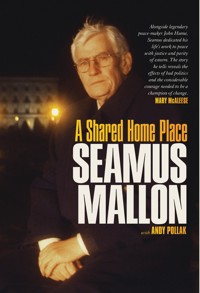
As one of Northern Ireland's most prominent nationalist politicians, Seamus Mallon has always sought the genuine reconciliation of conflicting traditions using only peaceful means. This is his personal testament. In A Shared Home Place, Mallon evokes his happy childhood in the Protestant heartland of Markethill, south Armagh, and dwells on the turbulent years of constitutional politics in the maelstrom of near-civil war during the 1970s and 19080s. He was the target of both loyalist violence and republican vilification, and his harrowing descriptions of tit-for-tat brutality in Northern Ireland's most bloody region outside Belfast bear poignant witness to the tragedy of hatred between neighbours. Mallon complemented John Hume in laying the foundations of the peace process and gives fascinating insights into what took place behind the scenes of negotiation that led to the Good Friday Agreement. Now in his eighty-third year, Mallon reflects upon this hard-won deal with the Ulster Unionists and calls for a new beginning – a shared home place in which Irish unity can only be achieved through parallel consent. This timely memoir encompasses the social and political history of Northern Ireland, and offers hope for its future. 'Alongside legendary peace-maker John Hume, Seamus dedicated his life's work to peace with justice and parity of esteem. The story he tells reveals the effects of bad politics and the considerable courage needed to be a champion of change.' MARY McALEESE 'Seamus Mallon's integrity, courage and fierce intelligence have long shone through the mark of sectarian emotions and tribal thinking. Here, with undiminished clarity, he illuminates both the recent past and the uncertain future of Ireland.' FINTAN O'TOOLE 'Typically honest and compelling, this book will further cement Seamus Mallon's place in the history of the peace process. One of the best of the good guys, witness to some of the worst atrocities of the Troubles, his passion for the future and hope of a new beginning burn as brightly as ever.' ALASTAIR CAMPBELL 'Mallon is a great Irishman who we can all honour and learn from. This book is a testament to the peace and progress achieved for the island of Ireland.' MICHEÁL MARTIN
Sie lesen das E-Book in den Legimi-Apps auf:
Seitenzahl: 458
Veröffentlichungsjahr: 2019
Das E-Book (TTS) können Sie hören im Abo „Legimi Premium” in Legimi-Apps auf:
Ähnliche



















the lilliput press
dublin
Dedication
To Orla, Lara and Mark
Acknowledgments
This book would not have happened without Tim O’Connor, who suggested to Seamus Mallon that he should ask Andy Pollak to collaborate with him on writing it. Particular thanks are also due to Tim for his detailed recall and wise interpretation of the Good Friday Agreement. Special thanks also go to Pat Hynes, who, along with Tim, acted as an informal editorial advisory team; Frank Sheridan, for his great help with archival material; and Dáithí Ó Ceallaigh, an invaluable source of advice and support throughout.
Other people who contributed their help and insights were: Orla Mallon, Marie Harte, Nuala Feehan, Brian Barrington, Alex Attwood, Noel Dorr, Cian Ferriter, David Donoghue, Eugene Reavey, John Redmond, Frank Feely, Anne Roper, Sean Farren, Brid Rodgers, Colm Larkin, Hugh Logue, Mike Nesbitt, Seán Ó hUiginn, Tony McCusker, Billy Gamble, Michael Lillis, Mary McNulty, Gary Ansbro, John Rogers, Peter Makem, Cormac McCarthy, Tom Kelly (Irish News columnist), Anne Cadwallader, Barry Cullen, Niall Gibbons and the helpful and efficient people at Rathmines Public Library; also Doireann Ní Bhriain, as always.
At Lilliput, particular thanks are due to publisher Antony Farrell, who took on the job of copy-editing our manuscript himself, and to his colleague Ruth Hallinan, for help in a multitude of ways.
Our grateful thanks go to all of them.
Introduction
Courage and generosity: those are the two words that come to mind when I think of Seamus Mallon. Courage because for twenty-five years between the 1970s and 1990s he spoke out ceaselessly against violence from whatever quarter it came, republican or loyalist or state forces. As a result he suffered constant threats (including death threats); physical attacks on him, his family and his home; intimidation and vilification. He vowed that he would attend every funeral in his Armagh and Newry constituency, whether the victim was civilian, IRA or security force member, and frequently took face-to-face abuse from victims’ families for that brave stand. He publicly condemned every IRA and loyalist killing in the harshest terms. At the same time he denounced collusion, harassment and sectarian bias by the RUC and the Ulster Defence Regiment, and demanded their reform or abolition. In the face of British government and unionist resistance and hostility, he demanded justice and equality in the actions of the security forces and the courts for the nationalist people of Northern Ireland, who had long been treated as second-class citizens at best and dangerous subversives at worst in their home place.
It is also often forgotten what an important role he played in the extremely difficult negotiations leading to the Belfast or Good Friday Agreement. Garret FitzGerald, not his favourite Southern politician, said after the Agreement was signed that Mallon’s ‘will be amongst the names to which history will pay tribute. Throughout this negotiation his steadiness, clarity and rationality have won universal respect in complementing John Hume’s long-sighted vision.’ Senator George Mitchell noted that he was ‘an important and influential figure’ in those talks who was ‘liked and respected on all sides for his intelligence and integrity’.
However, he was the opposite of a soft touch. The loyalist leader David Ervine described his negotiating modus operandi: ‘He was skilful, incisive and brutal. He could take somebody’s scrotum and slice off their balls – it would be over in a second; they wouldn’t know it was done, such was his skill.’ Former Secretary of State for Northern Ireland John Reid once said Mallon was the only politician he had ever met who could ‘make “Good morning” sound like a threat’.
Seán Ó hUiginn, the senior Irish diplomat who was one of the architects of the 1990s peace process, summed up Mallon’s importance:
He personified the decent, put-upon strand of Northern nationalism in a wonderfully attractive way. People in the Republic would say that if this good, honourable man is complaining, there must be something to his complaints. He thus had a very important and under-appreciated role in keeping the benign elements in the South engaged to some extent with the North during the Troubles, rather than falling back into the easy distancing mechanism that all Northerners were as bad as each other and were impossible people who could not be talked to or reasoned with.
Another diplomat, one of the Department of Foreign Affairs’ regular ‘travellers’ to the North, described Mallon in 1987 like this: ‘A formidable personality. The “green” conscience of the SDLP, to whom many younger members gravitate, but who is basically a loner who has not really built up a “Mallon wing” as such.’
Despite Mallon’s sometimes dour self-presentation, it is difficult to find a Northern politician of any stripe to say a bad word about him. Ulster Unionist deputy leader John Taylor called him ‘a good friend who will work for the good of Northern Ireland’. For Rita O’Hare of Sinn Féin he was ‘a tough negotiator, a formidable opponent, but always honest and honourable’. The surgeon and senator John Robb said his main strength was ‘his simple, absolute, complete integrity’. ‘I would trust Seamus Mallon with my life. I wouldn’t say that about many other politicians on my side or the other side,’ said Ulster Unionist security spokesman Ken Maginnis.1
Unlike John Hume, who was to some extent insulated from the surrounding violence as the uncrowned king of nationalist Derry, Mallon had to live in and represent an area in which the murderous activities of republican and loyalist paramilitaries, along with rogue elements of the security forces, pushed the inhabitants of both communities into a savage internecine war mindset. In Armagh he personally witnessed the Northern conflict at its most depraved and sectarian.
Generosity because he has always been sensitive to the fears and needs of the unionist community among whom he grew up. Even today he sits comfortably sipping coffee in a Protestant-owned cafe in his native village of Markethill, surrounded by evangelical pamphlets and biblical verses on the wall. This makes him unique among Northern nationalist politicians, with the possible exception of Gerry Fitt (who never called himself a nationalist anyway). Mallon remains a proud nationalist who believes in the long run only Irish unity can solve the deep historical divisions that have blighted Northern Ireland. But he believes with equal passion that his unionist friends and neighbours around Markethill, personified by the farmer and murdered police reservist whom he calls ‘Jack Adams’, have as much right to live in peace and without fear in Ireland as the community he led with such distinction over the years. And he believes his nationalist community, now they are moving into the ascendant, must show the generosity to unionists that was sadly absent from the way in which they were treated by the unionists during fifty years of one-party rule at Stormont.
Courage and generosity are there in abundance in Seamus Mallon’s central proposal in this book: that Irish unity must wait until there is a majority – or at least a substantial minority – in the Protestant and unionist community prepared to support it. This is what he calls ‘Parallel Consent’ for unity. He knows he will be damned from the heavens by most nationalists, who will say that just as the prospect of a numerical majority for unity – based largely on the demographic growth of the Northern Catholic community – is within sight, he has proposed moving the posts so that their long-dreamed-of goal of a united Ireland is pushed further into the future. Equally, he knows there will be little welcome for his proposal in the fearful and begrudging minds of many unionists, who will see it as an excuse to dig their heels in for another generation rather than as a new and nobler way to come to terms with the medium-term prospect of unity by genuine consent. However, he believes that there is another unionist constituency, those who voted for the Good Friday Agreement and against Brexit, who are open to looking at unity, or at least a greater accommodation with the South, in a new way after nearly a century of division and conflict.
Above all, he stresses the importance of generosity between the Northern communities. After several centuries of the United Kingdom being a ‘cold house’ for Irish nationalists, the independent Irish state being feared as a ‘cold house’ for unionists, and Northern Ireland being a ‘cold house’ for Northern nationalists, he hopes his own community will demonstrate a new generosity to their unionist neighbours as the prospect of Irish unity becomes visible on the horizon. Thus he hopes (against hope, some might say) that unionists and nationalists can eventually be united, after centuries of fear and conflict, ‘in all the diversity of their identities and traditions’ in the ‘harmony and friendship’ of the post-Good Friday Agreement amendment to the Irish Constitution.
At this late stage in his life Mallon is proposing this dramatic reconfiguration of the traditional nationalist demand because he knows that a simple majority for unity in a Border Poll in the foreseeable future can only be a narrow one: probably little more than the bare numerical majority laid down as a blunt instrument in the otherwise marvellously nuanced 1998 Good Friday Agreement. Unusually among nationalist leaders, he knows his unionist neighbours intimately; he knows what they are capable of when they feel coerced or threatened, and he knows this will probably mean a return to, and possibly an intensification of, the intercommunal violence of the 1968 to 1998 period. He knows from his own experience of the darkest years of murder gangs and counter-murder gangs in Armagh in the 1970s and 1980s, and of being Deputy First Minister during the most terrifying Drumcree confrontation in 1998, that at times of political instability – and there can be no deeper instability than the period following a narrow vote for unity – Northern Ireland is always in danger of going over the edge into outright civil war. He has also seen the new and angry divisions opening up in Britain following a narrow Brexit referendum vote.
My own belief was summarized thirty-five years ago by Bernard Cullen (later professor of philosophy at Queen’s University) who grew up as a Catholic in a Belfast working-class Protestant area. In response to a question at the 1984 New Ireland Forum about what would happen some day in the future if there was the threat of a demographic Catholic nationalist majority in the North for unity, he said the probability – given that there were loyalists willing to kill in order to resist what they saw as rampant Irish nationalism – was that there would be ‘a most terrible and horrific outcome, much greater in carnage and loss of life than anything we have seen so far’.
Mallon is careful to position his proposal to require the Parallel Consent of the two Northern communities for unity firmly in the context of a pre-Border Poll Review of the Good Friday Agreement, insisting it should be seen as an evolution of that Agreement. He also proposes a new version of the 1992–3 Opsahl Commission to initiate a wider public discussion on whether and how Irish unity can be brought about as peacefully and consensually as possible. He believes this double process should lead to the redefinition of the simple majority consent principle contained in the Good Friday Agreement, so that an eventual referendum on unity can gain as wide a measure of consent as possible.
Such a deliberative process should also work to resolve the hard questions that will be raised in the event of such a vote for unity, and which are almost completely absent from political and public discourse in today’s Republic of Ireland. How and over what period of time will the British element in the governance of Northern Ireland be replaced by an Irish one? Is some kind of joint authority or joint sovereignty feasible during a transitional period? What parliamentary, consultative, public administration and public finance structures will be put in place both during and after that transitional phase? How would justice, law and order be guaranteed during the probable breakdown of law and order that too precipitate a transition could cause, with the danger that revived loyalist paramilitaries would violently resist it and revived republican paramilitaries seek to enforce it? What guarantees will be put in place so that the proud British identity of the unionists will be protected, cherished and incorporated into the institutions, ethos and symbols of the new state? Would that identity be better protected under a separate Northern regional administration? What kind of continuing British government involvement will this require? Will it, for example, reverse the safeguard built into the 1985 Anglo-Irish Agreement to protect nationalists – that the Irish government would be consulted by the British government on key issues of concern to that community – so that in any future unity agreement, the interests of unionists would be protected by a legal clause giving the British government the equivalent right to intervene to protect their community?
All these issues need to be thrashed out in as mutually respectful and open-minded a manner as possible. It will take a considerable time. The peace process that started with the 1993 Downing Street Declaration, whose high point was the 1998 Good Friday Agreement, and which dragged on until the devolution of policing and justice in 2010, lasted almost seventeen years; or twenty-two years if one dates its beginning from the first Hume–Adams talks in 1988. Seamus Mallon suggests it could take even longer to prepare for the complex and potentially destabilizing consequences of a Border Poll that might lead to unity.
This book is an example of collaboration between the two traditions in Ireland. It is written by a former nationalist leader and Deputy First Minister of Northern Ireland from the Catholic tradition, with the help of a journalist from a Northern Presbyterian background (still a practising Unitarian) who is now proud to be an Irish citizen. Both politician and journalist believe that some form of Irish unity in the future – probably a medium- to long-term future – is the only way to resolve the centuries-old divisions in Ireland. But they also believe that if the journey to unity is mishandled, it could lead to civil war on this island that we love and which both traditions call home.
Because of the growth of the Catholic population in Northern Ireland, the theoretical possibility of a narrow majority for unity in a Border Poll is perhaps only twenty to thirty years away. Now is the time to begin thinking deeply about the consequences of this huge change for the happiness and harmony of the people of Ireland. Sinn Féin, fiercely dogmatic in their demand for ‘accelerated reunification post-Brexit’ – in party chairman Declan Kearney’s words – are incapable of leading that thinking. We can only hope that wiser and more generous nationalist leaders in the Seamus Mallon mould will emerge to engage in meaningful and empathetic negotiation with unionism.
In the meantime the wisdom of Mallon’s words about the two traditions learning to share their common home place, Northern Ireland, should be listened to. That is the only way forward to a new Ireland based on the twenty-first century challenge of how to bring together diverse peoples, with all the major complications that implies, rather than the nineteenth-century nationalist obsession with the unity of territory.
Andy Pollak
February 2019
1. Quotes on pages ix–x from For the record: Seamus Mallon, RTÉ programme, 27 March 2014; George Mitchell, Making Peace: The inside story of the making of the Good Friday Agreement (London 1999); Department of Foreign Affairs papers 1998–2001.
1. A Happy Upbringing in South Armagh
Every day of the week I am fortunate to be within touching distance of places and moments that have helped to shape our country’s history, and indeed have helped to shape me, both as a person and a politician. I was born in and have lived for nearly eighty-three years in the large village of Markethill, seven miles south of Armagh on the road to Newry. This was for many centuries up to the end of the sixteenth century part of Gaelic Ulster, whose chieftains were the O’Neill family. To the north I look across the rich lands of mid and north Armagh, settled largely by English ‘planters’ in the seventeenth century. To the south I can see Camlough Mountain and the brooding presence of Slieve Gullion, which marked the end of that good land, and towards the rugged, stony hill country of the Fews in south Armagh, settled in part by Scottish Presbyterians, but mainly the home of dispossessed Irish Catholics. Beyond that are the fertile lands of north Leinster, part of the ‘Pale’ under the control of the English from the twelfth century.
Both views are beautiful, and a reminder that this area is the Northern Ireland problem in microcosm. In simplistic terms one could say each of my kitchen windows looks at the symbols of four centuries of divided history: the fears, the prejudices, the ethnic hatred, the lack of understanding, the use and abuse of power that have fuelled life and tragic death in the county proclaiming it is the historic centre of Christianity in Ireland.
Markethill is a small and, to outsiders, an unremarkable place that these days is bypassed by the main Armagh–Newry road. Its houses line each side of a hill and appear almost to be clinging to each other to remain standing. On the brow of the hill are a few big, solid buildings, including an old courthouse and a Church of Ireland church. These solid hilltop buildings were put up by the Acheson family of nearby Gosford Castle. My childhood home was in Main Street, just a couple of hundred yards from where I now live on the edge of the village.
From my living room I can see across the main Armagh–Newry road to the Gosford Castle estate, the lands – 8000 acres at the time of Plantation, rising to 12,000 acres in the early nineteenth century – on which the Acheson family were ‘planted’ from their home in East Lothian in Scotland in 1610.2 Running through my garden is part of the old Armagh–Dublin road along which Hugh O’Neill marched in 1598 after beating the English forces at the Battle of the Yellow Ford during the Nine Years War, a war that ended with his final defeat, his flight to the Continent and the seizure of his lands and their plantation by English and Scottish settlers. The two armies skirmished again as the English retreated at Mullaghbrack, north-west of Markethill. Most of that battle was fought in the place where 250 years later a school was built where I was to attend as a pupil and later become principal, and a church was constructed where I served Mass as a child. Both are close to the remains of a Mass Rock or Mass Garden, a constant reminder of the anti-Catholic Penal Laws.
The mainly Presbyterian retainers and labourers who came across from Scotland with Archibald Acheson were also, in a sense, displaced. They were taken from their home place to a foreign land, fearful and mistrustful of the native Irish, with their different language and religion. Because of their noncomformist religion, they too were second-class citizens and there was significant tension between them and their Anglican fellow planters, many of them from England.
This was especially so during the reign of Charles the First, who introduced legislation that the Presbyterians saw as discriminatory. He levied a harsh tithe tax, payable by Catholic and Presbyterian alike, for the upkeep of the established Church of Ireland. As a result some returned to Scotland while others some generations later sailed to America, where they joined their co-religionists from Scotland and England as a group that was to play a significant role in the American War of Independence. They were, one might say, the original rebels against the British empire.
The Achesons were granted the hereditary titles of Baron Gosford in 1776, Viscount Gosford in 1785 and Earl of Gosford in 1806. The Gosford estate, a square mile of idyllic pasture and rich forest (with a unique arboretum), is reputedly where Jonathan Swift wrote part of Gulliver’s Travels during a stay of several months in 1728–9. In 1862 the second earl completed a vast castle in the neo-Norman style, whose 197 rooms then made it the largest building in Ireland. His extravagance crippled the family’s finances and in 1921 its contents were sold to pay his grandson’s large gambling and other debts. During the 1968–98 Troubles the estate was sometimes used by loyalist paramilitary groups for training. It is now a beautiful public forest park.
From plantation times County Armagh, with its mixture of Irish natives and English and Scottish settlers, was a place where conflict was waiting to happen. The Plantation of Ulster, the Penal Laws and, much later, the Partition of Ireland, were based on the same flawed policy: to create a Protestant ascendancy in order to maintain Britain’s rule over Ireland. The Protestant immigrants were enjoined ‘to enforce the doctrines of the English Reformation’ and ‘Protestantise the Gaelic speaking papists’ and to impose segregation, so that ‘all Gaelic Irish inhabitants were to be cleared off the Plantation estates of the English and Scottish undertakers’.3 One of the first things the Acheson family did when they arrived here was to build five defensive forts around their estate: nearly four centuries later the British army were once again erecting forts on nearly every hill in south Armagh.
Military and religious conflict usually coincided with economic conflict. At the end of the eighteenth century Protestants and Catholics increasingly competed for land and work in the growing cottage industry of handloom weaving of linen. Armagh was experiencing something of an economic boom in the 1780s and 1790s, based on the growth of that industry. A table of sales of unbleached linen in 1784 showed that the orchard county had the highest turnover in the province of Ulster, with weekly sales worth £5000 (over £300,000 today) in the markets at Armagh, Keady, Richhill, Tandragee and Lurgan.
The late 1780s and 1790s were particularly ferocious. Initially the problem was one of drinking and public brawling escalating into gang warfare, and sectarianism was less evident. Near my Markethill home is a small street known as Bunker Hill. In 1785 this had a gang known as the Bunker Hill Defenders, whose membership was mainly Catholic but whose leader was a Presbyterian. Only in the following year did the strife take a sectarian turn, with gangs from the countryside around evolving into the Protestant Peep O’Day Boys to take on the Catholic Defenders, as gangs fought at fairs and markets and raided houses by night. An attempt to burn down Catholic homes in the Bunker Hill area on 1 January 1789 was thwarted by vigilant Defenders alerted by Protestant friends.
The Peep O’Day Boys were joined by the Volunteers – a Protestant-only militia originally formed to repel possible French invasion and later to defend Protestant Ireland’s separate parliament in Dublin – in planned attacks against their Catholic neighbours. The Volunteers carried guns and were answerable to local landlords. They used this licence to raid Catholic homes (ostensibly to search for illegal arms) and brutalize, burn out and often kill their inhabitants. Catholic reprisals were equally savage, but greater access to firearms and force of numbers usually saw the Protestants winning. As the violence spread throughout the county in 1790, local authorities (the landed gentry backed by the military) took action, with six people executed and six more publicly whipped for crimes of murder, assault and robbery.
In the mid-1790s sectarian disturbances resumed in Armagh. These culminated in the Battle of the Diamond in Loughgall in 1795, leading to the formation of the Orange Order. Lord Gosford, as Governor of Armagh, was asked by the British authorities in Dublin for an explanation of the conflict. He said it was impossible to prevent an Orange parade of up to 1500 people marching through his estate. He neglected to disclose that he himself had taken the salute at the parade! This man, supposedly impartial, ruling the county of Armagh on behalf of the British crown, was giving explicit support to an organization which was directly involved in the killing of Catholics and the burning of their houses.
One Protestant couple from just outside Markethill wrote to relatives in the USA in 1796: ‘The Orange Boys has not left a papist family in all the lower part of the County from Richhill downward but they have [them] driven away.’4 In the following year an army officer serving near Keady wrote:
I am informed, and it is generally understood by every one, that the depredations committed by what they call Orange boys is done by the sanction of government. Were I to enumerate the robberies, murders and shameful outrages committed on the Catholicks of this place by those Orange boys, headed by officers in full Yeomanry uniform, would be an endless business.5
It is alarming to think that nearly two centuries later more outrages were being committed by the Yeomanry’s successors in the RUC and UDR with the apparent collusion of their superiors. These forces, whether in the eighteenth or twentieth centuries, were set up by the British in classic colonial mould: put one section of the population in uniform, let them police the other section, and they will fight our battles for us.
Many Catholics were forced to leave the area, around 800 migrating to Mayo. The statistics are revealing. In 1765, 5750 Catholics and 2875 Protestants lived in the parish of Mullaghbrack Ballymore, incorporating the village of Markethill and its surrounding areas. Over the next seventy years that Catholic population declined sharply while the Protestant population increased. By 1834 there were 2330 Catholics and 6481 Protestants in that parish: 3382 Church of Ireland, 2983 Presbyterians and 116 other Protestant Dissenters.6 A small but significant number of Catholics ‘took the soup’, disavowed their religion and became Protestants, thus keeping their land. This displacement of Catholics by Protestants did little to heal the bitter hatred or lessen the memory of internecine conflict between the planter and the Gael in County Armagh. In my lifetime I was once again to experience forty years of sectarian murder, hatred and deep suspicion in this, my home area. William Faulkner’s words were never more bleakly relevant: ‘The past is not dead. It is not even past.’
However, Markethill was not all bad community relations and outbreaks of intercommunal violence. The Gosford family had a reputation for benevolence during the Great Famine. Lord Gosford was sympathetic to the plight of his poorer farmer tenants who depended so much on the potato, and in autumn 1846, as it failed, he instructed his agent that tenants with under twenty acres who were dependent on that crop should not be charged rent. His two youngest daughters, who later became Catholics, were founders and patrons of a local school for Catholic girls, and actively engaged in charitable works in the area, tending to the sick and the poor.7
I have lived all my life among Protestants. Today over 90 per cent of Markethill’s inhabitants are Protestant, making it probably the most Protestant village in south Armagh. As so often in Irish villages, the Catholic church and school are not in the village at all, but a mile outside it at Mullaghbrack.
Despite its sometimes forbidding facade and often bloody history, Markethill in the nineteenth and early twentieth centuries developed into an outwardly prosperous place of commerce and worship. It had a town hall, a courthouse, a railway station, a bank, and in my childhood no fewer than six places of worship, all Protestant: two Presbyterian, Church of Ireland, Methodist, Baptist and Elim Pentecostal. It was, and remains, a church-going place, but the old adage was apt: ‘the nearer the chapel the further from God’. Christians here were as deeply divided as in any small Northern Ireland town or village.
Yet when I grew up here in the 1930s, 40s and 50s it was a happy childhood, and I felt secure and well looked after. I grew up in a loving and comfortable home. Both my paternal grandparents had come to Markethill from rural south Armagh as jobseekers: my grandfather, Charles Mallon, from Doogary on the border with Monaghan to work as a baker; my grandmother, Mary McKinley, from Dorsey on the other side of Slieve Gullion, to the wealthy Catholic Cummings family to work as a childminder and tutor.
Mary McKinley was a remarkable woman. Her life was difficult, particularly after my grandfather died when she was only in her forties, leaving her with two small children (my father was just two at the time). But she had an innate dignity and charm, and a poetic sensibility that revealed itself in her beautiful use of language and her lyrical singing voice. There were no pensions then, so she had to make a living somehow, and she did it by opening a little huckster’s shop in the front room of her tiny terraced house.
My grandmother was very near to the heart of the working people of Markethill, especially the ‘shawlies’: the women, Protestant and Catholic, who worked for twelve hours a day for a barely sufficient wage in its one linen mill, Spence and Bryson. The mill-horn used to sound twice every morning. There was a wake-up call at seven. A second, sounding half an hour later, saw huddles of shawled women hurrying to the mill, their dark figures morphing into larger blobs of black as they gathered around the factory gate. Once inside one could almost hear the sigh of relief from the assembled workers that once again there would be food on the table that night.
Few men worked full-time in the village then. The lucky ones, most of them Protestants, were part of Lord Gosford’s retinue of coachmen, household attendants and gardeners. Others, both Protestant and Catholic, relied on odd jobs on farms or drove cattle to fairs and markets. Some were hired hands, ‘bought’ by wealthy farmers in Tyrone or Derry for one- or two-year terms. Some were paid a just wage and treated well; most were treated as indentured servants, working long hours for basic food and lodgings.
Many of these poor people came to Granny Mallon’s shop. It was barely a shop: a single shelf held the plugs of War Horse tobacco, Woodbine cigarettes and other small items. Under the makeshift counter were the tea and sugar chests with their distinctive smells, lined with silver paper that crackled when the chests were moved, and the little funnel-shaped scoops used to measure their contents into brown paper bags. My occasional job was to fill those bags, mostly on a Thursday evening. I loved doing it. The smell of the tea leaves was addictive, the pay two clove rock sweets out of a big jar, and for a seven-year-old boy the sense of having a ‘job’ – even for an hour a week – was almost payment in itself.
Seldom did I see money changing hands in that little room. Eggs were bartered for tea and coffee. ‘Luxury’ items like a cut of home-cured bacon were exchanged for other ‘luxury’ items like War Horse plug tobacco. Occasionally a chicken came in as payment for groceries, but it was never sold: it was cooked for us, every scrap savoured in what for that time was a rare and veritable feast.
I never saw anybody turned away empty-handed. Often the small boy in the corner heard the whispered plea: ‘Mary, I have nothing on me now. Can I pay you later?’ And always a knowing smile and the same reply from my grandmother: ‘Take it with you, Mabel. Pay me when you can.’
Even the village shysters knew that tolerant smile. When they sidled into the shop seeking a half ounce of War Horse with the stuttered assurance that ‘I’ll pay you later when I get a day’s driving with Doyle’s cattle to the fair,’ her reply never changed: ‘Ah, of course you will George, sometime.’
Decades later, when I first stood for election to Stormont, a staunch unionist and Orangeman – and a celebrated Lambeg drummer – came to my house one night in an agitated state to say that voting for me would go against everything he had ever believed, but he would ensure that ‘she’ and ‘some of them’ would do so. I was touched by his good intentions, but not convinced that he had the necessary authority over his fearsome wife and two fighting sons, who were barred from every pub in the district. As he slipped away into the night, he volunteered the reason: ‘Seamie, I don’t much care for you, but your granny helped us out often when money was scarce. I want to say thanks to her.’
My father Frank, the principal of the Coolmillish Catholic primary school at Mullaghbrack, was the ‘Master’, a tall and broad-shouldered man who, when he wanted, could draw himself up to his full height in an almost imperious way. He always wore a waistcoat with a large watch on a chain strung from one pocket to the other. Daddy was a complex person: a devout Catholic who had no time for clericalism. He could be scathing about how some priests treated their schools as their petty fiefdoms. He had originally been supportive of the IRA’s fight for Irish independence, but that changed when six Protestants were murdered in a very brutal way at Altnaveigh outside Newry in 1922. I used to listen to him talking about Hugh O’Neill’s forgotten and unmourned foot soldiers who had died in our area three and a half centuries earlier. He would finish with a warning: ‘The only weapons which should ever be used again in this country are words. Guns never solve problems; they make them. Always remember that, son.’
My mother, Jane O’Flaherty, who came from a strongly republican family in Castlefinn in Donegal, was even more disillusioned. Her three brothers had been active in the IRA in Donegal during the 1916–23 period. Her youngest brother Sam was the officer commanding the East Donegal Brigade and had been incarcerated along with Eamon de Valera in Lincoln jail. In 1919 Sam, a classics student, wrote a letter with instructions in Latin to those outside who were planning to spring de Valera in what was to become a celebrated break-out. But he was later interned by the new Free State government during the Civil War and died as a young man from ailments sustained during his years of guerrilla activities. I could see the pain in my mother’s face when these matters were raised: ‘Leave things be,’ she would plead.
My father was a teetotaller all his life and went to bed each evening at 9 pm on the dot. He was also an avid GAA man. I remember the first time he took me to an All-Ireland final in Croke Park, Roscommon versus Kerry in 1946. To a ten-year-old boy who had never been out of his own village, there was a sense of awe: the bands playing, the bishop throwing the ball in, all that ceremonial stuff. It was a change from the Orange bands in the middle of our street. Even at that early age I got a sense that the GAA was something to hold onto.
Despite his stern visage and abstemious lifestyle, my father was not an intolerant man. He could smile his way through any heated argument or angry confrontation and inevitably won in the end. In those days teachers had no security of tenure and were subject to the whims of a parish priest who had the absolute right to hire and fire. Despite this, I remember one clash with a curate who liked to beat small children, whom my father ordered to leave his classroom or he would put him out. The priest left, shouting that he would have Mallon sacked. On another occasion he ejected a particularly obnoxious school attendance officer for being disrespectful to the children. He was not popular in some quarters for helping to organize a teachers’ union, the Irish National Teachers Organization, in the area. That and his confrontations with authority ensured that he would not get promoted from his three-teacher primary school outside a south Armagh village.
He was a very good teacher. He had been picked out as a particularly bright pupil by his own teacher at Coolmillish school – James Cotter, a Cork man who was the first chairman of the Armagh GAA county board – initially to be a monitor and then to be sent on a scholarship to St Patrick’s teacher training college in Dublin, where he was a student during the 1916 Rising. When we left his school, we knew some Latin and some Irish, neither of which he was supposed to teach. He was not supposed to teach Irish history either – only British – but that was another regulation he roundly ignored.
I started in the infant class of my father’s school when I was four, with a new cap and ‘sparable’ boots, studded with metal so they would last longer. The classroom enthralled me, with its long desks and open fire blazing in the grate. I remember my first teacher, Mrs Butterfield, with great affection for her kindness and her attempts to teach us how to sing, including English folk songs like ‘Bobby Shafto’. Every day I walked with my father the mile to the school, much of it along the wall of Gosford Castle. I was fascinated by that wall, trying to imagine the painful labours of the men who in the nineteenth century had to hoist its stone blocks onto a horse-drawn cart in a quarry beyond Newry and transport them here in a twenty-mile round journey in all weathers. I had listened to tales of carriages delivering famous visitors to its east door, including Jonathan Swift. But however much I quizzed my father, my mother, my sisters and both school and adult friends about life on the Gosford estate, I was never able to acquire much information about that unknown and inaccessible world so close to my home. That wall, I concluded with all the certainty of a small boy, was meant to keep the likes of me out.
The maternal warmth of the infants’ class cooled somewhat when I moved up to the Master’s room. There was a constant air of busyness there. There had to be. There were three classes in the room with one teacher, my father, overseeing them all. One at a time the classes were brought up to the blackboard and what was written on it was drilled into us without interruption. ‘Effort’ was the keyword in that classroom: the effort necessary to acquire the knowledge required for each pupil to make something of himself or herself in later life.
At the end of the day, the infants were the first to leave. Their chatter rose by decibels as the older children followed them into the hall, which acted as a cloakroom. As their voices blended with the tinsel tones of the younger children, the cows in the field opposite sometimes joined in. The Master came out, took a deep breath, and a smile crept onto his face. He often said that fusion of sounds, human and animal, was the moment he waited for every day. It was for him a celebration both of the children’s freedom and that moment when man and nature joined to create what he called the ‘Mullaghbrack Chorus’.
My father was known for his fairness, generosity and willingness to help others. As a child I often saw my mother making two or three extra packed lunches, which I assumed my father took to school to give to those poorer children who had none. He often acted as a counsellor to less educated neighbours. A knock would come at the door and it would be someone looking for a job reference, for example to join the British army, often the only place a young fellow, usually a Catholic, could get a job in those days. He wrote letters for people unable to read or write and made contacts for them with those in authority. He was particularly solicitous when a Protestant came to the door: they were always treated with friendship and respect, and often helped when their own unionist councillors could not.
My mother had arrived in Markethill along with her priest brother when he became curate in our parish. Tall and stately, she ran the house and everyone in it, including my father. I know that my mother felt a deep love for the complex man who was my father. She, like him, was generous to a fault, and only after her death did I become aware of the help she gave to local families who had fallen on hard times.
Often, when we were all there in the house, she would sing a traditional song in her beautiful Donegal Gaelic. Years later, in times of particular stress, I would hear echoes of that lovely lilting song in memories of walking with her along the bank of the river Finn that ran through her father’s farm.
As the only boy with four sisters, I was used to being around strong women. My gregarious and adventurous eldest sister Maura, whom we still call ‘the Duchess’, was not made for village life. She was the first to leave home when she went to teach at a British army school in Germany. She later lived in Guyana and British Columbia in Canada before retiring back to Newry. Peggy and Jean were the next two; they were rather more reserved than the charismatic Maura, natural home-makers who made life very comfortable for my father and me after our mother’s death. Peggy, a district nurse in the Bessbrook/Camlough area who radiated care and kindness to all, was the one I went to when I needed help or just to talk things over after a particularly harrowing experience. After our father had a stroke and became bedridden, it was Peggy who gave up her job to care for him. After leaving school Jean went to London to work in a bank, where she met and married the company secretary, John Povey, and has lived in England ever since, in the pleasant seaside town of Deal near Dover.
The baby of the family was Kate, whose blonde hair, pixie face and blue eyes belied a razor-sharp mind. She was my big pal when we were young, bossing me around but always standing up for me when I was caught up in some mischief, which was often. In later years I stayed with both Kate and Jean in their homes near each other at Beckenham in Kent when I was attending the House of Commons.
The most important place for me as a child was the house next door owned by the Binghams. Davy Bingham’s yard was a veritable treasure house. The Binghams, a Protestant family, had a shop and a seed and grain business. There was a loft with stone steps up to it where local farmers collected bags of grass, seed, grain and fertilizer. Opposite was a large pigsty and, in a shed above it, a poultry-rearing unit. Sometimes there were day-old chicks under a heating lamp. They were soft, fluffy and beautiful and one day I could not resist the temptation to put one in each trouser pocket, bring them home and put them in a box at the side of our living-room fire. No one noticed for a while, but then the inevitable happened. ‘What in the name of God is this? Where did these chicks come from?’ exclaimed my mother. When I stuttered that I loved these little creatures and was going to rear them for Mr Bingham, she marched me with the chick box into Binghams’ shop, which was half full of customers.
At the top of her voice, she announced: ‘Seamie has something to tell you, Mrs Bingham.’ Mortified, I put the little box on the counter and began to stutter: ‘I’m sorry, Mrs Bingham, I didn’t mean …’ My mother cut me off sharply in mid-sentence: ‘Did they fly into your pocket? He stole them from your loft, Mrs Bingham. What do you think of that?’ Mrs Bingham, a kindly lady, smiled knowingly at me: ‘No, no, Mrs Mallon, he did not steal them. I gave them to him as a wee present, didn’t I, Seamie?’ As I tried to stutter the word ‘Yes,’ my mother frog-marched me out of the shop. My public humiliation had purged any remains of guilt I felt about the theft of the chicks. That evening my father had a twinkle in his eye: ‘I hear you’re going into the poultry business, Seamie.’
I spent much of my young life with the Binghams, and particularly with my best friend Davy. As a baby my mother used to leave me with the Binghams when she went to Mass. Davy and I were never seen without each other, and also with two other friends who lived up the street, Sean Cassidy and John McConnell. We were known locally as the Main Street Gang and we were of mixed religion. We stayed good friends into our late teens and beyond.
There were, of course, tensions around the time of the Orange marching season. As every twelfth of July approached, a standing joke among the town’s Catholics was that ‘they [our Protestant neighbours] seem to have lost their voices’, not greeting their Catholic fellow citizens with their usual cordiality for the days around the ‘twelfth’. But that was very temporary. And I wouldn’t under-emphasize the way in which Catholic farmers in the area would milk the cows and do other chores for their Protestant neighbours on the twelfth of July, with the Protestants reciprocating when the Catholics took the fifteenth of August off to go to local seaside resorts like Warrenpoint and Omeath.
There are some myths about the Orange marching season and one is that it has always been anathema to the nationalist community. In fact, as a child I liked the music of those parades, the pageantry, colour and sense of excitement. Even as a young man I didn’t find the twelfth of July particularly threatening. I enjoyed watching the marches, and particularly wondering how some people I knew well would be marching in their full regalia, but would then be able to get to the first race at Dundalk before I did. Those people were mad into racing. It’s like a lot of what happens everywhere in Ireland: the same happens at funerals – people wanted to be seen to be at the parade; that was the important thing.
Having said that, as a Catholic I had to watch the ‘twelfth’ parade from the window in our sitting room. It would have caused a row if I’d appeared on the street. I remember that on a Friday evening in July my mother used to say: ‘Stay in the house, don’t be on the street, there is going to be a parade and the streets will be taken over – it’s no place for the like of us.’ My sisters and I would peep out the window watching the drumming match right in front of our house, the sounds of war. The interesting thing is that the two men doing the drumming were among the most inoffensive people I have ever known and here they were beating the tom-toms in the middle of a packed street that people like me could not even set foot on. We knew there were occasional incidents, with Catholics being beaten up. We were sometimes told on the way to school: ‘You’re not wanted here.’
The Second World War brought the excitement of the great outside world to Markethill in the form of German prisoners of war in Gosford Castle; tidy Belgian soldiers who never got into trouble; and American GIs who were never out of it. The townsfolk gave the Belgians and the Americans a warm welcome, particularly the GIs, young men with all the bravado of soldiers on their way to the front. They drank heavily in the pubs, often offered heady brews that were concocted specially for them at an exorbitant price. When they piled out of the pubs onto the street, their raucous renditions of ‘The Yanks are Coming’ were quickly stilled by red-coated military police, who arrived on cue, batons drawn, to throw them, these young men who were going to die for their country and for ours, into the backs of jeeps, like cattle into trucks bound for the abattoir.
For me the thrilling highlight of this period was the arrival of four light US aeroplanes on to Terry McCone’s field on the Mullaghbrack Road, where a runway of sorts had been constructed. The pilots had a real swagger about them and their officer came to our school to apologize for any inconvenience caused by their take-offs and landings and to give the Master, my father, a huge bag of goodies for distribution to the pupils (including delicious treats called American ‘cookies’).
I quickly decided that I wanted the Americans to win the war. Not everybody shared that view. Our local curate forbade any child of his flock to have any contact with these glamorous young pilots and, above all, banned anyone from getting into one of their aeroplanes. I decided I would do just that. Shortly after the priest’s edict I spoke to one of the pilots, a young man called Travis, on the road into Markethill and indicated in a roundabout fashion that I would love a flight in his plane. ‘OK, buddy, I’ll see you tomorrow afternoon,’ he said with a grin. I told no one of my forthcoming assignation. The next day on the way home from school I lagged behind my friends, complaining of a sore ankle. I then disappeared behind a large tree, and crawled carefully along a ditch to the aerodrome’s gate until I heard Travis call out, ‘Hey, buddy, are you ready to go up?’
It was an astounding experience for an eight-year-old boy. From the sky our school looked tiny and squat and ugly. I could see the wall of Gosford Castle looking insignificant and inoffensive from the sky. I looked down on a lone figure walking along the road from the school. I knew immediately from his brisk pace and the tilt of his shoulders that it was my father. When I arrived home that evening, my father was in his usual chair, having a cup of tea and a biscuit. There was the trace of a smile on his lips. After a long silence he asked in a conspiratorial voice: ‘Hey, buddy, did you have a good day?’
Less impressive than the US airmen was the Markethill Home Guard. I remember our family, complete with gasmasks and overexcited children, responding to a call by loudhailer from the head of that mighty military unit to evacuate the village by nineteen hundred hours. After several hours lying in a midge-infested field my father announced: ‘That’s it, we’re going home. Why the hell would Hitler want to bomb Markethill? We were bloody fools to listen to that self-important shorty with the white moustache.’
Things in Markethill used to become more polarized during elections. For example, I remember the Westminster election for the Armagh constituency in 1948. There were two candidates: O’Reilly, the nationalist, and Harden, the unionist, who lived in a big house at nearby Clare. I was, of course, shouting for O’Reilly. Coming home from school we had to shout those names at the other crowd and be shouted at in return.
In the immediate postwar period important changes were on the way. Water mains were laid down and running water in the home became available to all. We almost washed the skin off our faces as we enjoyed this new luxury. This was followed by the arrival of electricity. Overnight the brass lamps, water basins and pitchers were disposed of.
Then in 1948 I was successful in the eleven-plus exam, which allowed me to go on to a good secondary education in a grammar school. That was the first year of the exam in Northern Ireland, which opened the door to Catholic children who previously would never have dreamed of going on to higher education. John Hume also came from that first generation. I went to St Patrick’s College in Armagh for a short time and then switched to Abbey CBS Grammar School in Newry. I enjoyed it there: I was a fairly good footballer and we went on in 1954 to become the first day school to win the MacRory Cup, the Ulster GAA’s premier schools competition. It wasn’t easy in those days. After school you had football training no matter what the weather was like and when that was finished you were covered in mud; you washed yourself as best you could at a freezing outside tap, and then rushed down to the town to catch the bus home. As soon as you arrived home you had to start into your homework. It was hard but enjoyable. I also played for the local team, Mullaghbrack, and on the Armagh minor team; my life was centred around football.
I also enjoyed dancing, although I was never particularly good at it. You would be really hitting the high spots if you could take a girl to the Thursday night hop at the City Hall in Armagh. If I hadn’t a girlfriend to take I’d often cycle the fourteen miles to Armagh and back. There was also an occasional ceili at the parochial hall in Mullaghbrack. One of the good friends I met there was the musician Tommy Makem, who was from down the road in Keady; I always treasured his friendship.
Looking back, being a Catholic teenager in County Armagh was a mixed blessing. It was the era of the IRA’s border campaign and road checks with B-Specials who knew me well asking: ‘Good evening, Mr Mallon, what’s your name?’ It was fairly common when we were stopped on the road to Newry to be told to take our shoes off. Of course, I had nothing to show but my feet. Later, when a student in Belfast, I remember being taken off a bus back to college with another young Catholic man from the Markethill area and brought into Finaghy RUC station in the south of the city for questioning. The police there phoned the local station in Markethill and told them to search our house. To his credit the local constable, Bob Henry, who lived two doors from us, refused. We were let go after a considerable number of hours. It was my belief that it was a local bus driver who had fingered us. It was my first experience of being arrested and I didn’t like it.
I worked hard at school and was good at English language and literature, Latin and Irish. In those days there was no such thing as career guidance, or any expectation of getting some important well-paid job. If you were a young Catholic with a bit of education, you were either going to be a teacher, a priest or a civil servant (if you could get in). Only if your family had money could you go into one of the professions. My family didn’t so it was assumed that I would follow my father into teaching; there was no reason not to. I would have loved to go to Queen’s University to study law and regret that I didn’t at some stage of my life.




