


10,79 €
Mehr erfahren.
- Herausgeber: CASSAVA REPUBLIC
- Kategorie: Sachliteratur, Reportagen, Biografien
- Sprache: Englisch
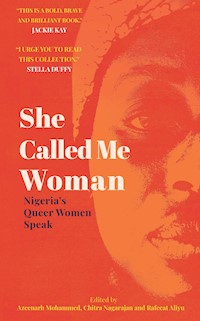
"These true stories are beautifully told, the pain and honesty and hope and joy in these accounts is strong like a song" – Stella Duffy This stirring and intimate collection brings together 25 first-hand accounts to paint a vivid portrait of what it means to be a queer Nigerian woman. These beautifully told stories of resistance and resilience reveal the realities of a community that will no longer be invisible. From the joy and excitement of first love, and from childhood games to addiction and suicide, She Called Me Woman shows us how Nigerian queer women, in all their multitudes, attempt to build a life together. She Called Me Woman challenges us to rethink what it means to be a Nigerian 'woman', negotiating relationships, money, sexuality and freedom, identifying outside the gender binary, and the difficulties of achieving hopes and dreams in a climate of fear.
Das E-Book können Sie in Legimi-Apps oder einer beliebigen App lesen, die das folgende Format unterstützen:
Veröffentlichungsjahr: 2018
Ähnliche


















She Called Me Woman
Nigeria’s Queer Women Speak
Azeenarh Mohammed Chitra Nagarajan Rafeeat Aliyu
Table of Contents
Introduction
It’s un-Nigerian.
It’s against our culture.
It’s not allowed by our religion.
This thing isn’t in us – it comes from over there.
I’m an African and there are some things I can never accept.
How often have you heard these phrases or others like them? How often have you said and thought them?
In recent years, hardly a day has gone by that we have not come across these arguments. Whether in the newspaper, on the radio, in church or mosque, in discussions with friends, eating with family, gisting at work or arguing on Facebook or Twitter, talk of queerness is everywhere. It seems everyone has an opinion, despite no one being or knowing ‘a gay’ – or rather, without admitting that they know someone or are themselves gay.
This book is a response to these discussions. It aims to correct the three types of erasure we see in these conversations.
The first is the erasure of queer people from the discussion about their own lives. Queer people are both hyper-visible and invisible, talked about but missing from the centre of the conversation. The voices and realities of the millions of queer Nigerians (estimated to be more than the population of Lagos) are largely absent from the debate.
The second type of erasure is the rewriting of the rich histories and cultural traditions of diverse sexualities and gender norms in the land now known as Nigeria. Living outside gender norms and heterosexual relationships, or fluidity in gender identity, is not new. They may not be the same as those reflected in the language, films and TV shows of the west, as well as contemporary Nigerian cultural industries, but they are part of Nigerian history, culture and tradition, not in opposition to it.
The final erasure is the state of denial or conscious forgetting that many people engage in of their own experiences and those of people they know. Those things you did in secondary school, that unmarried uncle who lived with his friend until he died, the yan daudu you buy from or indeed the strong, powerful grandmother who had a wife to give her children – they hardly ever make it into private or public discourse.
These erasures mean our conversations are divorced from the truth of our reality and lived experience. Conversations about queerness frequently dehumanise and are dehumanising. Queer people are seen as the absolute and dangerous Other: predators set on converting others, corrupted by outside influences, or focused only on marriage. Adding to the confusion is a conflation of sexual orientation (the gender(s) – or none - you are attracted to), gender identity (the gender(s) – or none – with which you identify) and gender expression (ways in which you express your gender in a world where this is interpreted according to norms of what it means to be a man or woman).
We decided to put together this collection of twenty-five narratives to correct the invisibility, the confusion, the caricaturisation and the writing out of history. We were inspired by similar books such as Bareed Mista3jil by the organisation Meem about Lebanon; Facing the Mirror: Lesbian Writing from India edited by Ashwini Sukthankar; and Tommy Boys, Lesbian Men and Ancestral Wives: Female Same-Sex Practices in Africa edited by Ruth Morgan and Saskia Wierenga about Kenya, Namibia, South Africa, Swaziland, Tanzania and Uganda. Moved by the power of their stories and convinced of the importance of documentation, we thought, We need to do something similar in Nigeria. We wanted to tell the stories we weren’t hearing, to provide a space for voices, lives and experiences missing and silenced from debate. Our audience is two-fold: we address the general public to hold up a mirror and show the richness and diversity of Nigerian society, and we address the queer community to provide a platform to speak and to see their lives reflected in full technicolour.
Our book focuses on queer women because they are often missing and outside the frame even in conversations about queerness, dominated as they are by queer men’s experiences. We recognise the fluidity of gender as a spectrum and this is a theme in several narratives. The book shows a range of attitudes towards the ways in which femininity is socialised in Nigeria and not all of our narrators want to be or identify as women (we use feminine pronouns only for those who identify as female). However, we wanted to examine what it means to exist at the intersections of queerness and femaleness. In Nigeria, as in other countries, entrenched prejudice and discrimination against people considered deviant and beyond the norm when it comes to sexual orientation, gender identity and/or gender expression (SOGI) occurs within a profoundly patriarchal society. Although there is commonality between queer people, gender affects experiences, access to resources and perceptions. Women face further marginalisation because societal, cultural and economic structures manifest power and control in very different ways than for men. This is under-examined within public discourse and in community spaces, where the experiences, realities and voices of men who have sex with men dominate.
This book also tries to address the issue of marriage in queer and non-queer circles. When people talk of homosexuality, they automatically link this with whether ‘gay’ people can or should get married. The most recent legislation, although covering a range of prohibitions from ‘registration of gay clubs, societies and organisations, their sustenance, processions and meetings’ to ‘the public show of same-sex amorous relationship’ was given the name ‘Same Sex Marriage Prohibition Act 2014’ (SSMPA). The stories in this book challenge this focus on marriage, with many other experiences and concerns reflected and many narrators questioning the importance of marriage itself. They also show very human desires to have ‘your person’ and have that recognised by society and the people who matter to you, particularly in a country like Nigeria where marriage and children are so pivotal to social and cultural life.
A note on terminology
The narrators used a wide range of terms to describe themselves: lola, luadi, lakiriboto, same-sex, gay, lesbian, trans, bisexual, queer. We use the term queer as a catch-all in this introduction while keeping the terms the narrators used in the narratives.
Our methodology
We were not aiming to provide a comprehensive picture but rather snapshots of histories, experiences and realities. We reached out through networks to encourage as wide a range of narrators as possible to contribute. Our narrators come from and live in every geopolitical zone of Nigeria. They experience and identify with a range of sexual orientations, gender identities and gender expressions. They are of different ethnicities, religions and language groups. Although most narrators are middle class, all class backgrounds are represented. What proved most difficult was ensuring age diversity. We did not have many older women in our networks and those we knew were not interested in participating. In the end, the narrators fell within a narrower age window than we would have liked, from 20 to 42 years old when their interviews were conducted. We greatly regret not being able to include the voices of older narrators, which would have enriched the narrative and provided an opportunity to compare growing up queer at different periods in Nigeria’s history.
The three of us travelled across Nigeria recording one-on-one interviews, asking questions ranging from childhood memories and first love to family relationships and experiences of work. The audio recordings were transcribed and written up into narratives. We then worked with the narrators to shape the narratives as they wished. We are conscious that there are contradictory statements within some of the narratives but feel one learns a great deal about the narrators and the way in which they perceive themselves from these inconsistencies. We have therefore reported these life histories as were told to us, and have made no attempt to iron out or ‘tidy up’ any contradictions in the narratives.
For a number of our narrators, opening up was a cathartic experience. Many shared experiences they had never previously spoken about. As a result, some looked to us for continued emotional support following the interview. Where relevant, we provided information about medical care, legal aid and counselling services. Unfortunately, discriminoatory attitudes and practices are common among service providers. Many narrators had never accessed these services before or had had bad experiences when they did so. We told them that services we recommended may not be friendly to them – for example, they could talk of sexual violence but might want to be careful about disclosing other issues – but they knew this without our even mentioning it.
It took substantial courage for many of the narrators to take part. They had the opportunity to withdraw at any stage up to publication and several of them did so. Those with whom we set up interviews sometimes did not show up. This was not necessarily because they had changed their minds. Two women in Maiduguri were due to be interviewed after a visit to their villages at the height of the violent conflict there. Nobody has heard from them since. We do not know what happened to them. Some narrators came to the interview location but could not bring themselves to enter. BM (To Anyone Being Hated, Be Strong), who had tried to persuade friends to join the project, said ‘I know at least ten people who are lesbian and bisexual but because they are married, they’re not safe. They can’t even be part of this project because they’re going to jeopardise their marriage.’
Many narrators were concerned that their identities would be revealed, but some wanted their names to be known, saying they were tired of hiding. We have anonymised all narrators in the interests of standardisation and scrutinised narratives to remove identifying markers. We give only initials, along with ages and states where the narrator felt comfortable doing so. We asked narrators to self-identify where they were from and have listed all the places given if they provided more than one location. Having anonymity may not bode well for writing the history of a community that has been rendered invisible. However, we feel that the writing of experience and documenting of lives at the very least ensures that the lived experiences, if not the people of experience themselves, enter history.
Narratives start with a content note to allow the reader to make informed choices about whether to skip certain narratives. This is not an exact science. Many narratives discuss discrimination, hate speech, alienation and internal struggles. These issues are not reflected in content notes as, unfortunately, they tend to be a given. We do, however, give content notes for violence, including gender-based violence, intercommunal violence and forced medical treatment. In this way, we hope to make the book accessible to readers who find reading about particular issues traumatising due to personal experiences.
Key Emerging Themes
All too Nigerian, all too human!
Although the focus of this book is on queer women, some of the experiences and challenges narrators face apply to many Nigerians.
From TQ (I Pray That Everyone Has Forgotten), whose family is from Gombe but grew up in Jos and Kano and now lives in Abuja, to IX (This Is What I Have Been Missing) who says, ‘I was born Yoruba but I grew up in a Hausa household in the north with a lot of Yoruba influence’, many of the narrators have links to more than one part of the country, mirroring the realities of many Nigerians. CG (There Is No One Way To Be A Woman) says, ‘I do not understand the concept of community because different people raised me.’
Narrators spoke of childhood memories: playing ten-ten and suwe; not being allowed to leave the compound for fear they would ‘spoil’; being expected to always be reading and studying when they wanted to watch TV; experiencing bullying at school; and being warned off boys. They spoke of financial difficulties when parents lost jobs, interrupted schooling due to lack of money, time spent helping parents in their businesses and being sent out to hawk products to earn money for the family. The narratives contain stories of being brought up by the extended family and community, polygamous households, parents dying and fathers leaving, parents too busy working to spend time with children, strict parents and guardians, and love, laughter and close families.
Whereas some narrators remember knowing ‘people like them’ growing up, for others this only happened later in life. Girls dating girls was seen as normalised by many narrators, particularly those who attended same-sex boarding schools. According to DK (Why Do I Have To Ask You To Consider Me Human?), ‘We had a boarding house at the school and it was obvious some of the girls were dating each other … Those girls were not treated any differently. In fact, they were seen as gods.’ She goes on to say, ‘The first time I saw two girls kissing was in my grandmother’s house – my aunt and one of the girls.’ That this was taking place does not mean it was always accepted – narrators and their classmates were also punished for relationships.
As adults, the narrators have different attitudes towards work. They talk of starting businesses, the stress of being an entrepreneur, relationships with colleagues and struggles to find work due to lack of social contacts or poor/no education. As TQ (I Pray That Everyone Has Forgotten) says, ‘Anywhere I go, people say, “No work.” Everywhere – no work, no work, no work. It’s very hard. I’m tired.’ However, a job does not guarantee income: ‘they will go three or four months without paying you. How can I go home and ask people for money?’ (JS, Some Things You Do For Your Heart). A recurring theme is the importance of money and the independence and freedom this brings. Narrators link providing for themselves with reduced attempts by family to control them. They feel this is particularly important for the queer community: ‘The moment you do something with your life, nobody cares about your sexuality’ (OW, My Sexuality Is Just The Icing On The Cake).
Religion comes up frequently. Some narrators had pastors and evangelists as parents, others were brought up in religious households and attended Islamiyya or church. Many are devout: ‘I believe in God. I pray five times a day, every day. I respect my parents and I believe in the day of reckoning. I believe in good, bad, heaven and hell’ (NT, I Can Still Love More). Others consider themselves spiritual rather than religious and are not tied to any particular religious institution: ‘I believe in God and His existence, I just don’t have to be in church to worship Him.’ (RD, If You Want Lesbian, Go to Room 24).
A few narrators do not believe in God at all or have broken with religious practice, often due to experiences of hateful preaching or pressure to conform to gender norms: ‘there was a particular day when the pastor started talking about homosexuality … I was a serious Christian but I thought, I’m done with this shit’ (VA, Living A Double Life). Others are critical of religion: ‘For me, religion causes the problems we have in the world right now – the killings and everything else’ (OW, My Sexuality Is Just The Icing On The Cake).
Given the history of violence in Nigeria ostensibly tied to religion, this point of view is not surprising. For example, both TQ (I Pray That Everyone Has Forgotten) and AG (Everybody In J-Town Is Now A Lola) talk of the Jos crisis and how it has affected their lives. AG’s boyfriend was killed and TQ had to run away to safety.
Intercommunal violence is one of multiple issues that has caused psychological harm, even if it goes unnoticed for many Nigerians. Many narrators speak openly about trauma. They reflect honestly on mental health issues, loneliness and feeling alone, depression and suicide attempts. The culture of silence around mental health in Nigeria means narrators who experience difficulties did not know where to turn to get help or even how to name what was happening to them. BM (To Anyone Being Hated, Be Strong) highlights this lack of knowledge, saying, ‘Here in Africa, you don’t know what depression is. They just say, “She’s not well. This one, ah, you know…”’
A few narrators speak of taking drugs and alcohol. While some say this was experimentation, others believe it was prompted by particular factors. At 15, when her boyfriend was killed, AG (Everybody In J-Town Is Now A Lola) ‘started taking drugs, hard drugs, like codeine, white ashes … They helped because there was no love.’ Six years later, she is trying to break the addiction.
‘I tried crack, I tried cocaine, to get my mind off things. I realised it felt better when I got high – or so I told myself’ says BM (To Anyone Being Hated, Be Strong), who struggled to deal with family reactions. ‘When they started hating me, I hated myself even more… I went deeper into drugs.’
When narrators reflect on being Nigerian, hopes mix with realism. ‘Nigeria is very disappointing’ says OF (Love Is Not Wrong).
‘Somebody my age in another country would have a Masters, PhD and subsidised school fees. In other countries, somebody my age would be planning retirement, but in Nigeria, life is just starting.’ says KZ (This Is Not Our World). For many, attitudes towards Nigeria are linked with how they are treated in it, but some of these experiences are common to all Nigerians in different ways, irrespective of identity. Mixed with queerness, these socio-economic and cultural conflicts make for explosive and challenging living.
On being queer
Coming to an understanding of themselves took time for narrators, all of whom had gone through a period of internal struggle. Access to information via media and technology was important, whether this was seeing girls dating on Facebook, reading online articles about trans identities, having conversations on social media, being able to access dating websites or watching The Ellen DeGeneres Show on TV.
Some knew they were ‘different’ from a young age: ‘I didn’t know at 7 that I was a lesbian but I knew I wanted girls’ (HK, Same-Sex Relationships Are A Choice). For others, reflections on same-sex attraction or gender identity was ‘a gradual liberation’ (NS, Focusing On Joy). Some saw queerness as integral to identity and used specific terms to describe themselves. Others took a different view: TQ (I Pray That Everyone Has Forgotten) says, ‘I wouldn’t put a word on my identity. It’s just something I do.’
For some, having girlfriends and/or boyfriends started in school, sometimes with drama: ‘I had three girlfriends in SS1. Two of them were best friends and I thought they knew that I was dating both of them’ (KZ, This Is Not Our World). Many of the girls the narrators dated are now married with children. While some former girlfriends continue to date women, others have seemingly buried their past experiences.
Narrators talk of desire and attraction, taking different approaches to sex, from seeing sex as a way to boost love to finding it unimportant. They talk about good sex: ‘After that night and during the next weeks, my friends got tired of me because I kept calling them like, “OMG I just had the best sex of my life.” They were like, “WTF? You told me this story yesterday.” I would be like, “Yeah, I need to tell you again. I do not know what she did but it was that good.”’ (FR, I Don’t Believe In Love).
They talk about bad sex: ‘We ended up having the most terrible sex. Terrible, terrible, terrible sex. In my mind, I was like, What the hell is this? I told her, “Let’s just not bother.” And that was the first time I was actually with a woman’ (IX, This Is What I Have Been Missing).
They meet potential partners in a range of locations: the library, church, markets, parties, through friends and relatives, nightclubs and online. Many prefer connecting online first. This can be due to increased ease, clarity and variety, as well as the need to be careful when approaching other women.
The narrators take a range of views of relationships, from finding them exhausting, full of expectations or vowing never to love again after heartbreak, to valuing and finding support and acceptance. They discuss love, monogamy, sexual exploration, multiple partners, relationship breakdown and bereavement. Some are adamantly against marriage whereas thers long for it.
They speak of relationship challenges, including jealousy, infidelity, money issues, being torn between two people and the difficulty of finding time for friends. A number of narrators have had girlfriends marry men, often due to societal pressure rather than inclination.
Many narrators have had and continue to have relationships with men. Others tried being with men and see this as a stage they passed through. Some narrators take a harsh view of women who date both women and men, seeing bisexuality as synonymous with cheating. This view is widespread: ‘Most of the time people think you are a cheat when you say you are bisexual’ says NT (I Can Still Love More). ‘I met a girl online last year and I told her I was bisexual. She said she didn’t think bisexuals could be faithful so nothing could happen between us. I wasn’t too surprised. She was not the first to think or say it.’
Gender roles in relationships are frequently raised. Many narrators critique this: ‘It is in a heterosexual relationship where you see a man and a woman, and gender roles are the whole problem in society.’ (OW, My Sexuality Is Just The Icing On The Cake). However, others stress the need to have roles.
Unequal power dynamics play out along gendered lines. JS (Some things you do for your heart) insists that ‘As the father of the family, I’m the one to dictate what happens in the relationship. No matter how busy you are, you have to tell me in advance that you are going out.’ KZ (This Is Not Our World) characterises this as being because some women ‘want to act and behave like men … have two girlfriends, beat up their girlfriend, cheat, go drinking, get drunk, stay at home and be the king while the girl cooks, serves the drinks, washes their clothes and stuff.’ Violence in same-sex relationships is not often discussed when talking of violence against women and girls but it comes up in many narratives.
The narratives also show a wide spectrum when it comes to gender identities, raising questions around the construction of gender itself in Nigeria. CG (There Is No One Way To Be A Woman) was confused by her gender: ‘I never fit any of the things that people said women were … I felt that I was not a woman.’ This is unsurprising given the rigid socialisation process involved in becoming female. One of the narratives where this is most marked is I Only Admire Girls. Here, QM says, ‘I used to run. I ran so much. But Islamically and in Hausaland, female children don’t run. The way I ate, the way I sat, I didn’t really behave as a female child. My father would say to stop that, that I’m a female child. Because of this, when I was growing up, I never saw myself as female. I saw myself as a male child.’ QM’s feelings may have been due to a longing for the freedom, possibilities and behaviour open to boys (she now identifies as female). She found it impossible to separate not conforming to social norms for girls from identifying as male. To her, the fact that she did all the things boys do meant she was male.
Some narrators have gender identities different from what they have been assigned. BM (To Anyone Being Hated, Be Strong) says, ‘Honestly, I’m lesbian because I’m female and I’m here in this time and place … I’m not happy. I’m not complete. I feel it’s wrong when I’m on my period … My folks and everybody will not accept me as transgender. I’m not ready for them to outright reject me. I love my mum and that would just kill her.’ JP (She Called Me “Woman”) says, ‘I was always wishing. I wished I came out as a lady, oh I wished. I wished I was a lady, I wished I was a lady, I wished I was a lady!’ She describes being shocked by a 1984 newspaper article on how ‘A man had changed his sex to female’ and details how she tried to answer the question, ‘Was I gay or was I a woman?’
Many narrators talk about the need to be discreet and careful. Some feel they cannot be open with the people who matter to them, and have to lie when questioned or living in a state where ‘it’ is known but not spoken about. Narrators have had friends withdraw, family members beat them up, insult them, preach at them to change, threaten to report them to the police, take them for deliverance sessions to cast out the ‘spirit of homosexuality’ and attempt forced medical treatment to ‘correct’ them.
On the other hand, narrators also talk about complete acceptance from friends, family members fundamentally changing attitudes, having supportive fathers and mothers counselling them through heartbreak, teachers encouraging them to dress how they wish, taking partners to office weddings and parties, getting relationship advice from cousins and receiving counsel from priests.
Indeed, the positive reactions found in this book are a far cry from the dominant narrative in Nigeria that ‘everyone hates gay people’. Narrators felt that acceptance by the older generation – socialised in earlier eras – and the younger generation – exposed to popular culture and social media – was higher than in middle-aged generations caught up in respectability politics and religious narratives. OW (My Sexuality Is Just The Icing On The Cake) believes, ‘older people, not fifties or sixties but seventies and above, are more tolerant because it was normal in the culture back then – female–female and husbands having lots of wives and stuff going on between the wives.’ What Nigerians actually think, particularly when it comes to their friends, children, grandchildren, siblings and others they love, seems to be a lot more varied than politicians and the media suppose.
Being women
The narratives also show what it means to be living in a patriarchal system. Narrators talk of girls being seen as unimportant, facing intense pressure to marry and the stigma of getting pregnant outside marriage. QM (I Only Admire Girls) states, ‘As a Hausa girl, you cannot behave as a boy. When you behave like a boy, they despise you.
They don’t see you as a real human being. They will always hate you.’ A common theme is the pressure to conform to gender roles and norms whether this comes to behaviour, life choices, dressing or speech. Many of the narrators experience a lack of control over their lives due to a lack of financial power or others making decisions for them, whether this be fathers, brothers or husbands. JP (She Called Me ‘Woman’) finds her understanding of the power relations between women and men considerably changed since presenting as female: ‘All the things that happen to women I now experience, especially the power play between sexes: men making passes at you and believing it is their right to have sex with you or rape you. Men calling you ‘ashawo’. If you disagree with them or stand up to them, you must be a prostitute.’
A key way unequal power relations based on gender manifest is through violence against women and girls. When conducting the interviews, we were struck by just how many of our narrators had experienced sexual and gender-based violence. A 2014 national survey by the National Population Commission found that 24.8 per cent of women and 10.8 per cent of men aged 18–24 years had experienced sexual abuse before age 18. This prevalence is high but borne out by the experiences of our narrators. They also talk of sexual harassment at work, with pressure to dress in certain ways and to sleep with male bosses to get and keep employment. As discussed above, there are multiple examples of violence in relationships with other women, but narratives also contain accounts of violence perpetrated by men.
However, narratives also show women fighting back. For example, IX (This Is What I Have Been Missing) recounts the story of how her university Muslim Students Society threatened to tell a friend’s parents about her boyfriend if she did not stop dating him: ‘She just insulted the shit out of them. Her boyfriend was beside her. She kissed him and told them to go fuck themselves.’
Nigerian queer women speak
She Called Me Woman is full of stories of resistance and resilience. Narrators fight back against the discrimination they experience, whether this is due to their gender, queerness or both, to find internal strength and combat discrimination in personal lives and in society at large. Several narrators point out the hypocrisy of those who condemn them for ‘immoral behaviour’: ‘She was preaching to me one day and I remember telling her, “Look, you have sex with your boyfriend. That is fornication. I am sleeping with a girl. Fine, that is lesbianism. We are going to the same hell, just different compartments”’ (PD, When I Die, I Just Want To Be Remembered).
DK (Why Do I Have To Ask You To Consider Me Human?) sees attacks as a political power play: ‘It all boils down to money or power. The 1 per cent who owns the wealth need to keep everybody so busy they won’t notice … They keep us busy so that we don’t demand our power back. Somebody has to be vulnerable and victimised so that they, who feel powerless in other aspects of their lives, can feel powerful over others.’
Many narrators find it a revelation to find connection with others. VA (Living A Double Life) says, ‘Now I can feel normal. It’s not like being LGBT is abnormal or anything, but when you find people who are like you and you can relate to them, you think less about this burden of secrecy. You are able to get over that and face the struggle. It’s a great thing.’ Narrators also point to areas where the movement can improve. Problems include a sense of community being limited, generational differences, finding it difficult to trust one another, lack of understanding (particularly of trans and intersex issues), people of different religions and ethnicities not meeting each other and people just wanting to party but not rock the boat.
They see the situation in Nigeria getting both better and worse. Even though certain sexual acts were already criminalised before 2014, the passage of the Same Sex Marriage Prohibition Act (SSMPA) made some feel that they were seen as criminals, with one narrator pointing out that the penalties are more severe than for rape. These feelings are exacerbated by increased (negative) public discourse and preaching in places of worship. AG (Everybody In J-Town Is Now A Lola) says, ‘Ten years ago, it wasn’t really open. People didn’t even know people like us existed. We could go out with a girl, hang out with her, hold her, but now it’s crazy. People are very, very afraid.’ Nevertheless, she goes on to talk about the openness she continues to experience in places like Jos, Abuja and Port Harcourt. Some narrators also feel that, conversely, the passage of the SSMPA has forced people to be open about their sexuality, to humanise and put a face to what is seen as the Other. HA (I Convinced Myself I Wasn’t A Lesbian) ‘wrote an article about being lesbian in Nigeria stating how the law couldn’t criminalise sexuality’ because she ‘was determined to show everyone that gay people were everywhere and we were just as regular as they were.’
The narrators also see people having more exposure to new ideas through reading, social media and technology, and being more willing to be open than before. They see a generation learning to speak out. They want to see a stronger, bolder, more educated community whose members know their rights. As DK (Why Do I Have To Ask You To Consider Me Human?) says, ‘I have a voice. Nobody can silence me.’
For the three of us, working on this book was an eye-opening experience. We were struck by the differences between the stories as well as the commonalities. It was an important reminder to us that not all queer experiences are the same. We expected more despair and loss, but instead we found joy and resilience. Although it was disappointing to note the number of people who wanted to leave the country, believing their chances at happiness existed somewhere other than Nigeria, it was affirming to see so many stories of triumph.
Our aim is for this book to add to conversations about gender and sexual norms in Nigeria, to introduce readers to queer people if they do not know any, and to introduce queer people to each other. We want readers to empathise with our narrators as they go through joys, heartbreaks and victories with them. We hope reading these stories makes the reader laugh, be surprised, feel angry, learn, reflect on their own opinions, feel moved, and be inspired.
— Azeenarh Mohammed
— Chitra Nagarajan
— Rafeeat Aliyu
She Called Me ‘Woman’
‘Oh jeez, I am beautiful! Even without make-up!’
Content note: sexual violence, physical violence, forced medical treatment, depression
I identify as a human being first. If anybody pushes, I say, ‘Fine, I am a woman, a lady.’ There was a time when someone said, ‘Oh you are a trans woman.’ I said, ‘No, I am not a trans woman, I am a woman.’ And then there was a time when someone was like, ‘A trans woman is a woman, but to me, whatever name you call it, a trans woman is a man.’ Hello! It is not just about your genitalia, please. But let me start from the beginning.
I remember living as a boy. It was fun initially because I was effeminate. I was 5 or 6 and my parents didn’t seem to care that I loved playing with female things. I loved watching movies that included ladies’ stuff and all those things ladies love to do. They were just there but I loved doing them. Then my father, a military man, left us – left me – when I was 9. My mum became a single parent to me and my two brothers, and life got really tough till I graduated from school.
In my teenage years, I was feminine. My trousers were unisex. I was more on the female side. I was always swaying when I walked, swinging my waist with reckless abandon because I didn’t care what people said and because my mum showed me love and didn’t seem to care either. I only started being concerned when she did, when it seemed as if there were external factors from her place of work, from society, saying, Why is your son like this? Why is your son like that? There was a time she would brush them all aside but then they started playing the religious card and all of a sudden it got to her. And she started giving it back to me.
Around that time, my younger brothers became huge, masculine, bearded men with deep voices. I, the first child, the first boy, was all feminine and gracious and my voice changed too. I sang in the choir and my voice went to sopralto, a higher key. When one of my brothers who used to sing that high key became baritone/tenor, all the questions started coming out. What is going on? I would ask myself the same thing. Somewhere along the line, my body and I went through different processes. At the age of 16, I started battling with depression. Even though I knew I was attracted to men, I had not acted on that because we had been taught that homosexuality was a sin. I was still trying to figure myself out.
I was always wishing. I wished I came out as a lady, oh I wished. I wished I was a lady, I wished I was a lady, I wished I was a lady! You know all these kinds of wishes. I wished, I wished, I wished I was a lady. And at times, I would look into the mirror and try to accentuate my looks, then realise, Oh jeez, I am beautiful! Even without make-up!
One day in 2001, while I was in school, a guy walked up to me with an old newspaper. He said, ‘Read it. It is for you,’ and walked away. This person had never spoken to me before. I picked up the newspaper and what did I see? A man had changed his sex to female. I looked at the date: 1984. And I was like, is what I have been wishing for real? I read through it with excitement, and there was even a picture. I was shocked! As of then, my quest for knowledge began. I went back to the guy who’d given me the paper and he said I should go do my research. I did, and I realised that anything is possible. No more wishful thinking followed by depression because you think it’s impossible. One day while doing research, I saw a book called Middlesex on Oprah. It’s about a trans woman and I was like, Wow, so this is actually real. I continued googling.
I was fighting with external pressure and at the same time, I was trying to know who I was. What was happening with me? Was I gay or was I a woman? I was afraid of acting on my sexual impulses because I knew I was attracted to men. I was trying to know myself and get through the confusion and conflict. My mind was going, No I am not gay, I am a lady … No, you are gay … uh uh, how else? And I thought my case might be more than that, that there must be something else. But at that point, I was always trying to know, trying to understand, trying to find me.
I came out to my mum when I was twenty years old. I just walked up to her in the room and said ‘Mum, I think I want to have a sex change. Not think. I know I want to. I am more like a lady and this is who I am.’ I started talking and talking and talking.
And she said, ‘I think it is a demon speaking through you.’ She tried to change my mind and made my brothers beat me up on the spot. I will never forget that day because it was just before my birthday. I didn’t even have to come out to my brothers. She told them. It was a circle. They brought me there and she was screaming ‘This is what your brother said o, haaay.’ My brother was like, ‘Really? No!’ They were 18 and 16 at that point. They called me all sorts of names: ‘You are a disgrace to us … You are urgh … You are this, you are that.’
The once beautiful mum who was my angel became my demon and my brothers became her bulldogs, her emissaries. They had grown bigger than me, over six feet tall and quite macho. If you looked at them, you would quiver at the sight. There was no day they didn’t beat me, their first-born ‘brother’.
I became less and less comfortable at home. When I wanted to clear my head, I would go to school and hear things like ‘obirin-asuko’, a Yoruba term that means boy-girl. Or ‘obirin-okurin’; those kinds of terms. And they were used in a friendly way. So to me, it seemed as if the people at school were the ones who were okay, treating me like I was okay. But when I got home, I would only get a fight from my family.
When I entered university, I breathed a deep sigh of relief. It wasn’t a nice environment but at least it made me mingle with people. People who seemed to appreciate me as a person. I met people who, if they saw you being harassed, would say, ‘Hey, stop am.’ These people didn’t come up to you and say, ‘Let’s be friends.’ But anytime they had the opportunity to defend you, they would defend you and walk away.
I was staying in Sultan Bello, a male hostel at the University of Ibadan, and it was so adventurous. People often wondered, ‘Is that a boy, or is that a girl?’ ‘Na boy, abi na girl?’ And I just walked without giving a hoot. Sometimes I would wear bum shorts because I loved to flaunt my legs, right from when I was living as a boy. And guys would hit on me. They knew I was a boy and yet they still came to me.
What I loved then was that I was doing what they call ‘shakara’ – show off. I was not interested in a relationship or even sex; I just loved myself. And so a guy would come up and express himself saying, ‘I like you.’ When I said no, he’d hurl insults at me – your papa, your mama – in frustration at being turned down. Some of them would then go to their girlfriends and say, ‘That guy na fag; he approached me.’ A lot of people frown at homosexuality and transsexuality, but so many of them are in their closets.
I didn’t give a hoot. I realised that I had to be strong for myself. You will not touch a small part of me and get away with it. I will retaliate on the spot so that you know I am not weak. They tend to harass the community. When the victim backs down, they keep doing it. They keep harassing us. But when you stand out and face them, they tend to back off. It doesn’t mean I didn’t have enemies at university, but at least everybody knew me as that beautiful boy. Some people would want to connect with me. Some would run from across the street to touch me. I felt like I belonged, contrary to what my family said, that people would stone me. Yes, when I was at home I had such experiences. Even while I was in school, I had such experiences, but they were not much.
Sultan Bello was a male hall but they hosted something called Ms Bello, where men dressed as women, like a drag or something. Macho guys would put up their pictures and everybody would come laugh. Even the Vice Chancellor sometimes attended. It was a very nice social event. They told me that I could do the Ms Bello, so I put up my picture and all the contestants backed off because I was exceptional. They said, ‘No, this is Ms Bello, s/he has the crown.’
That was a beautiful day I will not forget, because it was the first time I expressed myself as a lady to the full glare of everyone. Other halls came: Independence, Idia, Queens, Kuti, Melambi, Tedder. I was the only one competing for the crown. It was the first time I expressed myself with my hair, make-up and outfit, and I glowed. They said the Ms Bello should dance to a song, so I played Crazy in Love by Beyoncé and oh my goodness! I danced freely. I shook my bum, my tiny bum. I did everything. And because the show was within the hall space, it lasted till two in the morning.
When it was over I removed the feminine attire, the make-up and everything I’d used to express my true self, and went back to the life where I couldn’t express myself. I became sad, but that memory lingered. If this kind of thing could happen, then I could see the future. It meant that there would come a time when I could live in that dream, not just enjoy it once, remove it, and drop it on the side.
I was so excited that I called my mum, who I had not spoken to for a long time, and told her, ‘Guess what? I did this thing and it was so exciting …’
But she was antagonistic. Before I could say Jack Robinson I started receiving threatening messages: Oh you have started sleeping with men eh, ooohhhh, you have now sold your star, homosexual, blah blah blah. I said I had not started sleeping with men. I had not even had a boyfriend. I’d just expressed myself. The woman in me was crying for release and she came back! I felt sad. I became depressed. Later, I realised that my mum was communicating with L___, one of my best friends. L___ just turned her back on me and started insulting me.
But I was lucky; some people stood up for me. One of those people was the supervisor in charge of my project, Professor M___. I was scared of her at first, but she made me feel free.
I remember the day L___ stabbed me in the back. She said ‘No, no, no. You can’t take pictures with us cos we are taking a final-year picture. Are you a he, a she or an it? In fact, you are a disgrace to your mother!’ I told Professor M___. When I entered her office, she was combing her gold hair and looking at her reflection on her laptop. I told her what had happened and she said, ‘Nobody has the right to infringe upon your rights!’ Then she looked at me and said, ‘I have heard so much about you. Why don’t you start wearing earrings, necklaces and other jewellery? Please, express your feminine side!’
I looked at her and thought, Shoo, is it this woman who is telling me this? I was impressed. In my final year, I started putting on earrings and strutting my stuff. Professor M___even made me meet some social workers at school.
Another person who looked out for me was I___. She was a poet and a dancer. She was the mother I never had and she made me super strong. She was a phenomenal person. She taught me dance. She taught me choreography. She taught me to be bold about who I was. She called me ‘Woman’ even before I started to. I could not accept it at the time, but I was always free around her. She was strict and disciplined, yet open. People didn’t understand her, but I did. If she screamed at me, I understood. She used to call me ‘JP’, which means ‘sweet to have’ in Yoruba, and was always telling me, ‘Look, the world is bigger than what you think, JP.’
There was a day in 2009 when my mum used my brothers to beat me. They locked me up inside the room, but at 11pm, I___, who was in Ibadan, rescued me. She called a doctor who was a friend, told him how to get to our place and he got me out of the house.
I had to move on. I didn’t go back home. During the holidays, I stayed at the hostel. They normally didn’t send people away because there were 400-level1 students who wanted to do projects. My mum would say, ‘Come back home. You’re sleeping with a man,’ but I just ignored it all. Sometimes I received text messages from my friends, from people who were at home. I ignored them too.
Some people at school were transphobic but at least the people who stood up were like, ‘No, uhm uhm, let her be.’ A person who detested me once gathered the whole department for the kind of meeting where students discuss departmental issues, but this time they were castigating, talking rubbish about me. A lecturer came in and annulled the whole thing. He called me and told me what they were saying.
For the most part, though, I was favoured. I am eternally grateful to UI. I doubt if there are other schools like the University of Ibadan. I had one HOD who took a shine to me and other people who cared about me. In fact, all the women who groomed me were powerful and wild in a positive way. The wires in their brains used to touch. They thought outside the box. They were strong and hated injustice. Sometimes they were super aggressive. Somehow, I fell under the tutelage of such women.
When I was finishing university, it was assumed that I wouldn’t do my NYSC2. But I served in Kaduna State. Note, I had not had any surgery but I was presenting as female by then and everybody was like, ‘Oh, she has had the surgery.’ I just had to keep it mute. But deep down I was freaked out by the fact that when I went to serve, I would stay in an all-female space. Oh my goodness, I thought. How am I going to do it? Oh my God! But I did. I was lucky because I was given the last hall in the female hostel and there were only ten of us. The halls are spacious with lots of bunks so I could do whatever I had to do.
In the past, I’d acted Ms Bello but now I was living the dream. So when people tried to convince me to contest for Ms NYSC, I refused. They would have to dress me up and we might reach a stage where I’d stand naked before a couple of people. So I said no.
During my service, there was a guy who was pampering me. My clothes were washed. Everything I needed was sorted out. I dared not tell this person that I was trans. To this day, he still doesn’t know, but he was so interested in me, spoiling me with everything I needed. Other men would also make passes at me, but I could not tell them, ‘Look, this is who I am.’ Some of them, I would see them and like them. Some of them would come up to me and say, ‘I love you’ and all I could do was watch with teary eyes and say to myself, I wish I could tell you who I am. They would look at me like I was a heartbreaker, mean or wicked. But all that time, I was thinking, I can’t say anything.
When I finally started working, men were still making passes at me. I knew I was attracted to men. I started accepting myself, understanding myself a little bit. Around that time, I had a two-bedroom flat all to myself, so there was that privacy and that happiness. At least I was no longer acting the dream, even though getting to that stage had not been easy.
To date, my mum still has not accepted me. I am not really bothered about that. One of my brothers turned against her and started protecting me. He said, ‘For goodness sake, nobody wants to be persecuted. Nobody wants to go on the streets and see people stoned. Nobody wants it so don’t make it look like that for my sister.’ He refers to me by the proper pronoun. ‘Please take care of my sister,’ he will tell me. ‘Please be careful of mummy. Mummy is still on your neck. Be careful. If she invites you somewhere, please don’t go.’ When I am financially challenged, he will send money to me. This was someone who was an attacking bulldog, pinning me down with his strength. He said he did his own research and started studying and studying.
When I was still in school, my family told him they wanted to take me to the hospital to have my hormones measured and get female hormones so I could live as a woman. I knew that was a lie but they tricked him. They hired a cab and took me to the psych ward in LASUTH3. My brother was like, ‘You people told me we were going to the place where they will check her hormones. What am I seeing here?’
‘I told you,’ I said, but he could not see it. He wanted to give them some benefit of the doubt.
But inside, he noticed that one of the nurses gripped my hand, not with care, but in a tight fist. When they started taking me away, he flared up. ‘This is not the deal. This is not what you told me. Oh my goodness, you wanted to operate on her.’
It wasn’t long before they called the doctor in charge of psychiatry. By the time he came, they had registered me as male, so he asked, ‘Who is Mr. So-and-so?’ When he saw this female-presenting person, he said, ‘Oh, I understand.’ He asked me for my name, I told him, and he accepted it. And the tables turned.
He took me inside his office to talk. He was not trying to change my mind; he was talking to me to make peace. He said, ‘I have come across these cases. From the look of things, it’s your family that needs psychiatric evaluation. I am going to call them in.’
They claimed that they wanted to give me male hormones. The doctor said, ‘Do you know what you are talking about? To give male hormones, you have to obtain consent. Or else she could commit suicide.’
They kept saying, ‘We don’t care, we just want …’
‘Wait, you don’t care?’ he said. ‘You don’t care about her life?’ He printed a document on intersexuality and transsexuality and gave it to them. ‘Go and read,’ he told them. From that moment on, my younger brother started shifting ground. That doctor played a big role.
My mum and brother tried again when a doctor from the UK came to join the discussion. She didn’t know who I was and said, ‘This lady is beautiful. What’s going on?’ My mum and my brother shouted my birth name. The UK doctor said, ‘Oh, we understand. Did we give them anything on intersex and transsexuality?’ They said, ‘We did but they seem to be very stubborn.’
The doctors said that from the look of things, they needed to give me female hormones and take me to Israel to do a sex change. The doctors were talking about doing it free of charge and my mum and brother stopped taking me to the hospital. They continued their persecution but this time they could not go far with it as my younger brother refused to participate. Their bulldog wasn’t there to attack me any more. He said to them, ‘No, you were not straightforward. It seems as if you were wrong all this while. You people don’t want to face the truth.’ Since then he has evolved. He calls me his sister. From the way he talks now, my brother has really changed for the good. My mum is always afraid of laying a hand on me because of him.
I still maintain contact with my mum. I am just careful with her. The last time I saw her was June 2014 but she called me last month. Sometimes she talks to me once a week. It depends. Sometimes she pretends. She refers to me as ‘she’ but I know it is a ‘he’ in her head. I was in a relationship last year. She came and ruined it. She tried to make the guy sabotage me. I got wind of it so the guy and I went our separate ways. We’d been together for a year and he’d abused my mind, always threatening to out me. That was after I went to Belgium.
Everything changed in Belgium. When you change environments, you get some fresh air. You go out and see people who appreciate you. Even looking at you is enough of a compliment. My eyes opened and I tasted the forbidden fruit of freedom. Now I know what is good and bad.
Over time, I have had lots of people stand up for me. I can’t pick one but let me tell you about some of them.
A long time ago, I wanted to seek asylum and leave Nigeria, but I never knew the processes. So I went to the Dutch embassy and they helped me. They asked if I had a degree and I said I did. They said, ‘You are a trans woman and you have a degree. Do you know how many people have degrees and are presenting as women?’ So they put me in touch with Z___. He looked at me twice and said there was no way he would let me go out. ‘You are going to work with us,’ he said, and that is how I got my first job. He made me feel free. We could fight. I could express myself and say, ‘No, this is wrong.’ He treated me like everyone else, without being personal about it.
I eventually got another job, but you know how it is when you go to work and it is boring because you are not doing anything serious and nothing is challenging you? I got my salary working on HIV and AIDS but those were not the primary needs of the trans community. I got that job expecting to attend to trans needs, but I wasn’t, so I left.




