


Erhalten Sie Zugang zu diesem und mehr als 300000 Büchern ab EUR 5,99 monatlich.
- Herausgeber: Atlantic Books
- Kategorie: Sachliteratur, Reportagen, Biografien
- Sprache: Englisch
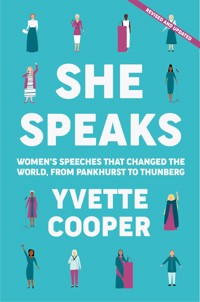
A powerful celebration of brilliant speeches by women throughout the ages, from Boudica to Greta Thunberg. 'A treasure trove of trailblazers...' Cathy Newman Looking at lists of the greatest speeches of all time, you might think that powerful oratory is the preserve of men. But the truth is very different - countless brave and bold women have used their voices to inspire change, transform lives and radically alter history. In this timely and personal selection of exceptional speeches, Yvette Cooper MP tells the rousing story of female oratory. From Boudica to Greta Thunberg and Margaret Thatcher to Malala, Yvette introduces each speech and demonstrates how powerful and persuasive oratory can be decidedly female. Written by one of our leading public voices, this is an inspirational call for women to be heard across the globe.
Sie lesen das E-Book in den Legimi-Apps auf:
Seitenzahl: 355
Veröffentlichungsjahr: 2019
Das E-Book (TTS) können Sie hören im Abo „Legimi Premium” in Legimi-Apps auf:
Ähnliche

















SHE SPEAKS
About the Author
Yvette Cooper is the Labour MP for Normanton, Pontefract, Castleford and Knottingley. She served as a minister and then Cabinet minister in the 1997–2000 Labour Government, including as Chief Secretary to the Treasury and Secretary of State for Work and Pensions. She was the first Cabinet minister to take maternity leave and has campaigned on issues from child poverty and economic regeneration to online abuse and child refugees. Since 2016 she has been chair of the Home Affairs Select Committee. She is also a mum, a terrible but enthusiastic gardener, and enjoys overly competitive family sports.
First published in hardback in Great Britain in 2019 by Atlantic Books, an imprint of Atlantic Books Ltd.
This paperback edition published in 2020
Copyright © Yvette Cooper, 2019, 2020
The moral right of Yvette Cooper to be identified as the author of this work has been asserted by her in accordance with the Copyright, Designs and Patents Act of 1988.
All rights reserved. No part of this publication may be reproduced, stored in a retrieval system, or transmitted in any form or by any means, electronic, mechanical, photocopying, recording, or otherwise, without the prior permission of both the copyright owner and the above publisher of this book.
Every effort has been made to trace or contact all copyright holders. The publishers will be pleased to make good any omissions or rectify any mistakes brought to their attention at the earliest opportunity.
10 9 8 7 6 5 4 3 2 1
A CIP catalogue record for this book
is available from the British Library.
Internal illustrations © Anna Higgie
Text design by www.benstudios.co.uk
Paperback ISBN: 978 1 78649 994 3
E-book ISBN: 978 1 78649 995 0
Printed in Great Britain
Atlantic Books
An imprint of Atlantic Books Ltd
Ormond House
26–27 Boswell Street
London
WC1N 3JZ
www.atlantic-books.co.uk
CONTENTS
Preface to the Paperback Edition
Introduction
1.BOUDICA
‘A Woman’s Resolve’
2.QUEEN ELIZABETH I
‘The Heart and Stomach of a King’
3.SOJOURNER TRUTH
‘I Am a Woman’s Rights’
4.JOSEPHINE BUTLER
‘A Voice in the Wilderness’
5.EMMELINE PANKHURST
‘Freedom or Death’
6.ELEANOR RATHBONE
‘An Insult to Mothers’
7.JOAN O’CONNELL
‘The Promise of a Dream’
8.AUDRE LORDE
‘There Are So Many Silences to Be Broken’
9.MARGARET THATCHER
‘The Lady’s Not for Turning’
10.MAYA ANGELOU
‘On the Pulse of Morning’
11.BENAZIR BHUTTO
‘The Ethos of Islam Is Equality Between the Sexes’
12.BARBARA CASTLE
‘The Red Light Has Gone On’
13.EVA KOR
‘A Message of Hope and Healing’
14.THERESA MAY
‘Modernizing the Conservative Party’
15.WANGARI MAATHAI
‘A World of Beauty and Wonder’
16.ELLEN DEGENERES
‘I Know Who I Am’
17.ANGELA MERKEL
‘A Door Suddenly Opened’
18.ALISON DRAKE
‘Get Up There and Get At It’
19.MARIE COLVIN
‘Someone Has To Go There’
20.JOANNE O’RIORDAN
‘No Limbs No Limits’
21.MANAL AL-SHARIF
‘Driving for Freedom’
22.JULIA GILLARD
‘He Needs a Mirror’
23.CHIMAMANDA NGOZI ADICHIE
‘We Should All Be Feminists’
24.MALALA YOUSAFZAI
‘Let Us Pick Up Our Books and Our Pens’
25.KAVITA KRISHNAN
‘Freedom Without Fear’
26.LUPITA NYONG’O
‘Being Beautiful Inside’
27.HARRIET HARMAN
‘Parliament Must Lead by Example’
28.EMMA WATSON
‘HeForShe’
29.JO COX
‘More in Common’
30.YVETTE COOPER
‘Britain Has to Play Our Part’
31.MICHELLE OBAMA
‘When They Go Low, We Go High’
32.DONNA STRICKLAND
‘Physics Is Fun’
33.ALEXANDRIA OCASIO-CORTEZ
‘Today I Rise’
34.JACINDA ARDERN
‘They Are Us’
35.DIANE ABBOTT
‘We Will Not Rest’
36.LILIT MARTIROSYAN
‘We Are Making History Today’
37.GRETA THUNBERG
‘Let’s Start Acting’
38.MEGAN RAPINOE
‘Be Better, Be Bigger’
39.ROSIE DUFFIELD
‘Sometimes There Are No Bruises’
40.QUEEN ELIZABETH II
‘We Will Meet Again’
Acknowledgements
Credits
Endnotes
Preface to the Paperback Edition
Women’s voices have been sidelined for too long. It’s time to fight back – to promote, debate and celebrate the public words of women through the ages and across the world. That is why I put together this collection of women’s speeches – to tell the stories of the incredible women behind them, to inspire readers, and to encourage more women to speak out.
In the hardback edition, published in November 2019, I argued that spoken words matter, speeches matter, that they are pathways to power. When women’s voices are not heard, it undermines democracy and hurts us all. I challenged the speech anthologies, public events and conference line-ups that still carry so few women’s words, and chronicled the attempts to silence women, both today and throughout history.
A few short months later, as I write these words for the paperback edition, everything has changed and nothing has changed. The world has been turned upside down by the COVID-19 global pandemic. Things once unimaginable have come to pass, with the heartbreaking loss of so many lives, with families kept apart, and with schools, workplaces and community centres closed to keep people safe. For months, the public forums for speeches have been silent. It is poignant to think of the words not spoken as weddings and wakes were put on hold; sports games, political rallies, conferences and graduation ceremonies were cancelled; and religious sermons were suspended. We have had to learn new ways to reach out and connect with each other, applauding key workers from doorsteps and balconies, speaking and meeting online. Even Parliament closed temporarily, and I could never have imagined that I would make a speech to the House of Commons whilst sitting at home in an upstairs room, staring into Zoom.
But the crisis has also shown the power of words and highlighted the importance of ensuring that diverse voices are heard. This year, speeches have held the power of life and death. Without drugs or vaccines to protect us from the spread of this deadly virus, politicians, scientists, doctors and public figures have had to use the power of persuasion to convince us to make the personal sacrifices necessary to protect each other, and to explain how much is at stake – words have saved lives.
In the midst of all this turbulence we have seen both inspiring examples of women’s leadership and oratory in some parts of the world, and a troubling absence of women’s voices in others. Sadly, here in the UK, in the words from the heart of government, women have been marginalized. Throughout the peak of the first wave, government ministers made daily short speeches to update and advise the public through virtual press conferences. A shocking eighty-nine out of the ninety-two ministerial speeches were made by men; only 30 per cent of the members of the key scientific advisory committee are women. The UK government has been criticized for lack of transparency and lack of empathy, both in its decision-making and its public communication – the absence of diverse views and voices has weakened the national response.
When looking for a British speech that encapsulated the crisis to add to this paperback edition, I could not find anything from our government. Instead, the most powerful unifying words, spoken when things felt darkest in early April, came from the Queen. In a very unusual televised address, the 96-year-old monarch drew upon our national history to evoke a sense of resilience and compassion, praising the ‘quiet good-humoured resolve and fellow-feeling’ that characterizes our communities.
At the same time, across the world, some of the women whose earlier speeches already feature in this book have been applauded again for their words and for their leadership in the face of this global emergency. New Zealand Prime Minister Jacinda Ardern and German Chancellor Angela Merkel have both been widely praised for their approach to the crisis and for the way they have communicated with their countries throughout the pandemic, building trust through empathy, honesty and clarity, and taking firm action to keep the loss of life down. The words Ardern chose when addressing the people of New Zealand differed starkly from the war-like language of ‘battle’ and ‘invisible enemies’ used ubiquitously by male leaders across the globe: ‘Be kind to each other,’ she said, mobilizing a sense of solidarity and responsibility among her listeners.
Several other speeches from among the thirty-five included in the first edition also feel more important than ever at this time. Words from the speech by civil rights activist and poet Audre Lourde, given in Chicago in 1977, have been emblazoned on the banners of Black Lives Matter protesters – her words, ‘your silence will not protect you’, are resonating with activists around the world and feel relevant and rousing for a new generation. This year, in response to the racist murder of George Floyd in the US, we have seen an important and long-overdue public acknowledgement of the responsibility we all bear to recognize and challenge racism and injustice wherever we find it, and to seek out under-represented voices, to amplify them and to learn from them. Lupita Nyong’o’s speech, included in this collection, is a powerful, personal reflection on how it feels to be judged by the colour of your skin. Here in the UK, the words and actions many decades ago of trade unionist Joan O’Connell and Labour stalwart Barbara Castle, both included in this book, once again feel relevant this year as we mark the fiftieth anniversary of the implementation of the Equal Pay Act, at a time when women face new job losses, pay cuts and childcare pressures as a result of the COVID-19 crisis. Meanwhile, Diane Abbott’s speech on the Windrush scandal continues to echo, as victims have not received the support and compensation they need. Back in Castleford Queens Mill in my constituency, as we have been delivering books, food parcels and activities to local residents during these difficult times, I have thought often of Alison Drake, our local champion whose speeches and campaigning first started our vital community network of volunteers at the Mill. And as we try to rebuild our economies in a better way after this crisis, we must remember Greta Thunberg’s call for action on the climate emergency.
Lilit Martirosyan’s words on violence against trans women aren’t just about her experience in Armenia but reflect evidence from across the world of continuing violence and threats against transgender people everywhere. And while nations across the globe feel fraught and divided, Jo Cox’s words still remind us that we have more in common than that which divides us.
Sadly, the experience of violence and threats, and the attempts to silence women, have continued. Angry tirades by online trolls continue without any sign of abating. Women ministers in Italy and Austria have had to seek police protection this year in the face of threats. Meghan Markle was the target of sexism and racism in the media and online before she left the UK. At the 2019 UK general election, which coincided with the first publication of this book, several women MPs stood down, saying they were no longer prepared to tolerate the vitriol and abuse. Soon afterwards a Conservative activist in my constituency was jailed for making a violent threat towards me.
The women in this book have refused to be silenced. Their determination has inspired me to find even more speeches to add to this paperback edition – and their struggles are not over. Manal al-Sharif spearheaded the movement for women’s right to drive in Saudi Arabia, but she lives in exile, while other women campaigners in Saudi Arabia have been imprisoned without trial – a stark reminder that some of the battles for women’s human rights have not yet been won. I listened in Parliament to Rosie Duffield’s deeply moving and personal speech about domestic abuse and I know it has already given comfort and confidence to women across the country at a time when domestic abuse has been on the rise. I have also included US footballer Megan Rapinoe’s uplifting team talk – a reminder to be bold, brave and, above all, kind. Words have most power when they are believed and trusted, so at a time when facts themselves feel under threat from those promoting conspiracy theories and fake news online, I was particularly keen to include Marie Colvin – the brave and remarkable war correspondent who died in pursuit of truth – and her speech from 2010 on the importance of journalists bearing witness.
In the months I spent researching this book, I came across so many brilliant speeches by formidable women and so many fascinating stories behind them that I struggled to choose only forty to include. This is not a definitive list of the all-time greatest speeches by women; rather, it is a compilation of powerful voices that have influenced and inspired me, that have helped build movements and deliver change. There are many, many more that could have been included in these pages. I urge you to seek them out, to find the ones that resonate with you and which represent you, and to share them with others. It is only by finding and amplifying the words of women that we can ensure that the power of our voices continues to reverberate through the generations.
I hope discovering and delving into these speeches will be as meaningful and inspiring for you as it has been for me.
Yvette CooperCastleford, July 2020
‘Where the words of women are crying to be heard, we must each of us recognize our responsibility to seek those words out, to read them and share them’
Audre Lorde
Introduction
For centuries, brave and bold women have spoken out. They have used their voices to rally communities and crowds, to persuade, to teach and to inspire change. But too often their words have been lost or drowned out and their powerful interventions omitted from history. Too often they’ve had to fight to be heard while others tried to silence them.
Speeches have been part of my working life for over twenty years, but when I’ve searched other speeches for inspiration, in anthologies or online, I’ve been amazed by how women disappear. Most collections of speeches include few women. You could be forgiven for thinking that Elizabeth I was the only woman in history to make a speech – and even her words were written down later by a man. Today, although there are far more women involved in politics, public services and business, women are still less likely to speak or be heard from a public stage, less likely to speak or be heard at conferences or in meetings.
This book fights back. It’s a celebration of speeches by women from across the world and across the centuries – brilliant battle cries, passionate polemics and reflective ruminations. These are speeches from warrior queens and world leaders, teenagers and pensioners, celebrity activists and local community champions. And they talk about everything from physics to prostitution, war to beauty.
For several years I have wanted to put this book together – hoping that some of the speeches that have inspired me will inspire both women and men and will also encourage more women to speak in public. After all, leadership and authority often depend on public speech – whether it be in politics or the workplace, at community events or office presentations, even weddings and funerals. So if women aren’t speaking or being heard, they will often be kept out of positions of power too.
It feels even more important to promote women’s speeches now. First, because we are in great need of more thoughtful, creative and passionate speeches from the widest range of people possible. Right now in our public debates, there is so much shouting, and too little speaking and listening. Politics is a maelstrom, there’s a culture war online, and the pace of changes in technology, population and climate means that no one has all the answers and we need more voices to be heard. Second, because while more women are now claiming the stage and speaking publicly, many also face a dangerous backlash and are targeted with vitriol and even violence. Some of those who try to speak out are being hounded instead of heard. They face deliberate attempts to intimidate them into silence.
When women parliamentarians from over 100 countries gathered at Westminster to mark the 2018 centenary of the first UK women’s votes, most of them had stories to tell of bullying, abuse and threats. Women outside politics who’ve led campaigns or become public figures can face organized trolling and targeted abuse designed to keep them quiet.
Most shocking of all is when the misogyny comes not just from keyboard warriors but from the most powerful man in the world. The President of the United States encourages huge crowds to chant against women politicians: for Hillary Clinton, the cry was ‘lock her up’; for Congresswoman Ilhan Omar it was ‘send her back’. He has called women ‘dogs’, ‘fat pigs’ and ‘slobs’, and set the tone from the top for waves of threats and abuse not just targeted at female politicians but towards women more widely.
Here in the UK, women MPs routinely receive death threats or rape threats – and the abuse is much worse for black, Muslim or Jewish women. I know talented women who are giving up politics because of it. In the House of Commons Labour MPs sit beneath a coat of arms painted for our colleague Jo Cox, murdered three years ago for doing her job.
Even five years ago, I could not have imagined any of this happening. I could never have imagined losing a friend to such violence. I would never have dreamed when I first became an MP that there would be weeks when my office would have to report thirty-five different threats to the police, when some would be so serious that arrests would follow, or when fellow human beings I have never met would call for me to be beaten, shot or strung up because they didn’t like something I’d said. None of this is normal. We must never treat it as so.
Hence this book. Instead of letting brilliant women be silenced, I wanted more and more people to hear their voices and their words. As I searched for different speeches, I came across wonderful, inspiring stories which show how speeches can change minds and change lives. I also uncovered tales that show the obstacles women have had to overcome. And I found shocking evidence that the backlash against women who speak out isn’t new. But nor, thankfully, is the bravery of strong women who persist and overcome.
THE POWER OF SPEECH
My dad taught me how to make speeches and gave me the confidence to speak out. He was a trade unionist who spoke up for his members’ rights at conferences and on shop floors, persuading crowds when to get angry and fight, or when to calm down because this was the best deal they were going to get. He told me about the speeches he made, how he wrote his arguments down in longhand, then a second time just as notes, and how he always aimed to speak from memory not from a text. I listened.
For over twenty years, public speaking has been part of my work and my life. I’ve made good speeches, bad speeches, funny speeches, waffly speeches and speeches that were frankly just deadly dull. Each speech can be a fresh nervous moment. Each one can be fraught. I’ve given speeches in the oddest of circumstances, sometimes with one of our children holding onto my skirt, running round the back of the hall or heckling. For years my husband Ed Balls and I had to make major speeches in parallel at Labour Party Conference – we would take it in turns to practise reading from an ironing board propped up as a makeshift lectern in the Conference hotel, rewriting each others’ perorations or jokes. One year I decided to delete a line about clamping down on anti-social behaviour after he returned from the annual Conference football match between MPs and the media having managed to elbow a journalist in the eye.
My worst moments involved misjudging my audience. On one occasion, opening a new school extension, I rattled on for far too long about the importance of education until an impatient seven-year-old ran up and pulled open the curtain behind me. The parents applauded loudly and a wave of relief spread through the room.
I became a Labour MP in 1997 because of a speech. We were in a packed main hall in Castleford High School at the local Labour selection meeting. I was just twenty-eight years old, there were several older men on the panel, and no one – including me – expected me to be selected as the candidate. But I spoke as my dad had taught me – from the notes I’d remembered and from my heart, not from a text.
I remember starting by talking about the Castleford High School pupils who would shortly be taking their exams in that hall and who needed an MP ready to fight for their future. I talked about my grandad who had been a miner, like many of the men in the hall. And I talked about the values that led me to join the Labour Party and the better future that a Labour government could bring. Party members told me afterwards it was the speech that did it – they changed their minds, decided to support me and eight weeks later, still in a bit of a state of shock, I entered Parliament as the Pontefract and Castleford MP.
Since then, I’ve seen how speeches can change people’s minds and people’s lives. Public debate is the lifeblood of democracy – the use of words not swords to change a nation. Spoken words can heal and unite communities or whip up anger and spread poison.
Speeches hold power, but not just in politics. They mark out the milestones in our lives – the wedding tributes, the retirement drinks, the funeral orations. Even towards the end of the Last Night of the Proms, I look forward to the conductor’s short speech – watching to see how the sentences dance between the music, and how they move the crowd. TED Talks have brought in new audiences as millions of people have watched online some of the most popular fifteen-minute talks on everything from body language to space travel. And from the sports captain’s team talk to the corporate manager’s PowerPoint presentation, we use them to steer and guide, to mark authority and to lead.
WHERE ARE THE WOMEN?
When speeches have so much power, it really matters that women are missing. Despite all the speeches I’ve made over the years, and despite the growing numbers of women in leadership positions, public speaking can still feel like a man’s world.
As we approach 2020, women are still less likely to hold public office, less likely to speak at private conferences, less likely to hold forth in a conference call. Even in recent anthologies or online celebrations of oratory, women are still notably absent – often accounting for just one in five or even fewer than one in ten of the chosen speeches.
For women breaking into traditionally male spheres, making speeches can be daunting. To hold an audience’s attention, you have to be confident in your authority but also feel something in common with those who are listening – all things which are harder if you are talking to an all-male audience. Harriet Harman has described speaking in Parliament in the 1980s when there were hardly any women and hearing the grumbling from all sides when she dared to stand up and talk about childcare. Even by the time I was elected with more women in 1997, I would often find myself facing Conservative opposition benches entirely filled with rows of chuntering men.
I remember being asked as a junior health minister to speak at a Labour Press Conference during the 2001 General Election with the Prime Minister (Tony Blair), Chancellor (Gordon Brown) and Health Secretary (Alan Milburn). Rightly, the party had realized that holding an all-male press conference wasn’t a great look. Heavily pregnant, I dutifully travelled down from Yorkshire to attend. But when I arrived, it became clear that no one actually expected me to speak or had any announcements or points for me to make. Nor did they expect me to answer questions from any of the journalists. I had to insist on speaking, and then I had to interrupt Tony Blair in order to get in an answer – feeling hugely embarrassed about doing so, but even more embarrassed about just sitting in silence on the stage.
The Penguin Book of Historic Speeches published in the mid-1990s offered the following explanation for the pitifully few women’s speeches it included:
There are three reasons. One is that … until the mid twentieth century few featured on the great stages. Another, given by some feminists, is that women have wanted no part in the macho game of domination by speech. The third is physical – women’s voices are not made by nature for oratory. They are not deep enough.
But this is ludicrous. The idea that women’s voices just aren’t manly enough to make a speech is circular nonsense. Tell that to the women whose TED Talks have been watched and enjoyed by millions – like Chimamanda Ngozi Adichie, whose speech is included in this volume. Women make up ten out of the top twenty-five most popular TED Talks online. Their higher vocal range hasn’t stopped audiences enjoying or being fascinated by their words.
Yes, it is true that until recently there have been few women prime ministers, presidents or Nobel Prize winners, but concentrating only on the great stages or offices of state means missing the powerful speeches made by women in church halls or assembly rooms or shop floors. Admittedly some of those speeches are harder to find and often weren’t written down. It took me longer to find recorded speeches from some of the early women trade unionists and even more recent women community activists. But just because many of their words weren’t written down it doesn’t mean women weren’t speaking out.
Nor does it mean those speeches were less important than the words of kings and princes. Many of the speeches I’ve chosen capture movements rather than moments. The speeches by the abolitionists, the suffragettes, the campaigners against extremism, or the environmentalists, have changed minds and changed lives. Unlike prime ministers and presidents on great stages, none of them on their own had the power to change the course of a country, but together they did something even harder and more important, they built movements – speech after speech, touring towns and cities, persuading strangers, spreading their words online – and the movements were more powerful than any one leader’s speech alone could ever be.
There are countless stories of trailblazing women speaking up and speaking out, not on the great stages but around them and behind them. I found many of them in the course of my search and included them here, but there are millions more – by women we’ve heard of and women we haven’t. They shouldn’t be forgotten or pushed to the periphery anymore. It’s time to put them centre stage.
As for the idea that it is women’s fault for rejecting the chance to join the male tradition of making speeches, that is nonsense too. That Penguin anthology was written the same year that Hillary Clinton declared at the United Nations that ‘women’s rights are human rights’, and that Benazir Bhutto spoke to the United Nations as the first woman ever elected to head an Islamic nation. Women haven’t shunned public speech, but for centuries many of them have been kept out altogether.
Growing up in Britain in the seventies, most of the early speeches I heard were given by men; headteachers in school assemblies, politicians on TV, vicars at church and local mayors at summer fetes. For centuries, the main oratorical traditions – for political and civic leaders to their constituencies, military leaders to their troops and religious leaders to their congregations – were mostly closed to women. From the time of the Ancient Greeks, women were excluded from public life and positions of power, the platforms on which speeches would typically be made. As Mary Beard, the authoritative classicist, wrote in her book Women & Power:
Public speaking and oratory were not merely things that ancient women didn’t do: they were exclusive practices and skills that defined masculinity as a gender.
Women’s oral traditions, teaching and passing on stories through the generations, haven’t been considered or counted as speeches in the same way. We don’t value those public speaking traditions enough. My mum was a maths teacher. Every day she had to stand up in front of an audience of teenagers, hold their attention, keep her authority, plant ideas and persuade them daily to open their minds. Effectively she was making speeches every day – and far more frequently than my dad or I ever did in our jobs – yet no one thinks about teaching like that.
Women have also always faced the added pressure of being judged on their appearance – their clothes and hair, as well as the sound of their voices. Even the Roman historians who recorded Boudica’s rousing battle cries also commented on her physical appearance and attire. I know how many times I’ve spent too long worrying about which jacket to wear for a speech, knowing I’ll be judged on my image, as well as my words.
Fear of judgement, be it on your appearance, your voice or your words, can become paralysing. The truth is, whatever the forum, however big or small the stage, public speaking is exposure and that can always feel risky and hard. In one of my favourite speeches in this book, the poet and civil rights activist Audre Lorde argues that speaking out ‘is never without fear – of visibility, of the harsh light of scrutiny and perhaps of judgement …’. But she also argues that visibility makes us stronger, that our silences will not protect us.
Even after years of making speeches, I still find them stressful and still sometimes want to run away and hide instead. If you throw your words out into the world, someone will disagree, someone will knock them down. But those words will also lift others up. Our words help us build precious personal relationships and create powerful public ones. It’s how we build our communities, our cities, how we teach our children, how we instil hope and create a vision for the future.
If you believe that your words need to be said, then you can’t stand back and hope someone else will say them. Whoever you are, whatever you’re wearing, your voice is important.
SHE SPEAKS
I’ve chosen speeches for this book that move me, in the hope that they will inspire others too. They come from across the world and across the generations – from Boudica to Greta Thunberg – two thousand years apart. The book includes stories and experiences that women have widely shared, but I hope it also reflects the diversity of women’s experiences rooted in class, race, sexuality or disability and the different countries, cultures and centuries in which they have lived.
They aren’t all speeches that changed the world – though some did and will continue to do so – but they are speeches that inspire, encourage and intrigue. Some are beautiful, poetic and rhetorical. Others are simple. Some, like Julia Gillard’s, I strongly agree with. Others, like Margaret Thatcher’s, I really don’t. But each speech has strength and purpose. And there were many, many more I could have chosen – limiting the selection for this book was a hard task.
Half the speeches are from Britain, the others are from across the world. Some are by national leaders like Angela Merkel and Benazir Bhutto. Some are by celebrities like Lupita Nyong’o, Emma Watson or Ellen DeGeneres. Others are by grassroots activists you have probably never heard of, like trade unionist Joan O’Connell, whose words were echoed in one of the scenes in the film Made in Dagenham, or my Castleford friend Alison Drake, who led a remarkable community regeneration in our coalfield town. I’ve included a speech from Malala when she was just sixteen years old, and a speech from Barbara Castle just before she turned ninety.
Some are difficult to read. I have included my friend Jo Cox’s maiden speech, made just a year before she was killed. And perhaps the most important speech of all is the testimony from the Holocaust survivor Eva Kor about her terrible experience at Auschwitz. Kor died aged nearly ninety while I was putting this book together.
Each of these women spoke with purpose and determination. Each showed leadership and strength in the face of obstacles. And they have shown that powerful and persuasive oratory can certainly be female.
SHE WON’T BE SILENCED
There is a darker side to all these stories. As I gathered these speeches together, I was struck, and actually horrified, by the number of these brave women who have had to face serious threats, abuse or violence from those who wanted them to stay quiet. Through the centuries, those who fear women’s voices have too often turned to violence or bullying to get their way. And out of the forty women in this book, most of them have faced serious threats, abuse or violence for speaking out.
Boudica was attacked and her daughters raped because she dared to speak up against Roman authority. Josephine Butler, the Victorian campaigner for women’s rights, had to escape from a window when the barn she was speaking in was set on fire by her opponents. Sojourner Truth, the abolitionist, faced mobs outside the churches where she spoke. The Suffragettes were tortured and force-fed. Benazir Bhutto, Pakistan’s first woman prime minister, was assassinated by the Taliban. Decades later they also shot Malala Yousafzai in the head when she spoke up for girls’ education.
Wangari Maathai, the Kenyan environmentalist, was brutally beaten by the police for her peaceful activism. Julia Gillard, the former Australian prime minister, was bombarded with misogynistic abuse and violent threats. Ellen DeGeneres had death threats, bomb threats and her TV show cancelled after she came out. Diane Abbott, Britain’s first black MP, personally received more than half the vitriolic abuse aimed at British MPs during the last general election. And we lost my fellow Labour MP, Jo Cox, when she was killed by a far-right extremist in 2016.
In 2019, Lilit Martirosyan had to go into hiding after death threats for being the first transgender activist to speak in the Armenian Parliament. Democrat rising star Alexandria Ocasio-Cortez was among four American congresswomen of colour told by the President of the United States to go back to where they came from, and Greta Thunberg, the sixteen-year-old climate activist, faced awful abusive online trolling for daring to speak out.
But this book is proof that women will not be silenced. The suffragettes weren’t silenced. Nor were the abolitionists. Nor are today’s campaigners deterred. These women’s stories should be the inspiration to us to challenge the rising tide of hatred and misogyny fuelled by a minority online and offline. Because now there are more of us who are willing to speak out. And there will be more still; women who speak out, and men who support us when we do.
The women in this book wouldn’t stay quiet. Their words live on after their speeches and will live on after they have gone. Because, as Jo Cox said, ‘we have far more in common than that which divides us’. Because, as Michelle Obama said, ‘when they go low, we go high’. And because, as Audre Lorde said, ‘there are so many silences to be broken’.
Perhaps, though, the most inspiring message in all of these speeches is not about the darkness these orators have had to overcome, but about the light ahead and their optimism for a better future. From Angela Merkel’s faith that we will find a door in the darkest of walls, to Maya Angelou’s hopeful poem about the pulse of a new day, these are women who believe in using words to build a better world, and persuading others to join them as they do. These are women who do wonderful things. Women who do normal things. Women like all of us.
They are all women of whom I have thought – she speaks, I must listen.
BOUDICA
‘A Woman’s Resolve’
BATTLE OF WATLING STREETAccount by Tacitus, AD 60
Two thousand years ago, a British warrior queen made this incredible speech.
It is one of the earliest accounts we have of public oratory by any woman and it is a furious roar against violation.
Reading it, I find it astonishing that this speech was given so long ago, as many of the images and ideas attributed to Boudica have continued to echo through the centuries since, including in the speeches of other women found in this book.
After her husband died in AD 60, the Romans refused to accept Boudica or her daughters as the heirs to the lands and the regency of the Iceni tribe. She was flogged, her daughters raped, and other tribe elders were killed. The cruelty of the Romans provoked uprising among several of the Celtic tribes, and with Boudica leading them the united tribes took Colchester and London, burning buildings and killing thousands before finally being defeated somewhere in the Midlands at the battle of Watling Street.
According to Roman historian Tacitus, this is the speech Boudica gave to the gathered tribes before leading them into their final battle.
All we really know of Boudica are the stories told about her by men some years later. Cassius Dio describes her as ‘very tall, in appearance most terrifying, in the glance of her eye most fierce and her voice was harsh’. Tacitus describes her riding her chariot among the united tribes, her speech a rousing battle cry.
Her words are stirring. Her fierce call for ‘a righteous vengeance’ against the violation of women and country would be echoed 1,500 years later by Elizabeth I in a speech to her troops at Tilbury. And her invocation of ‘a woman’s resolve’, ready to win or die, would be seized on by the suffragettes, who used her image on their banners.
The rhetoric may owe much to Tacitus, but the legend of a female warrior leader inspiring her people, defending her daughters and her land, has become an important part of British folk history. Be she bellicose warmonger or fearless mother and queen, her story and image have been appropriated through the centuries as the Elizabethans and Victorians erected monuments to her.
By Westminster Bridge in London stands one of those monuments; a huge bronze statue of Boudica and her daughters. Arms raised to the heavens, horses tearing, hair streaming, three women charge their bronze chariot towards Big Ben – a reminder to today’s campaigners and activists as they gather around Parliament of the long tradition of women roaring against injustice and turning personal pain and humiliation into a rallying cry for action.
But now,
it is not as a woman descended from noble ancestry,
but as one of the people that I am avenging lost freedom, my scourged body,
the outraged chastity of my daughters.
Roman lust has gone so far that not our very person, nor even age or virginity, are left unpolluted.
But heaven is on the side of a righteous vengeance;
a legion which dared to fight has perished;
the rest are hiding themselves in their camp, or are thinking anxiously of flight.
They will not sustain even the din and the shout of so many thousands, much less our charge and our blows.
If you weigh well the strength of the armies, and the causes of the war, you will see that in this battle you must conquer or die.
This is a woman’s resolve; as for men, they may live and be slaves.
QUEEN ELIZABETH I
‘The Heart and Stomach of a King’
SPEECH TO THE TROOPS AT TILBURY 1588
Elizabeth I’s speech to the troops at Tilbury was the first speech I ever read. It was the Silver Jubilee year for Queen Elizabeth II, and our small-town primary school was celebrating all things Elizabethan from the sixteenth century to the twentieth. In an old Ladybird book on Queen Elizabeth I from the school library, I found this speech. I loved it – as much for the rhythms and poetry as for the sentiment and story – and I learned it by heart.
When Elizabeth I gave this speech in 1588, she had already been queen for thirty years, but England remained divided, troubled and in fear of invasion by the mighty Spanish Armada. By the time she travelled to Tilbury, the Armada had already been driven off course after struggling against the English fleet, and the threat of invasion was starting to recede. But Elizabeth’s decision to appear on horseback and address the thousands of gathering troops was clever and important.
The defeat of the Armada became a turning point for the nation’s self-confidence and self-image as an emerging military power. The power of the speech – its timing, its pageantry, its words – is that it bound together Elizabeth and England’s victory for ever after, entwining Elizabeth and England’s strength.
There are strong echoes of Boudica’s speech 1,500 years earlier: a queen seeking to inspire her troops to save her land and her people from invaders; a woman needing to establish her authority over an army of men; a speech, a spirit and an iconic image that has endured through the centuries, but with words that rely on male accounts written many years later.
Like Boudica, Elizabeth seeks first to persuade that she speaks for and with her troops – Boudica says she is ‘one of the people’, Elizabeth pledges ‘to live and die amongst you all’. Like Boudica she invokes the images of violation and dishonour – Boudica calls for vengeance for her ‘scourged body, the outraged chastity of my daughters’, Elizabeth for scorn against ‘dishonour’ and any prince who ‘dare to invade the borders of my realm’.




