


Erhalten Sie Zugang zu diesem und mehr als 300000 Büchern ab EUR 5,99 monatlich.
- Herausgeber: Arena Sport
- Kategorie: Sachliteratur, Reportagen, Biografien
- Sprache: Englisch
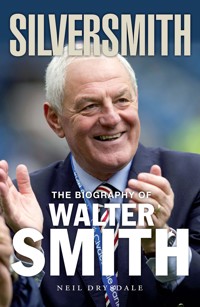
Walter Smith was one of the most respected managers in British football. This insightful biography casts a reflective and analytical eye over his life and career, examining this shrewd professional through the many highs and lows that he has experienced as a player and manager. He enjoyed an illustrious career in management at Rangers, joining the Souness revolution in 1987, winning nine successive league titles, a domestic treble in the 1992-93 season and winning both the Scottish Cup and League Cup three times. In 1998, Smith accepted a position in England with Everton, where he was the manager until 2002, before being reunited with Ferguson at Old Trafford in 2004. In December of that year, Smith was appointed as Scotland manager and his effort subsequently earned him the title of 'Scot of the Year' at the prestigious Glenfiddich 'Spirit of Scotland' awards in 2006. Midway through the qualifying rounds for Euro 2008, however, and with the Scots leading their group, he controversially accepted an offer to return to Ibrox in January 2007. Upon returning to Glasgow, Smith led Rangers to the UEFA Cup Final and triumph in the Scottish Cup in 2008, a domestic League and Cup double in 2009 and another double - this time in the domestic League and League Cup - in 2010. He retired from management in 2011 and died in October 2021.
Sie lesen das E-Book in den Legimi-Apps auf:
Seitenzahl: 585
Veröffentlichungsjahr: 2011
Das E-Book (TTS) können Sie hören im Abo „Legimi Premium” in Legimi-Apps auf:
Ähnliche


















SILVERSMITH
Neil Drysdale has been involved in journalism since the mid-1980s and has been praised for the quality of his writing across a wide range of sports. He was an award-winning writer with Scotland on Sunday for 15 years, but now works freelance, mostly for the Herald and STV. He is the author of three other books – Dad’s Army; the autobiography of Alan Rough; and Dario Speedwagon, a biography of Dario Franchitti. He is married and lives in Aberdeen.
SILVERSMITH
The Biography of Walter Smith
Neil Drysdale
This edition first published in 2011 by Birlinn Limited West Newington House 10 Newington Road Edinburgh EH9 1QS
www.birlinn.co.uk
Copyright © Neil Drysdale, 2010
The moral right of Neil Drysdale to be identified as the author of this work has been asserted by him in accordance with the Copyright, Designs and Patents Act 1988
All rights reserved. No part of this publication may be reproduced, stored or transmitted in any form without the express written permission of the publisher.
ISBN: 978 1 84158 992 3 eBook ISBN: 978 0 85790 067 8
British Library Cataloguing-in-Publication Data A catalogue record for this book is available from the British Library
Designed and typeset by Iolaire Typesetting, Newtonmore Printed and bound by Cox & Wyman, Reading
CONTENTS
Acknowledgements
1 A Man in the Crowd
2 Growing up in Football and Life Itself
3 A Coach in the Making
4 Intriguing Duo Answer Call to Ibrox
5 Trophies, Trials and Tribulations
6 Murray and Mo
7 A Dream Come True
8 A Canny Path from Tradition to Transition
9 Amazing Adventures in Europe
10 Papering Over the Cracks
11 Nine, Nine, Nine
12 Exit Strategy
13 Bad Times at Goodison
14 Reviving the Thistle
15 Back to Ibrox
16 Admirable Artisans Set to Work
17 Rewards and Regrets
18 Beating the Odds
19 Thriving in Adversity
20 A Season in Need of an ASBO
21 Goodbye to All That
Index
ACKNOWLEDGEMENTS
I would like to thank Craig Brown, Terry Butcher, Ewan Campbell, Ronnie Esplin, Andy Goram, Jim Guy, Sandy Jardine, Ally McCoist, Robert McElroy, Scott Nisbet, Alan Rough, Stephen Smith, Colin Stein, Sandy Tyrie, the Scottish Football Museum and Chick Young. Thanks are also in order to a number of former Rangers players and supporters, who asked for their contributions to remain anonymous, although since the majority of these respondents were expressing praise for Walter Smith, this shyness was sometimes difficult to understand.
I would also like to thank Neville Moir and Peter Burns at Birlinn and my agent, Mark Stanton, for exuding his usual calmness under pressure. Duggie Middleton worked assiduously in editing the original manuscript with his usual diligence. Finally, my wife, Dianne, had to tolerate me deploying my thumping two-finger typing style, often until 4.30 in the morning, and remained a pillar of support throughout the project, for which I thank her.
Neil Drysdale
CHAPTER ONE
A MAN IN THE CROWD
‘This club is different. This is Rangers Football Club’
Long before there came Heysel or Hillsborough with their relentlessly grim television images, incongruous floral tributes and uncomprehending vales of tears, there was one Saturday evening in Glasgow on which mothers and fathers, sons and daughters and many friends of friends clung anxiously to the hope that their loved ones would eventually make it home, and confirm that they had escaped the Ibrox Disaster. The majority did come home, and others such as Walter Smith, Alex Ferguson and Andy Roxburgh clambered around the mangled heaps of bodies and stricken souls, the emergency workers and Old Firm volunteers on Stairway 13, and thanked their lucky stars before absorbing the enormity of what had transpired. For 66 other families there was the spectre of a long night’s journey into the void, and recognition that the catastrophe which engulfed Ibrox stadium at the end of the New Year match on 2 January 1971, had snatched away their menfolk, and in Margaret Ferguson’s case, her daughter.
Decades on, pictures from the newsreels reflect collective mystification and bewilderment, accompanied by a sense of futile anger at the casual fashion in which so many lives were sacrificed. But beyond that is a numbness among the grieving families, possibly reflecting their feeling that such hackneyed phrases as ‘Time is a great healer’ and ‘They’re in a better place now’ are but platitudes for those fortunate enough never to have been obliged to identify relatives with faces blackened and life squeezed out of them. Talk to men such as Smith, Sandy Jardine or John Greig – hard-nosed artisans from an industrial background – and you will not hear easy sentiments, but rather hushed voices and instinctive sympathy for victims who, in other circumstances, could have been their very selves. Then prod them gently on their memories of that ghastly event, and they will relate their accounts of a tragedy which, all too fleetingly, tore through Glasgow’s sectarian curtain and saw Orangemen shed tears in the company of priests throughout the west of Scotland and yonder into Edinburgh, before snaking across the Forth Bridge to the Kingdom of Fife and the community of Markinch, where Peter Easton, Richard Morrison, David Patton, Mason Phillips and Bryan Todd, schoolboys who lived within a few hundred yards, perished together on that stairway, which had witnessed an accident in 1961 and near-disasters in 1967 and ’69.
Sandy Jardine, one of the celebrated ex-players who still walks the corridors of Rangers FC, describes the terrible events:
‘In these days, this was probably the biggest fixture of the season, considering that the Old Firm clubs only met twice a year, but it was dreadfully ironic that what had been a fairly good-natured occasion, with neither trouble on the terraces nor on the pitch, should develop into a waking nightmare for so many people. Everybody knows the circumstances whereby Jimmy Johnstone sent Celtic in front with a minute to go. The ball got centred, we equalised at once [through Colin Stein] and the referee blew full-time immediately. So you had Rangers supporters who thought: “Oh, that’s the game over” when Jimmy scored turning to go down the big staircase, then turning back when they heard the huge roar which greeted Colin’s strike, and that coincided with a massive number of spectators making their path towards the exit and the subway. Then suddenly somebody fell, and the whole terrible business began.
‘The thing is that I was on the ground staff, I had actually swept these stairways, and they were huge, really solid objects, so I could never understand how they could get mangled so badly by any number of human beings. But they were. Just think of it: the pressure of all those bodies cascading over one another and the panic which must have spread . . . Ach, there are no words in the dictionary to describe adequately what happened during those next few minutes. But you have to realise that we as players were completely unaware anything was wrong at that stage. We were in the dressing room fairly happy to have managed a draw, just sharing a few laughs together before getting into the bath. Well, I was one of the last guys to climb out, but as I re-emerged the order came that there had been an accident, and we all had to leave the room as quickly as possible. It could have been a fire alert or anything, but while we started putting our clothes on as fast as we could, the authorities started to bring some of the dead bodies into the place, and as you can probably imagine, everybody turned grey at the sight of them. But even then we had no real idea of the extent of the fatalities.
‘As I drove back to my home in the east end of Edinburgh, I heard there were two dead, but soon enough the figures mounted up. It was 12, then 22, then 30, then 44 – I don’t know why, but that number sticks in my mind – and finally it climbed to 66 as the news filtered out to all the parents and kith and kin of the folk who had attended the match, and then gone to pubs or restaurants or picture-houses afterwards. I have spoken to hundreds of fans since 1971, and they have told me of how vast crowds assembled at all of the drop-off points for the buses to find out whether their loved ones were okay. The telephone lines were jammed, Glasgow was in turmoil, the hospitals were all packed to overflowing. Anxiety, terror, pain, sadness, horror . . . a blanket of all these emotions was draped over the whole country that night, but there was nothing remotely comforting about it.’
Amid this hellish vista, Willie Waddell, the Rangers manager, somehow offered a semblance of sanity. It was significant that he and Celtic counterpart Jock Stein had observed casualties in other spheres, whether in battle or at the coal-face, and the pair constantly emphasised the desperate need for entrenched communities to pull together, and for religious tribalism to be cast aside. Sadly, but perhaps inevitably given the illogical nature of the positions adopted by extremists on both sides, the so-called healing process proved little more than a nine-day wonder. Yet in the longer term, the calamity yielded some benefits. Waddell, for example, vowed that the scenes he had witnessed would never be repeated at Ibrox, and before his death in 1992 that objective had borne fruit in the creation of a magnificent new stadium. Not that anybody connected with 1971 would forget the condition of the old edifice. ‘It’s strange what comes into your mind, but when I first went to the top of the steps and gazed down on the pile of bodies, my initial thought was of Belsen, because the corpses were entangled as they had been in the pictures which came out of the concentration camps,’ Waddell told The Scotsman newspaper’s illustrious football correspondent John Rafferty. ‘But my God, it was dreadful: there were bodies in the dressing rooms, in the gymnasium and even in the laundry room. My own training staff and the Celtic boys were working flat out at the job of resuscitation, and we were all trying everything possible to bring breath back to those crushed limbs. Honestly, I will never forget the sight of Bob Rooney, the Celtic physiotherapist, with tears in his eyes giving the kiss of life to innumerable victims. He never stopped, nor did the Rangers doctors, nor the nurses and ambulance staff who flocked to join them, and we will never know how many lives were saved in there in that frenzy of activity.’
Nearby, the Southern General Hospital was under siege, their switchboard of only 35 lines, plus a single police short-wave radio, jammed by a crescendo of panic-stricken calls. But by midnight a worse task was in prospect for the likes of Jardine, Waddell, Greig and Colin Stein, who seems troubled to this day by the notion that his goal might have been a catalyst for such carnage: the funerals. And the subsequent protracted search for answers allied to the quest for apportioning responsibility which, despite lengthy inquiries, discovered little beyond the tinder-box of ingredients that would also bring death and destruction to the environs of Heysel and to Bradford and Hillsborough as much as 18 years later.
Inside Ibrox, one fellow had stood intently throughout that Old Firm encounter transfixed by proceedings that were typically pulsating and frenetic. As a registered professional player with Dundee United, Walter Smith would not have been anywhere near Glasgow, let alone Govan, but for his acceptance that he was not good enough to merit inclusion in the Tannadice side’s festive plans, and was therefore free to travel to the ground he regarded as his spiritual home, the place where his grandfather had taken him to behold what old Jock had considered the best team in the world. At 22 years of age, Smith strode into Ibrox that afternoon with hardly a care. He was a phlegmatic individual, a young man of substance with a trade as an electrician already acquired, just in case football work proved to be in short supply, and even in those formative days he had started to appreciate that, irrespective of the fact that as a player he would never join the likes of Jim Baxter, Jimmy Johnstone and Billy McNeill in the Scottish Football Association’s Hall of Fame, he might have a part to play for his country further down the line. Indeed, Smith’s recollection of the Ibrox Disaster epitomises many of the core values that have shone through his ascent to the summit of soccer management:
‘I can remember leaving the stadium with my brother at the finish of the match. I was on Dundee United’s books at the time, but because of my lack of ability they had omitted to select me for the New Year match, so I travelled to Ibrox on the supporters’ club bus, and I remember there being a wall at the side of the staircase which, if it hadn’t been there, would have allowed people to spill over. Both of us got out, I thought because the fencing had collapsed, but on the 25th anniversary I looked at a photograph and the fencing was intact. We must have got over the top of other people, although nobody around us was in any danger; the deaths occurred at the bottom of the stairs, but we didn’t know that at the time. We got on the bus, which didn’t have a radio or anything, and it was only when I arrived home that I remember my mother crying, saying people had died. If we had left two minutes earlier, it would have been us.’
Histrionics are not in Smith’s nature, and his composure in discussing the Ibrox Disaster originated from the lessons he had learned growing up in visceral communities, where emotions tended to be best kept in check. In the days after 2 January he absorbed the consequences of the calamity which had befallen so many Scots by diabolical chance, but unlike many young footballers he did not stick his head in the sand or seek refuge in alcohol. Instead, Smith read about the tragic stories of those who had been killed, swiftly recognised that the extended Rangers family had been dealt a devastating blow and pledged that he would do what he could to heal the widespread hurt. At the time he was in no position to swoop to the rescue, but as the years unfolded he never forgot the fundamental experiences of 1971.
The voices of that awful evening still resonate among those who were there, as I discovered when tracking down some of the eyewitnesses. ‘I always remember standing in the middle of Stairway 13 and looking at this pile of bodies, some of them black, some of them blue, lying like rag dolls on all sides of me, whilst other fans were desperately grappling on to whatever they could find to avoid falling into the carnage,’ recalls Andrew Ewan, a head librarian in Dunoon, who was 23 in 1971. ‘I was at the match on my own because my best mate was in Aberdeen with his parents, and with hindsight I believe that one of the reasons why I survived is that I was wearing slip-on shoes, and I lost them as hundreds of supporters were caught up in the crush. I know that might sound strange, but I’m convinced that if I had been wearing shoes with laces, as I normally did, I wouldn’t have been able to wriggle out of the morass. But I was tall and skinny in these days, and somehow I escaped.
‘Yet in retrospect it always occurs to me that any of us could have been killed, that this was an accident waiting to happen and that you could drive yourself mad trying to rationalise why some survived and others perished. By the time the emergency services reached the scene and started working their guts out to rescue as many of the injured as they could, I was in shock, and I remember a policeman approaching me and saying: “Go home, son. Go home to your loved ones. There’s nothing you can do here.” That was the helpless feeling which engulfed us all when we woke up the following morning. It brought us all together, Rangers and Celtic fans, united in a common grief. But sadly it didn’t last long.’
Craig Smith, a Livingston-based glazier, was not present at Ibrox, but the escalation into tragedy still haunts him. ‘My father George was heading off for the Old Firm match, and as he put his coat on I asked if I could go along with him. But he just laughed, and after pointing out that my two older brothers also weren’t going with him because it was too big a game, he waved us all goodbye. Well, at about ten to five there was a news-flash on the TV reporting that there had been an accident at Ibrox, but the programme had no details of any injuries. My mother looked worried, and although she wasn’t too concerned at the outset, she became increasingly anxious as the time passed, because she and my father had arranged to go to a golf club dance that night. The later it grew you could tell that something was terribly wrong by my mum’s expression, and she was constantly on the phone. Then suddenly the doorbell rang. My brother Stephen went to answer it, my mum screamed, then Stephen and my other brother George were standing together with tears streaming down their cheeks, and for a few moments I couldn’t understand what on earth was going on.
‘Eventually, though, we learned the truth. That while my dad had managed to push his brother John and brother-in-law Alex over the fence, he himself had been swept away with the force of the crowd, and even as John shouted towards him, he saw him die, upright. The very life was squeezed out of him on that terrible, terrible afternoon. At the time we lived in house No. 66 on the 14th floor, although you had to walk down to the living room on the 13th floor. So my father was born on the 14th of August, was killed on the 13th stair, and was one of the 66 killed at Ibrox. I will never forget it.’
In many respects the 1970s still seem within touching distance, but in other ways they belong to a different world. In the distinctly remote possibility of a recurrence of the Ibrox Disaster, television coverage nowadays would be wall-to-wall, obliterating everything else on the schedules. As darkness descended on 2 January 1971, however, Walter Smith, professional footballer, and Craig Smith, pre-school child, were in the dark about the scale of the calamity unfolding at their favourite club. Retired TV executive Bill Malcolm recalls: ‘At that time, in my role as the director of the Saturday night football programme Sportsreel, we were out of the loop once the Old Firm match finished, whereas when you fast-forward three decades you have Sky, News 24, CNN, Ceefax, the Internet, breaking stories delivered straight to your phone or your iPod . . . all manner of up-to-the-minute news technology. In 1971 we had the Green Citizen sports paper reporting that three supporters had died at Ibrox. And that was it.
‘Afterwards, some of us at the BBC were criticised for not having pictures of the disaster, but you have to realise that news and sport were entirely separate entities at the time, and there was no blurring of distinctions. All the same, there was never any question of us going ahead with plans to screen highlights of the game, and let’s face it, on that evening an awful lot of people decided they would never again describe somebody missing a penalty as a tragedy, because the match at Ibrox didn’t matter at all in the grand scheme of things. Life couldn’t continue as normal in these circumstances.
However, I was involved later in the fatal accident inquiry, and I remember the pressure which was put on my secretary to recall the exact moment when the disaster started. Obviously it was a very painful experience for everyone caught up in the search for answers, and the job of dishing out blame. But, of course, we got off lightly, didn’t we? We were still alive to be able to discuss the minutiae of what should and shouldn’t have been done on that Saturday. The grieving families had no such get-out.’
From Walter Smith’s perspective, nothing would ever be quite the same after the winter of 1971. Born in Lanark in 1948, he had grown up in industrial Glasgow during a period when the metropolis truly fulfilled its reputation as the second city of the British Empire, and he was habitually a man at ease with his roots. By turns introspective, proud and competitive, his demeanour deadpan, sometimes even dour, Smith and Rangers were inextricably linked through his family background and his temperament. Endlessly restive, unsympathetic towards those who indulged in complacency, but fiercely protective of those he considered his friends, even at the age of eight the young Walter would stand up to bullies and was unafraid of the gangs who battled for the ascendancy on their patches of turf across Glasgow in the 1960s and ’70s. He quickly found himself drawn towards Rangers with their history, their reputation as giants within the British game, and their cussed refusal to become trendy. Why else, with the advent of the Swinging Sixties and Beatlemania and social revolution effecting a transformation in the ideas of young Scots, would Smith be so fascinated by the Calvinist tradition which permeated Ibrox? That he certainly was. But then it is difficult to picture this individual as anything other than middle-aged, with a tie-rack, trouser-press and Brylcreem, a noted concoction for grooming gentlemen’s hair, as essential elements in his bedroom.
None of this should be seen as criticism. After all, if everyone appeared the height of fashion, life would be pretty tedious, but it must be said that Walter Smith was conventional. He played football before starting school in Carmyle, was inducted into the Rangers fraternity by his grandfather, and watched the 1953 team thrash Queen of the South 6-0 with the sort of wonder that many of his contemporaries reserved for the latest science-fiction film. And so began a passionate love affair with the game that has burned more brightly than anything in his existence. And that’s it. Smith had three priorities etched in his mind: football, football and football, and his formative years were occupied in watching Rangers, reading about Rangers and discussing club stalwarts such as Eric Caldow and Jimmy Miller with the ubiquitous Jock, whose influence ensured that his grandson never forgot the importance of tradition. The word is central to Smith’s philosophy, and can be brought up to date with his commitment to support the Union, an issue which manifested itself in 2007 prior to Holyrood parliamentary elections, when his name appeared in the company of a string of senior footballing figures, including Billy McNeill, Ally McCoist and Sir Alex Ferguson, urging that Scotland remain part of the United Kingdom. That said, Smith has not jumped on any passing political bandwagon. No, he has always believed implicitly in old-fashioned values, whether in sport or in life, but especially in his career at Ibrox, expressed thus:
‘Every single thing that happens at the club is related to something that happened here before. There is always someone around the place who will remind you of that. Or there will be someone who says: “Old Bill [former manager Bill Struth] wouldn’t have done that.” Or: “Deedle [Willie Waddell] would have done it this way.” And you listen to that. I know there are those people who say that you cannot operate on history or live in the past, but that is not a view I agree with. When you have a club with a rich tradition, then you examine that tradition and take from it what can still remain important to the club in any era. It’s something which is almost tangible when you walk into the foyer at Ibrox, and you live with these feelings every day of your life, and you can learn from the club’s history.
‘We have always had the tradition at Ibrox, for example, that players have to report for training wearing a collar and tie, and despite recent objections to this, that’s the way it will stay. Sure it’s a little strange when you first arrive from another club to find that rule in place. But if you think about it, maybe that’s why it was there in the first place: to remind each and every player that this is not just any club. This club is different. This is Rangers Football Club, and it works because the players do wear collar and tie, and they all understand why that is being done. To wit, that it is another small way in which the club was set apart from other clubs in Scotland when the traditions were first being born.’
Walter Smith can appear a relic of the Struth era or even a soccerstyle Mr Pooter, being fastidious to a fault, quietly obsessed with detail and equipped with a boffin’s brain for arcane rules and regulations. Yet it is an injustice to portray him as a stuffed shirt. Down the years I have heard a litany of criticisms of Smith, the majority centring on the allegation that he has been a lucky manager who was in the right place at the right time, namely close to David Murray’s well-stuffed wallet when Celtic seemed to pursue ever-ascending levels of debt and mediocrity. While there may be a modicum of truth in such complaints, the charges ultimately fail to reflect reality on three counts. Firstly, because Smith was well respected from his managerial exertions at Dundee United before he arrived at Ibrox in 1986. Secondly, because no football club, regardless of the chairman’s wealth, can dominate a national championship by winning nine successive titles, as did Rangers from 1989–97, without being blessed with talented direction. And thirdly, because after Berti Vogts’ unfortunate spell as Scotland’s manager, most of the men who had floundered within his regime performed well for Smith. Are we saying that the man was fortunate once again, that in the few months between Vogts’ troops stumbling to ignominy in Moldova and Smith’s personnel orchestrating victory over France, a glorious new crop of national heroes emerged? Of course not! For the most part, Smith had to work with the modest resources that had been available to his unfortunate predecessor, and the difference was that the Scot brought purpose, commitment and tactical nous to the international campaign. He deserves credit for his achievements.
Early in his first managerial spell at Rangers, when he co-operated with Graeme Souness, Smith reflected that walking through the Ibrox corridors and inspecting the committee rooms was akin to visiting a museum. Everything was pristine, photographs on the walls were lovingly mounted, and staff from boot room bombardiers to club newspaper employees constantly sported glints in their eyes, as if they had reached the zenith of their ambitions. For some that was probably true, but what was sufficient for the boys of the old brigade was not enough for Smith, despite his devotion to tradition, and certainly not for the ambitious Souness. If they had to implement unpopular decisions and risk offending some sensitivities at Ibrox, so be it. Both recognised that popularity contests have no place in football, especially considering the slough of despond into which Rangers had plummeted during the decade before they took over. Hence the necessity of clearing away the cobwebs and effecting a transformation of an increasingly moribund institution into a streamlined organisation that was fit for modern times. Souness has been accorded most of the praise for persuading a string of England internationalists, including Terry Butcher, Chris Woods and Graham Roberts, to travel to Glasgow to join the Rangers metamorphosis. So too he has garnered accolades for his reputedly brave stance in signing Roman Catholic striker Maurice ‘Mo’ Johnston from under Celtic’s noses in 1989. Nonetheless, the notion that the former Liverpool player was single-handedly responsible for tearing down decades-old barriers of prejudice does not stand up to scrutiny. On the contrary, while Souness was the public face of the Murray-driven bandwagon, excoriating rival players and pressmen alike, whether it be Hibernian’s George McCluskey or Glasgow Herald journalist James Traynor, and fulfilling his role as hatchet-man of the Thatcher generation, it was Smith who toiled quietly and relentlessly behind the scenes, displaying some of the essential attributes that have made him so admired by Sir Alex Ferguson. In essence, Souness contributed ample sound and fury while Smith supplied the substance, and the divergent paths in their careers since the former departed Ibrox emphasise how his sharp suits and immaculate grooming were no match for his colleague’s off-the-peg wisdom.
Indeed, it can be argued that Souness’s role in elevating the expectation levels has had potentially ruinous consequences for those who have followed in his wake. Smith continued to be the beneficiary of his chairman’s largesse beyond the mid-1990s, but by that stage it had become increasingly difficult to entice European-class talents to Scotland, particularly once the English Premiership structure roared over the horizon. Celtic aficionados can respond with the name of Henrik Larsson, and I would add another couple of characters to accompany the exalted Swede: Lubomir Moravcik and Michael Mols. But the truth is that despite the acquisition of a past-his-peak Paul Gascoigne and a string of high-profile European stars, Smith’s stewardship owed more to the virtues of the River Clyde than to the Danube. Quite simply, he was placed in a situation which demanded all his powers of resilience, tenacity and fine-tuning, not least once the crafty Fergus McCann defied the rules of football business by staying true to his word and resuscitating the Celtic cause.
Any fair-minded analysis of Smith’s career needs to acknowledge the failures on his CV. When he exited Ibrox and signed up with Everton in 1998, some acolytes initially insisted that he could emulate the success achieved by Ferguson, a fellow Glaswegian, at Manchester United. As the months passed and the Goodison Park odyssey developed into a trying adventure for Smith, some of these optimists sought to rewrite history with the declaration that the Merseyside club had made promises to the manager which were not delivered. However, having spoken to a number of passionate Everton supporters who meticulously pointed out the mistakes which marred the Scot’s tenure, it is only fair to bear witness to their reservations. ‘He was a decent lad, but he bought us a lot of old crap,’ observed one, offering the most critical opinion. Another told me: ‘Walter Smith looked dead on his feet from the moment he arrived here, and he was knackered by the end of his first season. He didn’t need a new challenge; he needed a rest.’ A third perspective, provided by a Liverpool-based journalist, may be the most accurate: ‘He was the wrong man in the wrong place. Everton had been steadily slipping further behind their city rivals, and there wasn’t enough investment from the board to enable the manager to mount a revival. He didn’t help his cause, mind you, by trying to shore up his team with old sweats like Duncan Ferguson, David Ginola and a clearly past-it Paul Gascoigne. The fans tolerated him and liked the guy – there was no problem with him – but when he was sacked in 2002, the new boy, David Moyes quickly proved that he had the youthful ambition which Smith lacked.’ Perhaps it is significant that during his four-year period at Goodison, he did not attempt to lay down roots. That might explain why he seemed destined for the chop almost before the conclusion of his inaugural press conference.
A more painful deficiency in Smith’s career review has been his lack of success in European competition, not least considering the lavish expenditure at his disposal, as David Murray strove to extend Rangers’ dominance beyond domestic terrain. As soon as he assumed the mantle from Souness – after turning down a number of offers from him to move to Anfield – it was obvious to Smith that he required a larger number of Scottish-born personnel, given the limits being placed on foreign players in every squad. Sadly, the abiding memory of Rangers on Champions League duty in the 1990s was witnessing tales of woe, while Andy Goram produced a string of magnificent saves to restrict the damage to 3-0 or 4-0. These outcomes would inevitably prove the prelude to the usual suspects dashing into print to complain that the club had outgrown their origins, and that it was time for the Old Firm to migrate to Europe – a specious argument which nowadays tends to emanate more from Celtic Park, as if England’s finest would be so ingenuous as to indulge in favours to rivals.
If the fans were chasing impossible dreams at that time and Smith did his utmost to live up to such grand ambitions, he was thwarted time and again by a queasy combination of superior opponents, tactical naivety, schoolboy howlers from his defenders and, whisper it, a lack of belief that the Ibrox men could seriously trouble the likes of Juventus. Whether this inferiority complex, which is not usually associated with Rangers teams, was the consequence of their relative inexperience in Europe’s premier competition or whether Smith, so assured and confident in Scotland, suffered travel sickness when asked to plan strategies abroad, remains a matter of conjecture. I happen to believe that he had difficulties with the concept of assembling a squad who were capable of sustaining a twin-pronged attack. This should not be viewed with an excess of condemnation – Alex Ferguson has been as unconvincing in the role of Scotland manager as he has been magisterial in steering Aberdeen and Manchester United to European triumphs – but it does leave Smith exposed to the sniping of sceptics who pronounce that his domestic bullies wimped out at the highest level in his initial spell as manager.
Perhaps the most glaring manifestation of the tension bubbling constantly beneath the surface was the fundamental fashion in which Smith, usually a polite interviewee, lost his rag while fielding questions from BBC Scotland football journalist Chick Young, and launched into an expletive-laden tirade as the precursor to calling over assistant Archie Knox with the words: “Come and listen to this, Archie. Listen to the shite this wee c***’s coming out with.” This clip, which has been screened across the world on the You Tube Internet service, should not be in the least shocking to those who attend football matches, but it is a significant episode for no other reason than that the look on Smith’s face, amid his tantrums, reflects an amalgam of anger, frustration and resentment, all vying for primacy. ‘People have raised this with me about 100 or 1,000 times now, and I really don’t understand what all the fuss is about,” says Young, who has laughed off similar spats with most of the high rollers in Scottish football. ‘I asked Walter if he felt his players were good enough for Europe, and he took exception to the implication that somebody like Brian Laudrup was having his ability questioned, so there was a bit of industrial-strength language, but it was all done and dusted in the space of a few minutes, and soon enough we sat down and had a good laugh about it. The bottom line is that football is supposed to be a passionate business, and it would be boring if everybody agreed all the time. But I can honestly tell you there was no bad blood, no recriminations. That just isn’t Walter Smith’s style. The guy is an absolute gentleman, and I wager that you won’t hear anything else from every section of the sport in Scotland.”
I can testify to such unanimity, having spoken to Scottish managers of every discernible outlook. Even one such as Tommy Burns, who must have been shell-shocked at the fashion in which the Murray-Souness-Smith triumvirate laid waste to Celtic for much of the 1990s, talks about the Rangers man’s honesty, his deep commitment to his country and his love for football with a directness which cannot be feigned. Perhaps the straightforward explanation is that Walter Smith has followed his own path and never sought greatness, but treated it with due respect when it has arrived. He carried out his duties in the wake of Jock Stein’s untimely demise in 1985 or when Sir Alex Ferguson summoned him to Old Trafford in 2004, with the impassive relish of a character who fully appreciates that he might easily have ended up repairing electrical pylons if his life had veered a fraction in another direction.
Given which consideration, it is scarcely surprising that when Smith was showered with the accolade of Top Scot for 2006 in the Glenfiddich Spirit of Scotland Awards, he looked, initially at least, taken aback. It’s all there in his expression: one fifth’s worth of pride, a soupçon of incredulity, a further sprinkling of delight and an extra ingredient or two, of what? The realisation, as he knew well, that thousands of low-paid hospital staff and heroic fire-brigade crews had been saving lives every night across the country, without as much as a moment’s thought from the Glenfiddich judging panel? The acknowledgement, however much he might love football and its infinitesimal mysteries, that he was being disproportionately rewarded for a solitary 1-0 success over France on a nerve-shredding afternoon, when the visitors to Glasgow might have been two goals in front in the opening half-hour? In the final analysis, however, Smith’s celebratory humility struck the right note.
But then this is a trait that he shares with most of the best managers: an appreciation of the unsung heroes and a relish for those who carry out the regular chores without moaning about their lot. During his playing career Smith was a functional and prosaic performer, but nobody could ever accuse him of not expending 100 per cent of energy and desire. At Dundee United he watched the diverse methods of those on the Tannadice books, and though Smith can be as exhilarated by the flair of a Pele or Maradona as any observer, he is pragmatic enough to know that these players are rare in a Scottish context. Hence the manner in which Smith has praised the unstinting labours of Dundee United’s Dougie Smith, a combative centre-half who joined the club in 1958, and who missed only four competitive matches in the next decade:
‘He was a very quiet, very unassuming boy. He couldn’t hold up a bunch of medals or anything like that at the end of his career. But I don’t think I’ve known many people who wanted to win as much as he did. His personality wasn’t always what people would hold up as being a winner’s, but he definitely had a winning attitude. It was etched in him, this fierce hunger to win. A lot of times players run around kicking people and shouting at referees, and people view that as a desire to win. But Dougie didn’t do that. The desire was within him, and it burned very brightly. It taught me that there are guys who maybe don’t have a lot of ability who can bring themselves up to a tremendous level in any sport, and though they may just fall short of winning, in their own right they are actually winners, because they have dragged themselves up from being not the most naturally gifted to being amongst the best, and I really admire that. In fact, in some respects, in doing so they may have almost achieved more than some people who win medals. It might not look that way from outside, but a lot of managers in football do a terrific job without getting an end product in terms of trophies or championships.’
Walter Smith’s words are significant. They confirm that he has never had patience with those inclined to abuse their talent or to spend greater time at the nightclub than attending to the day job. This is an inevitable reflection of his upbringing, and we have heard the references to how Celtic supporters, asked to choose their club’s greatest-ever player, plumped for a prodigiously talented tanner-ba’ trickster known as Jimmy Johnstone. The Rangers brethren, by comparison, when presented with the same choice, hummed and hawed at Archie Henderson and Colin Stein, Davie Cooper and Archie Conn before settling for John Greig, an admittedly effective and aggressive defender who possessed all the romance and magic of a knee-trembler in Maryhill. On reflection, while the selection of Greig provoked sarcastic abuse around Celtic Park, he was a genuinely populist choice. Few of the supporters who flocked to Old Firm tussles in the 1960s could possibly have conceived of executing the mesmerising feints and jinks which were Johnstone’s trademarks. In contrast, all in the Rangers ranks could easily have imagined themselves lunging at Jinky and kicking him into the middle of Row C. A brutal distinction, admittedly, but Greig was built in the classic Ibrox tradition, namely: if you’re looking for frills or fancy-dan stuff, go elsewhere. That robust militarism, the ingrained philosophy of ‘Take no prisoners’ ensured that while he was nobody’s idea of a stylist, the young Walter Smith watched John Greig in action – and cheered.
In that respect, on the long and winding road from Ashfield Juniors to Tannadice and Dumbarton, prior to being instrumental in the Rangers revolution and from there onwards to Everton, and eventually to unemployment, Smith’s exploits have all been of the understated variety, and he has never been a man to indulge in trumpet-blowing. Yet for me, the working-class dignity that he has invariably exuded is redolent of the best Scottish values. When the call came from the SFA, when seeking a saviour in the worst days of the Vogts-inspired morass, it would have been the comfortable option to decline their offer and to continue pontificating on the periphery as an occasional pundit, but the easy outcome has rarely appealed. Instead, in his late 50s and safe in the knowledge that he had masterminded 13 trophies in seven seasons at Ibrox, he grabbed the challenge by the scruff of the neck, united myriad factions within the Tartan Army, and galvanised the Scotland side with such basic qualities as discipline, pride in the jersey and organisation. There was no mystery to it, but just as he has done at Rangers since replacing Paul le Guen, Smith has shown that homespun industry need not be inferior to foreign methods.
Whether he is a good manager with a gifted streak, or a great motivator with a shop steward’s ability to motivate the troops, is open to debate. But those who have worked with him and absorbed the lessons he has imparted, are in no doubt as to his status. ‘One thing I will say about him is that he is a gentleman, but if you get on the wrong side of him, he will quickly let you know,’ notes Charlie Nicholas, an individual one might suppose, as a media-friendly, Celtic-supporting dandy, was everything alien to Smith. ‘I worked with him when he was Alex Ferguson’s assistant at the 1986 World Cup finals in Mexico, and I had five weeks with him, and he displayed a burning intensity throughout that period. Scotland mattered so, so much to him, and that couldn’t help but filter through to the players. When I heard he had taken the Scotland job in 2004, I was mightily relieved, because I knew he wouldn’t tolerate a situation where a country with our history was languishing at 77th in the FIFA rankings. And you have to give him credit: he stamped his authority on the team and made a strong impression on the youngsters, and the turnaround was almost immediate. That tells you a lot about the man’s ambition.’ Typically, Smith is not interested in hogging the limelight, to the extent that even the hapless Vogts escapes his wrath in this summation:
‘Let’s be fair. It was a very, very difficult time for Berti to take the job. Craig Brown had been in charge of a very settled Scottish squad, but a lot of them were getting older, and those of us who were involved in football in Scotland knew that there were not a lot of guys around who were ready to take their place, so it was never going to be easy. Coming from another country, perhaps Berti didn’t quite realise the scale of those difficulties. And there is a different mentality in British football, and I think he maybe found that hard to encompass as well. The thing is, when Scotland had players of the calibre of Denis Law, Billy Bremner, Graeme Souness, Alan Hansen and Kenny Dalglish, the team pretty much picked itself. But when you don’t have players of that quality, the mentality of the players you pick comes far more into it, and it helps if you know the personality of the lads you are dealing with. It’s maybe why you don’t see many foreign managers taking over at places like Coventry and Southampton, where you have to build from the bottom up. When they come to Britain, they tend to come to big clubs with top players.’
Smith has been associated with many notable names in his vocation, and he has thrived in the company of lesser-known individuals, such as Jerry Kelly at Dundee United and the ubiquitous Archie Knox on their peripatetic trail. Though he is not inclined to hero-worship, there is little question which other Glasgow figure he holds in the highest eminence:
‘The obvious fact that I know and have worked with Sir Alex maybe makes me a wee bit biased, but when you talk about creating a winning environment, there has been nobody better in my experience. It isn’t just what he has done at Manchester United, who are an enormous club, but also at Aberdeen. They are not as powerful a club as Rangers or Celtic, but he still managed to turn them into a side who won a European trophy, who weren’t afraid to tackle the Old Firm, and made them a team who were always incredibly difficult to beat. So, probably he more than anybody else is the man I admire and respect in our sport.’
Life has been a tale of ebb-and-flow for Walter Smith since he entered this world on 24 February 1948. His critics too readily condemn his perceived fortune in being privy to David Murray’s largesse, and Rangers fans feasted on success so regularly throughout the 1990s that they assumed the regular acquisition of silverware would materialise with or without him in the boiler-room. But as the managerial privations of Paul Le Guen demonstrated, nothing is certain in the world of football, and Smith’s return to Ibrox was tinged with the feeling that he might be embracing a poisoned chalice. In the event, he rose to the challenge with the diligence, industry and redoubtable enthusiasm which have been his trademark qualities, and only a fool or a cynic would dismiss these powers. Ultimately, Smith thrives on the gladiatorial nature of life under the microscope in Glasgow, and relishes the positive aspects of the Old Firm’s traditional rivalry. But as he showed when his side were striving to chase titles and cups amid a congested fixture pile-up, he realises that defeat is not the end of the world. Indeed, the manner in which he spoke about Celtic’s Tommy Burns after his untimely death from cancer at the age of 51, on the very morning following Rangers’ disappointment in the UEFA Cup final in May 2008, was a testimony to the shared values of those who can appreciate the distinction between intense rivalry and rabid sectarianism. In sombre tones, intertwined with occasional shafts of laughter at the memory of Burns’ sometimes scatter-brained nature, he paid this tribute:
‘Tommy was one of the best people I have ever had the opportunity to work with. Football aside, he was also a terrific man, and the more I got to know Tommy, the more I got to enjoy that side about him. From the outside, I had always imagined that Tommy would be a very meticulous manager, but he also had this delightful, harum-scarum side to him. I remember the World Cup qualifier we played against Norway: it was a very important game, and I was in the dressing-room beforehand giving my state-of-the-nation address to the players. There was Tommy, my assistant, in the front row fast asleep. I had to stop because I was laughing so much. Later I said to him: “Was my team talk that good that it sent you to sleep?” He replied: “Oh aye!” That was Tommy. He just had a nice way about him, and there are few people who epitomise a club more than Tommy Burns did Celtic. He was a Celtic man: a supporter as a kid, all the way through to having a successful career with them. For me, Tommy showed everything that was good about Celtic.’
The same words could be applied to Walter Smith’s association with Rangers Football Club.
CHAPTER TWO
GROWING UP IN FOOTBALL AND LIFE ITSELF
‘He was a good, hard-working Scottish defender’
As Walter Smith is fond of reminding friends, there was a place for every footballer, irrespective of talent, size or commitment, among the fraternity of post-war schoolchildren who grew up addicted to the sport in Glasgow in the 1950s. Move forward to a new century, and it may seem strange to youngsters that their Scottish predecessors could have been so easily impressed. While it would be wrong to paint an overly sentimental picture of a period when gang warfare was rife and when a criminal dubbed Bible John was indulging in murderous exploits against women, a sense of shared community and esprit de corps were evident. The youthful Smith wrapped himself in football to the extent that every waking moment, when he wasn’t at school, he surrounded himself with comics, match programmes and newspaper features on his beloved Rangers, and he dared to dream that one day he might sprint on to the Ibrox greensward. As he came to realise even before he had reached teenage years, he boasted the commitment, but not the class, the enthusiasm but not the extra ingredient which marks out the elite from the journeymen, and he resolved to progress as far as he could without being deluded by the idea that he was on a par with John Greig or Colin Stein. There was no shame in that acceptance. The opposite, because Glasgow at that time was fixated with three things: football, heavy industry and religion. Smith could do nothing about two of those factors, but the sport was another matter. In common with thousands of his contemporaries, he was hooked.
As he related recently, the die was cast from his first fleeting experiences. Every Saturday and Sunday, wherever he and his mates could find pitches, the sole thought was to organise matches of six-a-side, 11-a-side or 22-a-side. Who cared, so long as there was the opportunity to break the monotony with a trip to dreamland? The weather, the state of the facilities and prospect of exams were rendered irrelevant, and though Smith was no classroom dullard – he shared with Alex Ferguson the capacity to soak up general knowledge like blotting paper – he was content to be captivated by his favourite game, as Glasgow lived up to its billing as the first city of football. It was, quite simply, another world, a vanished sphere of rudimentary pleasures. Many youngsters in the 21st century appear lost without mobile phones, PlayStations and other sophisticated devices, but the ground rules were much more straightforward in the formative Smith years. If it snowed and then froze, as it frequently did, he and his comrades would use sand to mark out impromptu pitches; if it rained, they would clamber over walls and sneak into car parks and school premises, and kick lumps out of one another on concrete or tarmac. Luxuries extended to the occasional Christmas present of a spanking new strip or a leather ball, and this down-to-earth upbringing was evident in the home: for much of the 1950s people were considered pretty posh if they owned a television and had a telephone. As for other items which we now take for granted – microwave ovens, video recorders, refrigerators and washing machines – Smith and his childhood contemporaries would have thought the Martians had landed if they had stumbled across any of these contraptions in the east end of Glasgow.
Even if it was a basic upbringing, Smith revelled in it. ‘I was as keen as anybody else when I was a kid, and I went where the games were,’ he recalls. ‘It’s the same with everyone, isn’t it? You want a game, you are desperate to play, and you follow the rest of the lads in your group just to make sure that you are playing football somewhere.’ At the outset, this entailed the two best performers convening the others and picking their best pals, whereupon they would move down the line until just a couple of duffers were left. In some respects this was a cruel process of elimination, but it was effective, and lest anyone forget, Smith grew up in a halcyon period for Scottish football, an era when the Old Firm, Hibernian, Heart of Midlothian and Dundee all celebrated rousing European adventures, and posted some momentous wins against the best on the Continent. Across the country, but most notably in Glasgow, every tiny strip of land was a home to wannabe Jimmy Johnstones and John Greigs, and as Craig Brown, the former Scotland manager, recollects, the competition for places at every level, from juvenile and junior to amateur and professional, was relentless: ‘In these days, you could travel round Glasgow at weekends, and on every street corner there were laddies chasing a ball for dear life, while the parks, whether they were blaes or grass or ash, were always packed out.’ Brown offers the noteworthy observation that Scottish children in those days received 10 sessions of physical education, hence the avoidance of the chronic obesity which has crept into our vocabulary in the past 20 years. ‘Most of us who love football know that we will never see a situation such as that again – there are too many other distractions for kids and a lot of the old playing fields have been swallowed up by developers – but although there was no shortage of problems in Scotland 50–60 years ago, there was also something heart-warming about being in an environment where football was king.’
Less admirable was the bitter sectarian divide which existed in the west of Scotland, and guaranteed that most of Smith’s generation strolled unquestioningly into the blue or green camp, often without recognising the more nefarious elements that inhabited such a culture. Even with hindsight, it seems extraordinary that so many lives should have been wasted on this issue, let alone that an appalling degree of ignorance often lies at the heart of the most deep-rooted bigotry. In the years when I grew up in West Lothian, on the edge of the Harthill Triangle which veered into the fastnesses of Lanarkshire, I noticed the graffiti on the walls between Whitburn and the Polkemmet Estate:
‘Kaflix are Skum,’ declared one legend. ‘Protistants are Kunts,’ was one response.
Along the road at regular intervals the letters ‘FTP’ had been spray-painted with finesse sufficient to stimulate thoughts that the perpetrator might do well on an art course, rather than wasting the talent on insulting the man in charge at the Vatican. Once, while walking from the estate to the relative civilisation of my home town, I was stopped by a couple of wild-eyed men who pinned me against a wall and demanded to know my religion. ‘Protestant,’ I blurted out, which was apparently the correct answer, since they did not beat me to a pulp. Earlier, as a primary-school laddie I was in the act of buying my Victor comic from the newsagent’s on what happened to be the day of the famous European Cup final involving Celtic and Inter Milan. The shop owner, Jim Hamilton, a rubicund chap sporting blue-nose and red-nose propensities, and with an unnerving ability to snivel and shout at the same time, adopted the role of chief interrogator and defender of the faith:
‘So what team are you supporting?’
‘Er, well I want Celtic to win.’
‘Why’s that?’
‘Because they are Scottish, Mr Hamilton.’
‘Aye, but they are Catholics, son.’
‘Yes, but aren’t the other team Catholics as well?’
‘That disnae matter – they are foreign Catholics! Now that’ll be thruppence, please.’
This was perhaps bigotry of a minor character, but almost 20 years later one of my occasional Catholic football-playing colleagues fatally stabbed one of his Protestant workmates in a drunken brawl that was precipitated by an argument over the Old Firm, and he found himself behind bars for the rest of his active life. All of which testifies to my belief that, long after drawing-room pontificators have lost interest in the subject, sectarianism will continue to be a blight on Scotland and the west of the nation, in particular, perhaps not around Ibrox and Celtic Park, where security and policing have eliminated most of the trouble, but more probably through random outbreaks of violence and hostilities, sparking agony for communities in Ayrshire, Lanarkshire and West Lothian. Within these areas I know of families who won’t allow their children to dress in green, or even use a crayon of that colour. Similarly, I am acquainted with one or two Celtic followers who casually make jokes about the Ibrox Disaster or strive to defend the Enniskillen bombings during the troubles in Northern Ireland, while striving to refute my argument that Aiden McGeady, who was born and bred in Scotland to Scottish parents and who established his reputation by playing for a Scottish club, should be honoured to represent Scotland, instead of trotting out words such as history and tradition to justify his decision to aspire to international honours with the Republic of Ireland.
In circumstances which inspire such enigmatic episodes, it would be unsurprising if Walter Smith had not been dragged into the ritual bigotry which used to tarnish Glasgow on Old Firm derby afternoons, and which was brilliantly depicted in Peter MacDougall’s Just Another Saturday. Yet to his credit, he has managed to transcend tribal conflict by adopting the mantra: ‘Treat people as you find them’. Even as a teenager, when he turned out for Chapelhall Youth Club while studying for an apprenticeship at Coatbridge Tech, Smith was blessed with the knack of being able to make friends on gut feeling, not after checking what educational establishment or church his new ally




