


7,60 €
Mehr erfahren.
- Herausgeber: Simply Charly
- Kategorie: Sachliteratur, Reportagen, Biografien
- Serie: Great Lives
- Sprache: Englisch
The man we know as Chinggis Khan (c. 1162-1227) began as a young boy named Temüjin, who was born in obscurity in the steppes of Asia. Far from immediately setting out to conquer the world, Temüjin had to overcome numerous hardships and setbacks, allowing him to gradually rise from a minor figure to one of increasing importance. Following an initial alliance with his father’s blood brother Toghril, Temüjin went on to lead a series of wars that unified the Mongolian tribes, and made him the ruler of a vast empire. In this role, he not only built Mongolia into a great power, but introduced revolutionary reforms that changed steppe society forever.
In Simply Chinggis, Professor Timothy May offers an engaging and authoritative chronicle of the numerous battles and conquests that transformed an unknown boy into the legendary Mongol leader whose legacy continues to reverberate in our own day. At the same time, Professor May makes clear that there is much more to the story of Chinggis Khan than just conquest and empire making—he was a complex man with a large network of family and friends, and his wit and wisdom belie his reputation as simply a warrior.
Few figures loom as large in the imagination of the world as Chinggis Khan. Simply Chinggis helps us understand not only why this is so, but also how our changing views of this legendary figure say as much about society and popular culture as they do about the man.
Das E-Book können Sie in Legimi-Apps oder einer beliebigen App lesen, die das folgende Format unterstützen:
Seitenzahl: 250
Veröffentlichungsjahr: 2021
Ähnliche


















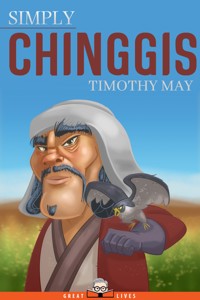
Simply Chinggis
Timothy May
Simply Charly
New York
Copyright © 2021 by Timothy May
Cover Illustration by José RamosCover Design by Scarlett Rugers
All rights reserved. No part of this publication may be reproduced, distributed, or transmitted in any form or by any means, including photocopying, recording, or other electronic or mechanical methods, without the prior written permission of the publisher, except in the case of brief quotations embodied in critical reviews and certain other noncommercial uses permitted by copyright law. For permission requests, write to the publisher at the address below.
ISBN: 978-1-943657-63-6
Brought to you by http://simplycharly.com
Contents
Praise for Simply ChinggisOther Great LivesSeries Editor's ForewordPreface 1. Chinggis Khan as Child (1162-1182) 2. Chinggis Khan as Temüjin (1182—1187) 3. The Rise of Chinggis Khan (1196-1206) 4. Creation of the Yeke Monggol Ulus 5. Campaigns of Chinggis Khan (1205-1227) 6. Family Matters 7. The Art of War 8. The Wit and Wisdom of Chinggis Khan 9. Chinggis vs. Genghis 10. Legacy of Chinggis Khan SourcesSuggested ReadingAbout the AuthorA Word from the Publisher1
Praise for Simply Chinggis
“Timothy May provides the reader with an accessible introduction to one of history’s most renowned figures. He offers a balanced portrait of Chinggis Khan, describing both the destruction the conqueror wrought, as well as his contributions to global history. May writes with readable prose and supplies apt and colorful references to modern people and events.”
—Morris Rossabi, author of Khubilai Khan: His Life and Times
“In this book written for a popular audience, Timothy May, a recognized expert on the Mongols, does much more than chronicle the well-known facts about the great conqueror. He brings vividly to life the world in which Chinggis Khan was born and rose to power. Unlike earlier biographers, he gives a full analysis of the family dynamics, which helped to shape Mongol rule for centuries. This is an excellent introduction to the world of the steppe and the life of one of the world’s greatest conquerors.”
—Beatrice Manz, Professor of History, Tufts University
“Chinggis (“Ocean”) Khan not only created by sheer force of personality the largest contiguous land empire in history, but also at the same time laid down foundations for the intensive exchanges of things and ideas that were to follow. In so doing, he became very much the founder of our modern global age. Without him, history would have been very different. Tim May has now not only produced the best biography to date, but also provides much more than a simple biography, making his book an introduction to the other sides of what made Chinggis Khan Chinggis Khan.”
—Paul Buell, author of The A to Z of the Mongol World Empire and Historical Dictionary of the Mongolian World Empire
“There are few people who can claim to have had a greater impact on world history than Chinggis Khan, which makes sketching his biography simultaneously very desirable and daunting for scholars. Simply Chinggis renders this complex topic into an easily understandable and highly engaging introduction to the Mongol ruler’s life and achievements. This witty and thought-provoking work is imminently readable, as Timothy May’s keen eye for detail and colorful descriptions help to reconstruct some of the major events in the Mongol khan’s military and political career, whilst also providing insights into his decision-making and strategy. Throughout the book, May sacrifices nothing in the way of rigorous analysis or historical methodology. Rather, ‘Simply Chinggis’ sees one of the foremost scholars of the early Mongol Empire at the top of his game, drawing on an extensive list of primary sources and the latest research to tackle some of the most perplexing aspects of Chinggis Khan’s life. Readers of this biography will be rewarded with a rich insight into the story behind one of the world’s foremost political and military leaders.”
—Michael Hope, Associate Professor of Asian History, Yonsei University, Underwood International College
“Timothy May proves an able guide through the complex politics and events of Chinggis Khan’s rise to power; and to the key personalities, issues and interpretations, providing contextual knowledge aimed to enhance the reader’s understanding both of what was happening and why it happened.”
—Angus Stewart, Lecturer in Middle Eastern History, University of St Andrews
2
Other Great Lives
Simply Austenby Joan Klingel RaySimply Beckettby Katherine WeissSimply Beethoven by Leon PlantingaSimply Chekhov by Carol ApollonioSimply Chomsky by Raphael SalkieSimply Chopinby William SmialekSimply Darwinby Michael RuseSimply Descartesby Kurt SmithSimply Dickensby Paul SchlickeSimply Diracby Helge KraghSimply Eliot by Joseph MaddreySimply Euler by Robert E. BradleySimply Faulkner by Philip WeinsteinSimply Fitzgerald by Kim MorelandSimply Freud by Stephen FroshSimply Gödel by Richard TieszenSimply Hegel by Robert L. WicksSimply Hitchcock by David SterrittSimply Joyce by Margot NorrisSimply Machiavelli by Robert FredonaSimply Napoleonby J. David Markham & Matthew ZarzecznySimply Nietzsche by Peter KailSimply Proust by Jack JordanSimply Riemann by Jeremy GraySimply Sartre by David DetmerSimply Tolstoy by Donna Tussing OrwinSimply Stravinsky by Pieter van den ToornSimply Turing by Michael OlinickSimply Wagner by Thomas S. GreySimply Wittgenstein by James C. Klagge
3
Series Editor's Foreword
Simply Charly’s “Great Lives” series offers brief but authoritative introductions to the world’s most influential people—scientists, artists, writers, economists, and other historical figures whose contributions have had a meaningful and enduring impact on our society.
Each book provides an illuminating look at the works, ideas, personal lives, and the legacies these individuals left behind, also shedding light on the thought processes, specific events, and experiences that led these remarkable people to their groundbreaking discoveries or other achievements. Additionally, every volume explores various challenges they had to face and overcome to make history in their respective fields, as well as the little-known character traits, quirks, strengths, and frailties, myths, and controversies that sometimes surrounded these personalities.
Our authors are prominent scholars and other top experts who have dedicated their careers to exploring each facet of their subjects’ work and personal lives.
Unlike many other works that are merely descriptions of the major milestones in a person’s life, the “Great Lives” series goes above and beyond the standard format and content. It brings substance, depth, and clarity to the sometimes complex lives and works of history’s most powerful and influential people.
We hope that by exploring this series, readers will not only gain new knowledge and understanding of what drove these geniuses, but also find inspiration for their own lives. Isn’t this what a great book is supposed to do?
Charles Carlini, Simply Charly New York City
4
Preface
Simply Chinggis. A rather odd title that could be a slogan for a vodka advertising campaign. And yes, Chinggis Khan does indeed have his own vodka brand. On the surface, it seems an unlikely title for a book about the Mongolian conqueror. Why not Simply Chinggis Khan? Or Simply Temüjin? After all, in the Mongolian language of the day, Chinggis Khan means “firm or fierce lord,” or perhaps “oceanic lord,” but the man who used that particular sobriquet was known throughout his childhood and early adulthood as Temüjin. For one thing, no one would buy a book called Simply Temüjin, except perhaps out of idle curiosity to find out who this person was—particularly if the book’s cover lives up to the standards of the others in this series. Indeed, the only people who know Temüjin in casual conversation would be those who have read a book on Chinggis Khan.
So why not Simply Genghis Khan, as the Mongolian conqueror is commonly known? For starters, it is not his name nor his title. It is a corruption of Chinggis Khan. Additionally, this author is adamantly against using the G-word and has taught legions of students to castigate those who use it. Furthermore, as my son was gently reprimanded when correcting his world history teacher after the latter referred to Chinggis as Genghis, I should hold up my end of the bargain and not blaspheme. There are other valid reasons as well, which should please the publisher of this book, who raised his own valid concerns about not using the dreaded G-word; I will divulge these reasons in a later chapter. Until then, I shall trust that the reader will make the adjustment while reading in anticipation of this “revelation.”
More importantly, this book is about one of the most influential figures in world history, at least in the last millennium, and as such, he deserves every respect and consideration. Indeed, he was fierce not only in the traditional sense—cruel and bloodthirsty—but also “fierce” as defined in The Urban Dictionary, bold in his actions. Thus, Simply Chinggis is more than an adequate title for the life of Chinggis Khan.
If one takes a casual perusal of Chinggis Khan’s early life, there is nothing to suggest that he would become one of the truly pivotal figures in world history. His life (c.1158–1227) was full of drama: they murdered his father when Temüjin was only 8 or 9 years old; his family was largely ostracized; young Temüjin killed his elder step-brother and was enslaved as a result but eventually escaped; they stole his wife from him and he did not regain her for several months. Although he rose to power, he lost it after one battle against his former best friend. At that point, he should have disappeared from history … and in fact, he did disappear for 10 years. We only have hints of where he was at the time, but we do not know what he did or with whom he associated. Yet, when Temüjin returned, he proved to be not only more mature, but also more determined as well. One might even say “fiercer.” No longer was he the pawn of others, but a man who made his own destiny.
The wars that followed in Mongolia unified the steppes under his rule. Although it is not apparent that Chinggis Khan planned to conquer the world, his armies conquered more territory than any other commander in world history. His children and grandchildren expanded the empire even more so that it spanned from Korea to Bulgaria, from the Persian Gulf and the South China Sea to the Siberian tundra, establishing an empire of approximately the size of Africa—almost 12 million square miles. Yet, Chinggis Khan was more than a mere conqueror, for he founded a state.
While the Mongol Empire lasted in some permutation for over 150 years, the notion of Mongolia endured. Before Chinggis Khan, the territory that is present-day Mongolia was simply the pastures of various nomadic groups. Empires rose and fell, and the identities of the groups dwelling there changed with time. Yet, after Chinggis Khan, only Mongols remained. Indeed, without him, there would be no Mongols. His legacy even survived 70 years of communist rule in the 20th century. To this day, he has remained very much present in the minds of Mongolians, who consider him as their founding father. While he did not do it alone, he was the genius of the State.
The rest of the world has mixed feelings about Chinggis Khan and the Mongol Empire in general. Prior to the late 20th century, the common view, especially among those living in the territory of the former Mongol Empire, was that Chinggis Khan was a destructive force; after all, he famously said, “I am the punishment of God … If you had not committed great sins, God would not have sent a punishment like me upon you.”
A more balanced reading of the sources, however, reveals that Chinggis Khan, like all people, was a much more complex figure. While the destruction he wrought can never be ignored, he was so much more than merely a villain: he was also a statesman, a visionary, a hero, a husband, father, and leader who sought to create a stable Mongolia and protect it from the machinations of outside forces that had contributed so much to the turmoil that had shaped his early life. Thus, this book not only examines his life, but also considers how the events and people Chinggis Khan encountered molded and influenced the decisions he made, which, in turn, changed the course of history.
Chinggis Khan first entered my life in fifth grade, when I stumbled upon the old Harold Lamb children’s biography of the great Mongol leader titled Genghis Khan and the Mongol Horde (1954). While Lamb’s biography is now outdated (as it was in my childhood), he wrote with such enthusiasm that one could not help but be captivated. While Chinggis Khan lingered in my memory for years, it was not until my senior year at the College of William & Mary that I immersed myself in the study of Chinggis Khan and the Mongol Empire. And the rest, as they say, is history. I can only hope that this book might have a similar effect on others as well.
Timothy May Dahlonega, GA
1
Chinggis Khan as Child (1162-1182)
On August 18, 1227, Chinggis Khan lay sweating from a fever in his bed in the kingdom of Xi Xia, which he invaded and conquered 18 years earlier.
Now almost 65 years old and ill, the emperor may have wished to be closer to home, in the cooler climate of northern Mongolia. There, one of his grandchildren or wives could have cooled his brow with a cloth soaked in the water from the Onan-Kerulen River Basin, where Chinggis Khan was born and which served as the cradle of the Mongol Empire that existed only due to the efforts of the man wracked with fever, dying far from home.
Xi Xia is on the frontiers of Mongolia in what are now Ningxia and Gansu provinces in the People’s Republic of China. Fourteen years after Mongol armies vanquished Xi Xia, a kingdom ruled by the Tangut, a people of Tibetan origin, its rulers rebelled when Chinggis Khan’s viceroy died and while Chinggis Khan was far away in Central Asia.
Chinggis Khan attempted to resolve the matter diplomatically, but negotiations failed. He realized Xi Xia would never fully accept Mongol rule as long as its own royal family existed, although the Mongols had not occupied the region in 1209 but rather agreed to accept tribute. With no other recourse but war, the Mongols invaded in 1226. Neither army nor fortresses could halt the Mongol advance, but the Tangut escaped total destruction. Taking a break from the campaign, the now elderly Chinggis Khan went hunting. When some qulan—wild asses—suddenly emerged from the brush, his startled horse reared and flung the Mongol leader. The fall did not kill him, but he suffered internal injuries. Although his generals and sons attempted to persuade him to cease the campaign, he refused, telling them not to stop until Xi Xia had been “maimed and tamed,” even if he died. The question was, which would expire first, Chinggis Khan or Xi Xia?
In the meantime, his generals, family, and perhaps even he himself, reflected on how Chinggis Khan, a boy from an obscure tribe in a remote Mongol region conquered the largest territory in history, dwarfing the exploits of Cyrus the Great, Alexander the Great, and Napoleon Bonaparte. He created the largest connected empire in history, exceeded only in total landmass by the British Empire, which was not contiguous. Conquest and military force alone are not enough to build empires; this task also requires genius. Chinggis Khan had plenty of that, but his brilliance would have been wasted if he had not learned valuable lessons from his life’s experiences.
History reveals that Chinggis Khan’s childhood was difficult, and it undoubtedly shaped many of his beliefs and core values. Then again, who doesn’t experience hardships? How we respond to them often becomes a defining character trait. In many ways, Chinggis Khan’s life was one of rags-to-riches on an unimaginable scale. He had what some might consider a dysfunctional childhood—before the age of 15, he lived through the murder of his father, ostracism and abandonment, poverty, fratricide, captivity, enslavement, and robbery. If Chinggis Khan had not risen to these challenges, you would not be reading this book—any of these experiences could have erased Temüjin from history. Yet persevere he did.
Historic context: tribes and khans
Chinggis Khan was born during a turbulent period in Mongolia in late autumn of 1162 and given the name Temüjin. While Mongolia had been the home of several empires, such as the Xiongnu (circa 200 BCE-200 CE) and the Uighurs (744-840), and then became part of the Liao Empire (906-1125), during Temüjin’s youth, it was a land divided among several tribal confederations, each vying for control of pastures as well as access to the trade routes of the historical silk roads. In 1162, the Mongols were but one confederation on the steppe. A few decades earlier, they had become a rising force. Indeed, their rapid emergence so concerned the Jin Empire in northern China and Manchuria that they aided the Tatars, a rival tribe, against the Mongols. The Tatars lured the Mongol khan Ambaghai into a trap and sent him as a prisoner to the Jin Emperor. There, Ambaghai was tortured and executed in an imaginative and humiliating way—nailed to a wooden donkey.
Why a donkey? Because the Mongols were steppe nomads who rode horses. Only sedentary cultures domesticated donkeys or rode them. Ambaghai’s death therefore symbolically broke his nomadic spirit and transformed him into a sedentary farmer—the kind of lowly person who he himself might raid.
Ambaghai’s death led to a number of consequences. Prior to his reign, the Mongols were led by Qabul Khan of the Borjigid Mongols. Although Qabul had seven sons, the khanship passed to Ambaghai of the Tayichi’ud Mongols, a different branch. While this was a major shift, it was not surprising, because while the position of khan could be hereditary, it was not necessarily so. In this book, I use the term tribe, which often makes scholars uncomfortable, as a lot of baggage can accompany it from its earlier use, which usually meant a group of people bonded by a common lineage to a real or fictional ancestor. The latter definition often falls apart on scrutiny. Now it is fashionable to use the term lineage to discuss the dominant elements of a steppe society or even use the indigenous term such as oboq and yasu. I, on the other hand, believe that the term “tribe” has some validity, as the average reader is at least familiar with it in a general sense. Furthermore, my use of tribe is guided by the definition of the term by Rudi Lindner in his classic article, “What was a Nomadic Tribe?”
To sum up, the medieval Eurasian nomadic tribe was a political organism open to all who were willing to subordinate themselves to its chief and who shared interests with its tribesmen. It was a dynamic organism that could expand or contract its fellowship in short order; its growth or decay was intimately related to the wisdom and success of its chief’s actions. It derived its identity from its chief, a fact which implied that its continued and powerful existence over several generations was doubtful (Lindner, 701).
I would add the caveat that “chief” can be replaced by lineage, and most members of the larger tribe are not related to it through a real or fictive ancestor. We must accept the idea that the name of any “tribe” or “clan” comes from the dominant element in any group related to the primary lineage. Secondly, there was some common identity defined by region, language, lineage, ethnicity, culture or a combination of these.
Tribal identity was fluid. Groups could move in and out of the tribe—sometimes voluntarily, sometimes not. Tribes often grew by forcibly dominating weaker groups. Others sought the protection of a more powerful tribe against external threats. Nor were all members of a tribe equal to one another; instead, a hierarchy existed. Additionally, these tribes could be acephalous, meaning that there was not a single dominant leader, but several leading figures who conferred on decisions. At times, one figure might gain ascendancy over others, particularly in times of crisis when strong leadership was needed. Otherwise, the various groups tended to be largely autonomous. Among the tribes of Mongolia, the title for such a ruler was khan. However, once a man became khan, he was not guaranteed to remain as such. He was supported by a number of retainers (nökörs) or men bonded to him by loyalty. If the khan assisted them in maintaining their status through gifts, rewards, and privileges, these nökörs helped him. If he failed to do so, eventually they might seek employment elsewhere, or help someone else seize the throne. While one can view this kind of “betrayal” as self-serving, the nökör had valid concerns, just as stockholders or employees might with a CEO; if he or she is doing a fine job, then all is good. But if they are failing, then others will be affected as well. Of course, unlike lay-offs or declining dividends, failure on the steppes could mean death. A weak khan invited disaster. Conversely, although a strong khan was desirable, too much autocracy also risked disaster. The benefit of being a nomad was that you could vote with your feet (or hooves) and leave. There was always a risk of retaliation, but tribal confederations only worked well when a good khan listened to the needs of the subordinate leaders and upheld a just rule over the long term.
“Born amid the turmoil”
So what does this have to do with Temüjin’s childhood? With Ambaghai’s death, the Mongols now lacked a single leader while they were feuding with the Tatars. The Jin viewed the Mongols as neutered after the death of Ambaghai. They could be a nuisance, but no longer posed a threat. The Tatars, however, still had grudges to settle, and the Mongols reciprocated. Additionally, Ambaghai’s death created an opportunity for the Borjigids to reclaim the leadership. Ultimately, the Mongols selected Qabul Khan’s son Qutula as their khan. But despite engaging the Tatars in 13 encounters, the Mongols failed to defeat them and avenge Ambaghai’s fate. After Qutula’s death in the 1160s, no one could agree on a khan, so the Mongols became acephalous or, rather, polycephalous with one body. A Mongolian proverb says that once there were two snakes. One had a single body and many tails. The other had a single tail but many heads. As winter approached, they both sought places to hibernate for the winter. The first snake found one and quickly decided it was suitable. He entered it and survived the winter. The second snake found a promising hole, but the many heads each vied to enter first, as they all could not fit at once. Winter came, and the serpent died while still trying to establish claims of priority (Juvaini, 40-41). The Mongols had become like the second snake: they were not unified and slowly fractured.
Temüjin was born amid this turmoil in 1162, clutching a blood clot in his tiny fist; his name was chosen by his parents because his father, Yisügei, had recently captured a Tatar leader named Temüjin. While naming your son after a prisoner captured on the same day as his birth might seem odd, the Mongols viewed it as an auspicious occasion. They may have hoped that part of the Tatar Temüjin’s valor would transfer to the infant Temüjin—aided, of course, by executing the Tatar leader (Dunnell, Chinggis Khan, 21). Indeed, Yisügei was a minor leader among the Mongol confederation, although he appears to have been an up-and-coming chief, as he was one of the few Mongol leaders who experienced any military success against the Tatars. There is no indication that he was considered as khan, but due to his military talent, one cannot rule out the possibility that, in time, he might have ascended to the throne, especially since he was a grandson of Qabul Khan. His father was Bartan-ba’atur, Qabul’s second son.
Temüjin’s mother, Hö’elün, came from the Olqunu’ut, a subgroup of the Onggirad. She married Yisügei after he kidnapped her from her original husband, Yeke-Chiledü, a Merkit who lived just south of Lake Baikal. Abduction was not uncommon in the medieval steppes. Yisügei, however, was determined that Temüjin would not need to acquire a bride by the same method. When Temüjin was around the age of nine, his father took him to the Onggirad in search of a wife. This was not yet a marriage, but a betrothal, which would form the basis of a marriage alliance between the Borjigid Mongols of Yisügei and Temüjin’s future wife and her people. Furthermore, the marriage could mend the gap between Yisügei and Hö’elün’s family. Despite his success, Yisügei needed to be mindful that the Merkit or the Olqunu’ut could retaliate for his kidnapping of Hö’elün.
Temüjin, however, never reached the pastures of his mother’s family. In route, he and his father encountered Dei Sechen, a leader of another branch of the Onggirad. Knowing the rising star of Yisügei, Dei Sechen convinced the Mongol leader that his daughter, Börte, would be the perfect match for young Temüjin. She was slightly older, and both beautiful and intelligent. Yisügei consented and left his son with Dei Sechen to become acquainted with his future father-in-law and fiancée.
On the return journey, however, Yisügei stopped at a camp for food and shelter—not an uncommon occurrence among nomads, then or now. Unfortunately, it was a Tatar camp, and they recognized Yisügei. Rather than attacking him outright, they poisoned his food instead. Thus, it was not until Yisügei departed that he became ill. Although he died shortly after returning to his own pastures and ger (or yurt), he sent someone to retrieve Temüjin. As they were still too young to be married, Börte remained with her father.
While it was quickly determined that the Tatars poisoned Yisügei, there was little a nine-year-old Temüjin could do. Yisügei’s poisoning violated several steppe norms concerning hospitality for visitors. In the steppes, one could travel for days seeing no one. Thus, when someone came to one’s camp, hospitality was expected and given—after all, you might need it one day as well. Food and shelter were imperative in a region where the winter temperature could reach 30 degrees below zero Fahrenheit, and where the open steppe offered little shelter from storms.
Yet Temüjin was not Yisügei’s only surviving son. After him, Hö’elün gave birth to three more boys, Qasar, Qachi’un, Temüge, and then a daughter named Temülün. Two years in age separated all, making Temüjin nine, and Temülün perhaps one when their father died. As has been noted by others, the ages are neat and tidy. Temüjin’s age itself is symbolic, as nine is an auspicious number. Yet, the two-year spacing is not incongruous with breastfeeding, which is thought to stop the woman from ovulating. After the mother weaned the child, she began ovulating again; thus, the timing of Hö’elün’s children was not out of the ordinary. Yisügei also had another wife named Suchigil, who produced two sons. Bekter was older than Temüjin, while Belgütei was younger, perhaps even younger than Qasar. Still, all were young, and not in any position to lead the Mongols or avenge Yisügei’s death.
As a rising war leader, Yisügei had attracted a following. Warriors will follow leaders who increase their chances of victory and thus loot, as regular paychecks did not exist. While risking one’s life for vengeance is all well and good, it doesn’t lead to a comfortable life. The need to acquire goods was important. For Temüjin’s family, therefore, Yisügei’s untimely death meant a loss of status. This was most apparent at a quriltai that occurred not long afterwards.
Quriltais (a congress or massive meeting) were infrequently held, as they required that all the factions involved gathered in one location. Since nomads traveled with their herds of horses, oxen or yaks, camels, and flocks of sheep and goats, holding a quriltai also meant finding a location that had sufficient pasture for thousands of animals for several days. Thus, they were only held for major events and ceremonies. While Yisügei had been a rising star among the Borjigid Mongols, another branch known as the Tayichi’ud saw his death as an opportunity to regain the reins of leadership. As no khan existed since Qutula Khan died (the year is uncertain), the events that followed are connected to the absence of a khan and perhaps the quriltai was held in order to determine a new khan. While one did not emerge from the quriltai, other events occurred. The widows of Ambaghai Khan, Örbei and Soqatai excluded Hö’elün from participating in the ancestral rites. Why no one interceded is unclear, but this may have been because of the absence of a khan who could enforce societal norms and prevent the fraying of the fabric of the community.
When the quriltai ended, the Tayichi’ud attempted to coerce most of Yisügei’s followers to depart with them, even killing the elderly Charaqa, one of Yisügei’s nökörs who interfered. Hö’elün briefly rallied some of them by riding with Yisügei’s standard and shaming them for their desertion. Hidden from Hö’elün’s gaze under the cover of night, they abandoned the widow. The Secret History of the Mongols, our only detailed contemporary Mongolian source on Chinggis Khan, emphasizes that Temüjin’s family was abandoned. One must question whether this is accurate, as they had spotted others in their company besides immediate family members. Nonetheless, the ostracization of Yisügei’s family was tantamount to a death sentence on the cold and unforgiving steppe, where the weak became prey to the more powerful.




