


18,49 €
Mehr erfahren.
- Herausgeber: The History Press
- Kategorie: Sachliteratur, Reportagen, Biografien
- Sprache: Englisch
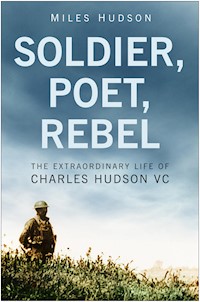
Charles Hudson VC was one of the twentieth century's outstanding fighting soldiers. His military career through two world wars and in Russia in 1919 earned him a host of medals. He was also a man of deep feeling, an accomplished poet and, in many ways, a rebel. In this compelling biography, the author skilfully interweaves his own narrative insight with his father's wartime journals and other unpublished material. The narrative includes detailed personal descriptions of the Battle of the Somme and other actions. It recounts the authoress Vera Brittain's bitter reaction to the death of her brother Edward when under Hudson's command in Italy in 1918 and tells how Hudson, out of compassion for her feelings, did not reveal the truth until he met her in 1934. It tells of the extraordinary affair in the summer of 1940, when the Secretary of State for War, Anthony Eden, asked a meeting of senior army commanders in the then beleaguered Britain whether, in the event of a successful German invasion, their soldiers would agree to be evacuated to Canada or whether they would insist on going home to support their families.
Das E-Book können Sie in Legimi-Apps oder einer beliebigen App lesen, die das folgende Format unterstützen:
Veröffentlichungsjahr: 2011
Ähnliche



















THE EXTRAORDINARY LIFE OF
CHARLES HUDSON VC
SOLDIER, POET, REBEL
THE EXTRAORDINARY LIFE OF
CHARLES HUDSON VC
SOLDIER, POET, REBEL
MILES HUDSON
THE HISTORY PRESS
First published in 2007
The History Press
The Mill, Brimscombe Port
Stroud, Gloucestershire, GL5 2QG
www.thehistorypress.co.uk
This ebook edition first published in 2011
All rights reserved
© Miles Hudson, 2011
The right of Miles Hudson, to be identified as the Author of this work has been asserted in accordance with the Copyrights, Designs and Patents Act 1988.
This ebook is copyright material and must not be copied, reproduced, transferred, distributed, leased, licensed or publicly performed or used in any way except as specifically permitted in writing by the publishers, as allowed under the terms and conditions under which it was purchased or as strictly permitted by applicable copyright law. Any unauthorised distribution or use of this text may be a direct infringement of the author’s and publisher’s rights, and those responsible may be liable in law accordingly.
EPUB ISBN 978 0 7524 6967 6
MOBI ISBN 978 0 7524 6968 3
Original typesetting by The History Press
Contents
Acknowledgements
Author’s Introduction
1.
Nineteen Years
2.
Ceylon
3.
War
4.
The Somme
5.
Italy
6.
The Final Advance and Russia
7.
Peace
8.
Second World War – Dunkirk
9.
The Home Front
10.
The Middle East
11.
Germany
12.
Retirement
Appendix A – Citations, Awards and Appointments
Appendix B – Perfect Lines
Appendix C – Newspaper Extracts
Acknowledgements
This book is based primarily on Charles Hudson’s own very full 720-page journal which he wrote after his final retirement. His poems, none of which were published during his lifetime, were also of primary importance in assessing his personality and character. Secondary and most valuable sources were his letters to his sister in extreme youth, from the trenches during the First World War and from the ill-fated intervention in Russia. These were made available to me by my cousins, Roger and Patrick Crowley, who also helped in other ways.
The excerpts from Vera Brittain are included by permission of Mark Bostridge and Timothy Brittain-Catlin, Literary Executors of the Vera Brittain Estate, 1970.
I was also helped by the biography, Vera Brittain: A Life, by Paul Berry and Mark Bostridge (London, Chatto & Windus, 1996).
Sir John Stanier and my son Mark both read the manuscript assiduously and made many useful comments. Sir John Graham assisted me with his knowledge as a former ambassador to Iraq. Peter Hewlett-Smith helped with place names in France and Belgium. My cousin John Hudson and Major Oliver Hackett of the Sherwood Foresters Regimental Headquarters have also been very helpful. My secretary Vikki Tate typed the various drafts with her usual assiduity and good humour
Any errors are, of course, entirely mine.
Miles Hudson 2007
Author’s Introduction
It is difficult for a devoted son to write a biography of his father without lurching into sycophancy, particularly if his father was touched by fame. Nevertheless the book will attempt to be objective. Charles Hudson’s decorations and other achievements, recorded at Appendix A, were extraordinary. Whatever else he was or was not, he was certainly a very brave man. This book will examine details of his courageous acts – not only in war. It will try to establish his motivation in the light of his experiences in youth, his times and the society in which he was brought up.
Further, against the background of Hudson’s life, the book will investigate the meaning of courage – that age-old virtue, almost universally accepted as such, but nevertheless full of ambiguities.
The mean point between cowardice and foolhardiness? (Aristotle) The absence or overcoming of fear?
A capital of willpower which is run down as it is used but is slow to build up again? (Lord Moran, Anatomy of Courage)
Fear of letting down comrades or of being seen to do so?
And so on. There are many facets to courage – physical and moral.
The book will look at Hudson’s poetry, a very vital part of the man exemplified not only in his own poems, which appear throughout, but also in his ‘Perfect Lines’ drawn from a wide range of poets and typed out in retirement on his own very old typewriter. These appear at Appendix B.
Then, Hudson the rebel, of which there are many examples: from deliberately failing his exam at Sandhurst, to constantly disobeying orders in war. His infuriating behaviour to his superiors in peacetime was probably a major factor, eventually, in him being relieved of his command of a division – as was his refusal to accept what he saw as wrong-headed authority.
Finally, to what extent did these aspects of his make-up – courageous soldier, poet, rebel – rely on each other in creating his character? Could one of them have existed without the other two? Where did his undoubted vast sense of humour come from? His lack of bitterness? And his all-pervading modesty?
Unless otherwise stated, all quotations in the book are taken from Hudson’s own journal.
ONE
• • • • • •
Nineteen Years
In the twenty-first century it is politically incorrect to talk about class. In the nineteenth century in Britain it was a central part of life and it was talked and written about a great deal, although not always directly. Charles Hudson’s family would have been described as ‘country gentry’. They had no pretensions to what was known as ‘London society’, to anything approaching aristocratic status or, indeed, to anything other than what they were. As Charles Hudson wrote in his journal: ‘Subsequent to my first known ancestors, Adam and Eve, there is a gap in my family tree which, on my father’s side, is considerable. A great-great-grandfather (Thomas Hudson, born in 1734) made money in the City of London trading with the West Indies but later generations consistently spent more than they earned.’
Indeed, his ancestors had resolutely turned their backs on trade, married people roughly of the same social status, and lived in various residences, some with small estates, almost always in the countryside. Their progeny had either stayed where they were in comfortable circumstances, joined the Army or Navy, or gone into the church. One became a barrister but did not practice and lived in Pau in France.
Another ancestor, Nathaniel Wright, had a sister who married Thomas Hudson’s grandson and lived with her at Brabyns Hall, near Stockport in Cheshire. Wright raised and fitted out a regiment in 1803 and 1804 to defend his country against Napoleon, who was threatening invasion. This no doubt fine body of men luxuriated in the resounding name of the Loyal Poynton Worth and Bullock Smithy Volunteers (the Smithy presumably being the spot where they rallied to the cause). Such was Nathaniel’s repute that he was presented with two gold-plated cups by the ‘Lord Viscount Warren Bulkeley, the Colonel Commandant of the Brigaded Corps of Stockport Poynton Worth etc [whatever the latter letters may mean] as a token of the Sense he Entertains of his Loyal Liberality and Activity’. It was unlikely that any of this family went to university – indeed the author of this book may well be one of the first members of his family to have done so. Those who joined the Army went into their county regiment; there was no question of them joining either the Guards or the Cavalry. They managed to raise enough money to buy their commissions and when this, to us now, extraordinary practice was abolished, Hudson’s father, Herbert, came into considerable obloquy because he arrived as the first officer to join the regiment by examination, ‘in the opinion of his brother officers, particularly the older ones, this innovation would result in the Army going to the dogs’.
India featured very prominently in the lives of those who joined the Army, as many members of Hudson’s family did. William James Hudson, Hudson’s grandfather, born in 1821, became an Ensign in the 61st Regiment of Foot (later the Gloucesters) in 1842. After two years of garrison duty in Ireland his regiment was posted to India. Things were very different in those days. They sailed in five ships, the voyage to Calcutta taking over four months. William recounts in his diary that, having arrived, they marched to Cawnpore, a distance of 623 miles. It took them two months, their wives and families accompanying them sedately in carriages. They remained in Cawnpore for six months in extremely unhealthy conditions – eighty soldiers died of various afflictions. They then marched a further 400 miles to a military station called Ambala. After a long series of marches and counter-marches, the regiment was heavily engaged against the Sikhs at the Battle of Chillianwalla, which was a disaster as far as the English were concerned, but the situation was retrieved three days later at the Battle of Gujerat at which the Sikhs were defeated.
Not long after this affair William died of cholera. His last entry in his diary read, ‘Feeling seedy.’ The day before he had written, ‘The NI [Native Infantry] have posted a notice on the barrack gate announcing that they will shoot their officers if their demands are not met – cheerful very.’
William had married the daughter of his colonel, Henry Burnside, and when the Indian mutiny broke out his brother, who was in the regiment, arranged for Burnside’s wife, four children and French maid (who subsequently went mad) to travel 1,000 miles by boat down the rivers Sutlej and Indus to Karachi. It was the hottest time of year and there was little protection from the sun. The party had an escort for some of the way, but mostly they were alone with the Indian peasants who steered or rowed the small boat. The mother was six months’ pregnant at the time. She was Charles Hudson’s grandmother and must have been a powerful lady.
William’s elder brother, Thomas, joined the 39th Foot (later the Dorsets), served in India and the Crimea, where he became Secretary to the HQP Hunt, started in Sebastapol after the war was over. (Despite much effort the author has been unable to discover what the letter P stood for.) William was also a steward at the Grand Military Steeplechase held on Monday 3 December, 1855 ‘before Sebastapol’. One of the races was for horses, ‘the property of and to be ridden by officers of the French or Sardinian armies’. The race was for ‘one mile on the flat’. Thomas’s note on the racecard read, with obvious chauvinistic disdain, ‘Eleven French started for this – a most amusing affair a French colonel winning.’
Charles Hudson’s father joined the Nottingham and Derby regiment (the Sherwood Foresters) and became adjutant of the local volunteers in Derby. He was due to rejoin his regiment in India, but his wife refused to go. He left the Army and went to live in Newent, near Gloucester, where he rented a shoot and settled down to what must have been a rather humdrum life. He applied to rejoin the Army on the outbreak of the Boer War but, much to his chagrin, he was turned down.
Charles Edward Hudson was born on 29 May 1892, known as Oakapple Day because Charles II hid from a Roundhead patrol in an oak tree on 29 May. Charles’s early life was clouded by constant rows and jealousies with his elder brother Tommy who, as the oldest son, was the apple of his parents’ eyes. Charles and his sister Dorothy (Dolly) were thus thrown together and became fast friends.
Charles recalled that during the Boer War the
small flagged pins stuck into the large maps in my father’s study fascinated me then, as they did later during the Russo-Japanese war, but as far as I can remember my father never explained their significance and I never had any hankering after a military career. Life in the army seemed to me excessively dull, for it never occurred to me that there was the remotest likelihood of there ever being another war, and an army without a war seemed to me quite pointless and rather ludicrous.
Charles remembered the death of Queen Victoria and the deep mourning clothing which he and his entire family were dressed in as a result. At the time of the coronation of Edward VII as a young boy he had his first confrontation with the ‘lower classes’ when ‘a crowd of rough-looking men surrounded the carriage in which we were driving and demanded funds for unemployed ex-soldiers’.
Charles recounts in his journal:
My father was a magistrate and as such he was asked to ride in the first ‘horseless carriage’ to appear in our neighbourhood. We children were taken to see this by our nurse and the nursemaid. The passengers sat facing each other. A number of speeches were made. A man carrying a red flag stood ready to mount a bicycle as the law required that all mechanically propelled vehicles should be preceded on the public highway by a red flag and he was deputed to carry it. I was in the charge of the nursemaid, and I was much annoyed at being dragged away from the car so that she could ogle the man on the bicycle whose name I learned was Joe. As the motor was set in motion after a few false starts, amidst the cheers of the crowd, a cloud of smoke and an all-pervading stink, the nursemaid told me that it might be a wonderful invention but however fast the car might go it would never catch up with Joe. Later I got to know Joe as a superman who wore a shiny striped black and white wristlet watch which fascinated me. His feats of strength were phenomenal. He was the blacksmith’s assistant and wielded a heavy hammer all day long. In his spare time, moreover, he was the best quoits player in the village.
A further event which seared deep into his consciousness and which remained with him all his life took place when
a rather pompous ex-brother officer of my father asked me one day in a drawing-room full of people, as stupid adults will, what I was going to be when I grew up. Without thinking I announced that I was going to be a judge and ride a bicycle. Everyone present burst out laughing. This was too much and I was led away in a flood of tears. When I recovered, even at so young an age it dawned on me that my unconsidered remark had raised the hope in my mother’s mind that I had unwittingly proclaimed my future destiny. Later she carefully explained that I would have to become a barrister before I could become a judge. At the time I was far more interested in the bicycle.
This event was to spark an amused echo in the verse he wrote later:
A Child’s Dream
If I could have my wish what I would be
I’d choose, I’d choose a monkey on a tree,
A feckless creature, one would think, but free
But then perhaps he thinks the same of me –
I’ll try again, a great man, let me see,
A learned man as busy as a bee,
A scientist or doctor with a fee
So great he never lacks the things that he
most wants, a bike or sausages for tea.
A man of action on the land or sea
Or in the air, perhaps I’ve found the key –
a hero, that’s the ticket, yes, that’s me.
But something’s missing, what then shall I be,
There’s always something else puts in a plea
Sometimes a tweedle dum and then a dee,
but in my heart there is a constancy –
I’d like to stay a child eternally,
But, sadly, I will have to wait and see.
When Charles was about seven years old a great change occurred in his life. His father inherited a considerable income from family land in Derbyshire. The lease of the house in Newent ran out at about this time and he bought a much larger house with land attached called Bereleigh, near East Meon in Hampshire. It was the first time Charles had come across electricity and he got into trouble for running from room to room switching the electric lights on and off.
No longer were we confined within the narrow limits of a small walled garden and daily afternoon walks under the close supervision of a nurse or governess. We could go as far as our legs would carry us on our own land. The so-called Long Drive was said to be a mile long. My brother went off to a preparatory school in Sussex where I later followed him. Bicycles appeared and ponies. We played cricket with boys and men belonging to the estate; we trudged the fields with my father and a keeper looking for plovers’ eggs. We had hideouts in the woods. We played tennis and croquet. Even lessons became less boring for a new governess appeared who knew how to conduct them. At Newent we had suffered under a series of impossibly incompetent and elderly spinsters, whose sufferings were only exceeded by our own.
When Mustard, a fiery little pony, arrived, my life became less carefree. I had little control and riding soon became an agony. Two experiences stand out, the first when riding along the edge of a wood I came round a corner and saw, a few hundred yards away, a light single-horsed trap. A man with it was just throwing some rabbits into the back. When he saw me he shouted and ran round to jump into the driving seat.
My father often talked of the poaching that went on, and I realised with a spasm of fear that I had come on poachers. Three more men appeared out of the wood and stood there awaiting me. They looked rough and tough-looking customers. Much as I would have liked to turn tail and bolt, for many unpleasant stories of the kidnapping of children by gypsies leaped to my mind, I felt this would be too ignominious. With beating heart I rode up to them and demanded what they were doing.
Their jeers and scorn reduced me to a state of confused impotence and ended with a final insult when one of the men, seizing the bridle, turned my pony round while another caught him a sharp crack with his whip. As I held on for dear life, my pony entirely out of control, the derisive cheers of the men in my ears completed my humiliation.
About this time my father became very ill, and in our last summer holidays at Bereleigh a tutor was engaged, ostensibly to give my brother extra tuition but mainly to keep us in order. I soon became his passionate admirer. He was in fact still an undergraduate, but to me he seemed an oracle of age and wisdom. . . .
One day Mr Johnson (later to become a very high-church and disappointingly dull young curate in a fashionable part of London) accompanied me out riding on his bicycle. Our progress down a main road – I on the broad grass verge and he in the roadway – developed into a race. I was soon out of control and he, not realising this, shot ahead. My pony, recognising a side road as the way home, swerved and deposited me on my head in the ditch. My poor young tutor hunted distractedly for his charge but since I was unconscious and out of sight he failed to find me.
I came to in a strange and enormous double bed in a room that seemed to me to surpass all normal standards of expensive elegance and luxury. My first reaction was to think how surprised people would be to know that Heaven was really like this, my second was that it was all very fine but I would really rather be in my own ugly little commonplace room at home. A very heavily starched and business-like professional hospital nurse and a splitting headache soon convinced me that I was still earth-bound.
It turned out that I had been found before the search party, headed by my father, had set out, and had been carried unconscious into the house of a very wealthy Jewish family who had recently appeared in the neighbourhood. I suffered no after-effects from my adventure, and our life soon after became over-shadowed with my father’s serious illness. An operation was performed upon him in the house by a London surgeon. The medical ruling subsequently given was that he must lead a very quiet life and should live by the sea. We went to Bournemouth and our whole scale and mode of living changed from that of a country to a suburban life – a poor exchange.
As happened to virtually all boys of his background, when he was eight years old, Charles was sent to a preparatory school – Fonthill near East Grinstead, Sussex. He was very close to his sister for reasons already explained and three letters from him to her have survived. Although not always clear – what is meant by ‘cobbed’? – they exemplify much of the atmosphere in which children from his background lived at the turn of the century – and indeed in many cases still do.
Fonthill East Grinstead Sussex Sunday, 26 February 1905
My dear Dolly,
I am sorry I did not write before. The chapel is not finished yet. It is taking an awful long time. I am looking forward to Nigger coming next holidays. My group has all been cobbed and so Walter would not let me into the Club. There are fifteen chaps who have got chicken pox. They are all singing or shouting rather in one of the bedrooms. I will get it soon I expect. It is pouring with rain now. We have had a little snow lately. I do not know whether I am in the eleven. We would have a match on Wednesday but chicken pox broke out on the Tuesday which was rather bad luck. We won’t have any matches for a good time yet. Nothing more has happened about it, you know. It was probably all rot. I here [sic] you get a good many bike rides. We had boxing yesterday.
Love to all
From your loving Charlie
Fonthill East Grinstead Sussex 11 February 1906
My dear Other Half,
I wish I could join with you and make a whole. I am getting on with my work pretty well for the master I do with. I am doing Euclid now because if I try for the Navy I have to do it. I like it. Do you think you could scrape together some eggs, not too common because I am promised a collection of moths and butterflies. I wish you could. What have you been doing lately! I have had a letter from Nigger lately. He sent some photographs, the ones which you and I took out on the veranda. One of the masters was biking back from East Grinstead, as he came down a hill just near Fonthill his lamp went out, so he did not light it because he was so near home, then he saw somebody biking towards him. When he came to the other man he jumped off and told him to get off too so the master asked him what he wanted. He said he wanted the master’s name and address for riding without a light. The man on the other bike was really a police inspector. My diary is getting on very well, is yours?
Love to all
From your loving Charlie
PS It is Ashton’s birthday today. We are going to have a conjurer soon, his present some books, £5 10s was given by the boys for it.
Fonthill East Grinstead Sussex Summer Term
My dear Dolly
It doesn’t seem as if it will ever stop raining. There are four new boys, two new masters. The tribal Alliance has got a band of 8 boys, 3 of which are secret spies. We are fighting another band, one of our spies pretended to be in theirs and found out all about their spies and plans. We have got a secret cipher of our own. We are going to have boxing. We did gym yesterday. The dancing class is jolly nice, we do not do exercises or steps or that beastly stuff. I hear you are going to drawing class and to Alice in Wonderland. The master who teaches boxing held the championship for two years on board the Britannia. How are the dogs and bird? Mind you water the caterpillar. We played hockey this afternoon. I hope you like the drawing lessons.
Love to all
From your loving Imp
There were two headmasters. They were brothers. One, married, lived in a separate house in the school grounds. The other, unmarried, lived with his sister in the school and it was this man, a sadistic monster, who was to have an enormous and unquantifiable effect on Charles’s character. The whole school was frightened of him, but for four boys, including Charles, fear was altogether too weak a word.
We were kept in a state of terror in the knowledge that not only did he loathe the sight of us but that our very presence brought out the worst and most cruel side of his sadistic nature.
His sister tried to console me by explaining that he suffered terribly from gout in the head and could not sleep at night. It never occurred to me to wonder why I should be picked out to suffer as a result of his misfortune. His persistent bullying soon convinced me that I was the fool he made me out to be. I never told my parents about the bullying headmaster, partly because I was too ashamed of my own failure, partly because to do so would be an unpardonable offence against the rigid code of a schoolboy’s honour, in which ‘to sneak’ even on a master was beyond the pale.
Richard (we actually called the two heads by their Christian names though the other masters we ‘mistered’ in the normal way) took all Latin classes in the school. It was during these classes that he seemed to take a delight in tormenting me. The technique was nearly always the same. He would pay little attention to me until nearly the end of the period. He would often hover over me and then at the last moment pass me by. But the inevitable moment would come. He would bend over me and at once I would be almost paralysed with fear.
He would make some superficially jovial remark in my ear, but I knew it to be ominous and charged with a faint sarcasm in connection with some previous painful incident. Slowly he would read my miserable effort to render some simple passage into Latin, and when he had found some obvious mistake the hectoring would begin. ‘Do you know that such and such a noun is feminine?’ he would say. Trembling, I would reply I didn’t know. He would pick up my exercise book and turn the pages back. He would find either the same error corrected or written as it should have been. In either case he could point out that I must have known and that I had lied in saying I didn’t. I would be told to go to his study and there await my doom. I used to try to pretend to the other boys that I did not mind being beaten, and to prove it I used to steal chocolates which Richard kept in a drawer in his room for distribution as prizes. These I would give to my friends when I came out. Richard’s beatings were not formal affairs of so many counted strokes.
One day he was laying about me with more than usual vigour and working himself into a fury at my failure to get a single word right under the threat of the cane, when there was an urgent knock at the door. He threw the cane into a corner as his sister entered. I could not fail to realise she had come in only to rescue me. It was after this that she told me of Richard’s gout.
Richard had told my father that I would never pass any Public School entrance examination unless I had extra tuition in Latin, and so my father had to pay for my extra hours of torment.
After prayers, every boy in the school had to pass Richard on his way to bed, shake hands and say ‘Goodnight, Sir’. When my turn came he might refuse my proffered hand and say, ‘I’ll see you later.’ That meant I would have to go into a small room in the private part of the house and await his appearance. Three other unfortunates accompanied me and we would be set an exercise while Richard had dinner.
The culminating horror of these private classes came one Saturday night. I had been beaten that morning and could only kneel on my chair. Richard came back to us in a joyful mood, apologised for his lateness, explaining he had some old boys to dine who had been most amusing companions. He looked over the other three boys’ work perfunctorily and sent them off to bed.
I had had a dreadful day and was in a state of collapse and quite unable to concentrate. All I had to show were a few lines of tear-stained and quite illegible writing. Richard stood behind me breathing heavily and alcoholically down my neck. He began thumping me in the back, his thumb between the fingers of his clenched fist, pouring out imprecations. I slipped from my chair and tried to run round the table but he caught and shook me. I thought he would kill me in his now uncontrollable rage. Then suddenly he threw me from him and rushed out of the room.
Soon after I heard men’s voices, Richard’s among them. They were coming out of the dining-room. I heard the drawing-room door open and the sound of women’s voices and laughter, then the door shut. My overwhelming need was to go to a lavatory. I tried biting my lips in an effort to control myself, but it was no good. I had just slipped out into the hall intending to make a dash for the lavatory near the front door when I heard footsteps. Before I could get back, Richard appeared at the top of the stairs, a cane in his hand. As he entered, I rushed into a corner of the room, and, unable to control myself any longer, the worst happened.
‘You dirty little brute,’ he said. ‘Get out of here, go to the matron and tell her from me you have got to have a bath.’
I fled before the lashing cane. In those days we had round tin baths in our dormitories on bath nights. The other boys in my dormitory were mostly asleep but matron herself brought a candle, filled a bath and told me to wash quickly and get into bed.
When she returned she found the water red with blood. Horrified, she examined my lacerated behind. Realising she was very upset and angry I begged her not to tell Richard. The door of the dormitory was always left open and it was not long after I crept into bed that I heard her tiptoeing along the passage outside and up a short flight of stairs to an assistant master’s room. Creeping out I went to the bottom of the stairs and listened.
The door above was open and I could hear enough of the conversation to gather that matron was almost hysterical and that Mr Vavasour, an assistant master, was urging her to go to bed, assuring her that he would see Richard in the morning.
I never learned what happened, but for the rest of that term Richard left me in peace. Mr Vavasour did not return to the school for the next term. I never saw him again, but I heard later that he was running a most successful school near Midhurst. I had good reason to be grateful to him.
After I left, something similar must have happened for, if my information was correct, an angry parent told Richard he must either retire or face a charge of assault. He chose the former alternative, and handed over the school to his brother.
This whole episode must have had a vast and permanent effect on Charles’s character. We can all remember with great clarity situations and events in our youth which were defining moments in our development although often to an outsider they may appear to be insignificant. But to a 10- or 11-year-old boy from a secure, although (except for his sister) perhaps a little frigid, home these barbaric events must have been totally horrific. The fact that he did not tell anyone about it at the time was not surprising – the reluctance of children to tell their parents about their personal problems persists now and probably always will. Whether this traumatic affair had a direct bearing on his subsequent behaviour and, if so, to what extent, we will examine later.
Before going to his public school, Sherborne, where he remained from 1905 to 1910, Charles attended an interview in London with a view to going into the Royal Navy. There was no question of his going ‘into trade’; he thought he was too stupid ever to qualify for a ‘learned profession’ and his brother, who had joined the Army, strongly dissuaded him from following in his footsteps. He failed the interview, learning many years later that it was decided, not surprisingly in the circumstances, that he was ‘of too nervous a disposition’.
Charles’s recovery of self-confidence was undoubtedly, in part, due to the environment in which he found himself at his new school, Sherborne, which his brother and his father had attended. Not knowing what to do with himself having failed the Navy, and very doubtful of his academic potential, he had joined the Army Class where he was taught by Trevor Dennis, an ex-member of the Sudan Civil Service. Schoolteachers, male and female, do not always realise what they can do for their pupils. Dennis transformed Hudson’s view of himself and of his academic abilities.
Until he arrived I had always imagined that I was only capable of floundering about at the bottom of any class and could not be expected to do better. Though his immediate concern with me as a pupil was to teach me mathematics, he lit up for me a far larger area of interest. I was probably at an age at that time when a boy’s mind is apt to open out, and lessons become education, but I had him to thank for the change that came over me. Intellectually I became alive. I had always been unable to memorise anything and I had thought that this was evidence of stupidity. Dennis showed me that the brain was not just a factual recording machine, nor was it only of use through its power of logical reasoning but that an understanding of a mathematical, and of any other, problem, could be reached imaginatively. Until in fact a proposition was so comprehended it was unlikely that a realistic solution could be found. Dennis himself never attempted to put these ideas into words. Still less did I attempt to do so myself, but nevertheless he did impress on me that I was seeking to find for myself a good deal more than an accumulation of factual knowledge that would enable me to pass examinations. This gave me an entirely new interest in life, and an exciting one.




