


Erhalten Sie Zugang zu diesem und mehr als 300000 Büchern ab EUR 5,99 monatlich.
- Herausgeber: The History Press
- Kategorie: Sachliteratur, Reportagen, Biografien
- Sprache: Englisch
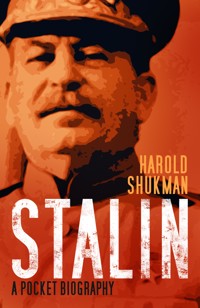
Joseph Stalin was one of the most ruthless and authoritarian dictators in world history, who plunged Russia into a barbarous nightmare, leaving behind a damaged nation and a legacy of grief. This concise biography presents Lenin's heir from his humble and troubled beginnings to the highest rank of all: General Secretary of the Communist Party. Stalin: A Pocket Biography is an accessible account of a complex tyrant, perfect for students or anyone taking a first look into modern Russian history.
Sie lesen das E-Book in den Legimi-Apps auf:
Seitenzahl: 109
Veröffentlichungsjahr: 2011
Das E-Book (TTS) können Sie hören im Abo „Legimi Premium” in Legimi-Apps auf:
Ähnliche


















In memory ofDmitri Volkogonov
First published in 1999 by Sutton Publishing Ltd.
This paperback edition published in 2023
The History Press
97 St George’s Place, Cheltenham,
Gloucestershire, GL50 3QB
www.thehistorypress.co.uk
© Harold Shukman, 1999, 2023
The right of Harold Shukman to be identified as the Author of this work has been asserted in accordance with the Copyright, Designs and Patents Act 1988.
All rights reserved. No part of this book may be reprinted or reproduced or utilised in any form or by any electronic, mechanical or other means, now known or hereafter invented, including photocopying and recording, or in any information storage or retrieval system, without the permission in writing from the Publishers.
British Library Cataloguing in Publication Data.
A catalogue record for this book is available from the British Library.
ISBN 978 0 75247 490 8
Typesetting and origination by The History Press
Printed and bound in Great Britain by TJ Books Limited, Padstow, Cornwall.
eBook converted by Geethik Technologies
Contents
Chronology
1 Introduction
2 Beginnings
3 Party Worker
4 Power
5 Lenin’s Heir
6 The Great Turn
7 Stalin the Executioner
8 The Nation Revived
Conclusion
Notes
Bibliography
Chronology
In February 1918 the Soviet government abolished use of the Julian (Old Style) calendar and adopted the Gregorian Western (New Style), which was thirteen days ahead (twelve days in the nineteenth century). Both dates are given here.
1878
6/18 December. Stalin born in Gori, Georgia
1879
9/21 December. Stalin’s ‘official’ (incorrect) birthday
1888
Enters church school in Gori
1894
Admitted to Tiflis Seminary
1899
Expelled from Seminary
1902
April. Arrested
1903
October. Deported to Novaya Uda, eastern Siberia
November. Escapes
1904
January. Adopts nickname Koba
June. Marries Yekaterina Svanidze
1905
December. Attends Bolshevik conference at Tammerfors, Finland, under pseudonym K. Ivanovich
1906
March. father dies in Tiflis
April. Attends Fourth Party Congress in Stockholm
1907
September. First son, Yakov, born
1907
November. Wife dies of tuberculosis or typhus Attends Fifth Party Congress in London Organizes bank robbery in Tiflis
1908
March. Arrested in Baku
1909
February. Exiled to Solvychegodsk, Northern Russia
June. Escapes
1910
March. Arrested
October. Sent back to Solvychegodsk Fathers a son by Maria Kuzakova
1911
Moves to Vologda under surveillance
August. Escapes to St Petersburg Re-arrested and sent back to Vologda
1912
January. Elected in absentia on to Bolshevik Central Committee
February. Escapes from Vologda
April. Re-arrested and deported to Narym, Western Siberia.
September. Escapes and returns to capital
November. Attends Bolshevik meeting in Cracow
1913
January. Visits Vienna, meets Trotsky and Bukharin
Changes his name to Stalin
February. Returns to St Petersburg as an editor of Pravda
March. Arrested
August. Exiled to Turukhansk on Arctic Circle
1917
March. Tsar Nicholas abdicates Stalin returns to capital, co-edits Pravda with Kamenev
1917
August. Delivers political report at Sixth Party Congress
25 October/7 November. Bolshevik coup in Petrograd (St Petersburg)
1918–19
Serves as Military Commissar Southwestern Front
1918
Stalin and Nadezhda Alliluyeva register marriage 16 July. Murder of Romanov family in Yekaterinburg
1921
Stalin’s second son, Vasili, born
1922
April. Stalin becomes General Secretary of the Central Committee
1926
Stalin’s daughter, Svetlana, born
1927
Kamenev, Zinoviev and Trotsky expelled from Central Committee
1929
February. Trotsky deported from USSR
November. Bukharin expelled from Central Committee
1932
8 November. Stalin’s second wife, Nadezhda Alliluyeva, commits suicide
1933
US recognizes USSR
USSR enters League of Nations
1934
February. ‘Congress of Victors’
1 December. Kirov assassinated in Leningrad
1936
August. Zinoviev and Kamenev tried and shot
1937
May. Tukhachevsky and seven other marshals shot
1939
August. Nazi-Soviet Non-aggression Pact signed in Moscow
1940
August. Trotsky murdered in Mexico on Stalin’s orders
1941
22 June. Germany invades USSR
1941
July. Stalin’s son, Yakov, captured as POW
1942
Churchill in Moscow for talks with Stalin
1943
Stalin in talks with Churchill and Roosevelt in Tehran Stalin adopts rank of Marshal
1945
February. Stalin hosts Allied talks in Yalta Stalin adopts title of Generalissimo
8 May. Victory in Europe Day in the West
9 May. Soviet Victory Day
July–August. Stalin attends Potsdam Conference
1952
October. Nineteent Party Congress
1953
5 March. Death of Stalin
1
Introduction
‘I kiss you on the nose, Eskimo-fashion. Dammit! I miss you something awful. I miss you like hell, I swear. I have no one, not a soul to have a proper talk with, damn you. Is there really no way for you to come to Cracow?’1 In December 1912, Stalin wrote to his party comrade Lev Kamenev, then in Geneva, in this jocular tone, very much as one Russian intellectual might write to another. Twenty-four years later, he would stage-manage Kamenev’s trial as a ‘Fascist spy’ and have him shot like a dog.
In 1912, Stalin was regarded by his comrades as an audacious revolutionary and an affable comrade – indeed, Lenin described him as a ‘wonderful Georgian’. By the 1930s, he had become a homicidal monster whose thirst for their blood seemed insatiable. When, in the late 1940s, for his own twisted purposes, he masterminded the arrest and in some cases the execution of the wives of some of his closest and longest-serving accomplices, the omnipotent dictator would sadistically respond to their pleas for mercy: ‘It doesn’t depend on me. I can do nothing. Only the NKVD [secret police] can sort it out.’2
What had wrought this transformation? How had a provincial, comparatively insignificant member of a small, unsuccessful group of journalists and persecuted political conspirators – which the Bolsheviks mostly were before the First World War – become one of the most powerful and merciless dictators in history, a dictator whose name and image would saturate every field of Soviet endeavour? How did that image evolve from the ‘grey blur’ depicted by one of the closest observers of 1917, and the ‘outstanding mediocrity’, as the revolution’s most vivid personality called him, into a demigod, an icon worshipped by his own subjects, as well as by an international movement that included many educated and thoughtful people abroad?
Under Stalin’s rule, what had been the Russian Empire was transformed no less spectacularly. When Lenin died in 1924 and Stalin took over the reins of power, the Soviet Union had barely begun to recover from the successive ravages of the First World War, the Civil War and the economic failures of the new regime. Both the industry and the agriculture of this predominantly agrarian country had been reduced to a shadow of their former scale. Yet by 1939 the Soviet Union was an industrial and military power of formidable strength. Driven in 1941 by Hitler’s armies into its own heartland, by 1943 the Red Army turned the war around and by the spring of 1945 was sharing Europe with its Western Allies. Under Stalin’s rule the USSR, a pre-war pariah among nations, took its place on the United Nations Security Council as the leader of the ‘socialist camp’ in a world that was soon to be divided by the Cold War.
As a member of the Politburo from 1917 and as its head from 1924, Stalin can be said to have been in power for thirty-six years, from the time of the revolution until his death in 1953. And since he left no personal diary – that we know of – the story of his life is inevitably and inextricably linked to the history of the period. It is the purpose of this brief account to examine these parallel transformations – Stalin’s and the Soviet Union’s – and to see how they are interrelated.
2
Beginnings
The Early Years
Stalin’s birthday has always been given as 9/21 December 1879. The local archives now reveal that he was in fact born on 6/18 December 1878, a year earlier. There is no explanation for this discrepancy. His birthplace was Gori, a small town of some 12,000 inhabitants of mixed Caucasian origin, in the Georgian province of Tiflis (Tblisi), and close to the Borzhom source of mineral water that would remain Stalin’s digestive of choice until the end of his life. Named Iosif (Joseph) and known by the Georgian diminutive of Soso, he was the third son of Vissarion (Beso) Dzhugashvili and Yekaterina (Keke), née Geladze. Two infant children had died before Soso arrived.
His father, Beso, was one of the small town’s ninety-two cobblers, among the lowest ranking trades in the hierarchy of artisanry, the topmost being that of watchmaker. His brutishness, poverty and frustration made Beso a violent, drunken husband and father; his wife, a pious Christian, was a hard-working laundry-woman and seamstress. She was dedicated to her only child and determined that he should rise above his origins and, ideally, become a priest in the Orthodox Church. Violence and discord in the family home eventually led to the parents’ separation and Beso ended up dying either in a Tiflis doss-house or after being knifed in a brawl. He was buried as a pauper.
A Georgian-speaker until the age of eleven – he would never lose the distinctive accent – thanks to his mother’s efforts and the help of a sympathetic patron, Soso entered the church school in Gori in 1888. In 1894, having graduated with top marks, he was admitted to the Tiflis Seminary to train as a priest. Here he showed talent and a phenomenal memory for Biblical texts. Here also it was that, like so many other young people throughout the empire, he was swept up by the tide of discontent and rebellion that characterized Russia at the turn of the century. Peasants were rioting for more land; workers were striking for better conditions; students were demonstrating for their curricula to be liberalized; intellectuals were demanding political reform that would give society a voice in government; senior officials were being assassinated; anarchists were throwing bombs; Social Democrats were setting up clandestine organizations to bring the message of socialist revolution to the proletariat.
Soso and his fellow seminarists were ripe for conversion to the new political creed. The lack of intellectual stimulation in their studies and the drab harshness of seminary life made them vulnerable to the political ferment that was stirring in Russia, let alone the excitement of the colourful Georgian capital. While still playing the diligent theological student in class, Soso was reading Marx and Darwin. He became an atheist and began associating with underground, i.e. clandestine, revolutionary circles.
By 1899, the seminary and everything it stood for was insufferable to him. After ten years of religious education, at the age of twenty-one and no longer manageable in the seminary, he was expelled for indiscipline. As a fellow seminarist and revolutionary of the time wrote, the young Stalin took with him from the seminary ‘a vicious, ferocious enmity against the school administration, against the bourgeoisie, against everything that existed in the country and embodied Tsarism. Hatred against all authority.’1 Soso abandoned theology and entered the underground world of the Marxist organization in Tiflis where he became a professional revolutionary.
Revolutionary Youth
‘Professional revolutionary’: the term came into use around this time, as Vladimir Lenin was promulgating his ideas about the kind of revolutionary party he wanted to build, and the nature of the people he believed should constitute that party. They must be so dedicated to the cause that no personal or other goals would dilute their zeal or their submission to the ‘Centre’. The Centre would be run by a small, self-appointed group of intellectuals who were themselves guided by the Leader, i.e. Lenin. ‘The cause’ was to overthrow tsarism and promote socialist revolution. Many of Lenin’s recruits were qualified for a professional occupation – economist, physician, lawyer, scientist, some of them potentially distinguished – but most had either dropped out or been expelled from university or high school precisely because they had become actively involved in the revolutionary movement.
Apart from the priesthood, Soso was not a candidate for any other profession. Like many revolutionaries, his abilities as a political writer would find expression only in the party press: poems he wrote as a teenager offered little prospect of a successful literary career. But he was effective as a Marxist teacher of illiterate workers, his seminary education having provided him with an ability to convey complex ideas about the relationship between the economic and political system and the lives of ordinary people in a way they could understand. His simple style would become his hallmark, as both speaker and writer, in later life.




