


Erhalten Sie Zugang zu diesem und mehr als 300000 Büchern ab EUR 5,99 monatlich.
- Herausgeber: Pushkin Press
- Kategorie: Sachliteratur, Reportagen, Biografien
- Sprache: Englisch
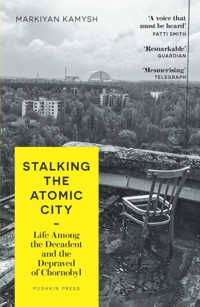
The 1,000-square-mile Chornobyl Exclusion Zone is, for many, a symbol of total disaster: a reminder of shattered ideals and lost lives, now a toxic, dangerous no-man's-land. For Markiyan Kamysh, it became a site of pilgrimage.He and dozens like him call themselves 'stalkers': wild adventurers who sneak past border patrols to spend days getting lost in this apocalyptic environment of dense swampland and desolate villages. Kamysh, the son of a Chornobyl disaster liquidator, takes us with him into this alien world.In electric prose that captures the spectral beauty of the Zone and the reckless spirit of the stalkers, Kamysh tells of hallucinatory journeys alone amid the rusted ruins, of frantic brushes with police and moments of ecstatic oblivion in the wasteland. Written with gonzo energy and brash lyricism, Stalking the Atomic City is a vital, singular document of this dystopian reality.
Sie lesen das E-Book in den Legimi-Apps auf:
Seitenzahl: 143
Veröffentlichungsjahr: 2022
Das E-Book (TTS) können Sie hören im Abo „Legimi Premium” in Legimi-Apps auf:
Ähnliche


















iii
v
To Flamingovi
Contents
ix
1.
The Downpour
BRIMMING WITH THE OPTIMISM OF UTOPIAN slogans and the motherfucking grotesque of Soviet supergraphics, we were building a Dream. And in pursuit of it, we stumbled upon the Cornucopia—the energy of the peaceful atom, the panacea for the national economy, and the beacon guiding us on the path toward a bright red Communist tomorrow. Thrilled by our own might, with an undimmed belief in all that is best, we were building nuclear power stations all across the USSR.
One of the most powerful ones was called Chornobyl. Its satellite town soon grew rapidly, its neat apartment 2blocks towering in their exemplary excellence, enormous slogans flowing high, proud, on the rooftops, and boisterous children running around cozy playgrounds.
A supermarket and a restaurant opened in town, and ads like “Looking to exchange my apartment in Odessa for one in Prypyat” no longer surprised anyone. In the wilderness of the Polissya region, the Atomic City looked like something out of a sci-fi novel promising rapid growth, further improvements, and outrageous opportunities. They even planned to build a promenade with bridges, street lights, and musical entertainment. They already started to lay the foundation of new power plant units, the apotheosis of joy and happiness looming on the horizon.
Until things got fucked, and nuclear reactor No. 4 blew the hell up. The area by Chornobyl lit up like the Wormwood star and turned into a poisonous emerald in the precious crown of Polissya. The cruel hangover of reality after long years of sweet dreams. The law of the pit: no matter how long you climb, you’ll fall back to the bottom in an instant.
However, brave firefighters put out the fire in the reactor, and valiant helicopter pilots showered the hellish crater with lead and boron. Desperate liquidators with pure hearts cleared the most polluted debris in the world, built the sarcophagus, and then left.3
They left after they’d picked up their doses of radiation, their health problems, their cancer, their category A and B liquidator certificates, and so on down the list. Their children acquired the privilege to hang out at summer camps for free and to go by the nickname “Chornobylite” at school. The country got a piece of land as big as Luxembourg where people were forbidden to live.
The town of Prypyat and its surroundings were evacuated immediately. The Exclusion Zone was fenced off by barbed wire and patrolled by watchful soldiers. They raced around like predators on their armored vehicles in search of looters, but when the turbulent 1990s exploded with even greater force than the reactor, the Zone’s borders loosened.
That’s when the first illegals appeared. Haggard drunkards would steal pickled food from the cellars in the villages just outside the Zone and run away from the patrol guards only to come back in a week, get caught, and be thrown in jail—no probation. Prypyat was packed with daredevils, bums, deserters, looters, and fugitives. They hid in the villages for months, munching on rotten apples and dreaming of hunkering down until all the troubles of the world melted away. It was then that the Zone turned into that dangerous place often depicted in today’s tabloids.4
You could run into some hippies, too. Stories about flower children sporadically appeared in the newspapers—the police would catch them laughing and swimming in a river and kick them out with a stern warning: “Don’t you ever come back, ever.” Hooligans from the capital dropped by, too, to loot clocks from Prypyat apartments and peddle them at the flea market on Andriyivskyy Descent. They’d shoot up drugs and carry guns. Then the hooligans left. They left behind their meth trips like a whirlwind of ashes and became family men, completely ordinary: small business owners and loving parents of kids who are now littering your social media feeds with pictures of their breakfasts.
There were loners, too. They never left any footprints and drank good brandy. They fished in the rivers just to see the sun in the clear sky—they didn’t give a damn that no one lived there and that they could be arrested. That’s how it went until the generation the same age as the explosion grew up. To them, the Zone became a land of tranquility and frozen time.
I am one of that generation.
WHAT IS THE Chornobyl Zone today? For some people, it’s a horrible memory of their half-forgotten childhood, of their 5happy Soviet youth, when, in a matter of days, their life shattered into pieces, and they and all their neighbors scattered, hopping on the evacuation buses to search for new homes. For others, the Chornobyl Zone is a pile of radioactive shit cleared away in May 1986. For some, it’s a terra incognita full of myths about zombies and soldiers riding dark green armored vehicles. For others, it’s authorized tours with greedy vendors delivering lofty speeches and making money on spaced-out tourists. For some, it’s the backdrop of a popular computer game about macho men with Kalashnikov rifles who scarf down canned meat and bandage their gunshot wounds amid the fog of early-morning swamps. And still others believe that things are all bad there and see the Zone as a site from the movie Chernobyl Diaries.
In my case, it’s even worse. For me, the Zone is a place to relax. Better than the seaside, the Carpathians, the gob piles (waste material removed after mining), or the Turkish resorts drowning in chilled mojitos. Countless times a year, I am an illegal tourist in the Chornobyl Zone, a stalker, a walker, a tracker, an idiot—you name it. They can’t see me, but I am there. I exist. Almost like ionized radiation. What does it look like? I pack my backpack, catch a ride to the barbed-wire fence, and dissolve in the darkness of the Polissya woodlands, clearings, the pine-tree 6scent, vanishing in the dizzying thicket where no one can see me.
I’m talking about stalkers. Not the ones who collect children’s gas masks in the district bomb shelters; not the ones who take pictures of unfinished piss-stained buildings in the residential areas. Not those stalkers. I mean the boys and girls who are not ashamed of shouldering their backpacks and treading through cold rain to abandoned towns and villages where you can guzzle down cheap vodka, smash windows with empty bottles, curse way too loudly, and do other things that distinguish living towns from dead ones. I mean the ones who are not afraid of radiation and don’t turn their noses up at drinking water from poisonous streams and lakes. The ones who take awesome photos from the rooftops in Prypyat that later find their way into National Geographic and Forbes.
SOMETIMES I THINK that we don’t exist. Not a single one of those forty people rambling time and again through Chornobyl’s swamps. We used to exist, but we dissolved a long time ago in the mire and decomposed into duckweed, reeds, and sunlight. We are swamp ghosts.7
Even flies do not notice us: they buzz around, busy, and pass us by. In the minds of our fellow citizens, we are a dim reflection of lies told on TV, just a bunch of tall tales about radiation, zombies, and three-headed calves. In the lethargic twilight, we spend hours looking for shallow places to wade through the impenetrable swamps; in the daytime, we drag ourselves along, up to our waists in leeches.




