


Erhalten Sie Zugang zu diesem und mehr als 300000 Büchern ab EUR 5,99 monatlich.
- Herausgeber: Atlantic Books
- Kategorie: Geisteswissenschaft
- Sprache: Englisch
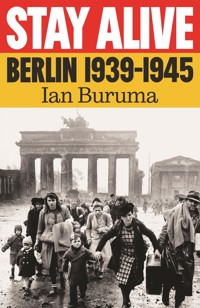
'A captivating mosaic of wartime Berlin' Katja Hoyer, Financial Times When war broke out in September 1939, what was most striking in the German capital at first was how little changed. Unless you were Jewish. Then life, already hard, soon got unfathomably worse. Drawing on diaries, letters and memoirs, Stay Alive chronicles daily life in wartime Berlin with extraordinary power and immediacy. Here are the movie stars and swing dancers, the resistance circles and SS patrols hunting deserters, the desperate calculations of survival and collaboration. As Allied bombs reduced the city to rubble and Soviet troops closed in, the common greeting of Berliners became not auf Wiedersehen or Heil Hitler but bleiben Sie übrig - 'Stay alive'. Revelatory, devastating and deeply humane, this book illuminates how ordinary people navigated the moral catastrophe of the Third Reich - what it meant to resist, to conform or simply to endure. Buruma shows how a society's accommodation to evil unfolds one compromise at a time, and why understanding this descent remains urgently relevant today.
Sie lesen das E-Book in den Legimi-Apps auf:
Seitenzahl: 603
Veröffentlichungsjahr: 2026
Das E-Book (TTS) können Sie hören im Abo „Legimi Premium” in Legimi-Apps auf:
Ähnliche








STAY ALIVE
‘Ian Buruma brings to life Berlin during World War II so vividly that you can imagine yourself blithely strolling the streets of the city or hunkering down in the bomb shelters. Buruma tapped a wealth of sources—not only published memoirs, but first-hand interviews with elderly survivors and a cache of letters stored in a tin written by Buruma’s own father, a forced laborer in Berlin during the war. The beauty of the book is Buruma’s nuanced writing about the Germans who weighed resistance against the imperative to stay alive, and those who simply became cogs in Hitler’s murderous regime. As the author of the definitive book about post-Germany and Japan, The Wages of Guilt, Buruma is uniquely qualified to take on these still-relevant questions of morality.’ Barbara Demick, author of Daughters of the Bamboo Grove and Nothing to Envy
‘In wartime Berlin it was possible to find every form of human behavior, from conformity and cruelty to bravery and indifference. Using his father’s memories and letters as well as a wide range of other sources, Ian Buruma has composed a brilliant account of what it felt like to be there. Stay Alive is a beautifully written account of a city under military and moral siege.’ Professor Anne Applebaum, author of Autocracy Inc.
‘Ian Buruma, renowned for his enduring work about German and Japanese guilt and complicity during World War II, now adds a searing chronicle of wartime Berlin, told in part through the experience of his own Dutch father there. Beautifully written and deeply researched, Stay Alive is particularly haunting in showing how ordinary Germans conformed with Nazism and the persecution and deportation of their Jewish neighbors. It makes a chilling warning of how people can acquiesce and look away from the worst realities.’ Gary Bass, author of Judgment at Tokyo: World War II on Trial and the Making of Modern Asia
‘An exceptional excursion into the multiple, contradictory lives, voices and dilemmas of Berlin’s inhabitants during the Nazi war years, almost hallucinatory in its incessant matter-of-factness. By providing a compelling and compulsive immersion into that crucial period of history, Buruma also eloquently reminds us of how, in our own time, the temptation to look away from persecution and injustice has terrifying consequences.’ Ariel Dorfman, author of Death and the Maiden and The Suicide Museum
ALSO BY IAN BURUMA
Spinoza: Freedom’s Messiah
The Collaborators: Deception and Survival in World War II
The Churchill Complex: The Rise and Fall of the Special Relationship fromWinston and FDR to Trump and Johnson
A Tokyo Romance
Their Promised Land: My Grandparents in Love and War
Theater of Cruelty: Art, Film, and the Shadows of War
Year Zero: A History of 1945
Taming the Gods: Religion and Democracy on Three Continents
The China Lover
Murder in Amsterdam: The Death of Theo van Gogh and the Limits of Tolerance
Occidentalism: The West in the Eyes of Its Enemies (with Avishai Margalit)
Inventing Japan: 1853–1964
Bad Elements: Chinese Rebels from Los Angeles to Beijing
Anglomania: A European Love Affair
The Missionary and the Libertine: Love and War in East and West
The Wages of Guilt: Memories of War in Germany and Japan
Playing the Game
God’s Dust: A Modern Asian Journey
Behind the Mask: On Sexual Demons, Sacred Mothers, Transvestites, Gangsters,Drifters and Other Japanese Cultural Heroes
The Japanese Tattoo (text by Donald Richie; photographs by Ian Buruma)
First published in the United States in 2026 by Penguin Press, an imprint ofPenguin Random House LLC, 1745 Broadway, New York, NY 10019.
First published in hardback in Great Britain in 2026 by Atlantic Books,an imprint of Atlantic Books Ltd.
Copyright © Ian Buruma, 2026
The moral right of Ian Buruma to be identified as the author of this work has beenasserted by him in accordance with the Copyright, Designs and Patents Act of 1988.
All rights reserved. No part of this publication may be reproduced, stored in aretrieval system, or transmitted in any form or by any means, electronic, mechanical,photocopying, recording, or otherwise, without the prior permission of both thecopyright owner and the above publisher of this book.
No part of this book may be used in any manner in the learning, training ordevelopment of generative artificial intelligence technologies (including but notlimited to machine learning models and large language models (LLMs)), whetherby data scraping, data mining or use in any way to create or form a part of datasets or in any other way.
The picture acknowledgements on pp. 367–8 constitute an extension of thiscopyright page.
Every effort has been made to trace or contact all copyright holders. The publisherswill be pleased to make good any omissions or rectify any mistakes brought to theirattention at the earliest opportunity.
10 9 8 7 6 5 4 3 2 1
A CIP catalogue record for this book is available from the British Library.
Hardback ISBN: 978 1 80546 289 7
E-book ISBN: 978 1 80546 290 3
Printed in Great Britain
Atlantic Books
An imprint of Atlantic Books LtdOrmond House
26–27 Boswell StreetLondon
WC1N 3JZ
www.atlantic-books.co.uk
Product safety EU representative: Authorised Rep Compliance Ltd., Ground Floor,71 Lower Baggot Street, Dublin, D02 P593, Ireland. www.arccompliance.com
For my sisters, Ann and Hilary
Contents
Introduction
Part One: 1939
Part Two: 1940
Part Three: 1941
Part Four: 1942
Part Five: 1943
Part Six: 1944
Part Seven: 1945
Aftermath
Acknowledgments
Notes
Image Credits
Index
INTRODUCTION
All I knew about Berlin as a child was that Hitler lived there. Hitler and my father. I sometimes asked my father, whose name was Leo, whether he had ever seen Hitler. It was the kind of naïve question a child would ask. People spoke about Hitler in the way people in the past talked about the devil. Of course, this made him seem interesting. My father’s somewhat testy reply was always, no, he hadn’t seen Hitler, nor had he ever had the slightest intention of doing so.
For a long time, my father’s stories about Berlin, where he was forced to work in a factory that made brakes and machine guns from the spring of 1943 until just days before the war ended in May 1945, were the only thing I knew about the German capital. He told me about the filthy flea- and lice-ridden barracks where he and other foreign workers were housed; about the Ukrainian girls he had met—a memory that still brought wistful tears to his eyes— who lived in far worse conditions in an adjacent camp; about the tedium of factory work; and about the terror and exhaustion from Allied bombing raids that went on day and night—US Eighth Air Force B-17 bombers by day, and RAF Lancasters and Halifaxes at night. A common way for Berliners to say goodbye was no longer auf Wiedersehen, or Heil Hitler, but bleiben Sie übrig, stay alive.
I still have an album of small black-and-white photographs that fascinated me as a young boy. It contains an identity picture of my barely twenty-year-old father, taken on arrival at his first camp, Rehbrücke, near Potsdam. My father deliberately screwed up his face in a grotesque grimace, as a small and wholly ineffective gesture of protest at his being there, making him look demented. There are photographs of my father and fellow students from Holland who shared his fate, standing in front of the wooden barracks of their camp in Lichtenberg, in East Berlin, many of them still dressed in shabby suits and ties, some smoking pipes. There are pictures of the same students carrying tin bowls to collect their daily rations of watery vegetable soup. There is a picture of friends being buried after being unlucky in one of the bombing raids. There are portraits of some of the Ukrainian girls, named Walja, Nadja, and Anna, as well as of a Red Army officer, named Valentin Sumkin, which must have been taken after my father was liberated by General Georgy Zhukov’s Red Army in May 1945.
When my father finally left Berlin in a Soviet army truck that picked him up from a displaced-persons camp near Karlshorst in the east of the city, Berlin was a sea of smoking rubble, the buildings still left standing little more than hollowed-out facades. The pompous monuments of Hitler’s Reich, his chancellery, the Gestapo headquarters on Prinz-Albrecht-Strasse, the People’s Court on Bellevuestrasse, where Nazi show trials were held, were bombed-out hulks, the remaining walls pockmarked by Russian artillery shells. Almost nothing was left of the metropolis that my father had entered in the spring of 1943.
Dutch students in the forced labor camp, Berlin. Leo is fourth from left.
My first visit to Berlin in 1972 was also my father’s first return since he left those ruins behind on a Soviet army truck in 1945. The Knorr-Bremse brakes and arms factory on Neue Bahnhofstrasse, in the Communist half of Berlin, still loomed in all its forbidding redbrick Wilhelminian pomp. It was a bleak, cold December day, when my father, with a visible air of satisfaction, parked his rather fancy Citroën car outside the building where he was once compelled to work for the German war industry. Since much of East Berlin remained in a semi-ruined state at the time, the barracks where my father was housed were still there. Today there is nothing left of the past. The area is still relatively poor, with broken beer bottles lying about the grungy streets, but the former workers’ camp lies buried under cheap apartment buildings.
My father, or Leo, as I shall call him from here on, was lucky to have survived his three-year stint in Berlin. Unlike my mother, he wasn’t Jewish, which saved him from deportation to a far worse place. In 1941, he was a law student in the Netherlands under German occupation. Two years later, when most young German men were conscripted to fight in the war, there was an acute shortage of labor in Germany. Foreign workers had to be drafted to keep German industry going. Some men from France, Belgium, Holland, and other occupied countries had already volunteered. But most people had to be forced to go. Students were compelled to sign an oath of loyalty to the Nazi regime, promising not to engage in any act of resistance against the occupation authorities. If you signed, you could delay labor in Germany until after your graduation. Those who refused would be sent to work in Germany forthwith. Eighty-six percent of Dutch students, including Leo, refused, and went into hiding. Then something went badly wrong in his case. For reasons he was never able to find out, Leo was told by a member of the student resistance that he should return to his hometown. Upon arrival at the railway station in Arnhem, he and his father were surrounded by German police. An announcement was made through loudspeakers that men who refused to sign on for labor in Germany would not only be punished severely, but their parents would be arrested as well. After much arguing back and forth with his father on the station platform, Leo felt he could not take the risk, especially since his father was not well at the time. And so, in the summer of 1943, he became one of the more than four hundred thousand foreign workers in Berlin, spread around more than a thousand labor camps.
First he was taken, together with other students, to Kamp Erika, a concentration camp near the Dutch-German border. Erika had once been a center for spiritual followers of the Indian guru Krishnamurti. During the war it was used mostly to train Dutch SS guards, criminal types who were encouraged to torment the prisoners in any way they wished. Most students who had refused to sign the loyalty oath passed through Kamp Erika. Leo witnessed some of this viciousness, but did not mention it in his first postcard to his parents. He didn’t wish to upset them, and every missive would have been scrutinized by Nazi censors.
Leo kept this postcard in a tin box, with hundreds of other letters, which I paid attention to only after his death in 2020. These were his letters from Berlin, sent from the day of his arrival until the fall of 1944, when his hometown of Nijmegen was liberated by British, Polish, American, and Canadian troops during the Battle of Arnhem and postal services from Berlin were cut off. Like that first postcard from Kamp Erika, in which he refrains from mentioning the brutality of the guards, these letters must be read with care. Leo was always aware of the censors, and of the need to shield his parents from worrying too much.
His experience as an unwilling worker in wartime Berlin haunted him for the rest of his life. Had he made the right decision? Should he have tried to escape from that railway station in Arnhem? He knew that some of the men of his age who had managed to remain in hiding regarded the workers in Germany as morally compromised. He also learned quickly from experience that life under dictatorship and occupation throws up all kinds of moral dilemmas. Not everyone is cut out to be a hero; and even heroes are not always morally pure. Compromises come with a price, however, some of which are more acceptable than others. Some men who volunteered to work in Nazi Germany actually joined the resistance. And some forced workers managed to escape, but at the cost of harsh reprisals against the men who stayed behind.
Foreign workers in Berlin were discouraged from “fraternizing” with the German population. Nor did most forced workers have much desire to do so. Personal relations with Russians, Poles, Ukrainians, and other “inferior races” were strictly forbidden, which must have made Leo’s liaisons with Ukrainian women risky. He did know some Germans, however. Someone, I don’t know who, must have introduced him to the widow of a German Jew, in whose house he stayed at the very end of the war, when he was almost killed by Soviet soldiers.
Many people after the war, especially in the Netherlands, hated all Germans. Leo certainly hated Nazis, but he never hated all Germans. This might sound paradoxical, but I think it was partly the result of being forced to live among them. The only Germans that people in occupied countries would encounter were Nazi officials, soldiers, Gestapo, or the SS. To people who refused to collaborate, every German was the enemy. In Berlin, during the war, the picture would have been more complicated. Even without wishing to fraternize, one would have met Germans who were not Nazis. Some Germans managed to remain decent, when decency could be very dangerous.
German civilians were in a different situation than foreigners forced to work in Berlin, even if many foreign workers, unlike POWs or concentration camp prisoners, were not strictly speaking slaves, since they were paid a salary— not as much as German workers, but something. The position of the small number of remaining Jews, either in hiding or saved from immediate deportation by marriage to a Gentile, was of a different order altogether. But many German people living in the capital of the Third Reich were faced with moral dilemmas too. There were fanatical Nazis, of course, who worshipped their Führer and cheered on every criminal move. There were the opportunists who snatched at any chance to better themselves at the cost of others, the petty clerks strutting in brown shirts and shiny boots, the pompous Nazi professors, the cynical lawyers, and the mediocre bullies who were given license to do their worst. Most people were, however, neither cynics, nor bullies, nor ideological fanatics; they simply conformed, did what was asked of them, averted their gaze from any unpleasantness, and pretended not to know what happened to people who suddenly disappeared in the night. But for others, who wanted to do right, there were life-and-death dilemmas: Should they risk the lives of their own families by hiding a Jew? Should they actively resist the regime they abhorred, a decision that was likely to end in torture and death? Some moral choices were perhaps less consequential, but still hard to negotiate. How could a journalist, a novelist, a writer, an actor, a filmmaker, continue to make a living, and still remain decent, in a state where all cultural and media organizations were controlled by the Nazis? We know from wartime diaries that Germans who hated the Nazis as much as people under German occupation were tormented by a range of conflicting emotions. Worried about a father or brother dying in a war they opposed, and threatened by the bombs dropped by countries whose victories they craved, they lived in constant fear of their own government.
Such German anxieties don’t enter into my father’s letters home. They wouldn’t have concerned him. His own survival was precarious enough, and even mentioning German attitudes about the Nazi regime would have aroused the hostile attention of the censors. But without his being specific, it is clear from Leo’s letters that some Germans did remain decent, while many others did not. He was not a sympathetic observer of life in wartime Berlin, but he was a curious one. Even though he was forced to work for the enemy, Leo was after all also a provincial Dutch student living in a metropolis for the first time in his life. And within certain limits he could roam around in his free time, when he was not too exhausted from sleepless nights in makeshift bomb shelters, and observe what was going on in concert halls, cinemas, cafés and bars, football stadiums, railway stations, and public parks. There is much that escaped his attention, and much he couldn’t tell, but even his partial view offers an extraordinary glimpse of what life was like in the center of a murderous regime at war.
The bundles of letters in the tin box first gave me the idea of writing a book about the way people lived in a great city that had only recently been famous, and to some notorious, for its sexual and artistic freedom, its extraordinary flowering of culture, and its intellectual and scientific sophistication, but ended up being pummeled to destruction because of the evil forces its rulers had unleashed. Few modern European capitals have been written about more than Berlin, apart perhaps from Paris. Berlin of the 1920s, with its brothels and cabarets, its daring intellectual magazines and newspapers, its expressionist art and movies, its poetry and its rich musical life, has been celebrated by devotees in countless books, musicals, and films. Much has also been written about the menacing 1930s, W. H. Auden’s “low dishonest decade,” when Hitler grabbed total power and the Nazis tightened the screws on a population that was both seduced and terrorized, and in the case of the Jews, viciously persecuted. Far less attention has been paid to the war years in Berlin, when the catastrophe that the Nazis had set in motion reached its climax. Perhaps liberal German writers shy away from it to avoid any hint of national self-pity. I wanted to know more about life in the city that marked my father’s life.
I am writing these lines even as another brutal war is being fought on European soil. Some things I read about Russia bear an uncanny resemblance to what I was finding in the newspapers and magazines of wartime Berlin. Vladimir Putin, just like Joseph Goebbels in the early war years, is trying hard to make life for middle-class Muscovites appear as normal as possible, even as Russian troops are causing bloody mayhem in a neighboring country. He is encouraging ordinary Russians to avert their gaze and pretend they don’t know what is happening in their name. But in a world where democracy is on retreat and the poison of violence is sickening the politics in some of the oldest liberal states, Russians are not the only people faced with the moral dilemmas of authoritarianism. If there is a warning contained in the following chapters, it is not just about the human capacity for cruelty, as well as bravery, which is hardly news, but about the temptation to look away.
Part One
1939
One
POLAND REJECTS PEACE!POLISH ATTACKS ON THE REICH!!RADIO GLEIWITZ OCCUPIED!
Headlines in the Berliner Lokal-Anzeiger, apopular Berlin newspaper, September 1, 1939
These were complete lies. The beginning of World War II began as a deadly theatrical performance staged by the SS. Hitler wanted to invade Poland, so an excuse had to be invented. Poles were cast as the aggressors. On the night of August 31, in an operation named “Grandmother Died,” the Gleiwitz radio station on the German side of the Polish border was “attacked” by German agents disguised in Polish uniforms. A brief anti-German message was broadcast in Polish. To make the imaginary act of Polish aggression seem more plausible, the corpses of a few “Polish” attackers were left on the site. They were in fact murdered concentration camp prisoners dressed up as Poles.
Similar deceptions were staged at other places along the Polish-German border, an area where Polish- and German-speaking populations had been at home for centuries, not always amicably. In a place named Hochlinden, not far from Gleiwitz, a German customs post was attacked on the same night by a number of men in Polish army uniforms. (They also sported heavy beards and sideburns, to make them look more “Polish”—in German eyes, that is.) A show was made of repulsing the attack by men dressed up as German border guards. All of them were Nazi commandos. Again, a few unfortunate concentration camp prisoners were forced to play their roles as Polish soldiers killed in the make-believe skirmish. Photographs of the murdered men were sent to Berlin as evidence of Polish belligerence.
At ten o’clock, on the following night, Hitler, dressed in the grayish-green uniform of the German army, the Wehrmacht, made a speech to members of the Reichstag, a rubber-stamp parliament now hastily assembled in the Kroll Opera House in Berlin’s Tiergarten district. Since the Reichstag building itself had been heavily damaged in 1933 by an arson attack that the Nazis might have staged themselves as an excuse to crack down on political opponents, the opera house now had to do. Many seats were empty, since their occupants were away on military duty. The stage, upon which great new music by Hindemith and Schoenberg had once been performed, now had a gaudy backdrop of a giant eagle with a swastika in its claws, flanked by massive red, white, and black Nazi flags. When Hitler’s speech reached its sweaty, fist-shaking climax of screaming bombast, the uniformed delegates stomped and cheered like brawlers in a beer hall. Hitler claimed that Germany had had no choice but to respond to Polish hostility with maximum force. “This night,” he barked, “for the first time, Polish regular soldiers fired on our territory. Since 5:45 a.m. we have been returning the fire, and from now on bombs will be met by bombs.”
Hitler’s speech in the Kroll Opera House
Hitler’s speech was broadcast on the radio, and through loudspeakers in the streets. The Berliner Lokal-Anzeiger described the scene around the opera house: “The night of August 31 and September 1 was a short one for Berliners. . . . Long after midnight, thousands of people stood on Wilhelmplatz to be near their Führer, as they always do at decisive hours for the German Volk.” The next day, warm late-summer weather had given way to gray skies. The city was relatively calm. People went about their normal business. By nightfall, however, “columns of SA [Brownshirts] and SS men came marching in to form an honor guard, and Berliners stood behind this brown and black honor guard to get a glimpse of the Führer and his loyal officials, and especially to hear his long-awaited speech to the Reichstag. . . . Every time one of the Nazi leaders was recognized by the crowd, he was greeted with a storm of applause.” There was Field Marshal Hermann Goering, smirking in his black Mercedes with satin furnishing, holding his diamond-studded baton; there was beetle-browed Rudolph Hess; and there was Joachim von Ribbentrop, the former champagne salesman now strutting around like a great statesman in a black SS uniform. The report continues: “The crowd became more excited by the minute until the Führer’s car, followed by his entourage, left the chancellery. The crowd exploded in a terrific storm of cheers. On this fateful day for the German people, the Führer once again inspired the stormy passion of Berliners.”
“Storm” (Sturm) and “stormy” (stürmisch), like “fanatical” ( fanatisch), were among the most common clichés in the Nazi lexicon.
This report, too, was a lie. Witnesses to the event were struck by the empty streets, the sparse crowds, and an atmosphere of glum indifference, or tense foreboding. When the invasion of Poland, which failed to arouse the kind of “stormy” enthusiasm reported in the Nazi press, provoked declarations of war by Britain and France on September 3, the mood was even more anxious. The patriotic fervor that had greeted the early stages of World War I in 1914 was nowhere to be seen. William Shirer, Berlin correspondent for CBS radio, was there, on Wilhelmplatz, “when the loudspeakers suddenly announced that England had declared herself at war with Germany. Some two hundred and fifty people were standing there in the sun. They listened attentively to the announcement. When it was finished there was not a murmur. They just stood there as they were before. Stunned. The people cannot realize yet that Hitler has led them into a world war. No issue has been created for them yet, though as this day wears on, it is plain that ‘Albion’s perfidy’ will become the issue, as it did in 1914.”
And yet, it was different this time. In Shirer’s words: “Today, no excitement, no hurrahs, no cheering, no throwing of flowers, no war fever, no war hysteria. There is not even hate for the French and British—despite Hitler’s proclamations to the people, the party, the East Army, the West Army, accusing the ‘English warmongers and capitalistic Jews’ of starting this war.”1
Helmuth James von Moltke, a young lawyer, Prussian aristocrat, British on his mother’s side, and a convinced anti-Nazi (for which he would pay with his life just months before the end of the war), wrote in a letter to his wife, Freya, that he had seen Nevile Henderson, the British ambassador, emerge from the German foreign office on Wilhelmstrasse on September 3, after Britain declared war: “There were about three hundred to four hundred people, but no sound of disapproval, no whistling, not a word to be heard; you felt that they might applaud any moment. Quite incomprehensible.”2
These are of course just impressions. Quite what most Berliners really thought at the time is hard to know. Berlin was a cosmopolitan city, full of leftists, artists, radicals, and minorities. Hitler never trusted Berliners. And many Berliners didn’t trust him, or indeed any central authority bossing them around. But since 1933, they were not free to talk, and there were obviously no opinion polls. There were convinced Nazis and Hitler worshippers, as well as many people who tried to get along by keeping their heads down. There were Berliners who hated everything about the Nazis, and a tiny number who would risk everything to actively resist them.
I used to know an eccentric figure in Berlin named Nicolaus Sombart. A sociologist, a dandy, a Francophile, and a literary man-about-town, he became best known in Berlin cultural circles in the 1980s and ’90s for his Sunday afternoon salons, where tea and cakes were served in the spacious drawing room of his nineteenth-century apartment filled with heavy oak furniture and thick rugs on the parquet floor. One might meet scholars, celebrated novelists, artists, and pretty young women, often of Russian or Eastern European origin. His father, Werner Sombart, had been a famous academic star of late nineteenth- and early twentieth-century Germany, whose conservative critiques of capitalism, which he associated with the “Jewish spirit,” helped prepare the way for National Socialism, even though Professor Sombart himself was far too refined and fastidious to join the ranks of what he saw as a crude and plebeian movement. To his son, Nicolaus, Werner Sombart represented the finest intellectual tradition of pre-Nazi Germany, a tradition of musical, artistic, and academic excellence carried by the cultivated upper-middle-class.
The first day of war was still vivid in Nicolaus’s mind. He and his fellow pupils of a posh Gymnasium, or grammar school, listened to a patriotic speech by the school principal, followed by raised arms and cries of “Sieg Heil!” The pupils were then dismissed to enjoy the day off. Nicolaus rushed up the wooden stairs of his family home to his father’s study. The venerable scholar was surprised to see his son back so early. The boy could barely contain his excitement; he was bursting to tell his father the news: “Hitler has declared war on Poland. Our German army has been marching into Poland since this morning!” Whereupon, the old man slowly removed his pince-nez. “Do you realize what this means?” “Of course,” Nicolaus replied, “it means victory.” A long silence. His father shook his head: “It means the end of Germany.”3
Nicolaus claimed that his father’s reaction was typical of most people in the comfortable suburb of Berlin where they lived. Grunewald, with its huge fin de siècle villas, some built in the style of Gothic castles or mock Tudor manor houses, and its fine woods and lovely lakes, was a place where famous professors felt at home, as well as diplomats, bankers, and wealthy businessmen, quite a few of whom were of Jewish origin. The Jewish industrialist and statesman Walther Rathenau had lived in Grunewald, in a grand pastel-colored classicist villa. He was assassinated by right-wing fanatics in 1922, while being driven down Königsallee in his open car. Grunewald station, with its replica of a rustic nineteenth-century gate, was where many Berlin Jews would be pushed onto the trains bound for the death camps in Poland, after being marched through the pleasant tree-lined streets. These marches took place in clear sight of the people who lived in the area, some of whom would have read newspaper articles such as this one in the Berliner Lokal-Anzeiger of September 19, 1939. “The Jews’ War!” was the headline. It continued in the clichéd style of newspaper propaganda: “It has become an open secret that world Jewry and international high finance pushed us into a world war which they secretly caused. . . . Germany must declare a merciless war on our number one archenemy, and let one thing be very clear: We will wage this war . . .”
No doubt, some people in Grunewald despaired like Werner Sombart. Nicolaus had already witnessed how Jewish schoolmates suddenly vanished after 1938, when Jews were no longer allowed to attend public schools. He saw the For Sale signs in front of houses whose inhabitants had had to leave precipitously. Fine real estate was often grabbed for nothing, or for a pittance, by Nazi bosses. (Some of these same houses are now the property of hugely wealthy Russian oligarchs.) Once-great gardens had gone to seed. Certain family friends no longer came to the tea parties held by Nicolaus’s mother on Sunday afternoons. The more fortunate ones were now in London, or Paris, or New York. Since April 1939, Berlin Jews had been forced to live in designated “Jew houses” ( Judenhaüser), stuffed into tiny sordid apartments shared with other families. One of them was a relative of mine, named Hedwig Ems (“Tante Hedwig”), who, like other Jews in Berlin, was also ordered to hand over personal possessions, such as electrical appliances, artworks, furs, radios, silver, and gold. (An exception was made for gold tooth fillings, which were, so far, exempted.) In some cases, friends and neighbors offered to take care of these items, even if they had no room for them. Fine Persian carpets were kept in garden sheds and silver candelabras in dank cellars. Only rarely did these possessions ever find their way back into the hands of the original owners. And much of this happened even before German troops left for Poland in railway carriages bearing slogans daubed in white paint that read “Leaving for Poland, to kick the Jews.”
Ruth Andreas-Friedrich, a journalist, not Jewish, was editing a magazine for young women when the war broke out. In her circle of friends—doctors, lawyers, journalists, musicians, writers, all solid members of the German upper bourgeoisie—there were quite a few “unreliables” in Nazi eyes. Her partner since 1931, the Russian German orchestra conductor Leo Borchard, who had once conducted the Berlin Philharmonic, was banned from performing in 1935: “politically unreliable.” In 1938, Andreas-Friedrich, Borchard, and a circle of friends had formed a resistance group called Uncle Emil. Their main task was to protect Jews and help them escape. On September 1, the couple was invited over for tea by a lawyer, named Günther Flamm. Flamm, too, had been deprived of his job as an “unreliable.” Like Borchard, he had to make ends meet as a private teacher. Flamm was in a somber mood. “This is going to be a long war,” he said. “Heaven knows who’ll be left alive at the end.” “Certainly not Mr. Hitler,” said Ruth. “What good will that do us,” said Flamm, “if we bite the dust before he does?”4
Ruth Andreas-Friedrich and Leo Borchard
In Dahlem, another wealthy suburb, not so far from the comfortable Sombart residence in Grunewald, lived Christabel Bielenberg, an upper-class British woman (her mother was the sister of Alfred Harmsworth, 1st Viscount Northcliffe, the newspaper tycoon). After marrying a German lawyer named Peter Bielenberg in 1934, just a year after Hitler seized power, she became a German citizen. Both she and her husband were anti-Nazis, and friends of Helmuth von Moltke. She wrote in her memoir: “On the night after hearing that war had broken out between England and Germany I could not sleep.” She felt very alone, “having somehow landed myself rather precariously straddling a fence. I was not apprehensive, life had been too good to me for that. I knew too that I was blessed with natural optimism and that my own interpretation of a simple Christian upbringing had provided me with a sturdy conviction as to the ultimate triumph of good over evil. In national terms, I had the sneaking feeling that by ‘good’ I had things British in mind, by ‘evil’ any foreigner stupid enough to dispute the matter.”5 One didn’t necessarily have to be British-born to have similar feelings.
Heinz “Coco” Schumann was a young guitarist with a great love of jazz, which Nazis tried to ban as “Niggermusik,” an art form that supposedly presented a severe threat to the healthy morals of the German Volk. That his mother was Jewish would not necessarily have been a fatal problem, but because his Gentile father converted to the Jewish faith, the son was counted as a so-called Geltungsjude, a child of a mixed marriage who was classified as a Jew.
Coco Schumann
American jazz music was forbidden on the radio, but fans still had access to it. One of the oddities of Hitler’s Reich was that until September 1939, records by Black and Jewish musicians from Britain and the US, such as Benny Goodman and Louis Armstrong, were still widely available, as were foreign newspapers and Coca-Cola—a hugely popular soft drink on sale and widely advertised in Nazi Germany until war was declared on the US in December 1941. Coco was part of the so-called Swingjugend (Swing Youths), jazz fans and musicians who adopted names like Teddy, Whisky-Bill, or Old Hot Boy, and danced in Berlin clubs, such as Delphi-Palast, Faun, and Kakadu. They liked to greet each other with a jaunty “Swing Heil!” On the night of September 1, Coco and his friends were playing and singing on the bank of the Lietzensee, in Charlottenburg. They spent the rest of the night listening to a nineteen-year-old jazz violinist at the Melody Bar on Kurfürstendamm. Even though Goebbels had banned public dancing for the time being, they sang, and played, and danced, as though there were no war on at all.
One could say that none of these people represented anything like the norm in Berlin in September 1939. They were “unreliables”: Jews, lovers of Jews, refined old-school intellectuals, foreigners, and jazz fans. None of them had any sympathy for the Nazis. They certainly were not excited by the war. But there was little active resistance to the war either, not yet. Some isolated Communists left a few leaflets in telephone booths calling for protest: “Youth of Berlin, be angry and resist!”6 But this truly was exceptional. The intrepid distributors of the leaflets were soon picked up by the Gestapo and tortured.
Others, who didn’t approve of the Nazis, kept their mouths shut, out of fear, or out of patriotic feelings they could not quite shake off. The devoutly religious poet and writer Jochen Klepper, son of a Lutheran minister, had many reasons to hate the Nazis. He had married a Jewish woman and was dismissed from his job at the radio in 1933 as an “unreliable.” Even though his wife, Johanna, had converted to the Christian faith just before their church wedding in 1938, they were not safe. When they were unable to leave Germany in 1942, Klepper, his wife, and their daughter killed themselves by turning on the gas in their kitchen. But in 1939, Klepper wrote: “We cannot hope for the downfall of Germany out of bitterness against the Third Reich, as many people do. That is absolutely impossible. Now that we are being threatened from outside, we cannot hope for a rebellion or a coup.”7
One more example, a little extreme but by no means unique: Erich Alenfeld, a former banker from a family of distinguished Jewish bankers, was married to a Gentile woman named Sabine. He converted to the Christian faith in the 1930s, again not at all unusual. Both were members of the Lutheran Confessing Church, founded by the anti-Nazi pastor Martin Niemöller. Their redbrick Paulus Church, where they worshipped in 1939, still stands in Zehlendorf, near the street where they once lived. Although marriage to a non-Jewish woman protected him from the worst anti-Jewish measures (they didn’t have to move to a “Jew house”), Alenfeld, a proud Prussian patriot who had been decorated for his bravery in World War I, had been robbed of his profession and was shunned by most of his non-Jewish friends. And yet, astonishingly, just days before the invasion of Poland, he wrote to his wife that he would send a letter to Hermann Goering personally to ask whether he could serve in the German army. “Don’t be shocked,” he said, “I want to live and die in honor, and save my children from my disgrace.”8 Goering didn’t bother to reply.
It may be true, as some foreign witnesses reported, that ordinary Berlin workingmen refused to greet each other with Heil Hitler! and cracked jokes about the Führer’s absurdities, Goebbels’s club foot, and fat Goering’s ridiculous posturing. The popular mood may have been anxious rather than militant at the start of the war. But after the shock of the first days of war, most people returned to their jobs and life appeared relatively normal on the surface.
But certainly not for everyone. An almost daily dose of vicious propaganda, mainly against the Poles, made sure of that. In a letter to the press from Goebbels’s Reich Ministry of Propaganda (popularly known as the “Promi”) the message was clear: “Everyone in Germany, down to the lowest milkmaid, should be convinced that to be Polish is to be an inferior specimen. That should be the constant lesson . . . pressed home until every German citizen has the code in his subconscious that every Pole—whether he is a worker or an intellectual—must be treated like vermin.”9
The story of one man, a property developer named Leon Szalet, shows that the propaganda had left its mark and violence lay very close to the surface.
Szalet was a Polish Jew, born in Warsaw. He moved to Berlin in 1921, when he was twenty-nine years old. Knowing perfectly well that Berlin had become a very dangerous place for him after Hitler took over, he had tried to escape in August 1939 by boarding a plane to Britain without a visa. Officious British immigration officials, convinced that they had to do things by the book, sent him straight back to Germany. On September 13, on the eve of Yom Kippur, the Jewish Day of Atonement, Szalet was arrested with several hundred other Polish Jews living in Berlin, some of whom were old and infirm, and many of whom were Polish nationals born in Germany, who might not even have spoken much Polish. They were locked up at the main police station on Alexanderplatz. The “Alex” was usually where “enemies of the Reich” were taken, before being transported to far worse places. Police officers at the Alex happened to be listening to a radio broadcast about alleged Polish atrocities committed against the German population. They turned to the prisoners and made menacing remarks about blood that was bound to flow.
One case in particular was given great play by the Promi. On September 3, two days after the German invasion of Poland, fights broke out in the town of Bromberg (Bydgoszcz in Polish) between Polish soldiers and local Nazi supporters, who were of German origin. A military conflict escalated into ethnic violence between neighbors. Several hundred Germans were killed in the violence, and about fifty Poles. The event caused a sensation in the German press and became known as Bromberg Bloody Sunday. In later speeches, Hitler ramped up the number of German dead to fifty-eight thousand, an entirely fictitious number. This was just one more horror story in a barrage of anti-Polish propaganda on radio and in the newspapers.
Szalet and the Polish Jews arrested with him were now cast as the “Bromberg murderers.” They were kicked, punched, and shoved onto trucks, taken to a large railway station, the Stettiner Bahnhof, and transported from there to the Sachsenhausen concentration camp, in the Berlin suburb of Oranienburg, where they were brutally assaulted by the SS upon arrival. When pious Jews, after being made to undress, were discovered to have tefillin, small black boxes containing tiny Torah scrolls on leather straps wrapped around their arms, they were savagely beaten, forced to watch as laughing guards spat on the scrolls, and made to dance while the guards jeered at the wounded men by making sheep-like noises and pulling them around by their beards. Much worse was to follow. One of the ways in which prisoners at Sachsenhausen were tortured was to force them to run for hours in shoes that were too small for them, so their feet would be reduced to a bloody pulp, causing excruciating pain. People who collapsed were often clubbed to death.
But the most shocking part of Szalet’s story is not the barbarous behavior of the SS guards, which was only to be expected. Ordinary German citizens, the people who were supposedly indifferent or even hostile to the war that Hitler began, behaved almost as badly, and this in the center of Berlin, as well as in a respectable suburb of twenty-five thousand people. Berliners had been aware of Sachsenhausen since 1933, when it was built on the spot of a former brewery. That terrible things happened there, as well as in more than one hundred other smaller torture camps all over Berlin, run by SS or SA storm troopers, often in working-class areas like Wedding and Neukölln, was also well known. When the Polish Jews, who had already been badly thrashed with clubs, sticks, and rifle butts, arrived on trucks at the Stettiner railway station, a large mob had gathered round. Szalet recalled that “the streets were black with people, in a state of great excitement. A cry went up: ‘The Bromberg murderers! Kill them!’” Szalet didn’t realize at first what this meant. Then he remembered the radio broadcasts. The fact that many of his fellow prisoners had never even been to Poland made no difference at all. The propaganda had spread its poison. Szalet: “The mob had worked itself into a great rage. They were in the grip of typically German mass hysteria. ‘Blood! Vengeance! Blood! Vengeance!’ If the police hadn’t stood on the trucks with their bayonets, the mob would have lynched us.”10
When they were pushed out of the train at the Oranienburg station, near the concentration camp, the prisoners were met by another screaming mob, men and women, some cradling children in their arms: “Kill the Bromberg murderers! Avenge our brothers in Poland! Blood for blood!” Szalet: “The yelling and shouting was just the beginning. We were pelted with stones, bits of wood, nails, dog shit. We were hit in the face, in the eyes. Some of us were blinded and fell over. But we weren’t allowed to help them up. We couldn’t even look back. We just had to keep running.”11
Prisoners in Sachsenhausen
Few prisoners survived the ordeals that awaited them. Szalet was fortunate. His daughter managed to get him released in 1940, and he was able to escape to Italy, from there by ship to Shanghai, and finally to the United States.
Jews weren’t the only prisoners in Sachsenhausen. They weren’t even the majority. Many were political prisoners, or “unreliables”; some were common criminals, murderers, rapists, and robbers, who were given special privileges to terrorize the other prisoners; and some were homosexuals, unlucky to have been caught looking for sex in a public lavatory, or denounced by someone who wished them ill or just wanted to earn a few reichsmarks. Again, here is one case out of many.
Gregor Galla was not an anti-Nazi resister. He worked for a German bank in Madrid. His crime was to have had a relationship with a younger man named Willie B. Their intimate letters had been intercepted by the police. The Berlin Gestapo concluded that they were dealing here with a “corrupter of youth of the worst kind, who urgently needs reeducation in a concentration camp.”12 Galla was a prisoner at Sachsenhausen when Leon Szalet arrived in September 1939. He died a year later, supposedly of pneumonia.
Two
Fall Hat Show
Elegant hunting cap handmade from antelopehair with finely worked pins and veil.
A lovely ostrich feather completes this fine hat madeof hair felt.
A new youthful cap of wool felt. A separate veil madeof wool is attached to the peak.
Advertisement, September 1939, for hats at the AWAGdepartment store on Leipziger Strasse. The store hadoriginally been called Wertheim, after the Jewish familythat owned it, before it was taken over by non-Jewishowners (“Aryanized”) in the 1930s.
After the first week of war, things looked relatively peaceful in the streets of Berlin. The children were back at school. Popular propaganda newsreels in the cinemas, called the Wochenschau, showed German military victories in Poland, but not the bombing of Warsaw, or the mass killing of civilians, often Jews, that had already begun in the first days of the war. Everything was done to prevent panic among the population. Twelve workers were killed in an explosion at the Berlin Asphalt Works, but this was not reported in the press. Neither was a minor bomb attack on Goering’s air ministry. People went to their offices. Orchestras played waltzes and foxtrots in the lobbies of smart hotels. It was hard to secure tables at bars and restaurants, since they were full of people seeking pleasure in grim times. There were horse races on Sundays and football matches at the Olympic Stadium. The cinemas were packed. Goebbels noted with satisfaction on September 30 that “movie and theater attendance has gone up tremendously.” In 1933, Germans had visited the cinema 245 million times. In 1939, that number more than doubled.1
The famous UFA studio, producer of such prewar masterpieces as The Blue Angel (1930), starring Marlene Dietrich and Emil Jannings, and M (1931), with Peter Lorre, the Jewish actor who left for the US in 1934, mostly stayed away from patriotic war movies or Jew-baiting propaganda (even though the viciously antisemitic film, Jud Süss, would be a huge success in the following year). That kind of thing quickly bored most Berliners. The public much preferred sweet operettas and other romantic fare, starring the same stars (minus Jews and “unreliables”) who thrived in better times. Among them: Heinz Rühmann, Theo Lingen, Marika Rökk, Heinrich George, Emil Jannings, and Zarah Leander. Goebbels had tried desperately to lure Marlene Dietrich back from Hollywood with lucrative offers. To her eternal credit, she refused, something that angered many Germans until the day she died. Zarah Leander, who was Swedish, took her place as the great “Aryan” diva. (I clamp “Aryan” between quotation marks, because it was a non-existing racial category invented by racists; for the sake of convenience, I will dispense with the marks henceforth, which doesn’t make the concept any less fictitious.) One of the most successful revivals of 1939 was a frothy operetta entitled Es gibt nur eine Liebe (There Is Only One Love), made in 1933, about a love affair between a simple German typist and a celebrated British singer, named Sir Henry Godwin. Another success was Der Mann mit der Pranke (The Man with the Paw), made in 1935, about a banker in love with his lawyer’s wife.
The biggest hit song of 1939 was featured in a Heinz Rühmann film, Das Paradies der Junggesellen (The Bachelors’ Paradise). The lyrics were perfect for anxious times:
No fear, no fear, Rosmarie, we won’t let our lives be spoiled, no fear, no fear, Rosmarie!
And if the entire earth is quaking and the world is unhinged
That can’t disturb a seaman.
No fear, no fear Rosmarie!
New plays were being written for the theater, often by hacks whose odes to the healthy German spirit would not have had much success in Berlin before 1933. German and foreign classics were widely performed, including Shakespeare’s plays. In September 1939, as well as a play by Goethe (Iphigenia in Tauris) at the Volksbühne, and Tosca at the Volksoper, and Der Opernball (The Opera Ball), an operetta set in nineteenth-century Paris, at the former Metropol Theater, home of the Weimar-period avant-garde, there was also a play by Noël Coward. The pages of the Berliner Illustrirte Zeitung featured photographs of revues and burlesque theaters, with chorus lines of seminude dancers kicking up their legs, Broadway style. On the surface, it would seem, Berlin was still Berlin, and not a huge amount had changed since the free-spirited Weimar days, except, of course, for the free spirit. Cabarets had lost their bite and irreverent wit. The avant-garde experimentation for which Berlin had been famous was dead. What was left were the classics, and a great deal of mostly insipid entertainment, “joyful art in serious times,” as it was described in the Völkischer Beobachter, the main Nazi newspaper. Goebbels wished to keep people amused, their minds off the perils of war. He even allowed many dance places and nightclubs to reopen at the end of September, after the fall of Warsaw, which had claimed the lives of eighteen thousand Polish civilians. Goebbels laid out his policy for the radio, which he saw as “by far the most important instrument to influence the masses.” To instill the right attitude in people was vital, but “not to be boring, not to be tedious. . . . The correct attitude is important, but it doesn’t have to be dull.”2
That people should be going about their normal lives, attending concerts and movies, sunning themselves at the beach on the Wannsee, betting on the horses at the Hoppegarten, dancing to jazz tunes at the Delphi-Palast, even as people were being tortured in the Gestapo cellars on Prinz-Albrecht-Strasse, and murdered or worked to death at Sachsenhausen, is disturbing but should not surprise anyone. Human beings adapt, carry on, turn away from things they don’t wish to hear or see.
Three
Long silky eyelashes and eyebrows add perfect beauty to your face. This can be achieved swiftly by using Eleska Balsom. You will never be disappointed.
Are you too fat? Your thighs? Your ankles? Your calves? Or your face? Use Plumhoff’s fat water. It will penetrate all your fat deposits and is guaranteed to be harmless.
Advertisements in Koralle, a weekly magazinefor “Knowledge, Entertainment,and Joy of Life,” September 1939
A Berliner returns home through the darkened streets. Suddenly a voice behind him: “Halt or I shoot!” Then: “Hand over your briefcase!” Whereupon the greatly relieved Berliner says to the robber: “My God, you gave me a shock. I thought you were the police.”
A joke going the rounds in 1939
In fact, under the somewhat artificial air of normality, things were not normal at all. Citizens of the Third Reich were now living in a war economy, with all the hardships and distortions that implied. A 50 percent income tax hike was decreed for everyone earning more than 2,400 reichsmarks (roughly 1,000 dollars). This applied to about one third of Berlin’s population. (Jews had to “contribute” a quarter of their financial assets to the state, but that was only the beginning of official larceny.) Food, clothes, and other necessities could be acquired only with ration coupons. (Jews had no access to clothes coupons; and they had their own coupons for food, stamped with the letter “J,” which were highly restricted, and could be used to buy food only between four and five in the afternoon, when most stores had sold out all their stock.) Flouting these rules was punished with imprisonment and even in some cases with death.
Listening to foreign radio stations was strictly forbidden. And already before the war in Poland began, the population had been told to prepare for future air raids by turning the basements under their apartment buildings into air-raid shelters, or LSKs, short for Luftshutzkeller. These had to be equipped with sandbags, bunks to sleep on, and some minimal furniture. Jews were separated from the non-Jews, including in the shelters; some people refused to be in the same room with them anyway. So, Jews often had to make do in case of an air raid with the garbage room, or with no shelter at all. In most apartment buildings, they had to stay on the ground floor, exposing them to bomb shrapnel, while their non-Jewish neighbors headed for the basement. The German Reich post office already had been practicing air alarms, with that eerie wailing sound that Berliners would come to fear. Air-raid drills had been practiced since 1937. By 1939, there were seven thousand shelters all over the city.
From September 1, Berliners were also ordered to black out all their windows with curtains and waxed paper. Not a sliver of light was permitted to shine through in shops, stations, restaurants, cinemas, buses and trains, or anywhere else that might attract hostile attention. Car headlights had to be reduced to tiny blue-filtered slits. All street lighting was turned off. To guide people in the streets at night, volunteers drew stripes on the asphalt in white phosphorescent paint; arrows pointed to the nearest air-raid shelters.
There was much less traffic in the streets anyway, since special permits were now required to show that driving a private vehicle served the war effort. Gas stations no longer sold gas to ordinary civilians. Kurt Rasenberger was a Lutheran pastor, who had fought at Verdun in World War I. He had once been a pacifist and was never a member of the Nazi Party, but he, too, believed that Britain and France were the aggressors and Germany had to win the war. I met his son, Johannes (“Hans”), who spoke to me in his old-fashioned Berlin accent, not heard much anymore, particularly in what used to be West Berlin (the East German working class held on to old habits a bit longer). On September 1, Hans told me, the family had to drive home in their family car, a DKW, from their holiday on the Baltic coast. But from one day to the next gas was nowhere to be had. The family was stranded. Kurt Rasenberger had to beg a fireman to share some gas from his truck. He was lucky. They made it back home. But that was the last time Hans saw the family car until 1945, when much of the city lay in ruins. The number of buses and trains—underground as well as the overground S-Bahn—was reduced as well, since many were requisitioned for military use.
Since private transport had become more or less impossible and public transport was curtailed, there was a run on the bicycle stores. Everyone wanted a bike, not a regular form of transport in Berlin before. And you didn’t need a ration coupon to buy one. But one still needed coupons to buy bicycle tires, for rubber had to be imported, and such coupons were available only if you could prove that you needed a bike to get to work.
George Kennan, then assigned to the US embassy in Berlin, described in his memoir what those early days of war were like:
I find it impossible to convey in this sort of account the atmosphere of the great city of Berlin in wartime. It is symbolized for me, in memory, by the recollection I have of my homeward progress as I left my work in the embassy on winter evenings: the groping in pitch blackness from column to column of the Brandenburg Gate, feeling my way by hand after this fashion to the bus stop; the waiting for the dim blue lights of the bus, lightened only by the sweeps of the conductor’s flashlight; the wonder as to how the driver ever found his way over the vast expanse of unmarked, often snowcovered asphalt which that wide and endless street presented; the eerie walk home at the other end, again with much groping and feeling for curbstones; the subdued voices of other pedestrians heard but not seen; and finally the confrontation with the façade of what appeared, from outside its blackout curtains, to be a dark and deserted home; and the ultimate pleasant discovery, always with a tinge of surprise, on opening the door that behind the curtains was light, at least a minimal measure of warmth, at times (when she was not taking the children somewhere) a wife, and a coziness all the more pronounced for the vast darkness and uncertainty of the war that lay outside.1
Kennan, as an American diplomat, was vastly more comfortable than most Berliners, especially when winter set in. In Kennan’s description: “Canals were frozen. Fuel was short. Whole blocks of huge apartment houses could not be heated at all and had to be evacuated in zero weather.”2 (Jews were deprived of coal, and left to freeze in their “Jew houses.”) People also lived in constant fear of busybodies who could have a person arrested for breaking any petty regulation. The lowest-level busybody was the block warden (Block-wart




