


Erhalten Sie Zugang zu diesem und mehr als 300000 Büchern ab EUR 5,99 monatlich.
- Herausgeber: Books on Demand
- Kategorie: Lebensstil
- Serie: Stay young with Qi Gong
- Sprache: Englisch
Qi Gong is part of Traditional Chinese Medicine (TCM) and is practiced by millions of people around the world today. The goal is to maintain body and mind health and thus lead a long, happy life. This is done with a combination of traditional movements, breathing methods and the power of imagination. Everyone can start learning Qi Gong regardless of age, previous knowledge or constitution - ideally today! In this volume, on the practical side, the Bone marrow-Qi Gong and the Embryonic breathing are mainly explained.
Sie lesen das E-Book in den Legimi-Apps auf:
Seitenzahl: 55
Veröffentlichungsjahr: 2023
Das E-Book (TTS) können Sie hören im Abo „Legimi Premium” in Legimi-Apps auf:
Ähnliche
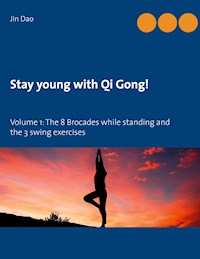










Qi Gong is part of Traditional Chinese Medicine (TCM) and is practiced by millions of people around the world today. The goal is to maintain body and mind health and thus lead a long, happy life. This is done with a combination of traditional movements, breathing methods and the power of imagination. Everyone can start learning Qi Gong regardless of age, previous knowledge or constitution - ideally today!
The author has been teaching Kung Fu and Qi Gong at his own school for many years. He had previously learned both arts from European and Chinese masters. His Qi Gong books contain useful knowledge and practical instructions in a compact, easy-to-understand form. Jin means "today" and Dao means "the way".
CONTENT
INTRODUCTION
GENERAL PART
The Three Treasures
Jing
Qi
Shen
The relationship between the Three Treasures
How can we avoid diseases?
Feng Shui
Qi and plants
Mindfulness
How do I know that my Qi Gong training is successful?
PRACTICAL PART
Bone Marrow-Qi Gong
The importance of the exercises
Bone breathing
Bone compression
Bone marrow washing
Summary of the exercises
Final exercises
Embryonic breathing
The goals of Embryonic breathing
The practice of Embryonic breathing
Summary of the Embryonic breathing
OVERVIEW OF THE PRACTICAL CONTENT OF THE SERIES
Introduction
This book is part of a series in which I try to share my experience in Qi Gong with interested people and enable them to start practicing on their own. I have always based myself on the following structure:
General part - practical part.
The general part includes some basic knowledge that is important for understanding Qi Gong. I concentrated on the essentials and tried to use an understandable expression.
The practical part only contains exercise instructions that I have been practicing successfully for a long time and which I teach in my Qi Gong school. Furthermore, all exercises are suitable for self-study and can be done safely if carried out conscientiously. Of course, the example of a real teacher and practicing in a group where a common energy circle is formed can never be completely replaced.
The instructions given in the volumes in this series are sufficient material for every need and for lifelong practice.
If, in individual cases, any health risks should be expected due to the individual constitution of the practitioner, it is recommended to consult a doctor.
As far as the rendering of Chinese expressions is concerned, I have not opted for a single method of Romanization (e.g. Yale, Wade-Giles), but always for the commonly used and known form.
Someone who has started Qi Gong training will in most cases not want to stop any more. Once you have felt the pleasant feeling of the flow of energy and learned the ability to control your own Qi, not only will you be very satisfied, but our whole life will be positively influenced by it.
A quote from Laozi, the founder of Daoism, from the 6th century BC, reads:
"Even a journey of a thousand miles begins with the first step."
General part
The Three Treasures
In Chinese philosophy, body and mind are merely viewed as different manifestations of Qi. The life energy thus creates both the physical and the psychic components. Furthermore, according to this view, the activity of the organism, i.e. human life itself, consists of certain basic substances. In addition to blood and bodily fluids, which are important as carriers of Qi, these are the so-called Three Treasures (San Bao):
Jing
Qi
Shen.
Until the birth of man, the Three Treasures still represent a unity, which is also referred to as the "prenatal aspect". After that, a separation gradually takes place. This corresponds to the Daoist guiding principle of constant transformation and change (cf. the explanations on Yin and Yang in Volume 3 of this series). However, there is an interaction between Jing, Qi and Shen, so that it is essential for health that they are in a close and harmonious relationship with each other.
A goal of Qi Gong is therefore to collect these three aspects, refine them and transform them back into their original state. This process of refinement and unification is also known as "Inner Alchemy".
Figures 1 and 2 show the Chinese characters for Jing, Qi and Shen and the connections between them.
Figure 1
Figure 2
Jing
Jing can be translated as "essence". Literally translated, the Chinese characters mean "seed" and "purity".
In "Huangdi Neijing Suwen", the "Yellow Emperor's Classic of Internal Medicine" by Huang Di it is said: "Essence is the root of the body". This means that all human vitality, including thoughts, feelings and actions, first of all goes back to our physical substance. Only the basic physical basis allows us all further physical and mental developments. Jing thus stands for the most essential form, i.e. the source, of life energy. At the same time, the essence also has a formative power, since other things grow from it and it gives them structure.
A distinction must be made between the prenatal and the postnatal essence. This corresponds to what we postulated in Volume 2 of this series about the types of Qi. The prenatal part of the life essence is that which was given to us from birth and is stored in the kidneys. It is the driving force, the basis for human development. The postnatal essence is nourished by food, drink and breath and nourishes all physiological activities of the organism.
The physical development of a person is determined by the Jing. In childhood, the Jing provides growth and in young adults for maturation up to the peak of physical performance. With increasing age, it is gradually exhausted, after which physical deterioration begins. These symptoms can be accelerated by bad habits or delayed by a wise lifestyle. For the purpose of cultivating the Jing, among other things, a healthy diet, responsible use of alcohol and sexuality, avoiding emotional stress and practicing Qi Gong are recommended. This topic is dealt with in more detail in the special volume "The Qi Gong Diet".
Qi
Qi




