


Erhalten Sie Zugang zu diesem und mehr als 300000 Büchern ab EUR 5,99 monatlich.
- Herausgeber: Books on Demand
- Kategorie: Lebensstil
- Sprache: Englisch
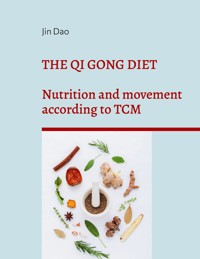
Qi Gong and Dietetics are part of Traditional Chinese Medicine (TCM). The goal of Qi Gong is to maintain the health of body and mind through movement, breathing and imagination, and thus to lead a long, happy life. Dietetics deals with the way food is consumed with the aim of using it to prevent and treat diseases. The holistic approach applies in each case, that physical and psychological aspects influence each other. Qi Gong and Dietetics also lead to weight reduction and an increase in performance.
Sie lesen das E-Book in den Legimi-Apps auf:
Seitenzahl: 56
Veröffentlichungsjahr: 2023
Das E-Book (TTS) können Sie hören im Abo „Legimi Premium” in Legimi-Apps auf:
Ähnliche










Qi Gong and Dietetics are part of Traditional Chinese Medicine (TCM). The goal of Qi Gong is to maintain the health of body and mind through movement, breathing and imagination, and thus to lead a long, happy life. Dietetics deals with the way food is consumed with the aim of using it to prevent and treat diseases. The holistic approach applies in each case, that physical and psychological aspects influence each other. Qi Gong and Dietetics also lead to weight reduction and an increase in performance.
The author has been teaching Kung Fu and Qi Gong at his own school for many years. He had previously learned both arts from European and Chinese masters. His Qi Gong books contain useful knowledge and practical instructions in a compact, easy-to-understand form. Jin means "today" and Dao means "the way".
Content
Introduction
What is Qi Gong?
How does Qi Gong affect the body?
The Organ clock
What can we learn from the Organ clock?
Dietetics
General rules of nutrition
Classification of food
Dishes based on Dietetics
Healthy herbal teas
Qi Gong exercises
The Daoist Cloud hands
1st Brocade while standing: Hold up the sky
3rd Tai Chi exercise: Moving the Rainbow
18th Tai Chi exercise: Filling Qi into the body
2nd Preparatory exercise of the Lohan Qi Gong: Absorbing energy with your hands
Summary – The 8 Golden Rules of the Qi Gong Diet
Overview of the practical content of the series
Introduction
I have been teaching traditional Qi Gong for many years. In order to make the resulting experience and the exercises, some of which are thousands of years old, accessible to as many interested parties as possible, I have written a series of six practical volumes. These are titled "Stay young with Qi Gong!" and include standing, sitting, walking and lying exercises that are partly internal and partly external in nature. In this book I have only been able to reproduce a small selection of them, otherwise this would have gone beyond the scope. If required, you can find many more exercises and useful background knowledge in the volumes mentioned above.
According to Daoist teachings, Qi permeates everything in the universe – including people. Qi Gong therefore has many positive effects on our health and life. Among other things, regular exercise leads to an improvement in metabolic processes and the consumption of excess energy reserves, which in turn increases well-being and, in the case of overweight, leads to weight reduction.
The Qi naturally has a slow progression. Accordingly, Qi Gong exercises are always carried out slowly, calmly and carefully. The same applies to the time and duration in which we should devote ourselves to our practices. Working with Qi is not a sprint, athletic competition, wellness, or fad. Instead, you should permanently integrate simple exercises into your daily or weekly schedule. Even if you can often perceive the amazing energetic effect of Qi Gong after the first try, the best and most lasting successes will come over time.
A book about the state of our bodies would be incomplete without nutritional information and advice. Qi Gong is a part of traditional Chinese medicine, as is Dietetics - the teaching that deals with the effects and composition of individual foods. Another instrument that is now also gaining recognition in western medicine is the Organ (body) clock. This explains which organs are particularly active or inactive at which times.
With the knowledge imparted here, which we call the "Qi Gong diet", you will be able to make your first practical experiences with Qi Gong and, if necessary, make some additional diet-specific adjustments.
Some quotations from Laozi (Lao Tse), the founder of Daoism and author of the Daodejing (Tao Te Ching) from the 6th century BC:
"The mightiest thing in the world is that which cannot be seen, heard, or touched."
"Where there is much shadow, there must be much light hidden."
“The wise man has no indisputable principles. He adapts.”
"You are not only responsible for what you do, but also for what you don't do."
“Those who dominate others are strong. He who controls himself is powerful.”
"Desirelessness leads to inner peace."
"When you realize that you lack nothing, the whole world is yours."
"Those who smile instead of raving are always the stronger ones."
"The one who knows his goal will find the way."
What is Qi Gong?
Qi Gong (qigong) is one of the pillars of Traditional Chinese Medicine (TCM) alongside acupuncture, pharmaceutics, Dietetics and Tuina (massage). Its beginnings are around 10,000 BC supposed. Regular practice of Qi Gong has the objective of maintaining physical and mental health, or restoring it where necessary. Also, the body is said to be rejuvenated in general. As a result, the aim is to achieve longevity in connection with the best possible physical constitution. Daoism, Buddhism and the Asian martial arts have had a significant influence on the teaching.
Qi means "life force" or "life energy". According to Chinese scholars, Qi is the basis of all phenomena, the primal force of all life and non-life. The Far Eastern world view states that everything in the universe consists of Qi, i.e. subtle energy. It is not tied to any specific appearance that would limit it, but can assume different physical states, forms and modes of action as required. When it gathers, it manifests into solid matter. When it disperses, it takes on subtle forms. Qi is contained in inanimate things like fire or water, in plants like grass or trees, and of course in humans and animals. Where there is Qi, there is life. A stagnation or absence of Qi is therefore equivalent to death. In the midst of a world that is subject to constant change and change, the presence of Qi is the only constant.
Gong means "work", "skill" or "ability". Qi Gong could therefore be translated as "work with life energy".
The character for Qi commonly used in China today (see Figure 1) consists of two individual characters. Below is the sign for "rice" and above is the sign for "fly" or "evaporate".
Figure 1
The Qi flows within the human being on the energy channels, the so-called meridians




