


13,99 €
Mehr erfahren.
- Herausgeber: Parkstone International
- Kategorie: Geisteswissenschaft
- Sprache: Englisch
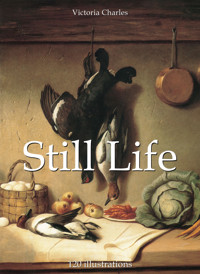
Cézanne transformed a teacup into something alive, raising still-life to the point that it ceased to be inanimate. Wassily Kandinsky said about the French artist: “He painted these things as human beings because he was endowed with the gift of divining the inner life in everything.” In addition to those of Cézanne, this book is devoted to still-life paintings by artists such as Van Gogh, Matisse, Chardin and Picasso.
Das E-Book können Sie in Legimi-Apps oder einer beliebigen App lesen, die das folgende Format unterstützen:
Seitenzahl: 46
Veröffentlichungsjahr: 2023
Ähnliche
Victoria Charles
Still
© 2023, Confidential Concepts, Worldwide, USA
© 2023, Parkstone Press USA, New York
© Image-Barwww.image-bar.com
© 2023, Estate Ozenfant Artists Rights Society, New York, USA / ADAGP, Paris
© 2023, Estate Derain/ Artists Rights Society, New York, USA/ ADAGP, Paris
© 2023, Estate Matisse/ Artists Rights Society, New York, USA/ ADAGP, Paris
© 2023, Estate Grabar Artists Rights Society, New York, USA / ADAGP, Paris
© 2023, Estate Larionov/ Artists Rights Society, New York, USA/ ADAGP, Paris
© 2023, Estate Friesz Artists Rights Society, New York, USA / ADAGP, Paris
© 2023, Estate Picasso/ Artists Rights Society, New York, USA/PICASSO
© 2023, Konchalovsky Artists Rights Society, New York, USA / ADAGP, Paris
All rights reserved. No part of this may be reproduced or adapted without the permission of the copyright holder, throughout the world.
Unless otherwise specified, copyright on the works reproduced lies with the respective photographers. Despite intensive research, it has not always been possible to establish copyright ownership. Where this is the case, we would appreciate notification.
ISBN: 978-1-78160-828-9
Contents
The Artists:
Pieter Boel (1622-1674)
Jean-Baptiste Monnoyer (1634-1699)
Alexandre-François Desportes (1661-1743)
Jean-Baptiste Oudry (1686-1755)
Jean-Baptiste Simeon Chardin (1699-1779)
Simon Saint-Jean (1808-1860)
Henri Fantin-Latour (1836-1904)
Nicolae Grigorescu (1838-1907)
Paul Cézanne (1839-1906)
Claude Monet (1840-1926)
Auguste Renoir (1841-1919)
Ilya Repin (1844-1930)
Paul Gauguin (1848-1903)
Vincent van Gogh (1853-1890)
Henri Matisse (1869-1954)
Igor Grabar (1871-1960)
Kuzma Petrov-Vodkin (1878-1939)
Othon Friesz (1879-1949)
Alexander Kuprin (1880-1960)
Martiros Saryan (1880-1972)
Nikolai Sapunov (1880-1912)
Mikhail Larionov (1881-1964)
Pablo Picasso (1881-1973)
List of Illustrations
Still Life with Large Earthenware Jar, Félix Vallotton, 1923
Oil on canvas, 81 x 65.3 cm. Galerie Vallotton, Lausanne
“Cézanne made a living out of a teacup, or rather in a teacup he realised the existence of something alive. He raised still life to such a point that it ceased to be inanimate. He painted these things as human beings, because he was endowed with the gift of divining the inner life in everything. His colour and line are alike suitable to the spiritual harmony. A man, a tree, an apple – all were used by Cézanne in the creation of something that is called a ‘picture’, and which is a piece of true inward and artistic harmony.”
– Wassily Kandinsky
Two Skulls on the Embrasure of a Window, Hans Holbein the Younger
Tempera varnished on wood, 33 x 25 cm. Public collection, Art Museum, Basel
One should treat with doubt the extremely widespread conviction that the still life has been in art since time immemorial. We know of a large number of “still lifes” from the art of antiquity, but it cannot serve as the sole criterion for today’s definition of still life in art history.
We should therefore avoid a confusion of the genre’s history with its pre-history. It seems that the researchers link the history of the still life with easel painting, “where its laws manifest themselves most distinctly and have direct parallels with the emergence of other genres within painting.”
The Dutch term “stilleven” (“the quiet life”), first recorded in the year 1650, came into general use only towards the end of the seventeenth century. Later still, it was taken up by the English and German languages, and only then was its meaning inherited by the French term “nature morte,” which shows however some degree of narrowing down, if compared with the original connotation. The fate of the still life proved completely different from that of the majority of genres in painting.
Alexandre-François Desportes, the noted still-life artist, “painter of the royal hunts”, was still entirely in the thrall of the Flemish school, as can be seen from Still Life with a Hare and Fruit and Still Life with Game and Vegetables (both in the Hermitage).
He displays the same refined naturalism in the juxtaposition of different textures to create his effect – foliage, fruit, stone, wood, feathers, wool, fur, and so on. His still lifes might also include works of art such as, say, the relief by Duquesnoy included in Still Life with Dead Game and Vegetables – one of the highly fashionable “quotations” found in French painting from that time (and one more proof of close Franco-Flemish links in art).
In short, in this modification the genre demonstrates what Boris Vipper termed a striving “to turn the still life into living nature”. Diderot notes in 1765 that it is to Chardin that we owe the fact that things, which had till then imitated perhaps beautiful, but nonetheless alien prototypes, those “silent creations” finally began to speak in French. Chardin recreated the genre, as it were, on the basis of the national artistic tradition.
It is important to bear in mind that the system of genres is anthropocentric: even if the human being is not shown directly in a work, the human element forms the basis of any genre orientation.
That means that objects arranged to make something independent, forming something whole, do not supplant, but only mask the human subject expressing in a new manner its aim with regard to the world as a whole.
Game and Fruits, Peter Boel
Oil on canvas, 61.5 x 81 cm. Museum of Western and Oriental Art, Odessa
Flowers and Fruit, Jean-Baptiste Monnoyer
Oil on canvas, 74.5 x 122 cm. The Hermitage, Saint Petersburg
Fruits, Jean-Baptiste Oudry, 1721
Oil on canvas, 74 x 92 cm. Pushkin Museum of Fine Arts, Moscow
Still Life with a Hare and Fruits, François Desportes, 1711
Oil on canvas, 115 x 199 cm. The Hermitage, Saint Petersburg
Still Life with Fruits, Jean-Baptiste Oudry, 1721
Oil on canvas, 74 x 92 cm. The Hermitage, Saint Petersburg
Still-Life with Game and Vegetables, François Desportes, c. 1700




