


Erhalten Sie Zugang zu diesem und mehr als 300000 Büchern ab EUR 5,99 monatlich.
- Herausgeber: Origin
- Kategorie: Sachliteratur, Reportagen, Biografien
- Sprache: Englisch
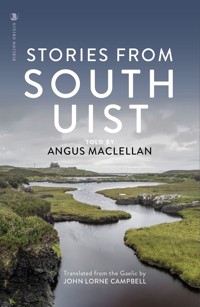
This is an extraordinary collection of tales from one of the very greatest Gaelic storytellers, Angus MacLellan, and translated by one of Scotland's finest Celtic Scholars, John Lorne Campbell. The stories in the book include every type of tale found on South Uist, from Fingalian heroes and ghost stories to international folktales and humorous and historical local anecdotes. These tales of ancient kings, thrilling escapes, jealous stepmothers and magic spells are fascinating not only for their narrative power, but also their links with myths and legends from Ireland, Scandinavia, France and Greece. The Hebrideaen island of South Uist was one of the last places in Western Europe where the ancient art of Storytelling was still honoured and practised, and the style of these translations is at once original and hypnotic, reflecting the oral tradition at their source.
Sie lesen das E-Book in den Legimi-Apps auf:
Seitenzahl: 425
Veröffentlichungsjahr: 2016
Das E-Book (TTS) können Sie hören im Abo „Legimi Premium” in Legimi-Apps auf:
Ähnliche



















STORIES FROM SOUTH UIST
This edition first published in 1997 byBirlinn LimitedWest Newington House10 Newington RoadEdinburghEH9 1QS
www.birlinn.co.uk
Reprinted 2001, 2005, 2011, 2015
Copyright © the Estate of John Lorne Campbelland the Estate of Angus MacLellan
All rights reserved.No part of this publication may be reproduced, stored or transmitted in any form without the express written permission of the publisher.
ISBN 978 1 874 74426 9eISBN 978 0 857 90271 9
British Library Cataloguing-in-Publication DataA catalogue record for this book is available from the British Library
Typeset by Iolaire Typesetting, NewtonmorePrinted and bound by Clays Ltd,St Ives plc, Bungay Suffolk
CONTENTS
INTRODUCTION
THE STORYTELLER’S OWN STORY
Fingalian and Other Old Stories
1 HOW THE FINGALIANS WERE FOUNDED
2 HOW THE FINGALIANS LOST THEIR HUNTING AND RECOVERED IT
3 THE FINGALIANS IN THE ROWAN MANSION
4 THE DEATH OF DIARMAID
5 THE BYZANTINE BRIGAND
6 BOBBAN THE CARPENTER
Simple Folktales
7 THE WEDDING-FEAST AT HACKLETT
8 GEORGE BUCHANAN AND THE DOGS
9 THE REASON WHY THE SEA IS SALT AND NOT FRESH
10 THREE MORE FOOLISH
11 THE PRIEST, THE MINISTER, AND THE TWO HENS
12 HOW A BAD DAUGHTER WAS MADE A GOOD WIFE
13 THE THREE QUESTIONS AND THE THREE BURDENS
Local Traditions
14 THE NORWEGIANS IN SOUTH UIST
15 CLANRANALD AND GILLE PÀDRA’ DUBH
16 HOW GILLE PÀDRA’ DUBH PAID HIS RENT
17 THE WIDOW’S SON’S REVENGE ON CLANRANALD
18 BLACK DONALD OF THE ‘CUCKOO’
19 HOW CLANRANALD BUILT ORMACLATE HOUSE
20 MACLEOD OF DUNVEGAN AND IAIN GARBH OF RAASAY
21 MACVURICH ASKING FOR THE WIND
22 MACVURICH AND THE CHANGELING
Stories of Witchcraft
23 ‘KINTAIL AGAIN’
24 THE WOMAN WHO WAS SHOD WITH HORSESHOES
25 THE LAIRD, THE PRIEST, AND THE EVIL ONE
Ghost Stories
26 WILD ALASDAIR OF ROY BRIDGE
27 THE LITTLE OLD LADY OF ÀIRD MHÌCHEIL
28 THE MERMAID
29 ‘SHIFT THREE POINTS TO THE STARBOARD’
30 THE COFFIN THAT CAME ABOARD
Humorous Stories
31 DONALD’S WOOING
32 THE FIRST GALVANIC BATTERY ON SKYE
33 HECTOR AND THE BALLOON
34 THE TINKERS’ HOTEL
35 THE HOLIDAY OF DONALD AND MAGGIE
36 THE SHEPHERD WHO COULDN’T TELL A LIE
Adventure Stories
37 ‘PRIEST DONALD’
38 A WIFE FROM ENGLAND
39 THE ADVENTURES OF THE DROVER BEFORE HE JOINED THE ARMY
40 THE STORY OF NIALL BEAG AND MÀIRI BHÀN
41 THE STORY OF ST CLAIR CASTLE
42 WHY EVERYONE SHOULD BE ABLE TO TELL A STORY
Notes
THE CLANRANALDS AND THE MACVURICHS
THE OLD ISLAND HOUSES
AONGHUS BEAG’S INFORMANTS
NOTES ON THE STORIES
GLOSSORIAL INDEX
INDEX TO THE STORIES
INTRODUCTION
I FIRST met Angus MacLellan, ‘Aonghus Beag mac Aonghuis ’ic Eachainn, Mac ’ill ’ialain’, at Lochboisdale, South Uist, in November 1949, shortly after I had begun making wire recordings of traditional Gaelic songs and stories in South Uist and Barra with the aid of a research grant from the Leverhulme Foundation, which I take the opportunity to acknowledge with gratitude here. He had come in by bus from Frobost, where there was then no electric light, to record stories for me in the hotel. Aonghus Beag tells his own story in the chapter that follows this introduction, and there is no need for me to elaborate it here; nor to describe the background of South Uist, the island where his family has lived for generations, as that has been most skilfully and sympathetically done in Folksongs and Folklore of South Uist by Margaret Fay Shaw.*
Aonghus Beag is a sturdy, cheerful man, with a very alert mind. He looks far younger than his ninety years and still conveys the impression of the bodily strength developed by his former livelihood, that of ploughman on mainland farms in Perthshire, Argyll, and Dumbartonshire, days about which he had recorded for me many reminiscences, which may some time become another book. He has the reputation of having been one of the most skilful sheep shearers in South Uist, and he is still capable of walking very considerable distances, and as a storyteller and conversationalist, he never wearies.
Loch Eynort, where Aonghus Beag used to live, is now considered one of the remotest inhabited parts of South Uist, but in the old days, before the evictions, and before Lochboisdale was developed, it was the main port of the island, and the scene of great comings and goings; it is from Loch Eynort, for example, that the famous Gaelic poet Alexander MacDonald (c. 1700–1770) portrays the Chief of Clanranald and his crew as setting sail for Carrickfergus in Ireland in his long poem called the Birlinn of Clanranald (Biurlainn Chlann Raghnaill). But after the Clanranalds sold South Uist to Colonel Gordon in 1838, Loch Eynort and the eastern part of the island, which contains the best hill grazing and the most sheltered land in South Uist, fell on evil days. A substantial population was evicted from this part of Uist to make room for big sheep farmers, and was dispersed to Eriskay, Benbecula, other parts of South Uist, or to North America**. In a statement made to the Crofters’ Commission at Lochboisdale on 28th May 1883, Donald MacLellan, ‘Dòmhnall Mór’, Aonghus Beag’s cousin, then aged about fifty-two, described how his grandfather, who lived at Glen Corradale, had a substantial stock of 600 sheep and 30 head of cattle impounded by a big farmer, how his father was later evicted and moved to a place three miles away, evicted again and forced to move by sea to Bàgh Hartabhagh with seven others, where they had to live in caves by the shore until they had made themselves turf huts, from which his father was evicted again six years later, to be given four acres of barren land on Eriskay.† Donald MacLellan told Mr. C. Fraser-Mackintosh, M.P., a member of the Commission, that ‘I would return tomorrow if I were permitted to the land my father had. I would not give a snuff for the land which I presently occupy, if I were permitted to return to the land which my father tenanted—Uishnish or Glen Corradale’—where his grandfather had lived, and his ancestors from time immemorial. ‘The chief of Clanranald sometimes spent nights in my grandfather’s house.’ Donald MacLellan’s grandfather was Aonghus Beag’s great-grandfather.
Only a remnant of the old population remained in the Loch Eynort district, impoverished by the loss of their traditional common hill grazings to the big sheep farms. Loch Eynort fell into disuse as the main harbour of South Uist; the entrance is narrow with a strong tidal current, and there is a dangerous reef in it. Lochboisdale became the main port of the island. The Loch Eynort district was sufficiently isolated in Aonghus Beag’s boyhood for school attendance to be difficult, if not impossible, and certainly not insisted on. It is, indeed, amongst persons like him who thus escaped the net of the Scottish Education Act of 1872, which made an English education compulsory throughout the Gaelic-speaking Highlands and Islands, that traditional oral Gaelic literature is now best preserved.
And what a literature we have here! The words of the late Dr Robin Flower are every bit as true of the Outer Hebrides, and particularly of Uist and Barra, as they were of the Great Blasket which lies off the coast of Kerry:
‘I listened spellbound, and, as I listened, it came to me suddenly that there on the last inhabited piece of European land, looking out to the Atlantic horizon, I was hearing the oldest living tradition in the British Isles. So far as the record goes this matter in one form or another is older than the Anglo-Saxon Beowulf, and yet it lives still upon the lips of the peasantry, a real and vivid experience, while except to a few painful scholars, Beowulf has long passed out of memory. Tomorrow too this will be dead, and the world will be the poorer when this last shade of that which was once great has passed away.’ Spoken Gaelic, Flower goes on to say ‘is perhaps the liveliest, the most concise, and the most literary in its turns of all the vernaculars of Europe.’***
Only a portion of Aonghus Beag’s stories belong to the oldest tradition, it is true. But he is a storyteller of consummate ability, the product of an immemorial oral tradition that is better preserved and more carefully cultivated in the Outer Hebrides than anywhere else in Western Europe. Often while sitting listening to Aonghus Beag and other storytellers, such as Dunnchadh mac Dhomhnaill ’ic Dhunnchaidh (the late Duncan MacDonald of Peninerine, South Uist) and Seumas Iain Ghunnairigh (the late James MacKinnon, of Northbay, Isle of Barra) or to their recordings, I found myself falling under the impression that they must have seen the events they described or have overheard the dialogues they reproduced in their stories. Aonghus Beag possesses to an uncommon degree the power of reproducing the conversation of his characters, and of varying his voice to imitate their tone, whether it be of an angry general, a disagreeable crone, a self-pitying drunkard, or the despairing mother on whom the fairies have inflicted a changeling for her own infant. He is also expert in the art of giving a spoken story form and climax.
We meet many well-known figures in his stories. In the older ones, Fionn mac Cumhail and his famous band (called in Gaelic An Fhinn or Na Fiantaichean) including Diarmaid, Oscar, Caoilte and Conan; Boban Saor, or Bobban the Carpenter, the famous joiner who invented the adze, so it is said, and for whom no task was too difficult; Kings in ancient Ireland, jealous stepmothers, cave-men or ogres, magic rings, escapes from dangers, feats of strength, persons under tabus or spells. It is of interest to consider the geography of the complex (non-Fingalian) Gaelic folk-tale. It seems to correspond to that of the Europe of about a thousand years ago. In these stories the Kings of Ireland, Norway, France, and Greece (i.e. the Emperors of Byzantium) are frequent figures; Kings of Scotland or England hardly if ever appear, which suggests that these stories must have been formulated before Scotland or England became united political entities.
Heroic and chimeric tales form only a small portion of Aonghus Beag’s repertory of stories; this probably corresponds to the taste of his contemporary Gaelic-speaking listeners, who now prefer the simple folk-tale or the anecdote—humorous or adventure stories such as are well represented here. In Aonghus Beag’s simple folk-tales we meet figures well known in international folklore: the shrew who is tamed and turned into a good wife; the ‘clever peasant girl’; the magic mill that makes the salt that prevents the water of the sea from being fresh; ‘clever Elsie’ (No. 10); ‘William Tell’ (No. 15, in Uist attributed to Clanranald); the Old Robber who related his adventures to free—here not his own sons, but the sons of the King of Ireland (No. 5). This is here fitted into the framework of an old chimeric Gaelic story.
In the sphere of local traditions, Aonghus Beag has some good stories about the MacDonalds of Clanranald, the ancient owners of South Uist and other lands, and their hereditary poets and historians, the MacVurichs of Staoiligearraidh. There is, or was, a wealth of such stories extant in South Uist, and a whole volume could easily be devoted to them and nothing else, but as far as I know, they have never been brought together.‡ They give a powerful impression of olden times—particularly of the seventeenth century. In justice to the Clanranalds, it should be said that their failings of pride and arbitrary violence were balanced by the virtues of fidelity to their ancient religion and to their legitimate sovereigns, the Stewarts.
The remaining types of stories translated here, the ghost stories and the humorous and adventure stories represent classes that have not received much attention from folklorists hitherto.†† In the case of the last two classes it is not impossible that some of the stories derive from literary sources. No. 41 is clearly derived from a romantic novel called St Clair of the Isles, first published in 1803. There is interest here in showing how such a story can be taken into the Gaelic oral tradition and adapted to its conventions and standards.
I have continued to record stories from Aonghus Beag, and old songs and ballads from his sister, till the present time, since 1956 on tape instead of on wire. Up to date the total amount of material he has recorded for Mr. Calum MacLean and for myself comes to over 130 stories and a number of ballads, as well as many personal reminiscences of the days when he worked as a ploughman on mainland farms. The latter I hope to translate in due course.
There has been a good deal of argument amongst folklorists about the way that folk-tales are transmitted and about the relationship between literary and oral versions of the stories. So far as Aonghus Beag is concerned, he learned his stories orally from friends of his family who came to work or to call at his father’s house at Loch Eynort. In those days the custom of the céilidh or informal conversational visit or party was still in full vigour, and many winter nights were passed in playing cards, telling stories, and singing old songs; the céilidh would be in one house one night, and another the next. Aonghus Beag told me that he could learn a simple story by hearing it once, if it was well and clearly told. Longer and more complicated stories, such as the Fingalian tales, he would need to hear several times. He kept the stories as he heard them at first without alteration, except perhaps for a few words (I can imagine he may have given more vitality to the dialogues at times). He did not put together or mend stories by hearing different versions from different storytellers. He is well able to remember who told him the stories. As a matter of fact, the forty-two stories in this book came to him from fifteen different persons; but two of these were the sources for more than half of them. Another person was the main source for his Fingalian stories and ballads.
I must now say a few words about the way these stories have been translated. This has been done direct from the tape recordings by writing down a fairly literal English translation in pencil while listening to the original on the tape. Aonghus Beag’s diction is so good that very few words and still fewer phrases were inaudible and some of these occasions were due to outside noises. The stories were then typed from the pencilled draft translations and turned into idiomatic English in the process. This is the first time as far as I know that translations of Gaelic stories into English have been made for publication direct from tape recordings without the intervention and use of a transcribed Gaelic text. I hope it will be possible to print the Gaelic texts of some of these stories later. My model in presenting them in English has been the book Tales from the Arab Tribes, translations into English from Arabic made by the late Major C. G. Campbell, a masterpiece of translation of folk-tales from another language into readable English.
My object has been to put before English-speaking readers translations which will read naturally and which will convey something of the terse and vivid expression of the stories as Aonghus Beag tells them. I have therefore carefully avoided alike the pseudo-archaic and the Celtic Twilight styles as well as the closely literal type of translation. Purely modern English colloquialisms are also avoided. A good many translations of folk-tales from Scottish and Irish Gaelic were made between 1860 and 1914; some of these, particularly some of the Irish ones, were good; some are so painfully literal as to be almost unreadable, others are presented in a style that invests the stories with a false atmosphere. For, as Dr Robin Flower has said,‡‡ what characterizes the Gaelic way of thought and style is an extreme concreteness of language, an ‘epigrammatic concision of speech, the pleasure in sharp, bright colour’ which is the antithesis of the mistiness of the Celtic Twilight. However, the difference between the structures and the modes of expression of the Gaelic and English languages is so great that this cannot be conveyed by a purely literal translation; and my method has been to translate expressions by expressions rather than words by words. Anyone who wishes to study the method used can do so by comparing Peigi MacRae’s account of Catriana nighean Eachainn which I printed in Gairm,††† and the English translation of it I published in the Scots Magazine of October 1955.
My purpose then is to use words and expressions that would be naturally used by an English speaker telling the same story. Only in one or two places has it been seen fit to let a Highland accent come in, e.g. No. 35. The stories are not embellished in any way in the process of translation, but, as some of the devices of the spoken tale do not always answer when exactly reproduced in print, it has been advisable at times, for instance, to invert clauses and define the names of persons or places. Gaelic possesses emphatic forms of the personal pronouns ‘he, she’ (esan, ise) which are loosely used in stories to indicate the first of two persons the storyteller is referring to (a usage I have not noticed remarked on by any grammarian). English does not possess this device and it is necessary to use the name of the person meant. In a few cases I have bestowed names on characters in some stories who were only called ‘a crofter’ or ‘a farm servant’, for the sake of clarity. I have dropped scores of ‘said he’s’, and I have divided sentences which in the Gaelic are linked by the conjunction ‘and’, but which would not be so linked in English. I have been careful to assign the tenses of the verb that the context requires: Scottish Gaelic is poor in verbal tense-forms.
I have reluctantly translated the Gaelic An Fhinn and Na Fiantaichean by ‘The Fingalians’, because the word is familiar and pronounceable, although it wrongly implies that the ‘Fingalians’ were founded by Fionn mac Cumhail, whereas they existed before he was born (No. 1). Rìgh na Gréige, ‘The King of Greece’, I have rendered ‘Emperor of Byzantium’, because that is his correct title. Fuamhaire I have translated ‘cave-man’, because fuamhairean always live in caves, and popularly their name is connected with uaimh, a cave, in Gaelic. Though they are sometimes referred to as larger or even much larger than ordinary men, this distinction is not consistently maintained. ‘Giant’ is a misleading translation. They are nearly always portrayed as stupid cannibals, and may represent an extinct race of mankind.
It remains to say some words about the collection of Scottish Gaelic folk-tales and folk-songs in general. The first person who recognized the great interest of this material and attempted to organize its collection was that remarkable folklorist J. F. Campbell of Islay (1822-85). He was the first person, too, to see that Gaelic folk-tales had, in many cases, an international background. A selection of his tales was printed in four volumes in 1860–62 and was reprinted in 1893. Further volumes were published in 1940 and 1960, edited by J. G. MacKay. Towards the end of the nineteenth century, the ‘Waifs and Strays’ series was published under the patronage of Lord Archibald Campbell, containing many folk-tales collected by the Rev. D. MacInnes, the Rev. J. MacDougall, and the Rev. J. G. Campbell, minister of Tiree, the last a particularly able folklorist. Around the same time, the Rev. Fr Allan McDonald and Dr George Henderson collected many stories in Uist and Eriskay, most of which are still unpublished; the same applies to the folk-tales collected by, and sent to, Alexander Carmichael during the course of his long and active life as a folklore collector.
The invention of mechanical means of recording folk-tales, first the clockwork Ediphone of the 1920s, later the wire and tape recorders that came into use after the last war, has enormously simplified the task of preserving this material and the labour of collecting and transcribing it. But it can hardly be said that adequate use has been made of the opportunity these means of collection have afforded, at least until very recently. This has been due, partly to the mistaken impression that J. F. Campbell and his collaborators and contemporaries had exhausted the field, partly to the supine and obscurantist attitude that prevailed in Scottish academic circles towards Gaelic and folklore studies between the two world wars, and partly to what one cannot help feeling has been a tacit decision taken at a high administrative level, that no studies which tend to emphasize or perpetuate a distinct Scottish or Gaelic culture shall receive any official encouragement.‡‡‡ Thus millions of pounds of public money are available to construct a rocket range in South Uist that will probably be obsolete within a generation but unfortunately not before the influences it introduces will have done much to obliterate the traditional native culture of the island; hundreds of thousands of pounds of public money are available for the preservation and protection of plants and animals, some of which are in no particular danger of extinction, under nature conservancy; but not a penny is available for the recording and preservation of the uniquely interesting traditional oral and material culture of the Scottish Highlands, of which South Uist is now by far the most important stronghold, and which is in far greater danger of disappearing, than is the red deer.§
Academic recognition at least has been afforded since the Irish Folklore Commission sent Mr. Calum MacLean as their collector, to the Hebrides in 1947, and since the School of Scottish Studies, of which Mr MacLean is now a Senior Research Fellow, was founded in 1951; but this institution is functioning on a mere pittance, while the cost of tape recorders and of tape put this method of collection beyond the reach of most private individuals.
If the publication of these translations succeeds in persuading anyone that research in this field deserves the support of governments, I shall feel that my labours have been rewarded. As it is, I hope the translations may give to others something of the same pleasure that listening to Aonghus Beag telling his stories has given to me.
It remains to record my gratitude to various persons who have helped and encouraged me in this work; to Aonghus Beag himself; to his niece, Mrs Patrick MacPhee, and her husband, and to the Rev. Fr John MacLean, formerly parish priest of Bornish, both of whom have made recordings of Aonghus Beag and his sister for me with my machine at times when I was not able to go to Uist myself to do so; to the Rev. Fr A. MacKellaig and the Rev. Fr D. MacDougall, parish priests of Bornish before and after Fr MacLean, for their help in many ways; to Mr Calum MacLean, who first encouraged me to record Aonghus Beag, in 1949; and to Major Finlay MacKenzie, owner of the Lochboisdale Hotel, a true patron of Highland music and folklore, who very kindly put a sitting-room in his hotel at my disposal to make these recordings in the days before electric light had reached Aonghus Beag’s present home, Mr and Mrs MacPhee’s house in Frobost. I am also obliged to Miss Annie Johnston, of Castlebay, Isle of Barra, to whom I am particularly indebted for notes on the old island houses, and to Miss Peggy MacRae, a contemporary of Aonghus Beag, for help in solving some difficulties in the texts of the stories, when visiting Canna.
Finally, I must record my indebtedness to the late Fr Allan McDonald of Eriskay. Not only do his collections afford a unique insight into the folklore of South Uist, but if it had not been for his labour in collecting unusual words and expressions from speech and old songs and stories between 1893 and 1897,§§ the task of making an accurate translation of these stories would have been very much more difficult for anyone who was not a native of the Isles.
J. L. CAMPBELL
Isle of Canna,
30th January, 1960.
POSTSCRIPT
SINCE these words were written, news has come of the death of Calum I. MacLean only a month before he was to have received the honorary degree of LL.D. from the University of St Francis Xavier, Antigonish, Nova Scotia, for his work for the preservation of Scottish Gaelic folklore. It is proper that tribute should be here paid to a scholar whose devotion to his subject and whose courage and cheerfulness in the face of a long and painful illness have been an inspiration to all other workers in this field. A version of the Táin Bó Cúailnge taken down from Aonghus Beag was published by Calum MacLean in ARV, Vol. 15, pp. 160-180, 1959.
Dr John Lorne Campbell (1906-96), scholar and farmer, dedicated his career to the recording, transmission and publication of the Gaelic song, literary and linguistic record of Scotland. His meeting with Angus MacLellan in Lochboisdale, South Uist, where he had gone to record waulking songs in the winter of 1948–9 led to the recording of Angus’s stories, ballads and songs as well as his personal reminiscences. Stories from South Uist reflects the extraordinary nature of the literary Gaelic of an ancient oral tradition and of Angus’ own skills. This had instigated a lengthy and successful phase of recording Gaelic song and story in the 1950s and 1960s and set the seal on Dr Campbell’s pioneering collecting work which had begun in Barra in the early 1930s.
From his boyhood at Inverneill and Taynish on the mainland of Argyll, John Lorne Campbell went to St John’s College, Oxford, where he studied agriculture with Professor Sir James Scott Watson, graduating in 1929. He had learnt some Gaelic from a Tiree man, Hector MacLean, Ground Officer of the Taynish Estate and at Oxford he began, in his spare time, the serious study of the language with Professor John Fraser. While at Oxford, he also began work on an anthology of Gaelic songs of the Jacobite Rising of 1745–6, which was published as Highland Songs of the ’45 in 1933 and republished in a second edition by the Scottish Gaelic Texts Society in 1983. In August 1933, John Lorne Campbell went to Barra to study crofting conditions and colloquial Gaelic. There he found a ‘community of independent personalities where memories of men and events are often amazingly long; in the Gaelic-speaking Hebrides they go back to Viking times a thousand years ago.’ His mentor was John Macpherson, ‘the Coddy’, whose lore has been preserved in Tales of Barra (1960). With Compton Mackenzie, then living in Barra, Campbell vigorously entered the economic and political life of the Hebrides by founding the Sea League, campaigning for the enforcement of fishing limits and the closure of the Minch to trawlers to protect the livelihood of the Islands.
In his approach to Celtic Studies, he recognised the importance of grasping a good dialect thoroughly and of learning the language from the inside. ‘Book Gaelic’ could be an obstacle to learning since, in his own words, ‘all spoken Gaelic dialects differ from the literary language, in some respects consistently: the dialects of the Outer Hebrides are in fact more vigorous than the modern literary language, and contain many words and expressions that are not in the printed dictionaries.’ He pioneered the use of mechanical and electrical recording equipment and took it acrosss the Atlantic in 1937 to record the descendants of Barra and South Uist emigrants in Nova Scotia. Source of the results of these efforts have been published in Sia Sgialachdan (1939), the three volumes of Hebridean Folksong (1969-81) and Songs Remembered in Exile (1990). Other topics developed by John Lorne have been the researches of the Celtic Scholar, Edward Lhuyd, the poetry and song of Alasdair MacMhaighstir Alasdair, and the incomparable folklore collections of Fr Allan McDonald, parish priest of Daliburgh and Eriskay. This original and outstanding work brought John Lorne Campbell honorary degrees from St Francis Xavier University, Nova Scotia, and Glasgow University, and a D.Litt. for his published research from Oxford.
In 1938 Dr Campbell bought the islands of Canna and Sanday and farmed them in the traditional manner until 1981 when he presented them to the National Trust for Scotland. In 1935 he had married Margaret Fay Shaw, an American who was collecting Gaelic song in South Uist and this longstanding partnership brought together her musical talents with his language skills to create a unique store in Canna and a lasting monument to their dedicated scholarship.
HUGH CHEAPENational Museums of Scotland
* Routledge and Kegan Paul, 1955.
** Their names were communicated to Alexander Carmichael by the late Fr. MacColl.
† Minutes of Evidence of the Crofters’ Commission, Vol. I p. 740 (Question No. 11674).
***The Irish Tradition, pp. 105 and 106.
‡ The Clanranald traditions extant in Moidart were published by the Rev. Fr. Charles MacDonald in Moidart or among the Clanranalds.
†† Cp. J. F. Campbell, West Highland Tales, IV, 428.
‡‡The Irish Tradition, p. 110.
††† III 58.
‡‡‡ Perhaps now the international nature of much of our Gaelic oral literature is beginning to be realized, the official mind may come to grasp that fact and divert itself of the fear that to encourage the preservation of Gaelic folklore might lead to a repetition of the Jacobite rising of 1745!
§ The distinguished Swedish folklorist C. W. von Sydow drew attention to the importance of the Scottish Gaelic oral tradition and the urgency of recording it in a paper in Béaloideas in 1934, which was reprinted in his Selected Papers on Folklore (p. 59); but he made absolutely no impression on official or academic circles in Scotland at the time.
§§ See Gaelic Words and Expressions from South Uist and Eriskay, collected by Rev. Fr Allan McDonald, 1859–1905. Dublin Institute for Advanced Studies, 1958.
THE STORYTELLER’S OWN STORY
I AM Aonghus Beag, ‘Young Angus’, son of Angus, son of Hector, son of Donald, son of Calum, son of Donald MacLellan.1 My mother was Mary, daughter of John Wilson in Benbecula. I was born at Poll Torain on Loch Eynort, in South Uist, on 4th July 1869, and baptized at Bornish by the Rev. Fr Donald MacColl on the 13th. My forebears, MacLellans, lived at Loch Eynort and Beinn Mhór for generations. Some of them emigrated to North America about two hundred years ago.
My father was a landless cottar on the farm of the big farmer who had Bornish, John Ferguson. My father had to pay rent for every cow he kept. He was allowed to cultivate what he could dig with the spade, and that was not much. He was not allowed to keep a horse. He was paying two pounds a year for every cow he kept, and if he had a stirk, he had to pay a pound after the cattle sale to the big farmer, for having kept it.
I was the youngest of his four sons. My brothers left home, but I stayed on after they had gone away. School was far away, and I did not get much of it. I was very young then. When I was about fifteen, my brother Hector, who was sailing, came home and gave me a gun. I used to go out with it pretty often. The world was a hard place in those times. One day I went to the hill to try to get a rabbit, and I shot one rabbit. Charles MacLean the big farmer at Gearrabhailteas had a fool of a shepherd who reported me to the gamekeeper, and not only to the gamekeeper, but to the factor as well. I was taken up to Lochmaddy* and fined two pounds or fourteen days in prison for the rabbit.† The Exciseman was at the court, and waited at the foot of the stairs until I came down, and when I came down he said to me: ‘That rabbit was pretty dear for you.’ ‘Indeed it was.’ ‘Well, they treated you very badly, they might have left it at ten shillings. They couldn’t have fined you more for a first offence. The best thing you can do is to take out a licence and give them their fill of work.’
‘Very well, give it to me.’
The Exciseman took me into his office and gave me a licence, and when the steamer came to Lochmaddy I went aboard, and who was on board but my brother on his way home with a new gun for me, a double-barrelled gun. I was very pleased to see him. We were put together in the steerage, and when we reached Lochboisdale, I put the gun on my shoulder and walked down the gangway and up the pier with it; the lad who had been taken to Lochmaddy to be fined returned to Lochboisdale with a new gun! After that I used to go out in a boat on Loch Eynort not caring who saw me, killing plenty of shags, and though I had been fined two pounds at Lochmaddy, I took in what would pay it within the year!
There was no work to be had, so I started fishing lobsters with two others, Allan MacMillan and Donald MacLellan from Snaoiseabhal. Some days we did middling well, and others we were working at a loss. Then I enlisted in the Militia. The night I went to join the Militia was the first night I ever spent away from home. We took the steamer to Lochmaddy, myself and six others, and when we reached Lochmaddy we had only a very little money between us, which we put together to buy tea and biscuits, hoping to make tea in some house or other. Behind the prison there was a neat little house with its door open, and we went over to it. A young woman came to the door. We asked her if we might brew a kettle of tea as we had had nothing to eat since breakfast at home that morning. (By now it was late in the afternoon.) She said we might, and asked us to come in. We went in, and put the kettle on the fire; but it wasn’t long on the fire before an old woman appeared, the worse for drink, swaying from side to side. She turned to the girl and asked her who were these men who were in the house? ‘Oh, only people who’ve come in to make some tea.’
‘They can’t make tea here!’ said the old woman. ‘If they want to make tea they can easily find somewhere else to make it.’ She took hold of the kettle and took it off the fire and put it on the other side of the room. ‘What brought you in here?’ she asked us. Not one of us was saying a word, only listening to her. The oldest of us, Duncan MacDonald, said:
‘Well, it’ll take someone stronger than you to put us out of here.’
‘What sent you here rather than to any other house in Lochmaddy?’ said the old woman.
‘This was the only house we saw with its door open. If you had kept the door shut we would be outside yet.’
‘Well, the door that let you in is the door that will let you out,’ she said.
‘We won’t go out,’ said Duncan.
‘Oh, it won’t take me long to find someone who’ll put you out.’
I didn’t care for the way things were going, so I got up and went out to the end of the house without a word to see if there was any other house we might go to to make tea. Then I saw the old woman come out of the door and go to the other end of the house. The girl had gone into the small room** in the middle of the house to go to bed. I thought I would slip in and ask her where we could make ourselves tea, and I did so.
‘Oh,’ she said, ‘if you go a bit farther on, about half a mile, you’ll find plenty of places where you can make tea, and somewhere to stay. I’m very sorry I couldn’t make tea for you.’
‘Is that your mother?’ I asked.
‘Oh no.’
At that moment whom did I hear coming into the house but the old woman. I was terrified she was coming into the small room, so I blew out the candle. She went into the kitchen. ‘Aren’t you the most useless men I ever saw?’ she said. ‘Why didn’t you go away along with the lad who’s with you to the house over there where he’s by himself?’
When they heard this, they all got up and went out. When they had gone out, the old woman slammed the door and locked it. ‘Ho, rascals!’ she said, ‘that’ll keep you out tonight. What did you let them in here for?’ she shouted to the girl.
‘Oh, they only came in to make tea; they had their own tea, they only wanted somewhere they could make it.’
‘Upon my soul,’ I said, ‘is she coming in here?’
‘Oh no, she’s going to another room,’ said the girl.
‘How shall I get out?’ I asked.
‘I’ll let you out when she goes to sleep.’
The old woman was a good while at the fireside before she went up to the other end of the house. The girl was waiting to let me out. When she thought that the old woman was asleep:
‘Come into the kitchen now, and I’ll see if I can make you a cup of tea.’
‘I’m afraid she’ll get up.’
‘She won’t get up, she’s asleep.’
I went into the kitchen. The girl put a chain on the fire, and I got tea. Then I went off to see if I could find the others. I went on to the pier. There wasn’t a sign of any of them,2 until I heard a noise3 over at the back of the pier in an old carpenter’s shed. I went over, and there they were. It was a frosty night and they were lying on planks in the shed there, white with frost. Then they started damning and cursing me, ‘Where were you, we were looking for you since night came!’
‘Where was I but in the small room along with the girl!’
‘You were not!’
‘Yes I was. Why did you heed the old woman when she told you I was in yon house by myself?’
‘Doesn’t Providence protect you! We were looking for you since nightfall, and you in the small room along with the girl!’
The steamer came at six o’clock in the morning, and we got tea when we got aboard her. I went to the Militia then, and when camp broke up, I engaged with a farmer near Inverness. My brother had been near Inverness himself, and had engaged with a farmer, and had had to leave him at half-term.*** I found this was the same farmer I had engaged with! He had given me half a crown as airles money, but when I found that this was the man I had engaged with, I’d sooner have jumped in the sea than go to him! I didn’t know how in the world I could get clear of him. He had promised to meet me at seven o’clock in the square,†† and I didn’t go! I and some others decided to take the train and go to Oban by Perth; if there were enough of us it was likely we would get to go at half fare. We went to the station and asked the stationmaster what it would cost to go to Oban. ‘Twenty-one shillings.‡ But if there were fifty of you you’d get fishermen’s tickets at ten and six.’
‘Oh, we’ll be here, and more than fifty of us!’
‘Very well, be here at ten to ten, and you’ll get them at ten and six.’
We went to the station when it was near the time, and when the office opened, we crowded round the window asking for the tickets. Everyone who got a ticket ran to the carriage. There weren’t many more than twenty of us altogether! But alas when I got to the carriage whom did I see in the station but the farmer I had engaged with looking for me, to catch me! I hid until the train left. That’s the only time I ever kept something that belonged to another man, the farmer’s half-crown!
After we reached Oban, I engaged there with a farmer to go back to Perth. The farmer whom I engaged with lived four miles out of Aberfeldy. I spent two and a half years with him. During that time I never saw a day that kept us indoors. It made no difference if it was wet or dry or what weather it was; when there were snow showers and the wind was so cold it would take the nose off a monkey, the farmer would come to the stable and say:
‘It’s cold, cold today, lads.’
We would say it was, very cold.
‘Oh yes, it’s a good thing it isn’t wet,’ he’d say.
The day it was pouring with rain, the farmer would come out with an oilskin on:
‘It’s wet, wet today, lads.’
‘Yes, indeed it’s wet.’
‘Oh yes, it’s a good thing it isn’t cold!’ he would say. It was never going to be cold and wet on the same day!
I left him at the end of two and a half years, and I engaged with a farmer nine miles outside Pitlochry. I spent a year with him. He wouldn’t let us out on a bad day at all. We sat at the same table as himself, and were a lot better off there. Then I heard the news of the death of my brother Hector who was sailing; he died of smallpox at Dunkirk in France. My father and mother were alone at home, and I thought I would go home to be with them for the winter. I came home for that winter, and left again in the spring. There was very little work to be had at the time. I went to Oban and started working with some stonemasons, building a church. The wages were low, the pay was only fourpence ha’penny an hour,4 a few men were getting fivepence an hour; sixpence an hour was the highest rate for a labourer. I couldn’t save much to send home.
Then I engaged with a hotelkeeper at Loch Lomond, an Irishman called Edward Kane. I spent two and a half years with him, and then came home for another winter. Then I had to go away again, and I engaged this time with another hotelkeeper, at Dalmally, a man called Fraser, who was a good master. I spent two years with him.‡‡
Then my father got a croft from the Congested Districts Board, and I came home, and helped my father work the croft, and started at the fishing. I got a boat, and my neighbour John MacAskill and another man John MacDonald, worked together steady. We fished herring and mackerel, ling and cod and lobsters and every kind of fishing. Sometimes we were doing very well and sometimes we were working at a loss. Often we were in danger of losing our lives. One night MacAskill and I were out by ourselves in a little boat, sixteen feet long, and it came on bad at sea. We tried to get into an anchorage where we could shelter. When we were only twenty yards outside, it came on a hurricane against us, and we were likely to be blown out to the open sea. We were going past a promontory and staying as close to the shore as we could, and we managed to put down an anchor as we went past the point of the promontory. The anchor held, and we managed to put another out. We sat in the boat all the winter night, and neither of us could see the other for spindrift. That was the longest night I have ever spent.
Another time John MacAskill and I were returning to Loch Eynort from Lochboisdale by sea. It was at the beginning of the summer. It was very calm, and we were rowing.
There is a bad place in Loch Eynort where there is a tidal current—the Sruth Beag or ‘Little Current’ it’s called—which runs at seven knots at spring tides. When we arrived from Lochboisdale, the current was so strong that we could not get into Loch Eynort against it. There is a submerged rock outside the place where the current runs into the sea. We let out our anchor at the outside end of this rock, to wait until the current should slacken at low tide. We had a lot of meal and salt aboard. We were tired out, and we stretched out and fell asleep. John MacAskill was sleeping below aft, and I was lying amidships. When I awoke, my two feet were above my head as if they were up against a wall and my head at the foot. I looked round, and saw that the sea was level with the gunnel and just about to come in amidships; the boat had gone dry on the middle of the rock, and was about to turn upside down over our heads! Things looked ugly.
John MacAskill was lying below aft on the other side of the boat, and was now standing straight up against her side! I was too frightened to say anything. I got up and crawled up on the high side of her. The anchor was at the bow. I managed to let it run out and to throw it out on the rock, and I threw another anchor out behind the rock and managed to tie the rope to the boat’s tholepins, and made it as tight as I could to keep her the way she was. Then I woke MacAskill up. When he opened his eyes, ‘God save me,’ he said, ‘where are we?’
‘Never mind where you are,’ I said, ‘but see you get out of here before she turns upside down over your head.’ He dragged himself out of her on to the rock, and we held her there. Luckily it was low tide. Well, we kept her from turning over with the anchor until the tide came in and raised her. The sea was up to the top of our knees above the rock before she floated on an even keel. Then we got aboard her and came home. The sun had risen, and we were very glad to have escaped from the danger in which we had been. I never saw such a miracle as when the boat stayed on top of the rock and didn’t turn upside down over us!
As long as Charles MacLean had the farm of Gearrabhailteas we had leave to keep some sheep on the hill. I used to work for him. When he gave up the farm, Mr MacDonald came there from Barra. He had had Vatersay.‡‡‡ Well, the order was that no one was to have sheep on the place but himself. All the shepherds had some sheep of their own, and they had to get rid of them. My sheep were on the hill, and I would have no chance to keep them unless I got someone else to keep them on his land for me.
Anyway, MacDonald had a shepherd out at Loch Eynort called Christie, and when there was to be a gathering, Christie used to give me a warning to take my sheep off the hill to my house so that they would not be taken into the fank. I used to do this, and MacDonald didn’t know I had any sheep on his hill! He had a half-wit of a manager from the Isle of Skye, called Neil Beaton, who was a lot worse than his master, if he got up against you. This time I was sent for to go to shear at Gearrabhailteas. It was the old sheep off the machair we had to shear, and it was difficult to shear them, as some of their fleeces were full of sand. Beaton thought there was no one as good at shearing as himself. This day he came out in good trim; I was sitting on the shearing-stool opposite him, and the first sheep he got, he said, ‘Get a move on, MacLellan.’ I didn’t think anything of it, I thought he was joking at first; but when he had shorn the sheep, ‘That’s one!’ he shouted.
‘Well, it won’t be long before this one’s done too,’ I said. My sheep was put out, and we got two others, but before he was half-way with his second one, mine was done and away. ‘That’s two,’ I said. ‘He’ll have to hurry.’ Before he had put out his second one, my third one was ready to go along with her.
‘Oh,’ I said, ‘there isn’t a man on the island who can beat me at this. You may as well give up now.’
He didn’t say a word, but he got so red in the face! He got up and jumped over the shearing-stool. ‘Let me see your shears,’ he said. ‘There they are.’ He took hold of them and tried them. ‘There isn’t a pair like them here,’ he said. ‘Haven’t they fallen into good hands?’ I replied. He had to agree.
We were going to finish shearing the old sheep early. Beaton came out and said to Christie, ‘Go and bring down the ones across the road this side of the hill-top, and the ones around the mill, and we’ll have less to do tomorrow.’ He turned to me:
‘Have you got your dog?’ he said.
‘No.’
‘Why didn’t you bring him with you?’
‘I didn’t need a dog here.’
‘Well, you’ll have to go to gather in the morning.’
‘All right, isn’t the dog out there already? Where are you going to gather?’
‘The hillside above Loch Eynort,’ he said.
My word, when I heard this, with my own sheep out on the hill! Every one of them would be in the fank tomorrow!
I didn’t let on, but when Christie was going off, I said to him:
‘Don’t bring in any more than you can help. Give me a chance to get off early. Put them off to the hill with the dog.’
‘I will if I can,’ he said.
Christie went off, and came back with two hundred sheep! I could have boiled him when I saw what he had brought in. The sun was getting pretty low. Well, I said to myself that if there was a chance to get away, I would have to go tonight! it would be no use trying to get my sheep in the morning. I began to shear for all I could. Beaton said I had gone mad! The sun had just set by the time we had finished. I asked what time would they be starting to gather.
‘Oh, I’m sure they’ll wait until they’ve taken their food.’
‘Well, though they went there right away, I’ll be there before you.’
‘Well!’ he said, ‘there’s steel in MacLellan!’




