


11,49 €
Mehr erfahren.
- Herausgeber: Atlantic Books
- Kategorie: Sachliteratur, Reportagen, Biografien
- Sprache: Englisch
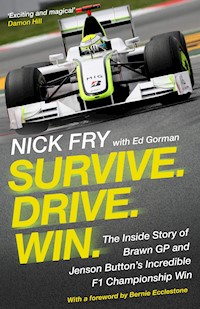
'The story of Brawn GP is legendary... Exciting and magical.' Damon Hill 'Nick Fry and Ed Gorman take us behind the mysterious and tightly closed doors of F1 to tell the remarkable story of the 2009 season.' Martin Brundle Foreword by Bernie Ecclestone The full story of F1's incredible 2009 championship battle has never been told. Until now. In this gripping memoir, Nick Fry, the former CEO of Brawn GP, reveals how he found himself in the driving seat for one of the most incredible journeys in the history of motor sport. At the end of 2008, Nick, then head of Honda's F1 team, was told by his Japanese bosses that the motor company was pulling out of F1 in thirty days. This bolt from the blue was a disaster for the team's 700 staff, for Ross Brawn, who Nick had recently recruited as chief engineer, and for the drivers, Jenson Button and Rubens Barrichello. But in a few short weeks, Nick and Ross would persuade Honda to sell them the company for £1 (plus all the liabilities). Just thirteen weeks later, the Brawn GP team, led by Nick and Ross, would emerge from these ashes, win the first Grand Prix of the 2009 season, and go on to win the Driver's and the Constructor's Championship, with a borrowed engine, a heavily adapted chassis and, at least initially, no sponsors. In Survive. Drive. Win., Nick gives an up-close-and-personal account of how he and Ross turned disaster into championship glory and laid the foundations for what was to become the Mercedes-AMG Petronas F1 team. Along the way he gives the inside track on the drivers, the rivalries between teams, on negotiating with Bernie Ecclestone, on hiring and working with two global superstars: Michael Schumacher and Lewis Hamilton - and offers a unique and thrilling perspective on an elite global sport.
Das E-Book können Sie in Legimi-Apps oder einer beliebigen App lesen, die das folgende Format unterstützen:
Veröffentlichungsjahr: 2019
Ähnliche



















SURVIVE. DRIVE. WIN.
First published in hardback in Great Britain in 2019 by Atlantic Books, an imprint of Atlantic Books Ltd.
Copyright © Nick Fry, 2019
Foreword © Bernie Ecclestone, 2019
The moral right of Nick Fry to be identified as the author of this work has been asserted by him in accordance with the Copyright, Designs and Patents Act of 1988.
All rights reserved. No part of this publication may be reproduced, stored in a retrieval system, or transmitted in any form or by any means, electronic, mechanical, photocopying, recording, or otherwise, without the prior permission of both the copyright owner and the above publisher of this book.
1 2 3 4 5 6 7 8 9
A CIP catalogue record for this book is available from the British Library.
Hardback ISBN: 978-1-78649-890-8
E-book ISBN: 978-1-78649-891-5
Paperback ISBN: 978-1-78649-892-2
Endpaper image: Mechanics prepare Jenson Button’s car during the second practice session for the Singapore Grand Prix at the Marina Bay City Circuit, 25 September 2009 (Saeed Khan/AFP/Getty Images)
Printed in Great Britain
Atlantic Books
An Imprint of Atlantic Books Ltd
Ormond House
26–27 Boswell Street
London
WC1N 3JZ
www.atlantic-books.co.uk
In memory of Richard Fry 1929–2019
CONTENTS
Foreword: Bernie Ecclestone
Prologue: Our dream start
1 Bombshell from Honda
2 Pulling the team from the fire
3 Now it’s our turn to become team owners
4 One hell of a tunnel and getting Ross on board
5 Bringing the RA109 to life as BGP001
6 Testing the rocket ship
7 Now Bernie wants to buy us
8 Branson steals the show at Melbourne
9 Winning with no money
10 A night to remember in Monaco
11 Keeping our heads as Ron calls for the aero number
12 The buying game: Mercedes, the Glazers and Air Asia
13 The dip
14 Rubens on a charge as Jenson struggles
15 Brawn GP scales the heights in Brazil
16 Splitting with Jenson
17 Michael
18 The long road to hiring Lewis Hamilton
Epilogue: Looking back on a sporting fairy tale
Cast of characters
2009 FIA Formula One World Championship Results
Illustration credits
Acknowledgements
A note about the authors
Index
FOREWORD
The story of Brawn GP and how the old Honda team was taken on by Ross Brawn and Nick Fry is one of the most remarkable in the long history of Formula One. Few of us imagined that the team could carry on, let alone win the world championship. It was something different in an era when the sport was dominated by big-spending teams like Ferrari, Red Bull and McLaren – and, really, I was delighted to see it.
At the time I was probably a bit exasperated by Jenson’s runaway start to the season, but actually – looking back – 2009 was one of our most exciting battles as Jenson made his mark early and then the others tried to catch him.
Of course, it was all a bit tragic for Honda, who saw the chassis they developed romp home to both the constructors’ and drivers’ titles without their name on it. I guess in sport and in business you have to hold your nerve and they didn’t do that. But I can’t blame them.
This is not to forget that the Brawn car was powered not by Honda but by Mercedes, and this story would not have happened without the offer by Martin Whitmarsh at McLaren to help a fellow British team in need. Modern Formula One is not known for that sort of generosity of spirit, as it was in the good old days.
I have seen some great champions over the years and some super British ones going right back to the likes of Mike Hawthorn and Graham Hill in the late 1950s and early 1960s, Jackie Stewart in the early 1970s, then James Hunt, Nigel Mansell and Damon Hill.
I was thrilled to see Jenson win at the end of the three-year period, 2007–09. Those years stand out in retrospect in a modern era that has been far too one-sided, with Ferrari, Red Bull and then Mercedes dominating more than is good for the sport.
Admittedly those guys are spending big bucks. What both Max Mosley and I liked about Brawn was the way they slimmed down their operation at Brackley – they had to, of course – and yet were still able to win. This has to be the future for Formula One.
Bernie Ecclestone
SURVIVE. DRIVE. WIN.
PROLOGUE
OUR DREAM START
There were seconds to go. Thousands of people were on the edge of their seats around the street circuit at Albert Park in Melbourne and millions more were watching on television.
Our mechanics sat in front of me in the team garage, kitted up in their black race suits and protective helmets, transfixed by Jenson Button on the monitors. It was a warm and sunny early autumn afternoon and the shadows were just starting to lengthen on the grandstands.
The man on pole was sitting apparently impassively in the cockpit of his Brawn GP Formula One car, his white-gloved hands gripping the wheel, his head encased in a white and yellow crash helmet, his eyes focused on the road ahead.
Ross Brawn, our eponymous team principal, was in his usual place for races, running the show on the pitwall, headphones on and outwardly calm. In front of him on the monitor desk sat a banana – sustenance for later in the race but a good-luck charm too. I knew what he was thinking. This was what we lived for as racers and this was a moment of truth for us.
Two lights on the gantry above the start–finish straight went red, then three, then four. The roar of twenty V8 engines rose to a crescendo that shook my heart in my chest. The fifth red light came on and then, a fraction of a second later, one of the most hotly awaited Formula One world championships of the modern era was underway.
At the opening race of his tenth season in motorsport’s most illustrious category, Jenson showed all his experience as he launched his car from stationary almost instantaneously. Within the blink of an eye the car was accelerating like a jet fighter taking off on an aircraft carrier, as the Englishman moved up through the gears at the beginning of a race in which he would never be overtaken.
Alongside him, in identical machinery but just slightly staggered on the grid, his Brawn GP teammate Rubens Barrichello was less fortunate. When the lights went out, his car sat motionless as the Brazilian former Ferrari driver stalled and then, after what seemed an age, grabbed first gear.
In the stampede to Turn 1 Rubens was already down to seventh place, running behind Sebastian Vettel in the Red Bull, Robert Kubica in the BMW Sauber, Nico Rosberg in the Williams and the two Ferraris of Felipe Massa and Kimi Raikkonen.
When they got to the sharp righthander, all hell broke loose. Rubens arrived with Mark Webber in the Red Bull ahead and to his left and Nick Heidfeld’s BMW to the left again, each trying to get through the corner first. Behind the Brazilian, Heikki Kovalainen in the McLaren locked up under braking and hit the rear of Rubens’ car, his front tyres hissing burning rubber. This sent Rubens sideways into Webber who, in turn, took out Heidfeld. How on earth did Rubens get away with that, I was thinking, as he roared on down to Turn 2, apparently unscathed?
This was the first wheel-to-wheel combat of the Formula One season in 2009 – a season that few thought Brawn GP would even take part in. That was because only four months earlier Honda had abruptly pulled the plug on their Formula One team, as the Japanese car giant retreated to lick its wounds after the 2008 global financial crisis wrecked its order books and stung its shareholders.
Refusing to acquiesce to Honda’s plan to simply shut the team down, we had made it to Melbourne after weeks of crisis management, including the painful business of letting more than a third of our 700-strong workforce go. At the same time, after having failed to find a suitable new owner, we had convinced Honda to allow Ross and me, the chief executive, to lead a management buyout of the team for the princely sum of one pound in return for taking on all its liabilities.
Just about everything about our presence that day in Melbourne was unprecedented. So certain was everyone Down Under that we would not be competing in 2009 that Brawn GP was not even listed in the official programme for the race. There were no driver profiles, no predictions for the team’s likely performance and the team was not shown in the full-season points table that you were invited to keep and fill in after each of the seventeen races. In summary, no one thought we would exist as a Formula One team by the time the race at Albert Park took place.
Minutes before the start our two cars, which we had such high hopes for after working on them under Ross’s expert guidance throughout 2008, had stood out like beacons on the front row of the grid, gleaming in the sunlight. With no title sponsor, they appeared almost pure in their plain white livery with fluorescent yellow flashes, reminding the thousands of people trackside and millions more watching around the world that we had virtually no sponsors at all (apart from a small deal with Richard Branson’s Virgin empire).
And we had arrived in Australia with hardly any mileage on the clock, having missed the first two pre-season test sessions when all the teams try out their cars together at European circuits over three days. When we did make it to the third and final session at Barcelona three weeks before the trip to Australia, our car had shown devastating pace, suggesting we could run at or near the front of the pack. But we had no real idea about whether the Brawn machines would make it to the end of the race without suffering mechanical failure. Would the gearboxes last the fifty-eight laps and 191 miles of the rough ride round the street circuit at Albert Park? And how would the much-modified suspension cope on a car that had been brutally altered to fit the Mercedes engine that we were using to replace the Honda one for which it had been originally designed?
It wasn’t just the fascination with how Brawn GP might fare that had ignited interest in the 2009 season. There were new tyre rules in play, new design rules to savour, including the use of energy recovery systems on Formula One cars for the first time, and the championship was taking place against a sharply deteriorating world economic outlook, with the prospect of a spending cap being introduced for the first time in Formula One the following year.
Among ardent race fans, the focus was on Britain’s Lewis Hamilton, who had won a thrilling first drivers’ championship the year before. The question in many minds was how would the sport’s youngest-ever world champion fare in the new cars and in a McLaren Mercedes that had the same engine we were using, but that had looked off the pace during pre-season testing? And what of Massa, who had so narrowly lost out to Lewis at the last race of the 2008 season in Brazil – could he lead the charge for Ferrari? This all left Jenson and Rubens rather nicely on the sidelines, regarded by most as also-rans in a season that would be dominated by others.
Our cars certainly stood out that day and not just because they were almost entirely free of sponsor logos. From an aerodynamic point of view they were simple and clean-looking, but with a finely detailed front wing and a lethally competitive design at the rear where the exhaust gases are channelled out of the engine. This area, known as the diffuser, was where we had made a huge step ahead of our competitors.
We had spotted a loophole that we could exploit in the design rules, and our so-called ‘double-diffuser’ gave our car more grip on the road and thus more speed through corners. Our opponents didn’t like it one bit and throughout the build-up to the start the paddock at Albert Park was full of talk about protests, which were duly made and then dismissed by the stewards at the track. These were then followed by an appeal against the stewards’ decision to the sport’s governing body – the Fédération Internationale de l’Automobile (FIA) – which would be heard after the second race of the season took place in Malaysia. There was a possibility that we could be retroactively disqualified from the first two races of the campaign but we had no difficulty putting that to the back of our minds. Now was the time to focus on the here and now…
Jenson drove a smooth and controlled race, expertly piloting his car through the twists and turns of a track that rewarded a machine that, as he put it, could ‘dance on its tyres’. In the engineering briefing before the start we had agreed that our plan would be for him and Rubens to go as fast as necessary to try to win, but no faster. Operating on a shoestring budget, we needed to preserve the cars as much as possible. We had few spare parts available if there was any damage in crashes – and we did not want to show our full pace, given the furore over our diffuser design.
On an eventful afternoon during which there were two safety-car periods, Jenson produced a virtually faultless drive save for a tiny blemish when he slightly overran his pit box as he came in for his second stop. At all times he kept his lead at 4–5 seconds while maintaining a close eye on Vettel, who was chasing him until the young German crashed after tangling with Kubica three laps from the finish.
Rubens survived a bump with Raikkonen’s Ferrari while taking fourth place. That became third when Kubica made a pitstop, only for the Polish BMW driver to take the place back before going on to collide with Vettel. By the time the second safety car came out in the dying laps, the two Brawn cars were running one and two and they cruised across the line, taking the chequered flag just metres apart.
Then the celebrations began. We had done it. We had won our first race of the season. We had brought the cars home first and second. We were in the almost preposterous position of leading the drivers’ and the constructors’ championships. Our mechanics were beside themselves, and Jenson and Rubens were ecstatic as they climbed out of their cars in parc fermé, with Jenson immediately running over to his teammate to shake his hand in the cockpit. A tearful Ross and I followed suit, giving each other the biggest of bear hugs.
This was elation and relief all mixed together in an intoxicating cocktail. In an interview on the pitwall immediately after the finish, Ross spoke movingly about what this victory meant for a team that was struggling merely to survive. He dedicated the win to the hundreds of employees we had been forced to make redundant only days earlier in the wake of the Honda pull-out. ‘This was for them,’ he said.
Jenson captured the emotions perfectly. ‘I think people understand what we’ve been through the last few weeks and I think we’ve got a lot of support out there,’ he said as the crowds cheered him to the rooftops. ‘This is not just for me, but for the whole team,’ he added. ‘This is the fairy-tale ending to the first race of our career together. We are going to fight to keep the car competitive and, with the limited resources we have, to keep it at the front.’
This was Button’s second victory in 154 starts in Formula One. His first had come at the Hungaroring in the rain back in 2006 when we were still under the Honda banner. This was the 200th victory in Formula One by a British driver, and it was the first one-two finish by a new team on debut since Juan Manuel Fangio of Argentina and Karl Kling of Germany finished first and second at the French Grand Prix in 1954. As a beaming Button stood grinning from ear-to-ear on the podium and the British national anthem struck up on the Albert Park PA system, Jonathan Legard of the BBC summed it all up in a sentence: ‘The sun is going down but Brawn has arisen from the ashes of Honda.’
My girlfriend Kate – soon to be my wife – had watched the action from the team base in the paddock. A superstitious character, she had been completely spooked by the fact that the official race programme had been printed without the Brawn cars included in it. Could that in some way presage something terrible that day, she wondered? She resolved not to touch the offending document before the race, let alone open it. But afterwards she went running round, buying up as many copies as she could. What better souvenir could there be for our friends and family back home than the guide to a race that never mentioned us and that we had won hands down?
That night we all piled into a Melbourne nightclub called Boutique, where we celebrated until four in the morning. In the run-up to the race the idea that we might have a shot at a drivers’ title seemed unthinkable. After the race it still seemed beyond our reach, but all of us had a feeling that – FIA Court of Appeal rulings notwithstanding – we had a tremendous chance to build a lead on our rivals before they started catching us up.
We knew we had the first four so-called ‘flyaway races’ – Australia, Malaysia, China and Bahrain – in which to establish an early lead in the points table, but that we would inevitably be pegged back as the likes of Red Bull and Ferrari started to upgrade their cars. While we were operating on a tiny budget and had next to no money available to improve our cars, Red Bull, with their design wizard Adrian Newey calling the shots, were rumoured to be spending £2 million a race on new parts – more money than we had available for the whole of the season. Everyone would be making a big step up in performance at the first European race of the campaign, at Barcelona, so we had to push as hard as we could until then.
We were the foxes running before the hounds and they were out to get us, whether in the FIA’s court of law, in the design race or on the track…
CHAPTER ONE
BOMBSHELL FROM HONDA
It was a cold and grey November morning, almost exactly four months before the Australian Grand Prix that would open the 2009 season so spectacularly for us. Mr Hiroshi Oshima, the Honda Motor Company’s bespectacled chief operating officer, with his trademark shock of greying hair, looked nervy as we greeted him in the black and grey marble reception of Heathrow’s Renaissance Hotel.
‘Good morning,’ I said, shaking his hand and then standing to one side to make way for our team principal, Ross Brawn, to follow suit. Greetings were always formal with our Japanese counterparts. Without further delay Oshima-san, as we generally referred to him, ushered us into a tiny conference room where the three of us sat huddled around a small table, uncomfortably close.
It was immediately clear that this was going to be no ordinary meeting. Mr Oshima was extremely tense and finding it difficult to compose himself. Eventually he took his glasses off and began speaking very quietly. The top man at Honda was close to tears. The news he said was ‘not good, not good at all’.
Motorsport is at the core of Honda’s DNA. One of Japan’s greatest post-war companies, founded in 1946 by the legendary engineer Soichiro Honda, it enjoyed a proud history in both motorbike and car racing. After working with the company in Formula One for seven years – four when it was the engine supplier and three more when it owned the team – I knew just how passionate Honda’s people were about racing. They loved it, they viewed it as a display cabinet for the excellence of their engineering and regarded the racetracks of the world as battlegrounds where they would take on their road-car rivals – especially Toyota.
This came home to me most vividly on one of my first visits to Honda’s HQ in Tokyo not long after I took over as managing director of the BAR Honda Formula One Team in 2002. We were taken to a nondescript warehouse not far from the great Formula One racing track at Suzuka. From the outside it looked run-down and altogether unremarkable and when we got inside it was dark. It felt like the set of Bond movie. Then someone flicked a switch and panels of dusty fluorescent lights burst into life – and there, stretching into the distance before us, were the serried ranks of Honda’s motor racing thoroughbreds and all their road cars too.
There was one example of every model. In the racing section there were scores of Formula One cars going back to the mid-1960s, including the unrepaired wrecks of cars that had been written off in big crashes. There were motorbikes too and there was not just one copy of each model but three or four, including those driven by legends like Freddie Spencer and Mick Doohan. In the Formula One collection the stars were the immaculately preserved examples of the iconic red and white McLaren Hondas driven by the great Ayrton Senna to world championship glory in 1988, 1990 and 1991.
So for Mr Oshima on that day at Heathrow in the autumn of 2008, ten weeks after the collapse of Lehman Brothers investment bank in New York, to have to be the person to deliver the news that Honda was pulling out of Formula One was an especially onerous – not to say humiliating – undertaking. I felt for him as he sat before us; he was a good man, a serious man and he was speaking to us from the heart.
Ross and I had known something was up. In the weeks before the meeting, with increasing concern we had watched the dramatic onset of what would turn out to be the worst global recession since the Great Depression. Big multinationals were being hit all around the world, people were losing their jobs and order books were dwindling.
Nigel Kerr, our financial director at Brackley, had been picking up signals that Honda was not going to be able to escape this without serious retrenchment and we had noticed a few straws in the wind, like the sudden repatriation of key Japanese members of staff back to Tokyo. But we assumed – as a worst-case scenario – that we were looking at a hefty funding cut.
In the days leading up to the meeting, we had been working on an emergency plan to cut 30 per cent from our £200 million annual budget, but we had been careful to try to protect the promising work we had been doing on RA109. This was our new car for the 2009 season and the first car that Ross had overseen since his much-heralded arrival at the team a year earlier. It incorporated what we believed was a highly competitive chassis with innovative aerodynamic solutions, including a design for the whole rear end of the car that would eventually become highly controversial. Our goal for that machine was to try and break into Formula One’s top three for the first time in Honda’s history as a team owner, and we were quietly confident we might be able to make a big step up in performance as the 2009 season drew ever closer. We had no idea that Honda was about to stun the motor racing world by announcing that it was abruptly ending its involvement in Formula One, a move that would eventually be followed by Toyota and then BMW.
Our recent results were not in our favour. Nor, indeed, was our long history of under-achievement stretching back to 2000 when Honda had first re-entered Formula One as an engine supplier after an eight-year absence. Although we finished second in 2004 in both the constructors’ and drivers’ championships, we never properly understood why our car was so fast that year and thus we were not able to build on that success in 2005. In short we had never managed to escape the also-ran category and our recent results in 2008 had been woeful. At the final race that year at Interlagos in Brazil, Jenson managed thirteenth place while Rubens could only finish fifteenth at his home Grand Prix. That season Honda finished ninth out of eleven in the constructors’ championship, with Rubens fourteenth and Jenson eighteenth in the drivers’ standings.
Even so we were not quite ready for what Mr Oshima had come to tell us. He was brief and to the point.
‘The financial crisis has had immediate and severe consequences for Honda Motor Company, which is anticipating “red ink” for 2009, with losses of the order of three thousand million dollars,’ he said. ‘US dealers are refusing to take more new cars into stock because they don’t see how they are going to sell them. Our sales in America have fallen by 32 per cent already and it is likely that our plant at Swindon is going to have to shut down for a few weeks to try to weather the storm. In the light of all this,’ he told us, ‘Honda Motor Company must cut its spending and protect its core business. Our shareholders simply would not understand it if we continued to pursue something as expensive and esoteric as Formula One, especially given our long run of poor results.’
And that was it. In less than ten minutes our world had caved in. Mr Oshima was clear that it was over. There was no debate. The decision had been taken by the top management tier in Tokyo a week earlier. Honda was departing Formula One, lock, stock and barrel. There was going to be no process or a gradual wind-down; it was going to stop with immediate effect.
Mr Oshima stood and we took our cue. There were other people, he said, in the conference room next door who we would now have to see.
We had turned up for an execution. Our own.
I had sat, winded for a second or two, listening to this genial man telling us politely that our business life had collapsed. But even before we had got up from the table we were thinking about how we were going to save this situation. We knew we were sitting on what our early assessments suggested was a pretty decent car for 2009 and I also knew that we could not let down the more than 700 people who worked with us at Brackley. There were designers, engineers, aerodynamicists, electricians, race teams – even drivers – secretaries and catering staff who all had livelihoods and families and we had to fight to protect them.
The phrase that was pinging around my mind as I listened to Mr Oshima was: ‘You can’t do that!’ I didn’t mean Honda had no right to close its Formula One business. Of course it could do what it wanted with its team. But they couldn’t just shut down the company as if it had never existed – something I suspect would have been politically impossible had we been talking about a company solely based in Japan.
As we were ushered into the much bigger conference room where twenty Honda executives were sitting around a large glass table, some from Tokyo, others from Honda UK, I was ready to mount a rearguard action. We needed time – as much of it as possible – to find an alternative to simply going back to Brackley and closing the door and turning the lights off.
Ross looked stunned. I guessed his initial thought was: ‘What on earth have I got myself into here?’ Having only joined us a year earlier and reportedly turned down lucrative offers to work either for Toyota or McLaren, or perhaps to rekindle his glory days at Ferrari, he must have been thinking he had made a dreadful mistake. But who could have guessed that Honda would have reached the point where it wanted out without any warning whatsoever?
The discussion with the lawyers and accountants began and I started to push back.
‘Look, you cannot simply sack 700 people and sell the plant,’ I told them. ‘There are procedures to go through; government has to be informed – this is a significant business within the UK – the sport’s governing body has to be notified and we have obligations not only to our staff but to our suppliers. We have to have time to work this through and find a solution and you have to give us that time.’
I could see from the puzzled looks on some of the Japanese faces staring at me from across the table that this was not what they had come to hear. The contingent from Tokyo had come to London to oversee an immediate shutdown and sell-off.
After an hour or two of discussion, Mr Oshima suggested we bring other senior managers from the team to assist us. I called Caroline McGrory our company lawyer, John Marsden our head of HR, and Nigel Kerr. They all jumped in their cars and headed to Heathrow to help us deal with the massed ranks of Honda’s finest. In Caroline’s case this was a heroic undertaking as she was heavily pregnant with her third child.
Eventually we managed to get agreement to one month’s grace. We would be given thirty days – until Christmas – to pull this thing from the fire, even if we had no idea how we were going to do it. There had been no time for detail. There was talk of limited funding to tide us over for thirty days, but the Tokyo contingent was adamant that there would be no more engines for the car, for example. And there was nothing on how we were going to continue to pay Jenson’s considerable salary.
I pressed them on the decision – was it final? Was there any leeway at all? The shaking heads opposite couldn’t have been clearer.
Racing ahead, in a room where you could have heard a pin drop, I asked about a disposal: ‘Would Honda Motor Company be prepared to sell the team? I recognize that even that would be a tough goal in the current climate,’ I added, filling a rather awkward silence.
Mr Omura, a Honda F1 board member, said the company had not had time to consider selling the team but that there would be a further full board meeting the following week to discuss the decision. It felt like the first glimmer of light on a bleak day for us.
Ross, meanwhile, was also thinking ahead and told the visiting executives that he would go back to Brackley and start discussions with senior technical staff on drawing up plans for the team to compete in the 2009 Formula One world championship as an independent entity. It seemed both of us were looking for the opportunity in this crisis.
On the way home that evening my head was spinning. Who could we get to buy the team and who might the buyers be? How would we find them? What would be the price and the process? What would we tell the staff and when would we tell them? What about Jenson and Rubens? And what about Fernando Alonso, the former world champion who was back with Renault after his unhappy spell at McLaren, whom Ross and I had been wooing for months to join us for 2009? I knew immediately that that project was doomed. We were going to be firefighting all the way to the first race of the season – if we even managed to get that far – and changing our drivers was a luxury we could no longer afford.
During a break in the meeting I had popped out to make a quick call to Kate back home in Oxford.
‘They are out,’ I told her breathlessly. ‘You can’t tell anyone. I’ll speak to you later.’
An American from Detroit with a typically enthusiastic – even gung-ho – approach to life, Kate was stunned and cried when I rang off. In the days leading up to the meeting she had listened to me speculating about what might happen but she hadn’t been expecting this. When I got home though, she was already on the front foot as I stood in the kitchen, glass of wine in hand, running through some of my more outlandish schemes to save the company.
‘You can fix this,’ she said and she meant it. Over the coming months she and Ross’s wife, Jean, would form a vital part of our team, encouraging us and convincing us that we would succeed when the doubts threatened to overwhelm us, as we did our best to fight back from the brink.
On the following Monday morning – 1 December 2008 – Ross and I informed the team’s directors of Honda’s decision at our weekly strategy meeting. Caroline, Nigel and John were there alongside Ron Meadows, sporting director, Joerg Xander, head of chassis engineering, and Graham Miller who was operations manager for the plant. Of course they were stunned and surprised but Ross and I did our best to convince them that we were going to find a way out of this and that the team was going to survive. At that stage the grim news was to remain under wraps.
A few days after that there was a pre-planned meeting of the Formula One team principals group – the so-called Formula One Teams Association (FOTA), a sort of trade body of F1 team owners and bosses. The meeting took place at Brown’s Hotel on Albemarle Street in London’s Mayfair, a favourite haunt of the then-chairman of FOTA, Luca di Montezemolo, the charming and statesmanlike chairman of Ferrari.
Ross knew Luca extremely well from his Ferrari days at Maranello. As technical director there, Ross had played a key role in helping the team win five drivers’ titles with Michael Schumacher. When we arrived, we asked Luca if we could brief him first, before we spoke to the full group. He was just as shocked as we had been when we told him what Honda was doing and that we no longer had an engine for our 2009 car, if it ever made it onto the track. We had no expectation that Luca might offer to assist us in any material way but, as we sat with him in Suite 201, he stunned us by making a generous offer that (even if ultimately we would not take it up) was hugely encouraging.
‘Ross, I know you very well,’ Luca said in his heavily accented English, ‘and Nick, I don’t know you so well, but you seem a good guy, so this is what I will do. We want Honda on the grid – we cannot afford to lose you. If you go, who will be next?’
He paused for a second.
‘You can have our engines for 2009,’ he continued. ‘I will organize that for you if you wish.’ Then with a smile, he muttered: ‘But don’t beat us with them.’ We all laughed heartily at the impertinence of such a suggestion.
It was a rare example of F1 rivals coming together to protect their sport. Luca could see we were in imminent danger of crashing out of Formula One and neither he nor his fellow team bosses wanted to see fewer cars on the grid.
The mood was grim when Luca informed the full meeting a few minutes later about Honda’s decision. John Howlett was there as head of Toyota’s very expensive Formula One operation (which was just as unsuccessful as Honda’s), alongside his Japanese boss Tadashi Yamanashi, and the anxiety on their faces was plain for all to see. Ron Dennis and Martin Whitmarsh from McLaren were, like Luca, immediately positive and indicated that they would help if they could.
Later that day we told our drivers. I called Richard Goddard, Jenson Button’s manager, at his home in Guernsey and broke the news. There was a long silence followed by expressions of support. I had a good relationship with Richard and I spent some time setting out my determination to find a solution. But I knew he had a job to do and the fear of losing Jenson was immediately on my mind. There was a clear risk that he would go elsewhere, although at that late stage in the year and in this commercial environment, where would he go?
That evening Ross and I returned to Brackley to inform our staff. Undoubtedly the rumour mill had been turning but it was important that they hear what was happening from us. The mood was solemn as almost all the 719 employees gathered around the bays where the new cars were being put together. That night two chassis of the RA109 were sitting in a state of advanced assembly along with their gearboxes and new Honda V8 engines on trolleys next to them. These were the engines that we had hoped would be a big improvement on the previous season’s power unit. But we already knew that those cars in that configuration would never turn a wheel on a racetrack.
I started off with the bad news: Honda was going and there was nothing we could do to change it. We had secured a month’s breathing space to find a buyer and, consequently, we would have to place everyone on three months’ notice from the start of January, unless that buyer was found.
Then Ross took over to talk about the opportunity. This was the start of our new double act forged in crisis – me as chief executive and Ross gradually morphing from a team principal with a strong bias towards the technical aspects of the job to more of an all-round leadership role. Ross was inspired that night and spoke in Churchillian tones, asking rhetorically whether we – as a company and a group of friends and colleagues – were up for the fight to survive.
‘Can we recover from this? Do we want to see all our work go to waste? Are we prepared to pull together to keep this great team alive?’ he asked in his mellow and sonorous voice. ‘Nick and I are committed to doing all in our power to find a solution to this crisis and we will do our best not to let you down, but please be patient and give us a little time to work out the best way forward.’
Ross exuded calm in the face of what otherwise seemed like impossible odds, and I could see the emotion swirling through the crowd of faces watching him. Ross gave them hope and the determination to get our cars to the start line of the first race of the 2009 season, in Melbourne. It was less than four months away.
As I mingled with the staff after the announcement, I did my best to try to reassure everyone that we would survive intact as a team. I was especially concerned about losing our star performers – our incredible engineers, mechanics, designers and aerodynamicists. I knew other teams would be hovering in the wings, looking for opportunities to snap people up. Losing our buildings and other physical assets was one thing; far worse was the much more likely prospect of losing the talent we had painstakingly assembled at Brackley over the previous eighteen months. The only thing in our favour was that we were not the only ones in the pitlane feeling the full effects of the world financial crisis, so cheque books were not going to open as readily to tempt staff to rival teams as they might have done a few months earlier.
That evening we issued a press release announcing Honda’s withdrawal from Formula One. The headlines were lurid the following day as the media digested what was described by The Times as a ‘seismic shock’ to motorsport’s most prestigious championship, amid much speculation that Williams, Renault or Toyota could be next.
My phone was hot all day. The main message I hammered home was that we were looking for a buyer. Already it was becoming clear that a lot of people had identified this as an opportunity to get into Formula One, and I knew that some media exposure would help those conversations happen. In the meantime I was ready for what I knew was going to be the biggest challenge of my professional life.
CHAPTER TWO
PULLING THE TEAM FROM THE FIRE
Normally the run-up to Christmas in a Formula One team is a relatively quiet time when senior management starts to plan the racing campaign for the following year, but things were very different in the run-up to Christmas 2008. Ross and I threw ourselves into a rescue mission and we left the planning for 2009 to department heads, while we devoted ourselves to trying to save the business inside the deadline set by Honda.
After that first meeting with the staff at Brackley, the job of sorting out our future began the following day, with Ross and I devoting most of it to doing interviews with the media. Obviously what we were saying was for external consumption and we had a team to sell. But we were both acutely aware that those inside the company would also be reading and listening, and wanting to know what was going on and what our plans were.
The important thing at that point was to put forward a boldly positive position. We needed to give the impression from the start that we were being looked at, and that good people were genuinely interested in the opportunity Honda had created for someone to get into Formula One with a big team and first-class facilities that were all ready to go.
In those press interviews I did my best to dispel the widespread assumption in the paddock that a buyer for our team was extremely unlikely to be found, especially in the short time left before the start of the 2009 season. I said that we had already received a ‘stream’ of enquiries from potential purchasers, and that Ross and I believed there were already at least three potential buyers who had what I described as the ‘resources and background’ to take the business on.
I have to admit that this positive spin was initially little more than a fabrication and we were talking our prospects up with a big dose of hope. But that was the only way forward; it was the only way to dispel the gloom that inevitably began to seep into the fabric at Brackley. We needed to fill everyone in the team with enthusiasm that there was a future and that we were going to find investors.
In our position Ross and I had no other option. What were we going to say? You can’t go out there and say ‘it’s all a disaster’ and ‘there is no hope’. What you’ve got to say is ‘we are going to fix this’. And this comes back to leadership in a crisis – you have to be prepared to be a little bit exposed and take risks because if you are not out there shouting from the rooftops and imploring people to greater heights and telling them that it is all going to be all right, then it is never going to work.
We knew immediately that we were going to have to decide which people we could afford to lose and which we could not afford to let go under any circumstances. At that stage the Honda F1 team had grown to be one of the biggest – if not the biggest – in the pitlane and this made the inevitable contraction all the more painful.




