


Erhalten Sie Zugang zu diesem und mehr als 300000 Büchern ab EUR 5,99 monatlich.
- Herausgeber: Origin
- Kategorie: Sachliteratur, Reportagen, Biografien
- Sprache: Englisch
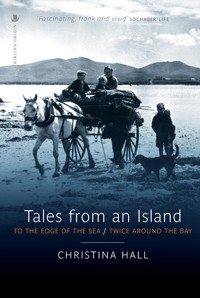
In this enchanting and moving memoir, Christina Hall writes with sharp observation about her childhood on the Hebridean island of South Uist in the 1940s and 50s. Humour and anguish reflect the spirit of a girl living through a time of dramatic change in her life, her family and the land that she loves. Beginning with her earliest memories, the book recounts her life up to the end of secondary school and is set in Uist, Benbecula, Barra and Fort William. As a sequel to 'To the Edge of the Sea', 'Twice Around the Bay' follows Christina Hall's story during her time at teacher training college in Glasgow and her return to the Hebrides, where she became the primary school teacher at South Glendale on her native island of South Uist. It is a story full of vibrancy, life and colourful Hebridean characters which recaptures with crystal clarity the joys and hardships of island life in the late 1950s and 1960s. It was during this period that the army arrived on Benbecula, and it was through them that Christina met a young English soldier. The book ends with their wedding, with faith in the future and the realisation that wherever that future might lead, the island of Christina's birth would always be part of her.
Sie lesen das E-Book in den Legimi-Apps auf:
Seitenzahl: 561
Veröffentlichungsjahr: 2017
Das E-Book (TTS) können Sie hören im Abo „Legimi Premium” in Legimi-Apps auf:
Ähnliche



















Tales from an Island
Tales from an Island
Christina Hall
First published in 2008 by
Birlinn Limited
West Newington House
10 Newington Road
Edinburgh
EH9 1QS
www.birlinn.co.uk
Copyright © Christina Hall 1999, 2001, 2008
First published as To the Edge of the Sea (1999) and Twice Around the Bay (2001) by Birlinn Limited, Edinburgh
The moral right of Christina Hall to be identified as the author of this work has been asserted by her in accordance with the Copyright, Designs and PatentsAct 1988
All rights reserved. No part of this publication may be reproduced, stored or transmitted in any form without the express written permission of the publisher.
ISBN13: 978 0 85790 280 1
ISBN10: 1 84158 705 2
British Library Cataloguing-in-Publication Data
A catalogue record for this book is available from the British Library
Typeset by Carolyn Griffiths, Cambridge
Printed and bound by Antony Rowe Ltd, Chippenham
Contents
To the Edge of the Sea
Twice Around the Bay
Acknowledgements
MY GRATEFUL THANKS to Donald Iain Campbell of Glendale Road, South Uist, and Mary Flora Forrester of the Old House, Kilpheder, South Uist, for helping me to track down old photographs. Thanks also to ‘the English soldier’ for St Kilda input, maps, commas and cups of tea.
To the Edge of the Sea
For Colin
An òige
Youth
Nuair dh’fhosglas sùil an òg-uain bhàin
Ri taobh a mhàthar air an raon, Seallaidh feannag air a fiaradh Anns an iarmailt os a chionn.
The lamb newborn surveys the world Close to its mother on the hill; Above, the crow, behind a cloud Looks down and notes it for a kill.
Tha sligh’ a’ bhradain cinnteach cruaidh
A’ dìreadh suas ri eas nan gleann; Dh’aindeoin riaslaidh, cuileag iasgair Airson lìon a chur mu cheann.
The salmon’s task is never easy– He toils against the stream instead: Despite his guile, the angler’s fly Will cast a net around his head. Reflect upon an infant’s face
An tug thu ’n air’ air aodann pàiste ’S e na thàmh an cadal trom – Cuiridh manadh na tha ’n dàn dha Saighead cràidh is crith na chom.
So calm and quiet sleeping near Some ghostly hint of what awaits him Makes him shake and cry in fear.
Nach math nach fiosrach dhuinn nar n-òige
Gach lot, gach leòn, gach bròn ’s gach tàir’,
Gach feannag ’s iasgair tha gar triall-ne,
Gach lìon is riasladh tha air sàil.
What a blessing that in youth We give no thought to future woes, The anglers and the crows that trail us – Each net, each struggle still unknown.
Tha clann òg an là an-diugh Mar bha clann an là an-dè, Cho beag de chùram ris an druid, Cho saor de dhragh ri dealain-dè.
The children that we see today Are like the child of yesteryear, As free from worry as the skylark Like butterflies, they know no fear.
Na bi ro throm air an fhear bheag, Ach crom ri thaobh is bi ris còir, Oir thig eallach trom an uallaich Air a ghuailnean tràth gu leòr.
So don’t begrudge your child his childhood: Bend down beside him, show him love For life with all its heavy burdens Will stoop his shoulders soon enough.
Donald John MacMillan, 1980
Translated by the author
Chapter One
WITH SHAKING KNEES AND gasping breath I squeezed myself as far as I could under the kitchen bench. It was a tight fit, warm, in a musty, smelly way. I tried to avoid the shoes and Wellington boots and fend off the welcoming licks of Scot, who was thumping his tail at this unusual invasion of his sleeping quarters. My two brothers were in there too, giggling, the way boys do when they are terrified and loving it. I could see it coming, leaving a fan-shaped track in the fine white sand on the stone floor. Its claw as it passed my father’s size-ten boot was exactly the same length! ‘It can’t get over the rail,’ I whispered to my brothers. ‘We’re safe in here.’ At that moment two eyes appeared, two stalks waved over the rail, inches from my face, and I wet myself.
‘For the love of God, man, stop playing with that lobster and get it in the pot before it dies of old age.’
We crept out of our hiding place and joined my father and mother admiring the latest victim of his croman, the piece of bent wire with which he tickled the lobster, teasing it, until it grabbed the croman in its huge claw and was caught. ‘Aye, Kate, the Sgeir Mhòr [Big Rock] has hidden him for the last time. Winston Churchill himself won’t have a finer dinner today.’ The massive lobster was dropped in the pot and we three children breathed again.
I was born in a crofter’s thatched cottage, on the Hebridean island of South Uist, the third child in a family of six, roughly one hundred years after Gordon of Cluny’s Highland Clearances and a year before the start of Adolf Hitler’s world war. On an island predominantly Catholic since St Patrick founded the See of the Isles in the fifth century, it was a matter of pride to fill a whole pew with healthy children, and family planning simply meant working out how many children you could sleep in a bed if you used the head and the foot.
How do I describe the land of my birth? The place where we say up south and down north? The island of South Uist is both beautiful and ugly. A heavenly place on a calm early morning, in Kilpheder, looking across the Gortain and Clach Ghlas towards Carisheval, when the call of the curlew and the distant sigh of the sea seem to be the only sounds left on earth. Travel south and east to the scenic village of South Lochboisdale and right at the tip you will find Rudha. There look across the bay to the busy harbour of North Lochboisdale, where, sheltered by Ben Kenneth, fishing boats, their size diminished by distance, bob at anchor. All around you the rich soil brought from Russia as ballast in empty boats and dumped in what was then the Harbourmaster’s yard has produced a lush country garden at odds with the rugged terrain beyond its walls. Go north to Rueaval and drive to the summit; ignore the radar base and instead turn your eyes towards the sea. The islands of the Hebrides rise up before you and you can see the Monachs and St Kilda on a clear day. You will say, ‘What a lovely island.’
Wait until a force 10 gale makes your feet take you where you don’t want to go and the sky looks as if the sun doesn’t live there any more. When the wind abates, walk out to Hartabagh, along the old hill road, and see the ruins of sad little houses once home to crofters driven to the very edge of the island by their landlord’s greed. See the evidence of their struggle for survival in the crop scars on the heather-clad hillside and be grateful that the two hours of hill walking which bring you back to twentieth-century Uist are all that is required of you. As you pass the lochs, try not to notice the noble salmon in their man-made watery compounds, leaping in vain as their instincts tell them to swim to freedom, while they wait to be starved, bled and smoked to tempt palates which can afford such delicacies. Comfort yourself by the thought that many islanders benefit financially from this sin against nature, and it is called survival, in a place where your sheep are bought for fifty pence. Beautiful and ugly, it’s a place that I love more than I admit even to myself, and if I could give a city child one gift, I would give him or her the gift of a summer in South Uist.
Life was basic but not too difficult by the time I was born, and we certainly never went hungry. Most families had livestock: cattle on the land in the summer, crops with which to feed them in winter, sheep grazing on the hills, hens and ducks and sometimes a horse or two, and the bounty of the sea all around us. Lobsters under rocks, herring, mackerel and many other kinds of fish to buy for pennies when the boats came in. Salmon was not for us, although the rivers bristled with them; they were the property of the Estate and the mainland anglers who could afford the permits. However, that is not to say that we never ate salmon – even a gamekeeper has to sleep sometime.
Running a croft was hard work for the crofter and his wife, and as soon as the children could understand simple instructions they were expected to help. The older children looked after the little ones and allowed the mother to get on with milking and other outside chores – feeding young calves, who had been separated from their mothers, setting the milk in wide basins in the cream shed, skimming off the thick cream from other basins and storing it in crocks for churning, and the many other tasks which running a croft involve. As the children grew, so their workload was increased. If you were big enough to do it, you did it.
This system meant that I came close to death or at least brain damage in early infancy. I was left in a cradle under the supervision of two brothers aged four and three while my mother milked the cows. She was in a byre just behind the house and nearly jumped out of her skin when they rushed in shouting, ‘He killed the girl!’ ‘No, it was him. He killed the girl!’ The milk pail went flying and my mother ran into the house to find the cradle up-ended, with its rockers in the air. Fortunately, she had used a harness to strap me in, and there I was dangling upside down, about six inches above the stone floor.
Apparently the boys had been having a rocking competition which had gone wrong. My mother was deeply shocked and asked one of the neighbours how she coped with her brood of toddlers and the outside work. ‘I have no trouble,’ said the woman. ‘I get a piece of rope and tie them all to the bench.’ Today’s social services would not approve. However, the family in question grew up tall and strong and pillars of the community with no need for counselling.
The island, even then, was no longer an island on its own, as it had been in the early ’30s, when my mother was nearly drowned crossing the South Ford, which separated South Uist from its nearest neighbour, the then island of Benbecula. Fed by the Atlantic on one side and the Minch on the other, currents and tides in that sandy stretch were treacherous, and the crossing at low tide was achieved by means of what in those days was called a ‘machine’. This was a special horse-drawn carriage used for carrying people and post across from one island to another. The coachman had a mature and experienced horse between one pair of shafts and was breaking in a young horse on the other side. It was a dark evening with a rising wind and he was anxious to complete the journey quickly, as it was dangerously close to the time when one of the channels he had to cross would fill with rushing water and become a death-trap. The horses were good swimmers, and in normal circumstances the high wheels of the machine would still have sufficient purchase on the sand to ensure a safe crossing.
Whether the young horse sensed the imminent danger or not we shall never know, but from the start of the journey the machine was difficult to control, and with the wind rising and the tide coming in, it was a frightening situation. The coachman saw that it was too late to turn back. Behind him the tide had turned, so on he went. As the water got deeper, the old horse showed no fear and simply launched itself smoothly into a swimming motion. The young horse, however, went completely crazy and tried to climb into the machine. The passengers faced certain death as the water got deeper and the rising wind carried their cries for help out to the Atlantic. On the Benbecula side one of the MacAulays from Creagorry Hotel was tying up a gate which had broken loose in the high wind and he heard what he thought was a play on the wireless coming from inside the hotel. When he went in and saw that the guests were eating and just talking quietly to each other, he realised that the faint sounds of mortal fear came from the South Ford. He quickly organised a rescue party, and it was just in time. The coachman and passengers were lucky: they survived, but the young horse drowned. In his panic he caught his hind legs in the harness and the tide did the rest. The other horse was cut loose and swam to safety. From that day my mother had the greatest fear of water going over her head, and when she washed her hair we could hear her making little whimpering noises.
In 1942 a causeway was built linking the two islands, and twenty-seven years later the completion of the North Ford Causeway joined the island of North Uist to its neighbours. As the Outer Hebrides had been erroneously called ‘The Long Island’ since the days when the receding Ice Age left the inlets between them still frozen, now at least the Uists and Benbecula fitted that description.
Money, in my young days, came from the sale of cattle and a few Government subsidies. Of course, there was also a workforce in paid employment including those who supplemented their income by gathering seaweed as their ancestors had done. My father and his peers sold it on at a fair rate to a factory, where it was burnt. The fine alkaline ash was then shipped out to manufacturers of such diverse goods as soap, glass, table jelly and orangeade. Their ancestors, MacDonald of Clanranald’s crofters, had cut it for nothing as part payment for the lease of their bit of land. They also burned it in bothies and had to collect twenty to thirty tons of kelp to produce one ton of ash. This was sold by Clanranald for around twenty pounds per ton. My father told me about this and said that much of the ash went to France and that the Napoleonic Wars put an end to the trade; so in his day it was only done on a much smaller scale.
The island was a place where you worked hard and brought your family up to do likewise. We all want our children to have a better life than we had, and in this respect my parents were no different to any town dweller; they wanted us all to have the chances they themselves had missed.
For my parent’s generation, education had been a hit-or-miss affair. All the schools were run by English-speaking masters who did not even acknowledge the existence of the Gaelic language, despite introducing the brighter children to Latin and Greek. One of our neighbours once saw my brother doing his Latin homework and said, ‘I know all about mensa . . . mensae . . . feminine . . . a table.’ This man could not read or write a word of Gaelic but knew the Latin declension for ‘table’. The children were taught in a tongue which they did not understand, for much of the time. Pupil teachers and a few Gaelic-speaking assistants had the task of teaching little island children a foreign language so that they could understand their lessons. With such a system, coupled with frequent absences when the children had to help with the croft work, only the brightest and most ambitious pupils stood a chance. Despite this situation, many fine scholars emerged to make their mark in various fields. Far from being the idle, witless, drunken lot they were described as being by A.A. MacGregor in his book The Western Isles, the islanders have always been tough, resourceful and intelligent. Without their quick wits they would not have survived exploitation through many generations. It’s a pity that certain authors did not take the time or trouble to get to know this before rushing into print.
Although they worked hard at it, neither my mother nor my father were natural crofters. She was a good-looking young woman who had left the island to work on the mainland, first as a lady’s-maid to a Lady Patten-McDougal in Oban, and then on to Oban Cottage Hospital, where she got bitten by the nursing bug and went on to Hawkhead Asylum in Glasgow to work with the mentally ill. She loved life away from the island and was in the throes of a romance with a young doctor when the summons came to come back home and look after her mother, who had broken her hip. My mother was reluctant to return, but things were desperate at home and her sister Catherine, a teacher, bought her a piano as a sort of consolation gift. She was very musical and used to sing at Mods (Gaelic Festivals) and ceilidhs, and that helped her to cope with her changed life. The romance with the doctor did not survive the parting, and some years later she met a young man called Tormod Ruadh (Red-haired Norman) MacMillan, when they were both singing at a ceilidh in his native Benbecula, and subsequently married him.
As a younger son in a family of boys, my father probably had little knowledge of croft work when he married her. (By tradition the older boys would shoulder most of the work in the knowledge that they were going to inherit their father’s land and the land of unmarried or childless uncles.) Tenure of the crofts was handed down from father to son. If the son happened to have ten sisters older than he was, then that was their hard luck. When there were no sons, the land usually went to the first son-in-law in the line of succession.
My maternal grandfather had lost his eldest son in a tragic case of medical misdiagnosis. He was being treated for a stomach ulcer and his appendix, which was the real problem, burst. That same year had seen the worst epidemic of flu the island had ever known. It hit my grandparents hard, as they lost one of their daughters and the baby of the family, a little boy. My grandmother was so ill that her children were dead and buried before she could be told about her loss. The death of the last male heir meant that when my grandfather died, my father, the only son-in-law and an incomer from Benbecula, became a South Uist crofter.
From an early age we children were urged to study hard and get qualifications which would open doors to a better life. By then, education on the island had much improved, and even now, after a lifetime of teaching all over the world, I think that Uist schools were up there with the best.
The idea of ‘getting on’ and ‘doing well’ meant passing exams and leaving the island to go to senior school and then on to university. So, sadly, many gifted islanders left, never to return. In my own family, all six of us joined the exodus, leaving my parents with an empty nest for many years. They had always encouraged us to do well and get on, and in so doing lost us to the outside world. Fortunately, the call of the island is strong and one returned to live on the croft, while the rest of us maintained the link and have spent much time on the island over the years.
The first step towards achieving this exile was taken for me at the age of four and a half. My mother and father literally gave me away. They figured that my chances of getting on would be much enhanced if my two maiden aunts (my mother’s sisters) brought me up, away from the rough and tumble of croft life in a very small cottage with an ever-increasing population. I was not given a choice. It was presented to me as a privilege and I was told to be very well-behaved so as to be deserving of such good fortune, and I felt very important.
One aunt, Catherine, was headmistress of a school in Benbecula, and the other, Christina, acted as her housekeeper. In their youth they may have been lovers of the bright lights, like my mother, but if so, by the time I joined them the impulses had long gone. They were good women in the full sense of the word. They lived blameless lives and spent a lot of it on their knees saying the rosary. All my educational and material needs were well met. They worried about me and often told me that they must be mad to take on ‘someone else’s property’; my place in Heaven was constantly sought, but it was a lonely time.
The schoolhouse where my aunts lived in Kyles Flodda was a large house with very high ceilings, and after the cosy crofthouse it was a bit frightening. There was a big spare room which housed all sorts of junk left there by the previous occupant, and I used to play among the boxes. I remember finding a big fox fur with glass eyes, and that was my dog, Scot. I hugged it and talked to it until one day its head fell off, and I gave it a lovely funeral, playing the part of priest, choir and congregation till Auntie Chirsty caught me and told me to stop being blasphemous or the Devil would come and get me. School was the only life I knew, so I played ‘schools’. The teacher aunt told me stories of her days at college and read messages that her student friends had written in a little red book. I could picture scenes of great companionship: happy girls being taught to be teachers by kindly nuns. So a new game evolved: ‘Packing my bag for the Convent.’
The highlight of the week was a trip to the shop. By now the war was well under way and many items were no longer available. On the way to the shop my aunt would tell me about fruit and sweets which were nothing more than a fond memory for her and a complete mystery to me. She described a banana. ‘It is a long yellow thing and you open it by pulling a strip down on one side.’
‘Ah,’ I thought. ‘It has a zip.’
‘The inside is sweet and creamy,’ said she.
‘Filled with cake,’ thought I.
Big disappointment in the banana department is my abiding memory of peace being declared.
The shop was on Island Flodda, which was a tidal island. Now it too has a little causeway, but then we had to be careful not to take too long over the shopping or we would have to stay overnight with the owners. This happened one night and I really enjoyed staying with the kindly Currie family. After a lovely meal of fried sgadan ùr (fresh herring) they settled down to share the local news with auntie and didn’t mind if I asked questions, as children do. There was much excitement, as a young man from Roshinish was well on the way to being ordained as a priest, and if he actually finished the course, he would be the first priest to come from Benbecula in living memory. They all knew why this would be such an auspicious occasion, but I didn’t, so they told me about the ‘Curse of Nunton’.
Nunton, situated at the south end of Culla Bay, between Aird and Griminish, used to be the traditional seat of MacDonald of Clanranald. Gaelic folklore has it that many centuries ago a convent stood there, hence the name Nun-town. Ripples of anti-Papist feeling, following the Reformation, spread as far as the islands, and the convent was destroyed. The nuns suffered deaths too awful to contemplate: some were burned, some buried alive, and the Abbess and her main helpers were staked out at the waters edge to drown by degrees under the incoming tide. With her dying breath the Abbess cursed the island and decreed that no priest would ever come from Benbecula.
According to the Curries the story was true: the nuns had existed; folklore said so. The curse had been effective until that time and now it looked as if it was about to be lifted. It would be nice if I could say that they got their wish. However, some time later, shortly before his ordination, the young man from Roshinish suffered a nervous breakdown and left the seminary. Who knows if the stories about the nuns are fact or fiction, but there was one very nervous child sleeping in a strange bed on Island Flodda that night.
On the way home auntie sat down and rested once we crossed the ford, and I played in the rock pools where partain (little crabs) scurried. I thought about being staked out waiting for the tide to engulf me and decided that I would probably have been too frightened to curse anybody.
My parents came to visit now and then, and once they left my brothers with us for a week. It was a time like no other for me. I’m sure my poor aunts never forgot it either. The boys were high-spirited, and as just about everything was forbidden, they spent all their time there finding ways to outwit the minders. We sneaked out and played on the shore and the boys came back with pockets full of partain. That night when we were all kneeling down in our nightwear saying the rosary, in the middle of the third Sorrowful Mystery the crabs were released. They headed, as if programmed, towards the aunties’ bare feet. I went into fits of hysterical laughter and the aunties leapt around, screeching, while the boys tried to capture the invaders. We had to re-start the rosary several times and each time one of us laughed, auntie intoned, ‘The first Sorrowful Mystery, The Agony in the Garden,’ again. We had sore knees in the morning and the boys were sent home.
War brought many changes to island life. A military base was established in Balivanich and the school there was requisitioned for use by the personnel. We children hoped that they would ask for our school too, but no luck. There was talk of huge planes called Flying Fortresses frightening the cows, but the tales of enemy U-boats being sunk by the brave young fliers and the awful losses of so many of their own numbers swung island opinion in their favour. Besides which, the NAAFI and other establishments in Balivanich provided employment and excitement for the locals. The ‘airmen’, as they were known, embraced island life and I believe, although this is only hearsay, that many of the local girls embraced the airmen. Well, there was a war on, so who could blame them. Not I. Many years later I met, married and have had a great life with a handsome young soldier who was serving on the self-same base.
A bartering system between the service personnel and the locals meant that many goods in short supply were exchanged for eggs, chickens, butter, potatoes, cream etc., and that’s how I first tasted chocolate. The aunties had contacts and managed to get a packet of Swiss chocolates. I was given one after dinner every night and to this day they are my favourite sweet.
It was the age of expediency, and, as the camp had a well-equipped hospital, the local doctor organised a mass tonsilectomy for all children who had tonsils. Well, that’s what it looked like as I lay in a Nissen hut with what seemed like the entire child population of the planet. The noise was horrendous as they all cried for their mammies. I could hardly remember my mammy and I certainly wasn’t going to cry for the aunties, but it seemed the right thing to do. So I cried too.
A voice from the next bed said, ‘Hey, you! Come and see what I’ve found.’ I stopped crying and followed this older girl into the bathroom at the end of the hut. Neither of us had seen a bathroom with porcelain fittings before, but we just knew that all was not as it should be. There, in the washbasin, was a large turd. Obviously some parent had not told their child which appliance was which. There was a very stern lecture on disgusting behaviour that night. That incident and being given ice-cream for my sore throat are my only memories of the airmen.
School holidays meant a return to the family. At Gramsdale I was put on Bus a’ Mhuilich (the Mull Man’s Bus), a rickety conveyance, with much wood in the bodywork, which creaked its way from one end of the island to the other, delivering goods and people, very slowly, to various destinations. The journey was long and the talk among the adult passengers was mostly about the war. Much merriment was caused by the news that some crofts close to Balivanich airfield now had red lights on their roofs. The driver’s insistence that it was a safety precaution for landing aircraft only gave rise to more ribald speculation, and there was shock at the news that a Benbecula girl had ‘gone and married one’. The old men talked longingly of the exciting lives the young airmen led and how brave they were to fly a plane even without ‘Jerry’ trying to shoot them out of the sky. This sobering thought usually turned the conversation to the news from their own young men who were in various branches of the services, and I lost interest as I counted off the landmarks between me and home. Creagorry, where there were parcels and sacks of mail for the hotel. The ‘New Bridge’ over the South Ford, unexciting if the tide was in, but spanning sands full of cockle-pickers if it was out. Carnan, where the driver got out for a cup of tea. Then across Loch Bee, where the waters were flung over the bus if the day was stormy and anglers stood waist-high in the loch if the day was fine. Beinn na Coraraidh, where the road took a hairpin bend and plunged downwards with much shrieking from the passengers. Then Askernish and Daliburgh, where I started to look for the smoke from our chimney, till we stopped at Kilpheder crossroads and my brothers got up from the verge where they had been sitting against the post-box waiting for the bus to arrive. As we walked the half mile or so home we caught up on our respective lives. Their stories were always so much more interesting than mine, and at the age of six they taught me to smoke.
Chapter Two
MANY OF THE YOUNG men from the villages were on active service, and sadly many were lost. My father, after a short time with the Lovat Scouts, was given an exemption. The Department of Agriculture provided him with a tractor so that he could help other families who were short of labour on their crofts. He was also a member of the Home Guard. As in the series Dad’s Army, they were often out on exercise, and our little windows in the crofthouse were faithfully blacked out every night; but thankfully they didn’t actually make contact with the enemy. Once or twice my father’s paratrooper brothers called in to see us when on leave, looking very handsome in their uniforms, but very tired and strained, and he would seem sad for a long time after they left. I don’t know whether he wished that he was going with them, but I think he was anxious for their safety.
The spirit of community was high, and peat-cutting and harvesting of crops were all done on a basis of ‘We’ll do yours today and you’ll come and help with mine tomorrow.’ Thus everybody managed to complete their tasks without feeling beholden to anyone. Island sense of pride and dignity prevailed.
Peat-cutting day was very festive. Sometimes my father would do a bit of cutting by himself, but the bulk of the hard, black peat which was burned in the shiny black Enchantress stove which kept us warm, boiled water and provided heat for cooking was cut by a team of friends operating on the terms which I have just mentioned. They would have breakfast and their evening meal at our house, but at mid-day we took food out to them. One or more of the men’s wives would come to help my mother prepare a substantial pile of sandwiches, hard-boiled eggs and freshly made scones and pancakes, spread with crowdie and cream over butter from our own churn. This was loaded into the wicker washing basket and we all set off over the heather to the workers. I can still recall the squishing of water between my toes and the prickling of heather on the soles of my bare feet as we played our way out to the bogs.
We could hear the men talking, singing and laughing long before we got there, and this added to the sense of occasion. They’d stop their work and build a fire on the bank to brew tea in a three-legged pot, before sitting round the crisp white sheet which we had spread on the ground and covered with food. Peaty hands were merely wiped on the grass and the food was consumed. Extravagant compliments were paid to my mother for producing such regal fare, and many amusing anecdotes would be exchanged about the morning’s work. We children admired the large slabs of peat and found new games to play, well away from the deep watery trench of the bog. After they finished eating, the ‘table’ was cleared and everything wrapped in the cloth and put back in the basket. The menfolk smoked a cigarette or a pipe and got back to their work, and the children got rides home in the basket.
Some time later, once the black slabs of peat had dried on one side, we children were called into service. Each slab had to be carefully turned, so that the other side could harden. Then came the gathering into table-like piles of three, with two slabs leaning towards each other and one placed on top, to let the wind blow through and complete the drying process. This was known as togail na mònadh (lifting the peat), then came cruinneachadh (gathering) into small cone-shaped piles, still out on the bog, ready for the great day when it was brought home and stacked. You had to choose the right kind of weather for making your peat stack. If any rain got into the centre of your stack, it could soon spread throughout the whole structure and make the peat damp and difficult to light. You chose large slabs of peat for the base and tried to grade it according to size as the stack grew. Building a peatstack was an art in itself, and the better the brick-like construction of the outside, the better your peat would be protected from the elements and the brighter your fire would burn through the dark Hebridean winter.
Each crofter had a piece of land on the machair, sandy fertile soil where they grew grain crops and Kerr’s Pink potatoes to die for. Nowadays, when I find some really outstanding potatoes I think of the machair crop. The sandy soil of the machair was fertilised by the seaweed, which lay along the shoreline in plentiful abundance. This was a messy, smelly job, but all it cost the crofter was his labour. At one time the powers-that-be came up with the idea of paying the islanders a subsidy for using guano and other fertilisers instead of the traditional seaweed, and this seemed to give good results, until the machair started to blow away in the wind. The kelp had bound the sandy soil particles together in a way that man’s invention simply did not. A subsidy was then paid to the crofters to collect seaweed and spread it on their land. So they ended up being paid for a task which, for centuries, they had performed for nothing.
The corn and rye were cut by hand with a scythe, a task for men only. The children helped to tie the sheaves and prop them up into stooks which were gathered together to form small stacks. Then the stacks were brought home, either by horse and cart or by tractor, and made into cruachan (big stacks) in the stackyard. Many years into the future, my own little boys and their father helped with the machair harvest whilst home on holiday, and I heard them telling their friends what a great time they’d had. A lobster boat had come in while they were playing in the dunes and they had been given a sack of crab claws to roast over an open fire which my husband lit for them, and then they rode home on the tractor. They’re men now and their grandfather and the lobster fisherman are long gone; but that day still lives in their memories.
Hay in the fields round the croft was given similar treatment to the corn, only it was a much more delicate operation and the weather played a vital role. After it was cut into long swathes and the rough shaws taken out, you prayed for fine weather. If it rained before it was dried, turned, dried, shaken and dried again, it would rot in the stack. It was a busy time and for me a golden time. I was back with my family and my father made me a small fork so that I could shake hay with the rest of them.
The hay was also destined for the stackyard, where it was made into a large loaf-shaped thing called a dais. While this was being built, we were hoisted up into the stack to stamp the hay down so that the finished product was compact enough to prevent pockets of gas being generated. This could make the hay hot and unsuitable for feed. Cows could be very ill if they ate it. This was my father’s explanation for the procedure. I have no idea whether it is true or not, but the stamping was fun.
When the stackyard was full there was a great feeling of security, much the same as I still get now before visitors are due and I know that all their meals are planned and the shopping done. No matter what the coming winter could throw at us, the cows, sheep and horses would eat, and therefore so would the family. We children treated the giant stacks as an adventure playground. Great games were invented, and as long as we did no climbing or in any way interfered with the lofty structures, we could play our own version of ‘pirates’ and ‘hide-and-seek’ to our hearts’ content.
Another annual event was the blanket wash. The canal, a wide channel of water which ran from Strome to Kilpheder machair and was regularly cleaned, provided the softest water you could wish for, and this was the venue. Usually two or three wives got together and with their children carried a zinc bath containing the family’s supply of soft white Highland blankets down to the canal. A fire was made and canal water heated in the bath. Soap flakes were added to the water as it reached the required temperature and the bath was removed from the fire. Then, one by one, the blankets were put in the bath and relays of willing children lifted in to dance the dirt out. The process was repeated with clean soapy water, and then three rinses of warm clear water.
The women spent most of the time talking and filling and emptying and wringing and folding, but we just danced all day. The clean, fluffy blankets were then spread out on the rocks to dry, and once again we prayed for good weather. It is so much easier to wash your duvet cover in your washer/drier, but communal blanket washing by the canal was such a grand social occasion.
Speaking of social occasions, have you ever heard of the ‘Polly’? If you’ve seen the film Whisky Galore or read the book, you can be forgiven for thinking that the people of Uist had little to do with the contents of the Politician. Well, think again. A whole lot of whisky and other goods found its way to Uist and Eriskay. Unfortunately, the Customs man lived in Lochboisdale, so the South Uist people had a great deal of his attention. The writer Sir Compton Mackenzie lived on Barra at the time and wrote a novel about a wrecked ship called The Cabinet Minister which was the subject of the film, shot on the beautiful island of Barra. There were some who would say that it was a bit unfair: the Barra people were not troubled by the attention of the Customs man, as he had his hands full in Uist, and they also got the film.
The ‘Polly’, for the uninitiated, was the good ship SSPolitician, which sailed out of Mersey harbour on February 3rd, 1941 bound for Jamaica and the USA. Her cargo ranged from whisky to bicycles. There was also a large amount of Jamaican money on board, but it was of little value to the islanders by comparison with the 264,000 bottles of the finest whisky, distilled in the country which gave whisky to the world. Instead of sailing round Barra Head, the ‘Polly’ ran aground in the Sound of Eriskay, far west of her plotted course. Many theories exist as to why this happened, and the one which makes most sense to me is that the whisky knew where it would be most appreciated.
The money: what was it for and where did it go? A question which has been asked many times. Naturally, the purpose of shipping vast amounts of money out of the country at such a time generated many rumours on the island. Some even said that King George was feathering his nest abroad in case we lost the war. Much of it was recovered legitimately and returned to the Treasury, and as for the islanders, they were much more interested in the cases of whisky, and any notes they found were given to their children, who used them to play ‘shops’. Rumour, of course, tells a different story, and sudden unexplained affluence in an island family’s lifestyle can still provoke whispers of ‘Polly money’.
My father and his friends sailed out to the wreck many times, favouring the darkest nights, as the Customs and Excise man on the island was anxious that the ship with all its cargo would remain intact until it could be salvaged. When this proved impossible they towed it to Lochboisdale and blew it up. A wicked waste. Well, that was how the islanders saw it, as they congratulated themselves on having rescued as much of the cargo as possible. The ‘rescuers’ came from near and far in their little boats, and, working side by side on the oily decks of a heaving ship lit only by Tilley lamps and candles, they ‘liberated’ as much of the cargo as their little boats could carry. Sometimes they got a bit too ambitious and piled the boat so high that they had to throw some of their spoils overboard to make room for the crew. But, as my father said, ‘We knew that there was plenty more there for the taking.’ Plenty there was: his average night’s share was 120 bottles of whisky, the odd bolt of fine cloth, shirts, and enough bicycle parts to service the Tour de France. When the Customs men stopped their searching and it was safe, he managed to make at least two good bikes out of the bits.
The raids were fraught with danger, as the most precious cargo was submerged in a hold full of oily sea water and had to be speared from above. As the wreck heaved around with the swell and the deck was covered in oil, one slip could be one too many, so one night my father thought that his time had come when he overbalanced and fell into the the hold. He was up to his shoulders in water and his legs were firmly jammed inside a bolt of cloth, too far down in the sloping hold for the men on deck to reach him with spears or rope. The boats carried only the minimum of equipment, as space was precious and the rope had only to be long enough for looping around a speared case and hoisting it on to the deck. As he struggled to save himself, my father heard someone say, ‘Chaill sinn Tormod bochd!’ (‘We’ve lost poor Norman’), and the nearest I can come to translating his response is ‘Not bloody likely!’ Somehow he found finger-holds, and, using the strength of his shoulders, clawed his way to safety with the unfurling cloth still wrapped around his legs. When he made it to the deck, the entire raiding party were on their knees praying, the Protestants reciting a psalm and the Catholics chanting the prayer for the dying, ‘Dia nochd, athair nam bochd . . .’ (‘Lord, father of the poor, be here tonight . . .’). ‘When they saw me appear,’ he told us, ‘they got off their knees and got on with their thieving.’ It’s a wonder that none of the islanders came to grief on their expeditions, because, apart from anything else, no more than a handful of them could swim.
As the years have gone by, interest in the ‘Polly’ has dimmed, but it takes little to rekindle it and I’m sure that the latest book, Roger Hutchinson’s Polly (1990), won’t be the last one we’ll see. Throughout his life, my father regaled Francis Collinson of the School of Scottish Studies and Fred Macaulay of the BBC, and many other broadcasters and authors, with anecdotes of the period. To this day one room in the family bungalow, in Kilpheder, is called No. 5. That was the hold full of oily water in which the whisky was found buried beneath a jumble of assorted cargo – in other words, a mess.
I was a very small child when it all happened but was aware that something rather special was going on. One minute it was all sighs and people talking in hushed tones about the war. We had one of the few radios in the village and always had people in, ‘listening to the wireless’. We children had to be very quiet, except when the traitorous William Joyce, the Irish-American hanged for treason in 1946, whom we knew as ‘Lord Haw-Haw’, spoke in praise of Fascism and called for British surrender: then we were encouraged to see who could produce a good fart.
Suddenly the visitors were all happy and full of suppressed excitement. My father was always getting ready to go somewhere secret at night. If any English-speaking stranger came to the door, we were coached to say, in English, ‘My father is out on the hill herding sheep and my mother is not in.’ Fortunately, our skills as decoys were never put to the test, as we often got it wrong in rehearsal and said ‘My father is on the hill looking for ships.’ Our closest shave came one day when I was playing outside and I saw the Customs man approaching on his bike. I called out the usual warning and my mother snatched me indoors, saying, ‘For the love of God, girl, your pinny is made from “Polly” cloth.’
Whisky was always around at that time and my younger brother was delivered by a midwife so drunk that my father had to cut the cord. Funnily enough, I can’t remember anyone getting nasty or any brawls resulting from the sudden deluge of ‘the Water of Life’, the literal translation of uisge-beatha, the Gaelic phrase that gives us the word ‘whisky’, although I can recall a group of sane but sozzled men digging for the Stone of Destiny in Clach Ghlas, the field opposite our house. All I know is that in the midst of the gloom of war, the entire population of a bleak and remote island always seemed to be excited and happy. But, as I said, I was very young.
We made our own entertainment and didn’t feel the days passing. One of the many bicycle wheels to bowl along with a stick kept me happy for hours, I’m told. One day my little brother got into terrible trouble for sitting on a flat rock and smashing something to bits with a stone. At the time I couldn’t see what the trouble was about, but I have since discovered that the something was my mother’s gold watch. He literally wanted to find the tick. As it happens, his life-long hobby has been tinkering with watches.
Little brother was named Donald, the third boy in the family to bear that name, a phenomenon not uncommon among island families. In those days you always named your children after your parents and other members of the family. Mother and father took it in turns to name the children, and as my mother’s father was Angus and her brother Donald, she named her first son Donald Angus. My father’s father was Donald John, so he named the second son Donald John. I was named Christina Ann, after my mother’s mother and St Ann. I think they felt that I needed someone with an established track record to guide me through life. Then the next son was Donald, after my father’s brother. Later, when the twins arrived, my mother named them Mary Flora after her sister and Alick Iain after her brother. She was given the chance to choose both names as she wanted to honour her sister and brother, who had died, aged eighteen and two, in the year of the flu epidemic. As Donald was a popular family name on the island from the days of the Clans, you often found a family with a Dòmhnall Mòr (Big Donald) and a Dòmhnall Beag (Little Donald), a Donald Joseph and a Donald Patrick and so on. The second names were always used, so it was not as confusing as it seems.
Donald was the fourth child, and as I was born between him and the two older boys, they considered him a baby. When the twins joined us they were a self-contained unit from the day they could toddle, talking and playing as one and always watching each other’s backs, so young Donald ploughed his own furrow and consequently became a very independent individual. He was always plinking out odd little rhythms on the piano instead of following a recognisable tune, but we were not to know that he was actually composing. Many years and many good tunes later, when his older brother, the late Donald John, wrote the popular Gaelic song Tioram air Tìr, it was young Donald who composed the swinging tune which made it a hit. His name did not appear on any credits or record labels due to an unintentional oversight, so now they know, little brother. His favourite playmates were the dog or the current pet lamb (one who had been rejected by its mother and had to be bottle-fed). In our society the animals were there for a purpose and one day at the dinner table he asked, ‘Where’s Tommy – I’ve been looking for him all day?’ My father replied, ‘You’re eating him.’ Donald is over fifty years of age now and since that day has never eaten lamb.
Home, in my childhood, always meant the periods of time which I spent on the croft, and going back to the aunties at the start of each new term was only made bearable by the thought that there was a school holiday to spend with my family at the end of it. The aunties questioned me avidly about the holiday activities and I tried to satisfy their curiosity, whilst instinctively watching my tongue, in case I told them anything which might show my parents to be less than perfect. Although I got to know Benbecula very well later on in life, my time there with the aunties produced a six-year-old who loved to read the works of Robert Louis Stevenson, but I might as well have lived on the moon for all I can remember of the place and its people. I wasn’t miserable – just waiting for the time when I could go home. When a transfer to Barra came through for the teacher auntie, I thought that was it. I’d done my time. I’d been good, well, good – enough – so I’d be going home now, forever.
Chapter Three
HELLO, BARRA! ONCE AGAIN I said a tearful farewell to the croft and its occupants and sailed across the sea with the aunties to their new home. I stayed there until my primary education was completed and I came home at last at the age of ten and a half. The island of Barra is the southernmost of the large islands of the Outer Hebrides. If you see the string of islands as a clawless lobster, as I do, then Barra forms the tail. In the early 1900s it was the herring ‘cash and carry’ of the West Coast of Scotland and Castlebay was a thriving port. There the fishing vessels brought their catch and sold it to the curers, and girls from all over the Hebrides found work on the gutting, salting and packing crews. By the time I first saw Barra, the herring industry was only a memory, but there was a sense of bustle and optimism about the island that even a child could not miss. The people seemed warm and full of good humour. They are renowned for their excellent singing voices, and I have memories of many a good ceilidh in the church halls.
The schoolhouse, on the borders of Grean and Cleat, was not as isolated as the one at Kyles Flodda. By the door grew a bush which was almost a tree, with the sweetest-smelling white flowers. We have one in our garden now and every time I pass it, especially in the evening when the flowers are at their most fragrant, I’m back in Barra. One day I might find out what it is called. Coming from a virtually treeless island, I was fascinated by it.
I was also captivated by the island itself. To me, just having read The Coral Island this was a real island-shaped island, and it seemed so much lighter and more colourful than Uist. The grass appeared to be a brighter green, the sky a lighter blue, and the hills, dotted with sheep, looked smaller and more friendly than the stark majesty of Ben Mòr, with its browns and greys and rocky outcrops.
Perhaps the impression was heightened by the fact that, along with most of the island children, my face had been furnished with my first pair of glasses. I really needed them, unlike most of the children who got them, threw them away and have lived their lives with perfect vision. I don’t know if it was a feature of the time, or whether it was an island thing, but it seemed that you had syrup of figs and worm syrup on a Friday, tonsils out when you started school, closely followed by the arrival of glasses, and you got false teeth at the first sign of toothache – it didn’t seem to have too much to do with your actual physical condition. At least I managed to hang on to my teeth.
Although Barra covers a large area, the centre of the island is rugged and mountainous, so most of the island’s core is unpopulated. All the main villages are coastal and the taobh an iar (west coast), the subject of many songs and poems, is a serene landscape of bays and sand dunes. Unlike Uist, where the main road system comes straight down the middle of the island, Barra is encircled by its thirteen or so miles of road. With or without spectacles, it is a lovely island, and much though I love Uist, it has a harshness to the landscape which is probably due to the fact that it is long and narrow and has so much water and volcanic rock in its formation.
Housekeeping auntie and I went shopping to Alasdale and we found distant cousins living there, whom we visited now and then. Their daughter was at our school and the same age as me. She was much taller than I was and fair-haired and very pretty. As if this wasn’t enough, she had a kilt. At this stage in my life I discovered envy. Despite all this, we became good friends – only during school hours, of course. The landscape might have changed, but the aunties hadn’t. They took me to church at Craigstone, and if my memory serves me right there were more relatives there, so more cups of tea after church. Then there was the biggest treat of all: a trip on the bus which went round the island, when auntie had to go to the bank at Castlebay.
Castlebay was unlike any place I had seen before. There was a real castle out in the bay, Kissimul Castle, the seat of the MacNeils of Barra, and it looked as if it had seen better days. Over the years I have learned that the island and the castle had been lost to the clan for some time and that when Robert MacNeil bought it back in 1937 it was in very poor condition indeed. Not only was the structure itself crumbling, but bits of the castle had mysteriously disappeared, and the original gate was found under a peatstack in Sponish on the island of North Uist. Robert, however, was an architect and a very determined man, and he lived to see his castle restored and lived in. It is now a place of interest and attracts visitors from all over the world, especially members of the clan. Its condition did not trouble me too much: I had never seen a castle before and in my eyes it was Camelot.
The beautiful church, Our Lady Star of the Sea, was up on the hill overlooking the commercial centre of Castlebay, with its few shops and pier offices on the road named ‘The Street’. I was impressed. We used to walk past a large, stone-built house, perched above the others, on a flower-filled, rocky site. It was called Craigard Guesthouse. I vowed that, one day, I would live in a house with that name, without the Guesthouse bit. Well, having had many homes in many countries, I now have one called Dùnàrd (High Mound). ‘Craig’ is derived from the Gaelic word for rock and we don’t have one in sight, but we are on top of a hill, so it was the closest I could get. After more than fifty years, I’m nearly there.




