



Erhalten Sie Zugang zu diesem und mehr als 300000 Büchern ab EUR 5,99 monatlich.
- Herausgeber: Musaicum Books
- Kategorie: Gesellschafts- und Liebesromane
- Sprache: Englisch
In 'Tender is the Night' by Francis Scott Fitzgerald, the reader is transported to the glamorous 1920s French Riviera, where the enigmatic Dick and Nicole Diver take center stage. The novel delves into themes of wealth, power, and the complexities of human relationships, all portrayed through Fitzgerald's exquisite prose and vivid imagery. The non-linear narrative structure adds an element of mystery and intrigue, keeping the reader engaged from start to finish. 'Tender is the Night' stands as a poignant critique of the American Dream and the emptiness that can lie at the heart of seemingly perfect lives. Fitzgerald's own tumultuous life, marked by success, excess, and tragedy, undoubtedly influenced his writing of 'Tender is the Night'. His keen observations of society's elite and his own personal struggles with love and identity are evident throughout the novel. Through the character of Dick Diver, Fitzgerald explores the corrosive effects of wealth and privilege on the human soul. I highly recommend 'Tender is the Night' to readers who appreciate beautifully crafted prose, complex characters, and thought-provoking themes. Fitzgerald's insight into the human condition is both timeless and compelling, making this novel a must-read for fans of classic literature. In this enriched edition, we have carefully created added value for your reading experience: - A succinct Introduction situates the work's timeless appeal and themes. - The Synopsis outlines the central plot, highlighting key developments without spoiling critical twists. - A detailed Historical Context immerses you in the era's events and influences that shaped the writing. - An Author Biography reveals milestones in the author's life, illuminating the personal insights behind the text. - A thorough Analysis dissects symbols, motifs, and character arcs to unearth underlying meanings. - Reflection questions prompt you to engage personally with the work's messages, connecting them to modern life. - Hand‐picked Memorable Quotes shine a spotlight on moments of literary brilliance. - Interactive footnotes clarify unusual references, historical allusions, and archaic phrases for an effortless, more informed read.
Sie lesen das E-Book in den Legimi-Apps auf:
Seitenzahl: 610
Veröffentlichungsjahr: 2017
Das E-Book (TTS) können Sie hören im Abo „Legimi Premium” in Legimi-Apps auf:
Ähnliche


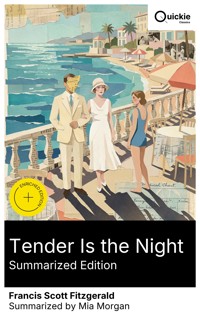









TENDER IS THE NIGHT
Published by
Books
Table of Contents
Introduction
Beneath the Riviera’s lucid sky, where charm seems a durable currency and laughter carries across glittering water, Tender Is the Night follows the incremental exchange of love, ambition, and privilege, season by season, until the bright surface that promised permanence yields to an unsettling twilight in which loyalties falter, identities blur, and the tenderness that once animated a charmed circle proves fragile against time, pressure, and the quiet reckonings that arrive after pleasure.
Tender Is the Night is a 1934 novel by F. Scott Fitzgerald, composed over several years after The Great Gatsby and set largely among American expatriates in Europe. Its central premise unfolds when a young American actress encounters a magnetic couple on the French Riviera and is drawn into their cultivated world. The couple’s brilliance and generosity dazzle, yet the glittering milieu conceals tensions that the narrative gradually brings into focus. Without venturing beyond this initial setup, the book invites readers to watch how an intimate constellation of characters navigates desire, status, and vulnerability under a sun that lights everything and forgives nothing.
This work holds classic status because it represents Fitzgerald at full command of a larger, more intricate canvas than the one that made him famous. It is his final completed novel, a summation of craft that extends the lyric intelligence of his earlier writing into deeper psychological territory. Critics and readers have long recognized its refinement of the American novel’s treatment of glamour and cost, as well as its layered approach to time and memory. The book’s artistry—subtle structure, poised sentences, and moral poise—keeps it within the enduring conversation about what the modern novel can accomplish.
The novel’s impact reaches beyond its initial reception, shaping how later writers conceive stories of beauty under stress and privilege under scrutiny. Its nuanced attention to social performance, its sense of moral drift within abundance, and its rigorous musicality of prose have become touchstones for narrative ambition. Authors studying the interplay between public allure and private fracture have found in Fitzgerald’s method a generative model: a way to blend sensuous surfaces with analytic depth. Because of that fusion, the book remains a living reference in discussions of style, structure, and psychological realism.
At the heart of the novel are themes that resist expiration: the seductions of wealth and ease, the art of self-invention, the burden of care inside intimate bonds, and the uncertainty of professional authority when entangled with personal desire. Fitzgerald examines how love can be both sanctuary and crucible, and how admiration shades into dependency. He investigates the pull of youth and the ache of its passing, the American appetite for reinvention abroad, and the costs of maintaining a brilliant facade. The result is a study of vulnerability disguised as strength and of strength eroded by its own overuse.
Fitzgerald turns setting into a kind of character, using the Riviera’s beaches, grand hotels, and luminous terraces as stages for performance and revelation. Travel inflects rhythm: trains, promenades, and port cities link scenes of conversation, flirtation, and quiet rupture. Europe’s layered past frames the bright restlessness of expatriate life, while occasional returns to America remind readers of the era’s shifting fortunes and expectations. Sunlight, sea, and architecture do more than decorate; they organize the book’s emotional weather, suggesting how place can sustain illusion even as it patiently records the cracks running beneath it.
Formally, the novel experiments with vantage and duration, asking readers to notice how perspective shapes truth. Fitzgerald modulates distance and closeness, often letting social observation slide into interior resonance. Time does not merely pass; it reconfigures. Past and present touch in ways that complicate motive and consequence, while scenes echo across the book like refrains in a symphony. This structural elegance allows Fitzgerald to withhold and reveal in measured sequence, cultivating a sense that understanding is always provisional—sharpened by context, altered by emotion, and vulnerable to the narratives people tell about themselves.
The book emerged from the interwar period, when the exuberance associated with the 1920s met the sobering realities that followed. Fitzgerald developed the novel through the late 1920s and early 1930s, and it appeared in 1934, when the Great Depression had recast American confidence. That timing matters: the story’s radiance is shadowed by awareness of decline, and its portraits of leisure are edged with anxiety about cost, responsibility, and loss. The cultural moment gave Fitzgerald both the material and the pressure necessary to refine his abiding concerns about aspiration and disillusionment.
Characterization is central to the novel’s power. Fitzgerald composes his principal figures with a balance of allure and opacity, allowing readers to experience both admiration and unease. The young actress’s curiosity and idealism provide a threshold into the circle’s glamour, while the established couple’s intelligence, poise, and kindness create an initial sense of security. Yet gestures, conversations, and slight asymmetries hint at unspoken histories and obligations. The novel’s drama lies in watching how such hints accumulate, altering relationships without reducing anyone to a simple emblem or moral lesson.
Fitzgerald’s style supports this ethical complexity. His sentences carry a tensile grace, shifting from crisp social notation to a full shimmer of image and cadence. Dialogue has the pitch of lived conversation, yet it is cleanly orchestrated to reveal power and desire. Motifs of light and night, sea and season, function as emotional registers rather than mere decorations. As readers move through the chapters, they hear a counterpoint of moods—exhilaration and fatigue, tenderness and withdrawal—composed with the musical intelligence that critics often cite as a defining contribution to American prose.
To approach the novel today is to encounter both a period piece and an unquiet mirror. Its social codes are of its time, but the psychological portraiture feels immediate. The book asks patience with nuance, rewarding attention to shifts in tone and to the ethics of care inside unequal bonds. It also invites reflection on ambition: professional, romantic, and social. Without disclosing the later turns of the plot, it is fair to say that the novel honors complexity over verdicts, trusting readers to inhabit uncertainty and to recognize themselves in flawed, luminous, resilient human figures.
The themes reverberate strongly now: the magnetism of celebrity and wealth, the negotiation of intimacy under public gaze, the porous boundary between work and identity, and the global drift of people seeking renewal elsewhere. Tender Is the Night endures because it decodes glamour without contempt and renders vulnerability without sentimentality. It shows how private tenderness can be strained by structural forces—money, medicine, reputation—and how even the most polished life requires forms of courage not easily displayed. For contemporary readers, that recognition keeps the book vividly present, its night still tender, and its light still instructive.
Synopsis
F. Scott Fitzgerald’s Tender Is the Night opens on the French Riviera, where a sunlit beach and a fashionable hotel frame the arrival of young American film star Rosemary Hoyt and her mother. Rosemary is quickly enchanted by Dick and Nicole Diver, a refined American couple whose hospitality draws an international circle. The Divers’ poise, generosity, and social ease make them the heart of the resort’s life, and Rosemary’s fascination grows into a deep personal attachment. Beneath the glittering scene, however, Fitzgerald lets small dissonances ring—glimpses of strain, guardedness, and carefully smoothed tensions that suggest a more complicated domestic core.
Drawn into the Divers’ orbit, Rosemary witnesses a world of cocktails, drives along the coast, and bright company that includes the talkative McKiscos, the talented but self-destructive Abe North, and the fearless adventurer Tommy Barban. The elegant façade is punctured by quarrels, secrets, and sudden flashes of insecurity. Nicole’s beauty is matched by a delicacy that others protect, while Dick’s charm has a practiced, almost professional composure. Rosemary’s admiration turns personal, and she measures her youthful certainty against the Divers’ cultivated maturity, sensing that their grace is sustained by effort and by an unspoken history she only dimly perceives.
As rosemary’s infatuation intensifies, Fitzgerald uses her perspective to explore the irresistible pull of charisma and the moral ambiguities it creates. She is both a coming-of-age observer and a participant, guided by a practical mother yet tempted by a vision of romantic destiny. Dick responds with a mixture of kindness, restraint, and susceptibility, revealing his own divided loyalties—between professional duty, marital responsibility, and the seductions of admiration. The social rhythm of parties and travel carries them along, but the atmosphere grows heavier, and the group’s conviviality begins to give way to jealousy, embarrassment, and the first overt signs of fracture.
A series of social mishaps and public embarrassments accelerates the unraveling. Conversations turn barbed, and loyalties rearrange as the group moves from the coast to Paris and other European stops. Alcohol sharpens conflicts, and the Divers’ carefully maintained balance starts to tilt. Dick’s drinking increases, and the protective cocoon around Nicole sometimes proves inadequate to sudden stresses. Wealth and influence cushion the consequences, yet they also entangle the couple in obligations and expectations. Fitzgerald’s scenes show glamour coexisting with discomfort, suggesting that this seemingly perfect household is built on routines of management and denial that are becoming harder to sustain.
The narrative then shifts backward, revealing the foundations of Dick and Nicole’s marriage. Dick, once a rising American psychiatrist working at a Swiss clinic, encounters Nicole as a patient whose illness is rooted in severe earlier trauma. Their relationship develops under the pressures of treatment and dependency, and their eventual union blurs professional boundaries with personal devotion. Nicole’s family, wealthy and protective, helps secure a life of comfort and mobility. Dick’s reputation grows, supported by his writings and promise, yet the ethical compromise of their beginning—and the power dynamics it encodes—quietly haunt the couple’s future choices.
In their early years together, the Divers create a cultivated, cosmopolitan household. They raise children, travel seasonally, and assemble friends who bask in their style. Nicole’s stability improves, while Dick’s status as husband, father, and physician intertwines with roles of guardian and guide. Over time, those roles clash with his need for intellectual independence and professional accomplishment. The money that allows him to live expansively also shapes his options. As Nicole gains confidence, the balance of dependence begins to shift. Fitzgerald traces how affection, duty, and pride can fuse into a structure that seems strong yet is vulnerable to slow, inward erosion.
The story returns to the later period with renewed clarity about motives and fault lines. Rosemary reenters the Divers’ sphere, and fresh journeys across Europe expose the couple to new stresses and temptations. Dick’s drinking and restlessness compromise his judgment, while Nicole’s episodes, though less frequent, remain a source of anxiety. Public incidents—minor in themselves but cumulatively damaging—undermine Dick’s professional standing. Friends change sides, and rivals step forward. The alluring social stage that once elevated the Divers now magnifies their missteps, turning personal volatility into spectacle and closing off paths that once seemed open.
Practical pressures intensify the private conflict. Efforts to establish or maintain clinical work entangle Dick with partners and with Nicole’s trustees, whose financial support carries implicit authority. Miscalculations, fatigue, and a growing reputation for unreliability make recovery difficult. Meanwhile, Nicole’s growing self-possession alters the marriage’s equilibrium, raising questions about duty, autonomy, and the possibility of renewal. Fitzgerald keeps the narrative focused on the unpredictable interplay of illness, care, and desire, showing how even well-intentioned choices can trap people in roles they can neither fully escape nor satisfactorily fulfill.
Without announcing a single decisive lesson, the novel closes on the enduring themes that give it power: the fragility of glamour, the costs of caretaking and dependency, and the way ideals erode under time and compromise. Tender Is the Night examines the American dream exported abroad, where wealth and sophistication promise freedom but conceal obligations that shape every gesture. Its shifting structure mirrors the workings of memory, asking how origin stories determine later fate. The book’s broader message suggests that charm and goodness are not sufficient safeguards, and that love—so radiant at first sight—must live with history, limits, and the complicated work of responsibility.
Historical Context
Tender Is the Night unfolds largely on the French Riviera and in Switzerland during the mid-1920s, extending into the early 1930s. Its world is defined by luxury hotels, seaside villas, international clinics, ocean liners, and the emerging dominance of American money abroad. The social order depends on private wealth, trusts, and the etiquette of cosmopolitan leisure, while national borders feel porous for the privileged. Marriage, medicine, and the studio system in Hollywood function as powerful institutions that regulate behavior and reputation. The novel’s glamorous locales frame a society shaped by postwar dislocation, easy transatlantic mobility, and the soft power of American culture in Europe.
The First World War (1914–1918) left Europe physically devastated and morally unsettled. The Treaty of Versailles (1919) redrew borders and imposed reparations on Germany, contributing to a volatile economic climate. Veterans, including many Americans, carried physical and psychological scars, and a broader disillusionment with prewar ideals was widely reported. This atmosphere underlies the novel’s tone: characters move through Europe with an air of restlessness and emotional exhaustion. The lingering shadow of wartime trauma, known then as “shell shock” or “war neuroses,” informs both the period’s medical debates and the fragile poise of those seeking pleasure and purpose in peacetime.
A distinct expatriate culture of American and British artists, writers, and wealthy travelers emerged in 1920s France, especially in Paris and along the Mediterranean coast. Favorable exchange rates, relatively permissive social norms, and a dense network of salons, bookshops, and cafes fostered this milieu. The label “Lost Generation,” popularized in the decade, captured a sense of moral drift and creative fervor. Fitzgerald participated in this transatlantic literary world and observed its tensions. The novel’s cosmopolitan parties, multilingual chatter, and shifting alliances mirror an expatriate scene where class privilege, artistic ambition, and spiritual fatigue coexisted uneasily.
The French Riviera underwent a transformation from a winter spa for aristocrats into an all-season playground for international elites. Expanded rail connections and improved roads brought Cannes, Nice, and Antibes within easy reach. Beaches, cabarets, and grand hotels promoted seaside leisure as a symbol of modern vitality. Americans were conspicuous consumers in this setting, and their dollars helped reconfigure local economies around tourism. The novel’s Riviera scenes align with this historical shift: luxurious resorts became stages for spectacle and self-invention, while the casual intimacy of sunbathing and yachting encouraged rapid, volatile social mixing among wealthy visitors.
Monetary dynamics were crucial. After postwar turbulence, France stabilized the franc in the late 1920s, but at a value lower than its prewar parity. The resulting devaluation—solidified under Raymond Poincaré’s government—made France comparatively inexpensive for those holding dollars or pounds. The broader gold-exchange standard, discussed at the Genoa Conference (1922), eased international payments and encouraged tourism. American purchasing power stretched farther on the Riviera than at home, enabling lavish consumption that felt almost consequence-free. The novel’s emphasis on seemingly bottomless spending, fine credit, and effortless hospitality reflects the era’s favorable exchange rates for foreigners.
Prohibition in the United States (1919–1933, with national enforcement from early 1920) criminalized the manufacture and sale of alcoholic beverages, transforming domestic nightlife into a network of speakeasies and bootlegging operations. In contrast, European resorts served cocktails openly, and ocean liners poured freely once outside U.S. territorial waters. Americans abroad often experienced European drinking as a liberation from moral surveillance and police raids. The novel’s parties—fluid, permissive, and ingenious in their rituals—echo this historical divide, showing how alcohol functioned as both social lubricant and symbol of expatriate autonomy from American legal and cultural constraints.
The 1920s “Jazz Age” signified more than music. It encompassed mass entertainment, changing fashions, new dances, and a brisk market for consumer novelty. Gramophones, radio broadcasts, and dance bands stitched together a transatlantic soundtrack, while magazines disseminated images of chic bodies at leisure. Youth culture, with its bobbed hair and shorter hemlines, signaled a generational break from Victorian restraint. Fitzgerald famously chronicled this cultural swirl. In the novel, glamorous gatherings, modern slang, and a heightened attention to surfaces all belong to the Jazz Age’s aesthetic, which promised freedom yet often revealed underlying anxieties about status, virtue, and personal identity.
Hollywood’s rise shaped aspirations and behavior throughout the decade. By the mid-1920s, a vertically integrated studio system controlled production, distribution, and exhibition, and the star system turned young actors into global ideals. The coming of sound (from 1927) intensified celebrity and standardized American speech and manners across borders. Publicity departments and gossip columns cultivated marketable innocence and scandal. A motion picture code was drafted in 1930; strict enforcement followed in 1934. The novel’s inclusion of a young American actress and references to studios mirror this apparatus, charting how cinematic fame created both opportunities and vulnerabilities for women in the public eye.
Modern psychiatry, centered in part in Switzerland, drew international patients in the interwar years. Private sanatoria near Zurich and Lake Geneva combined psychoanalytic ideas with rest cures, talk therapy, and somatic treatments. Freud and Jung’s influence shaped diagnoses of trauma and neuroses, though schools competed and boundaries of practice were contested. Wealthy families often sought discreet care in Swiss clinics renowned for bilingual staff and carefully managed privacy. The novel’s depiction of clinics, consultations, and guarded corridors of treatment aligns with this historical landscape, where mental suffering intersected with money, nationality, and the promise of scientific modernity.
Debates about professional ethics in psychoanalysis and psychiatry intensified in the 1910s and 1920s. Concepts such as transference and countertransference underscored the intimate power dynamics between doctor and patient, prompting discussions about neutrality, boundaries, and the risk of dependency. While codified rules varied, the profession increasingly warned against dual relationships and the intrusion of personal motives into therapeutic work. The novel’s tensions around medical authority, confidentiality, and the uses—and misuses—of diagnosis reflect these anxieties. It suggests how the doctor’s prestige could shelter questionable choices, and how patients’ voices were often mediated by guardians, clinicians, and family interests.
Gender norms were shifting but asymmetric. In the United States, the Nineteenth Amendment (1920) expanded women’s suffrage, and new educational and employment opportunities followed. Fashion and social behavior associated with the “flapper” signaled a break with older proprieties. Yet legal and financial dependence persisted, especially within marriage and among heiresses whose property could be placed under trusts or oversight. Divorce laws differed across countries and states, complicating transnational unions. Mental illness carried social stigma, often justifying paternalistic control. The novel’s portrayal of marriage, money, and medical oversight speaks to a world where women’s autonomy advanced unevenly and was frequently contested.
American prosperity in the 1920s rested on industrial productivity, expanding consumer credit, and a bullish Wall Street. Tax policies lowered rates for top earners mid-decade, and corporate profits soared. For the transatlantic leisure class, conspicuous consumption—yachts, grand tours, couture—was a language of prestige. Philanthropic gestures and cultivated taste helped legitimize wealth. The novel’s elegant surroundings and carefully staged entertainments reflect this order of display. Yet the same ethos invited moral scrutiny: ease could mask dependence on financiers, fragile credit, and the volatility of markets that financed both private extravagance and public dreams of endless growth.
The Riviera’s hospitality economy relied on armies of service workers: hotel staff, chauffeurs, guides, and seasonal laborers. Improvements in transportation—rail timetables, motorcar routes—organized their work around the rhythms of wealthy visitors. English and French functioned as common currencies of service; tips and the discretion of staff helped preserve patrons’ reputations. The novel’s settings—lobbies, terraces, bathing pavilions—evoke this infrastructure. Behind the glitter lay a precise choreography of servants, managers, and local trades. The intimacy between guests and staff, and the knowledge that employees accumulated about private lives, formed an unspoken contract central to elite leisure.
Interwar literary culture in France provided a network that shaped English-language writing. Parisian bookshops, notably Shakespeare and Company, circulated works and fostered communities of writers. American authors including Ernest Hemingway, Gertrude Stein, and others engaged in debates over style and expatriate identity, sometimes celebrating, sometimes critiquing the cosmopolitan scene. Fitzgerald’s work is situated within this conversation: he observed wealth from near at hand, noting its rhetoric of charm and its corrosion. The novel speaks to a shared preoccupation of the period—how to live after the rupture of war—by embedding characters in a milieu both seductive and spiritually precarious.
The stock market crash of October 1929 and the ensuing Great Depression (through the 1930s) altered the landscape that the novel portrays. Credit tightened, fortunes contracted, and international tourism slowed. France felt the downturn later than some countries, but the climate of confidence changed worldwide. Published in 1934, the novel carries this post-crash melancholy: the gaiety of the earlier decade now appears brittle. Characters’ anxieties about money and status correspond to real pressures that recalibrated marriages, careers, and social circles. The work implicitly measures the distance between 1920s exuberance and the harsher economic realities of the early 1930s.
Transatlantic mobility in the 1920s depended on reliable ocean liners, growing commercial aviation’s precursors, and dense rail networks. Steamship lines linked New York to Cherbourg or Southampton in under a week, while French and Swiss railways carried travelers swiftly to resorts and clinics. Automobiles extended private freedom of movement along the coast. Telegraph cables and, later, improved telephony shrank distances for the well-connected. The novel’s frequent border crossings—between countries and social worlds—echo this infrastructure. Mobility amplified experimentation with identity, but also exposed personal lives to legal differences over alcohol, divorce, and medical jurisdiction.
Within medicine, interwar psychiatry remained a blend of emerging science and social power. Diagnoses were colored by class expectations; wealthy patients could purchase privacy and extended convalescence unavailable to most. The mental hygiene movement advocated prevention and early intervention, yet institutionalization and stigma persisted. The novel captures this ambivalence: treatment promises cure, but it can also become a means of control, especially when family fortunes, public reputations, and marital negotiations are at stake. As in the period more broadly, medicine serves both as a beacon of modern expertise and a site where ethical complexities accumulate around vulnerable individuals and their caretakers.Overall, Tender Is the Night functions as an exacting mirror of its era. It stages American wealth abroad amid favorable exchange rates, navigates Prohibition’s shadow and Hollywood’s sheen, and scrutinizes psychiatry at a moment of professional ascent. The novel tests the bright promises of the Jazz Age against the legacies of war and the shock of depression. By mapping intimate relationships onto institutions—marriage, medicine, money—it critiques how interwar modernity distributed power and desire. Its gilded surfaces reflect real historical glamour, while its fractures expose the costs of living on credit—emotional, ethical, and economic—in a world between catastrophes.
Author Biography
Introduction
Francis Scott Key Fitzgerald (1896–1940) was an American novelist and short-story writer whose name is inseparable from the Jazz Age. He captured the glamour and strain of a decade defined by prosperity, prohibition, and the search for identity. His novels This Side of Paradise, The Beautiful and Damned, The Great Gatsby, and Tender Is the Night, along with numerous stories from major magazines, shaped public images of youthful ambition and social display. Although acclaim fluctuated during his lifetime, his finely tuned prose, structural control, and acute sense of American myth established him as a central figure of twentieth-century fiction.
Fitzgerald moved with ease between social reportage and lyric evocation, dramatizing how privilege and desire distort memory and promise. He spent stretches of the mid-1920s in Europe among American expatriates, absorbing the cosmopolitan energies of Paris and the Riviera while finishing The Great Gatsby. His work charts the trajectory from postwar exuberance to Depression-era disillusionment, often through characters who remake themselves and pay a cost for the reinvention. Beyond celebrity, he was a professional craftsman whose sentences balance musical cadence and narrative economy. Today, he is read both as a chronicler of his generation and as an analyst of enduring American dreams.
Education and Literary Influences
Fitzgerald grew up in St. Paul, Minnesota, in a family attentive to social standing and literary aspiration. As a teenager he attended St. Paul Academy and, later, the Newman School in New Jersey, where teachers encouraged his writing. In 1913 he entered Princeton University, immersing himself in campus theater through the Triangle Club and contributing fiction to student publications. Academic performance suffered under the pressure of literary ambitions and extracurricular commitments. In 1917 he left Princeton without a degree and accepted a commission in the U.S. Army. The discipline of military life coexisted with a steady habit of drafting and revising stories.
His early reading left deep marks. Romantic poetry, especially John Keats, shaped his ear for cadence and image. He also admired Joseph Conrad’s narrative control and moral complexity. As a young professional he navigated a literary marketplace dominated by magazines and by influential critics such as H. L. Mencken. The most consequential editorial relationship of his life began at Charles Scribner’s Sons with Maxwell Perkins, who encouraged ambitious revisions and supported risky projects. Theater and popular song honed his sense of dialogue and scene, while encounters with postwar expatriates broadened his sense of style and cosmopolitan setting without loosening his American focus.
Literary Career
After brief stateside postings during the war, he revised an earlier manuscript into his debut novel, This Side of Paradise, published in 1920. The book’s portrait of youthful restlessness and elite campus life became an immediate bestseller, transforming his finances and reputation. That same year he married Zelda Sayre, whose vivid presence and aspirations often intersected with his subject matter. Short stories for high-paying magazines followed, collected in volumes such as Flappers and Philosophers and Tales of the Jazz Age. Fitzgerald emerged as a public voice of his era, celebrated for depicting modern manners while quietly refining his craft behind the scenes.
The Beautiful and Damned, appearing in 1922, deepened his exploration of wealth, marriage, and time’s erosions. While its reception was mixed compared to his debut, it confirmed his ambition to stretch beyond topical charm toward more durable artistic structure. Throughout the early 1920s he produced a stream of stories—among them “The Diamond as Big as the Ritz,” “Winter Dreams,” and “The Curious Case of Benjamin Button”—that combined satire, fantasy, and psychological insight. Success brought notoriety and strain. Fitzgerald labored to balance magazine work that funded an extravagant public life with the slower, exacting process of novel-writing that he considered his true vocation.
In 1924–1925 he composed The Great Gatsby, much of it while abroad. Slim and meticulously shaped, the novel drew praise for its structure and style, though sales at publication were modest. The book’s elliptical approach to ambition, romance, and ruin marked a breakthrough in control—its careful point of view and patterned imagery would later set a benchmark for American prose. During this period he circulated among expatriate writers and artists, even as he remained focused on uniquely American themes of self-invention and class. With time, Gatsby’s reputation steadily grew, and it is now widely regarded as his finest achievement.
The long-gestating Tender Is the Night appeared in 1934, drawing on years of observation from Europe and the United States. Initial responses were mixed, with some readers challenging its structure, yet later criticism has acknowledged its psychological depth and stylistic daring. Fitzgerald’s finest stories of the 1930s, including “Babylon Revisited,” registered the fallout of the boom years. Essays later gathered under the title The Crack-Up revealed a frank self-assessment during the Depression. To stabilize finances he accepted screenwriting assignments in Hollywood beginning in the late 1930s, gaining credit on Three Comrades and working, often uncredited, on other studio projects.
Beliefs and Advocacy
Fitzgerald’s work is animated by a sustained inquiry into aspiration, status, and the costs of desire in a capitalist culture. He was not a public activist in a conventional sense, but his fiction consistently interrogates the spectacle of wealth and the fragility of identity built upon it. He treated the idea often called the American Dream with both sympathy and skepticism, showing how reinvention can inspire and destroy. The Prohibition era’s contradictions—moralizing law amid exuberant nightlife—furnished settings where characters test limits. He brought a moral imagination to these scenes without preaching, trusting narrative implication more than declarative argument.
Privately and in print, Fitzgerald argued for artistic seriousness shaped by discipline and revision. He accepted the commercial necessity of magazines yet viewed the novel as a higher test of form, motive, and memory. Letters and essays chart his struggle to sustain standards in the face of financial pressure and public celebrity. He respected the editor’s craft and responded to criticism with extensive reworking. Late writings about emotional collapse broadened conversations about mental strain without claiming therapeutic authority. Across genres he advocated, by example, for prose that unites musical surface with structural design, aiming at clarity, resonance, and emotional exactitude.
Final Years & Legacy
In 1937 he returned to Hollywood more steadily, writing screenplays under tight deadlines and learning studio constraints. The experience sharpened his sense of professional discipline and supplied material for the Pat Hobby stories, wry portraits of a down-on-his-luck screenwriter published near the end of his life. He formed a companionship with journalist Sheilah Graham while continuing to draft a new novel, The Last Tycoon, inspired by the movie industry. Fitzgerald died in 1940 in California after a heart attack, leaving the manuscript unfinished. Friends and editors prepared it for publication, allowing readers to see his evolving late style.
Posthumously, Fitzgerald’s reputation rose dramatically. The Great Gatsby became a fixture of American classrooms and a touchstone for debates about class, aspiration, and style. Tender Is the Night gained admirers for its portrayal of marriage, illness, and cultural drift. His stories continued to circulate as models of narrative economy, and his essays offered a cautionary self-portrait of celebrity. Filmmakers repeatedly adapted his work, renewing interest across generations. Today he stands as a canonical American writer whose sentences reward close reading and whose themes remain contemporary. His legacy endures in the tension he mapped between glittering surfaces and haunted interiors.
TENDER IS THE NIGHT
Tender is the Night.
New York: Scribners, 1934.
Already with thee! tender is the night
… …
But here there is no light,
Save what from heaven is with the breezes blown
Through verdurous glooms and winding mossy ways.
—Ode to a Nightingale
To Gerald and Sara Many Fêtes
Book I.
I.
On the pleasant shore of the French Riviera[1], about half way between Marseilles[2] and the Italian border, stands a large, proud, rose-colored hotel. Deferential palms cool its flushed façade, and before it stretches a short dazzling beach. Lately it has become a summer resort of notable and fashionable people; a decade ago it was almost deserted after its English clientele went north in April. Now, many bungalows cluster near it, but when this story begins only the cupolas of a dozen old villas rotted like water lilies among the massed pines between Gausse’s Hôtel des Étrangers and Cannes[3], five miles away.
The hotel and its bright tan prayer rug of a beach were one[1q]. In the early morning the distant image of Cannes, the pink and cream of old fortifications, the purple Alp that bounded Italy, were cast across the water and lay quavering in the ripples and rings sent up by sea-plants through the clear shallows. Before eight a man came down to the beach in a blue bathrobe and with much preliminary application to his person of the chilly water, and much grunting and loud breathing, floundered a minute in the sea. When he had gone, beach and bay were quiet for an hour. Merchantmen crawled westward on the horizon; bus boys shouted in the hotel court; the dew dried upon the pines. In another hour the horns of motors began to blow down from the winding road along the low range of the Maures[4], which separates the littoral from true Provençal France.
A mile from the sea, where pines give way to dusty poplars, is an isolated railroad stop, whence one June morning in 1925 a victoria[5] brought a woman and her daughter down to Gausse’s Hotel. The mother’s face was of a fading prettiness that would soon be patted with broken veins; her expression was both tranquil and aware in a pleasant way. However, one’s eye moved on quickly to her daughter, who had magic in her pink palms and her cheeks lit to a lovely flame, like the thrilling flush of children after their cold baths in the evening. Her fine forehead sloped gently up to where her hair, bordering it like an armorial shield, burst into lovelocks and waves and curlicues of ash blonde and gold. Her eyes were bright, big, clear, wet, and shining, the color of her cheeks was real, breaking close to the surface from the strong young pump of her heart. Her body hovered delicately on the last edge of childhood—she was almost eighteen, nearly complete, but the dew was still on her.
As sea and sky appeared below them in a thin, hot line the mother said:
“Something tells me we’re not going to like this place.”
“I want to go home anyhow,” the girl answered.
They both spoke cheerfully but were obviously without direction and bored by the fact—moreover, just any direction would not do. They wanted high excitement, not from the necessity of stimulating jaded nerves but with the avidity of prize-winning schoolchildren who deserved their vacations.
“We’ll stay three days and then go home. I’ll wire right away for steamer tickets.”
At the hotel the girl made the reservation in idiomatic but rather flat French, like something remembered. When they were installed on the ground floor she walked into the glare of the French windows and out a few steps onto the stone veranda that ran the length of the hotel. When she walked she carried herself like a ballet-dancer, not slumped down on her hips but held up in the small of her back. Out there the hot light clipped close her shadow and she retreated—it was too bright to see. Fifty yards away the Mediterranean yielded up its pigments, moment by moment, to the brutal sunshine; below the balustrade a faded Buick[7] cooked on the hotel drive.
Indeed, of all the region only the beach stirred with activity. Three British nannies sat knitting the slow pattern of Victorian England, the pattern of the forties, the sixties, and the eighties, into sweaters and socks, to the tune of gossip as formalized as incantation; closer to the sea a dozen persons kept house under striped umbrellas, while their dozen children pursued unintimidated fish through the shallows or lay naked and glistening with cocoanut oil out in the sun.
As Rosemary came onto the beach a boy of twelve ran past her and dashed into the sea with exultant cries. Feeling the impactive scrutiny of strange faces, she took off her bathrobe and followed. She floated face down for a few yards and finding it shallow staggered to her feet and plodded forward, dragging slim legs like weights against the resistance of the water. When it was about breast high, she glanced back toward shore: a bald man in a monocle[8] and a pair of tights, his tufted chest thrown out, his brash navel sucked in, was regarding her attentively. As Rosemary returned the gaze the man dislodged the monocle, which went into hiding amid the facetious whiskers of his chest, and poured himself a glass of something from a bottle in his hand.
Rosemary laid her face on the water and swam a choppy little four-beat crawl out to the raft. The water reached up for her, pulled her down tenderly out of the heat, seeped in her hair and ran into the corners of her body. She turned round and round in it, embracing it, wallowing in it. Reaching the raft she was out of breath, but a tanned woman with very white teeth looked down at her, and Rosemary, suddenly conscious of the raw whiteness of her own body, turned on her back and drifted toward shore. The hairy man holding the bottle spoke to her as she came out.
“I say—they have sharks out behind the raft.” He was of indeterminate nationality, but spoke English with a slow Oxford drawl. “Yesterday they devoured two British sailors from the flotte at Golfe Juan[9].”
“Heavens!” exclaimed Rosemary.
“They come in for the refuse from the flotte.”
Glazing his eyes to indicate that he had only spoken in order to warn her, he minced off two steps and poured himself another drink.
Not unpleasantly selfconscious, since there had been a slight sway of attention toward her during this conversation, Rosemary looked for a place to sit. Obviously each family possessed the strip of sand immediately in front of its umbrella; besides there was much visiting and talking back and forth—the atmosphere of a community upon which it would be presumptuous to intrude. Farther up, where the beach was strewn with pebbles and dead seaweed, sat a group with flesh as white as her own. They lay under small hand-parasols instead of beach umbrellas and were obviously less indigenous to the place. Between the dark people and the light, Rosemary found room and spread out her peignoir[6] on the sand.
Lying so, she first heard their voices and felt their feet skirt her body and their shapes pass between the sun and herself. The breath of an inquisitive dog blew warm and nervous on her neck; she could feel her skin broiling a little in the heat and hear the small exhausted wa-waa of the expiring waves. Presently her ear distinguished individual voices and she became aware that some one referred to scornfully as “that North guy” had kidnapped a waiter from a café in Cannes last night in order to saw him in two. The sponsor of the story was a white-haired woman in full evening dress, obviously a relic of the previous evening, for a tiara still clung to her head and a discouraged orchid expired from her shoulder. Rosemary, forming a vague antipathy to her and her companions, turned away.
Nearest her, on the other side, a young woman lay under a roof of umbrellas making out a list of things from a book open on the sand. Her bathing suit was pulled off her shoulders and her back, a ruddy, orange brown, set off by a string of creamy pearls, shone in the sun. Her face was hard and lovely and pitiful. Her eyes met Rosemary’s but did not see her. Beyond her was a fine man in a jockey cap and red-striped tights; then the woman Rosemary had seen on the raft, and who looked back at her, seeing her; then a man with a long face and a golden, leonine head, with blue tights and no hat, talking very seriously to an unmistakably Latin young man in black tights, both of them picking at little pieces of seaweed in the sand. She thought they were mostly Americans, but something made them unlike the Americans she had known of late.
After a while she realized that the man in the jockey cap was giving a quiet little performance for this group; he moved gravely about with a rake, ostensibly removing gravel and meanwhile developing some esoteric burlesque held in suspension by his grave face. Its faintest ramification had become hilarious, until whatever he said released a burst of laughter. Even those who, like herself, were too far away to hear, sent out antennæ of attention until the only person on the beach not caught up in it was the young woman with the string of pearls. Perhaps from modesty of possession she responded to each salvo of amusement by bending closer over her list.
The man of the monocle and bottle spoke suddenly out of the sky above Rosemary.
“You are a ripping swimmer.”
She demurred.
“Jolly good. My name is Campion. Here is a lady who says she saw you in Sorrento[10] last week and knows who you are and would so like to meet you.”
Glancing around with concealed annoyance Rosemary saw the untanned people were waiting. Reluctantly she got up and went over to them.
“Mrs. Abrams—Mrs. McKisco—Mr. McKisco—Mr. Dumphry—
“We know who you are,” spoke up the woman in evening dress. “You’re Rosemary Hoyt and I recognized you in Sorrento and asked the hotel clerk and we all think you’re perfectly marvellous and we want to know why you’re not back in America making another marvellous moving picture.”
They made a superfluous gesture of moving over for her. The woman who had recognized her was not a Jewess, despite her name. She was one of those elderly “good sports” preserved by an imperviousness to experience and a good digestion into another generation.
“We wanted to warn you about getting burned the first day,” she continued cheerily, “because your skin is important, but there seems to be so darn much formality on this beach that we didn’t know whether you’d mind.”
II.
“We thought maybe you were in the plot,” said Mrs. McKisco. She was a shabby-eyed, pretty young woman with a disheartening intensity. “We don’t know who’s in the plot and who isn’t. One man my husband had been particularly nice to turned out to be a chief character—practically the assistant hero.”
“The plot?” inquired Rosemary, half understanding. “Is there a plot?”
“My dear, we don’t know,” said Mrs. Abrams, with a convulsive, stout woman’s chuckle. “We’re not in it. We’re the gallery.”
Mr. Dumphry, a tow-headed effeminate young man, remarked: “Mama Abrams is a plot in herself,” and Campion shook his monocle at him, saying: “Now, Royal, don’t be too ghastly for words.” Rosemary looked at them all uncomfortably, wishing her mother had come down here with her. She did not like these people, especially in her immediate comparison of them with those who had interested her at the other end of the beach. Her mother’s modest but compact social gift got them out of unwelcome situations swiftly and firmly. But Rosemary had been a celebrity for only six months, and sometimes the French manners of her early adolescence and the democratic manners of America, these latter superimposed, made a certain confusion and let her in for just such things.
Mr. McKisco, a scrawny, freckle-and-red man of thirty, did not find the topic of the “plot” amusing. He had been staring at the sea—now after a swift glance at his wife he turned to Rosemary and demanded aggressively:
“Been here long?”
“Only a day.”
“Oh.”
Evidently feeling that the subject had been thoroughly changed, he looked in turn at the others.
“Going to stay all summer?” asked Mrs. McKisco, innocently. “If you do you can watch the plot unfold.”
“For God’s sake, Violet, drop the subject!” exploded her husband. “Get a new joke, for God’s sake!”
Mrs. McKisco swayed toward Mrs. Abrams and breathed audibly:
“He’s nervous.”
“I’m not nervous,” disagreed McKisco. “It just happens I’m not nervous at all.”
He was burning visibly—a grayish flush had spread over his face, dissolving all his expressions into a vast ineffectuality. Suddenly remotely conscious of his condition he got up to go in the water, followed by his wife, and seizing the opportunity Rosemary followed.
Mr. McKisco drew a long breath, flung himself into the shallows and began a stiff-armed batting of the Mediterranean, obviously intended to suggest a crawl—his breath exhausted he arose and looked around with an expression of surprise that he was still in sight of shore.
“I haven’t learned to breathe yet. I never quite understood how they breathed.” He looked at Rosemary inquiringly.
“I think you breathe out under water,” she explained. “And every fourth beat you roll your head over for air.”
“The breathing’s the hardest part for me. Shall we go to the raft?”
The man with the leonine head lay stretched out upon the raft, which tipped back and forth with the motion of the water. As Mrs. McKisco reached for it a sudden tilt struck her arm up roughly, whereupon the man started up and pulled her on board.
“I was afraid it hit you.” His voice was slow and shy; he had one of the saddest faces Rosemary had ever seen, the high cheekbones of an Indian, a long upper lip, and enormous deep-set dark golden eyes. He had spoken out of the side of his mouth, as if he hoped his words would reach Mrs. McKisco by a circuitous and unobtrusive route; in a minute he had shoved off into the water and his long body lay motionless toward shore.
Rosemary and Mrs. McKisco watched him. When he had exhausted his momentum he abruptly bent double, his thin thighs rose above the surface, and he disappeared totally, leaving scarcely a fleck of foam behind.
“He’s a good swimmer,” Rosemary said.
Mrs. McKisco’s answer came with surprising violence.
“Well, he’s a rotten musician.” She turned to her husband, who after two unsuccessful attempts had managed to climb on the raft, and having attained his balance was trying to make some kind of compensatory flourish, achieving only an extra stagger. “I was just saying that Abe North may be a good swimmer but he’s a rotten musician.”
“Yes,” agreed McKisco, grudgingly. Obviously he had created his wife’s world, and allowed her few liberties in it.
“Antheil[11]’s my man.” Mrs. McKisco turned challengingly to Rosemary, “Anthiel and Joyce[12]. I don’t suppose you ever hear much about those sort of people in Hollywood, but my husband wrote the first criticism of Ulysses[13] that ever appeared in America.”
“I wish I had a cigarette,” said McKisco calmly. “That’s more important to me just now.”
“He’s got insides—don’t you think so, Albert?”
Her voice faded off suddenly. The woman of the pearls had joined her two children in the water, and now Abe North came up under one of them like a volcanic island, raising him on his shoulders. The child yelled with fear and delight and the woman watched with a lovely peace, without a smile.
“Is that his wife?” Rosemary asked.
“No, that’s Mrs. Diver. They’re not at the hotel.” Her eyes, photographic, did not move from the woman’s face. After a moment she turned vehemently to Rosemary.
“Have you been abroad before?”
“Yes—I went to school in Paris.”
“Oh! Well then you probably know that if you want to enjoy yourself here the thing is to get to know some real French families. What do these people get out of it?” She pointed her left shoulder toward shore. “They just stick around with each other in little cliques. Of course, we had letters of introduction and met all the best French artists and writers in Paris. That made it very nice.”
“I should think so.”
“My husband is finishing his first novel, you see.”
Rosemary said: “Oh, he is?” She was not thinking anything special, except wondering whether her mother had got to sleep in this heat.
“It’s on the idea of Ulysses,” continued Mrs. McKisco. “Only instead of taking twenty-four hours my husband takes a hundred years. He takes a decayed old French aristocrat and puts him in contrast with the mechanical age—”
“Oh, for God’s sake, Violet, don’t go telling everybody the idea,” protested McKisco. “I don’t want it to get all around before the book’s published.”
Rosemary swam back to the shore, where she threw her peignoir over her already sore shoulders and lay down again in the sun. The man with the jockey cap was now going from umbrella to umbrella carrying a bottle and little glasses in his hands; presently he and his friends grew livelier and closer together and now they were all under a single assemblage of umbrellas—she gathered that some one was leaving and that this was a last drink on the beach. Even the children knew that excitement was generating under that umbrella and turned toward it—and it seemed to Rosemary that it all came from the man in the jockey cap.
Noon dominated sea and sky—even the white line of Cannes, five miles off, had faded to a mirage of what was fresh and cool; a robin-breasted sailing boat pulled in behind it a strand from the outer, darker sea. It seemed that there was no life anywhere in all this expanse of coast except under the filtered sunlight of those umbrellas, where something went on amid the color and the murmur.
Campion walked near her, stood a few feet away and Rosemary closed her eyes, pretending to be asleep; then she half-opened them and watched two dim, blurred pillars that were legs. The man tried to edge his way into a sand-colored cloud, but the cloud floated off into the vast hot sky. Rosemary fell really asleep.
She awoke drenched with sweat to find the beach deserted save for the man in the jockey cap, who was folding a last umbrella. As Rosemary lay blinking, he walked nearer and said:
“I was going to wake you before I left. It’s not good to get too burned right away.”
“Thank you.” Rosemary looked down at her crimson legs.
“Heavens!”
She laughed cheerfully, inviting him to talk, but Dick Diver was already carrying a tent and a beach umbrella up to a waiting car, so she went into the water to wash off the sweat. He came back and gathering up a rake, a shovel, and a sieve, stowed them in a crevice of a rock. He glanced up and down the beach to see if he had left anything.
“Do you know what time it is?” Rosemary asked.
“It’s about half-past one.”
They faced the seascape together momentarily.
“It’s not a bad time,” said Dick Diver. “It’s not one of worst times of the day.”
He looked at her and for a moment she lived in the bright blue worlds of his eyes, eagerly and confidently. Then he shouldered his last piece of junk and went up to his car, and Rosemary came out of the water, shook out her peignoir and walked up to the hotel.
III.
It was almost two when they went into the dining-room. Back and forth over the deserted tables a heavy pattern of beams and shadows swayed with the motion of the pines outside. Two waiters, piling plates and talking loud Italian, fell silent when they came in and brought them a tired version of the table d’hôte luncheon.
“I fell in love on the beach,” said Rosemary[2q].
“Who with?”
“First with a whole lot of people who looked nice. Then with one man.”
“Did you talk to him?”
“Just a little. Very handsome. With reddish hair.” She was eating, ravenously. “He’s married though—it’s usually the way.”
Her mother was her best friend and had put every last possibility into the guiding of her, not so rare a thing in the theatrical profession, but rather special in that Mrs. Elsie Speers was not recompensing herself for a defeat of her own. She had no personal bitterness or resentments about life—twice satisfactorily married and twice widowed, her cheerful stoicism had each time deepened. One of her husbands had been a cavalry officer and one an army doctor, and they both left something to her that she tried to present intact to Rosemary. By not sparing Rosemary she had made her hard—by not sparing her own labor and devotion she had cultivated an idealism in Rosemary, which at present was directed toward herself and saw the world through her eyes. So that while Rosemary was a “simple” child she was protected by a double sheath of her mother’s armor and her own—she had a mature distrust of the trivial, the facile and the vulgar. However, with Rosemary’s sudden success in pictures Mrs. Speers felt that it was time she were spiritually weaned; it would please rather than pain her if this somewhat bouncing, breathless and exigent idealism would focus on something except herself.
“Then you like it here?” she asked.
“It might be fun if we knew those people. There were some other people, but they weren’t nice. They recognized me—no matter where we go everybody’s seen ‘Daddy’s Girl.’”
Mrs. Speers waited for the glow of egotism to subside; then she said in a matter-of-fact way: “That reminds me, when are you going to see Earl Brady?”
“I thought we might go this afternoon—if you’re rested.”
“You go—I’m not going.”
“We’ll wait till tomorrow then.”
“I want you to go alone. It’s only a short way—it isn’t as if you didn’t speak French.”
“Mother—aren’t there some things I don’t have to do?”
“Oh, well then go later—but some day before we leave.”
“All right, Mother.”
After lunch they were both overwhelmed by the sudden flatness that comes over American travellers in quiet foreign places. No stimuli worked upon them, no voices called them from without, no fragments of their own thoughts came suddenly from the minds of others, and missing the clamor of Empire they felt that life was not continuing here.
“Let’s only stay three days, Mother,” Rosemary said when they were back in their rooms. Outside a light wind blew the heat around, straining it through the trees and sending little hot gusts through the shutters.
“How about the man you fell in love with on the beach?”
“I don’t love anybody but you, Mother, darling.”
Rosemary stopped in the lobby and spoke to Gausse père about trains. The concierge, lounging in light-brown khaki by the desk, stared at her rigidly, then suddenly remembered the manners of his métier. She took the bus and rode with a pair of obsequious waiters to the station, embarrassed by their deferential silence, wanting to urge them: “Go on, talk, enjoy yourselves. It doesn’t bother me.”
The first-class compartment was stifling; the vivid advertising cards of the railroad companies—The Pont du Gard at Arles, the Amphitheatre at Orange, winter sports at Chamonix—were fresher than the long motionless sea outside. Unlike American trains that were absorbed in an intense destiny of their own, and scornful of people on another world less swift and breathless, this train was part of the country through which it passed. Its breath stirred the dust from the palm leaves, the cinders mingled with the dry dung in the gardens. Rosemary was sure she could lean from the window and pull flowers with her hand.
A dozen cabbies slept in their hacks outside the Cannes station. Over on the promenade the Casino, the smart shops, and the great hotels turned blank iron masks to the summer sea. It was unbelievable that there could ever have been a “season,” and Rosemary, half in the grip of fashion, became a little selfconscious, as though she were displaying an unhealthy taste for the moribund; as though people were wondering why she was here in the lull between the gaiety of last winter and next winter, while up north the true world thundered by.
As she came out of a drug store with a bottle of cocoanut oil, a woman, whom she recognized as Mrs. Diver, crossed her path with arms full of sofa cushions, and went to a car parked down the street. A long, low black dog barked at her, a dozing chauffeur woke with a start. She sat in the car, her lovely face set, controlled, her eyes brave and watchful, looking straight ahead toward nothing. Her dress was bright red and her brown legs were bare. She had thick, dark, gold hair like a chow’s.
With half an hour to wait for her train Rosemary sat down in the Café des Alliés on the Croisette, where the trees made a green twilight over the tables and an orchestra wooed an imaginary public of cosmopolites with the Nice Carnival Song and last year’s American tune. She had bought Le Temps and The Saturday Evening Post for her mother, and as she drank her citronade she opened the latter at the memoirs of a Russian princess, finding the dim conventions of the nineties realer and nearer than the headlines of the French paper. It was the same feeling that had oppressed her at the hotel—accustomed to seeing the starkest grotesqueries of a continent heavily underlined as comedy or tragedy, untrained to the task of separating out the essential for herself, she now began to feel that French life was empty and stale. This feeling was surcharged by listening to the sad tunes of the orchestra, reminiscent of the melancholy music played for acrobats in vaudeville. She was glad to go back to Gausse’s Hotel.
Her shoulders were too burned to swim with the next day, so she and her mother hired a car—after much haggling, for Rosemary had formed her valuations of money in France—and drove along the Riviera, the delta of many rivers. The chauffeur, a Russian Czar of the period of Ivan the Terrible, was a self-appointed guide, and the resplendent names—Cannes, Nice, Monte Carlo—began to glow through their torpid camouflage, whispering of old kings come here to dine or die, of rajahs tossing Buddha’s eyes to English ballerinas, of Russian princes turning the weeks into Baltic twilights in the lost caviare days. Most of all, there was the scent of the Russians along the coast—their closed book shops and grocery stores. Ten years ago, when the season ended in April, the doors of the Orthodox Church were locked, and the sweet champagnes they favored were put away until their return. “We’ll be back next season,” they said, but this was premature, for they were never coming back any more.
It was pleasant to drive back to the hotel in the late afternoon, above a sea as mysteriously colored as the agates and cornelians of childhood, green as green milk, blue as laundry water, wine dark. It was pleasant to pass people eating outside their doors, and to hear the fierce mechanical pianos behind the vines of country estaminets. When they turned off the Corniche d’Or[17] and down to Gausse’s Hotel through the darkening banks of trees, set one behind another in many greens, the moon already hovered over the ruins of the aqueducts….
Somewhere in the hills behind the hotel there was a dance, and Rosemary listened to the music through the ghostly moonshine of her mosquito net, realizing that there was gaiety too somewhere about, and she thought of the nice people on the beach. She thought she might meet them in the morning, but they obviously formed a self-sufficient little group, and once their umbrellas, bamboo rugs, dogs, and children were set out in place the part of the plage was literally fenced in. She resolved in any case not to spend her last two mornings with the other ones.
IV.
The matter was solved for her. The McKiscos were not yet there and she had scarcely spread her peignoir when two men—the man with the jockey cap and the tall blonde man, given to sawing waiters in two—left the group and came down toward her.
“Good morning,” said Dick Diver. He broke down. “Look—sunburn or no sunburn, why did you stay away yesterday? We worried about you.”
She sat up and her happy little laugh welcomed their intrusion.
“We wondered,” Dick Diver said, “if you wouldn’t come over this morning. We go in, we take food and drink, so it’s a substantial invitation.”
He seemed kind and charming—his voice promised that he would take care of her, and that a little later he would open up whole new worlds for her, unroll an endless succession of magnificent possibilities. He managed the introduction so that her name wasn’t mentioned and then let her know easily that everyone knew who she was but were respecting the completeness of her private life—a courtesy that Rosemary had not met with save from professional people since her success.




