


Erhalten Sie Zugang zu diesem und mehr als 300000 Büchern ab EUR 5,99 monatlich.
- Herausgeber: THP Ireland
- Kategorie: Sachliteratur, Reportagen, Biografien
- Sprache: Englisch
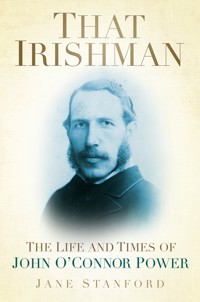
The story of John O'Connor Power is the story of Ireland's struggle for nationhood itself. Born into poverty in Ballinasloe in 1846, O'Connor Power spent much of his childhood in the workhouse. From here he rose rapidly through the ranks of the Fenian Movement to become a leading member of the Supreme Council of the Irish Republican Brotherhood. In 1874 he was elected Member for Mayo to the British House of Commons where he was widely acknowledged to be one of the outstanding orators of his day. His speeches, both in Parliament and to the US House of Representatives, secured crucial concessions and support for the Irish cause. O'Connor Power campaigned tirelessly for the rights of tenant farmers, and pioneered the policy of obstructionism to this end. Following his address to a tenants' rights meeting in Mayo, a protest was launched which would quickly become the powerful political force that was the Land League. He was, in short, one of a distinguished company, that indomitable Irishry of Charles Stewart Parnell, Michael Davitt and Isaac Butt, who made the dream of an independent Ireland a reality.
Sie lesen das E-Book in den Legimi-Apps auf:
Seitenzahl: 564
Veröffentlichungsjahr: 2011
Das E-Book (TTS) können Sie hören im Abo „Legimi Premium” in Legimi-Apps auf:
Ähnliche


















In memory of Russell and Anne Stanford and for Síle, Anne, Nóra and Lucy Jane
My friend, John O’Connor Power, once famous as ‘the Member for Mayo’ gave me, shortly before his death in February, 1919, the papers he had collected in the course of his unique political career – commencing as an Irish Fenian and ending as a British Liberal. ‘Make what use you like of them,’ he says in his letter to me, ‘subject to one condition – they must not be made the basis of an attack on any Irishman’.
Michael MacDonagh, preface to The Home Rule Movement
Contents
Title Page
Dedication
Epigraph
Acknowledgements
Pen Portraits
Abbreviations
Part 1
Part 2
Part 3
Part 4
Part 5
Afterword
Some Biographical Jottings
Time Line
Notes
Bibliography
Plate Section
Copyright
Acknowledgments
I would like to thank Dr Rosemary Power for generously sharing her family history.
The Dun Laoghaire librarians were enormously helpful and located books and articles for me in Irish and British libraries.
Brian Casey arranged an invitation to speak at the Ballinasloe Historical and Archaeological Society. A local photographer, Evelyn Donellan, was unstinting with her help and advice and introduced me to Jimmy Howley, a well-informed cousin. We toured Ballinasloe, Ballygill and Creagh graveyard. Evelyn assembled an impressive Power family tree. The Ballinasloe librarians, Mary Dillon and Colette Hanrahan, were welcoming. I was introduced to many descendants of the Power family and stayed with fourth cousins, Anne and Kieran Kenny, in Ballygill. They were generous in their hospitality and friendship and made me feel at home.
I must pay tribute to the scholarship of Professor T.W. Moody, Professor R.V. Comerford, Dr Donald Jordan, Dr John Cunningham, Dr Gerard P. Moran and many others. Without their published research, this story would not have been told.
I must thank Liam Byrne for posting my essay on the Roscommon History website. Thanks are also due to Dr Paddy Buckley, James Conran, Dr Helen Conrad O’Briain, Eileen Ó Dúill CG, Dr Tom Stanford, Dr Michael Stanford, Sally Corcoran, Maureen McDonnell, Mary McDaid and Peter Edwards, biographer of Henri Le Caron.
The National Library of Ireland, Director of the National Archives of Ireland, Special Collections, Boole Library, University College Cork, Kilmainham Gaol Museum, the Parliamentary Archives UK, the National Portrait Gallery, London, The British Library, the John Rylands Library, the University of Manchester, Indiana State University Library, findmypast.co.uk, Abney Park Trust, St Jarlath’s College, Tuam, County Galway, Middle Temple Library, St Bartholomew’s Hospital Archives and Museum.
Pen Portraits
So was John O’Connor Power, who was shortly after to be Member for Mayo, and was at that time a chief potentate in the Supreme Council’s mysterious sphere of influence; a man of great resolution, with a merciless underjaw, a furious temper governed by a carefully studied urbanity of manner, and a calm strong voice, that made the most common-place observation impressive; resolute enough in the ways of revolution to have himself headed raids for arms, and walked for years under the shadow of the gallows, but gifted also with a common-sense keen enough and fearless enough to guide him in the evolution from the impracticable to a wise and patriotic possibilism.
He would not be a follower of any man.
William O’Brien MP, Recollections (1905)
… Mr O’Connor Power, who had been notoriously a Fenian and member of the higher authorities of the conspiracy, but who was universally recognised as an able and conscientious worker in all English and Irish reforms, besides being the possessor of an oratorical gift with hardly any superior in the Parliaments in which he sat. But for the accident of not having been discovered while repression was in progress, Mr O’Connor Power, M.P., was everything wicked and incorrigible which Disraeli had castigated in the helpless and silent men at Portland and Dartmoor.
F. Hugh O’Donnell, A History of the Irish Parliamentary Party (1910)
He had all the qualities that make a leader of the people – a good presence, tall, muscular, and resolute looking; sincerity, belief in his cause, unbending determination, a cultivated mind, and oratorical gifts of the highest order. The matter of his speeches was always good. But if oratory is to weave its spells it demands in the speaker fine action as well as high thoughts and beautiful diction. O’Connor Power had a deep sonorous voice, which, used as it was, with fine modulation, was most impressive and appealing.
O’Connor Power was above the suspicion of interested motives.
Michael MacDonagh, The Home Rule Movement (1920)
He had very great gifts of speech, and I never knew a member of our party who had a more perfect and instinctive knowledge of what was called ‘the tone of the House of Commons’. Not by a demi-semi-quaver did he ever depart from the regular gamut of appropriate Parliamentary speech. In addition, he was a man of great courage, great self-confidence, and great force of character; but he had the tremendous defect of a very irritable and fierce temper.
T.P. O’Connor, Memoirs of an Old Parliamentarian (1928)
Abbreviations
AFIL
All-for-Ireland-League
CT
Connaught Telegraph
FJ
Freeman’s Journal
HR
Home Rule
HRCGB
Home Rule Confederation of Great Britain
II
Irish Independent
IGTWU
Irish and General Transport Workers Union
IPP
Irish Parliamentary Party
IRB
Irish Republican Brotherhood
IT
Irish Times
MG
Manchester Guardian
MP
Member of Parliament, UK
NBSP
National Brotherhood of Saint Patrick
NLC
National Liberal Club
NLI
National Library of Ireland
NYT
New York Times
PM
Prime Minister
RIC
Royal Irish Constabulary
SC
Supreme Council
UIL
United Irish League
UVF
Ulster Volunteer Force
Part One
The Home Place
A drift of men gone over the sea
A drift of the dead where men should be.1
We have no weapons, except patience and sufferance, and talk about tomorrow.2
It was the very worst of times. John O’Connor Power was born on 13 February 1846, in the first cruel winter of the Irish Famine, often called the Great Hunger and sometimes the Irish Holocaust. He lived with poverty, survived smallpox, and spent some time in the workhouse. Yet he rose to make a name for himself in the Fenian ranks, Westminster, radical journalism, and in later life, as a successful author, teacher and barrister-at-law. For over fifty years he would challenge the boundaries of a powerful Empire and build the connective bonds of a far-flung diaspora. One of the outstanding orators of the late-nineteenth century, he was ranked with Gladstone and Disraeli.
O’Connor Power was the youngest of three sons. Patrick Power, his father, was from a farming family in the Ballinasloe townland of Ballygill, in the parish of Creagh. Mary, his mother, was the daughter of P. O’Connor from Roscommon. His uncle, John Power, a tenant farmer with a small holding, has a place in Griffith’s Valuation, a property record of the time.3 Thomas Power farmed beside him.4 It was an extended family and there were aunts, uncles and many cousins to visit.
A stout, stone bridge, across a broad, full-flowing river, stands close to ‘Power’s Garden’, home to several generations of the family. A gentle, soothing view over lush meadows and sparse hedgerows directs the eye to a townscape, dominated by St Michael’s spire and the clock tower of St John’s. The Power homestead is no longer standing, but the vista remains unchanged.
Ballinasloe, on the border of counties Galway and Roscommon, and positioned on the River Suck, a tributary of the Shannon, was a thriving boom town. Strategically placed as the gateway to the west of Ireland and the Atlantic Ocean, its location was further enhanced by the expansion in 1828 of the Grand Canal and, later, in 1853, by the advent of the railway. The town provided a meeting ground for farmers, with access to the markets of Britain and Europe. It was the centre of Ireland’s inland trade and was bolstered by a productive hinterland.
The Earls of Clancarty dominated Ballinasloe life. They were progressive and enlightened landlords, and under their benign patronage, the town, countryside and local businesses prospered. The flour mill, the three oatmeal mills, the breweries, coach factory, bacon-curing factory and tan yards gave extensive employment. There was also a felt-hat making establishment. A limestone quarry, opened in the early part of the nineteenth century, employed over 150 stone cutters. Many of the main buildings in the town were built of cut stone. Limestone was used for statuary and memorials, and there was a steady export to England and the United States.
The Clancartys were of Huguenot descent. Richard, the second earl, was a former chairman of the Board of Trade and had been ambassador to The Hague. He initiated improvements from the 1810s, which were continued by his son, the third earl, who acceded to the title in 1837.
The Great October Fair, one of Europe’s oldest horse fairs and a sheep and cattle mart, was a major agricultural event in the trade calendar, and its wellbeing, it was said, mirrored the state of the national economy. The parkland of Garbally, the seat of the Clancartys, was thrown open to the public for the occasion.
The Ballinasloe Agricultural Society was established in 1841, and a model farm and an agricultural instructor provided training for local farmers. Grants for improvement and development were arranged, and tenants who excelled were rewarded with medals. The Horticultural Society for the Province of Connacht held three shows annually in the town, and these were always well attended.
Ballinasloe ‘(thanks to the Earl of Clancarty) is neatly built, clean and orderly … the streets are now paved and the town lighted by gas’.5 Many houses were whitewashed annually, a practice which was believed to be hygienic as well as cosmetic. The principal shops and hotels were illuminated at dusk. The two large inns were always thronged with customers. Steady transactions of commerce were dealt with by Bank of Ireland, the National Bank and the Agriculture and Commercial Bank.
The surrounding countryside was fertile. Rich pastureland served sheep and cattle farming, and graziers had an increasing significance in the economy of the province.
In good years there was food on the table and access to education for the children of farmers and local workers in the national school6 or in privately run establishments. Gaelic was the language at home, and English was the medium of education. The youngsters ran barefoot, but received a sound formation in reading, writing and arithmetic.
Ireland’s teeming population depended on the potato as the main food source. Inheritance traditions, a legacy of the savage penal laws, when land was subdivided between children, spawned small holdings, where a potato crop might just sustain a family. Seasonal migrant labour to England and to Scotland helped to stretch the budget during the lean months before the new harvest. Those who emigrated sent regular remittances home.
Potatoes and buttermilk supported families, at a meagre subsistence level, in a mild climate. A natural source of vitamin C, the potato built strong bones. It was a nutritious if monotonous diet, and the Irish, noted for their vitality, hospitality and good humour, made do in grim conditions. Turf, the local fuel, was plentiful, and its sale provided additional income.
On the old Dublin road, the state-of-the-art asylum St Brigid’s opened in 1833 and gave shelter to the disturbed souls of the province. The x-shaped building, crowned with a cupola, is built of local stone. On his tour of Connacht, William Makepeace Thackeray described it as ‘magnificent … as handsome and stately as a palace’.7 Not far from the Power farm, St Brigid’s was a steady customer for turf, milk and potatoes and gave employment, direct and indirect, to many families in the locality.
The winter of 1846 was the most severe in living memory. Bad weather had been responsible for poor harvests all over Europe. Ireland was a net exporter of food but, due to Britain’s laissez faire, non-intervention policy, allegedly adopted to promote self-reliance and discourage idleness, no equitable distribution methods were put in place.
… no, the Irish ports were left wide open for every kind of exportation and trade, while on the other hand they enforced the laws that laid an embargo upon the importation of foreign corn; these were enforced with cruel severity until the famine had decimated the population of whole villages and towns.8
Markets were glutted with produce, but the hungry had no money to pay even the lowest prices. A dependence on the potato made the Irish predicament impossible. Famine was inevitable. When the blight struck the crop there was no fall-back position. Over night, in field after field throughout the country, the leaves turned black and gave off an all-pervasive sickly stench. The potatoes, when lifted, had rotted in the ground.
The harvest failed dramatically, and the skills needed to grow alternative crops, or even to prepare other food, were lacking. Poaching game and freshwater fish was harshly punished. A bounteous sea did not provide an answer. Fishing was seasonal. The waters were dangerous, the weather unpredictable, and the boats inadequate for commercial fishing. The absence of refrigeration meant that a good catch could not be stored and sent on to the markets of large towns. Fish, viewed as a poor man’s food, was not sufficiently valued. For centuries, when the Catholic Church forbade meat on Fridays, its consumption was penitential. Now migration westward signalled an urgent interest in shellfish, seaweed, and the fruits of a long shoreline.
The workhouses9 of the country were inundated with victims of famine and disease. Road, bridge and pier building programmes were put in place to provide employment, but it was an inadequate intervention – too little, too late. One million were destitute, in workhouses or on relief. A coveted place in the workhouse was a step away from a slow and agonising death. A lane that led from one was called the pathway of death, casan na marhb: failure to gain entry meant all hope was gone.
Ballinasloe workhouse was built to shelter and accommodate 400 inmates. In the late forties it struggled to give food and medical attention to thousands of refugees crowding in from surrounding villages. Fourteen auxiliary shelters were provided to deal with the overwhelming numbers.
Fever followed famine and workhouses doubled as hospitals. Typhus, spread by lice, may have claimed more victims than starvation, taking the lives of close to 3,000 workhouse inmates in Ballinasloe alone. The disease thrived in overcrowded and filthy conditions, and was often referred to as ‘jail’ or ‘ship’ fever. Typhus was no respecter of persons. Masters of the workhouses, doctors and clergymen, had little immunity and were most at risk. During Napoleon’s retreat from Moscow, the deadly fever decimated the ranks of his soldiers more efficiently than the Russian army.
Livestock was infected; cattle and poultry died. Trade was disastrous, and the famous horse fair, reflecting the crisis, was a total failure. For decades, few reconstruction or agricultural improvements were put in place, and the country went into an irreversible decline. The population dropped dramatically. County Roscommon was devastated and lost almost a third of its people.
The Earl of Clancarty and the Quakers, the Society of Friends, established outdoor relief centres. There were thousands in distress, and the tools for the task were not adequate to the gravity of their plight. Soup kitchens, set up to feed the hungry, did not provide suitable fare for starving people. Thin gruel was distributed but caused dysentery in severely weakened digestive systems. Imported Indian meal, used as a substitute stirabout, had little nutritional value. The potato had provided vitamin C in the Irish diet, and now, in its absence, scurvy was rampant.
Catholic clergy ministered to a terrified flock, attempting to maintain some form of social cohesion. Funds poured in from parishes around the world. Religious groups worked shoulder to shoulder, but there was a barely subtle struggle for the hearts and minds of those they helped.
The Clancartys were active proselytisers, and Ballinasloe’s Irish Missionary College supplied Irish speakers for the Anglican ministry. The Famine was an occasion to weaken the hold of the Church of Rome, and ‘soupers’, ‘jumpers’ and ‘perverts’ were names given to those who changed religion for a bowl of soup and other favours. Proselytism, which went hand-in-hand with colonial settlement, had a bitter history:
Under the penal laws, in force in the last century, an apostate Catholic son was able to dispossess his father, and a younger son, by adopting the new religion, could destroy the heritable right of his eldest brother and procure the devolution of the estate on himself.10
Estates, with waves of evictions, were cleared in the years that followed. With picks and crowbars, the bailiffs’ men tumbled cottages and levelled cabins with battering rams. Some tenants took refuge in the bogs and mountains, competing ‘with the snipe and the curlew for such scanty sustenance as their dreary haunts afford’.11
Families fled to towns and cities across the English-speaking world. Liverpool, city of stone, was the first port of call and it became a magnet for the dispossessed. Some stayed in England, others, sick and emaciated, continued their journey. Many died during the long, arduous voyages to America. Vessels, aptly named ‘coffin ships’, were often unseaworthy, hulks, which sank on the Atlantic crossing.
Sixteen landlords were murdered in 1847, and the British government responded with soldiers rather than food. Queen Victoria and Prince Albert’s four-day visit to Dublin and Cobh in 1849, a public relations exercise, was received with apparent enthusiasm, large crowds greeting them at every stage of their journey. The disaffected talked of kidnap, but it went no further. There was no stomach for rebellion.
Young Irelander William Smith O’Brien despaired of an uprising. The Irish were exhausted, rendered torpid by disaster, ‘the people preferred to die of starvation at home, or to flee to other lands, rather than to fight for their lives and liberty’. Rebels faced penal servitude and transportation to Australia.
Survival was the priority. Food, clothing, shelter, the basics of life, took precedence over the political questions of Repeal of the Union and land reform. Mastering the language of a new country would be a daunting hurdle for the many whose mother tongue was Gaelic.
In earlier and better times, to leave home had been regarded as the worst of fates. The Irish had been driven out by unjust laws, proscriptions and confiscations. Now there was a mass exodus. What had once been a banishment was now a release, and those who could fled the country. Once established abroad, they sent money home to help their families to join them. A substantial brain drain of native talent, fostering the achievements of the Irish around the world, enriched the host countries. A self-confidence fuelled by the belief in a common descent from the High Kings of Ireland flourished in foreign climes. Money in Gaelic Ireland had not been a necessary adjunct of status, and few emigrants had a sense of inferiority. They carried with them their identity and self-respect.
In 1853 Queen Victoria visited Dublin to open an exhibition of Irish industry and art at Leinster House. The show promoted trade links, and a million people visited over a six-month period. However, countrywide reconstruction efforts moved slowly.
Many villages stood deserted. But Ballinasloe emerged from those years with its infrastructure intact and in a less perilous state than many other Irish towns. Local people had known prosperity and understood the mechanisms to restore and maintain a viable way of life.
A highlight of the Power boys’ young lives would have been the visit of Cardinal Wiseman, Archbishop of Westminster, in the autumn of 1858, to consecrate St Michael’s Church. From an Anglo-Irish family, the Cardinal had spent his boyhood years in Waterford. In earlier times, he had worked closely with Daniel O’Connell. His nationwide tour was an important gesture of support.
His Eminence, the first Cardinal to set foot on Irish soil for over two centuries, received a rapturous welcome from the crowds, who streamed into Ballinasloe from all over the west. The occasion was as significant and uplifting as the Papal visit to Ireland more than a century later. The faithful had dragged themselves out of the clutches of those terrible, dark years. The Church had sustained its people, taking a strong leadership role in the post-famine era. It was committed to an extensive building programme, and St Michael’s construction, begun in 1852 using limestone from the local quarries, had given employment to hundreds. The church could accommodate over 1,000 parishioners.
An estimated one million people died in the years 1846-9. Many children were orphaned. It is not known when and how O’Connor Power’s parents, Patrick and Mary Power, died. Was it the typhus epidemic of ‘Black ’47’ or the outbreak of cholera, which depleted the population of Ireland, in 1849? There are few records. In St Michael’s parish register, 13 April 1846, they are present at the christening of their niece Ellenora Power, daughter of John and Catherine.12 Possibly they were buried, uncoffined, in a mass plot, a famine graveyard. The urgencies of the national disaster destroyed the evidence and there remain few sources to inform us.
Nor is it known who cared for the three orphaned boys, but they were fortunate in their extended family, the Powers of Ballygill. Uncle John and Uncle Thomas stayed on the land. Their evangelical landlord, the reforming Dudley Persse, was of an ancient Galway family. He was the father of Lady Augusta Gregory, writer, patron of the arts and founding member of the Abbey Theatre.
The boys received a thorough, if elementary, education in a time when almost a third of the Gaelic-speaking population of Roscommon was illiterate. Standards were high and, in later life, O’Connor Power makes a reference to his early education, ‘My recollection of the pons asinorum at school is that of a passage on a scientific frontier, which having been once crossed the way was smooth and clear ever afterwards.’13
The young Powers survived the devastation and went on to lead extraordinary lives in an era that would be defined by the British Empire. Remaining close throughout their lives, they looked out for each other, maintaining bonds of affection. Family ties survived through the generations.
The second part of the nineteenth century offered exciting prospects for young men with ability and energy. New communication systems – a railway network, steamboats, mail and telegraphic service – in the era of the Industrial Revolution opened up endless possibilities. Inventions multiplied exponentially and changed the working and environmental landscapes, promising prosperity for those willing and able to seize the opportunities.
Centuries-old entrenched class and religious distinctions became blurred. Foreign travel in the service of the Crown was commonplace and the borders of Empire stretched into apparent infinity. The world opened its arms to men of no property or standing, who had the courage to embrace the challenges of a dawning, democratic age. The Times predicted that a ‘tremendous crash must come in which all interests and all classes will be swept away’.14
The eldest Power boy moved to Lancashire in the late 1850s, following the route struck by a million famine exiles. He worked his passage on the Liverpool–Charleston line and then joined the Confederate army, fighting with distinction in the American Civil War.
The cotton trade with the southern states was vital for the mills of the north of England, and the new livelihoods of the Irish depended on this connection. A cotton famine threatened an urban disaster. The mill hands knew the reasons for grim unemployment, and more Confederate flags flew from the rooftops of Liverpool than those of Charleston.
According to family history, the young Power fought bravely and, when the war was over, remained in North America. Towards the end of his life he journeyed home to Galway, by way of Australia. He had many tales to tell and must have told them well as he was fondly remembered by his nephews and nieces.
The economic depression of the early 1860s saw more young men leaving the country. Thomas, the second brother, joined the British army, enlisting with the 59th Regiment of Foot, 2nd Nottinghamshire Brigade.15 When he was posted to India he met and married Elizabeth (Gabby) Deveay Quinn. Six of their children lived to adulthood. Thomas’s service record shows he rose steadily through the non-commissioned ranks to become a Sergeant-Major in the Army Service Corps, provisioning in Ceylon and Afghanistan. In the last years of the century he made his home in Galway City.
In 1860, the summer was the wettest and coldest in living memory. The harvest failed and agricultural prices dropped. Sheep rot and foot and mouth destroyed the pastoral economy. O’Connor Power, the youngest, another link in the chain of emigration, followed his brothers to England, to seek his fortune and make his mark on the world.
Liberty, Equality, Fraternity
John O’Connor Power, 1846-1919: A Forgotten Irish Leader.16
It is in Lancashire, England, that we find O’Connor Power embarking on a career in the Irish Republican Brotherhood. At the age of fifteen, moving to Rochdale to live with relatives, he worked by day as a house painter and decorator in the family business, and, in the winter months, in a flannel mill.17 By night, he became part of the immigrant Irish community, studying in the Mechanics Institute, with its classes, library, and access to books, newspapers and periodicals.
The Mechanics in Rochdale, among the first established in Britain, introduced him to like-minded men, striving to improve their lot in life. He met factory workers, artisans, small traders: Irishmen and Englishmen, who believed that all men are created equal, a novel idea at this time.
A working man, without property, financial security or status, was seen as an inferior, of no consequence. But class prejudice – exclusivity and arrogance were the defining characteristics – had been challenged by the egalitarian constitution of a fledgling American democracy and the violence of the French Revolution. The idea that all men are equal questioned the centuries-old belief in the Divine Right of Kings and in the existing, non-negotiable social hierarchy of the Empire.
As he battled for Catholic Emancipation and Repeal of the Union, Daniel O’Connell had argued for an end to slavery and serfdom. In Britain, the abolition of slavery was only a few decades distant and the pace of change was slow. The Great Exhibition of 1851 displayed chains, fetters, manacles and shackles designed by Birmingham manufacturers for the American slave market.
The north of England, the wheel of the Industrial Revolution, with Manchester as its hub, attracted and nurtured radical thinkers. Egalitarianism was the driving force of the prominent social reformers, John Stuart Mill and John Bright, men who had great sympathy with the Irish fight for justice:
Why John Stuart Mill’s extraordinary proposition – that the Irish tenant is the only human being in existence who has nothing to gain by increased industry and nothing to lose by increased idleness – is not more extraordinary than true.18
Mill was a bible for Irish land reformers; he recommended giving the Irish control of their own land, a conversion of tenants into peasant proprietors. Bright, a Quaker who had been imprisoned for Chartist activities, worked alongside Irishmen for decades. Chartists fought for the Repeal of the Corn Laws, which kept the price of wheat, and therefore bread, artificially high. The poor starved. ‘It is a pantry question,’ said Bright.
Chartists held many aims in common with Irish Nationalists: a belief in universal education, and an end to the restrictive property qualification for the right to vote and seek election. The People’s Charter of 1837, at a time of great unemployment and political unrest, proposed a secret ballot, payment for MPs, electoral districts and annual parliaments. An enlarged franchise would give a voice to the English working class and a powerful voting bloc for the Irish in Britain.19
Darwinism strengthened the new republicanism, with On the Origin of Species reducing mankind to an evolutionary experiment. Karl Marx’s The Communist Manifesto appeared even earlier. Marx and his daughters worked for the Irish cause, believing the class war, the struggle to free men from economic slavery and political bondage, must be first fought in Ireland. Marx’s eldest daughter, Jenny, using the nom de plume, J. Williams, exposed the horrendous conditions of life in an English jail. Writing in La Marsaillaise, she demanded that the Fenian Jeremiah O’Donovan Rossa be released immediately.
Friedrich Engel’s partner was a Fenian, and the Engels entertained and sheltered dissidents in their home in Manchester. A dynamic to rearrange the social order propelled the zeitgeist.
Champions of equality, guided by the tenets of republicanism in America and France, were to the fore in revolutionary activity, in the war on rigid, discriminatory and demeaning class structures. Irish Nationalism and British democracy were different aspects of the same struggle. Industrialisation created prosperity, putting money into the pockets of the poor, creating the desire for a better life, a fairer future. The fight for the rights of workers was at its strongest in the north of England. The Mechanics Institute, a university for the workingman, was the practical response, providing the building blocks and the builders for a just society.
O’Connor Power belonged to the Irish Catholic world, involved in the many activities which bound and sustained the community. Immigrants lived in overcrowded tenements, without the modern comforts of running water and electricity, sheltered from the sky by the towering smoke stacks of new factories, the poet William Blake’s ‘dark satanic mills’. Open sewers in a ‘new Hades’ posed a constant threat of cholera. The Irish had exchanged the servitude of the fields for that of the new industrialism. It was a long way from the many shades of green and the changing skies of a mellow Irish landscape:
Poor, half-clad, half-starved women, sober, honest and virtuous, work twenty hours out of the twenty-four, in order to keep body and soul together, out of a pittance grudgingly paid by the capitalist. Themselves and their families are huddled together in crowded rooms, where, in the hot months, they gasp for one breath of the fresh air, which never visits their pale and haggard faces.20
Most of the exiled were unskilled, ‘They were obliged, therefore, to accept the very lowest and hardest kind of work, such as railroad working, quarrying, loading and unloading ships, digging foundations, boring tunnels, and excavating mines.’21
An enthusiastic teacher, O’Connor Power passed on the knowledge he acquired at the Mechanics Institute to Irish men and women, who were often illiterate, spoke little English and had no training or relevant experience. Language and strong regional accents were barriers to interaction with English workers. It is likely he would have read newspaper articles aloud, translating and explaining when necessary. Writing letters home for those unable to put pen to paper must have been one of the many demands on his time.
Rapid industrial growth increased demand for labour, and the flood of Irish newcomers supplied it. In the late 1860s a third of the population of Manchester was Irish born and they had to deal with the resentment of locals. Englishmen believed they were taking their jobs, working for less, or were brought in by mill owners to break strikes, to block the burgeoning trade union movement. For the most part they were excellent workers. Factory hands had to be quick-witted, ‘the only thing to strike a passer-by was an acuteness and intelligence of countenance, which has often been noticed in the manufacturing population’.22
Scattered around the world, the Irish took with them an unquenchable hatred of England. They blamed the English parliament for inadequate intervention in the Famine years:
When a people die in large numbers of starvation in their own country, or fly from it because they cannot get enough to eat out of the food which that country has produced, and which is more than sufficient to sustain them, that people are denied the right to live; and if a people have not a right to live in their own land while it is rich enough to support them, they are deprived of liberty and the pursuit of happiness.
This is what took place in Ireland during the famine of 1846 and 1847. The people perished in the midst of food twice sufficient to sustain them, because the food they produced had to be exported in immense quantities to pay the exorbitant rents of the landlords.23
Irish writer George Moore grimly juxtaposes the Dublin Castle social scene with the dire circumstances of the poor, ‘Never were poverty and wealth brought into plainer proximity.’24 Many in the political establishment viewed the Famine as an act of God, and an Irish solution to an overcrowded country. Depopulation would restore equilibrium to a nation in turmoil.
Anthony Trollope’s Lord Tulla, a character in the novel Phineas Finn, recommends disenfranchising the Irish and establishing a military governor. Irish members of parliament were powerless; Westminster was a talking shop; Ireland was effectively ruled from Dublin Castle, a military barracks which answered to an ill-informed and indifferent cabinet and not the legislative body.
Heathcliffe, the romantic anti-hero of Emily Brontë’s Wuthering Heights, is a street waif, who, speaking ‘some gibberish that nobody could understand’, is taken into a Yorkshire home from the back streets of Liverpool. Is he a Gaelic speaker, driven from his homeland? Heathcliffe portrays an Irish state of mind; angry, bitter, black of countenance, he is determined to survive at whatever cost to those who care for him and give him shelter. He reflects the Irish threat within the structured confines of the Empire.25
Emily’s father, the Revd Patrick Brontë, was born in Ireland and worked tirelessly to raise awareness and funds for famine victims. It is probable that there was at least one Irish stray brought into the household, providing Emily with fuel for her pen.
The new arrivals met with a pervasive anti-Irish, anti-Catholic prejudice, ‘no Irish need apply.’ In response to the naked hostility of a host nation, they developed a fortress mentality, proudly retaining their religious practices and patterns of life. The words of ‘Faith of Our Fathers’, the anthem of embattled Catholics in England and in Ireland, were a call to arms, ‘in spite of dungeon, fire and sword … we will be true to thee to death’. Religion was ‘hallowed by persecution and sanctified by suffering’. Catholics prayed for the conversion of England.
For centuries, the Vatican, in retreat after the Reformation, dealt with England as if it were a missionary outpost. Senior clergy were Vicars Apostolic and took their titles from foreign sees. In the autumn of 1850, Pius IX re-established a Roman Catholic Episcopal hierarchy. Henceforth, there would be one Archbishop and twelve bishops in England and Wales. Described by many as the ‘Papal Aggression’, the move was controversial. But for the Irish the Church was a bulwark in a foreign land, a haven in an alien culture. Its supranational organisation strengthened ties across oceans and continents, conserving and enriching the collective memory.
New churches were built by Irish parishioners all over Lancashire, an encroachment on the territory of the English. The Scarlet Lady of the Vatican was viewed as a serious threat to the security of the British State. With the cry of ‘No Popery!’, demonstrations and riots, attacks on Catholic churches and communities, were orchestrated by an Orange demagogue, William Murphy. The Irish, in response, defended their property.
On St Patrick’s Day 1872, Murphy, the author of The Confessional Unmasked, an attack on the sacrament of penance, met a violent death in Workington, Cumberland, at the hands of Irish miners.
After the unimaginable horrors of the Famine years, only independence would satisfy the Nationalist spirit. Fenianism was a defiant response, and a call to insurrection. The name came from Fianna Éireann, the legendary warriors of Celtic mythology; it was an invocation, reflecting a blossoming of Gaelic revivalism, with pride in race and in the language.
Fenians were the natural successors to Whiteboys, who wore white shirts, and Ribbonmen, identified by green ribbons, secret societies which had sprung up in reaction to an oppressive land system. Irish tenants saw themselves paying rent for land which rightly belonged to them. Landlords – the landocracy, a term coined in the Famine years – were thieves. The native population had been dispossessed by centuries of occupation and was regrouping to reclaim their birthright.
Fenianism promoted the common man. Unlike the Young Irelanders of a previous generation, its members were almost all working or lower middle class. A humble background earned early promotion within the movement’s hierarchy. National school teachers were in the ranks, as were commercial travellers. Members were predominantly Catholic, while seeking to be non-sectarian.
Resolute, they held their heads high, challenging authority with newfound confidence. Maddeningly insouciant, they did not defer. Beards were sported, eye contact was maintained. Cloth caps and open shirts might complete the picture. A nonchalant insubordination, imported from the levelling culture of America, identified them. They met regularly to prepare for action, to right Ireland’s wrongs. On Sundays they gathered after Mass to march and drill in disciplined formation. Participation had a social as well as a military purpose, and sporting events were encouraged to build morale and consolidate operating strengths.
Coursing, the race track and hurling matches were occasions for clandestine gatherings. Music and dancing, jigs and reels, were part of the entertainment. Stirring national airs were sung with great gusto. The rosary might be told in Irish at the end of the day.
Union with Britain underwrote the comfortable lifestyles of the well-to-do, and many middle-class Catholics, with much to lose, were alarmed. They feared the Government would introduce draconian laws to counter the threat of terrorism. A Catholic bourgeoisie wanted parity of esteem, equality of status within the Empire, and were wary of change, fearing a breakdown of public order.
The Irish Republican Brotherhood was founded in 1858. From the beginning it was a secret oath-based organisation, and there are few records. Absolute secrecy ensured a powerful and secure control centre. The IRB wanted an independent Irish Republic. Independence would be achieved through force of arms. The oath of allegiance was binding unto death:
In the presence of God, I … do solemnly swear that I will do my utmost to establish the national independence of Ireland, and that I will bear true allegiance to the Supreme Council of the Irish Republican Brotherhood and Government of the Irish Republic and implicitly obey the constitution of the Irish Republican Brotherhood and all my superior officers and that I will preserve inviolable the secrets of the organisation.26
Organised in ‘Circles’, on a cellular principle, members were led by an officer who was known as the ‘Centre’. Each Circle numbered 820 men. The Centre was known as A or the colonel. Nine captains (Bs) answered to the Centre. Nine sergeants (Cs) answered to the captain. Nine privates (Ds) were under a sergeant. In the mid-sixties there were Circles in all the major cities in England.
More than a quarter of the Empire’s armed forces was Irish-born, and more again of Irish descent. For centuries Ireland had provided a steady supply of troops and some magnificent military tacticians. Fifth columns in British garrisons at home and abroad gave tacit, often active, support to the Fenians. Members of the Royal Irish Constabulary might be fellow travellers. Rebel priests validated the movement and gave comfort.
Almost 200,000 Irishmen fought in the American Civil War and many were Fenians. The conflict was over in 1865 and, trained in guerrilla warfare, veterans arrived home, ready for action, adventure and revenge. They brought with them aspirations to equality, the inalienable right of every man to the pursuit of his own happiness, his own land. Irish Republic bonds, resembling American dollars, were sold in Irish communities to raise money for an army which would free their native land.
The legendary Jesse James was of Irish descent. A Confederate soldier, he fought on after the war had ended and left a mixed legacy. Was he a desperado or a Fenian freedom fighter? The parish priest of Asdee, County Kerry, celebrated a Requiem Mass for Jesse every year on the anniversary of his death and kept a small museum to his memory. Canon Ferris, a Sinn Féin sympathiser, felt there must be a special place in heaven for those poor souls who never had a chance.27
The relationship between Britain and America was tense. Britain, with its cotton trade, was perceived to side with the Confederacy. There was always a possibility of a conflict between the Empire and its ex-colony. Militant Irish-America looked forward to an Anglo-American war, when England’s danger would be Ireland’s opportunity.
A British Canada, with a large Irish population, might prove disloyal. In public places, an image of a fighting Fenian, sword in one hand, a green flag with golden harp in the other, was frequently displayed next to a portrait of Queen Victoria. A glass was often raised to ‘the Irish Republic, now virtually established’. This was a very uncomfortable situation for the British government.
Future Prime Minister Benjamin Disraeli was well versed on the Irish Question:
A dense population, in extreme distress, inhabit an island where there is an Established Church, which is not their Church, and a territorial aristocracy the richest of whom live in foreign capitals. Thus you have a starving population, an absentee aristocracy, and an alien Church; and in addition the weakest executive in the world. That is the Irish Question.28
He introduces a Fenian element to his 1870 novel, Lothair, complete with Head Centre. The Irish are in a state of ‘chronic insurrection’. The political situation is fragile:
Now that the civil war in America is over, the Irish soldiery are resolved to employ their experience and their weapons in their own land …
… the Irish people were organised and ready to rise: that they had sent their deputies to New York; all they wanted were arms and officers; that the American brethren had agreed to supply them with both, and amply; and that considerable subscriptions were raised for other purposes. What they now required was a commander-in-chief equal to the occasion …
The movement is not sectarian; it pervades all classes and all creeds.
… in an Irish business there is always a priest at the bottom of it.29
Lothair details the inroads made by the Catholic Church into the upper strata of British society. Disraeli’s cardinal has a strong resemblance to Henry Edward Manning, Archbishop of Westminster, who was not only ‘highly efficient as a gleaner of souls’ but ‘of souls who moved in the best society’.30
The proximity of the French Republic was threatening. The Irish had always found a generous welcome in France – my enemy’s enemy is my friend – and there was an established community of exiles. The French influence – liberty, equality and fraternity – was reinforcing, and IRB leaders met and plotted in a vibrant, recreated Paris. In fashionable café society, revolutionaries learnt the ways of secret brotherhoods: intrigue, subterfuge, sedition.
Fenians infiltrated every sector of communication across the Empire: the railroads, transatlantic steamboats, telegraph and post offices. The Gaelic language served them well, disabling interception.
In the 1860s, the IRB control centre was in Lancashire. John O’Connor Power was an organiser, moving around England and Scotland, recruiting members, addressing meetings and spreading the message. There was no money for train fares and he travelled mostly on foot. Husbanding his meagre rations, he often walked on an empty stomach.31 He was a young man of some ingenuity; perhaps he ‘borrowed’ a horse or hitched a ride on a passing barge or train.
He was a natural leader and already a gifted speaker and a skilled and disciplined strategist. His ‘dogged tenacity of purpose’ was attractive and recruitment drives were highly successful, ‘and there are scores of Irishmen today, who can tell how they were, in years gone by, led into the National fold by his teaching’.32
Until the early nineteenth century, platform oratory was suppressed. There was fear of rabble rousing and demagoguery, challenges to authority:
The platform, which now exercises so great an influence in the formation of opinion, is quite a modern institution.33
The public platform is the breath of the nostrils of the ordinary Irish agitator. He loves it.34
A mass meeting was the most powerful medium for the transmission of important information, and the skills of a platform speaker were indispensable to a political career. Oratory was a performance art. At large gatherings, names and stirring phrases were repeated and relayed from mouth to mouth, in participatory roundels, building up to a crescendo. Familiarity of sentiment and sonorous, captivating tones were the tools of the practised orator. A spiritual quality in the physical voice, a hypnotic intonation strengthened the message: word power was resonant and persuasive.
In The Making of an Orator (1906), O’Connor Power recommends reading aloud as a sound preparation for a public speaker. His near-fatal illness, with a long period of recuperation, may have been turned to great advantage. Many a convalescent child, confined to bed, explores the world of literature, furnishing his mind with new characters, new ideas and new horizons. An able youngster, perhaps he read to patients, developing his voice and his gift for capturing and holding an audience.
He had his early childhood beginnings in the old world of storytellers and myth makers, the amusements of the hearth. Imagination was kindled in a preliterate oral tradition, which fostered memory and exceptional recall. Travelling poets and seanchaí encouraged a sharp aural attentiveness.
Audiences were familiar with the oft-repeated stories. Legends and historical narratives were transmitted through the generations. The spoken word was treasured. It was only in the twentieth century, with widespread literacy, that the supremacy of the voice as the potent medium of communication would diminish.
Dissident groups met under cover of innocuous-sounding Irish societies, teaching republican ideals and raising money for the cause. Green tickets were issued for social events. In 1861, the National Brotherhood of St Patrick was founded in Dublin and it spread rapidly across Britain. It established political clubs and reading rooms for the disenfranchised classes and allowed young Irishmen to socialise, providing alternative venues to the Mechanics Institutes and Church-sponsored functions. Identified with the Fenian movement, it became a training ground, a front for their activities, allowing the IRB to mark its territory in a new bottom-up society.
The NBSP was condemned by the Catholic hierarchy, who had not forgotten the French Revolution’s rout of clerical authority. Politics had always been the province of the Church and the gentry, ‘the proper order’, but Fenians demanded a social and political revolution, an equal say in how society should be structured. Republicanism was a moral imperative.
Advanced communication networks opened up opportunities for the newspaper industry, which expanded dramatically in the second half of the nineteenth century. Publications multiplied. The spread of literacy fed circulation numbers. The need for men who could write and had opinions became pressing. The ability to access a large audience, to influence and shape political opinion, gave the spur to radical journalism: the printed word was an indispensable tool of revolution.
In his Dublin Castle file, O’Connor Power’s occupation is given as newspaper reporter. Journalism was a profession he engaged in at an early stage of his career, and, throughout his life, he wrote for newspapers and periodicals in Ireland, England and North America. His writing provided him with a medium to articulate his philosophy, an income to follow his star, and a cover for his political activities, ‘For when the Irish agitator is not speaking he is writing, and in Ireland much was done with tongue and pen.’35 In ‘The Irish in England’ he writes:
I know not what would become of the daily press of the country, if the Irishmen employed upon it were suddenly to fling down their pens. Fleet Street is largely Irish, and a good deal of what passes for English opinion in the London morning papers is the product of Irish talent.36
And Never Feared Danger
The noblest and most terrible manifestation of this unconquered nation.37
O’Connor Power met Michael Davitt soon after his arrival in Lancashire, ‘Mr O’Connor Power I knew when I was a boy; we were brought up together.’38 It is probable that he recruited Davitt, who joined the IRB at the age of nineteen. O’Connor Power was his commanding officer on the raid on the military arsenal in Chester Castle in February 1867. The Manchester Guardian wrote in his obituary, ‘In his youth he was connected with the revolutionary movement, and is credited with organising the daring Fenian plot to seize Chester Castle.’39
Organised with the encouragement of ex-Confederate soldiers, a band of a thousand Irishmen from the north of England, marched on the walled city and converged in large groups in the centre of Chester. They arrived from Manchester, Liverpool and other towns where the Irish were numerous, ostensibly to attend a prize fight.
The success of the raid depended on the Fenian Trojan horse, a sympathetic Irish soldiery within the garrison walls. The plan was to seize arms and ammunition in the castle armoury. They intended to cut telegraph wires and tear up railway lines, creating confusion and preventing pursuit. Commandeering the mail train en route to the boat at Holyhead, they would sail to Wicklow to prepare for the planned insurrection.
A police informer, John Joseph Corydon, gave the warning, and the authorities, alerted, were poised to intercept the rebels. News of the betrayal reached the Fenians, and an orderly and speedy withdrawal was set in place. The men dispersed and were heard singing the American Civil War march ‘When Johnny Comes Marching Home’, as they wended their way to their bases, the ‘little Irelands’ of Britain. No shots were fired. The attempted raid was aborted without loss of life. O’Connor Power travelled home by train in a second-class carriage. Arriving ahead of his comrades, he greeted them with a welcoming party in Watson’s public house in Marybone, Liverpool.40
The following month, the planned rising in Ireland failed for lack of men and arms. Bishop Moriarty of Kerry famously declared that ‘eternity is not long enough, nor hell hot enough to punish these miscreants’. He condemned the rebels with ‘God’s heaviest curse, his withering, blasting, blighting curse’.41
That summer, the Head Centres met in Manchester to reassess the position. They condemned the ill-conceived rising in the spring and blamed certain members of the American Brotherhood for the misadventure.
O’Connor Power was in Manchester in September for the dramatic rescue of two Fenian officers, late of the American army, on their way to Salford Jail. The police van in which they travelled was ambushed. In broad daylight, on a main thoroughfare in ‘a great English city’, a band of thirty men emerged from under the railway arch, seized the horses’ reins and released the handcuffed prisoners. A bullet fired to force the lock on the van’s door accidentally killed the police officer in charge. Several raiders who failed to make good their escape were arrested.
At the trial, Chartist lawyer Ernest Jones led the defence, but the prisoners stood convicted by public opinion and a prejudiced jury. Inflamed by fear and hatred, England was baying for vengeance, ‘The truth is that, at a time of panic, a technical point of law was strained against them, and a terrified Manchester jury sacrificed them to political prejudice and national excitement, and convicted them on evidence of the flimsiest description.’42
John Bright approached the Home Office for a reprieve, ‘to hang these men will embitter the Irish Question’. The Tory government did not yield. Three men have a place in history as the Manchester Martyrs. From the dock, the condemned shouted defiantly, ‘God Save Ireland’. These words became the hook in a rousing song, the anthem of the rebels, and sung, significantly, to the tune of the American Civil War march ‘Tramp, Tramp, Tramp, the Boys are Marching’.
On a cold, foggy morning in November, the men were taken out and executed. The hangings were botched and the agony cruelly prolonged. Denied a Christian burial, the bodies were consigned to quicklime, adding fury to the flames of outrage. Masses were said in Irish communities throughout the north of England and Scotland. Processions and demonstrations took place in Ireland and across the world. A mock funeral was held in Cork and a Requiem Mass was celebrated in Cong, County Mayo and on subsequent anniversaries. The faithful wore green defiantly. These men were martyrs to the Irish cause – blood sacrifices. In death they acquired iconic status and brought new impetus to nationalist aspirations.
Several others involved in the rescue were imprisoned for life. Eight years later, at Westminster, O’Connor Power did not offer an eyewitness account when rehearsing the events of that day, ‘Now, this is, as well as I can recollect from the newspaper reports at the time, an accurate description of what took place.’43
In December, while O’Connor Power was in America, an attempt to free Fenian officers from Clerkenwell Prison caused death and serious injury to innocent bystanders. The thick prison wall was blown apart with gunpowder, leaving a very large gap. The explosives had been inexpertly placed, and several hundred neighbouring houses were shattered by the blast. Collateral damage was not part of the plan, and the perpetrators were as horrified as the authorities. Gladstone urged that the violent attack not ‘deter the doing of justice to Ireland’, and, the following spring, a newly inaugurated IRB Supreme Council would forcefully condemn it: ‘This dreadful and deplorable event … was the work of persons … without authority,’ and the council saw it not only with horror but also with indignation, ‘were the perpetrators within our control … their punishment would be commensurate with our sense of justice’.44
The police had received information in advance from a well-placed informer, but no attempt was made to derail the plot, ‘Persons in England who deal in statecraft have seized upon this unhappy event, which, in all probability, they foresaw and foreknew, as a circumstance well calculated to afford a temporary apology for their most guilty practice towards Ireland.’45
The extent of the destruction panicked the public, and the swell of sympathy brought about by the execution of the Manchester Martyrs ebbed fast. The Fenians’ base support, the working class and the trade union movement, was alienated, and the credibility of the rebels’ purpose was undermined. Subsequent legal proceedings were weighted against the offenders. John Bright asked for a retrial.
One fifth of the population of Canada was of Irish birth or descent. Here, the Irish integrated with more ease than their fellow countrymen in Boston and New York, who met with the prejudice of an ensconced establishment. The French-speaking community in Canada was Catholic, and the Irishman’s faith was not seen as a badge of inferiority, but rather a calling card. Assimilation was less troubled, and the Irish excelled in a country where there were few restraints on their native abilities. Gaelic was spoken so extensively that it might well have been declared a national language.
Over a five-year period, the United Brotherhood in America organised several raids into Canada. It planned to take control of the newly created British Dominion of Canada and exchange the territory for Irish independence. The United States gave covert support to the raiders, who had a long, unguarded border to aid their efforts. Again, the British Secret Service infiltrated the lines of command and the incursions were not successful.
Of the many who escaped to Ireland after the raid on Chester Castle, most were later arrested. O’Connor Power hid out in Manchester and, in the autumn, as ‘accredited agent’, travelled to America to discuss reorganisation with the United Brotherhood. He returned in the New Year to set up the structures of a revitalised IRB. Its governing body, the Supreme Council, met in Dublin for the first time on 13, 14 February.46 The organisation continued to enrol, drill and arm in secret, awaiting its chance – England’s difficulty.
A few days after his twenty-second birthday, O’Connor Power was arrested on suspicion in Dublin and held under the Habeas Corpus Suspension Act, a law which allowed detention without trial or evidence, in Kilmainham and Mountjoy. The harsh application of this law in Ireland expedited the transference of operations to England, where the deracinated Irish, with intimate knowledge of the foe, were deeply politicised.
The police file and photograph give us a great deal of information.47 O’Connor Power had dark brown hair and grey eyes. He was well built, 5ft 9in, and had a fresh complexion, with the pits of smallpox evident. He was a newspaper reporter, living in Rochdale, or Bolton, Lancashire. His birthplace was County Roscommon. He glowers fiercely at us from the photograph taken in custody. It was a sedentary life; prison food was stodgy, a common complaint, and he has put on weight.
John Webster was his alias of the day. Had O’Connor Power already developed a great interest in the playhouse? And had he recently seen the Jacobean, bloodthirsty revenge plays of John Webster? But the adjective websterian was current, an allusion to Webster’s dictionary. Phrenology was fashionable, and a websterian head spoke of great knowledge and prodigious memory.
He became seriously ill in prison and was offered his freedom if he would take a ticket of leave and go to America. He refused, ‘I would rather die on the floor of my cell than make such a bargain with the British Government.’ He was the last of the Fenians arrested on suspicion to be released.48
Ten years later, at Westminster, he made a reference to the contemporary report of the medical superintendent in Mountjoy:
The untried prisoners committed to this prison during the last twelve months have undergone a discipline in some respects more stringent than the convict during the eight months of his probationary period … the length of their confinement makes the case of these prisoners unlike that of ordinary untried prisoners awaiting trial … some have shown signs of mental disturbance … I must recommend, on medical grounds, that some relaxation of this discipline be introduced.49
At large again, he became one of the most influential members of the IRB Supreme Council, which severed its ties with Irish America. The four Irish provinces, Connacht, Leinster, Ulster and Munster, Scotland, the north of England and the south of England, which included London, had representatives. Later, four honorary members were co-opted. The Council elected three members to the executive: the President, the Treasurer and the Secretary. The President was chairperson, the Treasurer managed recruitment and finance and the Secretary, a key figure, was director of operations. The Council met twice a year, usually in spring and summer.
The command structure was hierarchical, secret and secure. Few leading members were imprisoned and very little documentation was intercepted by Dublin Castle or British intelligence. The Irish Republican Brotherhood recognised the Supreme Council as the provisional government of the Irish Republic. The fraternity was laying the foundations of an Irish State. The British had no legal or moral claim to govern Ireland.
O’Connor Power was known by many aliases to the police in Britain and in Dublin Castle: John Webster, Charles Fleming, Charles Ferguson and John Delaney. He was an Irish pimpernel and, most probably, a master of disguise – many of his family were gifted actors.
In the correspondence of American activists, he was known for a time as Mr Shields. A Mr S— appears in an IRB Address:
In view of the probable embarrassment of the enemy in its foreign relations it was deemed wise to cast about for a suitable party to put our case in a proper light before foreign powers. And Mr S— whose long and great services are well known to us all was pitched upon for that purpose, and a resolution was come to opening the way to the appointment of Mr S— as foreign representative of the S.C.50
Dublin Castle ran a squad of detectives. The menace of trade unionism and the insolence and defiance of Fenians, fearsome threats to the middle-class comfort zone, were noted and filled police reports. Any gatherings of urban workers or rural labourers were viewed as subversive. Republicanism was a threat to the British connection and prosperity. In April 1868, the Prince and Princess of Wales visited Ireland for a week and received an even more enthusiastic welcome than Victoria and Albert a decade earlier.
Special legislation, not in force anywhere else in the United Kingdom, denied Irishmen the right to bear arms. Without a gun, the Irishman, vulnerable, could not defend his person or his liberty, a basic right of citizenship. The restriction of the right to vote was seen as less humiliating than the embargo on the right to bear arms. Were the Irish slaves or citizens of Empire? The law sharply distinguished the rulers from the ruled. The Irish were a subject nation, with a ‘degradation of wives and daughters … Speaking a language that is despised, professing a religion that is abhorred, and being disarmed, the poor find themselves in many cases slaves even in the bosom of a written liberty.’51




