


5,99 €
Mehr erfahren.
- Herausgeber: The Lilliput Press
- Kategorie: Sachliteratur, Reportagen, Biografien
- Sprache: Englisch
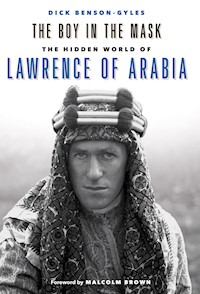
This groundbreaking work chronicles the author's quest to uncover previously unexplained areas of the life of T.E. Lawrence, the enigmatic desert fighter, aircraftman and writer. The result of years of painstaking research, it contains new material that throws a completely fresh light on Lawrence's concealed private life. Following an extraordinary journey to find the unknown man behind the many myths, the book's two halves are underpinned by the author's personal mission to reveal the man behind the mask; the secret Lawrence. Part One reveals Lawrence's lost Irish heritage – his father's real family (the aristocratic, Anglo-Irish Chapmans), his abandoned half-sisters (with evocative interviews), his illegitimacy, and his mother's obscure forebears. The author shows, for the first time, that his concealment from his titled and wealthy Irish family affected Lawrence more deeply than previously thought; and a surprising truth emerges – that he thought of himself not as English but as Irish. This compelling narrative is powerfully supported by a wide range of unseen photographs. These include his Chapman family and forebears, views of Killua Castle and South Hill (the family seats in Westmeath), and of his time in the RAF during the 1930s. The second part, which follows the author's adventurous travels to the Middle East in search of Lawrence's lost love, has a surprising dénouement – a convincing solution to the cryptic dedication to 'S.A.' of his book, Seven Pillars of Wisdom. The author also presents new evidence to vindicate Lawrence's account in the Seven Pillars of the brutal sexual assault on him at Deraa during the Arab Revolt of 1916–18, a controversial episode that has often been questioned.
Das E-Book können Sie in Legimi-Apps oder einer beliebigen App lesen, die das folgende Format unterstützen:
Veröffentlichungsjahr: 2016
Ähnliche



















THE BOY IN THE MASK: THE HIDDEN WORLD OF LAWRENCE OF ARABIA
Dick Benson-Gyles
Foreword byMalcolm Brown
the lilliput press
dublin
Dedication
To the Dear Memory of my Father and Mother,
always loving, always giving
Contents
T.E. Lawrence – A Chronology
Abbreviations
Foreword
1. A Meeting
2. Irish Initiations
3. A Lost Heritage
4. ATerritorial Root in the Proper Place
5. A Huge Grant of County Meath
6. Ancestral Voices
7. Fashionable Marriage
8. The Abandoned Sisters
9. A Double Life
10. A Standing Civil War
11. A Child of Sin
12. My Native Land
13. Crazed with the Spell ofFar Arabia
14. The Last and Lingering Troubadour
15. I’d Rather Morris Than the World
16. The Well at the World’s End
17. Body and Soul
18. The Citadel of My Integrity
19. An Imaginary Person of Neutral Sex
20.Candidates and Advocates
21. The Dark Lady
Appendix I: The Chapman Coat of Arms
Appendix 2: Farida Al Akle
Appendix 3: Chapman of Killua
Appendix 4: Lawrence – Junner
Appendix 5: Ms of Dedicatory Poem to Seven Pillars of Wisdom
Appendix 6: Map of the Middle East in1915
Appendix 7: Lawrence and Chapman at Rest
Bibliography
Acknowledgments
Illustrations
Copyright
Epigraph
There was a sort of dual personality – there was – the boy – and there was also – I think he called it a mask. That’s rather crude – but it is – the boy in the mask. We all liked him – but he began to be quite different.
Canon Edgar Hall (Omnibus.BBC2, 18 April 1986)
My self-distrusting shyness held a mask, often a mask of indifference or flippancy, before my face, and puzzled me. My thoughts clawed at this apparent peace, wondering what was underneath, knowing that it was only a mask.
T.E. Lawrence (Seven Pillars of Wisdom, 2004, p. 679)
T.E. Lawrence – A Chronology
16 August 1888. Born North Wales, second of five ‘Lawrence’ brothers.
1896. Family settles in Oxford.
September 1896 – July 1907. Attends Oxford High School.
Summers 1906 and 1907. Studies castles in northern France.
October, 1907 – June 1910. Attends Jesus College, Oxford.
Summers 1908 and 1909. Studies castles in France and in Syria for degree thesis.
Winter 1909-1910, WritesCrusader Castles. Awarded First Class Honours in History.
Summer 1910. Studies medieval pottery in France.
Winter 1910 – 1911. Studies Arabic at Jebail, Syria.
March – July 1911. Excavating at Carchemish (Jerablus) with British Museum Expedition under D.G. Hogarth and R. Campbell Thompson.
Summer 1911. Walks through northern Syria.
Early 1912. Excavating in Egypt under Flinders Petrie.
Spring 1912 – spring 1914. Excavating at Carchemish under C.L Woolley.
Summer 1913. Home in Oxford.
January – February 1914, Survey of Sinai.
Summer 1914. CompletesWilderness of Zin(report on Sinai work) in Oxford and London, then in War Office, London.
December, 1914 – May 1916. In Egypt with Intelligence Department.
March – May 1916. Journey to Iraq.
October 1916 – October 1918. With Arab forces during Arab Revolt, Syria (rising in rank from Lieutenant to Colonel).
October – December 1918. In London and Oxford.
January – October 1919. In Paris for Peace Conference.
May 1919. By air to Egypt.
October 1919 – 1921. At All Souls College, Oxford, and in London.
1921 – 1922. Adviser to Colonial Office.
August-December 1921. Missions to Aden, Jeddah and Transjordan.
Second half 1922 – January 1923. Aircraftman Ross, Royal Air Force (RAF).
Discharged on discovery of identity.
March, 1923 – August, 1925. Private Shaw, Royal Tank Corps, Bovington, Dorset.
Acquires cottage, Clouds Hill, near Bovington. Transfers toRAF.
August 1926. Aircraftman ShawRAFat Cranwell.
1926.Seven Pillars of Wisdom(SPoW)published.
January, 1927 – 1928. India,RAF, Karachi and North-West frontier.
Revolt in the Desert(abridgement ofSPoW) published and withdrawn in British Empire. CompletesThe Mint(account of time inRAFas Aircraftman Ross).
1930 – 1935,RAFMountbatten, with work around Britain on marine air-sea rescue craft.
February 1935.RAFBridlington, discharged. Returns to civilian life, Clouds Hill.
19 May 1935. Dies after motorcycling accident near Clouds Hill, Dorset, aged forty-six.
Abbreviations
AB:Jeremy Wilson,LawrenceofArabia:TheAuthorisedBiographyofT.E.Lawrence(William Heinemann Ltd: London 1989).
BHF:A.W. Lawrence (ed.),T.E. Lawrence By His Friends(Jonathan Cape: London 1937).
BL:The British Library, Euston Road, London.
BLAM:British Library Additional Manuscript.
BOL:Bodleian Library, Oxford.
DG:David Garnett (ed.),The Letters of T.E. Lawrence of Arabia(Jonathan Cape: London 1938).
HL:M.R. Lawrence (ed.),TheHomeLetters of T.E. Lawrence and his Brothers(Basil Blackwell: Oxford 1954).
HR:Harry Ransom Humanities Research Center, University of Texas, Austin, Texas,USA. T.E. Lawrence Collection,
IWM:Imperial War Museum, Lambeth Road, London.
IWM-ST:Imperial War Museum, Research material for The Sunday Times book,The Secret Lives of Lawrence of Arabia. Phillip Knightley & Colin Simpson (Nelson: London 1969).
JM:John E. Mack,A Prince of our Disorder: The Life of T.E. Lawrence(Weidenfeld and Nicolson: London 1976).
JTELS:Journal of the T.E. Lawrence Society.
MB:Malcolm Brown (ed.),TheLettersof T.E. Lawrence(J.M. Dent & Sons: London 1988).
NA:The National Archives, Kew, London.
SPW:T.E. Lawrence,Seven Pillars of Wisdom(Jonathan Cape: London1935).
SPWO:T.E.Lawrence,Seven Pillars of Wisdom: The Complete 1922 ‘Oxford’ Text(J. and N. Wilson: Fordingbridge, Hampshire 2004. Single vol.).
S-S1922–26:J. and N. Wilson (eds),T.E. Lawrence: Correspondence with Bernardand Charlotte Shaw, 1922–1926 Vol. 1(Castle Hill Press 2000).
S-S 1927:Vol. 2(2003).
S-S 1928:Vol. 3(2008).
S-S 1929–35:Vol. 4(2009).
THBRG & THBLH:Robert Graves & Liddell Hart,T.E. Lawrence: Letters to his Biographers(Cassell: London 1963).
TEL:T.E. Lawrence.
Foreword
malcolm brown
My initial response when asked to write a foreword to, or a review of, yet another book on one of Britain’s most enduring heroes is usually ‘No’. I’ve been involved in the T.E. Lawrence world for many years and am very suspicious of ninety plus per cent of any new authors coming out of the blue with the claim: ‘Look, I’ve got the Holy Grail.’
But this book is different. It’s an amazing story, powerful, moving and a genuinely fresh perspective on Lawrence’s life. It is, in fact, an original, both in the material it’s offering and its exceptional, indeed unique approach. It’s a book that has been lived as much as written by its author, who was captivated through the David Lean film and has ever since turned Lawrence into an aid and a companion, almost a doppelgänger. So, rightly, he calls the book a personal quest and has had the energy, insight and ability to translate his extraordinary story into an absorbing written account. It is brilliantly lucid and compulsive for pages on end and the author, a practised journalist as well as a gifted writer, has imposed order and clarity on complex argument and analysis while retaining the romance and evocative lyricism of an enthralling narrative.
What’s new in this book? This will undoubtedly be the question immediately asked. Well, for me, in the first part he has illuminated an area long dark about the Anglo-Irish background from which Lawrence emerged. We all knew his father was an Eton-educated aristocrat who left a socially prominent family of a wife and four daughters in Ireland to run off with their Anglo-Scottish governess and found a family of five illegitimate sons under an assumed name, the second of whom was to become the legendary Lawrence of Arabia; but Dick Benson-Gyles has put reality and detail into the story, so that we now know this was not just, as it were, any old Rochester running off with a Jane Eyre, but in social terms a cataclysmic fall from grace within a highly reputable and well connected social circle which left seriously hurt people all over the place and put a far bigger wound into Lawrence’s psyche than we had ever thought. He has also placed the story powerfully in the context of Irish history and of that fading clan of Anglo-Irish whose decline almost parallels that of the British in India. This isJewel in the Crownstuff Irish style.
Then, in the second half of the book, he takes us to where the story of Lawrence simply has to go – Arabia. The author went in pursuit of one of the great enigmas Lawrence left behind – who was the character ‘S.A.’ to whom he dedicated his most famous work,Seven Pillars of Wisdom?His conclusion, which is both surprising and persuasive, was reached after a quest which took him to, among other places, the deserts and mountains of Syria. As a by-product, this part of the narrative contains some very good travel writing. Finally, the book has a substantial number of genuinely exclusive illustrations, which even I hadn’t seen.
Anyone who reads this compelling story will be both moved and enlightened. After the plethora of biographies and studies published over the years it might be thought that there would be little of real consequence left to say about Lawrence. The author has proved such a belief emphatically wrong. Dick Benson-Gyles has achieved something rather remarkable.
1. AMeeting
I FIRST MET T.E. Lawrence in the Odeon Cinema, Richmond.
David Lean’s epic film,Lawrence of Arabia, had just moved out from the big screens of London’s West End to the suburbs and provinces. I decided to go and see it, expecting a lot of sound, fury and colour as well as the usual cinematic distortions, in short, a sort of Cecil B. DeMilleTen Commandmentswith Bedouin, camels, sheikhs and British army officers. Nevertheless, I was looking forward to enjoying what I imagined would be the desert exploits of an unusual First World War soldier brought vividly to life on the screen. Yet I had too a strong sense of something subliminal at work, an undercurrent of attraction that seemed to be drawing me like a magnet to the film.
When I came out of the cinema four hours later my student doldrums had been blown away. I was stunned. It wasn’t the film’s heroic narrative, sweeping grandeur, romantic backdrop or luxuriant photography that had so moved me. It was something transcending this, a glimmering suggestion of the apocalyptic, which troubled and tantalized me. As I emerged into the bright twilight of that never-to-be-forgotten summer evening, everything but the film seemed suddenly absurdly inconsequential. I have never discovered what happened, only that some inner alchemy responded like reawakened consciousness to this celluloid T.E. Lawrence luminously alive in the dreamworld of the Odeon. As soon as the house lights had dimmed and Lawrence’s motorbike appeared, gleaming in summer sunlight filtered through translucent green leaves in a quiet Dorset farmyard, the hair went up on the back of my neck. I sensed, despite the incongruity of the venue, that this was somehow a watershed for me. My body had gone, only my heart and soul were there. In such simple moments are lifelong involvements born. Since then down the years Lawrence has haunted me with a quiet, questioning persistence.
After the motorbike crash on a heathland road in Dorset in May 1935 and Lawrence’s death comes the funeral scene at St Paul’s Cathedral. The story then goes back to its beginnings in the Intelligence Department in Cairo in 1916. Lieutenant T.E. Lawrence, disguised as a rather taller Peter O’Toole, is in a basement office with an orderly, awaiting the arrival of his copy of theArab Bulletin. He is soon summoned by Dryden – his political guide through the bewildering corridors of power in the rambling mansion of British Levantine policy – to see General Murray, Commander of the Egyptian Expeditionary Force (EEF). Murray reluctantly permits the unconventional subaltern a temporary secondment to Arabia. Lawrence lights a match, looks at it and says, almost to himself, ‘It’s going to be fun.’ Then, in close-up profile, he blows it out. Instantaneously, in total silence, the giant screen turns an incandescent flame-red – the red of dawn in the desert. A huge, molten sun inches up over the austere, empty wastes and Maurice Jarre’s sweeping score swells to a powerful crescendo. Arabia in all its vast, purged expanses is slowly revealed in exquisite gradations of colour.I was mesmerised. Like so many others I had experienced the Lawrence moment. It takes hold of you quietly and firmly and doesn’t let go. Lawrence would probably have laughed at such a reaction, yet he knew that he and his life exuded a magnetism that invariably held an irresistible attraction for people. At the same time his personality contained paradoxes that he never fully reconciled, and, if he had an uncanny ability to understand others, he struggled to understand himself.
I have searched myself in vain to discover what happened to me that day in the cinema. It was David Lean’s film that urged me to go in search of the real Lawrence, in the hope that I might stumble upon something essential about him and, in the process, about myself. I had hoped that finding the truth behind Lawrence’s renunciation of the material and physical might somehow bring understanding and order to my own life. It hasn’t. Nevertheless, I picked up the gauntlet thrown down by the film, and the challenge ever since has been unfailingly dynamic: a quest, a continual meeting with the unexpected, the astonishing, and, occasionally, the unpalatable.
In our family house my father had a cosy little study just off the hall and in it were two home-made wooden bookcases containing an eclectic but modest collection. Among the books was a two-volume economy edition ofSeven Pillars of Wisdomby T.E. Lawrence. Its unusual title had caught my eye. I was young and hungry for spiritual food and the title held a strange fascination. Now, overwhelmed by the film, I went straight to the book. It promised something special, something mind-opening, even perhaps something mystical, and it more than exceeded the film in the indelible impression it made on me. I was on fire with the effects of reading this compelling work of extraordinary literary juxtapositions – the vivid chronicling of a medieval campaign in a modern theatre and an ancient land; the movingly lyrical evocation of a vast, primal landscape; the raw, unsparing recording of the brutalities of war; the unflinching self-analysis.
Lean’s seductive treatment of the Arabian campaign had first attracted me to the legendary Lawrence, but after the book I developed an obsessive urge to uncover what I sensed was another Lawrence, a very private person concealed behind the pages ofSeven Pillars. Despite years of intensive study, his nature and his life have stubbornly refused to yield up their secrets. Hence, of course, his continuing fascination. Lawrence was always trying to discover who he really was. He was the arch-introspective, the constant self-inquisitor, a man of both self-assurance and self-doubt. He was preoccupied with the hidden wellsprings that drove him, more interested in the ‘why’ than the ‘how’ or ‘when’ of things. Extrovert and introvert, actor and audience, which was the real Lawrence? Was there one at all? YetI was certain that there was one promising route to discovery – a pathway that led all the way back to his childhood and beyond.
As for his legendary status, if he hadn’t been in the right place at the right time – Arabia at the onset of the Great War – it is likely that there would have been no celebrated hero at all. He might have become well-known within academic circles, perhaps as an archaeologist or traveller, but without the Arab Revolt he would not have achieved the worldwide fame which is his today.And yet it is as though it was all pre-ordained. Nevertheless, a doubt stubbornly persisted. Did the events that effectively began in 1916 sweep him reluctantly into the spotlight, or did he purposely wait in the wings and on cue step out onto the boards and assume the lead role? A bit of each, I suspected.Neither the film, nor in fact the book, had really provided the answer, so I decided that before I looked anywhere else I would take a key, controversial area of his war service and subject it to as exhaustive and critical an examination as possible. That, surely, would provide a pretty good testing ground for the truth about him. If the Arabian Lawrence turned out to have been just a very good actor, or worse, a self-promoting charlatan, then there would be little point in researching further.
On the eve of the Great War the British Empire was hugely extended and cumbersome, and in the political context it was often a matter of the right hand not knowing what the left was doing. The strains imposed on the Empire’s policy-makers by having to conduct Imperial business through Byzantine channels of communication are well summarized by Sir Ronald Wingate, kinsman of Sir Reginald Wingate, who in the war years was firstly Governor-General of the Sudan and then High Commissioner of Egypt:
England herself, though she had a general and right idea of what should be her policy towards Islam – as from the population standpoint the greatest Muslim power – was prevented both by the extent of her empire and by her administrative machinery from being particularly coherent on the subject. The Foreign Office was responsible for England’s policy towards Turkey and the Middle East generally… This area of Foreign Office control included Egypt and the Sudan, where however the Foreign Office for years past had been accustomed to leave everything to the man on the spot … Then there was the India Office in London, which, through the Viceroy of India, was responsible for the Indian sphere of influence, which in those days included Aden, Oman, the Persian Gulf and Mesopotamia – Here again, the India Office had been content to leave everything to the men on the spot … Lastly there was the War Office in London – to which Kitchener came in August 1914 – which was directly concerned, from the intelligence standpoint, with the military potentialities of Turkey in the event of war … The result of all this was that, as regards Arabia and its problems, though the War Office, the Viceroy of India, and the British Agent in Egypt were all well informed and kept in touch with each other, the Foreign Office and the India Office in London had little to say and were not particularly interested. And so the British Government had no clear-cut policy in the Islamic Field, and often found itself, when the crisis of the war with Turkey came, in a cross-fire between advocates of one course or another.1
Into this bewildering network of Imperial rule in 1914, unsuspected and as yet unapplied, came the iron will and idealistic fire of T.E. Lawrence.Soon he would be adding his considerable intellect to that coterie of pragmatic luminaries in Cairo, which became the Arab Bureau. Under its shrewd Director, Colonel (later Brigadier-General) Sir Gilbert Clayton, Acting Director, Commander D.G. Hogarth, and his deputy, Captain Kinahan Cornwallis, and answering to the High Commissioner in Egypt and the Foreign Office, the Bureau rapidly developed into the hub of intelligence on Arab affairs. Hogarth, Lawrence’s mentor, wrote of the members of this brilliant club created to serve British intelligence and policy in Arabia:
Do you know
The Arab Bureau?
Clayton stability,
Symes versatility,
Cornwallis is practical,
Dawnay syntactical,
Mackintosh havers,
And Fielding palavers,
Mackindoe easy,
And Wordie not breezy:
Lawrence licentiate to dream and to dare
And yours Very Faithfully, bon à tout faire.2
This gifted group of men believed in the Empire and took it almost for granted that Britain’s birthright was to oversee the governance of much of the world; but they were not blinkered chauvinists. They were certainly privileged but they were also highly educated Oxbridge scholars, Arabists, linguists and travellers. They were dedicated to ensuring the Empire a dominant stake in the Levant in the event of the collapse of ‘the sick man of Europe’ – Turkey and its crumbling Empire. And some of these men – like Lawrence, who knew the area and its nomadic inhabitants well after four years of archaeology at Carchemish in northern Syria – had already been infectedwith an abiding fascination with the Near East, the cradle of civilization and the spiritual home of three of the world’s great religions.
These servants and savants of empire were intoxicated with the region’s long, rich history, its elemental deserts, the venerability of its cities, and the bewildering variety of its peoples. Nor were they immune to the powerful aura of romance and mystique that suffuses the Levant, its polyglot races spun by the centuries into a complex web of spiritual, political and nationalist allegiance, an ethnic and religious coat of many colours. There is even today an air of musty antiquity and shadowy intrigue about the cities of the Middle East. Memories of ancient dynastic struggle and religious revelation and persecution hover like ghosts in the dancing heat of the noisy, dusty streets of the old quarters of Damascus, Jerusalem, Baghdad and Cairo. It invests the region with a seductive power that British orientalists like Lawrence have always found hard to resist.
The story of his rise in the Great War from relative obscurity as a Lieutenant and an intelligence officer in the Arab Bureau in Cairo to Colonel Lawrence, legendary among the desert tribes as El Aurens, arriving triumphantly in Damascus in 1918 at the head of an irregular army of bedouin, has become almost a cliché. Put at its simplest, the legend has it that his unique vision and burning determination allowed him to appreciate what might be made of the initially disparate, and not particularly promising, materials at his disposal to build his ‘seven-pillared worthy house’, namely the Bedouin tribes and their potential as guerrilla fighters.
In the early stages Lawrence had little executive clout with policy-making superiors, many of whom were unconvinced of the military value of untrained native forces. However, his pre-war years living in Syria, a working knowledge of Arabic, powers of endurance well beyond the average, a natural gift for leadership, dissimulation and manipulation, and a driven urge to succeed, all suggested that he was tailor-made for the job of motivating and orchestrating bedouin irregulars. Few of his contemporaries saw this at first. In fact, he rubbed a lot of people up the wrong way with his outspoken opinions and unconventional behaviour and what they saw as his precocious belief in the rightness of his own views to the disparagement of those of others, even of those of much more senior officers. Lieutenant-Colonel Cyril Wilson, the British Representative in Jiddah on the Red Sea’s Hejaz coast, wrote to Clayton in November 1916:
Lawrence wants kicking and kicking hard at that then he would [illegibleword]. At present I look upon him as a bumptious young ass who spoils his undoubted knowledge of Syrian Arabs etc. by making himself out to be the only authority on war, engineering, runningHM’s ships and everything else. He put every single person’s back up I’ve met from the Admiral down to the most junior fellow on theRWteam.3
Someone, however, who did appreciate Lawrence’s remarkable potential was David Hogarth, and with his support Lawrence now carved out his place in history. The Arab Revolt of 1916–18 was always a piecemeal movement, and without General Sir Edmund Allenby (from June 1917 the General Officer Commanding-in-Chief of theEEF) there would most probably have been no revolt of any significance. It was initially a tribal insurgency launched in June 1916 by the Hejaz’s Sherif Hussein bin Ali, the Emir of Mecca and Guardian of the Holy Places of Mecca and Medina. He had not taken the British into his confidence and so the Revolt took them, and the Turks, by surprise. Nevertheless, the British reacted positively, providing intelligence officers (among them Lawrence), advisers, money, arms, and latersome artillery.
The British had been ambivalent about what military value an uprising of Arab irregulars would have. They tended to view the Bedouin through conventional military eyes as irredeemably tribal – volatile, untrustworthy nomads who could never be marshalled into a reliable, effective or regular fighting force. Lawrence was one of only a few who saw their real potential as guerilla fighters, and he later devoted considerable space inSeven Pillarsto explaining how he had envisaged their productive deployment, presenting his ideas as almost a new philosophy of irregular warfare. Elusive tribal units, avoiding direct confrontation with the enemy, would be armed with explosives as well as guns and swords and be despatched on desert raids to harass and cut the north-south Hejaz railway. This would theoretically tie down Turkish forces and create the illusion of a significant armed threat lurking hidden in the deserts to the south and east.
Lawrence, however, came perilously close to missing his chance altogether. Sir Reginald Wingate, Sirdar of the Egyptian Army, had originally chosen Captain Stewart Newcombe,RE, in Military Intelligence in Cairo, to liaise with the Revolt’sde factoleader, King Hussein’s son, Prince Feisal. Newcombe had first met Lawrence during his pre-war archaeological days and was to become a good friend. In November 1916 Wingate telegrammed Clayton: ‘I propose sending Newcombe to Yenbo but in view of possible delay of his arrival I think Lawrence would do the work excellently as a temporary arrangement.’4So Lawrence made sure that his services as liaison officer with Feisal became virtually indispensable. He was to forge an enduring rapport with the impressive Prince, a tall, slender, quietly heroic figure, subtly insinuating his strategic vision into Feisal’s mind, nudging the determined but sometimes vacillating Emir ever onward towards Damascus.
That accepted, how did Lawrence manage to become a major player in the Middle-East theatre? The received view is that it was a touch of genius by him– in the form of an unorthodox and secret plan in 1917 to take the northern Red Sea port of Aqaba by surprise attack from inland – that put him, and the Revolt, firmly centre stage. If executed successfully, it would be a giant strategic step, transforming the fledgling and uncoordinated Arab Revolt from a parochial one confined to the Hejaz into amuchlarger,organized movement with a new and permanent base in Syria. With Feisal’s approval Lawrence and a carefully chosen party of Arabs would cross hundreds of miles of desert, re-emerge in south-east Syria, and, capturing the Turkish posts enroute, march down to Aqaba. The Royal Navy would then supply the new base and a growing Arab army with munitions, provisions, money and British military advisers. Aqaba would then be the perfect springboard for an advance into Syria and the eventual capture of Damascus. In the event, it would also become the anchor of a right flank for theEEFunder Allenby when British Imperial forces later advanced into Palestine.
If it was to succeed, the Aqaba plan – as apparently conceived by Lawrence with Feisal’s full, and essential, backing – would require the vital support of Auda abu Tayi, the chief of the eastern Howeitat, whose tribal territories lay dotted about the Aqaba region. The plan in detail was to take a small party of sherifian-led bedouin from the Revolt’s new base at Wejh on the upper Red Sea coast and set off north-east through the vast, empty and mercilessly hot hinterland, skirting the forbidding Nefud desert and riding up the snake-infested Wadi Sirhan. The forty-strong expedition would establish a propaganda presence and set about persuading the northern tribes to enrol under Feisal’s banner. From there, after a feint or two to put the Turks off the scent, the force would turn south-west and capture the Turkish posts in the defiles and rugged terrain along the final fifty-mile ride down Wadi Ithm to Aqaba and the sea.
This great turning movement across hundreds of barren miles was an ambitious mission and a tremendous gamble, the more so because Lawrence claimed that he undertook it without either Cairo’s authorization or knowledge. He told his biographer Basil Liddell Hart: ‘The venture was a private one. I had no orders to do it, and took nothing British with me. Feisal provided money, camels, stores, and explosives. That explains why I had no help from the Navy.’5The gamble paid off, and it turned out to be Lawrence’s first step to fame. With £1000 of sherifs’ money in his saddlebags, given to him by Feisal in Wejh on 8 May, Lawrence set off the next day with the little party of camel-mounted bedouin under Sherif Nasir, Feisal’s cousin, and accompanied by the Damascene Nesib el Bekri as political officer and a few others, on the long, dangerous trek northward.6Two months later this initially insignificant Arab force, now 2000 strong, rode through Wadi Ithm winning several fierce engagements. On 6 July they swept triumphantly down to Aqaba, herding six hundred prisoners in front of them.
The port itself was defended by only a token presence because the bulk of the garrison had earlier withdrawn to the surrounding hills after a Royal Navy vessel on a chance reconnaissance hadloosed offa few rounds at the beach, ignorant of the force advancing in numbers on the port from inland. In Aqaba Lawrence and the Arabs found only three hundred panicking defenders, among them a bewildered German military well-borer called Liesegang, who hadn’t the faintest idea what was going on and had never heard of an Arab Army!
Aqaba’s thin sea-defences had, in fact, already been breached three months earlier by Royal Navy ships commanded by Captain ‘Ginger’ Boyle, subsequently Admiral of the Fleet, the Earl of Cork and Orrery. Boyle’s exploratory action to clear mines from the port waters, and his brief landing, had resulted in the taking of eleven Turkish prisoners. Boyle later commented: ‘The capture of prisoners was important and welcomed by Lawrence, who was anxious to get information as to the Turkish forces in the Aqaba district. He was already plotting his descent upon that place, which he carried out in such a gallant manner a few weeks later.’7
Nevertheless, there has always been controversy about who actually conceived the Aqaba scheme. Establishing whose initiative it was was important because it was the taking of Aqaba which launched the Revolt proper, elevated Lawrence to a pre-eminent role, gave him direct access to his chiefs in Cairo and Khartoum, and thereafter lent his tactical and strategic views considerable weight. It also opened the door to the creation of the Lawrence legend.
Some Arab scholars have claimed that the Aqaba plan had been an entirely Arab idea first suggested by Auda abu Tayi in consultation with Feisal and other senior sherifs when Auda and Feisal met for the first time at Wejh.8British officers in the field, though, were adamant that it was entirely Lawrence’s brainchild. Lawrence himself wrote that Aqaba had been taken ‘on my plan by my effort’, and years later, discussingSeven Pillarsin a letter to Charlotte Shaw, the playwright George Bernard Shaw’s wife, he confirmed the imperative of capturing Aqaba from the land and that it was his idea: ‘Yes, of course, the Aqaba ride was when first I was conscious of my aim in Arabia. It represents the changeover of the book from accident to intention.’910In 1934 he told her: ‘Aqaba beach could have been taken by ship’s gunfire, like the beach of Gallipoli. What I wanted was the 50 miles of mountain defiles behind the beach, which could (I still think) only have been taken by us from inland.’11
There is documentary evidence to support Lawrence’s claim. By early 1917 the goals of the fragile but growing Revolt were still ill-defined, its progress driven more by hope than expectation. Newcombe outlined ideas for its advance in a note to Wingate of 24 May, both the date and the contents suggesting that Feisal had not taken Newcombe into his confidence about the secret ride to capture Aqaba, which, of course, was already under way: ‘On May 31st Sherif Feisal hopes to leave Wejh to attack El Ula or Bedia while Sherif Abdullah destroys the railway from the South …’
In another comment he said:
From Uweinid Feisal with his escort moves to Jafar East of Ma’an, 150 miles. He might get there by July 7th. Auda Abu Tayi and Lawrence are to be told to collect there food for 1000 men for 10 days and food for mules: and a large number of camels, say 1000; until Feisal gets into that neighbourhood, these camels will not move South to Uweinid … [Newcombe continued, saying that Feisal would] then move to Kasr el Azrak about July 17th where food will also be prepared. Thence he will start his campaign. [He then added significantly that the capture of the northern port would be essential for success:] The importance of Aqaba is both political and tactical. Sherif Faisal considers it indispensable politically to encourage the Beni Sakhr, Huwitat, and Druzes. Once taken he thinks the Turks would not move towards it from Ma’an through a hostile country, any more than they did from El Ula after Wejh was taken, though water was ample. To take Aqaba, he will have 1500 Meccans at Wejh by June 24th. He would like to move these to Aqaba, though only partially trained, about July 15th. And would therefore want steamers about that date.12
Of key relevance here is the mention of the need for steamers. It further supports the view that Feisal was keeping his strategic cards close to his chest and, by placing emphasis on a capture by sea, was deflecting attention away from the overland expedition and maintaining its secrecy. Nevertheless, he probably did envisage a seaborne attack as a genuine fall-back option in the event of Nasir, Lawrence and Auda failing to achieve their objective. That Lawrence was the driving force behind the Aqaba plan is supported in an interview given by Newcombe to Frenchman Jean Beraud Villars for his 1955 Lawrence biography. He wrote that Newcombe had told him, ‘in a personal conversation in 1954’, that Lawrence had indeed been the originator of the plan.13
Villars wrote:
… all the witnesses are agreed on this point, and they prove that things did happen as they have just been related. Colonel Newcombe who had Lawrence under his command at the time has said so himself. During this period, he said, the leaders of the English mission were still groping in the dark, each one of them doing his best in his own sphere. Everyone had noticed the extraordinary ascendancy which T.E. had gained over Feisal, and they were pleased to see him decide the Sherifs’ men on effective action; they allowed their comrade to operate on his own so long as he only used native units and did not draw on the still limited resources of the allied base. Colonel Newcombe has confirmed that the Aqaba exploit was entirely conceived by Lawrence who was its real leader and animating spirit, although for reasons of diplomacy that are understandable the official command was left in the hands of the Arab chieftains.14
That the Aqaba initiative was Lawrence’s is further supported, if indirectly, by evidence of Feisal’s increasing dependence on him for advice and guidance. A month before the Aqaba expedition and shortly before a major tribal council at Wejh Feisal wrote to Lawrence, who was engaged on railway demolition raids in Wadi Ais, anxiously appealing to him to return to Wejh as soon as possible. He said: ‘I am waiting for your coming because I want to see you very much because I have many things to tell you.’15And in another anxious communication he entreated: ‘You are much needed here more than the destruction of the line because I am in very great complication which I had never expected…’16
Feisal’s increasing trust in Lawrence was to give hima vital credibility with the tribal sheikhs and by extension with the tribesmen themselves.This bond with Feisal, together with British funding and military support and his own extraordinary abilities, allowed Lawrence to pull the strings and in crucial measure to control the direction of the Revolt. He also knew that the desert Arabs believed in people not in institutions or in strategies dictated impersonally from on high, so, to identify himself more closely with them and to gain their confidence, he proved he could equal them in endurance and share their harsh life. He also dressed, with Feisal’s approval, like a Sherif. To the tribesmen such rich apparel marked and significantly enhanced authority and status. In combination, all these elements allowed Lawrence to build an unrivalled reputation among them. He also avoided leading from the front. He would drop well-considered ideas into conversations with the ashraf (the tribal chiefs) as though they were just passing thoughts, knowing that the Arab leaders, while often not admitting as much, would appreciate their value and usually ultimately adopt them as their own. That suited Lawrence. He was not in the business of self-aggrandizement, in directly establishing his own ascendancy, but in implementing vital plans. Who took credit for their execution didn’t matter, so long as they were executed successfully.
Lawrence’s fellow British officers confirm this psychological approach. Hogarth said of him in an article written after the war in 1919: ‘Pushing (not himself) he finds more congenial than leading and he loves to push the unsuspecting body: but if it does not get on as fast as he thinks it should, he pushes it into the gutter and steps to the front.’17Captain Boyle wrote that this policy of Lawrence’s was evident well before the taking of Aqaba: ‘Lawrence by this time had completely won over the Arab leaders. His influence with them was very great and most wisely used.’18Irishman Major (later Colonel) Pierce Joyce, a regular officer of the Connaught Rangers who was to become base commandant at Aqaba and was technically Lawrence’s superior officer but in practical terms his coeval, said of him: ‘At Arab conferences he spoke little, but he knew beforehand that his plan would be adopted, while the task of kindling enthusiasm amongst the tribesmen was better left to the Arab leaders’. He further commented: ‘as at dozens of other conferences we attended together, Lawrence rarely spoke. He merely studied the men around him and when the arguments ended as they usually did in smoke, he then dictated his plan of action, which was usually adopted and everyone went away satisfied.’19
One of Lawrence’s great virtues was patience, particularly with the volatile and unreliable tribesmen, who would only commit to action when it suited them, with money or loot often their prime motivation. Bedouin vision was localized; they could appreciate an immediate part of a strategy but seldom the whole, so Lawrence cajoled them along, biding his time for the judicious moment to act. During the long march to Aqaba he wrote in his message-pad, ‘Mem. don’t attempt too much’. Many of the British officers seconded to the Revolt lacked his reservoir of tact, their military training tending to demand unquestioning obedience. This didn’t suit the maverick bedouin at all and they often showed as much, on one occasion taking pot-shots at Newcombe for pushing them too hard.20The only authority they accepted,and even then not always, was that of their sheikhs. Lawrence’s shrewd, kid-glove approach to dealing with the bedouin is perfectly encapsulated in his now well-known ‘Twenty-Seven Articles’, a set of guidance notes for working with the tribes, which first appeared in the August 1917 issue of the secretArab Bulletin, published in Cairo for restricted Intelligence circulation (still consulted to this day by American and British forces in Afghanistan).21
While Lawrence was disappearing from Wejh into the desert wilderness, Anglo-French policy on a post-war Middle East had been hardening into official expressions of territorial covetousness such as the 1916 Sykes-Picot Treaty, which was a blueprint for draconian geopolitical dispositions, including French control of Syria. Lawrence loved France, particularly French medieval history and literature, but he had developed an implacable hatred of French designs on his beloved Syria. The Treaty was, of course, top secret, but Lawrence, kept informed by Hogarth and others in the Arab Bureau, knew that the promised reward of freedom and autonomy for the Arabs in the event of the defeat of their Turkish overlords was, in the final analysis, a deception and a lie.
Out in the wilds on the hazardous northern trek and weakened by illness and the extreme conditions of heat and terrain, which taxed even his hardened body and mind to their limits, Lawrence began to have misgivings and to suffer serious pangs of conscience. On the seemingly never-ending desert ride he had time to mull over the complex politics of the war in Arabia in which he was becoming more and more embroiled. He started to doubt both the feasibility of the Aqaba adventure and Imperial policy. Two days into the march he was ‘Tired and sorry’; the next day he was ‘V. sick’; the day after that he wrote in his diary: ‘The weight is bearing me down now. Auda last night, and pain and agony today.’ A further two days on he seemed close to giving up, recording: ‘If I could only get out.’22
Nevertheless, Lawrence persevered and got across the vast tracts of desert to the planned Syrian recruiting base of Nebk at the head of Wadi Sirhan. Weeks on the march had not changed his outlook. On 5 June he was still having serious doubts, writing in his diary: ‘Can’t stand another day here. Will ride N & chuck it.’23His urge to quit the Revolt just as it was starting to burgeon seems initially to have been triggered by no more elevated consideration than his disgust and impatience with the delay caused by the gluttonous tribal feasting going on day after day at the march’s northern end, at Isawiyeh, Abu Tareifiyat and Nebk. Lawrence scribbled in his message-pad: ‘I had been twenty eight years well fed & had no right to despise these fellows for loving their mutton’. But politics were clearly still uppermost in his mind because his next comment was: ‘Nesib was of their race, and brothers and sisters may tell the truth where we cannot. But I wish to God I was quit of it’ – a clear, if oblique, reference to the Sykes-Picot Treaty and the false position he felt it was putting him in.24However, in hisSeven Pillars’ accounts of the expedition to Nebk Lawrence makes no mention of wanting to give up.
It was now dawning on him that in order to achieve his strategic aims he would have to don a mantle of deceit and lie to his Arab comrades-in-arms, denying the existence of the secret Imperial agenda, which underlay Britain’s qualified support for Arab independence. His response to this moral dilemma was extraordinary. He would throw himself on the mercy of fate and go off by camel on another long, northward ride, half hoping not to survive. On the impulse of the moment he drafted a note to his superiors in Cairo (which he then crossed out) expressing his extreme disquiet with the way the Arabs were being treated: ‘Clayton. I’ve decided to go off alone to Damascus hoping to get killed on the way. For all sakes try and clear this show up before it goes further. We are telling them to fight for no motive, and I can’t stand it.’25This momentary, and probably unsent, cry from the heart was written in a very small hand for, as his friend the poet Robert Graves astutely noticed many years later, whenever Lawrence was depressed his handwriting shrank in proportion to the degree of his despondency.26Yet he always had an eye to the main chance and, ever the pragmatist and looking to the long term, he would also have known that priceless intelligence could be garnered on a secret northern reconnaissance, which, if he survived, would be invaluable to the Revolt, if and when it advanced into Syria in strength.
Astonishingly, having already covered six hundred miles of largely uncharted desert, he was now setting off again, initially with just two bedouin companions, then alone, to cross several hundred miles more of wilderness. He left Nebk on this impulsive and extremely risky spying venture on 5 June. His solitary ride into the unknown took him up the eastern desert as far as Tudmor and Ras Baalbek, sounding out tribal leaders and blowing up a bridge or two for propaganda purposes, and back down to the outskirts of Damascus, where he had a secret meeting with Ali Rida Pasha al-Rikabi, who had been General Officer Commanding the city but who was also covertlyPresident of the Syrian branch of the Arab Secret Society. When Lawrence got back to Nebk on or about 18 June, the enrolment of men for the campaign proper was well under way. The road to Aqaba and into the pages of history beckoned.
Lawrence’s solo ride was an extraordinary feat that would have been beyond the physical and mental capabilities of most men. Wingate, Clayton, Newcombe, Hogarth and others were fulsome in their praise of his major role in the capture of Aqaba, but it was his northern reconnaissance with its vital prize of invaluable intelligence, which attracted the most lavish praise and for which he was recommended for the Victoria Cross. Wingate wrote to the politician Mark Sykes on 16 July 1917:
Lawrence’s exploit in the Syrian Hinterland was really splendid and I hope you will have an opportunity of putting in a word that will help him to get theV.C,which, in my opinion, he has so thoroughly earned. Clayton and G.H.Q. are now digesting the information he has collected with a view to working out a scheme of co-operation from Sinai, Baghdad and the Hedjaz…27
On the same day Wingate also wrote to Wilson, in even more glowing terms, about Lawrence’s northern ride: ‘I have very strongly recommended Lawrence for the Victoria Cross for his magnificent achievement – in my opinion one of the finest done during the whole war…’28In the end, in Hogarth’s words: ‘HisV.C. was not given because of the proviso in the Charter of the Order that there must be British officer witnesses of the deed.’29
Critics of Lawrence later fastened onto this lack of corroboration to cast doubt on the whole journey. However, a scrutiny of Lawrence’s notes and pocket diaries in the British Library makes it abundantly clear that his secret ridedidtake place. These writings are what Lawrence called ‘observations on the road, scribbled at random in the saddle’. The pencilled diary entries are inevitably brief and dotted with erasures, faint, almost illegible words, isolated letters, and coded characters, all consistent with the constant dangers and difficulties of such a venture into remote enemy territory: ‘Riding since yesterday morning without stop’; ‘More miles Burga last night’; ‘S. Biar watered’; ‘My camel is done B’; ‘R. Baalb’; ‘Wanted to see M. but (He)–X.’30
The significance of the surprise capture of Aqaba was that it was achieved by an independent Arab force without any outside support. This gave the Arab irregulars a new credibility. It also altered the balance of power in the eastern theatre. An hitherto unstable and largely untested alliance of bedouin tribes was now set to play a crucial part in the subsequent British advance northward. The Arab Revolt had come of age and at a stroke Lawrence had become the indispensable link between the Arab insurgents and the British Forces. He now had the attentive ear not only of Feisal but also of his chiefs in Cairo. He was promoted Major and thenceforward to a role of increasing importance.
The securing of Aqaba brought him not just to the attention of the top brass in Egypt but also to the rarefied heights of the War Cabinet in Britain. Wingate wrote to Lawrence: ‘The Chief of the Imperial General Staff has requested me to convey his congratulations on your recent exploit and I do so with the liveliest satisfaction.’31In fact, the news of Lawrence’s extraordinary success reached the very highest in the land – the King himself. In late July 1917 Lawrence’s immediate chief, Brigadier-General Clayton, wrote to the King’s Private Secretary, Colonel Clive Wigram, describing in some detail both Lawrence’s secret northern ride and the taking of Aqaba, commenting: ‘His recent trip in enemy country ranks among the really gallant deeds of the war.’32
These fulsome plaudits are a major confirmation of some of Lawrence’s achievements, but in the years after his death came the inevitable backlash. More recently, hostilecritics pronounced the charismatic brilliance and meteoric rise of the twenty-eight-year-old from junior officer to colonel commanding thousands of Arab tribesmen as largely a triumph of promotion and self-promotion. They added that the legend had been given a crucial fillip by the impact on the British public of a post-war picture show about the Middle East campaign, put on in London theatres by a money-making American journalist. There is some truth in this but the central claims of these critics are being proved wrong. A more balanced perspective, provided by the passage of time and objective scholarship, has begun to sort the wheat from the chaff. Hitherto embargoed historical archives, new documentation and personal testimony are all confirming that the Lawrence story has solid foundations. In fact, even before the end of the war, accounts of Lawrence’s exploits and achievements were doing the rounds of military, intelligence and political circles in both the Middle East and England.
An indication of Lawrence’s growing reputation during the war can be had from Hogarth’s letters home from Cairo in 1917. He wrote of his protégé in a fatherly way and in language full of personal touches, which stand out all the more when read beside the norm of impersonal wartime communications. He wrote in October: ‘Tell his mother he has now four decorations including theCB(to qualify for which he had to be promoted Major) and despises and ignores the lot. Says he does not mind what they give him so long as he has not to wear them! He is rather run down but very hard and his reputation has become overpowering.’ In mid-December, less than a month after Lawrence’s capture and torture at Deraa, Hogarth wrote: ‘T.E.L. was with me at Gaza and is here now for a day and is looking much fitter and better than when I saw him last! He still looks absolutely boyish for 29! He is off again soon on another and bigger, but less perilous, adventure. I hope he has written to his mother!’ In a Christmas letter, clearly amused by Lawrence’s behaviour, Hogarth said: ‘It was a refreshing contrast to have T.E.L. about for a week. He anyhow only lives for one thing. They put him up at the Residency this time and made much of him. He went about happily in a 2nd Lieutenant’s tunic with badges somewhere between a Lieutenant and a Captain, and no decorations and no belt.’ And in early 1918: ‘Tell Mrs Lawrence that her blessed boy is all right, but his hair has got very long again.’33The reminiscences of others offer similar proof of how widespread Lawrence’s reputation was during the war, let alone after it. One memoir commented: ‘Lawrence and his prodigies made me early into a true disciple. During the rest of the war I earnestly cross-examined all who came from the Near East as to the latest exploits of our modern crusader. My best informant was Sir Henry McMahon himself, who was enthralling about Lawrence, and gave me in full measure the epic story … But I had many other friends fighting in Palestine; and from time to time they came home on leave, and brought more and more fantastic tales of the doings of this strange young man’.34
There is one particularly significant confirmation of the importance of Lawrence’s role with the Arabs and of its vital contribution to General Allenby’s success in Palestine, which, in my view, all but settles any debate. The French Military Mission to the Arabs, often preoccupied with what they saw as France’s historical claims on Syria, did their utmost to influence Feisal and the ashraf and to prevent the burgeoning Arab Revolt from spreading north. With the capture of Aqaba afait accompli, the French then tried to ensure that Lawrence’s activities were confined to the Ma’an-Aqaba region. General Allenby insisted to London, who were clearly getting jittery at the problematic political issues arising from increasing Arab involvement in the Middle-East campaign, that Lawrence’s operations were military and not politically sensitive because, in the terms of the Sykes-Picot Agreement, they were ‘outside the French sphere’. Allenby kept the French – always suspicious of British geopolitical ambitions – at arm’s length by largely confining his communications with them to military considerations. He promised London that if Lawrence ever did act in the French zone (i.e. north of Jerusalem), the French would ‘be informed as fully as military exigencies permit’.
In October 1917 he wrote to General Sir William Robertson, the Chief of the Imperial General Staff: ‘Lawrence must not be hampered while engaged on delicate and dangerous tasks which are purely tactical, which may be of great importance to the success of my operations, and which he alone can carry through.’35Needless to say, Lawrence had his own political and territorial agenda that went well beyond the tactical and envisaged a wholly Arab Syria to the exclusion of the French.
The Revolt, with its hair-raising skirmishes and dynamiting raids on the Hejaz railway, its gruelling marches and rare set-piece battles, moved in stop-start stages northward, drawing in ever more tribal and British support. Lawrence was trusted by the sherifs and admired by the bedouin and was, by common consent of the British officers and men, together with Feisal the inspiring and driving force of the Revolt with its culmination the final advance on Damascus and the capture of the city on 1 October 1918 so evocatively described by Lawrence inSeven Pillars.
There followed the cynical political manoeuvrings of the Paris Peace Conference in 1919 (where, at Feisal’s side, Lawrence was a vocal, and purposely very visible proponent of Arab autonomy, supplementing his advocacy with innumerable proselytizing articles in national newspapers); and then the Cairo Conference of 1921, after which he pronounced himself satisfied that an equitable settlement for the Arabs had been secured. But he surely knew that the settlement was fundamentally a compromise contrived to accommodate the needs (including oil) of British Imperial policy and what France rather ambitiously insisted were her claims on Syria.




