


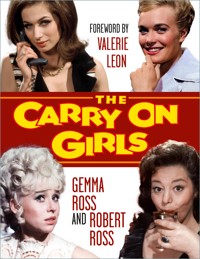
Erhalten Sie Zugang zu diesem und mehr als 300000 Büchern ab EUR 5,99 monatlich.
- Herausgeber: The History Press
- Kategorie: Sachliteratur, Reportagen, Biografien
- Sprache: Englisch
Whether it is the seaside postcard bubbly blondes of Barbara Windsor, the hysterically historical leading ladies of Joan Sims, the coquettish authoritarians of Hattie Jacques, or the statuesque confidence of Valerie Leon, the Carry On girls are stoic, sexy and fiercely independent. In this lavish celebration of a pioneering generation of comedy actresses who continue to radiate charm and contemporary relevance, a few home truths are revealed and some myths are debunked; but, above all, some of the best-loved icons of British entertainment are given fitting affection and respect.
Sie lesen das E-Book in den Legimi-Apps auf:
Seitenzahl: 377
Veröffentlichungsjahr: 2023
Das E-Book (TTS) können Sie hören im Abo „Legimi Premium” in Legimi-Apps auf:
Ähnliche



















To our mothers, Francesca Fanning and Eileen Ross,
Two very strong and independent women of the Carry On era.
With love.
Our Carry On cover girls are Valerie Leon (Carry On Again, Doctor), Shirley Eaton (Carry On, Constable), Barbara Windsor (Carry On Again, Doctor), Hattie Jacques (Carry On Doctor), Angela Douglas (Follow That Camel), Liz Fraser (Carry On Cruising), Jacki Piper (Carry On At Your Convenience) and Joan Sims (Carry On Again, Doctor).
First published 2023
The History Press
97 St George’s Place, Cheltenham,
Gloucestershire, GL50 3QB
www.thehistorypress.co.uk
© Gemma Ross and Robert Ross, 2023
The right of Gemma Ross and Robert Ross to be identified as the Authors of this work has been asserted in accordance with the Copyright, Designs and Patents Act 1988.
All rights reserved. No part of this book may be reprinted or reproduced or utilised in any form or by any electronic, mechanical or other means, now known or hereafter invented, including photocopying and recording, or in any information storage or retrieval system, without the permission in writing from the Publishers.
British Library Cataloguing in Publication Data.
A catalogue record for this book is available from the British Library.
ISBN 978 1 80399 340 9
Typesetting and origination by The History Press
Printed in Turkey by IMAK
eBook converted by Geethik Technologies
CONTENTS
FOREWORD BY VALERIE LEON
INTRODUCTION BY GEMMA ROSS
THE CARRY ON GIRLS
SHIRLEY EATON
DORA BRYAN OBE (1923–2014)
LEIGH MADISON (1934–2009)
HATTIE JACQUES (1922–1980)
JOAN SIMS (1930–2001)
SUSAN SHAW (1929–1978)
JOAN HICKSON OBE (1906–1998)
IRENE HANDL (1901–1987)
SUSAN BEAUMONT (1936–2020)
SUSAN STEPHEN (1931–2000)
JILL IRELAND (1936–1990)
ANN FIRBANK
DAME JUNE WHITFIELD (1925–2018)
MARIANNE STONE (1922–2009)
HILDA FENEMORE (1914–2004)
MARITA STANTON
ROSALIND KNIGHT (1933–2020)
CHRISTINE OZANNE
LUCY GRIFFITHS (1919–1982)
CAROL WHITE (1943–1991)
JANE WHITE (1945–2014)
JACQUELINE LEWIS
DIANA BEEVERS
SANDRA BRYANT
PATRICIA GARWOOD (1941–2019)
FRANCESCA ANNIS
DIANE LANGTON
JILL ADAMS (1930–2008)
JOAN YOUNG (1900–1984)
NOEL DYSON (1916–1995)
ESMA CANNON (1905–1972)
DIANE AUBREY
DORINDA STEVENS (1932–2012)
CARMEN DILLON (1908–2000)
LIZ FRASER (1930–2018)
FENELLA FIELDING OBE (1927–2018)
AMBROSINE PHILLPOTTS (1912–1980)
MOLLY WEIR (1910–2004)
BETTY MARSDEN (1919–1998)
JULIA ARNALL (1928–2018)
JUDITH FURSE (1912–1974)
CAROLE SHELLEY (1939–2018)
SALLY GEESON
DILYS LAYE (1934–2009)
MARIAN COLLINS
RENÉE HOUSTON (1902–1980)
AMANDA BARRIE
VALERIE VAN OST (1944–2019)
JULIET MILLS
VIVIANNE VENTURA
SALLY DOUGLAS (1941–2001)
DAME BARBARA WINDSOR (1937–2020)
THE CARRY ON AND THE WOMEN OF THE NHS
JUNE JAGO (1926–2010)
GWENDOLYN WATTS (1937–2000)
JEAN ST CLAIR (1920–1973)
PAT COOMBS (1926–2002)
FAITH KENT (1925–2008)
JULIE STEVENS
DAME SHEILA HANCOCK
TANYA BINNING
THELMA TAYLOR
WANDA VENTHAM
JULIE HARRIS (1921–2015)
ANGELA DOUGLAS
EDINA RONAY
MARGARET NOLAN (1943–2020)
DANY ROBIN (1927–1995)
JENNIFER CLULOW
JACQUELINE PEARCE (1943–2018)
NIKKI VAN DER ZYL (1935–2021)
ELSPETH MARCH (1911–1999)
DIANA MACNAMARA
ANITA HARRIS
ANGELA GRANT
ALEXANDRA DANE
VALERIE LEON
TRISHA NOBLE (1944–2021)
AMELIA BAYNTUN (1919–1988)
PATRICIA FRANKLIN
SANDRA CARON
VALERIE SHUTE
GEORGINA MOON
ELIZABETH KNIGHT (1944–2005)
ANNA KAREN (1936–2022)
SALLY KEMP
PATSY ROWLANDS (1931–2005)
PATRICIA HAYES OBE (1909–1998)
SHAKIRA BAKSH
YUTTE STENSGAARD
JACKI PIPER
NINA BADEN-SEMPER
IMOGEN HASSALL (1942–1980)
JANET MAHONEY
MARJIE LAWRENCE (1932–2010)
WENDY RICHARD MBE (1943–2009)
CAROL HAWKINS
LINDA REGAN
SHIRLEY STELFOX (1941–2015)
ANOUSHKA HEMPEL
ZENA CLIFTON
MADELINE SMITH
LAURA COLLINS
GAIL GRAINGER
OLGA LOWE (1919–2013)
BRENDA COWLING (1925–2010)
LARAINE HUMPHRYS
PAULINE PEART
LINDA HOOKS
PENNY IRVING
EVA REUBER-STAIER
PATSY SMART (1918–1996)
ELKE SOMMER
SHERRIE HEWSON
ADRIENNE POSTA
DIANA DARVEY (1945–2000)
JENNY COX
HELLI LOUISE JACOBSON (1949–2018)
VIVIENNE JOHNSON
SUSAN SKIPPER
JUDY GEESON
TRICIA NEWBY
LOUISE BURTON
ANNE ASTON
SUZANNE DANIELLE
BERYL REID OBE (1919–1996)
DAME MAUREEN LIPMAN
SARA CROWE
REBECCA LACEY
SARA STOCKBRIDGE
HOLLY AIRD
CARRY ON GIRLS CARRY ON …
ACKNOWLEDGEMENTS
Valerie Leon in her signature comedy role as Leda of the Lubi Dubbi tribe in Carry On Up the Jungle.
FOREWORD BYVALERIE LEON
When I made my first faltering steps into the world of Carry On one chilly day back in 1968, little did I think it would be the start of my ongoing and seemingly everlasting identity as a ‘Carry On Girl’ – let alone that many years later I would be writing the introduction to this wonderful book celebrating the girls of Carry On!
Oddly enough, my entire career came about almost by accident. As a child I was stage-struck and used to hang around stage doors to collect autographs, but I never seriously expected to take to the stage myself because I was terribly shy and introverted. This may seem strange, given my image as a man-eating temptress, but nothing could have been further from the truth at that time in my life!
After I left school, my mother encouraged me to apply for a place at RADA but unsurprisingly I failed the audition. Putting all thoughts of show business aside I began working in sales for a fashion house called Dereta, and then became a trainee fashion buyer at Harrods in Knightsbridge before eventually becoming controller of their sportswear department. Actually, I got my first taste of acting when I joined the Harrodian Entertainments Society and appeared in a play called The Shop at Sly Corner.
Over Christmas 1965, I went carol singing with the actress Eleanor Bron, who told me she had an excellent singing teacher. I signed up for lessons with the same lady, and she encouraged me to read The Stage newspaper where I would find details of new shows that were casting. One day, The Stage announced that singers were required for a musical called Belle of New York, so just for fun I played truant from Harrods, went along to the audition, and amazingly enough got the job! I say amazingly because I was head and shoulders taller than all the other chorus girls – and indeed some of the men!
When Belle of New York finished, I went up for the highly anticipated West End musical Funny Girl starring Barbra Streisand, and after six auditions I was finally cast as a Ziegfeld showgirl with a small speaking role. Working in a smash hit show with Barbra, THE superstar of the day, was something of a dream come true. It was a great credit to have on my CV, and when the show closed it led to small roles in films and on television.
One day in April 1968, along with several other young hopefuls, I found myself walking through the gates of Pinewood Studios to be seen for Carry On … Up The Khyber, the sixteenth in the wildly successful film series, and you could say I have never looked back. As a harem girl in the court of the Khasi of Kalibar, played with unforgettable aplomb by the outrageous Kenneth Williams, I did little more than proffer fruit and try to look exotic, but it was a start.
Six months later I was delighted to be back at Pinewood filming Carry On Camping, in which I struggled to keep a straight face whilst showing Charles Hawtrey how to put his pole up! His TENT pole, I hasten to add! We had tremendous trouble with the censor over that risqué line. It was an extra bonus that my scene featured three of the team I had worked with in Khyber: Charlie Hawtrey, Sid James and Bernie Bresslaw.
In March 1969 I was back – this time as Jim Dale’s amorous secretary Deirdre in Carry On Again, Doctor, vamping away as if there was no tomorrow. A couple of years earlier I had played Jim’s fairy godmother in pantomime at Bromley, so it was another happy reunion.
In October 1969 I filmed Carry On Up the Jungle, my personal favourite of the six films I made with the team. Dressed in a fur bikini à la Raquel Welch in One Million Years BC, I played the aptly named Leda, head of an intrepid all-female tribe called the Lubi Dubbis. We inhabited the village of Aphrodisia and were manhunters of a different variety! Once again, I shared scenes with Sid, Charlie and Bernie, as well as another cast member I had worked with previously, the inimitable Frankie Howerd. Frankie and I got on very well, and he and Joan Sims were old pals and wonderfully funny together. They could not stop giggling during filming, and I am smiling even now thinking of them in the scene with the snake.
In 1972’s Carry On Matron I was Jane Darling, a heavily pregnant film star admitted to the event-filled hospital ruled by Matron Hattie Jacques, where my triplets were eventually delivered by ‘nurse’ Kenneth Cope. Hattie was such a wonderful warm human being and so very kind. She was beloved by every single member of the cast and crew.
I was back with Hattie, as well as Joan, Barbara Windsor, Kenneth Connor, Peter Butterworth and Jack Douglas for the seasonal television special that year: the Carry On Christmas for 1972 – this is also blessed with the cheeky alternative title of Carry On Stuffing!
My final appearance of the series was in Carry On Girls, playing Bernard Bresslaw’s uptight girlfriend, Patricia Potter, who later blossoms into a beauty contestant and shares the catwalk with Barbara Windsor and Margaret Nolan. The severe-looking glasses I wore as plain Patricia were in fact my own, which I had used when working at Harrods before I invested in contact lenses!
And only recently did I learn through an agent friend that in late 1973 I might have had the opportunity to work one last time with the gang, in the musical comedy revue Carry On London! at the Victoria Palace Theatre. I was on the list of casting ideas but, unfortunately, I was already committed to other projects.
I treasure my memories of working with great talents such as Sid, Kenneth, Hattie, Charlie, Bernie and co., and I will never forget how warm and welcoming Barbara Windsor was to me. She took me under her wing and really was the epitome of the joyous, earthy, funny Cockney sparrow – a true professional who could sing, dance, make you laugh and make you cry. Sid James was a true gentleman and not at all like his lecherous Carry On persona. In the 1960s, along with many young actresses, I often had to endure unwanted attention which nowadays would be deemed sexual harassment, but on the Carry On set I never saw any such behaviour – and, in fact, Sid was very quick to step in and intervene when a visiting executive once tried it on with one of the girls.
A Hammer glamour girl thanks to Blood from the Mummy’s Tomb, Valerie was your 1973 Christmas Cracker for the December release of Carry On Girls.
Jacki Piper, Anita Harris, Robert Ross and Valerie Leon of Carry On Cruising for Cruise & Maritime Voyages, in 2017.
I have been so fortunate in my career to have been associated with three iconic British film institutions: Hammer Horror (in Blood from the Mummy’s Tomb), James Bond (in The Spy Who Loved Me and Never Say Never Again) and of course the Carry On series. I love greeting fans of all three genres at conventions throughout the world, and I am always delighted by how many young people tell me they have grown up watching the Carry Ons and how much they enjoy them. In recent years I have even joined BritMovieTours on their tours of the Carry On film locations, meeting fans in the pub featured in Carry On Dick. The legacy of Carry On is still very much a big part of my life.
I formed enduring friendships with several of my fellow Carry On girls, most especially the late Maggie Nolan, the irreplaceable Fenella Fielding, and my great friend Jacki Piper. A few years ago, Jacki and I joined Anita Harris on a wonderfully happy Carry On-themed cruise organised by Robert Ross, co-author of this book. He is the official Carry On historian, and someone I have known since he was a very young aspiring writer and fan! Jacki, Anita and I had the best time ever, laughing uproariously as we recounted stories of our days as Carry On girls. And even though it is many years since the series came to an end and we have all matured, Carry On GIRLS we will remain, as the films continue their extraordinary popularity on television, DVD, Blu-ray and beyond. May they Carry On forever!
Valerie LeonLondonMarch 2023
Barbara Windsor, in her iconic Carry On Camping moment, signed to the author at the Cinema Museum, in November 2015.
INTRODUCTION BYGEMMA ROSS
My first encounter with the Carry On films was at a young age. My grandmother took my brother and me to Blockbuster video store every Saturday and introduced us to an array of films, including the greats such as Gone with the Wind, My Fair Lady and The Sound of Music. It must be said though, that before I hit the heavier stuff, I was introduced to Carry On Up the Jungle. I distinctly remember seeing the cover with Valerie Leon towering over the lecherous Sid James, and I was intrigued. To me Valerie was (and still is) one of the most beautiful women in film. How brave to be standing there, in a skimpy outfit and oozing charm and strength as a woman. I don’t view this as sexist at all, although many may argue it’s a poor portrayal of women in film, to have such beauty, in little clothing, on the cover of the VHS.
When we set out to create this book, we felt the need to turn to some research into the subject of women and humour. It is argued that women fit into categories: the spinster, the feminist, the girl next door etc. However, academics will go on to argue that other than giving them a label there is no psychological depth to these roles. Yet, women are funny! Many will argue that women in Carry On films are being sexualised for the male characters; however, it is my belief the writers choose particularly to go deeper than this, and allow the women to have the last laugh.
If we conduct historical research of women in literature, one of the first female authors to present women as humorous was Jane Austen. As women, we know how to joke, despite the argument that it is men who decide what is universally funny. Women tend not to find certain situations funny, such as a spate of back luck or being embarrassed. However, women do laugh and when we do, we do it with great enthusiasm. This is why I believe so many women love Carry On. Women laugh at situations which enable us to feel empowered; we also find systematic misappropriation funny. Our humour is based on the controls we have on our own lives, and this is certainly something the Carry On girls give us. The women tend to have the last laugh. A scene which springs to mind is one in Carry On Henry, in which Sid James takes Barbara Windsor outside for a breath of fresh air and a chance to play his card. It is Barbara, though, who has the last laugh, by placing two watermelons in Sid’s hands before giggling and running away. Here is a perfect example of a woman in control and taking over the situation, thus resulting in females roaring with laughter, because she has got one over on poor old Sid. We’ve all been there: how many times do our girlfriends call us after a date and relate the stories of how they defeated the man? And we laugh!
Perhaps the best argument for women laughing at comedy is that if the joke is about ‘us’ and told by ‘us’ then it’s okay. However, if the joke is about ‘them’ then the ‘us’ part will make us feel offended. Interestingly, though Carry On was produced, directed and written by men, the affection the ladies have towards the scripts and the way director Gerald Thomas took care of them rings true for all the ladies who were involved in the films. How Gerald Thomas, in particular, looked after the ladies on set is a little-known fact. It was none other than Kenneth Williams who revealed a story about how love scenes or, dare I say it, scenes which could be seen to objectify women, were shot. During the filming of the links for That’s Carry On, Kenneth was feeling nostalgic, but he was also perceptively reflective on the making of the comedy:
Old School Film-Making: Shirley Eaton is greeted by the Pinewood Studios commissionaire during the production of Doctor at Large, in 1956.
When you see a love scene in a Carry On film or a bloke getting in a lather over some girl’s boobs, the chances are that, in reality on the film set, there is no girl there at all. Once Gerald has got all the shots he wants of the girl, he sends her home. Then he takes her place. So the reaction shots you see on the screen of a bloke getting going, are done opposite Gerald. He sits there and prompts you. ‘Come on,’ he says, ‘you’re throbbing with it. She’s getting them out! You can’t believe your eyes!’ And, of course, you respond to this like mad.
I believe that this is something which was quite forward thinking of the director. The fact that he was so protective of the ladies and sent them home so they didn’t feel objectified, is something we don’t hear too much about in films of the era, or indeed today.
A wonderful piece of modern research has highlighted the difference between what men and women find funny; women do not like to have their appearance commented on, and this can lead to mental health issues, whereas men do not like to be told they’re weak or vulnerable. Although, upon reflection, perhaps one of the biggest arguments we miss about Carry On films and their relevance today, is that they do indeed also poke fun at male weaknesses. Calling back to Carry On Henry, it is poor Sid James who is subjected to this, whilst Princess Bettina (Barbara Windsor) runs off with the younger, richer and more handsome Francis King of France (Peter Gilmore). Sid’s King Henry VIII also has to contend with the insult that his current wife, Queen Marie (Joan Sims), gives birth to a child conceived by another man.
When celebrating our favourite actors, we split them between men and women, e.g. best female artist, best male actor, best actress, the list is endless. It is only really in the last two years we have started to see the likes of BAFTA-nominated actors as a whole. We have made it far too specific with ‘male’ comedy and ‘female’ comedy, but why do we do this? Perhaps because with comedy we map out every detail of our lives and how we respond to it comedically – be it religion, race, social class, age and of course, men and women. All of these are undoubtedly a way in which we respond and subject ourselves to comedy. However, Carry On was always the star, no man or woman was above its title. Of course, certain actors were paid more, but this was not down to gender – in fact, Jim Dale received the same pay as Joan Sims in certain films – it was merely down to favouritism and simply most of the favourites of the time were men.
There is an argument today, in 2023, that Carry On films would no longer be considered to be funny for fear of upsetting certain generations. How often do we hear that phrase ‘I used to be able to crack this joke, but now women are in the workplace I can’t say it for fear of offending the ladies’. Yet I find this more of a sexist remark than that of the actual joke. It’s about educating, and understanding the concept of the joke. If I look back on Carry On, personally, I did not feel offended by anything; in fact, I would often hear people say these are family films. Sure, I didn’t always get the joke – I think it took me until my mid-twenties to understand the joke from Carry On Abroad, another classic scene with Sid and Barbara where he says ‘How ’bout the other ’alf?’ referring to her top, and her not really getting it, very much like me. However, he quickly realises what he’s said, and I like to think a moment of ‘oops did I just say that out loud’ to save Barbara the embarrassment. Going back to my first point, women don’t find being embarrassed funny, but we do laugh when we see the guy is uncomfortable. We girls come out on top again! If you pardon the pun!
Angela Douglas, as Annie Oakley in Carry On Cowboy, was a seasonal pin-up during the film’s release in December 1965.
I think another important argument to make about the Carry On girls is why would they (to coin a phrase) Carry On making the films if they felt a) objectified and b) underpaid? Well, Hattie Jacques summed up with this answer: ‘For fun. Not for the money. No, that’s not quite fair. But it was for fun … Good chums … We used to have lots of laughs.’ Along with Hattie’s comments, June Whitfield touched on the point that whether you loved or hated them, the critics would endlessly discuss them, but for everyone else, we continue to look back on them with fondness and memories of the very best in British comedy.
Sir Roger Daley (Bernard Bresslaw) and his wife (Margaret Nolan) are stripped of everything by the notorious highwayman Big Dick Turpin, in Carry On Dick.
A cheeky reverse angle of the scene during filming, with director Gerald Thomas in dark glasses, chuckling merrily, and proof of the production’s laudable protection of Maggie’s modesty thanks to a pair of briefs. Bernie was given no such luxury!
Newly-weds Mary and Charlie Sage (Shirley Eaton and Bob Monkhouse) in a publicity pose from the very first scene of the one that started it all, Carry On Sergeant.
THE GIRLS
SHIRLEY EATON
The typical girl next door, as long as your neighbours were Princess Margaret and Kenneth More, Shirley Eaton had a dash of the derring-do of a Hitchcock Blonde, and remains an icon of post-war British film.
Having made her debut in revue at the age of 12, Shirley found stardom opposite Dora Bryan in At the Lyric. She provided glamorous support for the star comedian on television, notably episodes of And So to Bentley, with Dick Bentley, and Mostly Maynard, with Bill Maynard. Shirley even had her own adventurous comic strip in TV Fun.
Early, eye-catching film appearances include You Know What Sailors Are, written and produced by Peter Rogers in 1953; Doctor in the House, produced by Peter’s wife, Betty Box, in 1954; playing Arthur Askey’s daughter in The Love Match (1955); and as one of the three gorgeous young ladies in Three Men in a Boat (1956).
By the winter of 1957, Shirley had joined the top comic ranks of Peggy Mount, Peter Sellers, and Terry-Thomas, as one of Dennis Price’s blackmail victims in Mario Zampi’s jet black comedy hit The Naked Truth. Hardly surprising then that Peter Rogers turned back to this attractive and very able leading lady to play bride Mary Sage in Carry On Sergeant, with a £1,000 pay cheque for the 21-year-old starlet – the same fee as seasoned British film actor Bill Owen, and £100 more than Kenneth Williams!
Shirley was on-call at Pinewood Studios for extensive publicity photographs on 15 April 1958, returning on 24 April, the first day of the schedule, to shoot the first of eleven days on set. A historic day to be sure; our original Carry On girl, Shirley Eaton, is far from the image of a sweet little housewife. Bearing in mind the year that this film was produced, and the stereotype and expected behaviour of a newly-wed from this era, Shirley’s performance taps into the deconstructive script of Norman Hudis, to show that she is far from her sex’s expectations in society. She is sassy, cunning and determined.
Shirley returned to the series for a guest star cameo as Sally Barry in Carry On, Constable. Her marquee value was utilised in the publicity, including this alluring portrait.
With her husband called up on their wedding day, she does not dutifully sit at home waiting for his return. She follows him, determined to spend her wedding night with her new husband. In fact, Bob Monkhouse is resigned to the fact of spending the night alone. As the pioneer of the franchise, Shirley establishes the morality and sexuality of women throughout the series. She paves the way for the determined screen sirens personified by the Lubi Dubbis in Carry On Up the Jungle to the playful Barbara Windsor, turning the tables and pinching Peter Butterworth’s bottom in Carry On Girls, via June Whitfield enthusiastically throwing off her inhibitions and having a fling with Georgio the barman (Ray Brooks) in Carry On Abroad.
Shirley gracefully returns as the staff nurse in Carry On Nurse, falling under the spell of the dashing doctor (John Van Eyssen) but finally succumbing to the gorgeous reporter Ted York (Terence Longdon). She is sublime as the perfect nurse, but maintains that twinkle in her eye as she tells a floundering Joan Sims to put the suppository in the ‘other end’. At this point though we see Shirley’s worth to the studio and its producers, with a pay increase of £250. Indeed, already recognised as the leading lady of the company, Shirley’s income for just nineteen days’ work on the film was exactly the same as co-star Kenneth Connor. Furthermore, film actor of nearly forty years’ experience and fellow Carry On Sergeant cast member Charles Hawtrey was paid just £800 for the film. It is clear there were no gender discrepancies in pay here, and Shirley was in fact being paid in relation to her performance and billing.
It’s also Shirley’s favourite Carry On. She chuckles:
Those of us who had been in the original production were delighted to be back together again, at Pinewood Studios, for Carry On Nurse. Only Kenneth Connor had sensed something special about Carry On Sergeant but even he wasn’t all ‘I told you, so!’ while we were filming Nurse. It was just another film, but we were part of a gang now: the Carry On team. It was all very exciting and, as far as I’m concerned, the films never got funnier than the operating room scene, with the laughing gas. My fellow mad men were hilarious in that. Carry On Nurse is the tops, but I would say that, wouldn’t I?
She was aware of her impact from an early age, and the camera simply adored Shirley. Here, in Carry On, Constable, it’s Leslie Phillips as Police Constable Tom Potter who is getting hotter under the collar.
It was during the making of Nurse that Shirley found out she was pregnant, and thus unavailable for the next film, Carry On Teacher. That didn’t stop the publicity department adorning the poster with a caricature of a sexy educator that looked exactly like Shirley Eaton! She would return for the glorified cameo of Sally Barry in Carry On, Constable. A fond farewell to the franchise that she had helped define and a personal favour to the series, one which was fully exploited in terms of her ‘& Shirley Eaton’ billing on the poster. Shirley’s appearance was also tied in with a skilful marketing campaign with the Kayser Bondor lingerie and gingham sleep coat that she wears in the film. When Constable was released across the United States as ‘the clowning achievement of the year’ in 1961, Shirley’s come-hither likeness was fully to the fore on the poster.
In British screen promotion too, it was happily noted that during location filming, when Sid James escorted Shirley across the road, her loveliness had stopped traffic.
In a quick burst of screen activity thereafter Shirley capitalised on her increased marquee value and escalating wages by accepting even more lucrative leading lady roles in film producers’ deliberate attempts to cash in on the craze for Carry On. In the winter of 1960, Shirley was back with Sid James, over at Hammer Films, for the caravan caper A Weekend with Lulu. The film, starring Bob Monkhouse, was released the following spring, during which time Shirley was filming a jolly reunion with Carry On Sergeant cohorts Monkhouse, Kenneth Connor, and Eric Barker, for Dentist on the Job. Foreign territories even released it as Carry On TV.
Their first tiff! Shirley Eaton playfully minces Bob Monkhouse’s hand in this hilarious, candid publicity lark during the making of Carry On Sergeant.
Brains and beauty combined was the spearhead for this publicity photograph session for the Betty Box production Doctor at Large.
Later in 1961, Shirley was back with Connor, as his leading lady in the Royal Air Force comedy film Nearly a Nasty Accident, and the haunted house romp What a Carve Up!
Thereafter it was mostly intrigue and espionage, including the first episode of The Saint: ‘The Talented Husband’ (30 September 1962), with Roger Moore at Elstree Studios, and a return to Pinewood to play the ill-fated golden girl Jill Masterson in the third James Bond film, Goldfinger (1964). There was Agatha Christie incrimination in Ten Little Indians (1966), sub-aqua adventure in Around the World Under the Sea (1966), and an encounter with Christopher Lee’s inscrutable oriental mastermind in The Blood of Fu Manchu (1968).
Happily retired to family life in the sun, thirty years later Shirley published her memoirs, Golden Girl, and enjoyed a lengthy career on the signing convention circuit. Once a Bond girl, forever a Bond girl; and once a Carry On girl, forever a Carry On girl.
DORA BRYANOBE (1923–2014)
Having made her West End debut in Noël Coward’s Peace in Our Time and immediately followed that production with a two-year run opposite Yvonne Arnaud in Traveller’s Joy, Dora Bryan was gloriously philosophical about her concurrent roles in British film. ‘If they wanted a shop girl, a barmaid, or a tart with a heart they would usually call me in. I was grateful for the work, but it wasn’t the most challenging.’ Indeed, her first screen role was as a girl in a telephone kiosk in Carol Reed’s Odd Man Out (1947). The following year, Reed used her again, this time as Rose in The Fallen Idol. Dora was a sales assistant in Harold French’s comedy Adam and Evelyne (1949) shot at Pinewood Studios, and was a beautician in Don’t Ever Leave Me (1949). At Ealing Studios, she was cast as goodtime girl Maisie in pivotal police drama The Blue Lamp (1950), while Hammer Films saw her as La Fosse in rollicking crime thriller Whispering Smith Hits London (1951).
It was on cinema’s poverty row that Dora began to enjoy fuller, funnier roles, memorably Tilly, the inquisitive girlfriend of policeman Richard Wattis, in Mother Riley Meets the Vampire; and the rather malicious Peggy Stebbins in Time, Gentlemen, Please! (both 1952). Soon after, she was swimming in the ken of Peter Rogers, playing Gladys in You Know What Sailors Are.
She was Berengaria in Mad About Men (1954), Ralph Thomas’s sequel to the Glynis Johns mermaid comedy Miranda; Sergeant Hortense Tipp in the Tommy Trinder vehicle You Lucky People (1955); and Lily, opposite Alastair Sim, in The Green Man (1956). By the September of that year, she was such a family favourite that Granada Television launched her in her own situation comedy, Our Dora. Ill health forced her out of the show after just four episodes, with Eleanor Summerfield being drafted in as replacement and the show’s rebranding as My Wife’s Sister.
Dora returned to work at the behest of comedian Ronald Shiner, playing his wife in The Love Birds, at the Adelphi theatre. Dora’s first return to film was Carry On Sergeant.
Dora is NAAFI girl, Norah. She is the girl who is desperate to find a husband. A great contrast with Shirley Eaton, the girl who, in Norah’s eyes, appears to have it all. Even so, she takes pity on Shirley, offering her a job, despite the high heels and the fact she has never worked in a NAAFI before. She certainly can’t cut chips, that’s for sure. Still, the two rub off on each other, coaxing one another to get their man. Norah isn’t afraid to play her card when a nervous Kenneth Connor is shying away from her intentions. It was quite groundbreaking to see a lady chase after a man on screen, but to get married and have a family was the goal of many women watching the film in the late 1950s. When girls left school, the vast majority went straight into work as secretaries, bank tellers or clerical workers, sales clerks, private household workers and teachers – in fact, all those roles Dora Bryan had been playing on screen for the last decade. These were the jobs women did until they got married, so it’s no wonder Norah was looking for a husband.
That being said, women from poorer backgrounds had always done some sort of work to earn a crust, often through casual occupations such as charring, baby-minding and taking in lodgers. In the film, it’s unclear exactly how long Norah has worked on the base camp and whether she would actually give up her job if she was made an honest woman through marriage. We know that the proportion of married women in regular paid work grew dramatically from the 1950s onwards. In fact, it may have become likely that Shirley Eaton’s character would end up in work, so her time with Norah would have been a good experience.
The first girlfriend to the leading lady, Dora Bryan is the embodiment of resigned dependability in Carry On Sergeant, with star-crossed lovers Bob Monkhouse and Shirley Eaton.
Dora’s long and prolific career included films with Sid James in Desert Mice (1959) and Frankie Howerd, Up the Front (1972); a BAFTA-winning role as Rita Tushingham’s mother in A Taste of Honey (1962); and her defining stage role as Mrs Levi in Hello Dolly at the Theatre Royal.
In the late 1950s, Dora and Joan Sims were always being mistaken for each other, so it was more than fitting that Joan took on the role tailor-made for Dora in Carry On Nurse. There were certainly no hard feelings though. Indeed, nearly fifteen years later when Joan was down on location in Brighton for Carry On Girls, local resident Dora Bryan greeted her by shouting, ‘Oh, Dora! Dora!’ Joan returned with an enthused, ‘Oh, Joan. Joan!’, as they collapsed with laughter into each other’s arms.
Dora gleefully joined Shirley Eaton and Terence Longdon for the audio commentary for Carry On Sergeant, some fifty-five years after its production. She was as enthusiastic and outrageous and energetic as ever. ‘I used to dance a lot in my variety act, but I never went to dancing lessons or exercised or anything like that to keep trim, I just have that kind of body!’
LEIGH MADISON(1934–2009)
Leigh Madison played Sheila in Carry On Sergeant, an attractive bit of fluff for Miles Heywood (Terence Longdon) to fraternise with, and attractive female Doctor Winn in Carry On Nurse. No wonder Jack Bell (Leslie Phillips) is greeted with outraged jealousy: ‘He gets her for a bunion!’
What is most innovative in her casting for Nurse is that during the 1950s it was very rare to see a female doctor. In fact, in the early 1950s the number of women listed in the medical directory as doctors is 12,500. It’s quite an impressive number, and yet we still underestimate it. We know that many women would have been involved in supporting the war effort and it’s a theme that is also echoed in Carry On Sergeant with Hattie Jacques as the doctor.
Leigh Madison in a 1958 publicity portrait – the year she filmed the first two Carry Ons.
Blonde, shapely and spirited on screen, Leigh Madison had proved decorative and engaging on such television successes as The Dave King Show and Six-Five Special, where her singing talents matched her beauty and charm.
Her film roles outside the environs of the Carry Ons included the thriller Blind Spot (1958); the advertising satire Make Mine a Million (1959); and as Jean Trevethan, the female lead in Behemoth the Sea Monster (1959).
On television she played three different roles in three different episodes of the Peter Rogers-produced historical adventure series Ivanhoe, starring Roger Moore as the fearless knight: Lady Agnes in ‘Slave Traders’, 12 January 1958; Bess in ‘Murder at the Inn’, 12 April 1958; and Winfreda in ‘The Monk’, 30 November 1958, by which time her first Carry On had been released, and her second and last was in production.
The producer used her one final time, as a cashier in the reality versus fiction comedy Please Turn Over, in 1959. Soon afterwards, Leigh joined fellow Carry On veterans Charles Hawtrey, Norman Rossington, and Hattie Jacques in the Norman Hudis-scripted sitcom Our House. In December 1960, two months into the show’s transmission, she married its director Ernest Maxin.
Ding Dong! Humphrey Hinton (Charles Hawtrey) chooses to ignore the good fortune of Jack Bell (Leslie Phillips) as Doctor Winn (Leigh Madison) and Staff Nurse Dorothy Denton (Shirley Eaton) tend to his tender bunion!
HATTIE JACQUES(1922–1980)
One of the greatest, and most garrulous, comedy actresses of her or any other generation, Hattie’s career was launched by old-time music-hall antics and pantomime fairies with the Players’ Theatre, from the mid-1940s. She came to national fame as a tail-end member of Tommy Handley’s repertory company in the radio sketch show It’s That Man Again, or I.T.M.A. as it was more famously shortened to.
Hattie was a late addition to Ray Galton and Alan Simpson’s Hancock’s Half-Hour too, although her at turns bombastic and coy secretary Grizelda Pugh was more than a match for her employer Tony Hancock, and as often as not set the romantic pulse of Sid James racing.
At the time of her casting and filming for Carry On Sergeant, Hattie’s work with Hancock – and Kenneth Williams, of course – was at fever pitch; having her extremely thick gravy condemned in ‘Sunday Afternoon at Home’, beating all-comers in wrestling in ‘The Grappling Game’, and displaying her talent for characterisation in the Walter Mitty-like revisionism of ‘Hancock’s War’.
From the very outset, Hattie is strong and determined in a role that could, with the slightest of rewrites, have been played by a man. Indeed, Kenneth Connor is shocked that Medical Officer Clark isn’t a man but a twist of femininity in khaki. It’s a terrifying buckling of the wheel of the expected normality. Cor, madam, mate …
Next came Carry On Nurse, and Hattie’s first appearance in her defining role as Matron. Incredibly, her role took just three days to film, but the moment she retrieved that daffodil from the posterior of the troublesome Colonel (Wilfrid Hyde-White) Hattie was the nation’s visual image of the merry Matron. Even now.
Producer Peter Rogers went on to explain:
When one wag on the set made a noise like a champagne cork popping out of a bottle, as she lifted up the daffodil, she was a complete goner. [Director] Gerald [Thomas] tried take after take, but she couldn’t keep a straight face. We had to abandon the shoot for the day. When we picked it up again the following day Hattie was still delightfully tickled by the conceit of the scene. We finally managed to get her through that scene, but that final grin at the end is pure Hattie. She just couldn’t help herself.
That joy in the robust comedy of the Carry Ons, and that skilful ability to regain the character while allowing her genuine, sheer exuberance to twinkle through, was key to Hattie’s staying power in the team, and the lasting legacy of her greatest comedy roles.
The legacy of her days with Tony Hancock also loomed large over her twenty years as part of the Carry On team. Unsubtle references to her size had been part and parcel of her comedy career since I.T.M.A., but Hattie was genuinely hurt by some of the cruel jibes directed at her in Hancock’s programmes. The Carry Ons were peppered with them too, be it self-deprecating commentary in Carry On Cabby, ruefully reflecting that her husband (Sid James) spends his time tinkering on his fleet of taxis because ‘he knows I can’t get under one!’; or in Carry On Doctor, with Jim Dale’s clumsy, ‘Come, come, you’re not that big Matron!’ The young medic is trying to appease an awkward situation but, typically, makes it worse. The fact remains though that Hattie was large, and clearly it is a common reference point in their shared place of work, be that the fiction of the hospital or the fact of the film studio.
For Hattie, one of the pressures of being a woman was to keep fit and lose weight. During the post-war period, with rationing having been abolished, women’s magazines and media culture started to publish articles about how to lose weight. It marked the start of the modern slimming culture which has since permeated all aspects of women’s lives. The idea was in the 1950s that as housewives you could trim your figure by polishing and dusting in such a way that would enable you to lose weight. In fact, by the mid-1960s the pressure had mounted for women to begin to diet, and this became the centre of women’s magazines as part of their beauty advice. No wonder poor Hattie felt under pressure, with the executives wanting to follow the trend, and in her personal life continually seeing magazines stating that slimming was part of an expected look to be considered attractive. Moreover, female slimness was portrayed as an ideal post-war femininity.
Even more than half a century on, Hattie’s personification of the hospital matron is an indelible part of the British psyche. Here promoting Carry On Again, Doctor, for its December 1969 release.
During the 1960s, however, research into obesity began and it fuelled a growing slimming culture and an increased popularity of slimming clubs. This was rapidly becoming a capitalist market. Articles were written about the dangers of being overweight and even more derogatory language such as ‘All fat people tend to look alike’ from Women’s Own magazine in 1969 along with ‘Fat has a knack of ironing and flattening out all the features, obliterating them’. It’s no wonder Hattie suffered because of this language. Thankfully, today, attitudes have shifted and we can be grateful to women like Hattie that we really do come in all shapes and sizes.
Despite her personal concerns, and the concerns of film production insurance policies, Hattie saw the Carry On team as part of her family. She certainly had great admiration for director Gerald Thomas. In an interview for the promotion of the compilation film That’s Carry On (1978), Hattie said:
Gerry is a darling, benevolent headmaster. He knows his job and expects you to know yours. You can’t turn up not having learnt your lines. But, apart from any other reason, you just wouldn’t do that anyway, for his sake. You wouldn’t want to let him down.
With Carry On, Constable on general release in 1960, that year had seen Hattie’s television ratings increase too. From January, she was playing the twin sister of Eric Sykes on the BBC, while from September she was the loud-mouthed librarian Georgina Ruddy in Norman Hudis’s house-share sitcom, Our House.
In Carry On Cabby, we see Hattie taking up her role as the early feminist, about to embark on a war with her husband Charlie (Sid James). It is lovely to see Hattie being a fighter for all women, although interestingly enough she wanted to play even more diverse roles. During a promotion of the film, Hattie stated, ‘I want to be a murderer. The idea of playing a thoroughly sinister woman in an Alfred Hitchcock type production appeals to me. I’m sure I could frighten most people out of their wits.’ We know what a marvellous actress she was, and although she has a chance to shine in a meaty role in this film, just imagine what she could have done in a Hitchcock film!
A moment that sums up the sheer affection at the heart of Carry On: Sidney Bliss (Sidney James) plants a smacker on the nose of Sophie (Hattie Jacques) in Carry On Loving.
A rare display of joyous abandon as Floella (Hattie Jacques) dances the night away with Brother Martin (Derek Francis) in Carry On Abroad.
Behind the scenes on one of the most oft-screened scenes in all of British film: director Gerald Thomas coaxes Kenneth Williams and Hattie during the making of Carry On Camping.
The year 1964 proved to be exciting. If not a character from the dark side she was personally selected by Noël Coward himself as his celebrated medium, Madame Arcati, for a television adaptation of his play Blithe Spirit.
From July to October, Hattie starred as intrepid Stacey Smith in ABC’s comedy adventure serial Miss Adventure




