


Erhalten Sie Zugang zu diesem und mehr als 300000 Büchern ab EUR 5,99 monatlich.
- Herausgeber: THP Ireland
- Kategorie: Sachliteratur, Reportagen, Biografien
- Sprache: Englisch
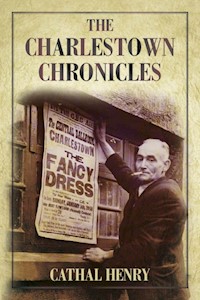
Charlestown has long been a place of strategic importance to Mayo. It has provided many prominent and dedicated residents who have made their contribution not alone to their own area but to the county at large through involvement in public life, sport, community development and business. In The Charlestown Chronicles, Cathal Henry has immortalised the people, places and events that have shaped his native place. Painstaking historical research is presented alongside lively and affectionate personal recollections, resulting in a book to be treasured by Charlestown people across the globe.
Sie lesen das E-Book in den Legimi-Apps auf:
Seitenzahl: 221
Veröffentlichungsjahr: 2012
Das E-Book (TTS) können Sie hören im Abo „Legimi Premium” in Legimi-Apps auf:
Ähnliche



















THE
CHARLESTOWNCHRONICLES
THE
CHARLESTOWNCHRONICLES
CATHAL HENRY
First published in 2009
The History Press Ireland
119 Lower Baggot Street
Dublin 2
Ireland
www.thehistorypress.ie
This ebook edition first published in 2012
All rights reserved
© Cathal Henry, 2009
The right of Cathal Henry to be identified as the Author of this work has been asserted in accordance with the Copyrights, Designs and Patents Act 1988.
This ebook is copyright material and must not be copied, reproduced, transferred, distributed, leased, licensed or publicly performed or used in any way except as specifically permitted in writing by the publishers, as allowed under the terms and conditions under which it was purchased or as strictly permitted by applicable copyright law. Any unauthorised distribution or use of this text may be a direct infringement of the author’s and publisher’s rights, and those responsible may be liable in law accordingly.
EPUB ISBN 978 0 7524 8116 6
MOBI ISBN 978 0 7524 8115 9
Original typesetting by The History Press
CONTENTS
Acknowledgements
Preface
Foreword
About Charlestown
Politics
Sport
Entertainment
Memories of Charlestown
ACKNOWLEDGEMENTS
I would like to thank the following people for their help and co-operation in the production of this book: my mother Delia and late father Tony, for their patience and articles written; Patsy Dunne MCC, RIP, and Paddy Henry, RIP, for their interest and contributions; Mary Esler and Michael Hambly of Mayo-Ireland Claremorris for their advice and help; Gerry Durkin and Ted McDonnell, and everyone who gave me photographs; Ivor Hamrock, of the local studies section, Mayo County Library, Castlebar, for his valuable help, and last but not least, Nonsuch Publishing for their interest in the project.
PREFACE
To understand the present we need to examine our past. People, places and events through time made us what we are. However, succeeding generations always regret not having engaged more with their elders in exploring and recording the past. Too late we realise what we have lost. For this reason the publication of Cathal Henry’s Charlestown Chronicles is to be welcomed.
Cathal always had a great interest in fostering the written heritage of his native Charlestown. Through my work in the local studies section of Mayo County Library, over many years, Cathal and I have exchanged a great deal of material on the Charlestown area. He has been generous in donating many rare and historical documents to the library, ensuring their preservation for the future. Cathal’s book is also a work of preservation. I know that it will be appreciated and cherished by the present and future generations of Charlestown people.
I congratulate Cathal on the publication of this important work.
Ivor Hamrock
Mayo County Library
Castlebar
FOREWORD
There is a vast amount of historical information available in many areas of Co. Mayo. Much of this information has been put together by amateur historians who have taken on the task of informing themselves on the people, places and events that have shaped those localities that we refer to as our native places.
Charlestown has long been a town of strategic importance to Mayo. It has provided many prominent and dedicated residents who have made their contribution not just to their own areas but to the county at large through involvement in public life, sport, community development and business.
The Henrys have been committed to the growth of the town for generations and have made their mark on politics, commerce and art. They are part of the history of the area.
Cathal Henry’s decision to draw together the many articles on Charlestown, its places of interest, its characters, its people, and its changing streetscape and hinterland is another example of unselfish commitment to his home town.
The compilation of this history of Charlestown has been painstaking, the research has been detailed and a fine body of historical data has been prepared. Getting the information together is one thing; having it published is another.
Cathal Henry’s decision to go ahead and publish this volume is a brave one and his endeavour deserves to be supported by Charlestown people wherever they may be presently located. For Cathal, the work has been a labour of love and yet another important contribution to Charlestown and to Mayo.
Christy Loftus
‘CHARLESTOWN’
Amid the crisp Mayo skies
On a cold December’s day
A town still quiet new emerges
There you stand with many facades
Like leaves from a story ready to be told
Dotted on your landscapes are fortresses
Where hunter-gathers came
With herd and kin
Engraving a life that has now since past
Traces of ancient souls
Lie upon the plains of Barnacahogue
In a graveyard at Tample lies the tomb of Costelloe
Dressed by well and relic of St Attracta
The abbey of Urlaur now destroyed
Once echoed with monks at evening prayers
Who chanted songs to a rising sun.
Reminders of history lie hidden within
The very heart of you,
Recollections of times past
Where famine ravaged the limbs of Ireland
And took the salt of mother earth
Tragedy scorned you
Through mines at Maypole
Men of Charlestown lost their lives
Mothers grieved and beat their breasts
For native sons they would see no more
The old town hall stands in glory
Proclaiming a time of finery
Names of Healy and Coogan
Grace its ledges now
Documentation upon shelves of Ash
Tell of your unknown story
While Names of the ascendancy
Pay homage to you
From their resting places
At Tample, Bushfield and Carracastle.
Noirin A. Gannon
ABOUT CHARLESTOWN
COSTELLO
The family Costello are of Cambro(Welsh)-Norman descent, from the family of de Angulo. Gilbert de Angulo, whose surname later became N’angle, participated in the Norman invasion of Ireland (AD 1167-1172) with Richard de Clare (Strongbow).
Gilbert had two sons, Jocelyn and Costilo, and the son of the latter, known as MacOisdeaibh (son of Costilo) participated in the Norman invasion of Connaught in 1235, along with the de Burgos (Burkes) and the de Lacys, and established the Barony of MacOisdeaibh, later MacCostello, in eastern Mayo and western Roscommon, which lasted some four hundred years.
The Costellos were the first of the great Norman families in Ireland to use the ‘Mac’ (Son of) prefix to their name. Like many other Cambro-Norman families they became ‘More Irish than the Irish themselves’. The Barony of MacCostello is still an identifiable geopolitical district in Mayo, and the Costello name is common in the county. Charlestown is very much part of this Barony.
For this information, my thanks to Bob Costello. As an addendum to the Costello saga, the following may be of interest, relative to the place where the Romantic Tomás Láidir Mac Costello was murdered and relayed to me by my mother, Delia Henry. One day in 1934, when teaching in Tavneena National School, the Principal, Mr Gerry Henry asked my mother if she knew where ‘Sithestin’ west of Swinford was. Although she lived in Killaturley, Swinford was our postal and market town and she went to secondary school there. She had never heard of that place, but said she would find out if it existed. An elderly neighbour, Luke Tunney visited in our house. He was about seventy years of age at the time. On his next visit, my mother put the question to him about the village named Sithestin, west of Swinford. After a few moments, he said, ‘No, there is no Sithestin, but Sithestin Dubhaltaigh, now known as Barcul. It is situated between Shammer crossroads and the Charlestown–Ballyhaunis road.’ My mother had never heard of the word ‘Dubhaltaigh’ before, but had cycled through Barcul many times.
The next day she repeated the statement made by Luke Tunney. The Principal got a book called The Love songs of Connaught by Douglas Hyde and there in the print was Sisthestin a Dubhaltaigh, Dudley’s Sithestin. The poem ‘Una Bhain’, composed by Tomás Láidir MacCostello, about his lost love, Una McDermott, was on page 117 and underneath it was an account of that place, where he was murdered by the Dillons.
The descendents of the Costellos in the Charlestown area owned around two hundred acres of land at one time, and their tomb is in Tample graveyard, complete with the following inscription:
GLORIA IN EXCELSIS
O Lord have mercy on the soul of Thomas Costello Esq., of Hagfield, who departed this life, February the 1st, 1822, aged 95 years, also his wife, Maria Costello, who departed this life, 6th of January 1810, aged 75 years.
His son Thomas Costello Esq., who departed this life, August 1st, 1828, aged 78 years.
His son Edward Costello Esq., who departed this life, the 2nd of August 1811, aged 59 years.
His son Richard Costello Esq., who departed this life, the 1st of September 1859 aged 95 years, and his grand-daughter Louise Costello, who departed this life, on the 10th of June, 1860, aged 19 years.
Erected by Peter Costello Esq.
The Bridge, Charlestown, taken from the square in the 1930s.
Also buried in this tomb are the following descendents:
Frances Wynne, née Costello, wife of Andrew Wynne.
Margaret Mulligan, née Wynne, who was buried on the 16th of February 1987, by her son James ‘Seamus’ Mulligan.
The descendents of the Costello family named above still live in the Charlestown area. They include James ‘Seamus’ Mulligan, his nephew Michael Giblin, and nieces Marcella McBrien, Patricia Leonard (Aclare), Evelyn O’Keefe, and Jacqueline Cummins (Swinford).
Maire McDonnell-Garvey, in her book Mid-Connacht, gives a very interesting and detailed account of the Costello era and the transition of their lands to the Dillons. In chapter six, she pays tribute to the great work done by Charles Strickland, Chairman of Gallen and Costello Relief Committee, for the relief of the poor during the Famine years.
Not mentioned in this account, however, is perhaps his greatest achievement – the founding of the town of Charlestown. The first house was built in Charlestown in 1846 and the foundation of the Catholic church was laid a decade later in 1856. The first Mass was celebrated there in 1858. The church and town in the parish of Kilebeagh, in the Barony of Costello, have much to be grateful for the work done by Lord Dillon’s agent Charles Strickland.
LOUGHGLYNN HOUSE
Loughglynn House, formerly owned by Lord Dillon, is now owned by the Franciscan missionaries of Mary. Loughglynn is a little lake set in the heart of an ancient forest midway between the towns of Castlerea and Ballaghaderreen in the north of Co. Roscommon. The lands at one time belonged to the Clan Costello, whose main residence was at Castlemore Costello near Ballaghaderreen. Lord Dillon, an Englishman, owned the parish of Loughglynn, three or four parishes in Mayo, Ballyhaunis, Kiltimagh, Charlestown, Tibohine, Fairymount, Ballaghaderreen, Frenchpark, Cloonarrow and Errit. At this time he lived in the old castle at the farmyard in Loughglynn, where the towers stood beside an old church. One of the towers still stands, the other was taken down. It was he who built the house at Loughglynn, as it stands today.
Every Saturday, Mass was celebrated by either the parish priest or the curate. Lord Dillon attended this Mass. Had the British Government known that Lord Dillon was a Roman Catholic, the property would have been taken from him. Eventually this information did leak out and the British Government sent two detectives to investigate. His neighbours told the detectives that they knew of Lord Dillon’s presence at Mass because they could hear his footsteps coming into the chapel. However they never saw him there; the reason being that a screen separated Lord Dillon from the people.
The old castle at the farmyard was burned, and while the new house was being built Lord Dillon lived in Dublin, coming now and again to see the work. The out-offices that were left intact were turned into a National School and later into a Cavalry Barracks by the yeomen, Lord Dillon’s bodyguards.
One of Lord Dillon’s sons married Miss Burke, a Roman Catholic, from Castlemagarrett, three miles outside Claremorris. His father was very displeased with this marriage, and in disgust sold half his property, Frenchpark. Lord Dillon lived in Loughglynn until his death. He is buried in Ballyhaunis.
The property was given to the next heir, another Lord Dillon, who was not a Catholic. He continued his father’s business, taking rents from the tenants. This Lord Dillon had an agent named Whyte, an Englishman. He planted the demense of Loughglynn in the year of the Union, 1801. The demense consisted of all the avenues and stables around the present house. Whyte was an old man, so he shortly retired and returned to England. His successor was Strickland, another Englishman, who made the lake.
Strickland lived in the house at Loughglynn with his wife and family. One of his sons became a priest, Fr William, and celebrated Mass in the old church. The second son, W. Strickland, a sea captain, married a lady who owned a big property in her homeland of Malta. He later became Governor of Malta.
The third son, Thomas Strickland, lived in Castlemore house in Ballaghaderreen. He owned a large Flax Mill in Castlemore. He married a girl from Dublin, and when he retired he went to live there. The fourth son, Charles Strickland, obtained the agency after his father’s death. He also married a girl from Dublin, and after his term of office expired, he retired to live in the capital city. He is buried in Glasnevin.
The agency was next taken up by Hussey, an Irishman, whose father was an agent for several landlords in Ireland. He was married to an English girl called Miss Smyth, Daughter of Captain Smyth. He continued the agency until Loughglynn House was burned on 5 November 1896. Hussey had five clerks: Jackson from Birmingham; Thomas O’Connor, later paymaster for the County Development Board, from Dingle; Feeley from Kerry, whose family lived in Ballaghaderreen; Dyar from Roscommon, and Doran, from Tralee, who was a land steward and later became Sir Henry Doran, Head of the County Development Board. Sir Henry lived in Tavrane House, not far from Kilkelly.
Hussey was a kind-hearted man, a great sportsman who loved racehorses and he was liked by all the people. He was manager of all the schools on the Dillon Estate and when he gave them up, the clergy took them over. He lived in Loughglynn until the property was sold in May 1899. He then went back to his father’s house in Tralee and his wife went to England.
When the property was sold by Lord Dillon to the County Development Board, the land was divided up among the tenants having small holdings. The house was repaired by a contractor named Beckett. He demolished one storey and left it as it stands today, with three storeys. His Lordship Most Revd Dr Clancy, Bishop of Elphin, then bought it for the diocese. When the Franciscan Missionaries of Mary came to Ireland in 1903, Dr Clancy offered them the estate as their first convent and it has belonged to the institute since.
A POEM
There is a blue lake far awaySet round with honeyed meadsWhere little breezes laugh and playAmong the lisping reeds.
A jewel of a turquoise lakeBlue as a pigeon’s wingWhere little waves in music breakAnd shadowy waters sing.
And in the midst a flowery isleEnchantment’s fairy home,Where shy wood blossoms sweetly smileAnd shy wood creatures roam.
A place to soothe a poet’s heartWith balm of leaf and sodFrom tumult of the world apart,A place to dream of God.
The iris lifts a purple plumeIn oozy marsh and pool,The flame-bright marigolds illumeThe birchen shadows cool.
The gold bees hum the meadows through,The darting dragonflyIn brilliant mail of burnished blueOn quazy wings flits by.
The water hen has there her homeMid lily pads and reeds,The heron wades the creamy foamThat laps the fringing meads.
The skylark hangs on flickering wingAnd pours from heaven his lay,And finch and linnet flute and singFor joy the live-long day.
The hazels whisper to the moon,The birches to the sun,The flaggers shiver as they croonWhere vagrant breezes run.
The blossom of the sloe is whiteAnd pink the wild rose bloom,And azure day and purple nightAnd filled with mild perfume.
There to the fortress of the waveFor peace of soul divineFled ancient prince and warrior braveOf Connaught’s kingly line.
From royal court and castle rudeBrehon and bard and chiefBeneath the wood’s beatitudeFound refuge and relief.
P.J. Coleman, MA.
THE FIRST HOUSE BUILT IN CHARLESTOWN
In the 1840s, by what is now Charlestown was a bog. Stepping stones across what is today known as the Roundabout (or the Square), led to the ancient town of Bellaghy – where once there was a British Army Barracks – just across the county border in Co. Sligo. There, the Mayo tenants of the Lord Dillon Estate had to carry their sacks of potatoes and grain on market days. Because they were Mayo men and tenants of Lord Dillon, they were forced to wait at the weighing scales until all the Sligo men had their produce weighed.
The Mayo tenants complained bitterly to the agent of Lord Dillon, one Charles Strickland, who protested to the Lord of Sligo estate, one of the Knox family. He was rebuffed, but it was not until later, when Strickland was publicly insulted, that he swore vengeance. ‘I will wipe out Bellaghy’, he said.
With the consent of Lord Charles Dillon, the 14th Viscount, Strickland immediately offered a large holding of rent-free land forever to the man or woman who would build the first house in what would be a new town. He had takers from many sides.
In the end it boiled down to a two-horse race. The houses were in Main Street (often nowadays referred to as the Square) on opposite sides of the road that comes from Swinford. John Mulligan was the original owner of the site on which the first house was built. His wife was Elizabeth Haran and they had one daughter, Mary. The other site, on which the second house was built, was originally owned by Patrick Egan and then Bridget Mulligan. The two Mulligan families were closely related. Mary Mulligan married Michael Henry from Swinford, and both families lived in the first house that was built. Elizabeth Mulligan died first, Michael Henry in 1862 and John Mulligan in 1876. Mary Henry, wife of Michael, died in 1897. Mary and Michael Henry had two sons; John M., born in 1852, and Mark C., born in 1854.
The race itself is a very interesting story. One July day in 1846, the labourers and builders employed by the Mulligan-Henry family looked across at their opponents and began to worry. Their opponents had now rafters in place and were calling for the slates to finish off the job. Michael Henry decided on a daring move – he would delay the cargo of slates to his opponents. Since Michael Henry hailed from Swinford and had good contacts there, he hurried to Swinford and encouraged a publican there to entertain his opponent’s men with their cargo of slates when they arrived. The slates were coming from the port of Ballina. The opponents drank well into the night and were assured that they had won the race. The carter with Henry’s slates duly passed through the town and on to Charlestown. The slates were put in place, and the workers laboured all through the night and finished the job.
The first fire was lit and Henrys won the race to build the first house! Henry’s opponents, the Mulligan family, were related to Michael Henry’s wife, and it is not surprising that relations were a bit cool for many years afterwards.
DISTRESS IN CHARLESTOWN
The following is taken from an 1880 edition of the Freeman’s Journal:
A crowded meeting was held yesterday, 8 January, in the Charlestown church, for the purpose of forming a sub-committee, for the relief of the poor in this parish.
The following were appointed: Revd T. Loftus, in the Chair; Messrs M.J. Doherty and J. Doherty, secretaries; J. Fitzgerald Esq.; J.W. Mulligan Esq.; J. Morrisroe Esq.; P.W. Mulligan Esq.; J.C. Brady Esq., PLG; M. McDonnell Esq.; P.A. Mulligan Esq.; J. McDermott Esq., Bushfield; J. McDermott, Charlestown; P.J. Doherty; M.J. Doherty Esq., VP, CDS; John Henry Esq.; T. Murphy Esq.; H. Campbell Esq.; M. Moffit Esq.; P.E. Henry Esq.; J. Gallagher Esq.; Patrick Gallagher Esq., PM; J. Cassidy Esq.; Patrick Harrington Esq.; Patrick Mulrooney Esq.; J. Doherty Esq., Tample, and P. Doherty Esq, Tample. The principal male teachers were also present.
The following resolutions were unanimously adopted:
Proposed by Revd T. Loftus, PP, seconded by J.C. Brady Esq., PLG, that, ‘We hereby resolve ourselves into a committee to enable the poor to avail themselves of the funds at the disposal of the Duchess of Marlborough, Mansion House Committee, Dublin.’
Proposed by J.M. Henry Esq., and seconded by J.C. Brady Esq., that, ‘We exert ourselves to the best of our ability, to provide food, fuel and clothing for the starving poor of this parish, in which the destitute families number, to the best of our knowledge, about 700 and to effect this object, that an appeal be made on their behalf, to the Duchess of Marlborough Committee, and the other charitable bodies engaged in collecting funds for the relief of the poor.’
It was also proposed by J.W. Mulligan, and seconded by J. Morrisroe, that the Board of Guardians of the Swinford and Tubbercurry Unions be also involved.
NINETEENTH-CENTURY CLERGY
PARISH PRIESTS
Very Revd Fr Michael Filan, died 1828.
Very Revd Fr William McHugh, served 1828-1848.
Canon James Higgins, 1848-1878.
Canon Thomas Loftus, 1878-1894.
Very Revd Fr Michael Keveney, 1894.
CURATES
Fr Patrick Groarke, 1843.
Fr Michael Muldowney, 1846-1848.
Fr John Gallagher, 1850-1854.
Fr Patrick Davey, 1860.
Fr Paul Henry, 1862-1866 and 1866-1886.
Fr Peter Harte, Fr Michael O’Donnell, Fr John O’Grady, Fr Patrick Hunt, Fr E. Meehan, Fr M. Cawley, Fr J. Morrin, 1882-1885 and 1885-1894.
John McNicholas and John McDonnell.
The order of churches in Kilbeagh was: Killeen, Tample, Bellaghy and Charlestown. Fr McHugh lived either in Killeen or in Bellaghy opposite Mr Moran’s Warehouse.
CANON HIGGINS
Canon Higgins, a native of Kilmovee parish and an uncle of Canon Patrick Higgins, Swinford and Mr L. Higgins, Kilkelly, ministered as Catholic Curate in Bohola and Ballymote and as administrator in Kilmactigue.
As Parish Priest of Kilbeagh, Canon Higgins lived some twenty years in Bracklough near the old parish church at Tample. Then as Charlestown took shape he transferred to a house in the middle of Chapel Street, on the same side as the church, and he died here in 1878. He built the new, correctly proportioned Gothic church of Charlestown. In it there is a memorial tablet to him, and also one for Fr Paul Henry who died here in 1866. There is also a memorial tablet for Fr John Morrin CC, uncle of Canon Morrin, Collooney, and brother of Mr James Morrin of Kiltimagh, who donated the pulpit through Fr Charles Gildea, in memory of Fr Morrin who died in Ballaghaderreen around 1895.
CANON LOFTUS
Canon Loftus, who succeeded Canon Higgins, was a native of Aclare, an uncle of Mr Val Loftus, and a massive, broad-shouldered priest of fine presence and affable manner. He built the Parochial House and later on left it to become parish priest in Ballymote, being succeeded about 1894 by Fr Michael Keveney.
THE FILANS
Concerning the first parish priest of Kilbeagh, Fr Michael Filan, Dr O’Rourke, a painstaking and careful historian tells us that the distinguished Filan family, noted for priests, belonged to Killasser. He makes reference to Fr Michael, PP Kilbeagh, and his younger brother, Fr James, PP Curry. He also refers to Fr Michael Filan and his brother Fr A.D. Filan, who were pastors in Philadelphia, and then commemorates, always in a laudatory way yet another pair, Fr Michael, who went to Mobile diocese, and Fr P.A. Filan, then CC in Gurteen. They were all born in Killasser and all educated in Ballaghaderreen. The Archdeacon rounds off his account of the Filans with a sketch of Fr James Filan, PP Curry, one of the most distinguished priests Achonry ever had.
JAMES FILAN
Of the first batch of students to enter Maynooth in 1795, James Filan read a brilliant course and was appointed on ordination as Professor of Humanities. He relinquished his position after a few years at the request of the Catholics of Sligo town, and in 1807 started and successfully maintained the first Catholic church in Sligo until he was invited back to Achonry, to be parish priest in Curry, and in commendam Adm. in Kilmactigue. Fr James was a ready writer, an educationalist and until that time, the greatest pulpit orator ever heard in Sligo town. He died in 1830 and was buried in Drumahillian graveyard.
I add to Dr O’Rourke’s account on the Filans a few more details. They had come from Co. Roscommon, settled in Killasser, and were closely related to Dr McNicholas, Fr James and the future bishop having been professors together in Maynooth. Fathers Michael and Dudley of Philadelphia were nephews of Fr James and uncles of Mrs M.C. Henry, Charlestown, and in turn, nephews of the Philadelphia priests were Fr P.A. Filan (brother of Mrs Henry and uncle of Michael Henry, Jack Henry, Tony Henry and May Henry) and the Fr Michael Filan who went to Mobile. Though the Filans have passed on, the family tree hath still a bloom, their relation and worthy representative being a genial, well-loved priest, Fr Anthony Durcan of Keash.
To come back to Kilbeagh, our subject Fr Michael Filan lived in Marron’s in Hagfield and in Harrington’s. He died in 1828 and was buried in Tample, where the parish church then was, and his gravestone bears this epitaph:
Gloria in Excelsis Deo.
Here lie the remains of Revd Michael Filan, who departed this Life on the 7th of January 1828, aged 42 years.
As he often preached for his flock, So may they often pray for his soul.
Requiescat in Pace.
Another priest buried in Tample is Fr James Murphy, brother of Mr Thomas Murphy and of Mr Pat Murphy, the Mills, Charlestown, now the home of Miss Berney White. Fr James died as CC in Keash in 1881. There was a Fr Peyton, who was a native of Charlestown, and who lived in Barnacogue. People ascribed thaumaturgy to Fr Groarke. Fr Gallagher (or Fr O’Gal as he was called) was from Killasser and lived in Thomas Harrington’s of Bracklough. Fr John McNicholas from Killasser lived in Bellaghy, as did the other curates of the parish.




