


Erhalten Sie Zugang zu diesem und mehr als 300000 Büchern ab EUR 5,99 monatlich.
- Herausgeber: The History Press
- Kategorie: Sachliteratur, Reportagen, Biografien
- Sprache: Englisch
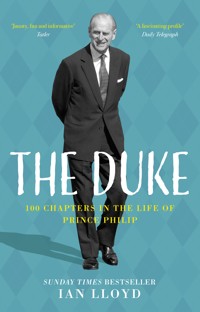
'Witty and well-researched' - Daily Express 'A fascinating profile' - Daily Telegraph For seven decades the Duke of Edinburgh was the Queen's 'strength and stay', far surpassing the predictions of courtiers who had feared 'a foreign interloper out for the goodies'. Journalists continually portrayed him as bluff and gaffe-prone – yet the letters he wrote in private show he had a kind and sensitive side. Drawing on extensive interviews with those who knew him best, The Duke reveals the man in all his endlessly fascinating contradictions. While tracing his characteristic self-reliance back to a difficult childhood and six years' war service, Ian Lloyd highlights some rare aspects of the royal consort's personality – from his fondness for Duke Ellington to his fascination with UFOs. The result is a portrait like no other, and a rich tribute to Prince Philip's extraordinary life and legacy. With an updated final chapter on Prince Philip's funeral, legacy and the future of the monarchy without him.
Sie lesen das E-Book in den Legimi-Apps auf:
Seitenzahl: 448
Veröffentlichungsjahr: 2021
Das E-Book (TTS) können Sie hören im Abo „Legimi Premium” in Legimi-Apps auf:
Ähnliche

















ABOUT THE AUTHOR
Ian Lloyd is a full-time writer and former photographer, specialising in the British royal family. He covered over 500 of the Duke of Edinburgh’s royal engagements and many of his carriage-driving competitions as well as several state visits. Two of his books were Sunday Times bestsellers and his writing has appeared in the Daily Mail, Mail on Sunday, Hello! and Majesty magazine. He is a frequent after-dinner speaker and a regular pundit on Sky News, BBC News and BBC Radio 5 Live. He lives in Oxford.
PRAISE FOR THE DUKE
‘A fascinating account of Prince Philip as seen from every conceivable angle. Ian Lloyd demonstrates that there is much we didn’t know about this much-loved – and at times controversial – royal consort’
Joe Little, Majesty magazine
‘Fascinating’
Victoria Ward, Daily Telegraph
‘Wonderfully lively’
Grazia
‘Jaunty, fun and informative ... a multifaceted account’
Tatler
‘Witty and well-researched’
Alice Scarsi, Daily Express
‘Very readable … The book doesn’t gloss over any criticism of its subject, but reminds us that Philip has lived an extraordinary life that, in many ways, has been far from easy’
Roland White, Daily Mail
DEDICATION
To Debbie Clayden,the truest of friends.
First published 2021
Reprinted 2021
This paperback edition first published 2021
The History Press
97 St George’s Place, Cheltenham,
Gloucestershire, GL50 3QB
www.thehistorypress.co.uk
© Ian Lloyd, 2021
The right of Ian Lloyd to be identified as the Author of this work has been asserted in accordance with the Copyright, Designs and Patents Act 1988.
All rights reserved. No part of this book may be reprinted or reproduced or utilised in any form or by any electronic, mechanical or other means, now known or hereafter invented, including photocopying and recording, or in any information storage or retrieval system, without the permission in writing from the Publishers.
British Library Cataloguing in Publication Data.
A catalogue record for this book is available from the British Library.
ISBN 978 0 7509 9699 0
Typesetting and origination by The History Press
Printed and bound in Turkey by Imak
eBook converted by Geethik Technologies
CONTENTS
Foreword
1 Born with Two Birthdays
2 ‘My Place of Rest’
3 Keeping It in the Family: How Prince Philip and the Queen Are Related
4 A Slice of Battenberg
5 Phil the Greek
6 Paris and a Bohemian Aunt
7 Baby Steps in Britain
8 Family Tragedy No. 1: Philip’s Mother is Forcibly Removed
9 First Meeting
10 Quips, Gaffes and Banter: The Duke’s Memorable Clangers 1–10
11 No Fixed Abode
12 Not a Hard Act to Follow: Philip and the Stage
13 Family Tragedy No. 2: The Death of a Beloved Sister
14 The Nazi Link
15 Girls, Girls, Girls
16 First Love
17 A Practical Joker
18 Breaking and Entering
19 It’s Not for Me, It’s for a Friend
20 Quips, Gaffes and Banter: The Duke’s Memorable Clangers 11–20
21 Two Degrees of Separation: Philip and the Duke of Wellington
22 For Queen and Country: The Duke’s Medals
23 Naval Hero
24 1945: The Final Surrender
25 The Moment They Clicked
26 Pathway to Love
27 The Mystery of Their Engagement
28 Philip Flunks an Exam
29 An Unwelcome Welcome
30 Quips, Gaffes and Banter: The Duke’s Memorable Clangers 21–30
31 Philip the Jewellery Designer
32 An End to His Vices
33 Phil the Dish
34 Pre-Wedding Jitters?
35 Philip’s Austerity Wedding
36 Wedding Presents
37 Honeymoon Hysteria
38 Philip and a Royal Mistress
39 A Working Royal
40 Quips, Gaffes and Banter: The Duke’s Memorable Clangers 31–40
41 Philip and Charles: Good Cop or Bad Cop?
42 Ol’ Blue Eyes
43 Two Dukes and the King of Jazz
44 The Thursday Club
45 First Home
46 Princess Anne: The Son He Never Had
47 ‘The Whole World Had Dropped on His Shoulders’
48 ‘That Damned Fool Edinburgh’
49 And to Crown It All …
50 Quips, Gaffes and Banter: The Duke’s Memorable Clangers 41–50
51 Don’t Call Me Albert!
52 Mother-in-Law Trouble
53 What Have You Come As?
54 Edinburgh Green
55 The Rumours
56 Tours de Force
57 The Day the Queen Sported a Beard
58 When is a Prince Not a Prince?
59 Special Brew
60 Quips, Gaffes and Banter: The Duke’s Memorable Clangers 51–60
61 The Dukebox
62 The Queen Raises Philip’s Six-Bar Limit
63 The D of E Awards
64 Sartorial Star
65 Royal Variety: Not Always the Spice of Life
66 Man of Faith
67 On the Police Database
68 A Very Mixed Media
69 Dodgy Palace Lifts
70 Quips, Gaffes and Banter: The Duke’s Memorable Clangers 61–70
71 Poesy Prince
72 … Talking of Poetry
73 Man Belonging Mrs Queen
74 Feature Film Philip
75 The Prince and the Profumo Scandal
76 1969: The Year the Queen Banned Christmas
77 Crash, Bang, Wallop: The Duke Behind the Wheel
78 A Fatherly Bond with JFK Jnr
79 Take the ****ing Picture: The Potty-Mouthed Prince
80 Quips, Gaffes and Banter: The Duke’s Memorable Clangers 71–80
81 Royal Winker
82 Turning the Queen Decimal
83 A Sensitive Touch
84 Diana: A Complicated Daughter-in-Law
85 Frozen-Out Fergie
86 Biblio-Phil
87 North of Watford Gap
88 Prince Philip: The Godfather
89 Philip the Good Father
90 Quips, Gaffes and Banter: The Duke’s Memorable Clangers 81–90
91 Charity Case
92 The Death of Diana
93 Is There Anyone There? Part 1
94 Is There Anyone There? Part 2
95 Cartoon Character
96 Cry Freedom
97 Fun Phil Facts
98 My Husband and I
99 Quips, Gaffes and Banter: The Duke’s Memorable Clangers 91–100
100 The End of an Era
Notes
Bibliography
FOREWORD
The present reign has, to all intents and purposes, been a joint one. For sixty-five years, from the accession in 1952 to the Prince’s retirement in 2017, many events in the royal year, from the State Opening of Parliament to the opening of a factory in Birmingham, were ‘in the presence of HM the Queen and HRH the Duke of Edinburgh’.
Elizabeth II is the most travelled monarch in British history, having made some 266 overseas visits to 116 countries. It has been calculated that she has travelled 1,032,513 miles – the equivalent of lapping the globe forty-two times. Equally amazing is that for every one of those million-plus miles, the Duke of Edinburgh has been by her side (or, more often than not, three steps behind). In addition to all those joint tours, the Duke carried out 637 overseas tours on his own as well as 22,219 solo engagements between the Queen’s accession in 1952 and his retirement in 2017. Their marriage of seventy-three years, ending with the death of Prince Philip in April 2021, was the longest royal one in British history.
The aim of this book is to present an overview of the Duke’s life in 100 chapters. It is by no means a complete biography of Prince Philip but will try to highlight certain themes or topics that may be unfamiliar to many readers.
His has been a fascinating life, dominated by two family tragedies. The first was his mother’s manic depression which led in 1930 to her incarceration in the first of two sanatoria and, crucially, a seven-year separation from her only son. That same year, his father left for the South of France with his mistress and, between December 1930 and August 1931, his four sisters married. Nine-year-old Philip was effectively orphaned and, since the family home in Paris was closed down, more or less homeless, forcing him to spend his school holidays with friends and relatives. His unstable teen years probably accounted for his prickly character and defensive comments. Contemporaries recall he never felt sorry for himself, though he once revealed to a courtier: ‘I used to wonder who I was.’
The second family tragedy came just over four years after his wedding to Princess Elizabeth with the death of her father King George VI at the age of only 56. Had the King died at, say, 80 years of age, then Elizabeth II would have succeeded just short of her fiftieth birthday and Philip would have been 54, and would almost certainly have enjoyed another two decades of naval service.
There was another problem. According to her friends, American-born Meghan Markle felt ‘totally unwelcome’ in the Royal Family, but her story pales into insignificance against Philip’s. At the time of his engagement, a newspaper poll found 40 per cent of readers objected to Elizabeth marrying someone ‘foreign’, despite the fact he had spent the whole of the Second World War serving in the Royal Navy. Senior members of the Royal Household disliked and distrusted him, whilst, continuing the ‘foreign’ theme, the King’s friends dubbed him ‘Charley Kraut’. Even in his later years, he was satirised by the press and public as ‘Phil the Greek’.
He was even an outsider constitutionally. As a male consort his role was less defined than that of a female consort, as he explained to one of his biographers: ‘If you have a King and Queen, there are certain things people automatically go to the Queen about. But if the Queen is also the Queen they go to her about everything.’ In the end he tried to carve out his own role, supporting some 800 organisations. These included the Duke of Edinburgh’s Award, founded in 1956 as a series of self-improving exercises for adolescents and young adults involving a wide range of activities. An ongoing success story, in the UK to date over 3 million awards have been achieved. The scheme has expanded to 144 nations over its six-decade history.
While the D of E Award is part of his legacy, so is his reputation as a ladies’ man and his propensity to make gaffes. Much to his annoyance, the former haunted him right through his life, and reports and reports of his alleged flings were often based on the flimsiest of evidence. His quips and gaffes have always been a constant delight to the press. As 97 per cent of royal engagements are boringly routine, the few that fail to go to plan are relished by the media. During the state visit to the Czech Republic in 1996, the Queen and Duke followed separate itineraries for one day. Two coaches waited to take journalists and photographers on the two away days. I climbed aboard the one for the Duke and was surprised to find half of Fleet Street following me. The reason soon became apparent, as one royal tour veteran claimed: ‘Well, he’s bound to stick his foot in it.’ In print his comments veer towards the downright offensive. One I was told hasn’t ever made it in on to the list as it is so jaw-droppingly awful it’s hard to believe. The majority are actually very funny, said with a twinkle in the royal eye and, more importantly, well received by those he’s talking to.
In writing this book I have drawn on my past interviews with the Duke’s cousins, Lady Pamela Hicks and the late Countess Mountbatten, as well as several interviews with the Queen’s cousin, the late Hon. Margaret Rhodes, and a former assistant private secretary, Sir Edward Ford. I am also thankful to David Gorringe and the late Peter Bartlett for sharing their memories of filming the Royal Family documentary, and a former charity executive for recounting, off the record, his many anecdotes about the Duke at the Royal Variety Performance.
The book could not have been written without the invaluable help of the published sources written by biographers who had access to the Duke and his circle. Philip Eade’s Young Prince Philip: His Turbulent Early Life is a superbly researched account of the first three decades of the Duke’s life. Gyles Brandreth’s Philip and Elizabeth: Portrait of a Marriage is a witty overview of the royal couple’s life together and benefits from access to many ‘new’ sources including the Duke’s alleged amoureuses. Basil Boothroyd was the first to interview the Prince about his life in detail for his Prince Philip: An Informal Biography.
Over the years, I have also seen the Duke in action during more than 500 public and private engagements and several state visits abroad.
I would like to record my thanks to Joe Little, managing editor of Majesty magazine, for reading the manuscript and offering advice, to portrait painter Richard Stone for recalling his sittings with the Duke and to graphologist Tracey Trussell for analysing the Duke’s handwriting for me. Finally I am indebted to Simon Wright, commissioning editor of The History Press, for agreeing to publish the book and for coping with the author’s tardiness during this oddest of years.
Ian Lloyd
Oxford
November 2021
1
BORN WITH TWO BIRTHDAYS
The Queen is not the only member of the royal family with two birthdays: Prince Philip had two for an entirely different reason. Elizabeth II enjoys a private celebration on 21 April to mark her actual arrival into the world and an official one in June marked by Trooping the Colour.
At the time of Philip’s birth, Greece was still using the Julian calendar, under which the date was 28 May 1921. When the country adopted the Gregorian calendar two years later, the date was put forward by thirteen days to 10 June – the date it was celebrated on thereafter.
With his father, Prince Andrew, away on active service, it took four months to officially register his son’s birth, which was done on 24 October 1921 – Julian date – and ‘Entry No 449’ tells us that Prince Philippos of Greece, sixth in line to the throne, ‘was born on the day of the twenty-eighth of the month of May in the year 1921 on the day of the week of Friday at 10 o’clock in the morning’.1
2
‘MY PLACE OF REST’
‘Mon Repos’ might sound like a bed and breakfast in Eastbourne, but it’s also the name of a neoclassical villa on the island of Corfu and the birthplace of Prince Philippos of Greece and Denmark. Built in the late 1820s for Sir Frederick Adams, Lord High Commissioner of the Ionian Islands, it was given by Greece to Philip’s grandfather as a summer residence. It was bequeathed to the Prince’s father Prince Andrew and remained with the Greek royal family until its overthrow in 1967.
Philip’s cousin, Queen Alexandra of Yugoslavia (the former Princess Alexandra of Greece), recalled ‘the broad, sunny hall, the wide staircase curling up to the upper floor’. Outside was the all-pervading ‘scent of orange and wisteria’ and the garden was ‘thick with eucalyptus, magnolia, cypress, olives and orange and lemon trees’.1 According to Alexandra, Andrew ‘loved every part of it’ and ‘it was a particular joy and pride to him that his son should be born there’.2
Princess Alice was 36 and in a high state of anxiety when her baby was due and for some reason the local doctor thought it was more expedient for the mother to give birth to her son on the dining room table rather than her bed and carried her downstairs himself.
Afterwards, the recuperating Princess wrote to a relation: ‘He is a splendid, healthy, child thank God. I am very well too. It was an uncomplicated delivery and I am enjoying the fresh air on the terrace.’3
Like many of Queen Victoria’s descendants, Princess Alice was assisted by no-nonsense, salt-of-the-earth, English women. Nanny Miss Roose, ‘Roosie’, had already looked after Philip’s cousin Princess Marina of Greece and her sisters. Now once again she stocked up on English baby foods and ordered infant woollies from London.
Housekeeper Agnes Blower avoided ‘those messy foreign dishes which the Greek cook concocted’ and opted for soundly British ‘rice and tapioca puddings and good wholesome Scots porridge’ for the baby.4 Miss Blower was clearly no fan of the locals and recalled being assisted by ‘a few untrained peasant girls’, ‘and two unwashed footmen who were rough fellows’.
Meanwhile Philip was oblivious to the unclean staff and contented himself playing with nanny’s pin cushion, ‘for hours, sat quietly in his cot, pulling the pins and needles out and pushing them in again’.5 Stabbing a pin cushion for hours sounds a bit alarming for a 6-month-old baby but, looking back, he would no doubt have said his usual mantra: ‘it did me no harm’.
3
KEEPING IT IN THE FAMILY: HOW PRINCE PHILIP AND THE QUEEN ARE RELATED
The Duke was related to the Queen through the ancestry of both his mother and father.
THE MATERNAL LINE
His mother, Princess Alice of Battenberg, was the granddaughter of Queen Victoria’s second daughter, Princess Alice, who married the future Grand Duke Louis of Hesse.
The Queen is descended from Victoria’s eldest son, Edward VII.
In other words, both Philip and Elizabeth are great-great-grandchildren of Victoria and therefore third cousins. Queen Victoria is known as the ‘Grandmother of Europe’ and her living descendants also include Harald V of Norway, Margrethe II of Denmark, Carl XVI Gustaf of Sweden and Felipe VI of Spain.
THE PATERNAL LINE
Philip’s father, Prince Andrew of Greece and Denmark, was the son of King George I of Greece. George was the younger brother of Britain’s Queen Alexandra, consort of Edward VII.
So both Philip and Elizabeth are descendants of George and Alexandra’s father, King Christian IX of Denmark. Since Philip was Christian’s great-grandson and Elizabeth is his great-great-granddaughter, in this line they are second cousins once removed.
Due to the fact that his six children made upwardly mobile marriages in the other courts of Europe, King Christian was dubbed the ‘Father-in-Law of Europe’. Like Victoria, he is an ancestor of Margrethe II, Harald V and Felipe VI, though unlike her he is also ancestor of Philippe of Belgium and Grand Duke Henri of Luxembourg.
4
A SLICE OF BATTENBERG
‘My grandmother was an extraordinary character,’ recalled Prince Philip in a 1968 interview, some eighteen years after the death of the Dowager Marchioness of Milford Haven. ‘Tremendously well informed and with an ability to argue and discuss intelligently any subject you care to mention. She was the nearest thing to a perambulating encyclopaedia that anyone could possibly perceive.’1
His admiration is unsurprising: the two had much in common. ‘Radical in her ideas, insatiably curious, argumentative to the point of perversity’, says the official biographer of her son, Earl Mountbatten.2 It’s a description with a familiar ring – neatly summing up her grandson too.
Louis Mountbatten himself labelled his mother ‘outspoken and open-minded’,3 something his exact contemporary Queen Elizabeth the Queen Mother echoed: ‘She was rather like a man … She was quite dictatorial. I remember she would say: “Now, I am going to tell you this.”’4
Born Princess Victoria of Hesse in 1863 at Windsor Castle, she was the first of Queen Victoria’s grandchildren to be born in Britain, the first to be named after her and the first of many to have been born in her presence. Princess Victoria’s mother was Queen Victoria’s second daughter Princess Alice, who in 1862 married the future Grand Duke Louis IV of Hesse. Their five daughters included ill-fated Alexandra, Empress of Russia, who was murdered by the Bolsheviks in 1918 alongside her husband Tsar Nicholas II and their five children. The Empress Alexandra and another sister, Princess Irene – who married Kaiser Wilhelm II’s brother Henry – were carriers of the haemophilia gene. Their brother Frederick was a haemophiliac and died at the age of 2 following a fall from his mother’s bedroom window. Fortunate for the British royal family, Princess Victoria was not a carrier.5
Victoria married Prince Louis of Battenberg in 1884 at a lavish celebration at the Hessian court in Darmstadt in a ceremony attended by Queen Victoria. Legend has it that the famous Battenberg cake was created for the wedding banquet. Victoria’s granddaughter Lady Pamela Hicks likes to think it was: ‘It is very likely, though what’s the harm if it wasn’t! We were told about it, growing up, and that the four squares represented the four Battenberg brothers.’6
After the death of Princess Alice from diphtheria in 1878, when Victoria was 15, her grandmother acted in loco parentis and was a frequent correspondent with her Hessian granddaughter. She was concerned that the newly married Princess showed ‘a certain coolness and detachment’ (something her grandson would be accused of, particularly in his relations with his eldest son) and thought she failed to convey sufficient love and affection towards her husband.7
Certainly Princess Victoria’s grandchildren found her a rather imposing figure and they were expected to treat her with deference, as Lady Pamela recalls: ‘On meeting her we had to kiss her hand, then kiss her cheek before curtseying to her.’8 Prince Philip kissed her and bowed with similar deference.
Princess Victoria’s apartment at Kensington Palace was one of several bases the teenage Philip used during school holidays and then later when on shore leave from the navy. A Mountbatten family butler, Charles Smith, recalled, ‘The patience of Grandmama was sometimes a little exhausted by his restless enquiring nature. She would always keep a good eye on him, tidying up behind him and ensuring his clothes were in good order, but inevitably she needed breathing space to collect her thoughts.’ That’s where Charles the butler came in useful, and he was deputised to take young Philip to see a series of swashbuckling films, from Treasure Island to Charles Laughton in Mutiny on the Bounty.9
The boy Prince’s film choices show a maritime theme and it’s no surprise that, with war looming, a career in the British Royal Navy – following the path of his grandfather and uncles George and Louis – was inevitable. Princess Victoria surprisingly thought he might have stayed in Greece, which he visited in the late 1930s with his mother, and was ‘where he belongs … War is too serious a matter for boys of foreign countries to have to undergo the risks,’ she wrote to her younger son Louis, adding, ‘and they can only be an encumbrance & of no real use to our country’. Nevertheless, as both Lord Louis and the King of Greece felt Philip would be better serving in the Royal Navy, she acquiesced.10
The Princess lived to see her grandson serve with distinction in the Second World War. She attended his wedding to the granddaughter of her cousin George V and she was godmother to her great-grandson Prince Charles. Philip was serving at sea when his grandmother died peacefully at Kensington Palace on 24 September 1950, though a few weeks earlier he had been able to tell her of the birth of his daughter Princess Anne.
5
PHIL THE GREEK
When he first arrived on the scene as a suitor for Princess Elizabeth, sniffy courtiers dismissed him as ‘a penniless Greek prince’. By royal standards he was certainly impecunious but genetically he was faultless. In fact, his pedigree was far more royal than his future wife’s.
Through the Queen Mother’s ‘commoner’ family tree, Elizabeth II’s great-grandparents include run-of-the-mill land-owning stock – Caroline Burnaby and Frances Smith. Among her eighteenth-century ancestors are John Edwynn, Sheriff of Leicester, George Smith MP and Thomas Bird, a silk manufacturer.
On the other hand Prince Philip’s great-grandparents were all pretty august including one king, two grand dukes and one of Queen Victoria’s daughters. Only his great-grandmother Julia Hauke, a lady-in-waiting at the Hessian court whose marriage to Prince Alexander of Hesse was declared morganatic due to her ‘low’ status, was not of blue blood.
The Duke’s family tree shows a fascinating link with Tsarist Russia. His paternal grandmother Grand Duchess Olga Constantinova of Russia was the granddaughter of Tsar Nicholas I. On his mother’s side Philip was the great-nephew of Tsarina Alexandra Feodorovna (born Princess Alix of Hesse) and her sister the Grand Duchess Elizabeth Feodorovna, who were both massacred with other members of the imperial family following the overthrow of the Romanov monarchy during the Russian Revolution.
In 1994 Philip visited his great-aunt Elizabeth’s convent in Moscow during the Queen’s state visit to Russia. Four years later, he and the Queen attended a commemorative service at Westminster Abbey for the restored West Front which included ten new statues of saints – among them one of Elizabeth, canonised in 1992 by the Moscow Patriarchate.
The following year a blood sample from the Duke of Edinburgh allowed scientists to compare the mitochondrial DNA of bones thought to be those of the murdered imperial family with matrilineal living relatives. They were able to prove beyond doubt that the bones included those of the Tsarina Alexandra and her daughters, and confirmed their fate at the hands of a Bolshevik firing squad in the cellar of the house in Yekaterinburg.1
Although the Prince was fondly nicknamed ‘Phil the Greek’ by cheekier elements of the press for over seventy years, he hadn’t a single drop of Greek blood in his veins. The modern-day Greek royal family was imported from the Danish royal house when Philip’s 17-year-old grandfather Prince William of Denmark was invited to be King of the Hellenes, opting for the regnal name of George I. Thanks to this mid-nineteenth-century job swap, Philip’s DNA was Viking rather Mediterranean and he was part of the very un-Greek-sounding dynasty of Schleswig-Holstein-Sonderburg-Glücksburg. Certainly he always thought of himself as Danish.2
Philip at his great-aunt Grand Duchess Elizabeth’s former convent in Moscow, which at the time was being used as an icon and painting restoration studio, October 1994. (© Ian Lloyd)
Not only did he lack a Greek bloodline, but the Prince could barely speak the language, although he told one interviewer that he ‘could understand a certain amount’. In childhood he and his family spoke English, French and German.3
6
PARIS AND A BOHEMIAN AUNT
From the spring of 1923 until Princess Alice’s mental collapse in 1930, Princess Alice and Prince Andrew and their children divided their time between Paris and London. They were given a lodge on the estate of Philip’s aunt, Princess George of Greece, at St-Cloud, some 6 miles from the centre of the French capital.
Princess George was a fascinating character, famed for her all-consuming interest in psychoanalysis, her friendship with Sigmund Freud and her unconventional lifestyle. Born Marie Bonaparte in 1882, she was the great-granddaughter of Napoleon I’s rebellious younger brother Lucien. She was fabulously rich thanks to her maternal grandfather François Blanc, who made his fortune on real estate development in Monaco, buying 97 per cent of the casinos in Monte Carlo.1
Her wealth made it possible for her to bankroll Philip’s family. This included sending the young Prince and his sisters to private schools in Paris in the belief that this would have been their right had they not been exiled. Paradoxically she sent her own children, Prince Peter and Princess Eugénie, to the local state-run lycée, feeling it was important they should mix with children of all backgrounds.
In 1907 Marie married Philip’s paternal uncle Prince George of Greece. George has a footnote in history for saving the future Tsar Nicholas II of Russia from assassination during a visit to Otsu, Japan, in 1891. The Tsarevich was attacked by a sword-wielding policeman who turned out to be a former samurai with a grudge against Westerners. George managed to knock him to the ground using his cane. George was also passionately in love with his own uncle, Prince Waldemar of Denmark, the youngest brother of Britain’s Queen Alexandra. The Queen of Greece had brought the young George to Copenhagen to serve with the Danish Navy, lodging him with Waldemar, who was ten years his nephew’s senior. ‘From that day, from that moment on, I loved him and I have never had any other friend but him,’ wrote George.2 So passionate was their relationship that whenever the younger Prince had to depart his uncle’s estate at Bernstorff he would weep and Waldemar fall sick.
Unsurprisingly, George and Marie’s own relationship was passionless. The groom never allowed his new wife to kiss him on the lips and after the honeymoon she wrote: ‘You took me that night in a short brutal gesture, as if forcing yourself. You said “I hate it as much as you do. But we must do it if we want children.”’3 Marie would seek passion elsewhere, even to the extent of romancing Uncle Waldemar while her cuckolded husband sat and watched or lay next to them. Tiring of the older man, she then enjoyed a liaison with his eldest son Prince Aage. After accruing a list of willing sexual partners, Marie documented them in her unpublished 1918 memoirs The Men I Have Loved.
Marie enjoyed an equally fulfilling life out of bed. She was a very close friend of Sigmund Freud, who mentored her interest in psychoanalysis and who once memorably asked her, ‘What does a women want?’, presumably feeling if anyone would know, it would be the Princess. After all, she had carried out her own study on frigidity under the pseudonym A.E. Narjani. Her theory was that the closer the clitoris was to the vagina the more chance a woman had of achieving an orgasm. To back up this notion she personally measured that crucial distance in 243 women. Satisfied she had discovered the truth, she had her own clitoris surgically shifted a few inches in the right direction. Unfortunately both this and a subsequent operation failed in their ultimate goal.
So focused was she on the benefits of psychoanalysis that when she was once ‘flashed at’ on the Rue de Boulogne she handed the baffled perpetrator her card and the offer of a free session on her analyst’s couch – a gesture that sent him scuttling away.4
Marie also had an interest in the criminal mind, describing Jack the Ripper as ‘a supermurderer and a superanarchist’.5 In 1934 she published The Life and Works of Edgar Allan Poe: A Psycho-Analytic Interpretation, with a foreword by Sigmund Freud.
The Princess’s writings also give a vivid picture of some of Philip’s relations. She describes his mother as ‘a beautiful blond, Englishwoman with ample flesh, smiles a lot and doesn’t say much as she’s deaf’. The tall gangly Prince Andrew, she thought, ‘looks like a thoroughbred horse’.6 She has also left us a fascinating vignette of Queen Alexandra, whom she found ‘sixty-three years old [in 1907], surprisingly young, enamelled skin. Disturbing when youthfulness covers an old skin. She seems kind and friendly, but also insignificance personified.’7
Marie and George maintained strong links with the British royal family, particularly after Prince Philip joined what George VI referred to as ‘the firm’. They represented King George I of Greece at the 1911 Coronation of George V and Queen Mary and half a century later stood in for King Paul at the 1953 Coronation of the present Queen. They were also present in Westminster Abbey to witness the marriage of their niece Princess Marina of Greece to Prince George, Duke of Kent, in 1934 and again thirteen years later for Philip’s marriage to Princess Elizabeth.
Philip stayed in touch with Marie for the rest of her life and she was present with George when the Greek royal family were reunited at Tatoi Palace for a private visit by Elizabeth and Philip in December 1950, enabling the Princess to meet her husband’s extended family. The Edinburghs enjoyed several private dinners with George and Marie. Less to the latter’s liking were the official palace dinners hosted for the British Princess by King Paul and Queen Frederica. Princess George wrote to a friend: ‘Grand dinner at court for Elizabeth and Philip, decorations, tiaras, horror!’8 Marie, the most unconventional of princesses, remained a maverick to the end.
7
BABY STEPS IN BRITAIN
By the time he was 18 months old, Prince Philip had made two visits to the country he would one day make his home.
In September 1921 Philip’s only surviving grandfather, Princess Alice’s father Louis, Marquess of Milford Haven, died suddenly from heart failure in London. Alice and her baby son arrived too late for the funeral service at Westminster Abbey or the interment at Whippingham Church on the Isle of Wight.
Like Philip, Prince Louis was a foreign national who had a distinguished career in the British Navy. Queen Victoria kept a keen eye on his progress in her armed forces and was unafraid of voicing her ‘belief that the Admiralty are afraid of promoting Officers who are Princes on account of the radical attacks of low papers and scurrilous ones’.1 He spent forty years in the British Navy, rising to the rank of First Sea Lord, but had to resign from the post due to intense anti-German feeling during the First World War. He was also forced to change his name from the Germanic-sounding Battenberg to its anglicised version Mountbatten.
In a touching gesture, Philip carried his grandfather’s ceremonial sword with him at his 1947 wedding to Princess Elizabeth and used it to cut their wedding cake.
The second visit was the following year. After exile from his homeland as a result of the Greco-Turkish War (1919–22), Prince Andrew and his family visited London en route to their eventual home in Paris. They were based at Spencer House, St James’s – the ancestral home of Philip’s future daughter-in-law Diana, Princess of Wales – leased to Princess Christopher of Greece. The Princess was the fabulously rich American heiress Nancy Leeds, who had married Andrew’s brother and was known as Princess Anastasia of Greece and Denmark, during her three-year marriage before she succumbed to cancer in 1923. Nancy/Anastasia kept Spencer House permanently staffed and ready for visits such as Andrew and Alice’s.
While in London the royal couple and their son visited Philip’s great-aunt Queen Alexandra, the widow of Edward VII. Born in 1844 in Denmark, Alexandra had married a future British monarch and spent the majority of her life in Britain – as Philip was to do. Joining the group was Andrew’s widowed mother Queen Olga of Greece, who was married to Alexandra’s younger brother King George I of Greece. This visit took place at Marlborough House, the Dowager Queen’s London residence, on 18 December 1922.2
8
FAMILY TRAGEDY NO. 1: PHILIP’S MOTHER IS FORCIBLY REMOVED
On 2 May 1930, in Darmstadt, Germany, Prince Philip was taken out for the day by his grandmother Princess Victoria. He enjoyed a carefree picnic with plenty of opportunity for the rough and tumble Prince to run off his boisterous energy.
He was a month short of his ninth birthday and would have had no idea the day out was in fact a diversionary tactic. A few miles away at Neue Palais, a group of men in white coats arrived in a car and forcibly detained his mother, giving her a powerful sedative concealed in an orange. When she awoke she was hundreds of miles away at the Bellevue Sanatorium at Kreuzlingen in Switzerland.
In 1928 Princess Alice had converted to the Greek Orthodox faith and had become increasingly religious. She began to suffer religious delusions, thinking she was in a sexual relationship with Jesus Christ and that she even had a signed photo from him. Alice, in the words of her mother, was ‘in quite an abnormal state’, wandering around the house praying and believing she was about to be given a message from Christ to share with the world.1
The family turned to the still largely experimental treatment of psychology and in February 1930 they sent Philip’s mother to a psychiatric clinic, Sanatorium Schloss Tegel run by Dr Ernst Simmel near Berlin. Here Alice was diagnosed as a ‘paranoid schizophrenic’, to use the insensitive pre-war parlance.
A lady-in-waiting revealed to Simmel that Alice had had a passionate, unrequited, crush on an unnamed Englishman for several years. The psychiatrist believed the repression of Alice’s highly emotional feelings accounted for her state of mind.
At this point the clinic was visited by Sigmund Freud, the founding father of psychoanalysis. In March he examined Alice’s case notes and recommended the alarming treatment of X-rays to the ovaries to bring on the menopause. This, he maintained, would cure her excessive libido and improve her mental illness. There is no evidence Alice had any choice but to submit to the procedure or that it worked. Shortly after, she discharged herself from Schloss Tegel and returned to St-Cloud and to Philip.
The Princess’s health must have rapidly declined at home since it was only a matter of weeks later that she was detained in the Bellevue Sanatorium.
Her two nieces were particularly sympathetic to Alice’s plight. ‘I think my aunt would have suffered very much,’ was the verdict of Countess Mountbatten, speaking in 2012. Her sister, Lady Pamela Hicks, agreed: ‘It was difficult to talk to other people about it because they were embarrassed or ashamed … In those days it was something to be kept quiet about.’2
Alice’s suffering is evident in her case notes, which show that on 27 July she climbed through a window at the sanatorium and ran away. She managed to get onboard a train bound for Germany but was apprehended and returned.
At the end of September it was decided that Alice was well enough to leave. At this point she found out she had been detained on the orders of Princess Victoria. She never entirely forgave her mother. Since Prince Andrew had already left for the South of France with a mistress, and the household in St-Cloud had been disbanded, Alice made the decision to adopt a nomadic existence, staying in modest hotels or boarding houses in different parts of Germany. It would be another five years before she was reunited with Philip.
Prince Philip appears delighted to be reunited with his mother at the marriage of her granddaughter Princess Margarita of Baden to Prince Tomislav of Yugoslavia, at Salem Castle, Germany, in June 1957. (Keystone-France / Getty)
Oddly, it was another family tragedy, the death of her daughter Cécile in an air crash in 1937 with her husband and three of her children, that once more propelled Alice back into Philip’s life. The shock somehow made her feel needed by her family. She would remain close to her only son and died in apartments the Queen provided for her in Buckingham Palace in December 1969.
9
FIRST MEETING
They don’t remember it, but the first time Elizabeth and Philip saw each other was at the wedding of the Princess’s uncle George, Duke of Kent, to Philip’s first cousin Princess Marina of Greece, on 29 November 1934.
Eight-year-old Elizabeth was one of the two bridesmaids, charged with looking after Marina’s frothy white veil. Philip was sitting in the second row of assembled royal guests just below the five steps up to the high altar. Photos show the tiny bridesmaid intent on her job and, just to her left, the back of Philip in his Eton suit.
‘One of the most interesting guests’, noted one journalist, ‘was a fourteen year old [sic – he was 13] flaxen-haired schoolboy Prince who had made the long journey of over five hundred miles from Elgin alone.’1 Poignantly, when he revealed to his school mates that he didn’t have collar studs or cufflinks, they had a whip-round to get him some.2 He might have been the only prince at Gordonstoun but he remained an impoverished one.
While Europe’s royal families had arrived by train and sea in a variety of groups, Philip as usual had to cope by himself. He left school at Gordonstoun two days before the wedding, travelling in a sleeping berth reserved for him under the name of Mr Phillips on the afternoon mail train. He returned four days later.
10
QUIPS, GAFFES AND BANTER: THE DUKE’S MEMORABLE CLANGERS 1–10
UPSETTING THE WORLD
01China: To British students during the 1986 state visit, ‘If you stay here much longer, you’ll all be slitty-eyed.’
02Paraguay: To Alfredo Stroessner, the Paraguayan dictator, ‘It’s a pleasant change to be in a country that isn’t ruled by its people.’
03Germany: In 1997, he welcomed German Chancellor Helmut Kohl at a trade fair as ‘Reichskanzler’; the last German leader who used this title was Adolf Hitler.
04Hungary: To a Briton in Budapest, in 1993, ‘You can’t have been here that long – you haven’t got a pot belly.’
05Cayman Islands: To a wealthy islander in 1994, ‘Aren’t most of you descended from pirates?’
06Thailand: In Thailand, in 1991, after accepting a conservation award, ‘Your country is one of the most notorious centres of trading in endangered species in the world.’
07Another Oriental slur: Addressing the World Wildlife Fund on the topic of endangered species in 1986, ‘If it has got four legs and is not a chair, if it has got two wings and it flies but is not an aeroplane, and if it swims and is not a submarine, the Cantonese will eat it.’
08Germany: Asked what he thought of the new £18 million British Embassy in Berlin in 2000, ‘It’s a vast waste of space.’
09Ethiopia: On being shown some local art during the 1965 state visit by the Queen, ‘It looks like the kind of thing my daughter would bring back from school art lessons.’
10USA: Visiting President and Mrs Reagan in California in 1983, Philip was bothered by over-zealous secret servicemen. ‘Are you expecting any trouble?’ he asked one, and, after being told they weren’t, he snapped, ‘Then back off!’
The South Seas? Actually, it’s Morecambe in 1999, and Philip makes a characteristic quip to exotically dressed band members on the seafront. (© Ian Lloyd)
11
NO FIXED ABODE
From 1930, when he was aged 9, to the summer of 1949, when he was 28, Prince Philip had no permanent family home, with the exception of a weekend retreat given to Elizabeth and her new husband in early 1948. Quite what this lack of a fixed base did to Philip’s personality as he grew up is anyone’s guess. ‘The effect of not having a home is imponderable,’ his lifelong friend Lady Myra Butter once reflected. ‘You didn’t go into those things then, but now people like Philip would be counselled all the time.’1 The Prince himself decided at an early age to drop an iron curtain around the sensitive topic, merely stating: ‘I just had to get on with it. You do. One does.’2
For the next decade and a half, when he wasn’t either at school or in the navy, Philip was shunted from pillar to post, staying with a variety of relatives and friends in Britain and Germany.
The British contingent was led by his formidable grandmother Princess Victoria, Dowager Marchioness of Milford Haven. She tended to be the one who organised where Philip would spend his holidays and he always kept a couple of trunks of clothes at her Kensington Palace apartment, ready to take with him. He would often touch base with her in London before heading for another location. A typical grandmotherly instruction from 1935 began: ‘You might spend the few days after leaving Gordonstoun & starting for abroad with me at Kens. Pal.,’ asking him to let her know when he would be arriving.3
Shorter school holidays were often spent at Lynden Manor, home of Philip’s uncle George, Marquess of Milford Haven, and his wife Nadeja (‘Nada’) at Holyport, near Windsor. Uncle George was Philip’s guardian in Britain, though not a particularly hands-on one since, during the Prince’s five years at Gordonstoun, he never visited his charge there. Following the Marquess’s death from cancer in April 1938, his younger brother Lord Louis Mountbatten (known to his friends and family as ‘Dickie’) stepped in loco parentis and Philip stayed with him and his wife Edwina at their Brook Street apartment in London or Adsdean, their country estate near Chichester. During the war, Philip often crashed at the Mountbatten’s small house at 16 Chester Street.
Other UK-based holiday destinations included Coppins, the country home of his cousin Princess Marina and her husband the Duke of Kent at Iver, Buckinghamshire. There was also the estate of Nada Milford Haven’s sister Zia and her husband Sir Harold Wernher at Market Harborough. The couple again took on a near-parental role for Philip, and he remained a lifelong friend of their two daughters Gina and Myra. Gina Wernher, later Lady Kennard, remembered, ‘it was never ever “poor me!”’ from Philip, though he did once say: ‘Where is home? Except for all of you, I don’t have a home to come back to.’4
Philip also holidayed in Germany with his four sisters, their German husbands and a growing brood of children. Aged 12, he spent several months at school there during the winter of 1933–34. He appears to have taken this peripatetic lifestyle for granted at the time, but over the years occasionally dropped his protective carapace to show how his nomadic youth had affected him. ‘Looking back at my childhood,’ he revealed to a close female friend, ‘it really is amazing that I was left to cross a continent – taxis, trains, boats – to get to my sisters’ homes in Germany. There was no one to pick me up.’ The friend thought he sounded like an orphan.5
His cousin, Princess Alexandra of Greece, holidayed with Philip, then aged 17, in Venice in 1938 and remembered how grateful he was to be included in the family party. ‘Philip gave the impression at the time’, she wrote in 1960, ‘of a huge, hungry dog; perhaps a friendly collie who had never had a basket of his own and responded to every overture with eager tail-wagging.’ Like Gina Kennard, she noted there was never any self-pity: ‘Though never sorry for himself, to be fed and looked after meant such a lot to him.’6
Two entries in separate visitors’ books, both in 1946, show that sixteen years after the family home broke up, Philip hadn’t come to terms with his rootless existence, even if he might have meant the comments in his usual jokey fashion. ‘Whither the storm carried me, I go – a willing guest,’ he wrote at one home in June, and, staying with his cousin, Patricia Knatchbull, elder daughter of Lord Mountbatten, a few days before Christmas, he put ‘no fixed abode!’7
Decades later, in another uncharacteristically revealing comment, Philip told a courtier, ‘I used to wonder who I was.’ Around this time the American writer Rabbi Arthur Herzog, who had known Philip well, reflected on the damage the Prince’s rootless existence as a youth had had on his character. ‘He does not know who he is,’ he said at the time of the Duke’s eightieth birthday. ‘He has lost his real identity. He once told me he thinks of himself as a cosmopolitan European.’8
Marriage to Princess Elizabeth, and their four children together, not only gave Philip a family but a sense of belonging. ‘I think he’d always thought how marvellous it would be to have a home and family,’ said Gina Kennard, adding, ‘and he knew there would be a home of real security with the Queen.’9
His cousin David Milford Haven summed it up in that winter of 1947: ‘at long, long last … he’s got a settled home.’10
12
NOT A HARD ACT TO FOLLOW: PHILIP AND THE STAGE
While the Queen, Margaret, Charles and Edward all trod the boards on several occasions in amateur productions, Philip only managed three very forgettable performances.
On 17 December 1935 the front page of the Dundee Evening Telegraph tells us that Gordonstoun School is to put on a performance of the Oberufer Nativity Play the following day and ‘Prince Philip of Greece will have one of the leading roles’. It was a far cry from the royal nativity at Windsor in 1940 when Princess Elizabeth played one of the three kings and her sister Margaret made their father cry his eyes out by singing ‘Gentle Jesus’. Instead, this was a traditional German version that used three plays to focus on the expulsion of Adam and Eve from the Garden of Eden, the proclamation of the birth of Jesus to the shepherds and the visit of the magi to see the Christ child. Thanks to the Gordonstoun ethos of supporting the local community, the nativity was put on in nearby Hopeman to raise money for the school’s newly opened coastguard service. It’s unclear which of ‘the leading roles’ Philip was assigned in the all-boy school of less than fifty pupils, but it’s a safe bet it wasn’t Mary.1
The previous summer Gordonstoun had put on its first production, an aptly chosen rendition of Shakespeare’s ‘Scottish play’. Fourteen-year-old Philip was chosen for the minor role of Donalbain, younger son of the about-to-be-murdered King Duncan, and would no doubt have been aware that the site of the ‘blasted heath’ where Macbeth meets the three witches was 20 miles west of the school, on a low hill near Brodie Castle.
Fourteen-year-old Philip prepares to make his acting debut as Donalbain in the Gordonstoun School production of Macbeth, July 1935. (Fox Photos / Stringer / Getty)
A crowd of 300 was said to have enjoyed the outdoor production characterised by ‘vigour and youthful enthusiasm’ and ‘particular interest attached’ itself to Philip’s performance, which was limited to three silent appearances in Act One and ten lines in Act Two.2 The following July he had the tiniest of stage appearances as an unspeaking sentry in Hamlet.
Exactly thirty years later Philip returned to watch another version of Macbeth, starring Prince Charles, who was widely praised in the eponymous role. It’s a shame the Duke wasn’t as good at acting the part of a proud father, since at the point when Macbeth/Charles was thrashing about in emotional turmoil while lying on a fur rug, all he was aware of was the sound of his father’s laughter. ‘I went up to him afterwards and said: “Why did you laugh?” and he said “It sounds like The Goons.”’3
Official theatre visits have been a staple of the royal engagement list throughout the Queen’s reign. For instance, in March 1984 the Queen and Duke attended a charity gala performance of Andrew Lloyd Webber’s Starlight Express. Five years later they attended Aspects of Love, where as well as the musical they could observe Prince Edward, one of the production assistants working for Lloyd Webber’s Really Useful Theatre Company. Spotting her youngest son standing behind a posse of photographers in the foyer, the Queen said, ‘Hello!’ and feigned a look of surprise.
One of the oddest theatrical outings of the reign was for the official opening of the Globe Theatre in Southwark in June 1997, modelled on the Tudor original. The Queen and Duke made the journey in suitably Elizabethan fashion, embarking on a barge at Lambeth and arriving at Emerson Street Stairs accompanied by the Queen’s Bargemaster and Watermen. The couple were amused during the performance of ‘Triumphes and Mirth’ when Tudor costermongers among the groundlings pelted the stage with currants.
Off-duty, during their long marriage the Queen and Duke were occasional theatre-goers, preferring to remain as inconspicuous as possible, though inevitably word spread through the cast, audience and passers-by. As the curtain fell it might as well have been yet another royal gala with applause from the stalls and, latterly, a blitz of smartphone flashes.
Until the mid 1980s they paid an annual visit to the local Theatre Royal in Windsor with their house party during Royal Ascot week.
In London they tended to arrive by taxi – their own, a liquid petroleum gas-powered Metrocab bought by Philip in 1999 in which to whizz round the capital. They used it in 2006 when they went to see Billy Elliot the Musical at the Victoria Palace Theatre for an eightieth birthday treat for the Queen. Six years later, in Diamond Jubilee year, they went in it to see One Man, Two Guvnors, at the Theatre Royal, Haymarket, with grandson Peter Phillips and his wife Autumn.
An undeniable treat for the equine-loving pair was their night out at War Horse, when an onlooker noted they were ‘incredibly apologetic for asking people to let them pass’ as they took their seats in the stalls.
13
FAMILY TRAGEDY NO. 2: THE DEATH OF A BELOVED SISTER
Early evening on Tuesday 16 November 1937, and as darkness enveloped the grey seventeenth-century edifice of Gordonstoun School, headmaster Kurt Hahn summoned Prince Philip of Greece to his study to tell him the traumatic news that his sister Cécile, his brother-in-law Georg Donatus, known as ‘Don’, and their two sons had been killed in an air crash.
Born in 1911, Cécile was ten years older than Philip and according to their grandmother stood out from her sisters as ‘the prettiest of the lot’. Philip had attended her wedding in February 1931 to Georg Donatus, son of Ernest Louis, Grand Duke of Hesse, one of Queen Victoria’s many grandsons. In May 1937 Philip and Cécile were reunited in London during the Coronation festivities of George VI in London. That same spring Cécile and Don took Philip to visit Princess Alice over lunch in Bonn – the first time mother and son had met since 1932.




