


0,49 €
Mehr erfahren.
- Herausgeber: Quickie Classics
- Kategorie: Gesellschafts- und Liebesromane
- Sprache: Englisch
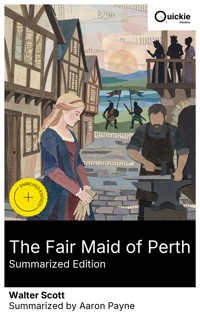
Set in late fourteenth-century Perth under the waning reign of Robert III, The Fair Maid of Perth braids civic ritual, clan rivalry, and intimate romance. Scott evokes burgh guild life around Simon Glover and his steadfast daughter Catherine, while the fiery armourer Henry Gow and the conflicted Highland youth Conachar are drawn toward the combat on the North Inch. With archival scruple and dramatic drive, he opposes Lowland law to Highland honor, threads in royal intrigue—Albany, Rothesay, Douglas—and introduces a nascent reforming conscience in Father Clement. Prose moves from brisk vernacular to stately chronicle, laced with Scots idiom, marking a mature Waverley romance. Scott, architect of the historical novel, wrote late in life amid financial crisis that sharpened rather than dimmed his antiquarian zeal. Mining medieval chronicles and local tradition, the advocate-sheriff and border ballad collector studies the institutions of a royal burgh as closely as battles, filtering national memory through humane skepticism. Unabridged, the novel rewards readers who relish dense period texture, morally tested characters, and political nuance. Students of medieval Scotland and admirers of Ivanhoe will find Perth's streets and the North Inch both instructive and exhilarating. Quickie Classics summarizes timeless works with precision, preserving the author's voice and keeping the prose clear, fast, and readable—distilled, never diluted. Enriched Edition extras: Introduction · Synopsis · Historical Context · Author Biography · Brief Analysis · 4 Reflection Q&As · Editorial Footnotes.
Das E-Book können Sie in Legimi-Apps oder einer beliebigen App lesen, die das folgende Format unterstützen:
Veröffentlichungsjahr: 2026
Ähnliche






The Fair Maid of Perth (Summarized Edition)
Table of Contents
Introduction
Set against the clang of forges, the whisper of courts, and the drumbeat of clan vendettas, The Fair Maid of Perth turns on the perilous crossing of private love and public power, where a craftsman’s honor, a young woman’s conscience, and a kingdom’s fragile laws collide in a city that tests whether courage can restrain violence, whether justice can resist spectacle, and whether integrity can endure when romance is entangled with rivalry, ambition, and the ancient, stubborn energies of a nation struggling to choose between negotiated order and the glittering, ruinous temptations of might.
Sir Walter Scott’s The Fair Maid of Perth is a historical novel set in late fourteenth‑century Scotland, chiefly in the royal burgh of Perth and its Highland environs. First published in 1828, it belongs to the mature phase of Scott’s career, when he refined his blend of romance, antiquarian detail, and political insight. The narrative draws on chronicled events from the turbulent reign of Robert III, evoking civic life, courtly maneuvering, and the tensions between Lowland towns and Highland clans. Readers encounter a carefully staged past that illuminates the pressures of authority, faith, and custom without sacrificing momentum or dramatic color.
At its outset, the novel introduces a master smith of uncommon skill, a principled young glove‑maker celebrated for her beauty, and a Highland youth whose loyalties are divided, all drawn into a web of court attention and civic rivalry as festivities give way to unrest. Around them move powerful nobles and a vulnerable monarchy, their designs altering the fates of artisans and clansmen alike. Scott’s voice is magisterial yet playful, alternating bustling street scenes with intimate moral debate. The style is richly descriptive, with occasional archaisms, and the tone balances romance, satire, and mounting danger, rewarding attentive reading with layered texture.
Without revealing turns of plot, it is fair to note the book’s persistent scrutiny of how love and loyalty operate under pressure from faction, spectacle, and fear. The craftsman’s code and the burgh’s ordinances strain against aristocratic privilege; private vows must contend with public rumor, while religious feeling intersects with superstition and civic ritual. The novel also weighs the appeal of chivalric display against the claims of law, using preparations for a formal combat to question what kind of peace a divided society can afford. Scott’s compassion extends to conflicting parties, allowing moral complexity to emerge without simple verdicts.
Scott’s reconstruction of late medieval Perth is immersive: workshops ring with labor, markets bustle with guild pride, church bells punctuate the day, and the Tay’s banks offer both refuge and peril. He modulates from panoramic civic tableaux to swift, close‑quarters encounters, sustaining narrative tension without losing the sense of lived-in place. The narrator’s learned asides and dry humor temper the darker currents, while dialogue shaped by regional cadence adds texture without barring comprehension. Readers encounter not a museum diorama but a breathing society, where policy is hammered out in council chambers and in doorways, at altars and at anvils.
For contemporary readers, the novel’s questions feel urgent: how urban communities absorb or repel external violence, how rumor and pageantry distort justice, and how ordinary work can ground ethical life in times of chaos. Its portrait of competing identities—clan, crown, church, and town—mirrors ongoing debates about belonging and authority. The dignity afforded to skilled labor counters narratives that privilege only aristocratic action, while the heroine’s moral stamina invites reflection on conscience amid coercion. Scott shows that historical memory is not nostalgia but an argument about the future, making the book a timely meditation on forces that still shape public life.
Approaching this unabridged text, readers will benefit from patience with its period idiom and delight in its careful architecture, allowing scenes to accumulate meaning as they echo across civic squares, workshops, and corridors of power. Attend to how small objects—a glove, a hammer, a token of favor—carry ethical weight; notice how festivity shades into crisis; listen for the quiet negotiations that offset ostentatious challenge. The reward is a story at once humane and bracing, where affection meets statecraft and courage meets restraint, an enduring example of historical fiction that animates the past in order to test the present.
Synopsis
The Fair Maid of Perth (also known as St. Valentine’s Day) is a historical novel by Walter Scott, first published in 1828. Set in late fourteenth-century Scotland, chiefly in the burgh of Perth, it weaves civic life, court intrigue, and Highland–Lowland tensions into a single narrative. The story centers on Catherine Glover, renowned for beauty and piety; her father, the craftsman Simon Glover; the redoubtable smith Henry Gow; and the Highland youth Conachar. Against the backdrop of King Robert III’s troubled reign, Scott explores the competing claims of royal authority, municipal order, and clan allegiance, while tracing personal loyalties tested by ambition, desire, and fear.
The novel opens amid Perth’s winter festivities around St. Valentine’s Day, when guild pride and youthful revelry strain the city’s fragile peace. Catherine’s modest conduct contrasts with the exuberant mood, and her suitors’ attentions sharpen latent rivalries. Henry Gow, a master smith famed for courage and skill, guards her honor with a craftsman’s directness. Conachar, fostered in the Glover household, is marked by pride and unease that hint at deeper obligations beyond the burgh. As festivity tilts toward disorder, Scott establishes the book’s central tensions: between restraint and impulse, burgher stability and aristocratic license, and private affection and the demands of public reputation.
Royal influence intrudes through Prince David, Duke of Rothesay, whose impulsive pleasures collide with the city’s norms. At his elbow stands Sir John Ramorny, a worldly and vindictive courtier. Their circle’s notice of Catherine brings a dangerous mixture of gallantry and coercion into the Glovers’ world. Scott sets the steady integrity of skilled labor—embodied by Henry—against the volatile caprice of courtiers who confuse power with right. Catherine’s scruples and Simon’s protective caution expose the frailty of civic safeguards when confronted by noble privilege. Scenes of street tumult and hurried negotiations show how quickly a proud burgh can be unsettled by a prince’s whim.
A midnight crime then crystallizes the city’s alarm. Oliver Proudfute, a bonnet-maker and braggart, is found slain, apparently mistaken for Henry because of borrowed apparel. Perth’s magistrates convene inquiries as the guilds clamor for justice, and suspicion falls upon retainers linked to Ramorny’s faction. Scott uses the investigation to examine urban procedure, the limits of legal remedy, and the seductive pull of private vengeance. Henry pursues evidence with blunt resolve, while Catherine recoils from fresh violence and prays for a righteous outcome that avoids further bloodshed. Conachar’s furtive movements and changing temper suggest divided loyalties he cannot openly acknowledge.
The novel’s horizon widens to the Highlands, where ancestral feuds smolder. Scott presents the protracted enmity between Clan Chattan and Clan Quhele as both a cultural inheritance and a political problem for the Crown. Conachar’s connection to the Highland world becomes increasingly evident, and his inward battle—between fear and pride, duty and affection—complicates his hopes for Catherine. Henry’s plain honor, rooted in craft and community, contrasts with chivalric display and the stern codes of clan justice. The city’s tensions now mirror a larger national dilemma: how to reconcile competing legalities—burgh, court, and clan—without plunging into open war.
At court, weak kingship and strong factions shape events. Robert III’s gentle nature struggles to restrain turbulence; his brother, the calculating Duke of Albany, regards disorder as an instrument of policy. Great magnates, including the Douglas interest, weigh advantage. To avert broader conflict, the Crown sponsors a formal combat on Perth’s North Inch, where selected champions will decide the feud in ritualized battle. Henry—better known as Hal of the Wynd—is drawn in to complete the number on one side, becoming a rare burgh champion amid Highland partisans. Catherine watches the escalation with growing dread, sensing that sanctioned spectacle may still exact a terrible price.
Preparations for the combat reveal the moral architecture of Scott’s tale. Oaths are taken, arms are blessed, and the royal presence lends an air of solemn legality to an ordeal that remains, at heart, a test of sinew and nerve. Conachar’s internal pressures mount as kinship claims contend with personal longing. Henry girds himself with a craftsman’s economy of purpose, mindful of the difference between defense and bloodlust. Simon Glover navigates competing duties to daughter, guild, and city. Clergy urge conscience and restraint, even as civic officials build stands and set rules, and Perth braces for a day meant to trade general carnage for measured trial.
The staged battle at the North Inch unfolds with pageantry and rigor, exposing character through action—steadfastness, panic, cunning, and grace under mortal threat. Scott’s description of regulated violence underscores how thin the boundary is between law and chaos. The encounter’s result reshapes standings in Perth and echoes through the court, prompting official reviews and private reckonings. The Prince and Albany adjust their calculations; Ramorny’s intrigues encounter resistance; the burgh measures its losses and lessons. Catherine, confronted by gratitude owed and fears sustained, must gauge what fidelity, prudence, and spiritual conviction require as reputations rise or fall around her.
Without depending on revelations, the novel’s lasting power lies in Scott’s blend of documentary vigor and romantic sympathy. He illuminates the machinery of medieval Scotland—guilds, magistracies, noble patronage, and clan custom—while asking how individuals keep faith amid systems prone to abuse. Catherine’s steadiness serves as a moral touchstone; Henry’s square dealing champions civic virtue; Conachar’s turmoil embodies the costs of honor. By translating a notorious feud and a celebrated Perth combat into human terms, Scott offers an enduring meditation on justice pursued by force, the responsibilities of power, and the fragile, necessary work of conscience in public life.
Historical Context
Set during the closing decade of the fourteenth century, The Fair Maid of Perth unfolds in and around Perth (then commonly called St. Johnston), a royal burgh on the River Tay. Scotland was ruled by Robert III (reigned 1390-1406), whose court and council relied heavily on powerful magnates. Urban life was regulated by burgh law, guild statutes, and watch-and-ward ordinances, while ecclesiastical institutions, including the Dominican (Blackfriars) house at Perth, shaped religious observance and education. The sheriff and the justiciar exercised royal justice, but authority on the ground often depended on local lords. This institutional framework forms the civic and political setting of the tale.
Robert III's authority was widely perceived as weak, and effective power frequently lay with his brother, Robert Stewart, Duke of Albany. The period was marked by baronial rivalries, contested regencies, and a fragile balance between crown and magnates. Tensions were especially acute along the Highland-Lowland frontier, where Gaelic clan structures, kindred loyalties, and private feuds challenged royal officers and burgh jurisdictions. The crown sought order through bonds of manrent, commissions of justiciary, and occasional musters, yet enforcement proved uneven. These conditions, documented in parliamentary records and chronicles, underpin the novel's atmosphere of guarded streets, anxious councils, and negotiations between civic leaders and formidable regional powers.
One of the era's most striking episodes, central to the book's historical backdrop, is the staged combat on the North Inch of Perth in 1396. Chroniclers such as Andrew of Wyntoun and Walter Bower record that two rival Highland factions, often identified as Clan Chattan and their opponents, fought before King Robert III and a large assembly. Intended as a dramatic means to end a destructive feud, the combat illustrates both chivalric spectacle and the limits of ordinary justice. Its formal arrangement, fenced lists, and royal oversight provided a theatrical assertion of authority, even as it admitted the persistence of private enmity.
Wider unrest in the north shaped perceptions of royal weakness. In 1390 Alexander Stewart, Earl of Buchan, known as the Wolf of Badenoch, burned Elgin Cathedral and much of the town following conflicts with ecclesiastical and civic authorities. Contemporary accounts and later legal proceedings attest to his excommunication and to the crown's difficulty in restraining him. Such episodes underscored the reach of semi-autonomous magnates and the vulnerability of church and burgh institutions. They also reinforced the crown's reliance on negotiated settlements and public displays of discipline, providing a grim counterpoint to the ceremonial order claimed by royal justice in places like Perth's North Inch.
The Stewart succession crisis added to the volatility. David, Duke of Rothesay, the heir apparent, clashed with leading nobles and with his uncle Albany over finance, patronage, and policy. In 1402 Rothesay was arrested under authority of the Council and placed in Albany's and the Earl of Douglas's custody; he died that year at Falkland Castle. Contemporary records acknowledge his detention and death, while later narratives dispute the degree of culpability. The episode exemplified factional governance and the hazards facing royal heirs. These circumstances, together with ongoing Anglo-Scottish tensions, inform the political atmosphere surrounding Perth's civic leaders and the traveling court.
Perth's urban society revolved around burgess status and organized crafts. Craft incorporations, such as hammermen (smiths and armourers), glovers, and allied trades, regulated apprenticeship, quality, and prices under burgh statutes and council oversight. The Tay corridor linked Perth to regional and overseas markets, connecting local leather-working, metalwork, and textiles to wider Scottish and Low Countries commerce. Civic security relied on watch-and-ward, curfew bells, and the authority of the provost, bailies, and serjeants. Royal burgh privileges in tolls and courts supported a self-confident citizenry able to petition the crown and negotiate with nobles. This urban framework is essential to the narrative's focus on craft pride and municipal autonomy.
Religious observance structured daily life through parish rites, saints' days, and confraternities, while preaching friars influenced urban piety. Festive customs surrounding St. Valentine's Day had, by the late fourteenth century, entered courtly and urban culture, echoed in literary works like Chaucer's and in social rituals pairing youths. Chivalric ideals informed noble conduct, with tournaments, heraldic display, and the vocabulary of honor shaping both diplomacy and feud. Judicial and ceremonial combats, though exceptional, remained imaginable remedies in disputes. Along the Highland-Lowland divide, differences of language (Gaelic and Scots), law, and kinship practice framed encounters between burghers, courtiers, and clan retinues.
Published in 1828, The Fair Maid of Perth draws on chronicles, legal antiquities, and local tradition to reanimate the 1390s with Romantic detail and documentary care. By staging burgh institutions alongside royal councils and Highland retinues, Scott reflects on the fragility of justice when authority is divided. The North Inch combat, the manipulation of councils, and the perils of faction become touchstones for examining civic virtue, princely responsibility, and the costs of private revenge. Anchored in verifiable events, the narrative tests ideals of chivalry and urban order, offering a historical critique of violence, opportunism, and the compromises required to preserve peace.
Author Biography
Walter Scott (1771–1832) was a Scottish poet, novelist, and legal professional whose work helped define Romantic-era historical fiction. Emerging from Enlightenment Edinburgh into the Romantic movement, he bridged antiquarian scholarship with popular storytelling. His narrative poems and the Waverley Novels fused legend, social history, and vivid settings to dramatize the passage from traditional to modern society. Internationally celebrated in his lifetime, Scott became one of the first global literary celebrities and a central architect of the historical novel. His career ranged from collecting Border ballads to composing epics and multi-volume sagas, while his public life in law and letters linked literature to civic culture.
Scott was educated in Edinburgh, attending the city’s High School and studying law at the university before admission to the bar. Early periods spent in the Scottish Borders fostered a lasting attachment to local lore, dialects, and ballad traditions. An avid reader of antiquarian collections such as Thomas Percy’s Reliques of Ancient English Poetry and of German Romantic literature, he translated works by Gottfried August Bürger and Goethe. His legal training and later administrative posts cultivated habits of documentation, travel, and close attention to social detail. These experiences formed the groundwork for his historical method: gathering sources, listening to oral tradition, and shaping them into accessible narrative.
His first major successes came as a poet. Minstrelsy of the Scottish Border (1802–03), an edited collection with extensive notes, combined scholarship with popular appeal. He then produced best-selling narrative poems—The Lay of the Last Minstrel (1805), Marmion (1808), The Lady of the Lake (1810), followed by Rokeby (1813) and The Lord of the Isles (1815). Their strong rhythms, chivalric scenes, and Highland landscapes captivated a broad readership and tourism followed in their wake. The rapid rise of Lord Byron later diverted the public’s poetic taste, and Scott increasingly turned to prose fiction, where his historical imagination found a still larger canvas and sustained readership.




