


0,49 €
Mehr erfahren.
- Herausgeber: Quickie Classics
- Kategorie: Gesellschafts- und Liebesromane
- Sprache: Englisch
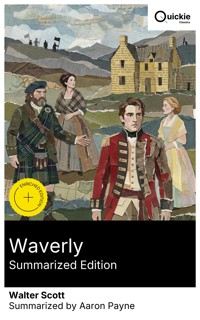
Waverly (1814) virtually inaugurates the historical novel, entwining Edward's education with the Jacobite Rising of 1745. Stationed in Scotland, the ingenuous officer drifts from Hanoverian loyalty toward Fergus and Flora Mac-Ivor, counterpoised by Rose Bradwardine and her whimsical Baron. Scott's digressive, ironic narrator layers dialect, humor, and antiquarian detail across settings from Tully-Veolan to Prestonpans, balancing romance with skeptical realism to meditate on loyalty, modernization, and the forging of British identity. Scott—lawyer, ballad-collector, and Sheriff-Depute—married Enlightenment training to Tory sympathy for order and tradition. Years of legal practice and fieldwork among Borders and Highlands, plus conversations with Jacobite descendants, furnished the novel's documentary texture. Writing anonymously, he sought to reconcile Scotland's fractured past with a commercial, imperial present and to preserve vanishing customs without sentimental falsification. For readers of historical fiction, political history, and the literature of national identity, Waverly remains indispensable: adventurous yet reflective, generous in sympathy yet clear-eyed about rebellion's costs. Begin here to see how the modern historical novel was made—and why later writers learned history by learning Scott. Quickie Classics summarizes timeless works with precision, preserving the author's voice and keeping the prose clear, fast, and readable—distilled, never diluted. Enriched Edition extras: Introduction · Synopsis · Historical Context · Author Biography · Brief Analysis · 4 Reflection Q&As · Editorial Footnotes.
Das E-Book können Sie in Legimi-Apps oder einer beliebigen App lesen, die das folgende Format unterstützen:
Veröffentlichungsjahr: 2026
Ähnliche







Waverly (Summarized Edition)
Table of Contents
Introduction
Poised between the duties of rank and the seductions of romance, between the stability of an ordered present and the restless claim of a storied past, Waverley follows a young man’s hesitant passage through clashing cultures and competing loyalties, tracing how private sentiment, national memory, and the urgencies of political choice press upon one another until they yield a vision of history at once intimate and public, uncertain and formative, in which the making of character and the making of nations become inseparable, forging a narrative where sympathy contends with ideology and where encountering difference becomes the path to self-knowledge.
First published anonymously in 1814, Walter Scott’s Waverley is a pioneering work of the historical novel in the English-language tradition, set chiefly in Scotland during the Jacobite rising of 1745. The story moves from the world of English gentry into Lowland towns and Highland landscapes, observing how contrasting customs and legal orders meet under the pressure of rebellion. Its retrospective frame—signaled by a subtitle that situates the action some sixty years earlier—allows the narrator to balance immediacy with historical perspective. Readers encounter a carefully realized social panorama in which politics, manners, and place intertwine, giving the novel both breadth and specificity.
At the center stands Edward Waverley, a young English gentleman who enters military service and is posted north, where encounters with new hosts, landscapes, and traditions loosen the assumptions of his upbringing. His curiosity, courtesy, and susceptibility to ideals lead him into circles that do not always align with official duty, and he must navigate competing claims on his loyalty without foreseeing their costs. The reading experience is leisurely yet vivid: an omniscient narrator guides us with irony and warmth, interweaving scene-painting with conversation, so that choices emerge gradually from character, custom, and chance rather than from stark melodramatic turns.
Scott’s narrative manner is hospitable and explanatory, pausing to sketch social rituals, clarify unfamiliar practices, and compare regional habits without condescension. He frequently frames scenes with brief historical notices and reflective asides that invite the reader to weigh multiple viewpoints at once. The result is not antiquarian display for its own sake but a dramatic sense that public events are carried by ordinary talk, hospitality, rumor, and local obligations. Landscapes are not mere backdrops: roads, streams, and passes shape movement and choice, while the rhythms of travel create suspense. Humor softens conflict, yet the underlying seriousness of decision never disappears.
Among the novel’s abiding themes are the formation of identity under pressure, the pull of inherited loyalties, and the uneasy border between personal conscience and collective cause. It explores how modernizing institutions and older customary authorities coexist, sometimes in harmony and sometimes in friction, and how cultural contact can kindle admiration without erasing difference. The narrative repeatedly tests the appeal of the romantic imagination against the constraints of political reality. By giving sympathetic attention to divergent allegiances, the book models an ethics of understanding that neither sentimentalizes the past nor reduces it to a simple contest of winners and losers.
For contemporary readers, Waverley remains pertinent because it treats national history as a living conversation rather than a fixed verdict. It shows how people interpret upheaval through habit, hospitality, faith, and fear, and how generous curiosity can coexist with partisanship. In an era preoccupied with identity, polarization, and the uses of memory, Scott’s attentiveness to multiple perspectives offers both caution and hope: caution against romantic simplifications, hope that understanding across difference is possible without surrendering principle. The novel’s patient mapping of institutions alongside affections provides a durable lens for thinking about change, belonging, and the costs of commitment.
As an entry point into Scott’s achievement, Waverley offers both pleasures and challenges that reward attentive reading. Expect measured pacing, stretches of description that make place and custom palpable, and occasional Scots usages whose meaning is clear from context. The narrative voice speaks directly yet respectfully to readers, guiding them through unfamiliar terrain without insisting on a single verdict. What emerges is an adventure of manners and ideas in which action, feeling, and reflection continually refine one another. To read it now is to discover how historical fiction can entertain while enlarging sympathy and sharpening judgment about the uses of the past.
Synopsis
Walter Scott’s Waverley (1814) inaugurates the historical novel by placing a personal story within the Jacobite rising of 1745. The narrative follows Edward Waverley, a young English gentleman whose imagination and education prepare him more for reverie than for practical life. Through military patronage he receives a commission and is posted to Scotland, where the political landscape is fractured between supporters of the Hanoverian government and adherents of the exiled Stuarts. Scott begins with Edward’s formation and the genteel world that shapes him, setting a tone of curiosity rather than partisanship and guiding the reader toward a country on the brink.
On his way north, Edward is introduced to Scottish society through letters that bring him to Tully-Veolan, the estate of Baron Bradwardine. The Baron, erudite and ceremonious, embodies an older order of manners and law, while his daughter, Rose, provides a gentler counterpoint to her father’s pedantry. Edward lingers amid their hospitality, attracted by the novelty of customs and conversation that differ from his English routine. Meanwhile, his military obligations recede into the background, and the novel quietly establishes a pattern: his susceptibility to influence, his taste for romance over duty, and his tendency to read politics through personal loyalties.
From the Lowlands, Edward’s curiosity carries him into the Highlands, where he meets Fergus Mac-Ivor, a charismatic clan chief, and Flora, Fergus’s sister, whose convictions lend poetic intensity to the Stuart cause. Scott contrasts clan solidarity and Highland honor with Lowland legality and English pragmatism, underscoring how place shapes politics. Edward is impressed by ceremonial hospitality, martial discipline, and songs that preserve ancestral memory. His attraction to Flora merges with his growing fascination for a movement that promises loyalty, courage, and restoration. The encounter enlarges his world while exposing the gap between idealized sentiment and the hard calculations of power.
As tensions sharpen across Britain, Edward’s position becomes precarious. Communications falter, obligations are missed, and his absence from duty invites scrutiny from government officers uneasy about borderland sympathies. Misunderstandings accumulate around him, heightened by the secrecy that surrounds Highland organizing and the coded courtesies of Jacobite circles. Scott allows ambiguity to do much of the work: Edward is neither conspirator nor innocent, but a young man whose delays and impressions entangle him in rapidly polarizing events. The novel places him at the intersection of competing claims, asking how a well-meaning outsider might navigate allegiance when friends stand on opposing sides.
The Jacobite rising takes public shape, and Edward is drawn into its orbit more directly, witnessing councils, musters, and the momentum of a cause sustained by charisma and tradition. Scott presents pageantry alongside logistics: banners, oaths, and the stir of marching men balanced against shortages, disputes, and the discipline required to hold a coalition together. Through Edward’s eyes, the glamour of a chivalric revival meets the realities of campaigning. He is compelled to weigh gratitude toward hosts and benefactors against his oath as an officer, increasingly aware that any choice will compromise one promise in order to keep another.
Amid this pressure, character contrasts sharpen. Fergus embodies ambition harnessed to clan leadership, capable of charm and command but attentive to prestige. Flora’s steadfast idealism lends moral fervor yet allows little room for compromise. Rose represents constancy and prudence within the older Lowland gentry. On the government side, figures such as Colonel Talbot exhibit duty tempered by personal honor, complicating simple binaries of villain and hero. Edward’s regard for these people intensifies his dilemma: affection and gratitude press him toward one camp, while conscience and obligation pull another way. The novel treats loyalty as a network rather than a slogan.
The campaign moves through successes and setbacks without narrating every engagement in detail. Edward experiences the exhilaration of swift advances and the anxiety of reversals, learning how rumor, weather, and supply determine strategy as much as valor does. He also sees the effects of conflict on estates and villages, where law and custom are suspended and personal enmities find opportunity. The social world he admired at Tully-Veolan proves vulnerable to political earthquake. Through these shifts, Edward’s earlier indolence gives way to more deliberate reflection, and he begins to measure honor not only by sentiment but by consequences borne by others.
As pressure mounts, legal and personal reckonings converge. Authorities seek examples to stabilize order, while clan ties demand solidarity even when prospects darken. Edward must negotiate safe conduct, pleadings, and intercessions that test the limits of patronage and forgiveness. Scott uses these negotiations to explore how eighteenth-century Britain balanced punishment with reconciliation, and how private mediation could soften public severity. The narrative remains attentive to the costs exacted by ambition and by idealism, tracing how choices ripple through families and tenures. Edward’s path becomes a study in responsibility: how to acknowledge error, repay kindness, and preserve life without betrayal.
Without disclosing final outcomes, the closing movement points beyond immediate fortunes to a longer transition in Scottish life. Waverley brings feudal loyalties, legal reform, and emerging commercial habits into contact, suggesting that nations change when individuals learn to hear more than one history at once. The novel’s enduring significance lies in its even-handed sympathy: it renders both cause and government as human communities, capable of honor and of misjudgment. By wedding romance to record, Scott shaped a genre that treats the past as living argument rather than museum. The book endures as a meditation on loyalty, memory, and change.
Historical Context
Waverley, published anonymously by Walter Scott in 1814, is set primarily in Scotland and northern England during the Jacobite Rising of 1745-1746. The novel unfolds against the political framework of the Hanoverian monarchy under George II, the authority of the British Parliament, and the operations of the British Army. It also portrays the internal structures of Highland clans, local lairds, and Lowland civic institutions. Scott situates his characters amid garrisons, courts, parish kirks, and clan gatherings, presenting a landscape where state power and customary loyalties intersect. The resulting panorama anchors a fictional journey in accurately rendered historical time, place, and institutions.
Scott’s setting follows the 1707 Act of Union, which created the Kingdom of Great Britain by uniting the parliaments of Scotland and England. The settlement preserved the Presbyterian Church of Scotland and Scotland’s legal system, but altered economic and political power. Against this backdrop, Jacobitism sought to restore the exiled Stuart dynasty, drawing support from certain Highland clans, Episcopalians, and some Tory-leaning interests. The Hanoverian succession in 1714 consolidated Whig influence at Westminster, while patronage and militia structures extended central authority. These constitutional changes and loyalties frame the novel’s contrasts between metropolitan governance and regional societies with their own laws, languages, and customs.
Earlier unrest shaped the terrain. The failed rising of 1715, led by John Erskine, Earl of Mar, prompted the British government to pass Disarming Acts aimed at reducing weaponry in the Highlands and to strengthen garrisons. In the 1720s and 1730s, General George Wade oversaw the construction of military roads and forts to improve rapid deployment of troops across the Highlands. Independent military companies that later formed the 42nd (Black Watch) Regiment were raised to police the region. Despite these measures, traditional clan jurisdictions and obligations persisted, creating a fragile balance between central authority and local power that the 1745 crisis would test.
In July 1745, Charles Edward Stuart arrived in the Hebrides and on 19 August raised his standard at Glenfinnan, initiating the Jacobite Rising that anchors the novel’s chronology. Highland regiments mustered and took Edinburgh, though its castle remained in government hands. On 21 September, Jacobite forces defeated Sir John Cope at Prestonpans, opening a southward advance. By early December, the army reached Derby in England but, facing logistical limits and uncertain English support, retreated north. These movements bring into contact government officers, clan leaders, and civilians, the very interactions Scott dramatizes while keeping close to the documented sequence of the campaign.
The government response intensified under William Augustus, Duke of Cumberland, leading to the decisive battle at Culloden near Inverness on 16 April 1746. The defeat ended the campaign and ushered in systematic measures to integrate the Highlands. Parliament passed the Heritable Jurisdictions (Scotland) Act 1746, abolishing many private judicial rights of chiefs and lairds, and the 1746-1747 Proscription Acts, which included a ban on Highland dress. Estates were forfeited, and roads and forts were expanded, culminating in new works such as Fort George begun in 1748. These policies, firmly documented, supply the novel’s backdrop of transition from regional power to centralized law.
Scott depicts societies shaped by distinct economies and legal customs. Highland communities were organized through kinship, tacksmen, and rental obligations, with cattle, droving, and seasonal migration important to livelihoods. Lowland towns and estates were entering an era of agricultural improvement and commercial expansion; Glasgow’s tobacco trade and textile enterprise grew markedly in the eighteenth century, while Edinburgh concentrated legal and intellectual life. The established Church of Scotland set parish structures and discipline, alongside surviving Episcopal congregations. Scots law, administered in sheriff courts and the Court of Session, differed from English common law. Linguistic contrasts - Gaelic, Scots, and English - further marked cultural boundaries the narrative carefully navigates.
Intellectual currents shaped Scott’s method. The Scottish Enlightenment fostered historical analysis and social theory through figures such as David Hume, Adam Smith, and William Robertson, encouraging attention to manners, institutions, and change over time. Antiquarian interests flourished, exemplified by collections of ballads and charters; Scott himself edited Minstrelsy of the Scottish Border (1802-1803). The popularity of James Macpherson’s Ossian poems, though later disputed for authenticity, fed a Europe-wide taste for Highland themes. As an advocate, Sheriff-Depute, and Clerk of Session, Scott worked amid archives and legal processes, equipping him to integrate documentary texture with narrative art in framing the 1745 crisis.
Waverley reflects and critiques its era by juxtaposing the charisma of dynastic loyalty with the claims of constitutional order. Its episodes trace how military mobilization, legal reform, and economic change reshape local allegiances without reducing them to caricature. Scott’s careful topography, multilingual dialogue, and attention to courts, garrisons, and estates present the movement from a customary, honor-based society toward a centralized, commercial state. The novel’s measured sympathy for multiple sides aligns with early nineteenth-century efforts to reconcile post-Union identities, inviting readers to see 1745 as both a romantic memory and a lesson in political modernization rather than a simple partisan tale.
Author Biography
Walter Scott (1771–1832) was a Scottish poet, novelist, and legal professional whose work helped define the historical novel in the Romantic era. Rising to international fame in the early nineteenth century, he fused antiquarian learning with narrative energy, making the past vivid to a broad reading public. His poems and the long sequence later marketed as the Waverley Novels shaped perceptions of Scotland, chivalry, and national identity across Europe and beyond. A commanding figure in British letters, Scott also engaged public culture as an editor, organizer of pageantry, and collector, leaving a literary and material legacy that continues to calibrate how history enters fiction.
Educated in Edinburgh, Scott attended the High School and studied law at the University of Edinburgh before being admitted to the bar as an advocate in the early 1790s. His professional training coexisted with a lifelong antiquarian curiosity nurtured by the Scottish Border’s ballads, landscapes, and oral traditions. Early literary influences included the vernacular song tradition and German Romanticism, which he encountered through reading and translation. He produced versions of German ballads and adapted Goethe’s Götz von Berlichingen, sharpening his sense of historical drama. These interests, combined with disciplined legal habits of documentation, grounded a method that sought credible detail within imaginative storytelling.
Scott first gained notice as a collector and editor with Minstrelsy of the Scottish Border (published in the early 1800s), a landmark anthology that preserved and reshaped ballad materials. He then turned to original narrative poems that became bestsellers: The Lay of the Last Minstrel, Marmion, and The Lady of the Lake. These works blended romance, local color, and martial pageantry, attracting a mass readership and tourist interest in the Highlands. While building his literary standing, he held legal and administrative posts, roles that provided financial stability and a historian’s access to archives. By the 1810s he was a national celebrity.
In 1814 Scott anonymously issued Waverley, a novel set against Jacobite-era change that inaugurated a prolific series. Publishing as the Author of Waverley, he produced Guy Mannering, The Antiquary, Old Mortality, Rob Roy, and The Heart of Mid-Lothian, among others, mapping conflicts between tradition and modernity across Scottish society. His approach combined rapid plotting with careful attention to speech, social types, and historical sources, creating an expansive panorama that readers found both instructive and entertaining. The sustained anonymity became a literary game and commercial strategy, and he did not formally acknowledge authorship until the later 1820s.
Scott extended his range beyond Scotland with novels such as Ivanhoe, Kenilworth, and Quentin Durward, helping to popularize medievalism and Renaissance politics for general audiences. His books circulated widely in translation, influencing opera, painting, and stage adaptations. A cultural organizer as well as writer, he took part in the rediscovery and public presentation of Scotland’s regalia and helped orchestrate the royal visit to Edinburgh in the early 1820s, events that encouraged a tartan-inflected national pageantry. He founded the Bannatyne Club to publish historic texts. Politically conservative, he favored established institutions, yet his fiction explored social change with sympathetic breadth.
The collapse of his publishers and associated printing concerns in 1826 created a severe financial crisis. Refusing bankruptcy, Scott undertook to discharge large debts through intensified literary labor. He produced new novels, short fiction, and histories, including Woodstock, The Life of Napoleon Buonaparte, Chronicles of the Canongate, and the multi-volume Tales of a Grandfather, written for younger readers. The strain coincided with declining health; by the end of the 1820s he suffered strokes and sought relief through travel on the Continent. He returned to his Borders home, Abbotsford, where he continued working as strength allowed, and died in 1832.
Scott’s legacy is unusually broad. He consolidated the historical novel as a major form and offered a template for integrating archival texture with popular storytelling, shaping later writers from Dumas and Manzoni to Tolstoy. His evocations of place influenced tourism, heritage preservation, and the imaginative geography of Scotland and northern Britain. Critical fortunes have fluctuated, with debates over romanticization and politics, yet his technical innovations—polyphonic narration, historical framing, and attention to everyday voices—remain foundational. Abbotsford stands as a museum of his tastes and collecting. His work continues to be re-edited, adapted, and studied for insights into nationhood and memory.




