


5,49 €
Mehr erfahren.
- Herausgeber: The History Press
- Kategorie: Sachliteratur, Reportagen, Biografien
- Sprache: Englisch
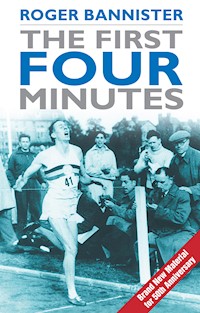
Roger Bannister's own account of becoming the became the first man to run a mile in under four minutes - a feat which established him as one of the most famous sportsmen in history.
Das E-Book können Sie in Legimi-Apps oder einer beliebigen App lesen, die das folgende Format unterstützen:
Veröffentlichungsjahr: 2011
Ähnliche



















THE FIRST
FOUR
MINUTES
50TH ANNIVERSARY EDITION
ROGER BANNISTER
The First Four Minutes was first published in 1955 by Putnam.
This special hardback limited edition first published in 2004.
Revised and enlarged 50th Anniversary Edition first published in paperback in 2004
First published in 2011
The History Press
The Mill, Brimscombe Port
Stroud, Gloucestershire, GL5 2QG
www.thehistorypress.co.uk
This ebook edition first published in 2011
All rights reserved
© Roger Bannister, 1955, 2004, 2011
The right of Roger Bannister, to be identified as the Author of this work has been asserted in accordance with the Copyrights, Designs and Patents Act 1988.
This ebook is copyright material and must not be copied, reproduced, transferred, distributed, leased, licensed or publicly performed or used in any way except as specifically permitted in writing by the publishers, as allowed under the terms and conditions under which it was purchased or as strictly permitted by applicable copyright law. Any unauthorised distribution or use of this text may be a direct infringement of the author’s and publisher’s rights, and those responsible may be liable in law accordingly.
EPUB ISBN 978 0 7524 7222 5
MOBI ISBN 978 0 7524 7221 8
Original typesetting by The History Press
Contents
Introduction to the 50th Anniversary Edition
THE FIRST FOUR MINUTES
Introduction
1. European Games, Berne 1954
2. Early Days
3. Oxford – Initiation
4. Oxford – Graduation
5. Olympic Games, Wembley 1948
6. First Tour in America, 1949
7. Hesitation and Transition, 1949–50
8. Training and Touring, 1950–51
9. Benjamin Franklin Mile and First British Mile Title, 1951
10. Preparation for Olympic Games, Helsinki 1952
11. Olympic Games, Helsinki 1952
12. So Near and Yet – 1953
13. Four-Minute Mile, 1954
14. Empire Games, Vancouver 1954
Conclusion
Steps to the First Four-Minute Mile
After the First Four Minutes
Peril in the Post
Running Cold
Mile Record Holders since 1954
Author’s Acknowledgements
To my wife, Moyra, my children and grandchildren
Introduction to the 50th Anniversary Edition
The year 2004 is the 50th anniversary of the first four-minute mile. On a windy and rain-sodden day in Oxford in May 1954 my friends Chris Chataway and Chris Brasher* helped me to run the first sub-four-minute mile – a goal sought from as far back as Victorian days. The barrier of four minutes had been believed to be insurmountable. John Landy, my great Australian rival, who had run three 4 minute 2 second miles, said, ‘Two little seconds are not much, but when you’re on the track those fifteen yards seem solid and impenetrable, like a cement wall.’ But, as a medical student and physiologist, I knew this could not be true.
Success came through the fortunate link with my friends, who had been University athletes and had the generosity of spirit to help me reach this seemingly unattainable goal. They themselves later triumphed in their own spheres. Chataway famously overtook and defeated the great Russian 5,000-metre champion Vladimir Kuts and broke the world record in 1954. Chris Brasher won his gold medal for the steeplechase in the 1956 Olympic Games, and they both went on to have distinguished careers after retiring from sport.
The original purpose of this book was to try to describe what being a runner was like during my student days, what fun it was, how freely we travelled, how we coped with success and the fame that it brought – and how we dealt, too, with the disasters that so suddenly brought us back to earth. The hope was that the whole experience might help others to fill the gap between school and work. I wrote it in just six weeks between retiring from competition and switching to medicine. For some years it has been out of print in Britain and I have been pressed to republish it. I have hesitated because, set as it is in immediate post-war Britain and in an Oxford largely filled with ex-servicemen, it might seem too dated for readers today. But so many have written to say it helped and inspired them that this seemed a good moment to republish and it appears here without a word changed. As newspaper pages show daily, sports dramas can resonate widely as sportsmen try to cope with success and failure, with the long-term disappointments of training and injury, and even with the moral issues of honesty and loyalty. In 2003 Lance Armstrong won the Tour de France for the fifth consecutive year. Six years earlier he had cancer with multiple secondaries, including some in the brain, and was given a 40 per cent chance of living. After treatment, he recovered and, instead of retiring with distinction, he started cycle racing again. The question is why so many of us want to seek such challenges.
I have reflected on rereading this book that, however ordinary each of us may seem, we are all in some way special and can do things that are extraordinary, perhaps until then even thought impossible. When the broad sweep of life is viewed, sport, though instinctive, physical and ephemeral, illustrates a universal truth that most of us find effort and struggle deeply satisfying, harnessing almost primeval instincts to fight, to survive. It gives us all a challenge, a sense of purpose and freedom of choice. It is increasingly difficult to find this in our restricted twenty-first-century lives. The particular target we seek may not be important. But what is important is the profoundly satisfying effort in thought, feeling and hard work necessary to achieve this success.
A seventy-year-old man from Lancashire wrote a letter to me for my seventieth birthday explaining how the four-minute mile had affected him:
It gives me great pleasure to thank you for something you did for me, albeit unknowingly, in 1954. At the time of the first sub-four-minute mile I was also twenty-five, but had no sporting prowess whatsoever, because it seemed I had no talent. Then I saw the epic race at Iffley Road in a newsreel at the cinema . . . and I wondered if running might be the sport for me! I knew nothing of athletics at that time, but I contacted my nearest club and was invited to join. To cut a long story short, running became my life, and still is, as I still turn out most days. The sport gave me a new lease of life and I am as enthusiastic now as I was in 1954. This is all due to that wonderful race all those years ago. A new vista opened up to me at that time from the inspiration that short glimpse of another world gave to me whilst watching that cinema newsreel. I have no cupboard full of medals or trophies, just a sackful of wonderful friends and very happy memories.**
I hope something in this book both inspires the serious athlete and encourages the recreational runner.
The years since 1954 have been too few and have gone too fast for all I had hoped to do, but in the main they have been very happy and endlessly interesting. I had work I relished, colleagues I admired and many friends in my hospitals, at the Sports Council and lastly during my eight years at Pembroke College. Life has been taxing sometimes, boring never.
Sir Roger Bannister
Oxford
March 2004
* Chris Brasher died on 28 February 2003.
** John Thompson died of cancer in February 2003 but his family tell me that his logs showed he had run 85,000 miles before illness forced him to stop.
The First Four Minutes
Introduction
‘Write the vision and make it plain upon tables, that he may run that readeth it.’
Book of Habakkuk
What are the moments that stand out clearly when we look back on childhood and youth?
I remember a moment when I stood barefoot on firm dry sand by the sea. The air had a special quality as if it had a life of its own. The sound of breakers on the shore shut out all others. I looked up at the clouds, like great white-sailed galleons, chasing proudly inland. I looked down at the regular ripples on the sand, and could not absorb so much beauty. I was taken aback – each of the myriad particles of sand was perfect in its way. I looked more closely, hoping perhaps that my eyes might detect some flaw. But for once there was nothing to detract from all this beauty.
In this supreme moment I leapt in sheer joy. I was startled, and frightened, by the tremendous excitement that so few steps could create. I glanced round uneasily to see if anyone was watching. A few more steps – self-consciously now and firmly gripping the original excitement. The earth seemed almost to move with me. I was running now, and a fresh rhythm entered my body. No longer conscious of my movement I discovered a new unity with nature. I had found a new source of power and beauty, a source I never dreamt existed.
From intense moments like this, love of running can grow. This attempt at explanation is of course inadequate, just like any analysis of the things we enjoy – like the description of a rose to someone who has never seen one.
The scientist may attempt an objective explanation. The sense of exercise is an extra sense or perhaps a subtle combination of the others. It is one which most of us ignore. Small electrical impulses, so the scientist tells us, pass from our contracting muscles and our moving joints to our brain. The electrical rhythm produced there is a source of pleasure. Like that caused by music, it has some interplay with the rhythms inherent in our nervous systems. But no explanation is satisfying that does not take account of feelings of beauty or power.
The satisfaction we derive from games is complex. We enjoy struggling to get the best out of ourselves, whether we play games of skill requiring quickness of eye and deftness of touch, or games of effort and endurance like athletics. It is not just the desire to succeed. There is the need to feel that our bodies have a skill and energy of their own, apart from the man-made machines they may drive. There is the desire to find in sport a companionship with kindred people. I have found all these. The sportsman enjoys his sport even if he has absolutely no prospect of becoming a champion. In athletics there are many events, running, jumping, and throwing, which suit different physiques, the long and thin, the broad and strong. Industry and perseverance, without any great natural aptitude, bring greater success in athletics than is possible in ball games.
For nearly ten years I have run about 25 miles a week: my grasp of the reasons why I run continues to grow. Running through mud and rain is never boring. Like 100,000 cross-country runners, their number ever increasing, I find in running – win or lose – a deep satisfaction that I cannot express in any other way. However strenuous our work, sport brings more pleasure than some easier relaxation. It brings a joy, freedom and challenge which cannot be found elsewhere.
Does this primitive joy remain when I put on shoes with three-quarter-inch steel spikes and run round a circular cinder track, only to come back to the starting point? What is it like to have the excitement of competitive struggle grafted on the natural freedom found in movement – to champion the cause of club or country and to have their honour, as well as your own, at stake? What difference does it make when the sound of breakers on the shore is replaced by the roar of a crowd of 50,000 spectators in a stadium, crying out for more and more effort and identifying themselves with each runner’s success or failure? What does it mean to wait weeks or months for a race which only lasts for a few minutes – to travel thousands of miles for the few seconds of supreme exertion before reaching the winning post?
Until quite recently, if I had been asked what running meant to me I should have replied, ‘I don’t know.’ Life must be lived forwards even if sometimes it only makes sense as we look back. Before now it would have been impossible for me to attempt to write about running, but now I can see a pattern of striving – of success and failure – which I hope will grow clearer. Though I have only experience of my own running, this story, I feel, applies to athletics in general, to other sports, and I hope even beyond. That is my justification for overcoming a reticence which makes me shrink from writing about my own feelings. This description may be helpful to others who may have experienced these same emotions but are not prepared to talk, let alone write, about them. I must try to steer a course between false modesty on the one hand and conceit on the other. I shall write mainly as though running were all-important. It will be difficult to describe how moments when running seems utterly insignificant alternate with moments when it threatens to engulf me.
This book includes a picture of the last important race in which I competed – the European Championships in Berne in the summer of 1954. This race is described first, because it contrasts the complexity of such a struggle with the simplicity of my first impulse to run.
In the rest of the book I attempt to trace the way my primitive desire to run brought me into the competitive atmosphere of big races.
Roger Bannister
London, 1954
1
European Games
Berne 1954
‘And thick and fast they came at last And more and more and more.’
Through the Looking Glass
The political ferment in Europe seemed to have transferred itself to the Berne Stadium. The 29 August was a sweltering cloudless day, and 30,000 people sat cheering, chanting and waving flags. Switzerland, as in politics, was neutral in the struggle. Her few competitors were forgotten in the confused impact of blond Scandinavians, swarthy Southerners, burly iron men from the East, and pale Englishmen from the West. At times it seemed as though the strong winds of encouragement and hope from compatriots blew in from each corner of the stadium, creating a whirlwind in the centre that blew the competitors faster and faster round the track.
It was the last day of the European Championships of 1954. These quadrennial games are the most important event in world athletics during the four years between the Olympic Games. The winners gain the awards most coveted of all, ranking only below the Olympic titles. I was competing in the next furious struggle, the 1,500 metres. I knew what to expect – a well-meaning mêlée of arms and legs. It was the sort of race in which anything could happen. I felt it was a spectacle more than a fair athletic competition; but that is the way sportsmen on the continent seem to like their running – a contact sport, too intimate for my liking. It was in just such a race, the Olympic final of 1952 at Helsinki, that I had come fourth and been dubbed ‘a failure’. This was attributed by many newspapers at the time to my unsuitable training methods – a criticism to which my only answer was silence until the next big race gave me the chance to prove my ideas were right.
This was my second chance. But this time there had been only one day of heats (eliminating races) instead of two, as in the Olympics, and there had been two days’ interval before the final. Despite a series of outstanding performances by the British team, many of whom had excelled themselves, Britain was still without a gold medal in the men’s events. Little Hungary – someone reminded us – had already won three. In the words of the Olympic dictum we were ‘fighting well’ but not ‘conquering’. How many worlds between a gold medal and second place!
I could not see myself in the winning place. But as at Helsinki mine was the unenviable position of being expected to win.
In some ways, the heat on the previous Thursday was as great an ordeal as the final. The thought suddenly came – how awful to be knocked out and left to watch the final from the stands! And the little things that can go wrong! I was warming up on the uneven grass near the track, like a racehorse in the paddock, under the curious eyes of those who could not afford to buy tickets or who were only interested as autograph hunters. I suddenly noticed that my best pair of spikes had split along the side – trivial perhaps, but most unsettling. I had to wear another pair with spikes which were too long, increasing the danger of tripping up. I was not mentally prepared for the heat, and as a result took fright at the last minute when I found myself surrounded by aggressive-looking athletes from other countries. The one next to me had been involved on a previous occasion in a skirmish with a British athlete, first on the track and then off it. He still carried a fierce look in his eye. I smiled sweetly at him as if to say, ‘You and I are good friends’, very much the sickly smile that Charlie Chaplin reserved in his early films for policemen and heavyweight champions. This time there was no skirmish, but I caught his elbow at the first bend.
I ran extremely badly, like a startled rabbit, darting up and down amongst the runners in an unnecessarily agitated way. Looking back now it seems a nightmare, but I qualified for the final in third position, in the relatively easy time of 3 minutes 51.8 seconds.
In the two days following the heat I had been preparing myself for the final. I went away for long walks, seeking the mental calm I needed. By Sunday when the final came I had built myself up to withstand any setback. I no longer wanted to be wrapped in cotton wool. If my spikes had split now I should have run in bare feet. If I were knocked over I should not feel martyred, but would draw new impetus from my anger.
With military precision we walked out on the track in the order of our starting position, like prisoners in Indian file. Each one of us perhaps was listening for the calls from his countrymen that told him he was not alone. At this time in particular it was a great encouragement that Ian Boyd, one of the younger members of the British team, had reached the final and was running with me. I very much admired his outward calm, which concealed great strength and tenacity, and gave me the companionship I needed.
There were only eleven lining up for the start. The twelfth man, Langenus of Belgium, had not recovered from a foot injury received while running in my heat. My great disappointment was that one runner was not there – Jose Barthel, reigning Olympic champion – who had not qualified to represent his country. I had been looking forward to getting my revenge for Helsinki. Revenge is really too strong a word because Barthel was a great Olympic champion, and I was happy that he won so deservedly. But nothing is cancelled out in running – I wanted a complete victory, and it would not be complete if he were not running.
To come now to some of the others. Iharos of Hungary was favourite on the basis of times, but was otherwise an unknown quantity. He had helped Hungary on two occasions to capture the 4×1,500-metres relay world record. A few weeks before the games he had in a single race defeated the Norwegian Boysen, broken Gunder Haegg’s world record for 1,500 metres, and run the fastest lap recorded in a race of that speed. Of him there were rumours of sleepless nights and great anxiety. He looked thin, angular, and excitable like a thoroughbred.
All the others had done sufficient racing for me to have some idea of their capabilities. Gunnar Nielsen (Denmark) was by far the best ‘fighter’ in the field, and had reached fourth place in the Olympic 800 metres at Helsinki in 1952. In 1954 he had on three occasions run over two seconds faster than my best time for 800 metres. Nielsen was tall and sandy-haired, a natural runner, well versed in the jostle of continental running. He and Audun Boysen, a good friend of his from Norway, had decided to run in different races, Boysen having chosen the 800 metres. This had disappointed me, because Boysen would certainly have set a pace which might well have resulted in a new world record in our race. Instead, the race might become a procession because no one would take the lead.
Next there was Werner Lueg, a Berlin schoolmaster, who had equalled the world record for the 1,500 metres a few weeks before Helsinki, and thereby become Olympic favourite. He was a clever tactician and very confident. He was liberal in good advice to other competitors – telling me, as we sat waiting on a bench in the centre of the track, not to put on my spikes too soon. Then there was Stanislav Jungwirth, the cheerful Czech, who had beaten me soundly over 880 yards at Whitsun, after my strange ‘goodwill’ visit to New York. He was a powerful runner but inclined to be inconsistent.
Finally came Denis Johansson, the chain-smoking Finn, who had tremendous natural ability but might have sapped some of this by too much running in America. There were five other runners, any one of whom might come through to win, after the giants had battled each other to a standstill. In the light of what happened later, I recall now a letter written home before the race in which I singled out Nielsen as the runner I feared most.
We lined up behind the starting post – eleven anxious athletes, a colourful sight in our national vests, if one had time for such thoughts. ‘Auf die platze’ – ‘Get to your marks’; ‘Fertig’ – ‘Set’. We crouched forward expectantly – the gun fired. One runner was too eager and anticipated it. As always I was a little slower off the mark than the rest. I could not help smiling; it seemed so unnecessary to beat the gun in a race that would last for 3¾ minutes. We crouched again – this time we were off.
The starting line is curved, so that each runner shall cover approximately the same distance. We all accelerated in line, inevitably converging – the outside men moving inwards to get good positions, the inside men forced to run straight. I was a little behind the main line, and 15 yards from the start they all crashed into each other. Mugosa of Jugoslavia fell, and only by jumping over him did I avoid transfixing his hand with my spiked running shoe. I might just as easily have been the one to fall. The leaders tore round the first bend in a bunch, three abreast. I was last. No one wanted to lead, yet no one was content to be last – except me.
Soon the leading runner slowed down, worried at being unable to see what was happening behind him. The runner at his shoulder, hustled by a discontented rearguard, was forced into the lead himself. The race was slowing down. The half-mile was 4 seconds below four-minutemile standard. I rested in eighth position from the jostling elbow work to glance up at the enormous clock at the end of the stadium, with its ruthless second-hand recording our progress round the track. I knew it was dangerous to look up, because for a moment I was unguarded against the man outside me who was cutting in, the man behind who was pushing me, and the man in front whom I might well trip over. None of this jostling is deliberate, of course; it is just that eleven men are running at the top speed within their compass, and no difference between them will show until the last 300 yards of the race.
Each runner worries the others. The anxiety of being pressed and jostled increases; soon it will become too much for someone and he will make an effort to break away from the field. It is this controlled tension about to break down that gives miling its great excitement for the spectators. The early cheering of the crowd was now stilled, and the expectant hush had a positive quality that linked every spectator with the runners on the track. It was certain to be one of the favourites who would try to break away first. Which was it to be – Jungwirth, Lueg, Iharos, Nielsen or myself?
The decision to ‘break away’ results from a mixture of confidence and lack of it. The ‘breaker’ is confident to the extent that he suddenly decides the speed has become slower than he can himself sustain to the finish. Hence he can accelerate suddenly and maintain his new speed to the tape. But he also lacks confidence, feeling that unless he makes a move now, everyone else will do so and he will be left standing. The spurt is extremely wasteful because it is achieved at the cost of relaxation, which should be maintained throughout the race. The athlete’s style and mood change completely when he accelerates. His mind suddenly starts driving an unwilling body which only obeys under the stimulus of the excitement. The earlier in the race this extra energy is thrown in, the greater the lead captured, but the less the chance of holding it. The surprise of being first to break away is worth an immediate advantage of 20 yards when there remains one further lap to complete (with a high danger of being overtaken before the finish), an advantage of 10 yards if halfway round the last lap, or of 5 yards in the final straight. The ‘break’ is like suddenly exposing your hand in a game of cards. You show how much reserve you have left by the speed at which you try to open up a gap, and by the point at which you start to do so.
If Landy had been in the race he would have been the first to break – or he would have led all the way. I knew Denmark’s Gunnar Nielsen was bound to leave his finish as late as possible. Since he was easily the fastest half-miler in the field it would suit him best to make the race into a dawdle, ending with a fast finish, in which his speed would tell. I guessed that Jungwirth the Czech, very nervous and not so sure of his finish, would ‘break’ first. The German Lueg, with the knowledge that he had shot his bolt too soon in the Olympic final, might be the second man to try to break away. Iharos from Hungary was still an unknown quantity. I could not see him when I looked around the field at the bell, which is rung when the runners have only one more lap to go. I moved out into the second lane so that I could manoeuvre more easily and avoid the danger of being boxed in.
The background noise from the crowd began to rise again. I moved up to Jungwirth’s shoulder. He was eager to shoot off and only waiting for a stimulus. The mere presence of another runner outside him was sufficient. The crowd roared as he gained a lead of a yard or so, but the rest of us were soon up to him again. I kept at his shoulder as we rounded the next bend and entered the long back straight before the finish.
I had decided that the place where I could make the most of my finishing burst was 220 yards from the tape, and so I wanted to hold Lueg and the others back until this point – just before the last bend. If I started sprinting earlier, Iharos or an outsider might catch me on the finishing post as I tired. If I started later, Nielsen might outsprint me. I kept at Jungwirth’s shoulder, forcing him to keep up a good pace if he was to retain the lead. I felt in command until suddenly I sensed someone closing up on my own shoulder and about to move past me. It was Nielsen, as I learnt later.
We were nearly at the last bend now. I waited anxiously for two or three more strides, almost sandwiched between Jungwirth and Nielsen. If I allowed anyone to overtake me now I should have to satisfy myself with third position until the finishing straight. Alternatively, if I overtook the second runner, the first would be able to make me run wide round the bend and waste precious energy in covering extra distance. The longer I could hold off those behind me the better, because Jungwirth’s speed was a good stride for me, and all the time I was building up a reserve of energy preparatory to sprinting. But so were the others.
We reached the bend. Jungwirth, I hoped, imagined himself securely in the lead until the home straight. As the bend began I struck past him with all my power, feeling like an engine with the supercharger full on. I gained valuable yards before Nielsen realised what had happened. I later discovered he came up to me at the beginning of the straight, but I drew away to win by 5 yards. This was probably not more than the distance I gained through the surprise of the sudden acceleration. Never did my finishing burst serve me so well. There was no longer any need to call on emotion to produce this ability to take an overdraft on my energy. There had been times in other races when I felt real fear as I tore down the finishing straight as if my life depended on it – such were the temper and distortion of values produced by my excitement during a race.
This time it was different – I was calm. Just as I had not spent the previous night bathed in sweat, racing the distance a dozen times in my imagination, so it was in the race itself. My mind remained quite cool and detached. It merely switched over the lever, and well-worn channels carried to my body the extra energy that my mind unleashed. As I came down the finishing straight I was moving with all the speed I could possibly have mustered even if I had been running for my life (25 seconds for the last 220 yards). I remember coolly looking up at the clock and thinking: ‘What a pity! No world record today – the final time will be about 3.44 – if only Boysen had been with us!’ The race was run in 3 minutes 43.8 seconds, a championship record and 1.4 seconds (10 yards) faster than the 1952 Olympic final, a race of the same jostling kind.
The crowd had their spectacle. But I feel strongly that there should be a maximum of eight, not twelve, runners in a race of this kind. This would give the competitors the best possible chance of running instead of scrambling. The spectators would still have their thrill, and for those who are stopwatch minded the time would be faster. The final placings were:
Mugosa (Jugoslavia) fell, and abandoned the race.
2
Early Days
‘With the first dream that comes with the first sleep, I run, I run.’
Alice Meynell
It is difficult to remember what we thought of things before we began to grow up – before we were fully conscious of ourselves. As a boy I had no clear understanding of why I wanted to run. I just ran anywhere and everywhere – never because it was an end in itself, but because it was easier for me to run than to walk. My walk was ungainly, as though I had springs in my knees. I always felt impatient to see or do something new, and running saved time.
In part my running grew out of an intensity and enthusiasm I have always had. Games and adventures swallowed me up and swept me along until some setback would make me give up. Like other children I used to build models of machines in imitation of things I had seen. I can remember a great three-wheeler trolley built out of an old-fashioned wooden draining board. I was interested most in things that moved – the faster the better. I made up for my lack of knowledge of carpentry by increased use of nails. ‘Just a minute,’ I would say, ‘one more nail will fix it.’ One of my boats was so covered with nails that it nearly sank. Nonplussed, I turned it into a submarine. The only things that I built without nails were model aeroplanes, but few of them flew successfully. Usually I played alone.
As every child does, I wondered what life had in store for me. I can distinctly remember moments when my life seemed clear ahead, free of obstacles I had overcome, though I cannot remember what these obstacles were. Now I wonder whether this was just wishful thinking or a sign of determination to spare no effort of mind or body. If there is ever a time when the real core of a person is revealed it is in childhood. Perhaps we all have some concept of our own ‘specialness’ and purpose at a very early age, but we never dare to admit it.
The first time that called for a practical use of my running was when I had been trespassing on some building land near my home. A school friend shouted from the other side of the fence that the builder was coming. I shot down from a high tree, reached the fence and vaulted it. It might have been easier to talk my way out of trouble on such occasions, but at the time it was easier to run than to think. I found afterwards that my hands and clothes were torn by barbed wire which I had not noticed in the frenzy of excitement caused by fear.




