


9,49 €
Mehr erfahren.
- Herausgeber: Hamad Bin Khalifa University Press
- Kategorie: Sachliteratur, Reportagen, Biografien
- Sprache: Englisch
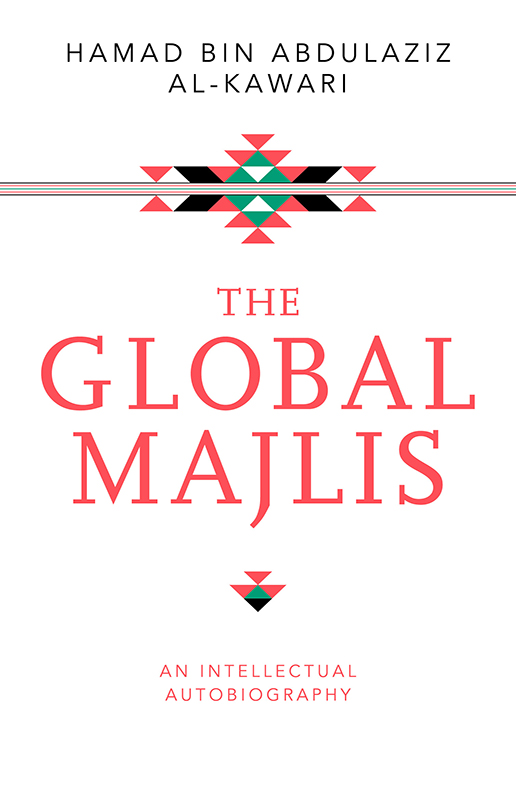
With a career in international politics and diplomacy that spans decades, Dr. Hamad Al-Kawari offers his unique perspective to the complex social and political issues facing Qatar and the Arab world. A mixture of personal stories, professional biography, and intellectual observations, The Global Majlis covers themes ranging from methods of negotiation to cultural diplomacy, education, art and literature, and the path to freedom. In doing so, Dr. Al-Kawari offers cultural solutions to pressing political and social dilemmas seen in both the Middle East and the world at large, such as injustice and intolerance.
Das E-Book können Sie in Legimi-Apps oder einer beliebigen App lesen, die das folgende Format unterstützen:
Veröffentlichungsjahr: 2020
Ähnliche



















THE GLOBAL MAJLIS
HAMAD BIN ABDULAZIZ AL-KAWARI
Translated by Karim Traboulsi
Contents
Foreword
Introduction
The Sea and the Desert: Cultural Bearings
Chapter One
Doha: Localisation versus globalisation
Chapter Two
The War on Heritage
Chapter Three
An Aesthetic Exploration of the World
Chapter Four
From Majlis to New Media
Chapter Five
On Cultural Diplomacy
Chapter Six
Consultations as a Cultural Phenomenon
Chapter Seven
Dialogue between Cultures
Chapter Eight
Education:The Road to Freedom
Chapter Nine
The Creative Industries
Afterword
The Global Majlis
Arabic works cited
Works cited
Notes
Foreword
Resolutions are as good
As the resolute; generosity
As the generous
Trivial men exaggerate
Trivial matters
Great matters are overcome
Without effort by the great.
– Abu al-Tayeb al-Mutannabi
I have written this book in stages and chapters that imposed themselves on me insistently whenever I recalled a memory or an event. In the beginning, the material consisted mainly of my comments on Instagram and texts I wrote on my mobile phone. But as the material gradually coalesced to express a certain vision and reflect a set of opinions, I decided to piece them all together into a book, to highlight the link between those scattered events and observations, bonding them with my views on issues such as culture, diplomacy, heritage, art and literature.
It is for this reason that I considered these chapters an ‘intellectual biography’. It was not my original intention to write an autobiography, a form that has certain requirements and which would be premature for me to write. But the connections that emerged among the observations, remarks and short texts I was posting on social media prompted me to take a closer look and reorder them in a way that would make their reading a smoother and more coherent process.
The chapters of this book may be read separately, as each addresses a specific issue in as complete a manner as possible. They are also part of a connected and progressive narrative, representing a unified intellectual vision that is the essence of my knowledge, positions and opinions on life, culture, diplomacy and related topics.
In these pages I tackle the issue of distinctive cultural character versus universal cultural character in the context of culture and development. I describe how my perception of literature and the arts has evolved. I talk about the public space as a place for public discussion, beginning with the majlis tradition in our countries and extending to new media trends.
I also shed light on some of the basic aspects of cultural diplomacy, its nuances, mechanisms and objectives. In another chapter, I deal with the issue of dialogue between cultures as a way to build understanding between people and as a path to peace. I particularly focus on the cultural foundations of multilateral negotiations.
I dedicate an entire chapter to education, the ‘royal road’ to freedom, expressing my opinions on this cornerstone of human development. I could not omit my views regarding the link between culture and industry, through new concepts prevailing in our world today in creative and cultural industries.
The world we live in is full of instances of extremism and criminality disguised in religious garb. With this in mind, I dedicate a chapter to the crimes perpetrated against humanity and human heritage, with particular focus on Mali, Syria and Iraq.
The reader will discover, by linking the chapters together, that my perceptions are the result of the responsibilities I shouldered, as much as from the fact that I was keen for culture and its broader implications to act as a guiding light for my work. As a young man, I was appointed ambassador to serve in many countries. After working in Beirut and Damascus, I represented my country in Europe; my residence was in Paris but I was in charge of Qatar’s diplomatic missions in other European countries as well. I moved later to the Americas, serving as ambassador in Washington and as ambassador extraordinary to several South American nations.
As fate would have it, part of my diplomatic mission would be ultimately devoted to multilateral action, whether as Qatar’s envoy to UNESCO or as permanent representative to the United Nations in New York.
My political contributions were inseparable from my interest in culture and cultural issues. Ultimately, culture became my main preoccupation, when I was appointed first minister of culture and information from 1992 to 1997, and then minister of culture, arts and heritage from 2008 to the present day.
In this book I do not intend to recount personal experiences for the purpose of storytelling. I want to present the fruit of decades of experience in taking on cultural, educational, media and diplomatic issues. I see it as both a duty and a pleasure to share my experiences, in the hope that this will open new horizons, impart fresh ideas and broaden the space for debate and intellectual exchange.
The book is also an invitation to the reader to ponder the future of culture in our country and beyond, in the extensive world of people and intellect.
Hamad bin Abdulaziz Al-Kawari
Introduction
The Sea and the Desert: Cultural Bearings
One of the most beautiful verses of poetry that I, like most Arab school children, memorised as a child, was uttered by Al-Mutannabi, a genius of Arabic poetry and language. He wrote:
Man can never gain everything he hopes for
The winds blow against what ships desire.
But the truth is that I do not agree with the great poet here. I believe that it is possible to attain one’s goals, if the will is there and the factors conducive to success are secured and achieved. My poetic response to Al-Mutannabi’s verse would go something like this:
The winds blow as our ships go We are the wind, the sea, the ships He who diligently seeks shall gain What he hopes for against the odds So seek the highest goals boldly The winds always favour resolve.
I retain these verses in the recesses of my memory and they surface often as I sit in my home opposite the sea in Ras Laffan in northern Qatar, contemplating the charm and majesty of the sea, the vast desert stretching behind me. There, on the azure horizon, I can often see giant LNG tankers emerging out of Ras Laffan heading to all corners of the earth. This is a sign of the success of Qatar in the region and the world, which would not have been possible but for the will to work and the determination to succeed.
Sitting there watching the sea and recalling Al-Mutannabi’s verses, my thoughts intermix with images and scenes forming in my mind. An unconscious stream of memories plays out in succession, like a well-made film, together with profound emotions not unlike those of a person who ‘has left nature itself confused’, as another great Arab poet, Al-Maari, once said, or like a person with an unbearable lightness of being, to borrow from Milan Kundera.
Between those old verses, which form part of my culture and literary tastes, and modern prose, through to modern cinema, there are many eloquent ways to capture the experiences we live in today’s world. Fierce winds are blowing from all directions – the winds of conflict, poverty, disease and ignorance – clashing with the winds of astounding progress in technology and culture. The more steps humanity makes towards freedom and progress, the more we see it, paradoxically, retreating, sometimes in the direction of primeval forms of oppression and backwardness.
I grew up in a culture where a celebrated caliph once said, ‘If an animal should stumble on a road in Iraq, then God may hold me accountable and say, “Why did you not pave the road for it, Omar?”’ The responsibility Omar speaks of here may not be actual and direct, but, rather, a moral responsibility arising from a cultural fabric woven with noble values and principles, whose ultimate goal is the happiness and well-being of all sentient creatures.
I have always believed that the compass in my mind and in the minds of all leaders points clearly towards the direction we must take and the goals we must pursue, despite adverse winds and currents.
The metaphor of the ship rocked by sea winds is not random, occurring to me only because I am overlooking the sea. The tale of Noah and the flood is present in all monotheistic faiths, and in the myths and legends of many cultures. Its significance and implications are shared across many civilisations, although the details of the various versions differ.
The ship, or more aptly the ark, was built to save the righteous from the deluge that flooded everything, to preserve the seed of life from the devastation. On the ark pairs of all living beings, humans and animals, tame and wild, set their conflicts aside and come together peacefully against the overwhelming threat. This motif recurs frequently, reaffirming humanity’s desire to live together in peace.
It is easy to find in the metaphors of the ark and the flood some expression of the current state of our world. Today, there is a deluge of ideas, perceptions, feats and cultures, carrying with it, as a sweeping tide would, a jumble of contradictory and often selfish interests, tendencies towards domination, oppression and humiliation, along with the detritus of disease, deprivation and violence. Nevertheless, we are all on board the same ark, which has room for everyone, an ark constructed of a mosaic of cultures, races, religions and, of course, shared aspirations.
Unlike in the Epic of Gilgamesh, we need not send birds to learn whether the water has receded from the land. Modern humanity is now able, thanks to astounding cumulative efforts made down the centuries, to predict accurately adverse weather and take the necessary precautions. Humanity, now more than ever in control of nature, is better able to steer the ark to safety.
Meanwhile, the compass fashioned by philosophy and religion, and by the work of intellectuals of all backgrounds and attitudes, has given us a precise direction and coordinates. So what is preventing us from saving the ship despite all the signs of an impending storm and an approaching flood?
History shows that all the monotheistic faiths emerged in the vicinity of a desert. This is not surprising; deserts are often synonymous with silence, solitude and mindfulness. Before their infinite vastness, man and woman feel small and insignificant, but are also motivated to strive more and to find meaning and purpose.
I would say the desert is a giant mirror in which a person can see his or her soul and actions, through a process of introspection and self-probing that has been known at least since the time of the ancient Greek philosophers. The Greeks had a great metaphor to explain this crucial process in the life of every man and woman: to be standing on a balcony and see one’s self walking underneath it.
A question begs itself here: why has humanity not embarked on collective introspection? Should this not be a mission for the nations that lead the world and their intellectual and cultural elites? If humanity is navigating a desert or a vast, turbulent sea, should there be any doubt that the best course of action would be to do so collectively, in a caravan, so to speak? Those who otherwise travel in the desert or sail alone might quickly perish. The wolves prefer to eat the outlying sheep in a flock, as the Prophet Muhammad is thought to have said, the wolf here being thirst and hunger, and war, disease, poverty and ignorance.
The sea and the desert in the Arab Gulf symbolise our past and present. The sea was once the source of our livelihoods. Our ancestors sailed over its waves to fish and trade, and dived to its floor to extract its precious pearls. The desert and its oases, meanwhile, were our home and shelter against all odds, and an inspiration for our poetry and prose.
In the present, fate has ordained that the sea and the desert should become the source of our natural wealth that has helped make the region an example of comprehensive, integrated development.
But braving the sea and the desert was rarely easy, and our ancestors suffered many difficulties and ordeals, though this did not diminish their love and awe for the ocean and the dunes.
They appeared as if in a dream at the top of the dune, half-hidden in the cloud of sand rising from their steps. Slowly, they made their way down into the valley, following the almost invisible trail. At the head of the caravan were the men, wrapped in their woollen cloaks, their faces masked by the blue veil. Two or three dromedaries walked with them, followed by the goats andsheep that the young boys prodded onward. The women brought up the rear. They were bulky shapes, lumbering under heavy cloaks, and the skin of their arms and foreheads looked even darker in the indigo cloth.
This is how Jean-Marie Le Clézio, winner of the Nobel Prize in Literature in 2008, marvellously describes a convoy traversing the desert, in his epic book Désert (1980).
They walked noiselessly in the sand, slowly, not watching where they were going. The wind blew relentlessly, the desert wind, hot in the daytime, cold at night. The sand swirled about them, between the legs of the camels, lashing the faces of the women, who pulled the blue veils down over their eyes. The young children ran about, the babies cried, rolled up in the blue cloth on their mothers’ backs. The camels growled, sneezed. No one knew where the caravan was going.
The sun was still high in the stark sky, sounds and smells were swept away on the wind. Sweat trickled slowly down the faces of the travellers; the dark skin on their cheeks, on their arms and legs was tinted with indigo. The blue tattoos on the women’s foreheads looked like shiny little beetles. Their black eyes, like drops of molten metal, hardly seeing the immense stretch of sand, searched for signs of the trail in the rolling dunes.
There was nothing else on earth, nothing, no one. They were born of the desert, they could follow no other path. They said nothing. Wanted nothing. The wind swept over them, through them, as if there were no one on the dunes. They had been walking since the very crack of dawn without stopping, thirst and weariness hung over them like a lead weight. Their cracked lips and tongues were hard and leathery. Hunger gnawed their insides. They couldn’t have spoken. They had been as mute as the desert for so long, filled with the light of the sun burning down in the middle of the empty sky, and frozen with the night and its still stars.
They continued to make their slow way down the slope toward the valley bottom, zigzagging when loose sand shifted out from under their feet. The men chose where their feet would come down without looking. It was as if they were walking along invisible trails leading them out to …1
Leading them out where? Where is humanity heading, if we assume we are those travellers in the caravan? Towards extinction by means of weapons of mass destruction, or towards salvation by boarding the ‘ark’ and remaining in the ‘caravan’? How can humanity show solidarity, and traverse the desert peacefully? How can humanity’s ark avoid sinking and survive the deluge?
I believe that the wager at the heart of all this is cultural, and not a bet on fickle politics governed by vested interests. Culture for me implies moral and social responsibility in domestic, foreign, national and international policies. All of humanity’s know-how in governance, public administration, urban planning, resource management and investment in education and human development are but the fruits of constructive culture-focused development.
In addition to my career and the senior positions I have occupied in culture and diplomacy, the above is another reason why I believe the path to peaceful coexistence may only be achieved through culture, an idea I will further expand in the forthcoming chapters.
To me, the link between culture and diplomacy – one the basis of social peace and the other the basis of relations among nations – is the path to fostering collective thinking to save humanity’s ark and caravan from being wrecked or losing its way. This book serves in part as a tour of culture and cultural diplomacy, which have much to offer by way of attaining a more secure and peaceful world.
Perhaps culture will serve as our dove bearing an olive branch, and will point us towards safe shores.
Chapter One
Doha: Localisation versus Globalisation
Sometimes we find ourselves in a position in which we must act out a script that we neither wrote nor developed. In such a situation, we must do what we have to do, play the part with self-confidence and perform to the best of our ability.
This is exactly what happened to me, as minister of culture, one day in 2009 on a live programme on Qatar TV involving viewers both in the studio and via telephone. The topic was preparations for Doha to serve as the 2010 Capital of Arab Culture.
I was there to answer questions from viewers. These questions were numerous and sometimes complicated, reflecting the strong interest of young people in particular in the year-long festivities, and their profound awareness of what needed to be done. They were very keen for the event to succeed in promoting Doha and her cultural achievements. It was also evident to me from their questions and comments that they had high hopes for the year, which put further pressure on me, there, live on air and in front of the public.
I had been appointed to lead the Ministry of Culture, Arts and Heritage, for the second time, in September 2008. Not long after, my ministry and I faced a great challenge: organising the Doha 2010 Capital of Arab Culture events.
There was little time to meet that imminent challenge. More challenging still was that this was happening in a country that does not believe in half-solutions or half-accomplishments. The boundless ambition of the country’s leadership meant that it would accept nothing less than a resounding success.
There was no escaping it. Arab nations had approved the initiative unanimously and a date had been set. There was no way to postpone it or pull out, even though I did not even know where to begin to prepare for the big event. There was not even a hint of a programme. Worst of all, the infrastructure to host the series of events was neither ready nor adequate enough to meet the expectations of the leadership, which, after several years, had put me back in the top cultural post in the country.
When I went into the television studio that day, I had no idea of what kind of questions the public was going to ask. I was also not aware that the audience had been requested to submit answers to the question that was at the heart of my own concerns: Was Doha ready to be the 2010 Capital of Arab Culture?
I realised during the interview that what was at stake was successfully persuading the audience and viewers at home that the answer was 'yes', and to have confidence in the state and its resolve. My task was to inspire confidence in the Ministry of Culture, Arts and Heritage and its ability to achieve the success the public yearned for.
Yet, measured against what we knew at the time, organising a series of events that would meet such high expectations was a nearly impossible task. I had to delicately balance being sincere and creating the impression, as the person in charge of the events, that my team and I were ready to meet the challenge. But how does one convince people of anything based only on sincere intentions, in a world where the success of policies is measured with solid data and hard evidence?
That moment inspired me to try to address doubts and to emphasise our overwhelming desire to succeed.
I was, unquestionably, in a bind. Everyone, as it turned out, knew that preparations had yet to begin. Everything I told those young people came across to them as exaggerations unsupported by any real evidence. They were not convinced of my arguments about there being a strong will and ambition, despite all my efforts. However, I held on to my profound faith that we would succeed – and maintained a sense of calm that came from where I still do not know.
The polling soon ended and the answer of a majority of the audience was that Doha would not be ready in 2010 to serve as Capital of Arab Culture. More than 70 per cent had a negative answer.
By the standards of political communication, it was a disaster. I was not shocked, however, because what I knew supported the audience’s conclusion.
The politician’s role is to build on what is positive and inspire hope among people. So when the host asked me his most serious questions yet that day – ‘Do you accept this challenge? Do you still believe Doha can be a successful culture capital?’ – I answered confidently, ‘Yes. I accept the challenge, and Doha will be one of the most successful capitals of Arab culture.’
This was not false optimism, despite the very real difficulty of my position and my failure to convince the audience and the viewers at large of my arguments. I drew my self-confidence from my intimate knowledge of the leadership’s political will, its record in dealing with challenges and its keenness to always ensure perfect delivery. There was a rich record of achievements in this regard, and I would not have placed my expertise and credibility on the line if I had not myself been convinced of this.
Besides, I didn’t have many options.
My team at the ministry and I had to roll up our sleeves and start working the very next day, although the reaction to what I had said on the programme was not enthusiastic. Many believed that we had taken a bigger risk than we should have done.
Today, when I recall some of those details, I have mixed feelings about those reactions. On the one hand, they added to the pressures that had piled up on me and my colleagues, driving me towards a certain frustration and despair. Doubts and fear of failure are very difficult. On the other hand, they served as an incentive to fulfil not a personal imperative, important as that may be for any politician entrusted with a difficult task, but, rather, a national, Arab and even human one.
Ultimately, my colleagues and I rose to the challenge and Doha succeeded brilliantly as Capital of Arab Culture.
Experience has taught me that success stems solidly from sincere political will. In the end, I was working with a leadership that never withheld the material or moral means for people to move forward and overcome difficulties.
“Arab Culture Is Our Homeland, Doha Is Its Capital”
We had only a few months to get the job done. There were no departments in my ministry or in any other ministry which could supervise the forthcoming event, and the committee that would be formed later for the purpose did not yet exist.
I proposed to the cabinet that the prime minister chair this committee, and that I serve as his deputy. However, he insisted that I assume full responsibility and chair the committee myself. Again, this was something that acted as both a source of pressure and an incentive for me.
The first thing the committee did was to study the programmes of previous Arab culture capitals, to set a ceiling for expectations and to benefit from their experiences. Our goal was to distinguish ourselves with added quality and excellence.
I received many suggestions for a slogan for the event, many of which were appealing and memorable. In the end, I chose ‘Doha, capital of the Arab culture homeland’ as the slogan.
I chose it and proceeded to draft it delicately. I must say that we got it right with the slogan, as regards both its connotation and its phrasing. It truly captured the meanings and values we wanted to convey. Everyone who saw it was impressed right away. And to this day, it still reverberates in hearts and minds.
Doha Capital of Arab Culture was a chance for me, despite the sheer size of the responsibility and the urgency of what had to be done, to bring new thinking into an old issue related to culture. This was the issue of local versus global culture, which, like many cultural issues, was often raised in an antagonistic manner that almost forced one to take sides.
In truth, many aspects of this issue would not be raised were it not for the colonial legacy, the weak state of some societies and cultures, and the onslaught of globalisation. In addition, the context in which we live has brought a set of problems fundamentally linked to industrialisation and its impact on the cultural sphere, levelling many of the relics of the past caught in its path and the traditions of any given culture.
Generally, there is increasing tension between the local and the global, causing many latent fears to come to the surface. Many are concerned with the future of their local cultures, amid a flood of cultural goods and influences from every corner of the earth.
This is not strictly a phenomenon of the developing world. There are concerns even in some developed nations regarding so-called Americanisation and the threat of cultural homogenisation, prompting calls for cultural exceptionalism and cultural diversity.
The main concern behind all this is about surrendering to market logic when it comes to culture. Many nations have rushed to redouble their efforts to protect their cultures, while lobbying for a greater role by international organisations such as UNESCO and the WTO in safeguarding cultural diversity.
The great irony here is that globalisation’s blitz against local cultures has been coupled with increasing calls emphasising indigenous cultural identity. It seems that our world is moving in opposite directions simultaneously: The more people come closer and move towards shared values and perceptions, the more there is a retreat into native identities and established traditions.
The obvious tension in the globalised cultural market has sometimes even led to extremist attitudes that promoted intolerance and threatened world peace. What is behind this kind of reaction is globalisation’s tendency to impose on all cultures and lifestyles uniform values and to eliminate cultural distinctiveness.
Can cultural particularities be wiped out?
A fair observer, however, will not readily accept appearances. A distinction should be made between globalisation, a fundamentally economic current with cultural implications, and global or universal values that are shared among cultures, no matter how far apart from one another they are or how strongly entrenched they are in their distinctiveness.
Reality seems to confirm that the continuous drive for modernisation by means of spreading certain cultural values from the West has not abolished distinctive cultural identities elsewhere. Indeed, despite the rapid erosion of some cultures, many of which were reduced to objects in museum displays, we also observe resilience among other solid cultures rooted in strong traditions that the globalised cultural market could not gobble up.
I see much evidence suggesting cultures have been able to absorb and assimilate the effects of industrialisation into their own respective contexts. The explanation behind this perhaps is that culture is not a set of inanimate goods consumed without leaving a mark. By its very nature, culture is averse to homogeneity and has great affinity for diversity and otherness. Meanwhile, cultures rooted in strong traditions can be flexible and adaptable in a way that makes them continuously shifting and developing, never quite coalescing into something permanent even if they sometimes appear to do so.
In this sense, many arguments advanced in the debate concerning the local versus the global seem to me erroneous and inconsistent with reality. People, as I see it, tend instinctively to emphasise their distinctiveness.
Furthermore, no one should claim that modernism, with its Western roots, is underpinned by an inclination to dress everyone in the same robe. Rather, one of the most distinguished traits of modernism is individuality and openness. Did modernism not rescue people from the vicious cycle that had made each individual an embodiment of behaviours their community chose for them? Did modernism not give individuals the ability to chart a path for their lives out of their own volition and awareness, and open their minds to potential opportunities that were not possible for them before?
The same goes for cultures.
From my own experience and observations of my country’s culture, my Arab culture, and from my travels across five continents, experiencing their innumerable cultures, I came to see how each culture in its own way incorporates globalised cultural influences into its own specific context. Sometimes this process allows the old and the new to coexist. At other times, the two are merged and fused. And at others still, the new reshapes the old and presents it in a new form, or the new is incorporated into the old in a way that suggests it has always been part of a cultural tradition.
The same applies to how the particular and the universal, and the local and the global, interact. In effect, what I am arguing here is a logical consequence of the nature of culture in and of itself, should we contemplate it in a cool-headed manner.
We must forget about the technical definition of culture as the sum of knowledge, belief, art, morals, law, custom and any other capabilities and habits acquired by any one of us as a member of society. As important and as common as this definition may be, it does not explain the resilience of cultures in the face of the sweeping tide of globalisation.
I am not aware of any culture that, like mushrooms, grows outside of a social context rooted in history and geography. In that sense, culture is much more entrenched than we may imagine.
We should not be tricked by the might of the machine behind globalised culture. Cultures are quintessentially local, and they cannot be eliminated unless the societies that produce them disappear.




