


Erhalten Sie Zugang zu diesem und mehr als 300000 Büchern ab EUR 5,99 monatlich.
- Herausgeber: Sandstone Press
- Kategorie: Sachliteratur, Reportagen, Biografien
- Sprache: Englisch
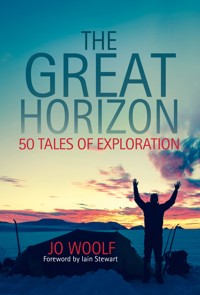
Fifty stories of adventure and exploration over more than two hundred years of human history. The Great Horizon features those who set out to conquer new territories and claim world records alongside those who contributed to our understanding of the world all but accidentally. Published in association with the Royal Scottish Geographical Society, and with full access to their extensive records, the book includes unique images and insights from the RSGS archives, along with never-before seen material.
Sie lesen das E-Book in den Legimi-Apps auf:
Seitenzahl: 571
Veröffentlichungsjahr: 2017
Das E-Book (TTS) können Sie hören im Abo „Legimi Premium” in Legimi-Apps auf:
Ähnliche



















First published in Great Britain by
SandstonePress Ltd
Dochcarty Road
Dingwall
Ross-shire
IV15 9UG
Scotland
www.sandstonepress.com
All rights reserved.
No part of this publicationmay be reproduced, stored
or transmitted in any form withoutthe express
written permission of the publisher.
Copyright © Jo WoolfFRSGS 2017
Images: copyright as ascribed
Editor: K.A. Farrell
The moral right of Jo Woolf to be recognised asthe
author of this work has been asserted in accordancewith the
Copyright, Designs and Patents Act 1988.
The publisheracknowledges subsidy from
Creative Scotland towards publication of this volume.
Published in partnership with the Royal ScottishGeographical Society.
The RSGS is a charity registered in Scotland, No: SC015599
ISBN: 978-1-910985-88-5
ISBNe: 978-1-910985-89-2
Front coverimage © Bengt Rotmo
Back cover image © Nick Hayes
Cover designand picture layout by Raspberry Creative, Edinburgh
Ebook compilation by IolaireTypography Ltd, Newtonmore
Contents
List of illustrations
List of image credits
Acknowledgements
Foreword – Professor Iain Stewart
Introduction
ICE
Fridtjof Nansen
Robert Peary
Robert Falcon Scott
Teddy Evans
Sir Ernest Shackleton
William Speirs Bruce
Roald Amundsen
Sir Wally Herbert
Sir Ranulph Fiennes
Børge Ousland
VOYAGERS
Tim Severin
Isobel Wylie Hutchison
Isabella Bird
Sir John Murray
Mary Kingsley
Sven Hedin
Dame Freya Stark
Bertram Thomas
Robert Ballard
Michael Palin
HEAVEN AND EARTH
Sir John Lubbock (Lord Avebury)
Sir Archibald Geikie
Sir Francis Younghusband
Frank Kingdon Ward
George Mallory
W. H. Murray
Sir Edmund Hillary
Sir Chris Bonington
Sir Alan Cobham
Neil Armstrong
MISSIONARIES AND MAVERICKS
David Livingstone
Henry Morton Stanley
Joseph Thomson
Fanny Bullock Workman
Annie Taylor
Lord Kitchener
Mildred Cable, Eva and Francesca French
Frederick Marshman Bailey
Marion Newbigin
Rosie Swale Pope
VISIONS FOR CHANGE
John George Bartholomew
Sir Patrick Geddes
Sir Hubert Wilkins
Thor Heyerdahl
Wangari Maathai
Dick Balharry
Sir David Attenborough
Sir David Hempleman-Adams
Karen Darke
Craig Mathieson
Afterword – Mike Robinson
Select Bibliography
List of illustrations
1. Sketch by W.A. Donnelly depicting the inaugural address by H.M. Stanley to the newly-formed Scottish Geographical Society at the Music Hall, Edinburgh, on 3rd December 1884.
2. Map annotated by Sir Ernest Shackleton, showing his intended route across Antarctica on the Imperial Trans-Antarctic (Endurance) expedition of 1914-17. The crossing was never made, as fate led them on a different path.
3. Gilbert Kerr, piper on Speirs Bruce’s Scottish National Antarctic Expedition, entertains a bemused Emperor penguin in the Antarctic.
4. Members of Fridtjof Nansen’s Greenland expedition, 1888-1889. L to R: Ole Ravna, Otto Sverdrup, Fridtjof Nansen, Kristian Kristiansen, Oluf Christian Dietrichsen, Samuel Balto. Ravna and Balto from Lapland are wearing traditional ‘caps of the four winds’.
5. Leaflet advertising George Mallory’s lecture to RSGS in November 1922. The photograph shows Everest from the Rongbuk Glacier base camp.
6. ‘Carriage by bearers’ – a lady’s carrying chair, photographed (and probably used) by Isabella Bird in China c.1900.
7. Sir Alan Cobham landing his seaplane on the Thames in London on 1st October 1926 after his round trip to Australia.
8. Neil Armstrong receiving the Livingstone Medal from RSGS President, Lord Balerno, in March 1972.
9. First page from the RSGS Visitors’ Book dated 4th and 5th December 1884. Among the first signatories are H M Stanley, Joseph Thomson, John George Bartholomew and Agnes Livingstone Bruce, daughter of David Livingstone.
10. Map of Loch Lubnaig from the Bathymetrical Survey of the Fresh-water Lochs of Scotland, 1897-1909, undertaken by Sir John Murray and Laurence Pullar. The maps were produced by Bartholomews of Edinburgh.
11. Menu from RSGS celebratory banquet held in honour of Fridtjof Nansen in Edinburgh in February 1897.
12. Telegram to the RSGS from Robert Peary announcing his ‘discovery’ of the North Pole on 6th April 1909. His claim was later shrouded in doubt.
13. Tickets to a lecture by Robert Falcon Scott entitled ‘Furthest South’ in St Andrew’s Hall, Glasgow, on 14th November 1904.
14. Dungle Phuntsok, grandson of the Mönba guide who led Frank Kingdon Ward and Lord Cawdor into the Tsangpo Gorge in Tibet, points out the route that the explorers took in 1924.
15.The Times Everest Colour Supplement of 1953, signed by Sir Edmund Hillary and other members of the Everest team including team leader Sir John Hunt.
16. Aerial view of the Northabout, the vessel in which Sir David Hempleman-Adams and his crew circumnavigated the Arctic ice in 2016 to highlight the effects of global warming.
17. Børge Ousland picks his way over pack ice near Sredny in Arctic Russia, in preparation for his North Pole expedition of 1994.
18. Karen Darke hand-cycling in the Tibetan Himalaya.
19. Rosie Swale Pope pulling her specially-designed cart through Alaska in November 2005, on her round-the-world run.
20. Craig Mathieson holding an RSGS flag at the South Pole on 28th December 2004.
List of image credits
Chapter portraits
ICE
Nansen: Henry Van der Weyde*
Peary: NOAA Photo Library*
Scott: Unknown**
Evans: 1914, Bain News Service
Shackleton: Unknown**
Spiers Bruce: Messrs Thomson, London*
Amundsen: Unknown*
Herbert: Sir Wally Herbert on the Arctic Ocean, 1968. Copyright Herbert Collection, Polarworld www.polarworld.co.uk. Used with permission.
Fiennes: Liz Scarff
Ousland: Thomas Ulrich. Reproduced with kind permission of Børge Ousland.
VOYAGERS
Severin: Arthur Magan, from the Severin Archive. Reproduced with kind permission of Tim Severin.
Wylie Hutchison: Every attempt has been made to trace the copyright holder**
Bird: c.1899, photographer unknown*
Murray, J. 1923, William A Herdman Founders of Oceanography andTheir Work: an Introduction to the Science of the Sea, Edward Arnold & Co.
Kingsley: Wellcome Images, via Wellcome Trust.
Hedin: Dated 3rd December 1897 and signed ‘Yours faithfully, Sven Hedin, Edinburgh’.**
Stark: John Murray Collection.
Thomas: Reproduced with kind permission of Patricia Knowles.
Ballard: Courtesy of Titanic Belfast.
Palin: John Swannell.
HEAVEN AND EARTH
Lubbock: From a drawing by George Richmond RA in 1867, reproduced by courtesy of the Lubbock family.
Geikie: Reginald Grenville Eves (1913)*
Younghusband: ‘A German staff officer in India’, 1909*
Mallory: From a lecture programme (1922)**
Kingdon Ward: Undated studio portrait**
Murray, WH: J. Stephens Orr.
Hillary: c.1953, photographer unknown*
Bonington: Stuart Walker, Chris Bonington Picture Library.
Cobham: Bain News Service*
Armstrong: NASA publicity image*
MISSIONARIES AND MAVERICKS
Livingstone: Portrait by Frederick Havill*
Stanley: Unknown**
Thomson: Unknown*
Bullock Workman: Unknown*
Taylor: From Travel and Adventuresin Tibet by William Carey (1902)*
Kitchener: Reproduced from De Guerville, A B, New Egypt, E P Dutton & Company, New York, 1906.*
Cable, French & French: Unknown*
Bailey: c.1934, photographer unknown*
Newbigin: Unknown**
Swale Pope: Bob Collins. Reproduced with kind permission of Rosie Swale Pope.
VISIONS FOR CHANGE
Bartholomew: Edward Arthur Walton*
Geddes: Unknown**
Wilkins: c.1922. Reproduced with kind permission of the Ohio State University, Byrd Polar and Climate Research Center Archival Program, Sir George Hubert Wilkins Papers.
Heyerdahl: Kon-Tiki Museet*
Maathai: Martin Rowe.
Balharry: With kind permission of Scottish Natural Heritage.
Attenborough: Courtesy of Mike Robinson, RSGS.
Hempleman-Adams: With kind permission of Sir David Hempleman-Adams.
Darke: Hannah Dines, reproduced with kind permission of Karen Darke.
Mathieson: With kind permission of Craig Mathieson.
Photo Section
1. Sketch by W.A. Donnelly, from the RSGS archives by kind permission of RSGS
2. From the RSGS archives by kind permission of RSGS
3. Unknown*
4. Siems & Lindegaard.
5-9. From the RSGS archives by kind permission of RSGS
10. As ascribed. From the RSGS archives by kind permission of RSGS.
11-13. From the RSGS archives by kind permission of RSGS
14. Kenneth Storm Jr, reproduced with permission.
15. From the RSGS archives by kind permission of RSGS.
16. With kind permission of Sir David Hempleman-Adams.
17. Kjell Ove Storvik, with kind permission of Børge Ousland.
18. Fiona Duncan, with kind permission of Karen Darke.
19. Bob Collins, with kind permission of Rosie Swale Pope.
20. With kind permission of Craig Mathieson.
* Public domain
** From the RSGS archives by kind permission of RSGS
Every effort has been made to trace the copyright holders.
Acknowledgements
This book has been made possible through the interest, support and co-operation of many individuals and organisations. I have made lots of friends while writing it, and have been deeply touched by the enthusiasm of so many, both here in Scotland and around the world.
First and foremost, my heartfelt thanks go to everyone at the Royal Scottish Geographical Society, who supported this idea right from the start and believed in my ability to bring it to fruition. The RSGS is such a happy place to work and a lovely organisation to be a part of. In particular I would like to thank Mike Robinson, Chief Executive, and staff members Gemma McDonald, Susan Watt, Anne Daniel and Linda Davidson. Thank you all so much for your enthusiasm, encouragement and friendship.
My sincere thanks to RSGS Chairman, Roger Crofts, and the Board of Directors; to the Archive Collections Team comprising Margaret Wilkes, Kenny Maclean, Bruce Gittings, Pat Brown, Andrew Cook, Tony Simpson, Blair White, Cameron Ewen, and Michael Cairns; and all the other volunteers, both in the RSGS offices and in the Fair Maid’s House, who have been so helpful and enthusiastic.
Grateful thanks to Professor Iain Stewart, President of the RSGS, for his warm support of this book and for writing the Foreword.
I wish to thank all the RSGS members and other benefactors who helped to make this book a reality with pre-orders and donations. What a huge vote of confidence, and greatly appreciated! The RSGS would like to acknowledge with thanks the support received from The Patron’s Fund and RSGS Treasurer, Tim Ambrose.
This brings me to the explorers themselves. Special thanks to Børge Ousland, Craig Mathieson, Karen Darke and Sir David Hempleman-Adams who generously shared memories and images of their experiences while I was writing their chapters. My research has also brought me into contact with some relatives and descendants of past explorers. In particular I would like to thank Patricia Knowles, great-niece of Bertram Thomas; Kaye and Andrew Ridge, great-niece and great-great-nephew of Sir Hubert Wilkins; Oliver Tooley, grandson of Frank Kingdon Ward; the Lubbock family, in particular Lord Avebury; and Alexandra Shackleton.
For the generous supply of images, I would like to thank Frances Daltrey (for Sir Chris Bonington); Audrey Scott (for Bill Murray); Paul Bird (for Michael Palin); Joyce Burnett (for Sir Ranulph Fiennes); Rosie Swale Pope and James Swale; Tim Severin; Kenneth Storm Jr; and Kari Herbert. Many thanks to Bengt Rotmo, for allowing us to use his beautiful image on the front cover; for the fantastic artwork on the back I would like to thank Nick Hayes.
Members of organisations and institutions offered valuable assistance in my research, among them Håkan Wahlquist at the Sven Hedin Foundation; Sabine Kraus at Sir Patrick Geddes’s Scots College, Montpellier; Olive Geddes at the National Library of Scotland; and Lucy Martin at the Scott Polar Research Institute. I would also like to thank Laura J. Kissel, Polar Curator, Byrd Polar Climate Research Center Archival Program, Ohio State University; Mark Pharaoh at the South Australia Museum; Dr Janet Owen at the Royal Society; Andrew Renwick and Nina Hadaway at the Royal Air Force Museum, London; Kenneth Cox of Glendoick; Ian Baker; staff at the British Library, including John Falconer; the Royal Botanic Gardens, Edinburgh; and the National Portrait Gallery.
I would like to thank Sir David Attenborough (via Michael Ridley of DLA Piper) for kindly permitting me to use quotes from Lifeon Air.
For their enthusiastic and professional support of this project, and for seeing it through to a happy conclusion, I would like to thank everyone at Sandstone Press, in particular Kay Farrell and Bob Davidson. My thanks also to Ruth Killick Publicity, Roger Smith and to Heather Macpherson of Raspberry Creative Type for her superb design.
From the bottom of my heart I thank my husband Colin for being an unfailing source of love and support; likewise Verity and Chris, Leonie and Andrew. You are my inspiration.
Foreword
Aswe plunge headlong into the twenty-first century, it is tempting to think that the era of Earth exploration is over. After all, we are now in the ‘Human Age’ – the Anthropocene – an epoch in which humans have chemically if not physically touched virtually every corner of our planet, including its deep oceans and upper atmosphere, and the digital eyes of satellites, cameras and drones have scanned the entire face of the Earth. What’s left to find?
In that light, globetrotting adventures of the kind chronicled here might seem like anachronisms from a bygone golden age of exotic discovery. Certainly, the Royal Scottish Geographical Society nurtured and encouraged many of those wild and wonderful nineteenth and twentieth-century expeditionary forays. The archives and artefacts adorning its Perth home – the Fair Maid’s House – evoke many of those past marvels and exploits, while its prestigious talks programme still gives public voice to first-hand accounts from the latest generation of wayfarers and voyagers. Indeed, the Society has three ‘in residence’ explorers of its very own, though they are more likely to be ‘out of office’ in the snowfields of the Arctic north.
For, as is clear from the final pages of this collection, there is a very real and vital need for modern adventurers of the type long celebrated by the Society. Many of the deep-seated signs of a planet under pressure from our modern industrial society are manifest most clearly in distant lands – amid the Arctic or Antarctic ice floes, on Alpine and Himalayan peaks, in deserts and drylands, and along tropical coralline shores. Highly tuned natural systems are subtly shifting, and with them the lives and livelihoods of those who depend on them.
Today, more than ever, we need daring and passionate explorers to venture out into the wilds to track, chart and document the transformations that are happening around us. Across the globe, people and place are changing at a quickening pace. Just as the Society championed past explorers who boldly went where none had gone before, so it seeks to excite and incite a new breed of adventurers to report back from the planet’s front line.
Those frontline reports will, in turn, feed a broader appetite for armchair adventure among those who, for whatever reason, cannot journey far afield to indulge in their own escapades of derring-do. Perhaps someone like me, raised in the Scottish flat lands on a diet of David Livingstone, Mungo Park and James Bruce, and who assumed that ‘explorer’ was a standard profession that emerged out of school Geography lessons. Or perhaps someone who simply travels in the mind, infusing them with fascination for our remarkable world, past and present.
For whatever the motivation of those who read these pages, this is a collection of geographical grit designed to inspire.
Iain Stewart
President of the Royal Scottish Geographical Society
Introduction
InDecember 1913, when Sir Ernest Shackleton publicly announced his plans for the Endurance expedition to the Antarctic, he received nearly five thousand letters from hopeful applicants. Shortly afterwards, a friend noticed that these letters had been sorted into three large drawers in his desk, which he had labelled ‘Mad’, ‘Hopeless’ and ‘Possible’.
Shackleton could only accept fifty of those applications, and it is tempting to wonder how many from each category were successful. I would love to believe those he considered ‘mad’ stood the best chance of all.
When asked to imagine an explorer, we likely picture someone muffled in furs and battling Arctic winds, or perspiring in the heat as they hack their way through an equatorial jungle. Exploration seems to be a basic human instinct; the Phoenicians and ancient Greeks, the Romans, the Vikings and the Polynesians all set sail in a quest for new territory. This questing spirit is also seen in the European Age of Discovery which inspired Christopher Columbus, Vasco da Gama and Ferdinand Magellan. In more recent centuries, explorers such as James Cook, Mungo Park and John Franklin staked their lives – and lost them – in the great unknown.
By the late nineteenth and early twentieth centuries, vast regions of the world still lay unexplored; there were, quite literally, blank spaces on the map. In the pure spirit of adventure, these attracted men and women whose curiosity spurred them to travel the unknown landscape, and tantalised the minds of scientists eager to expand and enhance their knowledge. Then there was political power; if a nation could plant a flag in these uncharted places, it could claim them as its own. Explorers often took on many roles, for example as scientists, cartographers, ethnographers, even negotiators and diplomats. Very often, therefore, their stories are linked with events in the wider world. In the late 1800s the ‘scramble for Africa’ saw European countries vying to claim slices of the continent for trade; meanwhile the ‘Great Game’ was playing out in Central Asia, as Russia and Britain manoeuvred for power in the Himalayas. This is true even of more modern figures; Neil Armstrong’s first steps on the moon were arguably precipitated by the Cold War.
Some found themselves especially drawn to those inhospitable parts of the globe where the extremes of climate made human survival all but impossible. The Arctic and the Antarctic captured the imagination. The discovery of the Northwest and Northeast Passages opened up shorter routes for trading vessels, while the Antarctic was identified as a vast continent. For a growing band of explorers, the ultimate prizes were the Poles.
In more recent decades, our perception of exploration has undergone a subtle change. The euphoria that greeted new ‘conquests’ in previous centuries has gradually been replaced by a sense of responsibility. As we begin to understand the absolute dependence of human life on the survival of our natural environment, the efforts of modern-day explorers are focused on enhancing our awareness and encouraging us to look ahead for the welfare of generations to come. Although Sir Patrick Geddes warned us that ‘environment and organism, place and people, are inseparable’1 over a hundred years ago, we are only just beginning to appreciate the truth in his words.
The experience of the explorer himself has changed, too. From the time when voyagers would bid goodbye to their families and head off into the great unknown, with absolutely no contact for several years at a time, we have progressed into an era of digital technology which allows instant communication and precise global positioning. Increasingly, the feeling that those early pioneers must have known is going to be lost to us: their vulnerability, their total isolation. It took nearly eleven months for the news of Scott’s death to reach the outside world. Admiral Teddy Evans, along with Tom Crean and William Lashly, was one of the last people to see him alive; as the two groups parted ways and Scott’s men headed towards the South Pole, Evans watched them until they became specks on the ‘great white horizon’.2
In 2014 I was invited to the headquarters of the Royal Scottish Geographical Society, to discuss writing about some of their medal recipients. The long list of names, stretching back to the late 1800s from the present day, reads like a Who’s Who of exploration. Alongside the ‘greats’ of Scott, Shackleton and Amundsen were some unfamiliar names that invited further investigation. From that point I set out on my own journey of exploration.
The RSGS was established in 1884, the brainchild of a forward-thinking young cartographer named John George Bartholomew, whose influential friends included Agnes Livingstone Bruce, the daughter of David Livingstone, and Professor James Geikie of the University of Edinburgh. A meeting to constitute the newly formed Scottish Geographical Society was held in the Hall of the Chamber of Commerce in Edinburgh on 28th October 1884, and a little over a month later the inaugural address was delivered by the celebrated African explorer Henry Morton Stanley. In 1887 the Society was granted Royal status by Queen Victoria.
Besides promoting geographical education, the Society will direct its attention to the encouragement and assistance of exploration in unknown countries...3
It was an auspicious beginning. Indeed, the RSGS was blessed with so much support, from both Council members and public subscriptions, that the newspapers wondered openly why a Scottish geographical society had never been thought of before. The nineteenth century had seen an explosion in scientific knowledge and the public’s appetite for new discoveries was perhaps unprecedented at that time. The RSGS was welcomed as a champion of the newly emerging science of geography, setting the stage for explorers to share their stories of daring adventure with audiences throughout Scotland – which they did in their hundreds, year after year. Some sought purely to share their knowledge, while others also hoped to engage public interest in order to finance their next expedition.
It is hard to describe my excitement as their stories began to unfold, for the life of each person turned out to be a revelation. Mountains, deserts and oceans opened up for me as they had for the explorers themselves. I realised that these people were vulnerably human, with all the human qualities of fear and doubt. Diverse as the characters were, each had a connection with the RSGS, either as a medal recipient, a Fellow, a Council member or a guest speaker. I felt there must be a way of celebrating the Society’s wholehearted support of these explorers and scientists throughout its 130-year history. That is how the idea for this book was born.
On the first page of each chapter you will find brief details about the explorers and their connection to the RSGS. This includes any medals or Fellowships they have received. The Society periodically bestows a total of eleven different awards, but here I have described only those that are relevant to these particular explorers.
The Gold Medal (renamed the Scottish Geographical Medal in 1933) is the Society’s oldest gold medal, first awarded in 1890 ‘for work of conspicuous merit within the science of geography itself, e.g. by research, whether in the field or otherwise, or by any other contribution or cumulative service to the advancement of the science.’4 The Society continues to present it periodically for ‘conspicuous merit and a performance of world-wide repute.’5 From its early years, the Society also bestowed Silver and Bronze Medals, which were often given to additional members of an expedition.
Struck in gold, the Livingstone Medal was endowed in 1901 by Agnes Livingstone Bruce in memory of her father, David Livingstone. Originally presented for ‘outstanding public service in which geography has played an important part, either by exploration, by administration, or in other directions where its principles have been applied to the benefit of the human race’6, it is now awarded ‘for outstanding service of a humanitarian nature with a clear geographical dimension.’7
The Mungo Park Medal was introduced in 1930. Named in honour of the Scottish-born explorer, this medal is presented ‘for outstanding contribution to geographical knowledge through exploration or adventure in potentially hazardous physical or social environments.’8 The Geddes Environment Medal, introduced in 2009, celebrates the philosophy of Sir Patrick Geddes and is awarded ’for an outstanding contribution to conservation of the built or natural environment and the development of sustainability’.9 Finally, Honorary Fellowships, first introduced in 1888, are awarded ‘in recognition of services to the Society and to the wider discipline of geography’10; recipients may place the letters FRSGS after their name.
The very bones of the pioneers became the stepping stones of knowledge.11
Wherever possible, I have used reference material from the RSGS archives. Of these, the ScottishGeographical Magazine (the academic journal of the RSGS) is the primary source. Newspaper cuttings, especially from the early days, are a goldmine of detailed observation, while other reference material includes lecture programmes, leaflets, invitations and even banquet menus. It is lovely to look through the lecture sheets and imagine the anticipation that preceded an appearance by Nansen, for instance, or George Mallory. How I would love to have been there in person!
In some cases, my investigations led me to make contact with descendants or family of the explorers, or the explorers themselves, all of whom have been very helpful.
With so many fascinating people to write about, it was a challenge to limit myself to fifty. Even with the scope defined by the timeline of the RSGS, what a vast array of stories can be found! I have deliberately mixed more famous characters with a generous scattering of lesser-known ones, in the hope that, while you are reacquainted with some of your lifelong heroes, you may find some more. Time after time, I have been astonished to discover that these ‘quiet voices’ have hair-raising stories to tell. Annie Taylor, for example, or Hubert Wilkins, or Frederick Marshman Bailey have been half forgotten by history, but they deserve to be brought back into the limelight.
From our present-day viewpoint, some of the choices are undeniably controversial: Henry Morton Stanley, for instance, or Lord Kitchener. As I read about these potentially difficult characters, I began to think that there was more to appreciate about their nature, and wondered if history had required them to make the best of a situation they had created for themselves. Please understand, I am not attempting to justify prejudice or violence, but it was rewarding to try and glimpse the human spirit beneath the hardened shell.
Some of the most amazing stories are those of the women, who in the early days had an additional barrier to overcome: the prejudice attached to their sex. However, the RSGS was co-founded by a woman and opened its doors to women members from the very beginning, welcoming a large number of female speakers including Mary Kingsley, whose first ever public lecture was delivered in Edinburgh. The lives of these remarkable women, who usually travelled alone and revelled in the freedom and spontaneity, make an interesting contrast with the many military-style expeditions that are essentially the domain of men. There are exceptions, of course; Fanny Bullock Workman had the organisational capacity of an army general, whereas Frank Kingdon Ward could be lured down just about any precipitous gorge in the Himalayas if a rare and beautiful plant lay at the bottom of it.
As my research progressed, it seemed that some of these explorers fell naturally into groups. The polar explorers, of course, were the most obvious, and these are in the section called ‘Ice’. Then there were those who set sail across oceans of sea or sand, and they became the ‘Voyagers’. ‘Heaven and Earth’ is devoted to scientists, mountaineers, an aviator and an astronaut, while ‘Missionaries and Mavericks’ contains a colourful mix of characters, each a rebel in their own way. Finally, in ‘Visions for Change’, I have collected remarkable people from every era, whose messages challenge us to follow our own dreams, deepen our understanding and take steps towards a better future for the Earth and its inhabitants. Over the years, many of the place-names in this book have been spelled in a variety of ways. In most cases, for the sake of consistency I have chosen to use the form or spelling which would have been familiar to the explorers themselves.
The business of the discoverer is to leap into the dark – taking, of course, all the precautions he can to light softly.12
So what makes an explorer? The fur coats, the jungle heat? Is there some defining element in his personality which propels him towards that great horizon? Can you see it written in her face, along with the sunburn or the frostbite? And how many of them belong in Shackleton’s ‘Mad’ drawer? These are the questions I found myself pondering while writing this book. Explorers are often described as inspirational, and indeed there is something to inspire in every story, especially those where the instinct for discovery is rooted in a heartfelt desire to care for fellow human beings and the environment in which we live. Is this what exploration is about, as the new generation succeeds the old? Are we not all explorers, after all?
Jo Woolf
Perth, July 2017
1. Patrick Geddes, quoted in Patrick Geddes in India by Jaqueline Tyrwhitt (1947)
2. Dundee Advertiser, report on lecture by Teddy Evans to RSGS in Dundee, 19th November 1913
3.Prospectus of The Scottish GeographicalSociety, 1884
4. Report of Council, Scottish Geographical Magazine (1930), 46:6
5. RSGS website
6. Report of Council, Scottish Geographical Magazine (1930), 46:6
7. RSGS website
8. RSGS website
9. RSGS website
10. RSGS website
11.The Scotsman, 5th June 1895, from an editorial about Franklin Commemoration, quoting W. Scott Dalgleish, RSGS Secretary
12.TheScotsman, 20th November 1885, report on Lieut Adolphus Greely’s lecture to RSGS in Synod Hall, Edinburgh, 19th November 1885
ICE
Dr Fridtjof Wedel-Jarlsberg Nansen
Polar explorer, scientist, humanitarian, Nobel Peace Prize winner
Born: 10th October 1861 (Oslo)
Died: 13th May 1930 (Oslo)
§
RSGS Gold (Scottish Geographical) Medal, 1897
Honorary Member of RSGS
In1886, at the Royal Lyceum Theatre in Edinburgh, a twenty-five-year-old Norwegian man confided an astonishing ambition to a young Scotswoman as they watched a performance of Hamlet. One day, he told her, he would be the first man to cross Greenland, and in doing so would reveal to the world what lay in its unexplored interior. Marion Sharp, the vivacious and free-minded girl sitting next to him, saw no reason to dispute the claim. She knew the unyielding nature of Fridtjof Nansen well enough to believe he could succeed.
On 23rd May 1889 TheScotsman published a telegram which had been received by the Royal Scottish Geographical Society. It read: ‘Copenhagen, 6.50 AM—Safely arrived. Hearty thanks. Greeting friends, Edinburgh. Fridtjof Nansen.’1 True to his word, Nansen had made the first crossing of Greenland. In a short accompanying tribute the Secretary of the RSGS, Mr A. Silva White, acknowledged the remarkable feat, and added that the Society hoped to have a paper from Dr Nansen by the next session.
This was the first tangible proof that Nansen was a force to be reckoned with. What drove him on, and how did he hatch such an outrageous plan in the first place?
By the time he was eighteen, Nansen knew he was unlike his peers, although he could not explain why. He was the son of a lawyer in Christiania (now Oslo), and with his brother and step-brothers would go away for weeks on walking and skiing tours in the vast Norwegian forest. He was a skilled hunter and sportsman, excelling in the winter competitions that were held regularly in the surrounding countryside. It sounds like an exhilarating life, but Nansen was aware of a darkness within himself. Once he came up against an obstacle – a terrifying ice-cliff, for example – it took hold of his mind until he was compelled to throw himself against it or down it, trusting to his athleticism and determination to survive. If the Norse gods were watching over Christiania, they must have held a special conference over his fate.
Despite his habit of courting death, the young daredevil had to think about temporal things, the most urgent of which was his choice of career. On the face of it, a degree in zoology offered many splendid prospects: a respectable profession, an academic post and the promise of a dependable income. The course of study would include field trips to far-flung places, allowing students to examine organisms in their natural environment. In his second year at the University of Christiania, Nansen responded to an invitation to study marine life in the polar regions. He had to make his own arrangements for travel, and in March 1882 boarded a vessel bound for the Arctic. This voyage awakened new desires that would change the course of his life.
I got the idea one day in 1882, whilst on board a Norwegian sealing-ship [and] we were ice-bound for twenty-four days near the still unknown part of the east coast of Greenland, and from that time I could not get it out of my mind.2
Staring at unexplored terrain for the best part of a month must have played havoc with his brain. The crew, who were all hardened seamen, were focused on collecting seal skins and they were happy to ignore the challenge of geographical discovery. From the crow’s nest, Nansen gazed over what is now Christian IX Land and he begged the Captain to put him ashore. The Captain refused on the grounds of safety, and when the ship broke free of the ice, Nansen watched the coast of Greenland melt back into the distance. He arrived home with a commendable haul of zoological specimens and a new sense of yearning that wouldn’t go away.
Greenland, at that time, still held a special appeal in the minds of geographers. What lay in its interior? There had been several doomed attempts to cross it in previous centuries, and in 1886 the American explorer Robert Peary had ventured 100 miles east from Godhavn before turning back. Now Nansen saw a way of succeeding where others had failed. He was, after all, a master skier. Deciding that he would travel light and fast, completing the trek in just one season, he would take a small team of hand-picked men and, unlike all the former expeditions, he would travel from east to west. This choice of direction was governed entirely by logic. At that time, there were Danish settlements on the west coast of Greenland, whereas the east coast was virtually uninhabited. If they started from the west, Nansen argued, they would be leaving behind the only place of comfort, the ‘flesh-pots of Egypt’, with nothing ahead of them but the ice-desert. His men could easily grow dispirited and turn around. If, however, they started from the east and travelled west, they would be heading towards the promise of shelter and rescue. Nansen put it more brutally than that. ‘They had no choice, only “forward”,’ he told the RSGS in 1889. ‘Our order was, Death or the west coast of Greenland.’3
People muttered and shook their heads over Nansen’s insane idea. He was not, however, blundering into it with his eyes shut: he had sought the advice of seasoned explorers such as Nordenskiöld and Holm, and was inspired by the legacy of Orkneyman John Rae. He was intensely practical, building lightweight sledges with broad runners, making sleeping bags out of reindeer hide, adopting a new layering system of pure wool garments and redesigning the heating stove so that it was more efficient. He tested them all rigorously on his own outdoor treks. The use of dogs as draught animals was virtually unknown in Scandinavia, and Nansen had no experience of dog-driving. Briefly, he considered taking a team of reindeer, but concluded that the animals needed vegetation on which to graze. He realised that his only option was to man-haul the sledges. It would be an exhilarating challenge. He could not attempt it alone, so he applied his mind to the choice of a team:
I selected three Norwegians, viz. Captain [Otto] Sverdrup, Lieut. [Oluf Christian] Dietrichsen, and a peasant, Kristian Kristiansen Trana. From Lapland I got two Lapps, Samuel Balto and Ole Ravna...4
On 17th July 1888 the party was waved off from a sealing vessel which had deposited them offshore in two small boats, and soon disappeared into the labyrinth of ice floes that choked the fjords of eastern Greenland. As the ship receded from sight, so did all contact with the outside world. They were alone, dependent entirely on their own resources against an unknown land and the vagaries of the weather.
An unknown land it certainly was. It was the best part of a month before they were able to properly set foot on it. The extent of the ice floes meant that they were constantly scanning the horizon for a glimpse of the shore, while trying desperately to avoid collisions and damage to the boats. Meanwhile, the prevailing current swept them ever southwards, so that when they finally struggled ashore on a rocky islet they realised that they were too far south to make a valid crossing, and they were forced to row north again, eventually finding landfall near Umivik. They were exhausted, and by now the Arctic summer was well advanced. Some of the men favoured staying there for the winter, and attempting the crossing next year. Nansen was adamant. They would start now, without delay.
We saw only three things: that was snow, sun, and ourselves. One day was quite like another.5
At first their endurance was tested to the limit as they hauled their sledges across a challenging landscape of crevasses, steep slopes and soft snow. Storms from the north confined them to their tent for days at a time, making their progress slow and painful. As the land rose towards a central plateau the cold became excruciating and the ice smooth and polished, ideal for skiing. When the wind was favourable they lashed the sledges together in pairs and hoisted makeshift sails. Nansen recalled their exhilaration as they clung onto the sledges, gliding down the slopes at tremendous speed.
In September, when darkness began to return, the nights brought an unexpected beauty as the aurora danced like a ‘terrible fire’ across the sky and the moon flooded the ice fields with silver light. It was a wildness that sang to Nansen’s soul, even though, by morning, his head in the sleeping bag was often encrusted with rime from his own breath. He did all the cooking himself, partly because the stove was temperamental and partly because he did not want his men to drink the fuel, which was pure alcohol. Nansen admitted the temptation himself; despite his improvements the stove was stubbornly inefficient and struggled to melt enough snow for drinking water.
Thirst was just one of many hardships, which were worse than any of them could have imagined. In particular, the two Lapps, Samuel Balto and Ole Ravna, were convinced that they were going to die. Nansen had only met them a few weeks before departure, and realised too late that their unfamiliarity with discipline would pose additional problems. Wearing their distinctive ‘caps of the four winds’, the two were venturing out of their homeland for the first time. Although they had lived their lives above the Arctic Circle, and were well used to the climate, they believed they were being led to their deaths by inexperienced strangers. Terrified by the threat of polar bears, they read the Bible with desperate fervour and gave their souls up for lost.
Somehow, Nansen held the party together. On 3rd October, two and a half months after setting out, they arrived in Godthåb (Nuuk) on the west coast. They had missed the last ship home before winter, so their homecoming was delayed until the next spring. Nansen seized the opportunity to learn as much as he could from the Inuit people, who taught him to hunt from a kayak. He was very impressed:
This small skin-boat... is the best one-man vessel in the world... If you are capsized by a sea, and can manage your oar, you can rise again and need not be afraid of anything.6
Overwintering in Greenland proved to be a pleasant experience, and when the Danish steamship Hvidbjørnen arrived to collect them in April 1889, the men were sorry to part from their hosts. These happy people, Nansen observed, were like ‘children of nature’ who did not know real poverty. Samuel Balto’s leave-taking was especially hard; he had fallen in love with an Inuit girl who was engaged to another man. As the ship pulled away he was fighting back tears.
On 21st May they arrived in Copenhagen, and a week later Christiania gave a tumultuous welcome to her returning heroes. By that time it seemed as if the whole world knew Nansen’s name, and everyone wanted to hear his story at first hand. Marion Sharp, the young woman to whom he had confided his dream, was among the first to write and congratulate him.
That July, Nansen gave a detailed account of his findings to the Royal Scottish Geographical Society. During his 260-mile crossing he had, he said, concluded that the Greenland ice sheet was shaped like a shield, rising rapidly from the east coast to reach a height of between 9,000 and 10,000 feet and falling again gradually towards the west. He gave his opinion that its contours were governed not by the underlying land but by meteorological conditions. The team had experienced snowfalls every day, suggesting that the depth of snow in Greenland’s interior was forever increasing. Nansen had an alternative theory: the ice, he said, was constantly moving under pressure. He likened it to an immense layer of pitch that was slowly but inexorably spreading outwards, towards the coast.
This analogy was echoed in an unfortunate supper-time incident which Nansen described:
I remember one night our cooking apparatus was upset, and all our precious pea-soup was poured out over the canvas floor of our tent; but we did not hesitate: we immediately took hold of each side of the floor, lifted it up, and sucked the pea-soup out of the middle. No drop was lost.7
Two months after his appearance in Edinburgh, Nansen was married. His bride was not Marion Sharp, nor any of the other hopeful young women whose paths he had crossed in those early days. His choice was Eva Sars, a dark-haired and enigmatic Norwegian singer whose proficiency on skis nearly matched his own. Eva was single-minded in her own way, and when everything had settled down and Nansen began to look northwards again, she wanted to go with him. In the end she did not, and Nansen had no idea how to comfort her. The story of Fridtjof and Eva is just as stormy and troubled as Nansen’s relationship with the Arctic. Eva was jealous of the attention that her handsome husband received from adoring women, while Nansen’s restless nature urged him away from the happy home life that Eva craved. Their marriage contained long periods of dark isolation punctuated by moments of joy.
In 1893 Nansen set sail on a voyage like no other. His idea was so mad that no other explorer would have given it a moment’s thought. After all, who else but Nansen would dream of allowing his ship to be frozen into the Arctic sea ice, with the intention of drifting over the North Pole? It sounds more like a dark fairy tale, or an extract from one of the Icelandic Sagas. When he departed on his specially designed ship, the Fram, he expected to be away for at least five years; although he was absent for only three, his departure still racked Eva with fresh agonies.
In February 1897, when Nansen was welcomed back by the Royal Scottish Geographical Society as their guest of honour at a glittering banquet, he was recognised as one of the greatest heroes of polar exploration. In presenting him with the second Gold Medal in the Society’s history (the first was awarded to H. M. Stanley), Professor James Geikie, Vice-President of the Society, paid tribute to a man whose story ‘would live to stir the blood and quicken the pulse of all good-hearted men in all time coming.’
Nansen’s response was typically modest. ‘I really do not deserve so much praise,’ he said, ‘as I have only done what I thought was my duty. It is an old saying in Norway – I do not think you have it in Scotland – that a man’s will is his own heaven... I think when I am praised that my comrades are much more to be praised. My comrades believed in me and they went where most men would say there was nothing to find except death.’8
1.The Scotsman, 23rd May 1889, reporting on telegram received by RSGS from Fridtjof Nansen
2. Dr Fridtjof Nansen ‘Journey Across the Inland Ice of Greenland from East to West’, Scottish Geographical Magazine (1889) 5:8, 393-405
3. Dr Fridtjof Nansen ‘Journey Across the Inland Ice of Greenland from East to West’, Scottish Geographical Magazine (1889) 5:8, 393-405
4. Dr Fridtjof Nansen ‘Journey Across the Inland Ice of Greenland from East to West’, Scottish Geographical Magazine (1889) 5:8, 393-405
5. Dr Fridtjof Nansen ‘Journey Across the Inland Ice of Greenland from East to West’, Scottish Geographical Magazine (1889) 5:8, 393-405
6. Dr Fridtjof Nansen ‘Journey Across the Inland Ice of Greenland from East to West’, Scottish Geographical Magazine (1889) 5:8, 393-405
7. Dr Fridtjof Nansen ‘Journey Across the Inland Ice of Greenland from East to West’, Scottish Geographical Magazine (1889) 5:8, 393-405
8.The Scotsman, 15th February 1897, report of RSGS banquet in the Waterloo Rooms, Edinburgh, on 13th February 1897
Rear Admiral Robert Edwin Peary
Arctic explorer
Born: 6th May 1856 (Cresson, Pennsylvania)
Died: 20th February 1920 (Washington DC)
§
RSGS Silver Medal,1897
Livingstone Medal, 1903
Silver ship, 1910
InDecember 1897, a steamer bound for New York prepared to depart Southampton Dock on a week-long voyage across the Atlantic. Passengers lined the decks, waving in excitement to friends and family as they embarked. Among them was an ambitious explorer named Robert Peary, who was returning to his native America after giving a number of lectures to British institutions about his adventures in the Arctic. Recalling his warm reception by the Royal Scottish Geographical Society in Edinburgh, he put his hand in his pocket to turn over the gleaming silver medal which they had presented to him just a few days before: it was not there.
The loss of Peary’s prize was only temporary – it was soon discovered in the auditorium of a London theatre – but it was in a way symbolic. Robert Peary hungered for fame in a way that alarmed his mother and truly tested the patience of his wife. Glory was what he craved, and he meant to achieve it while he was still young. His career in the United States Navy offered good prospects, but to Peary it merely provided a useful training for bigger and better things. He collected clippings and notes on polar exploration, devoured books by Arctic explorers and pictured himself as the ‘discoverer’ of the North Pole. He imagined life in the frozen wastes to be not only endurable, but enjoyable. He wrote to his mother that he did not wish to live and die without accomplishing anything, or without being known beyond a narrow circle of friends.1
Peary’s first trip north was in the company of Christian Maigaard, a young Dane who persuaded him that to travel alone would be suicide. In the summer of 1886 they ventured eastwards nearly 100 miles from Godhavn on Disko Bay in Greenland, pulling their own sledges and escaping from the jaws of crevasses within a whisker of their lives. They wore goggles of smoked glass to protect their eyes against the harsh sunlight reflecting from the snow, and as they slept beneath the midnight sun they tied strips of fur over their closed lids to give an illusion of darkness. It was an important test for Peary, and he soon proved his adaptability. He and Maigaard lashed two sledges together and rigged an improvised sail to ease their passage over the ice. This device lightened the load so well that they had to hurry to keep up with it. Obstacles appeared almost without warning, and each man had to rescue the other on several occasions. Peary slipped into a glacial torrent and was hurtling towards imminent death when the spikes on his shoes snagged on the ice walls, giving Maigaard just enough time to pull him out. In turn, Maigaard stumbled while crossing a deep abyss; he snatched at the rear of the sledge and dangled over the precipice. Peary instantly threw his weight onto the sledge to prevent them both from catapulting into oblivion.
This was the second furthest anyone had ever penetrated the interior of Greenland – only Nordenskiöld in 1883 had gone further – and for Peary it confirmed his life’s goal. The Arctic became his second home, an obsession. Speaking at the RSGS in Dundee in 1897, he told his audience that ‘if he could stay at a fixed place for five years, as he was ready to do if necessary... he believed that some season the door to the Pole would open or could be pushed open.’2 His mother and his wife begged him to settle down, but they were wasting their breath.
Unfortunately for Peary, a rival was about to sneak into his obsessively controlled world in the guise of a ship’s surgeon. Frederick Cook accompanied him on his Greenland expedition of 1891, and treated Peary for a broken leg which he suffered on board ship. Any friendship between the two men, however, was not destined to last very long.
Meanwhile, some more long-term trouble was brewing.
A ‘Furthest North’ of 87°06’, which Peary claimed in 1906, was achieved by dog sled from Ellesmere Island where the ship SS Roosevelt awaited his triumphant return. Peary sowed the seeds of doubt that would later damage his credibility; to the north of Ellesmere Island he claimed to have seen new territory, which he called ‘Crocker Land’ after his sponsor, George Crocker. Eight years later, an expedition led by Donald Baxter MacMillan proved that this land did not exist.
On 21st April 1908, Frederick Cook checked his custom-made French sextant and believed himself to be standing at a spot which was as near as possible to the North Pole. The ship’s surgeon had been nurturing ambitions of his own, and had overwintered at Annoatok in northern Greenland. He had travelled across the ice by dog sled, accompanied by nine Inuit men. Incredibly, the party did not arrive back at Annoatok until April 1909, having miraculously survived the dark Arctic winter.
Around the same time, on 6th April 1909, Robert Peary raised the American flag over a point which he believed to be the North Pole. Since nature had not honoured the North Pole with any distinguishing features, he and his companions built an igloo and posed in front of it for photographs.
To understand why the North Pole was so difficult to pin down, it is important to remember that Arctic ice is not attached to a solid landmass like the Antarctic but instead forms a cap which is constantly shifting on ocean currents. Explorers who set off in a northerly direction often find themselves being borne southwards at a rate that makes their progress even slower. For this reason, the North Pole is an ever-moving point on the surface of the ice that can only be confirmed by careful calculation. In Peary’s time, a sextant would have been used to measure the angle of the sun in the sky; the degree of latitude would then be calculated from the date and precise time of day.
Returning to the Roosevelt, Peary set a southward course at a leisurely pace at least until August, when the vessel stopped at Cape York. Here, Peary learned from the skipper of a whaling vessel that Frederick Cook had laid claim to the North Pole a year earlier, and was – belatedly – on his way to announce it to the world.
Suddenly, a stately triumphal procession had turned into a race – first to the nearest telegraph station, and then back to New York.
The following cablegram has been received by the Royal Scottish Geographical Society in Edinburgh, relative to the discovery of the North Pole: ‘Brooklyn, New York, Royal Scottish Geographical Society, Edinburgh: North Pole discovered April 6th, 1909, by Peary Arctic Club expedition under Commander Peary.’– Bridgman, Secretary.3
Cook reached New York first, and was greeted with widespread acclaim – but his glow of glory faded quickly when Peary stepped in front of the sun. Peary had powerful supporters, some of whom had paid good money to see their names on maps in perpetuity. Peary’s spectacular announcement appeared in the newspapers just a week after Cook’s rival claim, and the obvious discrepancy was a subject of bafflement and intense public scrutiny. Meanwhile, Cook’s evidence was examined by government officials and his claim was pronounced to be ‘not proven’. Cook, it turned out, had a troubled background of his own. Peary was jubilant.
Speaking to a rapt audience of the RSGS in Edinburgh in 1910, Peary relived every moment of his heroic journey in words and pictures. His narrative was positively bristling with military-style detail as he described his programme of marches and the organisation of the team. He was far from proof against a little lyrical embellishment when it came to his own physical fitness, describing himself as being ‘in shape beyond his most sanguine dreams of earliest years.’ As they neared the Pole, the air, he said, was ‘as keen as frozen steel’, with a bitter wind ‘burning the face till it cracked.’
The going was even better than previously, and there was scarcely any snow on the hard, granular, last summer’s surface of the old floes, dotted with the sapphire ice of the previous summer’s lakes. A rise in temperature to 15 degs below zero reduced the friction of the sledges, and gave the dogs the appearance of having caught the spirits of the party. When we had covered, as I estimated, a good fifteen miles, we halted, made tea, ate lunch, and rested the dogs. In twelve hours’ actual travelling time we made thirty miles... I had now made my five marches, and was in time for a hasty observation (at approximately local noon Columbia meridian) through a temporary break in the clouds, which indicated our position at 89 degs, 57 mins.4
It was stirring stuff, and the RSGS, like many other institutions, believed that Peary’s achievement merited an exceptional token of honour. He was grandly presented with a solid silver ship, specially commissioned from Messrs Brook & Son of Edinburgh. Standing two feet high and weighing over 100 ounces, it represented the type of vessel used by illustrious Arctic navigators in the olden times. Not surprisingly, Peary confessed himself speechless at such a magnificent and unique trophy.
Unfortunately for Peary, karma, like the Arctic ice, swings in a slow but inexorable circle. It was not long before Peary’s own evidence, like Cook’s, came under scrutiny. In 1911, representatives of the United States Naval Affairs Sub-Committee expressed surprise at the cleanliness of his diary, which they had expected to exhibit the grimy stains and rough wear of an arduous journey. The pages that recorded his arrival at the Pole seemed to have been added afterwards and, to make things worse, he had taken no one with him who was capable of confirming his sextant readings. Official opinion was divided, but deep-rooted doubts were placed on record. Peary, for reasons which he kept to himself, never again revealed his journals and, after this episode, rarely spoke publicly of his achievement.
Of all the explorers who were drawn to the polar regions, Peary in particular seems to have been a martyr to his own ambitions, sacrificing much in the name of glory. His wife, Josephine, was a staunchly supportive partner, even accompanying him on some of his expeditions, but of their first twenty-three years of marriage only three were spent together. Peary’s second daughter died while he was in the Arctic, before he had even seen her. The revelation of an Inuit mistress shook Josephine to the core. His mother died in 1901, while he was presumed missing but was in fact living among the Inuit in Greenland. His stalwart companion on all but one expedition, an African-American called Matthew Henson, lived the rest of his life in poverty.
Robert Edwin Peary certainly carved a name for himself among the great explorers of his country, and of his era. To salve his disappointment on one of his early expeditions, he summoned a work party to haul three huge meteorites, believed by the Inuit to be sacred stones, back to his ship, which transported them to a New York museum. He even brought back six of the Inuit people, naive and ill fated, fully expecting that they would become living studies in ethnology. Perhaps the meteorites exacted their revenge, because Peary suffered a breakdown at the height of the North Pole controversy, and was later diagnosed with pernicious anaemia. He died in 1920, only ten years after his glittering reception in Edinburgh.
During his lifetime, it was never certain whether Peary really had reached the North Pole. In 1989, the British explorer Wally Herbert was commissioned by the National Geographic Society to examine the evidence, and regretfully concluded that Peary’s claim was untrue. Without realising it at the time, Cook and Peary did a great deal of damage to their own reputations while each sought to discredit the other’s, but the full truth will never be known. As Wally Herbert observed, fame can sometimes appear as tragedy disguised as a reward.
Both Peary and Matthew Henson fathered children with Inuit women while in the Arctic. In 1971 Peary’s grandson, Peter, reached the North Pole in the company of his half-brother Talilanguaq. With them on the expedition, which was led by Italian explorer Guido Monzino, were Avatak Henson, the Inuit grandson of Matthew Henson, and ten other Inuits. Peter Peary trekked to the Pole again in 1978, as a guide for a Japanese expedition. On both occasions he retraced the route taken by his grandfather in 1909. Perhaps only now, as if carried there by his descendants, can Robert Peary’s yearning heart rejoice in standing at the North Pole.
1. Letter from Peary to his mother, 1880
2.Dundee Advertiser, 13th December 1897, report on lecture to RSGS in Dundee
3. Edinburgh Evening Dispatch, 7th September 1909, report of a telegram to RSGS
4.The Scotsman, report on lecture to RSGS in Edinburgh, 25th May 1910
Captain Robert Falcon Scott
Antarctic explorer
Born: 6th June 1868 (Plymouth)
Died: about 29th March 1912, Antarctica
§
RSGS Livingstone Medal, 1904
Insome photographs of Robert Falcon Scott, there is a look of such sadness in his eyes it seems possible he had an inkling of his fate. Or are we, sensitive to the harrowing story of his final weeks, just seeing our own sadness reflected?
In 1887, Scott was competing in a sailing race in St Kitts when he caught the eye of Sir Clements Markham, Secretary of the Royal Geographical Society in London. Markham was a former naval officer whose adventurous years were drawing to a close, so he found an outlet for his enthusiasm in planning other people’s expeditions. He worshipped the British Empire and the Royal Navy and thought they could be brought together in one great, glorious act: the conquest of Antarctica. He was looking for potential leaders and quietly added Scott to his list, struck by his intelligence and charming manner. The eighteen-year-old midshipman had no way of knowing where such distinguished attention would lead.
Meanwhile, a burden of care and responsibility was about to descend upon Scott’s young shoulders. Financial disaster, shortly followed by his father’s death, left his family largely dependent on his meagre income. Scott was at an age when grand gestures and sartorial extravagance were expected of ambitious young naval officers but he had to pare his spending down to a minimum so that his mother and sisters could keep a rented roof over their heads. Already self-conscious, he steered clear of expensive parties and withdrew further into himself. Perhaps this was the reason for his air of detachment, misread by others as insecurity and distrust.




