


Erhalten Sie Zugang zu diesem und mehr als 300000 Büchern ab EUR 5,99 monatlich.
- Herausgeber: The History Press
- Kategorie: Sachliteratur, Reportagen, Biografien
- Sprache: Englisch
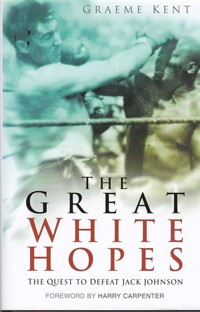
In Sydney, Australia, in 1908 the talented black fighter Jack Johnson won the heavyweight championship of the world from the Canadian Tommy Burns. There was an immediate storm of protest. It was predicted that his reign would lead to civic unrest and race riots. This is the story of sport, racism, corruption and larger-than-life characters.
Sie lesen das E-Book in den Legimi-Apps auf:
Seitenzahl: 420
Veröffentlichungsjahr: 2005
Das E-Book (TTS) können Sie hören im Abo „Legimi Premium” in Legimi-Apps auf:
Ähnliche


















THEGREATWHITEHOPES
THEGREATWHITEHOPES
THE QUEST TO DEFEAT JACK JOHNSON
GRAEME KENT
FOREWORD BY HARRY CARPENTER
First published in 2005
The History PressThe Mill, Brimscombe PortStroud, Gloucestershire, GL5 2QGwww.thehistorypress.co.uk
This ebook edition first published in 2013
All rights reserved© Graeme Kent, 2005, 2013
The right of Graeme Kent to be identified as the Author of this work has been asserted in accordance with the Copyrights, Designs and Patents Act 1988.
This ebook is copyright material and must not be copied, reproduced, transferred, distributed, leased, licensed or publicly performed or used in any way except as specifically permitted in writing by the publishers, as allowed under the terms and conditions under which it was purchased or as strictly permitted by applicable copyright law. Any unauthorised distribution or use of this text may be a direct infringement of the author’s and publisher’s rights, and those responsible may be liable in law accordingly.
EPUB ISBN 978 0 7524 9615 3
Original typesetting by The History Press
CONTENTS
Foreword by Harry Carpenter
Acknowledgements
Introduction
1. ‘There was no Fight!’
2. The Future Assistant Provost Marshal of Baghdad
3. The Philadelphia Irishman and Two Warm Bodies
4. The Hobo
5. A Hot Day in Reno
6. ‘His Chin Begins at His Knees!’
7. The Hopes and Hopefuls Assemble
8. The Cowboy from Driftwood Creek
9. The Bushman and the Blacksmith
10. French Connections
11. The Last Hopes
12. The Pottawatomie Giant
13. The Captains and the Kings Depart
Epilogue
Bibliography
FOREWORD
by Harry Carpenter
This book is about envy: white envy of black talent. The talent belongs to Jack Johnson, the first black man to win the world heavyweight championship. Because he was black, and successful, he was reviled in the USA by white men. Mind you, he didn’t help his cause. He was saucy, he smiled a lot (this was interpreted as a sneer), he flaunted his wealth with fast cars and sprauncy clothes, and, oh, the horror of it, he married two white women and formed a liaison with a third, which led to a criminal charge and exile from the States. In the seven years of his reign as champion, the world of boxing was determined to get him beaten.
Before we get too high-minded about what seems to us now an insane chase for a white Sir Galahad, let’s remember that other sports dragged their feet when it came to recognising black talent. Jackie Robinson was the first black player allowed to participate in major league US baseball, and that didn’t come about until the late 1940s, some thirty years after Jack Johnson had left the world stage.
In Britain black (or coloured, as we had to say then) boxers were denied the right to fight for a British title until 1948. The first man to break the colour bar was Dick Turpin, elder brother of Randolph. Hasn’t there always been a white edginess about black success and doesn’t it still exist? For evidence of that I give you some members of football crowds.
I never met Jack Johnson (he died in 1946), but in the 1950s I went to Texas, Johnson’s home state, where segregation still existed. Black people couldn’t stay in white hotels, couldn’t eat in white restaurants and, when they got on a bus, were banished to the back seats. In those surroundings it wasn’t too difficult to understand how the impact of Johnson’s boxing supremacy must have felt.
The American white hatred of Jack Johnson in those early years of the twentieth century was mirrored when Muhammad Ali came on the scene in the 1960s. Here was a modern-day Johnson: voluble, smiling, taunting, boasting and blessed with a boxing talent such as had not been seen before, or since. The US press immediately pinned the bad-boy label on him. He had too much lip, he was arrogant, he answered back and his unpopularity with white people increased a thousand-fold when he refused to swear the oath of allegiance to the US flag, which meant he wouldn’t go to Vietnam (‘them Viet Cong never called me nigger’). The fate of Jack Johnson now befell Muhammad Ali. He faced a criminal charge and, although he wasn’t forced to leave the States, he was exiled from boxing for more than three years. When he was allowed back, his first opponent, Jerry Quarry, was a white man.
Graeme Kent is a painstaking researcher and writer. You will find plenty in this book you didn’t know before. I thought I knew a bit about Victor McLaglen. I was wrong. I didn’t know the half of it. There are two levels at which Mr Kent’s book is important. It adds considerably to our knowledge of the heavyweight championship and it lays bare a fascinating slice of social history. Graeme Kent has pulled off a fine double.
Harry CarpenterMarch 2005
ACKNOWLEDGEMENTS
I have received much help from many people in the writing of this book, and I would like to express my thanks to them. For information on Victor McLaglen’s service in the Life Guards at the turn of the century I am indebted to K.C. Hughes, Assistant Curator of the Household Cavalry Museum, while details of other aspects of McLaglen’s rather mysterious wartime military career were supplied by Major (retd) J.E.H. Ellis, Curator of the Cheshire Military Museum, Major (retd) J. Rogerson, Curator of the Prince of Wales Royal Regiment and Queen’s Military Museum, and Amanda Moreno, Curator of the Regimental Museum of the Royal Irish Fusiliers.
Patti Wotherspoon of the Vancouver Public Library’s Research and Information Centre provided background information on Jack Johnson’s sojourn in Canada, while closer to home Helen Wallder of the Doncaster Local Studies Library discovered a great deal of material on local heavyweight ‘Iron’ Hague. Tracey Booth of the Local Studies Library, Kingston upon Hull, found information about the early life of Con O’Kelly. Malcolm Matthews of the Local and Naval Studies Section of the Plymouth Library Service provided information about the White Hopes campaign in the West of England. My friend, the late Bob Hartley, was able to supply a great deal of first-hand information about life on the boxing booths and the career of the American heavyweight George Christian. I am indebted to Barry Hugman, Editor of The British Boxing Board of Control Yearbook, for his permission to reprint some of the material on Victor McLaglen that was first published in his annual. I am grateful to Dr Sandra Salin for her meticulous translations of French sporting journals and magazines from the opening decades of the twentieth century.
I am deeply indebted to Harry Shaffer for allowing me access to many old newspaper clippings from his magnificent collection in Archives of Antiquities of the Prize Ring antekprizering.com.
The only other book published on the subject of the White Hopes is White Hope by Oswald Frederick (the late Fred Snelling, doyen of British boxing writers). This is a small paperback published in the 1940s. Fred, with typical modesty, claimed that he wrote it in a few weeks while fire-watching during the London bombing raids. Fred was very kind to me when as a young man I first wrote about boxing in the 1950s, and I hope that I may have done some justice to the topic that is rightfully his.
Finally, I would like to express my gratitude to my editor Sarah Bryce, for her unflagging enthusiasm and support for the project and her dedication and conscientiousness in seeing it through to its conclusion.
Graeme KentLincolnshire, March 2005
INTRODUCTION
The worldwide search between 1908 and 1915 to find a white fighter who could defeat the unpopular black champion Jack Johnson is one of the most unusual yet little-known stories in the annals of world sport. This is the first full-length book to deal with the history of the White Hopes.
Carrying out the research has occupied many years in a number of different countries. A great deal has been written about the charismatic and controversial Johnson, but hardly anything has been said about his Caucasian challengers. Apart from the film actor Victor McLaglen, none of the White Hopes wrote a book about his experiences, and even McLaglen’s autobiography hardly touched upon his ring career. Much of this investigation necessarily has been conducted with the aid of yellowing press cuttings and dusty contemporary accounts of court proceedings between 1908 and 1915, along with other public records and private reminiscences, published and unpublished.
During the bizarre hunt, hundreds of ambitious young men came forward all over the world to challenge Jack Johnson, and thirty or forty of them proved good enough or determined enough to have been classified, no matter how briefly, as a White Hope. Their stories are told, often for the first time, in these pages.
The optimistic Hopes came from different countries and varied backgrounds. Victor McLaglen was the English son of a South African bishop. Oklahoman railway fireman Carl Morris was sponsored by an oil millionaire, failed as a scientific boxer and reinvented himself under the billing of the world’s dirtiest fighter.
Luther McCarty ran away from a tent show where he was selling snake oil dressed as a Native American. George Rodel’s manager claimed that his South African heavyweight had been a Boer War hero, until the unforgiving press discovered that the fighter had only been a child when the war ended. French Hope Georges Carpentier was a genuinely decorated war hero, but was so small that he seldom dared to be photographed next to potential opponents. Handsome, philandering Frank Moran was the boyfriend of silent-film stars Mary Pickford and Pearl White and was stranded penniless in wartime Paris by a heartless manager. There were many others, all with their own fascinating stories.
Their heyday was a brief one, less than seven years in duration, and when it was over the fall from grace for many of them was equally swift. Sandy Ferguson and Jim Barry were both killed in barroom brawls. Al Palzer was shot to death by his own father. Iron Hague was gassed on the Somme and never fought again. Luther McCarty was killed in the ring.
The saga of the White Hopes was played out against a background of vicious racial prejudice and unrest. Only twelve years before Jack Johnson took the title, the US Supreme Court’s decision in Plessy v. Ferguson had upheld the principle of racial segregation. Jack Johnson was feared by many whites as ‘a bad nigger’, the term traditionally applied to slaves who had had the courage to rebel against their masters. To have such a proud and independent man as heavyweight champion, a position Eldridge Cleaver, spokesman for the militant Black Panthers movement, has called ‘the ultimate focus of masculinity in America’, was regarded by many whites as an affront to white supremacy, to be rectified quickly.
The era of the White Hopes was a fascinating one and deserves to be remembered. It is hoped that this account will present a true picture of an unusual and long-departed age.
1
‘THERE WAS NO FIGHT!’
It was several minutes past midday on the afternoon of 26 December 1908. The first World Heavyweight Championship under the Marquess of Queensberry rules between a white and a black boxer was about to end. In the fourteenth round, Tommy Burns, the totally outclassed Canadian heavyweight champion of the world, had been smashed to the canvas for a count of eight. As the fighter staggered to his feet, bleeding from the nose and mouth, Superintendent Mitchell, in charge of the 250-strong police contingent at the ringside in the open-air stadium at Rushcutters Bay, just outside Sydney in Australia, climbed into the ring.
Unable to make himself heard above the noise of the crowd, the inspector indicated to the referee, Hugh D. McIntosh, who was also the promoter of the contest, that he should stop the fight. McIntosh nodded and moved forward to do so. Ignoring him, Jack Johnson, the black American challenger, advanced to finish off the reeling Burns.
Sam Fitzpatrick, Johnson’s manager, and his seconds, terrified that their man would be disqualified, screamed at Johnson to step back. Their cries rose to the cloudless skies; unable to borrow enough wood to complete the stadium, McIntosh had built it without a roof. The black heavyweight saw his handlers’ wild gesticulations and hesitated. McIntosh shouted, ‘Stop, Johnson!’, and placed his hand on the black man’s shoulder as an indication that he was the winner and new champion.
Realising what was happening, Tommy Burns turned on Superintendent Mitchell, who had instigated the stoppage, and swore luridly at him, demanding that he be allowed to fight on. Pat O’Keefe, a British middleweight boxer and Burns’s chief second, hurried across the ring and led the still shouting and struggling former champion back to his corner. Burns was $30,000 richer, the highest sum ever paid to a boxer up to that time, compared to Johnson’s $5,000, but his championship had passed out of his hands.
Towards the end of his life the Canadian would always deny vehemently that he had been outclassed by Johnson. He claimed that the police had intervened mainly because Rudy Unholtz, a Germanborn South African boxer on Johnson’s payroll, had crept under the elevated ring as early as the tenth round. From here, Burns declared indignantly, Unholtz had kept screaming, ‘Stop the fight!’, thus influencing the police at ringside. Few spectators backed Burns’s claim.
In the immediate aftermath of the Rushcutters Bay championship bout, Burns stayed on in Australia and lost much of his purse money at the races. He took his losses philosophically. A shrewd businessman but a pragmatist, he had been paid one dollar and twenty-five cents for his first fight, against Fred Thornton in Detroit in 1900, and he had once journeyed all the way to the Yukon to inspect a gold mine he had won in a poker game. Finding it to be worthless, he had earned his passage back by fighting the local champion, Klondike Mike Mahoney.
For some time Johnson had been pursuing Burns halfway across the world in search of a title shot. Over a nine-year period, he had defeated all the major black contenders and those white heavyweights who would fight him, and now he was 30. He had scraped a living across the USA, working as a sponge fisherman, stable boy, porter, dock labourer and sparring partner. He had ridden the rails as an itinerant wanderer and lived and fought in hobo jungles. Before he had been lucky enough to embark upon an organised boxing career, he had taken part in the horrific ‘Battles Royal’, where half a dozen or more black youths were pitched into a ring at the same time and forced to fight for the delectation of a largely white audience until only one was left standing. It was the right sort of background to produce a tough, bitter and fearless man.
After years in the doldrums, boxing was undergoing a worldwide resurgence, although there was little legislation anywhere to control the sport. There were no national controlling bodies and there was little organisation, just fights everywhere before huge crowds. Even President Theodore Roosevelt in the White House had his own resident fisticuffs trainer in ‘Professor’ Mike Donovan, a grizzled former bare-knuckle fighter and veteran of General Sherman’s Civil War march through Georgia.
Taking advantage of the general enthusiasm for boxing, Johnson decided temporarily to remain in Australia, though definitely not in Sydney. A goodwill visit by a fleet of sixteen US battleships, which had occurred before the title fight, had aroused alarm and anti-black resentment in the city. Many citizens feared that the warships would be crewed almost exclusively by black seamen, who might not take kindly to the prevailing ‘White Australia’ policy. This had caused The Age, a Melbourne newspaper, to state reassuringly, ‘It is not at all probable, however, that a very large proportion of the crews will be found to be coloured. There will be some on the battleships, but they will not be nearly as numerous as rumour is suggesting just now.’
Hugh D. McIntosh had relied on sailors from the fleet to support the Burns–Johnson contest. In fact the Americans showed very little interest in the bout, causing the promoter to remark, possibly with some exaggeration, ‘Australians supported it. I had counted on American sailors for a possible sellout. Exactly two appeared in uniform. They started fighting and had to be evicted.’
Before the fleet had left to sail home, the Australian Defence Minister, Mr Ewing, had urged the departing Americans to tell their fellow-countrymen that they had seen for themselves that Australia was emphatically a white-man’s country and would remain so.
The ‘White Australia’ policy had been sparked off in the 1850s to combat the influx of over 50,000 Chinese immigrants who came to join in the gold rushes. Not only were the new labourers distinctive in their appearance, maintaining their own social customs, they toiled hard and cheaply. Soon they became very unpopular with Australian workers in the goldfields. By 1888, legislation had banned any more Chinese from entering the country. It was not long before the policy was applied tacitly to all non-whites. This was emphasised in 1903, when a trading vessel was wrecked off the coast at Point Nepean. The survivors were taken to Melbourne by a rescuing tugboat, but only the white officers and crew-members were allowed ashore. The non-whites were put on a Japanese mail ship and conducted to Hong Kong. Within another five years, by the time that Burns fought Johnson, most of the South Sea Islanders who had been recruited in the nineteenth century to work in the cane fields of the north had been sent back home.
So how did a black boxer become heavyweight champion of the world on Australian soil? White Australians loved their sport and were becoming increasingly good at it. The English cricket team which had toured the continent in 1907/08 had lost four of the five games it had played against the Australians, while at the 1908 Olympics the Wallabies had defeated England, the only other entrant for rugby football, 32–3.
In addition, boxing was immensely popular in Australia, and in Squires and Lang the country had just produced a pair of formidable heavyweight boxers of its own. So highly were these two regarded by their fellow-countrymen that the world’s leading big men, Jack Johnson and Tommy Burns, had been imported in the hope that the favoured home-grown boxers would defeat them. Unfortunately, both Australians had been crushed by Burns, while Johnson had compounded the national disappointment by thrashing Lang. These impressive results had led to a public outcry for Burns to defend his title against the black challenger, and Johnson had been allowed to return to meet him.
The black fighter’s subsequent victory was a watershed in the history of sport. For the first time, boxing left the sports pages and was featured all over the world in major news stories on the front pages of the contemporary tabloids and broadsheets alike. Typical was the New York Evening Journal, which published a picture of Johnson occupying most of the front page, unprecedented coverage for a sporting personality. Caucasian supremacy had been publicly challenged and humiliated. The fact that the breakthrough had occurred in the haphazard and often crooked world of professional boxing made matters even worse. What, people wondered, appalled, would happen to the established order with the scarcely known and unpredictable ogre Jack Johnson now bestriding the sport like a colossus, a figurehead for his oppressed race?
In the immediate aftermath of his victory the new champion felt that, under the circumstances, he would be more popular on a tour of the remoter areas of Australia than he would in the large cities. He cashed in on his new title by touring Western Australia, fighting exhibition contests and making public appearances. In the outback, with his outgoing personality, gold teeth, shaven head and colourful ring attire, he was a great success. By the end of his short small-hall tour of the Antipodes, he had almost doubled the money he had been paid for fighting Burns. If he had been self-confident before, Johnson was now positively ebullient.
An example of his strong self-worth and refusal to buckle under white pressure occurred in the gold-mining town of Kalgoorlie, when he stopped for a drink in the Palace Hotel. While he was there, one of his many new-found instant friends admired Johnson’s superb defensive qualities but remarked that it would not have been much of a fight at Rushcutters Bay if Burns had not done most of the attacking. Johnson disagreed in lordly fashion, stating that his ability was such that he could force any opponent to lead, while picking him off with his devastating counter-punches. At this, a 61-year-old respectably dressed gentleman with luxuriant mutton-chop whiskers stepped forward from the back of the crowd and informed Jack Johnson crisply that never in a million years could the new champion force him to lead unless he wanted to.
A murmur of recognition went round the bar. The challenger was Larry Foley, the father of scientific Australian boxing, the man who had learnt his trade from Jem Mace, the Swaffham Gypsy, and who had passed it on in turn to such ring luminaries as Peter Jackson, Frank Slavin and Bob Fitzsimmons. Now a local politician, he was in Kalgoorlie for an assembly of state councillors.
Lazily, Johnson unpeeled himself from the bar to face his affronted elderly opponent. He raised his massive fists and started swaying gently, his feet planted firmly on the floor. For three minutes, by the watch of one onlooker, Charlie Rose, who described the odd confrontation in his autobiography, Life’s a Knockout, Johnson feinted, punched the air and made fake attacks. It was all to no avail. The vastly experienced Foley just stood his ground stolidly, refusing to respond to any of the champion’s overtures.
The crowd began to grow restless and jeer at Johnson. The black fighter was not disturbed. Suddenly he bent forward and murmured a scatological remark about Foley’s parentage. The Australian veteran flushed, spat an oath at Johnson and lashed out with his right hand. Johnson deflected the blow easily by placing a massive hand across Foley’s biceps at the crucial moment. Calmly he murmured to the still outraged councillor that the drinks were on Foley.
It was Johnson’s first public exhibition as the champion of how he could always get under the skin of self-important members of the establishment. However, Jack Johnson knew that the big money lay back in the USA, and that, scarred by his experiences, confrontational, self-assured and afraid of no one, he was about to return and make the whites pay dearly if they wanted the title back.
All over the world writer after writer began to stress the fact that Johnson had been completely superior to his outweighed opponent, and declared that a white contender must be found to wrest the title back from the black man. Jack London, the novelist, who had witnessed the bout, led the way. ‘There was no fight,’ he wrote in a New York Herald article syndicated across the world. ‘No Armenian massacre could compare with the hopeless slaughter that took place in the Sydney Stadium today.’ Australian writer W.F. Corbett, also present, demanded despairingly, ‘We now have a black champion of the world. Who will dethrone him?’ The Melbourne Herald said of Johnson’s victory, ‘Already the insolent black’s victory causes skin problems in Woolloomooloo . . . It is a bad day for Australia and not a good one for America. The United States has 90,000 citizens of Johnson’s colour, and would be glad to get rid of them.’
The New York Times demanded the instant emergence of a white champion to undo what had happened in Australia and take the title back from Johnson. The black journal the Colored American Magazine, on the other hand, described the result of the bout simply as ‘the zenith of Negro sport’. It was rumoured in the USA that President Teddy Roosevelt himself, a keen follower of boxing and smarting from recent public condemnation after the disciplining of a black regiment involved in an uprising in Texas, had expressed his concern that a black man had won the supreme crown of pugilism.
This was taking place at a time when blacks made up roughly 10 per cent of the population of the USA, and 89 per cent of the black population lived in the southern states. Only five months earlier there had been a major racial disturbance in Springfield, Illinois. A white man had died of razor wounds inflicted upon him by a black man, and a white woman had subsequently falsely accused a black man of raping her. In the riots that had ensued, businesses had been burnt to the ground, forty black men had been attacked and several killed. Armed militia had been called out and five white men had been shot and killed by the part-time soldiers. After matters had calmed down eighty people were indicted and brought to court. There had been only one minor conviction.
As Jack Johnson prepared to leave Australia for home, more and more newspapers in Europe and the USA joined in the campaign to find a Caucasian heavyweight who would bring the title back to the white race. Johnson was vilified as newspapers devoted hundreds of column inches to the search. Competitions for big men were held in halls all over the world. Managers began to scour the factories, farms, armed services and even prisons for a behemoth who would be their meal ticket in the lucrative scramble to dethrone the black champion. The White Hope campaign had started. It was to lead to seven years of trouble and madness.
2
THE FUTURE ASSISTANT PROVOST MARSHAL OF BAGHDAD
The first fighter that Johnson met after winning the title was probably one of the worst. He was also one of the most interesting and irrepressible. The name of the first White Hope was Victor McLaglen. He was a 22-year-old English soldier of fortune, the son of a South African bishop. For the previous five years, since 1904, he had been working his way optimistically around North America doing a variety of menial jobs. His fighting record was negligible. He was matched against Johnson as a lastminute substitute because the champion and his connections knew that the burly and willing youngster had no chance.
McLaglen claimed to have been born in Tunbridge Wells, Kent, in 1886, one of eight brothers and a sister, although his birth certificate gives the less salubrious East End of London as his birthplace. He had been brought up in South Africa, where his father became Bishop of Claremont. The family then returned to England in 1899, at the time of the Boer War. One of McLaglen’s older brothers, Fred, joined the colours and left for Cape Town.
The 14-year-old McLaglen dearly wanted to follow him, but his father forbade it. McLaglen, who captained the Tower Hamlets schools’ football team, was already tall and looked older than his years. He ran away from home, lied about his age and joined the Life Guards, in the anticipation of being sent to the war. The attestation book of the 1st Life Guards for this period records that he enlisted on 30 July 1901. He gave his age as 19, his trade as engineer, and claimed to have been born in Stepney, London. His complexion was dark and his eyes were hazel.
To his chagrin, Trooper McLaglen, instead of fighting the Boers, found himself spending most of his time on guard duty outside Windsor Castle. It was here that he first learnt to box and took part in his regimental heavyweight championships, fighting grown men when he was only 15 or 16.
For a future professional fighter McLaglen had joined the Army at just the right time. The first independent Army championships had been held only seven years earlier, in 1894. In the following year the sport was given an enormous fillip when Field Marshal Lord Wolsey, the Commander-in-Chief of all Britain’s armed forces, attended the Guards’ boxing competition at Chelsea Barracks and was so impressed by the fighting spirit he saw in the ring there that he declared that in future he wanted to see every soldier a boxer.
Wolsey was just the man to be impressed by a public display of aggression. As a young subaltern he had decided that the fastest, if riskiest, way to promotion was to place himself in harm’s way at every conceivable opportunity. At a speech at the Brigade of Guards’ championships in 1899, before a wildly cheering audience, he stressed the importance of boxing for soldiers: ‘It is conducive to endurance and pluck, and makes men of them – the sort of men who alone can defend us against our foes.’
Efforts to make Army boxing socially acceptable, however, were less successful. When Colonel G.M. Fox, Inspector of Gymnasia at Aldershot, invited a number of ladies to attend the Army finals, the first contest they witnessed was such a bloody one that they swept out en masse, and the experiment was not repeated. But Wolsey’s imprimatur was all that the sport needed in military circles. Officers everywhere did their best to accede to the field marshal’s expressed wish, and placed boxing high on the agenda of training exercises. By 1900, there were 137 entries for the Army championships for other ranks. The officers had their own less-well-supported championships. In the championships for privates and NCOs, entries included seventeen sailors and a number of members of the part-time militia, an early form of the Territorial Army. They were allowed to enter because many of the militia were on standby to leave their civilian occupations to be shipped to South Africa.
The standard in Army boxing was quite high at this time. In one championship final, Private Ham of the Ninth Lancers, a former professional who had boxed under the name of the Bermondsey Boy, was outpointed over three rounds by Sergeant Collins of the Guards. Afterwards Ham protested indignantly that he could not get going in the limited time provided. With the connivance of his officers and the tacit approval of Lord Wolsey and the War Office, the soldiers were rematched over ten rounds at the National Sporting Club. This time Private Ham won.
Like many later boxers, McLaglen found that boxing was a passport to a relatively easy life in the Army. He was excused many of the fatigues that were the lot of his less athletic comrades. He was still only a boy, fighting men, and it was during this period that he began to accumulate some of the battered features which were to serve him well as a ‘heavy’ in his later Hollywood pictures.
The Boer War ended in 1902 without having needed McLaglen’s services. After three years of home soldiering, bored and disillusioned and still, at 17, too young to serve, he was at last discovered by his father, who promptly informed the authorities that his wayward boy was still under age and would have to be discharged immediately. The Life Guards agreed and McLaglen was released. The official reason given was ‘Discharged in consequence of him having made a misstatement as to his age on enlistment’. McLaglen’s service conduct summary was adjudged to have been very good.
Army service had not made McLaglen lose his taste for adventure. ‘By this time, my brothers, all of whom were as tall as I, had scattered all over the world,’ he recounted in a later newspaper interview. ‘I decided I wanted to go to Canada.’
When he was 18, McLaglen crossed the Atlantic steerage and found work as a farmhand at ten dollars a month in Ontario in south-eastern Canada. He had not been there long when he heard of a silver strike at Cobalt, not too far away. McLaglen abandoned the farm at once and joined in the rush. Only seven years had passed since the famous Klondike gold rush in the Yukon had made wealthy men of some itinerants.
The silver had been discovered in 1903 when two men employed to find suitable timber for the construction of a railway line had instead discovered rocks containing metallic flakes as they scouted the edges of a remote lake. They sent samples of the rocks to be analysed and were told that the gleaming flakes were silver, assaying 4,000 ounces to the ton.
In the following year the two pioneers established a silver mine in the region. Any attempts they might have entertained of keeping their discovery to themselves were thwarted when a third man, a blacksmith called LaRose, also stumbled across the secret. Mining lore has it that one day, while working, he threw his heavy hammer at a fox which was annoying him. The hammer missed the animal but knocked a lump out of a piece of rock, disclosing signs of silver deposits. Whatever the truth of this, by 1904 it was known that there was silver in large and valuable quantities in the region of Lake Timiskaming. Even official reports emerging from the area were using such emotive descriptions as ‘pieces of native silver as big as stove lids or cannon balls lying on the ground’.
It was essential to get there before the lakes and rivers froze over and isolated the region for the winter. There was a newly constructed railway line heading northwards from Toronto, but the majority of prospectors came through the passages between the hills in great convoys of humanity, packers carrying their equipment on dog sledges at ten cents a pound, while the hopeful fortune-hunters trudged behind. McLaglen was among the hundreds of hopefuls who arrived among the first wave.
There was nothing in the region but snow, ice and flat rock. Even so, the mining camp sprung up on every level surface that could be found. Cobalt, so named for the mineral found lying interleaved with the silver deposits in the ground, was known as that most cherished of institutions, a ‘poor man’s mining camp’, because the silver veins lay so close to the surface, it could be mined with a pickaxe and shovel. A historian described the first shipments out as ‘slabs of native metal stripped off the walls of the vein like boards from a barn’.
McLaglen joined up with several other prospectors and started digging some way from the centre of the region. Although he was still only 19, he had achieved his full growth, being a muscular 6ft 3in at a weight of just under 14 stone, and was fully able to hold his own with his companions at digging or fighting off potential claim-jumpers.
For months they toiled under conditions of great hardship. Eventually they found silver and started to pile it up. It was then that McLaglen encountered his first great setback. It was discovered that he had no right to the claim. He was always vague about the exact details. The most that he would later ever say about the event was, ‘I was deliberately cheated out of my share of the silver after I had worked a year. We had found the ore but I had failed to sign certain papers that would have entitled me to my share.’
Whether or not McLaglen was defrauded by his partners is uncertain, although they would have been brave men to have attempted to cheat such a husky youngster. It is more likely that he fell foul of mining bureaucracy. A regulation was being widely enforced whereby a valuable mineral had to be found on the site before a claim could be registered. Many miners found that their claims did not belong to them because they had registered them before striking lucky, and this was probably McLaglen’s misfortune.
Whatever the cause, in 1905 the disillusioned 19-year-old was broke and in urgent need of money. For shelter he built himself a wooden shack on the shores of Lake Timiskaming. By this time Cobalt had become a boom town. Major mining companies and syndicates were moving in to work alongside the fortune-hunters. At its peak, 10,000 people were living in the town.
The tough miners were in urgent need of forms of relaxation on which to spend the fortunes some of them were accruing almost overnight. Saloons and brothels flourished, taking in thousands of dollars a week. One popular form of entertainment was the arrival of battered but experienced professional boxers and wrestlers, willing to take on all comers for a price. These were familiar sights in mining camps.
The pioneer in this field had been the veteran Australian heavyweight Frank Slavin. A few years earlier he had toured the mines of the Klondike gold rush in Alaska, interspersing his own efforts at prospecting with fighting before enthusiastic crowds for enough money for another grubstake. Slavin was past 40 when in 1902 he had engaged in his last mining-camp bout, and his example had opened the door for many others.
In McLaglen’s case it was a professional wrestler who arrived at the mining camp. The down-and-out McLaglen accepted the man’s challenge and defeated him before a large audience of miners. He won only a few dollars, but many of the miners had bet on him to win, a sign that the young giant already had something of a reputation as a fighter. After McLaglen’s success, the winning punters passed the hat for him, and he ended up with almost $500, more money than he had ever seen before.
For a man of his strength and size, fighting seemed an easier option than mining. McLaglen took the decision to become a professional – challenging anyone in the area at wrestling or fighting, either with the gloves or bare fists. Among the tough but untutored prospectors he proved a real handful, taking a share of the gate money for his bouts from any local entrepreneur who cared to make the arrangements.
Things were going so well that McLaglen sent for his brother Fred, the sibling who had fired his incipient wanderlust by going off to fight the Boers. By this time Fred had engaged in a few boxing matches himself and was able to impart such skills as he had to his brother and to act as his sparring partner. It was during this period that McLaglen developed his main training exercise. He would saw logs of wood at chest-height for long periods. He never became a skilful boxer, but he was strong and his exercise routines helped him to develop a fair right-hand punch. He also enjoyed boxing. ‘I always loved the flicker of the gloves,’ he once reminisced, ‘the tap of feet on the canvas, the snort of breath as the punches beat home.’
For a time, he and Fred toured the thriving mining areas, challenging all comers at boxing or wrestling. When no one accepted their challenges they put on exhibitions of both sports. Fred soon tired of the rough-and-ready conditions of Ontario and decided to try his luck further south, in the USA, where he would fight as Fred McKay. Before he left, he saw McLaglen fixed up as a professional wrestler with a touring circus, where the young man accepted challenges from the audience, paying twenty-five dollars to anyone who could last three rounds with him. McLaglen’s main venue was the Happy Land Park in Winnipeg. Here his most notorious and highly publicised stunt was to defeat an entire football team in the ring, taking its members on one at a time.
This job did not pay very well, and although it got him away from the dangers and hardships of the mining camps McLaglen soon became fed up with it. He quite liked the ambience and the relatively easy way of show-business life, but aspired to something a little higher up the evolutionary scale than the small circus with its cowed animal acts and unfunny slapstick clowns. At some time during this period he worked as a barman, then as a railway policeman driving hobos away from the sidings and dissuading them from ‘riding the rods’.
Next, with a partner called Hume Duvel, he put together a physical culture and strongman act that entailed being clad in silver paint and involved displays of muscle-flexing and strength, including the lifting of impressive weights which were perhaps not quite as heavy as they looked. McLaglen’s speciality at this point, and one he was rather proud of, was to lie in a wrestler’s bridge on the stage with an anvil balanced on his chest, while his partner used a sledgehammer to break a rock placed on top of the anvil. The new act, calling itself the Great Romanos, was almost immediately successful once they started looking for work.
The two of them were booked for a tour of the Pantages circuit. This was a chain of vaudeville theatres running down the Pacific coast of the USA and Canada. When McLaglen joined it, the circuit had only been in operation for four or five years, but it had a good reputation. It was definitely to be preferred to the notorious ‘Death Trail’, another chain of Pacific seaboard halls, or, even worse, the Shitty circuit, as the underfunded east-coast Sheedy circuit was known to artistes unfortunate enough to be booked on it.
On the Pantages circuit there were between eight and ten acts on a typical bill, including acrobats, contortionists, comics, singers, dancers and speciality performers. Admission cost ten cents. Shows seldom lasted more than an hour, and in order to make the maximum amount of money the next audience was shoehorned in just as the last one departed.
The Great Romanos was a so-called dumb act, meaning that the protagonists did not speak. Usually they were in the lowly regarded first or last positions on the bill, sometimes known as ‘walk-in’ or ‘walk-out’ acts, as spectators either arrived or departed during their performances. These spots notoriously went to the strongman and alley-oop, or acrobatic, artistes. They performed in front of the curtains while the scenery was set for the more expensive ‘flash acts’ involving a large number of performers. Bottom-of-the-bill acts like McLaglen’s were lucky to earn twenty dollars a week and to work for thirty weeks in the year.
At least the bishop’s son got to see more of North America as he moved round the country with the act. By now he was beginning to supplement his income by boxing in properly organised professional tournaments, usually picking up bouts in towns along the route of the circuit, or during weeks when he had no theatrical bookings. For a time he settled in Milwaukee and he is next recorded as engaging in three bouts in the Washington area during this period. He fought a no-contest bout with Phil Schlossberg, outpointed Emil Shock and knocked out Curley Carr, all of them little known. The fight manager Doc Kearns, who met McLaglen at this time, described him as ‘a big-chested youngster with a booming laugh and he could fight like a tiger’.
The bout with Schlossberg, the Heavyweight Champion of the US Navy, occurred in Tacoma in 1908, where the English fighter’s bad luck kicked in yet again. According to his own account, McLaglen had been holding his own up to the end of the fourth round. During the interval, however, an overexcited second, ‘Longshoreman’ Bill Burke, inadvertently administered the coup de grâce to his already exhausted fighter. Writing about the incident in the Ring magazine of January 1932, almost twenty-five years later, McLaglen’s manager of the time, Biddy Bishop, described how McLaglen’s second tried to administer water to the heavyweight: ‘He raised the bottle with the same hand in which he was holding a smaller bottle of ammonia. Vic opened his mouth with the intention of taking a gulp of water, and as he did so, the ammonia was spilled down his throat, and with a moan he sank to the floor, completely out.’
The referee declared the fight abandoned. The stricken McLaglen was carried back to his dressing room, where a doctor revived him. It was midnight before the heavyweight was fit enough to leave the stadium and return to his digs, where he was confined to his bed for a few days.
By 1908, he was firmly based at Tacoma in Washington and taking part in wrestling matches as well as boxing contests. Then, as now, wrestling was mostly a case of fixed, choreographed matches, and McLaglen was obviously already showing signs of latent thespian ability. On 4 November 1907, the Tacoma Daily Ledger reported, ‘In the fiercest and at the same time very cleanest wrestling match ever seen in Tacoma, Dr B.F. Roller of Seattle last night twice pinned “Sharkey” McLaglen, the South African champion, to the mat and won the bout after a forty-two-minute struggle before an assembly of 800 appreciative lovers of sports at the Savoy Theater.’
During this part of his career, McLaglen sometimes claimed to be South African, although, having left the continent when he was a boy, there was no way in which he could have been the champion of that country. Ever the pragmatist, he was also billed as a Scottish heavyweight when fighting in cities with large Caledonian immigrant populations. He adopted the nickname of Sharkey in deference to a barrel-chested heavyweight challenger from a former era, Sailor Tom Sharkey.
Although he enjoyed fighting, the extroverted McLaglen never bothered to keep a complete record of his contests, a sign that he did not take boxing very seriously. He was a self-avowed ‘pork-and-beaner’, someone who often fought only for his next meal. When he could on his travels, on arrival at a new town he would challenge a local champion purely as a means of garnering publicity for his vaudeville act. This meant, of course, that he was always up against the district favourite, something that never particularly bothered him even though he was only just out of his teens: ‘I always liked a mixed reception,’ he claimed. ‘The knowledge that some of the fans were against me always inspired me to do my best.’
The fight with Jack Johnson came out of the blue. McLaglen just happened to be available when the champion’s original opponent, Denver Ed Martin, dropped out. The fact that Martin had been selected as an opponent in the first place was a sign that Johnson was not being fed with ‘a live one’ so early in his reign. Martin’s recent record was spotty in the extreme. At one time he had been a leading heavyweight, noted for his footwork, but that had been a decade earlier.
Martin had already met Johnson twice. In 1903 in Los Angeles he had gone twenty rounds with the up-and-coming Galveston man for the so-called Coloured Heavyweight Championship, a synthetic title dreamt up by Californian sports writers. Martin had held his own with the younger man for the first ten rounds but had then been floored several times, leaving Johnson to run out an easy winner. A year later they had met again. By now Johnson had improved considerably, while Martin had deteriorated commensurately and was knocked out in the second round.
Since then, over a period of five years, Martin had almost drifted out of the game, fighting on average only once a year, with a solitary win to his name. He had been resurrected on this occasion merely to provide an easy opponent for Johnson, who had barely trained since winning the championship three months earlier, in December 1908. No reason was given for his late withdrawal from the exhibition; it was merely announced that Martin had been called away unexpectedly to Seattle.
When the black fighter pulled out of the fight, there was consternation in the Johnson camp. Every seat in the Vancouver Athletic Club had been sold and Johnson had already collected his share of the box-office receipts. They had to get someone to sit in the opposite corner. It did not matter who this was. In boxing parlance, the only stipulation was that the opponent should at least have a pulse.
It was then that Victor McLaglen appeared, swaggering, charismatic, capable of engendering his own headlines, with a few fights behind him and showing absolutely no sign of being able to bother Jack Johnson in the ring. He was made for the part and was quickly imported from his temporary home in Tacoma.
At the time, Johnson had other things on his mind. Arriving from Australia by way of Hawaii, because of his colour he had been refused admittance to half a dozen hotels in Victoria on Vancouver Island and was dossing down in a cheap lodging house on the waterfront. To make matters worse, he had decided in future to look after his own affairs and was in the messy process of dispensing with the services of his indignant manager, Sam Fitzpatrick, one of at least eight managers Johnson was to employ over the course of his career. The forthcoming fight was merely the beginning of a long process for Johnson of cashing in on his championship with a minimum of effort.
The bout was billed as a no-contest affair, which meant that McLaglen would have to knock Johnson out to win, a most unlikely eventuality. Because of this it was not billed as a worldchampionship defence. In fact, it was little more than a glorified exhibition match, designed to show Johnson off to the Canadian audience.
This meant nothing to the British heavyweight. Later in life, when he was a more-than-capable character actor in Hollywood, McLaglen was known for never turning down any role offered to him, no matter how unsuitable, as long as the money was right. Whatever his private reservations might have been about entering the ring with the most deadly heavyweight of the age, McLaglen jumped at the offer.
He was well aware that he had little or no chance against the champion, but not only would the money offered be useful, McLaglen knew that the fame that would follow would carry over into his show-business career. From now on, no matter what the result, he would always be known as the first man to fight Johnson after the latter became champion, an item which soon found its way into his billing matter for the halls. And anyway, there was always the chance, no matter how faint, that he might just manage to connect on Johnson with one lucky sucker punch.
Such was Johnson’s fame, even this early in his career as a titleholder, that the fight was a sell-out. McLaglen recorded later that engrossed spectators were practically hanging from the rafters. It mattered little that local newspapers were contemptuously dismissing the challenger as an unknown.




