


5,99 €
Mehr erfahren.
- Herausgeber: Dean Street Press
- Kategorie: Sachliteratur, Reportagen, Biografien
- Sprache: Englisch
Laurence Whistler's story of his five-year marriage to Jill Furse before her sudden early death has achieved a classic quality. Despite the tragedy of its ending the lasting impression is of two lives lived to the full in supreme happiness. Jill Furse was remarkable for many gifts; beauty, acting, poetry and above all gaiety and courage. This edition includes her poems. 'One of the most sustainedly beautiful [prose] poems I have read for a long time.' Lord David Cecil, Sunday Telegraph 'One of the most moving prose threnodies ever written.' Daily Telegraph 'One of the most poignant love stories in the English language.' Country Life 'Certain to have a permanent place in the literature of love.' Yorkshire Post
Das E-Book können Sie in Legimi-Apps oder einer beliebigen App lesen, die das folgende Format unterstützen:
Veröffentlichungsjahr: 2015
Ähnliche


















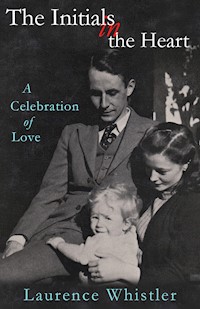
LAURENCE WHISTLERThe Initials in the HeartA CELEBRATION OF LOVE
Laurence Whistler’s story of his five-year marriage to Jill Furse before her sudden early death has achieved a classic quality. Despite the tragedy of its ending the lasting impression is of two lives lived to the full in supreme happiness. Jill Furse was remarkable for many gifts; beauty, acting, poetry and above all gaiety and courage. This edition includes her poems.
‘One of the most sustainedly beautiful [prose] poems I have read for a long time.’ Lord David Cecil, Sunday Telegraph
‘One of the most moving prose threnodies ever written.’ Daily Telegraph
‘One of the most poignant love stories in the English language.’ Country Life
‘Certain to have a permanent place in the literature of love.’ Yorkshire Post
FOR TESSA
Where the lost truth, being treasured, remains true,
There now, inextricably dear, are you.
Little Place Lyme Regis
I
The best thing my poetry ever did for me was to bring about the story of this book. But that is enough to compensate in advance for the inevitable death-bed recognition of failure.
To be. a poet! Not relinquishing this hope, from the age of fifteen or so until now when I was twenty-four, I published in November 1936 a third book of verse called The Emperor Heart, and at my elder brother Rex’s suggestion sent a copy to the novelist Edith Olivier at Wilton, that well-read, vivacious, slightly eccentric person who was his closest friend, though perhaps twice his age, and who lived in the Daye House, the converted dairy at one side of the park. Staying with her when it arrived was a young actress, then twenty-one, whose career of great promise on the London stage had been interrupted by illness—paratyphoid, it was said. Edith Olivier had known her from infancy; for she was the grand-daughter of Sir Henry Newbolt at Netherhampton House near-by. In fact almost her earliest memory, from the age of one, was of sliding on a tray along the snowy road beside the wall of Wilton Park. Now she had arrived to convalesce in the little Italianate house just inside the wall, as Edith’s journal records. “Jill Furse came before dinner. She has lost her six months’ contract to play Shakespeare’s young heroines at the Old Vic. She still looks very ill.” It was her first major disappointment.
Then she was gone, summed up in those not-too-indulgent pages as “lovely to see, perfect manners, very intelligent, sensitive, and great fun.” My poems had arrived before she left, and Edith had read them aloud, she told me, “straight through from end to end with a very delightful, sympathetic and poetic guest.” Name not given, and effect not mentioned. But she had perceived some effect; for she presently proposed that we should meet, all four, in her house.
Accordingly Rex and I drove to the Daye House in February 1937, where on Sunday morning Jill Furse was to arrive by train for an actress’s week-end of one night. (She was playing by then in Because We Must at Wyndham’s.) Rex, who had met her once already, went to Salisbury station alone. Probably this was said to be less intimidating for her. In reality Edith liked first meetings to take place in her own house. Waiting in the Long Room, I heard the shutting of the car door with the slight uneasiness evoked by that typical sound—an inclination to withdraw from a new encounter that comes of shyness. Devoid of preconceptions, I went out on to the stone path.
My first impressions of people are never overwhelming or reliable. Nor were Jill’s, she was to tell me later—a thing seldom admitted by women. I had, gradually, these impressions. A lovely girl of refinement and simplicity, and natural poise; slim, tallish, with a clear musical voice, gentle rather than soft. Both spiritual and spirited. Yet also reticent. Not at all the conventional actress; though that I did not expect her to be. Distinct features, and the skin finely drawn across them. A sensitive mouth. A small straight nose, very faintly raised at the tip and with flared nostrils. A high intelligent forehead left uncovered by the hair— very beautiful hair that flowed away medium-dark but with auburn high-lights. It was a face at that time more childish than it appears in this book. Meeting her first at a theatre, Rex had wanted to paint her (though he never did), being taken by something that he called her “primness.” It seems an odd word for her, in retrospect. He must have meant a touch of the demure, of the Victorian, which intrigued him. If his noun is accepted, it needs to be qualified as a physical primness, not a moral one—intriguing just because it was contradicted by a strong suggestion of warmth, an immediate response to anything beautiful or anything funny— by a trustfulness that perhaps had already made her suffer. Such qualities are hardly prim. She did look sad, as though she found life piteous, without pitying herself. She was both tentative in approach and socially quite at ease. Somewhat “mute, mild and mansuete,” she nevertheless had “danger” or “daungier”—in the mediaeval sense of compelling deference. She parried the teasing jokes of customary Edith, she fenced with the unfamiliar Whistler interest, more formidable because doubled in brothers. But she ventured shyly, if at all, on jokes herself. She made no deliberate attempt whatever to attract, concerned with things of the mind, and content to be whatever she was, though she did not appear to set conscious value on that. These impressions, I say, came slowly—not all on the first day.
It was St Valentine’s Day. (Had Edith arranged even this?) The snowdrops would be out where she remembered them from childhood in the park. My sharpest picture is of standing at a bedroom window—how an incident framed by a window gains meaning, as if removed from the merely fugitive!—to watch her running out of the house and down the track to where they grew. Spontaneous and virginal, her hair bobbing in the wind. Quite unknown. Not “mysterious” in the usual sense, but remote and warm as sunrise on far-off mountains—unexplored as a spiral nebula. Whose was she? Nobody’s, perhaps.
The next day occurred one of those little decisions that determine lives. Rex offered me his car, an open Swallow Special, precursor of the Jaguar, to drive her back to London. He was tired, he insisted, and would really prefer to rest and go later by train. (He left, I find, within an hour or so.) It could have been a suggestion of Edith’s; but he was of all men I have known the most generous. He needed no prompting. Thus it came to me gratis and unearned from the very beginning.
Not that the drive was eventful, but it established her as my friend more than his. Had he wished otherwise I should have stood no chance. No doubt I should have tried to compete; and, competitive, should not have made myself any more personable. Admiring him as I did, I should have withdrawn without spite at the first clear mark of her preferring him. How could she not?
His reputation would have meant little to her, and his (comparative) wealth nothing—apart from the opportunities for pleasure that only money can create. But considering his looks, charm, character, and gifts, to say nothing of his concern with the theatre, the two might have seemed ideally matched. In point of fact he was involved elsewhere—as often, doubly so, and rather wretchedly; and perhaps he could not have been ideally matched with anyone. For myself this was not love at first sight, and the spirit of perception did not say so clearly to me, “Your blessing has now appeared.” But a mutual response had been felt, and I was quick to take chances. She agreed to lunch with me the next day, and on the next again there was supper at the Café Royal, à quatre with Rex and one of his girls, after seeing Jill in her play.
That she was born to act had been foretold in a most striking way when she was seven. The poet Ralph Hodgson came to tea and declared that she had genius, nothing less. When I reminded him of that, years later, he replied, “Heavenly little elf!—as I write this I shut my eyes and here she is, tripping in and out from behind my chair again, each time in an entirely different character —doing anger, pity, sorrow, merriment.... It required no especial insight on my part to make that confident prediction: I knew I was watching a consummate artist in advance of time.” None of that reached her ears, of course, or was taken very seriously at the time: there was no professional acting in her ancestry. Her own later version was this: “I very soon found out that when I made faces grown-up people laughed, and I definitely held performances.” At ten she was taken to the single performance in London of the fairy play Crossings by Walter de la Mare. In this Ellen Terry appeared for the last time on any stage—appeared twice, but only for a moment, as the ghost of the old lady. She did not speak; she smiled—at Ann, the child with whom Jill perhaps identified herself. It was while watching this farewell that Jill first recognized her calling.
A year later Sir Henry Newbolt was describing family charades to a friend. “The quietness and the certainty of her conversations were marvellous. She said afterwards, ‘Oh yes, I did love it—I felt as if I were in a dream’—which sounds rather as though she had been really acting.”
She was fifteen when Ralph Hodgson returned from Japan. Inviting him to tea, her mother gave news of the family, saying that Jill did want to act, and recalling that he had seen in her the promise of talent. “Ah, Jill has no talent for the stage,” he replied with conviction undiminished after eight years. “What I saw was something beyond talent. You’ll know all about it when you open The Times on the morning of a day in the autumn of 19—. I forget the exact date, but it is all right. Let her keep her health and avoid elopements.” The two conditions. Twin injunctions from a fairy godfather.
He came—as Jill recorded on the first page of the diary she had been given for Christmas. It had a lock and key and would become a familiar sight in the family, always locked, but with the key left dangling. She thought this an excellent arrangement; for everyone would know that it was private; and the key would not be lost.
Mr. Hodgson came to tea.... He talked about everything under the sun, breaking off to tell me I looked—then he said he’d better not tell me how I looked but he would one day. He said I must go straight to the top and be a great actress as that was my “spiritual home.”
Unwaveringly she held to this one ambition. Soon she was in Switzerland, at St George’s School, learning to be a fluent speaker and writer of French, while the life and the landscape gave happiness. Then, at seventeen, she became a drama student of Elsie Fogerty’s at the Albert Hall. This was a worrying time; for though it was seen that she was gifted, and though she was unshakeable in purpose, her confidence was only too easily shaken. She appeared to fellow-students, and often to herself, so unlike what an actress is supposed to be.
At about this time Norman Marshall had bought the small private theatre in Villiers Street called the Gate, and reopened it to give the kind of plays that West End managements never gave; and at least seven of them to a season. No long runs, no stars, equal salaries and those very small—it was an intimate affair. But the audience was said to be the most intelligent in London, as the theatre was certainly the most exciting. The second season, of 1935, included a new play from the French of Jean-Jacques Bernard called National 6, simultaneously produced in Paris. Marshall says:
I found the leading part extremely difficult to cast. It needed an actress who was youthful and unsophisticated without being girlish and ingenuous. Most young English actresses are, on the stage, either too old or too young for their years. They lack the genuine simplicity of youth because they have either tried to grow up too fast or refused to grow up at all. After interviewing dozens of young women the only hope seemed to be to find a girl of the right type who had never been on the stage before. At Miss Fogerty’s School I found Jill Furse. She was at once recognized by the critics as an actress of rare and exquisite quality.
Elsie Fogerty thought he was making a mistake. “There’s no bellows there!” she told him, thumping her chest. She did not mean simply carrying-power; for she had stationed herself at some remotest point in the Albert Hall and heard Jill speaking every word on the stage, a test that defeated many students. Doubtless she found her altogether too reserved. By contraries Jill may have found that rather fruity and Edwardian example inhibiting.
“It was only after the first night,” Norman Marshall says, “that I learned that she had, during rehearsals, gone through agonies of doubt about her ability to do the part. She showed no signs of her nervousness. She always seemed so calm and businesslike.”
“The most promising of first performances,” wrote W. A. Darlington in the Daily Telegraph. “If she can keep the delicate sensitiveness of her touch she may go far.” The New Statesman critic declared: “At present she is neither a great nor even a good actress, but her ethereal charm comes from a personality of the true magnetism from which great acting sometimes springs.” One press-cutting arrived from her earliest backer in Japan, simply endorsed, “Good report. Quite content. R.H.”
Of course she was longing to play Shakespeare; and Michael Macowan saw her in the play and tried to cast her for Perdita at the Old Vic. But Lilian Baylis did not think her equal to so large a theatre. Her second play was therefore Whiteoaks at the Little Theatre, with Stephen Haggard in the cast, on which the New Statesman commented, “That lovely actress Jill Furse had too little to do.” Miss Baylis and Tyrone Guthrie were now satisfied. Within a week or so came the breathtaking offer of the young Shakespeare heroines, Miranda, Beatrice, and the rest. And the contract was signed. And then illness ruined all. Later Desdemona was offered, and she began to grow long hair. But the production was shelved.
So now in February 1937 here she was in Because We Must, another mediocre play, with Vivien Leigh. Mr Darlington still approved. To him her performance was “just about the best thing in the evening.” So thought I, distinguishing between criticism and incipient involvement, on that evening when with Rex and his girl I went to see her. But it was a pity that I missed her, next month at the Gate, as Lily in Out of Sight, the daughter of the clerk who has gone to prison, a part that required the pathos she could give it. During this run she wrote in her diary:
When I played on Saturday I nearly broke down and cried. —I have wondered since if that was why Lily was so good that night. I thought at the time it was because — was there. But it happened again last night and again I gave a very good performance. I must try one night crying properly and see what happens.
She had not been ready for Shakespeare last year. She recognized that. But now she was brimming with expectancy.
I wonder what’s going to happen next. I want a marvellous part now—it would be such fun. Desdemona, Desdemona, Desdemona. How she haunts me and tantalises me.
A few notes in her copy of the play suggest that she would have made of that heroine a playful, even teasing, innocent; not a woebegone of purity.
Fundamentally the reason I missed Out of Sight was poverty. My father’s building business, once lucrative, had dwindled to nothing by the time he retired. At Balliol I was generously supported by the College, but I did little work there, and had no ambition whatever but in verse. Coming down with a second, I took a second-rate job in Church Assembly, rashly telling a friend that “a year’s future is all one ever wants to see.” I quickly found that I was sunk without trace beneath the feet in the tube lift, morning and evening, for ever ... That is, for five months. For I was rescued in 1935 by the astonishing award of the King’s Gold Medal for Poetry, the first and most publicized; or rather I was rescued by Kenneth Rae, my original publisher, who now commissioned a life of Vanbrugh, chosen because his architecture excited me. Sweet rescue it was. But scholarly biography does not pay—at least when undertaken by a novice who cannot write prose as fast as some poets write verse. £50 down, in exchange for £3 a week: it meant giving up my London room, and working mostly at my parents’ house in north Buckinghamshire. Fortunately I had begun to engrave glass with a diamond, teaching myself, since there was no one to learn from. But this, with the frequent versifying, meant that Vanbrugh was still very much of a labour when Jill and I met.
Neither was happy. She ought to have been happy with so promising a future and so many friends. She did not falter, but she had innate misgivings—about herself. Her unconfidence had been worsened by the slow fading out of a relationship in which she had trusted, her first true affair of the heart. Writing her diary after the play, she fell into the slightly stilted cynicism of youthfulness. “He liked me tonight. I’m afraid it must have been the spring—or my new hat. It would be rash to impute it to anything more lasting. I must see Rex and Laurie again. I’ve been re-reading Laurie’s poetry.” Any implication in the sequence of ideas was quite unconscious, but the entry shows that she was ready for new friendship, though not for new trust.
I was unhappy, without need of external cause. Too timid and self-conscious, and too poor—I had had no cheque-book—to make anything of Oxford until it was nearly too late to begin, I had seen a little gaiety in my last year, but had come down without one new permanent friend of my own age. I had nothing to recall of that time but two love-affairs and two books of verse, all outgrown. No companionship was like Rex’s; but in the presence of others he inhibited me and I felt like his shadow. Consequently in that brilliant world which he longed to introduce me to, I made small headway. Not that this worried me: the reputation I coveted was in the twilight world of poetry. Yet in poetry I was bewildered. I had been sped on my way—and failed to “arrive.” I had failed with the younger reviewers, and the medal only earned me their rancour. I feared that the older men rejoiced to back me as a young traditionalist, out of step with the disturbing new movement. Which they did, and I was. With my assumption, never examined, that “traditional” must be a synonym for “conventional” I was often silenced completely. Then that dejected me still more. For then I supposed that if I had any talent I should know it—and was like some Calvinist horribly not-conscious of being one of the Elect. And still there were those other times when I could not think my rapture in the use of words to be wholly spurious. Thus I alternated between advance and repulse, like an obstinate snail bumped by a windy leaf. I remember as a moment of sun the news of de la Mare’s approval, passed on by Jill who had known him from her childhood; but even he was not young in years.
I, too, had innate unconfidence; and this prevented my believing that I could do anything at all unless I had, by sleight, or by accident as it seemed, already done it. My uncertainty extended beyond verse to the very citadel of self, or rather radiated from there. I did not know what I believed. I did not know who I was. Often I did not like living, which is not the same thing as wishing it to stop. I was saved from cynicism only by the glad appetites of youth and the never-extinguished craving to create. My emotional life, once happy, had arrived at an end distressingly drawn out. At twenty-five—to be a little portentous, but appropriately so—I was like a shaky civilization not asking for a new religion to transform it.
Thus Jill in London, and I in the country. We could meet only when I came up for architectural research in museum and library, and to make use of Rex’s flat. She too lived at home. Very few established actresses of twenty-two would be content with this, but she was more at peace with her family, and superficially less grown-up than is normal. She had been ill too often to be eager for independence of the outward sort; and inwardly she had it, as I presently perceived. In April we began to meet about five times a month, mostly for lunch in modest Soho restaurants; rarely in one more expensive. I noticed that while she relished the good living other friends could provide, she took it for an occasional luxury. Pleased with vin ordinaire as with a vintage wine, she chose inexpensive dishes without a hint of motive, making poverty seem ours, not mine. It was courteous, but more than courtesy, this early mark of an unspoilt simplicity. We had the same love-hate towards London, it appeared. We began to make excursions of escape: as once to Oxford, to lie in the fritillaries beside a punt in Port Meadow. Late that night I said that I was entirely at her feet. She was pleased, and did not believe me; for this was only a half-truth, as the conventional phrase made evident. It was a pity to have spoken prematurely. It did not matter.
Through such days I discovered the strength of her character, and what I would call the clarity of her spirit. It sprang from a fusion of humility and sure ideals. She did not seem to have intellectual convictions; at least she did not have rigid opinions. Strong opinions she had, and expressed them with zeal, but as like as not would break off with “Well, I don’t know...”, having instantly seen how an opposite case could be argued. Her mind was open. Her certainties were of the heart and imagination.
Through such days, too, I discovered her sense of humour, in some of its variety. It could be childish. It could also be deliciously indecent, belying that demure appearance. Indelicate, however, it hardly was, so nimbly did she confine it at that time to the broken sentence, the dropped glance, or the eloquent silence, never permitting more than was appropriate to our degree of intimacy; and that was not great.... Indistinct days of some progress to no distinct end.
And then I began to understand the sadness that lay beneath laughter and enthusiasm. Early childhood, it appeared, had promised something glorious of life which the adult world would never now fulfil. It could not be helped; for such was growing up. Recently, supporting her pessimism, there had been the last and worst disappointment of love; but no one was to blame. This failure she revealed to me, after a while. Meanwhile the locked book was receiving similar reflections. She wanted to go abroad, to unknown countries like Provence and Italy, but preferably alone. “I think I’m growing to need people less. I’m always happy by myself as long as I have books or lovely things to look at. One should be self-supporting inside if one can be—I’m sure God means us to be.” Another day it was London spring across the black little garden walls, sharply recalling Netherhampton. “Will one never look forward again?” Nothing, she wrote in her diary, would ever matter like the impact of beauty in childhood, not even her career—“nor any one person any more.”
She did not want to be hurt any more. New companionship she wanted, but not self-surrender. My case was altogether different, if not opposite. Nothing but possession would assuage me, and the lack of it was very hard to bear at times. My mind leapt ahead to it, and, finding no assurance, recoiled into frivolity. Though never intentionally cruel, she would jib and side-step, laugh and parry to the end of time, I thought. I adopted a frivolous pose to provoke. “Have you heard any Chinese music?”—I put the needle on a badly warped dance record. “How fascinating!”—She was touchingly easy to take in. But there was an ache like a hollow tooth in this teasing. I longed to be somewhere beyond it with her, somewhere hardly imaginable, where the necessary laughter sprang unanimous out of intimacy, and did not involve her in “playing back” to a joke, did not call for the mock-pout and charming mime of injury: “I think you’re horrid!” But thus it was. And “Chinese music?” became a question in her guarded glance, until it fell out of currency for ever.
It was more than a pose, it was a persona I adopted. Immature as I was, there were times when I was dreadfully afraid that I was no one. I had to be someone in her eyes, even if someone who had been what she would not approve of. She would not condemn, I knew. She was realistic about people, and very gentle in her natural wisdom. Unconsciously despairing, then, of any future together, I let her form the impression that I had been rather a “rake,” as she presently put it. This was not only absurd but manifestly so, because any genuine rake in my situation would be at pains to camouflage himself; but this did not strike her unsophisticated mind. My experience of love, in fact, had been as honest as Rex’s, and narrower. Really I made out a very poor case for myself, fabricating by innuendo to my own disadvantage.
She was brought up with the same Christian notions of marriage as We were, and her view of love was exalted. Marriage was a sacrament, the most beautiful and difficult form of loving, only to be attempted by those who were prepared for sacrifices. She had put down in her diary, at nineteen, a conversation with a fellow-student who used to confide in her, much to her surprise.
People can be classed as natural penitents or confessors, and Jill had notably the three marks of a confessor: warm understanding —discretion—and no itch to be told. Your confessor can have anyone’s story at will; never tries to; and often must. Anyone’s, that is, except another confessor’s. I mention this only because I was one myself, in a much smaller way; and thus we did not rush to unburden our histories, but rather revealed them in hints, and step by step, more easily talking of ideas and sensations. This fellow-student, then, had a new mistress, with whom he had nothing in common but sex. “I wonder why I don’t behave like that,” she had asked herself, “and whether if I live among these people it will be harder. It all seems so sordid and the spoiling of something rare that belongs to one man only, and it doesn’t matter whether you know him yet or not. A. said it was ridiculous to be faithful to a woman you’ve never met. But then it isn’t being faithful to the woman that counts but to the eternal that she brings in her. Perhaps this is all rubbish and I should have lived with someone if I hadn’t lacked the curiosity or had been brought up differently. The trouble is it seems to matter so little.” She must have been aware of the notion that “experience”—which always means sexual experience in this context— would be good for her art, but she wisely thought that it would not, unless it mattered. About ideals in general she was now telling herself “They should be pure—and livable. Like a long unending range of peaks, impossibly lovely, but scaleable all the same.”
Throughout our first spring, then, Rex, who was approaching thirty-two, could have been a formidable rival had he chosen to be. In May she recorded:
I had lunch with Rex at the Jardin des Gourmets and that was lovely. He is a darling, one of the most attractive and fascinating people in the world. But he ha a sad face and his hair is going grey. He works much too hard and has I believe been always fond of people who wouldn’t marry him. He’s a more trustworthy person than Laurie I think and has far more fundamental goodness in his face. In lots of ways they’re very alike—the same voice and hands and the same freakish sense of humour. I should love to know him really well. But then I always fall for sad people. I always think they are the kind I should like to marry and make happy for ever after. I feel I could give something that they’ve never had before. But I expect it is only a fancy like all my hopes and ideals.
As for Laurie, I’m much too fond of him without either trusting or being in love with him. I love his mind—one side of it, and we fit extraordinarily well. We’re much too like each other, though.
“Too like.” It is not the usual obstacle; and surely it could only intrude for potential lovers each of whom was dissatisfied with himself. We were already half-conscious of something we shared with each other as never with anyone else. Does not everyone feel that he looks out from some inmost cell—or gazebo—of personality, to a vision of existence that is utterly private and incommunicable? Well, we sensed that our secret visions over-lapped, notwithstanding our outward differences. She thought it inauspicious; that I needed someone quite different from her, and she from me; that there has to be a sense of “otherness” in love, as of strangers grown intimate. I thought this wrong, but could not prove it. The truth that physical love, when happy, provides through the opposition of sex all the “otherness” one could wish for, and permeates the whole of ordinary life, like roads winding up to and down from a glittering hill-city—this truth was unguessed by her. How one could simply trust love to thrillingly impose on similarity the huge distinction of sheer gender was not envisaged.
On the other hand small similarities were only helpful. For example, neither of us smoked—but smokers never conceive that the flavour of stale nicotine in a kiss can be disenchanting. Then her eyesight matched mine. She could compete with me for the tiniest marks on a glass, and for the faint pricking of an obelisk twenty-five miles away. We saw the world clear and liked clarity, liked it more than the mistiness preferred by most painters. Yet to say this is no truer than saying that one likes darkness—as indeed we did. No one likes total darkness. What the eye feeds on must always be light—and in darkness the mystery, solace or excitement of diminished light. Total clarity also would be disagreeable. It is the softening of the sharpest daylight into blue remoteness that appeals. We discovered an equal relish for the remote, and one day she would think of writing an Ode to Distance.
For she wrote verses, in both English and French, and began to show them to me, with much diffidence. They issued from the single mood of reflective sadness.
Tonight there was a woman come to stare
From the opposite window, parting the firelit lace
Of curtains on the vacant square;
Fingers on glass, eyes upon nothing there,
And hardly light on that indifferent face.
I never saw a woman more alone—
A statue to empty lives that grow, obscure:
Sad when their narrow day is gone
That there was no love said or done.
Knowing their sadness only will endure.
She had been passionately fond of poetry from the earliest years, encouraged and educated by her grandfather, Newbolt, that catholic appreciator. And it was, after all, poetry of a sort, her own sort, that had brought and kept us together, as she was to remind me, years later. “I remember the shock, almost physical and almost prophetical, that went through me when old E.O. read The Emperor Heart. I suppose that to the part of me which recognized you in that moment in Edith’s room, all this was known —had happened and was still happening. Otherwise it would not have made such a tremendous impression.” Another time she wished that a soldier-friend at the war could have had with his mistress “an intellectual contact to hold on to in letters. It was always that which kept me with L before I learnt to love him.” And once when I teased her for being biased in my favour, she replied, “But I loved and admired your poetry long before I loved or admired you, so I’ve never seen quite where the prejudice came in!” Thus she disproved that faint verse never won fair lady.
One day as we ate together, after her return from abroad that summer, I quoted Hawksmoor’s recommendation of a design he had made. “What I have sent you is Authentic, and what is According to the ye antients, and what is Historicall, and good Architecture, Convenient, Lasting, Decent, and Beautifull.” A fairly wide range of virtues—I suggested that we might mark each other out of ten. The result shows what each of us thought, or thought it best for the other to think:
L on J:Convenient 5Lasting 10Decent 7Beautiful 10
J on L:Convenient 10Lasting 0Decent 0Beautiful 6
I got full marks for Convenient, because, with theatrical business and a more social day than mine, she was always cancelling or altering our arrangements, and I never complained; for she was never capricious. The biggest error was my nought for Lasting, had she only guessed. And for that my fatuous persona was to blame. I almost knew that mark was wrong.
II
Returning from a holiday abroad with a sense of roots torn in both countries, she felt that she belonged to the seventeenth century, was irremediably old-fashioned, hated the speed of the present. She was still there, in the little Swiss courtyard, where the wistaria had moved against the wooden gallery. She day-dreamed with her diary.
If I planned my life now, setting my stage life apart, I should like a husband whose career was vitally important—to me if to no one else!—who loved me enough to forgive my failings and not enough to spoil me, who loved only a few of the things I loved, I couldn’t hope for all.
She pictured the home they would have (some other Netherhampton, of course), the children, the ilex, and the river. She recognized that really her longing was for early childhood, in an adult world that now seemed glamourless and alarming. Thus in a poem:
With every rapture that I sing
The childish tears will blind me.
In every room I look into
A door has closed behind me.
But she did not mean to remain an escapist. “I’m not really afraid, at least I don’t think so.” The purpose was there. The mountains were climbable. Then with a complete change of mood— “I have found Donne and am happy. He fascinates and repels me, and any man who does that is dangerous.” The next day, convinced by the frankly carnal Elegy XIX, she denied the repulsion, finding only “a glorious comprehension of both physical and spiritual.” In such hours she grew; for growth is not continuous.
There were hours, though, when she was wretched from “a mixture of no work, Laurie, and the unsettledness of myself.” Ralph Hodgson would have thought our friendship precisely the kind she should avoid. Not that “elopement” was likely, for we made no progress: fell back, even. Still, we could not relinquish each other. A day at Stowe together, where I had been at school, filled her mind with the beauty of round grey temples in a gauze of rain. We were not happy face to face, as it were; but when we looked at good things side by side, it seemed by their expression that we ought to be. “I wish I didn’t make you sad, my dear—it’s so wrong and such a pity. I always get so much pleasure from seeing you.” And to herself: “There is so much in him that I love and so much that I distrust and fear. He has been so very kind to me, and I don’t think knowing me has made him more unhappy than he was already.”
Depressed by failure, tormented by sex, I padded moodily like a caged animal, or did turns for relief. I seemed cynical, and felt merely discontented, aimless. Reading Freud for the first time, she wrote, “It’s a great pity to reduce everything to sex and deny that there is a life of the spirit.” I agreed. “You probably won’t agree with me as I know your philosophy of life is very, very different from mine.” It had not been very different once, and was becoming less so, under her influence. She took a private vow to live for her acting,
work harder, and worry less about what is happening to me personally. Until I fall really in love and marry I must dedicate myself. I know that, fundamentally, I think about the theatre in the right, truly artistic and humble way. But one is led superficially into becoming faintly vain and self-expressionist. Today I want to dedicate myself to the highest things—to doing all that I can to the glory of God. And God help me not to be selfish.
The “marvellous part” she wanted was not forthcoming, and perhaps she was being pigeon-holed under “pathos.” After Out of Sight she had appeared in Lord Adrian, also at the Gate. Perhaps the big parts would not come her way until her personality had been enriched by happiness. How to be enriched, though, and still heed Hodgson’s warning not to jeopardize her whole career? In September she went into Victoria Regina at the Lyric, taking over the minor part of Lady Jane.
By winter’s end three events had occurred. My family home had been sold, since Buckinghamshire was too cold for my father in failing health; and I was delivered of Vanbrugh, with relief; and I had taken a small flat in London. Years later, casting back in memory, she sent me a poem written, she said, “because I thought how odd it was that while you were at Oxford and I in Switzerland we couldn’t know that we were moving all our days towards each other. That even then I was like an unlit candle in the shadows of your room.”
My new room was on the first floor of Constable’s House, No. 76 Charlotte Street, and had once been the drawing-room of the painter I loved most in those days. On the mantelpiece I put the human skull I had acquired while at Oxford, called Truepenny. For £7 a month I had this room and the small one behind it, and Rex furnished them for me in the Regency style, with striped curtains, and gave me a set of coloured eighteenth-century prints of Rome which for years made me suppose that city to be spaciously laid out, like Belgravia. Somewhere he found me a self-portrait of Constable as a young man at his easel, in features very like the pencil portrait of 1806: one day it may well be accepted as authentic. He designed the curved wooden frame, with padded upholstery striped green and buff, which by day turned my bed into a capacious sofa at one end of the room. Then he gave me a little oil painting he had made of Eros and Psyche, she kneeling naked, her face lifted to the hands of the winged boy who bent towards her. This I placed above the bed.
When Jill came to see me the first day, we leant on the sill, looking down into Charlotte Street, still more or less Georgian, and less squalid than now, pondering my new stretch of living with that sense of “time enough” which only young people have. Spring was actual above the houses opposite, London’s flat dandelion spring of down clouds over parapets, and yellow light on stock bricks. Summer seemed lengthy, but still notional. From far away to the left, out of Oxford Street, by way of Percy Street or Rathbone Place, in a high crescendo of voices, the news-boys came baying a special edition. Hitler had been speaking on Czechoslovakia.
Nothing followed from the move but pleasanter days for me, though I made hardly any new friends in that quarter of artists. When Tambimuttu, the poets’ compère, rang the bell in friendly inquiry, I gave him but an awkward welcome, partly because I had gone down in my socks, for some reason. I wrote, and I engraved—thirteen glasses this year, earning perhaps £130. It seems odd that I could share so much of life with my £1800-a-year brother up the road, but then his generosity was always reducing the effective difference. I liked the long twilight of my open window, warm-scented with grime and exhaust, a twilight drawn to a thread by the sketchy tinkling of a distant barrel-organ.
Jill had returned to the Gate for Elizabeth La Femme Sans Homme, followed by The Masque of Kings, Maxwell Anderson’s play on the Mayerling tragedy. In this she played Marie Vetsera, Prince Rudolph’s seventeen-year-old mistress. “Miss Jill Furse, with a radiantly virginal air, played an unvirginal character with a delicacy fetching in itself, but fatal to the character,” said one critic, though others were better pleased. Then she was away to Switzerland, Paris, and the Riviera, where she danced and lived well for a week, met Maurice Chevalier, the Oliviers and other stage friends, and resisted an invitation to go to Cornwall with a member of the Crazy Gang.
We were supposed to be uncommitted; and yet, in Cambridge for the first time, at the exact moment when we stepped from sunlight into the chill glory of King’s Chapel, the organ burst out into Bach’s Toccata and Fugue in D Minor, and, by the sheer gooseflesh thrill of it, turned our entry into a coronation. In love, when the notion of providence replaces the notion of coincidence, the committal has occurred. But we had hardly acknowledged that, and were still groping. For example, neither was particularly jealous by nature, though she more than I. When she was jealous I hated it: so that when I was jealous I concealed it. Yet jealousy too well hidden is not flattering to a woman. Then, I made it a point of honour to earn my ten for Convenient, only to find that she began to take it for granted. Irritated to be supposed a kind of spaniel, and exasperated by her long reserve, I lay on the sofa with her one day and took her character to pieces, indifferent to the consequences, which, with most girls, would have been injured pride and a quarrel. She defended herself, but with a look of quiet interest; and years later claimed it as the hour in which I won her respect. But neither of us knew what was needed, or what would result from any action. We were still taking risks of losing one another.
On my way to Clovelly that August I was invited to spend one night at the Furses’ holiday home, called Venton, a farm on her grandfather’s estate somewhere to the south of Torrington. From the wayside station the car took me deep into an unknown part of North Devon that had always seemed, from my annual Clovelly point of view, obscurely “mid” and sadly unmaritime; and now seemed each minute more indispensable and gay, with the glorious blue wave of Dartmoor, new to me, flowing along on the left, over wind-skewed beech hedges. At the end of a rough lane, near a group of elms, I found an ancient farm of rough stone and white cob, under a long thatched roof that rose to an engaging hump about the middle, with rather the effect of a crouched animal, but a friendly one.
I had first met Jill’s parents at the Coronation of the year before, on a stand in the Mall, when I had scored a good mark for entertaining the youngest children, Nicolas and Theresa, and a bad one for making Jill giggle with a joke about the ritual—weak, but harmless, I had wrongly supposed. Perhaps my judgement had been warped by my love for Sir Edwin Lutyens, who never ceased from far worse flippancies. This lapse had been overlooked, possibly: anyway I was received without the least constraint, whatever was thought, by a family that loved one another with a refreshing lack of the aggressive or, at best, subtly exclusive “family manner” which commonly results from a strong bond. I took instantly to them all and to their way of life in this house, which for me perfectly combined a measure of style with pastoral simplicity—a painted panel in the Queen Anne parlour, with old string-and-bobbin latches to the bedroom doors. The farmer’s family lived under the same roof-tree, at one end of Venton beyond a door left unlocked, and that itself was characteristic of the easy simplicity. It seemed to me a delectable way of life: farm-house meals on a bench in the stone-flagged kitchen, raw home-brewed cider and Devonshire cream—and all the day and all the night of deep country.
I woke to a second day of dazzling light. Jill showed me the farm, and led me out through the high-banked fields to where they fled steeply into a narrow valley, from the bottom of which rolled up higher again on the other side the huge August boskage of a hanging wood. Somewhere, to the west, there was a river— but for another visit. Here, down the floor of the wood, flowed a stream, meandering half out-of-sight among hart’s-tongue ferns and mossy roots. Then I twisted my ankle.
Apt and singing pain! There is nothing like a small physical pain for a solvent to the affections. I sat and cooled the bulge on tender instructions in flowing crystal. I relinquished the satisfactory lump to fingertips that bound and knotted the handkerchief with deftly feminine solicitude. I made light of it, and the most of it. I rejoiced to have it hot and gleeful in her hands. For how could there be anything but rare pleasure in all this for the pair of us? I now had a footing in the Eastern Brook. It had hastened to take a hand in the story.
An hour before the car was due, she suddenly asked me to engrave the family names on the guest-room window-pane. Across a landscape where a distant church tower stood up beside a round bit of Dartmoor’s blue, I wrote:
and then the date—August 17th 1938. As I did so, she, silent beside me, said something that made me glance at her. It was not already in my mind, and yet it seemed that I had said it myself. That instant I knew beyond doubt that she really did look at life with my eyes, a thing never known or hoped for. One day she would write:
Seeing things the same... that is our most perfect gift of all. Do you remember the first time you came to Venton and stood engraving on the window of what would be our room, and I said something. ... That and your ankle were I suppose what made me love you. But I can never imagine why I took so long!




