


2,99 €
Mehr erfahren.
- Herausgeber: RWG Publishing
- Kategorie: Sachliteratur, Reportagen, Biografien
- Sprache: Englisch
This book is a collection of short stories of travel, adventure, and growing up as an Italian Catholic. The author tells stories of her great grandparents that came to America, and how it was literally murder getting out of Sicily. Coming from being poor peasants in Italy, America promised to provide the family with the opportunities to become wealthy aristocrats, even if one had to bootleg whiskey to do it.
Shocked by the faith-shaking realization that nuns were actually human beings underneath all that garb, she was still hopeful that the pope would be coming to dinner after she purchased the best china available. With some Italian traditions that just wouldn't die and too many relatives that did, Annette relates stories of their lives and deaths with wit and humor.
Das E-Book können Sie in Legimi-Apps oder einer beliebigen App lesen, die das folgende Format unterstützen:
Veröffentlichungsjahr: 2023
Ähnliche



















The
ITALIAN Catholic Divorce
Annette C. Schiro
The ITALIAN Catholic Divorce
Copyright © 2016 by Annette C. Schiro. All rights reserved.
No part of this publication may be reproduced, stored in a retrieval system or transmitted in any way by any means, electronic, mechanical, photocopy, recording or otherwise, without the prior permission of the author except as provided by USA copyright law.
All characters appearing in this work are fictitious. Any resemblance to real persons, living or dead, is purely coincidental.
The opinions expressed by the author are not necessarily those of Revival Waves of Glory Books & Publishing.
Published by Revival Waves of Glory Books & Publishing
PO Box 596| Litchfield, Illinois 62056 USA
www.revivalwavesofgloryministries.com
Revival Waves of Glory Books & Publishing is committed to excellence in the publishing industry.
Book design Copyright © 2016 by Revival Waves of Glory Books & Publishing. All rights reserved.
Published in the United States of America
Paperback: 978-0692736807
Hardcover: 978-1-60796-544-2
Table of Contents
Dedication
The Italian Catholic Divorce
The Arrangement
Nonno
She Doesn’t Speak Italian
The Egg
The Victrola
The Plague
The Whiskey Barrel
My Mother’s Wedding
Lights, Camera, Action!
My Big Sister
The Baccouso
Ketchup, The American Sugo
Nuns Are People Too
The Black Box
Picking Worms
The Kiss
The Mammoni
The Entertainer
The Angel
Dogs
The Dig
The Designated Driver
Time for Tea
The Pope Isn't Coming to Dinner
Mangia! Mangia!
Our Lady of the Snows
The Tourist
In The Balance
How to Say “I Like You” in Italian
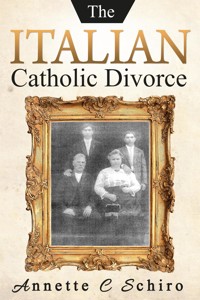
Front Lt to Rt: Giuseppe Nastasi, Antonia Nastasi
Back row Lt to Rt, sons Giuseppe (Joseph), Fillipo (Philip)
Dedication
To Our Lady of the Snows
I dedicate this book to the memory of my mother, Antoinette Nastasi Schiro, for her influence, inspiration, and whose stories are forever imprinted on my heart.
Also, this dedication would not be complete without giving glory to God for His divine inspiration and permission for Our Lady of the Snows to make guest appearances in my life.
The Italian Catholic Divorce
In the mid 1800’s and early 1900’s, a lot of Sicilians emigrated from Sicily to the United States. Some of them came into the port of New Orleans. This is where my ancestors got off the boat, and settled near New Orleans. My mother said that her family wanted to come to America because they heard that the streets were paved with gold.
My mother’s paternal grandmother, Antonia Nastasi, came over with her husband, Giuseppe, and their six children in the early 1900’s. It was a hasty departure from Italy as my mother told me. Apparently, Antonia and her husband were in a tavern, when she looked across the room and saw a woman flirting with Giuseppe. She promptly went over to the fireplace, picked up a fire iron, and proceeded to “go take care of that”. It ended tragically for the flirtatious woman, and Antonia and her family took the first boat out of Italy.
Antonia had borne her first child, Libonio, before she was thirteen years of age. However, it was another 13 years before she had her next child. No one really knows when she got married to her husband Giuseppe, or even if he was the father of her first child. By the time she made her departure from Italy, she had had six children in all. My mother said that she really didn’t like her grandmother Antonia, and that she wasn’t a very nice lady. When my mother was born at home in Bogalusa, Louisiana, Antonia ran down to city hall and had it recorded that her name was Antonia, naming my mother after herself, before my mom’s own mother had a chance to name her. My mother later changed her name to Antoinette.
About the same time Antonia and her family came to America, Antonia’s sister’s husband, Roy Monteleone, also came over to make his fortune. He was supposed to save up enough money to send for his wife, Vita, and their daughters Katie and Rosa, back in Italy. Roy was so busy spending his money on drinking and wild women that he never sent money to his wife in Italy. Antonia decided that if she saved up enough money for her sister to come over, that Roy would straighten up once she got here. So they got all the money together and sent for Vita and her daughters. However, when they arrived, Roy didn’t change his ways, and still spent his money on booze and wild women.
Back in those days she couldn’t get a divorce because our family was Catholic, and Catholics could not divorce, because if you did, you would be excommunicated from the church, and bring disgrace on the whole family. The only way for her to marry again, was if her husband died. Enter the Italian Catholic Divorce. My great grandmother Antonia, who was already thrown out of one country for murder, decided against taking care of this matter herself, and sent her son Fillipo to “go take care of that”, as my mother put it. So he did. And Antonia’s sister went off and remarried. Of course Fillipo spent the next couple of years in jail, but it was only a slap on the wrist because, of course, it was self-defense. At least that’s what he said. I often joke to my husband that we will never get divorced, and if he doesn’t behave I will call my uncle Guy to “go take care of that”.
The Arrangement
“I’ll take him, but I won’t take him!” exclaimed my grandmother Josephine. It was an acceptable arrangement to all the parties involved, and the date was set. On June 30, 1917, Josephine Gagliano (pronounced Gal-yee-ano) was wed to Joseph Nastasi. She was 15 years old, and Joseph was 21.
It all started when her father decided that she should get married. My mother said that Josephine and her father, Gaetano, did not get along very well, and he was looking to get rid of her. He needed sons to work the farm, and girls were considered more of a liability. They had never bothered to educate her, so she never learned to read or write.
Josephine’s parents, Gaetano and Rosa Gagliano, were tenant farmers in Louisiana. They rented land from Antonio Nastasi, son of the infamous Antonia Nastasi. Antonio and his wife also had a grocery store and oyster bar in Independence, Louisiana. It was through Antonio that Gaetano met Antonia Nastasi. Antonia apparently wanted to marry off her son Fillipo, who was only 17 at the time. Antonia and Gaetano made an agreement that Antonia’s son Fillipo would marry Josephine. All the families involved were immigrants and still carried on as if they were in the old country; they still spoke Italian, still practiced the traditions of the old country, and still arranged marriages.
On the appointed day, when Fillipo was supposed to go meet the girl he was to marry, he was so nervous that he asked his older brother Joseph to accompany him. When Josephine was presented with her husband to be, she took one look at his brother Joseph, and promptly declined to marry Fillipo, and agreed to marry Joseph. It really was love at first sight.
After Fillipo was rejected by his “would be” wife, Josephine, he sought to find his own match in the daughter of Roy Monteleone. On January 30, 1918, Fillipo’s 18th birthday, Fillipo ran off to New Orleans and eloped with 15 year old Rosa Monteleone. Her mother, Vita, happened to be sisters with his own mother, Antonia. Rosa and Fillipo’s marriage was pretty happy despite the fact that sometime in the 1930’s, Fillipo had to go on a long business trip to “go take care of something” for his mother. Meanwhile his wife and children moved to Savannah, Georgia to await his return.
Nonno
Nonno: noun, the father of one’s father or mother.
My dad’s father, Joseph (Joe) Schiro, was around twelve years old when he made the voyage from Sicily to America. He made the trip along with his mother Maria, and sister Rosalia. His father Giorgio had left Pianna de Greggia, Sicily, to come to America five years before, around 1890. Giorgio had been working on a sugarcane plantation near Donaldsonville, Louisiana, to save up enough money to send to his family for their voyage to America.
Joe and his family were really lucky, because some men came to America, but were never heard from again. Railroads, plantations, and other industries needed laborers, and agents were paid commissions to get immigrants to come to America. They touted America as the Promised Land. They painted a picture of wealth and opportunity to get people to come here. Most men that came to America thought that they would return to their families as wealthy men.
Many of the poor peasant farmers that came here, ended up as poor tenant farmers here in the U.S. Conditions didn’t seem to be much better than they were back at home. Maybe it was the shame of failure, or maybe they ended up starving and homeless. Whatever the reason, many wives and children were left abandoned back in Italy.
My grandfather, Joe, never forgot his voyage to America. He said the passengers were herded like animals onto the ships. There were no staterooms, and instead they were all crowded into one big room. It was not uncommon for these ships to carry several hundred people at a time. The more passengers they brought to America, the more money the captain and the ship would be paid. There were no sanitation measures taken, and the cabinets that they used to store human wastes would spill all over the floors in rough seas. Consequently, there was a high rate of sickness and disease. Many people died during the voyage that lasted almost two weeks.
When Joe and his family finally arrived at the port of New Orleans, there was a plague of yellow fever in the city. The ship wasn’t allowed to dock unless the captain accepted a 30 day quarantine. The captain refused to be quarantined, and instead sailed the ship up into the inland waters to Plarfumine, Louisiana. The people were allowed to get off the boat after the mayor of the town had sponsored the ship.
Joe and his family took a ferry across the river to the Burnside plantation to meet his father. They remained there for five years. When Joe was 17 years old, he went to Roscoe, Illinois, to work on the railroad as a water boy, but he returned to his parents after six months.
His family finally settled in a village called Popular Grove, where Joe met his wife, Virginia, and they were married in September of 1911. Soon after, Joe’s dad bought a farm in Lobdell, Louisiana, and the whole family moved there. The village had one general store that was also a post office. My father, Giorgio, was born in December of 1912, and by 1917, Virginia had had four children in all.
The family grew various crops, but the farm was always poor. My father, being the oldest, always had to help out on the farm. They grew sugarcane, and when it was harvest time, Nonno Joe went to get my dad out of school to come home and chop sugar cane. This is why my father only finished school up to the sixth grade.
Eventually my father moved to Rockford, Illinois in the 1930’s to seek employment, and the whole family soon followed. My father got a job at the General Electric Radio Factory where he met my mother.
The American dream seemed to end up paying off for my parents and their families. They worked hard and did well, especially when the economy was good. If my ancestors would have stayed in Italy, they might still be poor peasant farmers today.
In all, I have traveled to enough foreign countries, including Italy, to know that here in America we are truly blessed: from spacious houses with indoor plumbing, to soft, plush toilet paper. No other country has afforded its people with the opportunities and luxuries that America has. It truly was the land of opportunity.




