


18,49 €
Mehr erfahren.
- Herausgeber: Nonsuch Publishing
- Kategorie: Sachliteratur, Reportagen, Biografien
- Sprache: Englisch
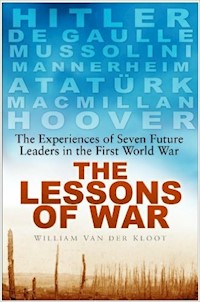
Examines the experiences of seven national leaders during the First World War including Adolf Hitler, Charles de Gaulle, Benito Mussolini, Gustav Mannerheim, Mustafa Kemal Ataturk, Harold Macmillan and Herbert Hoover.
Das E-Book können Sie in Legimi-Apps oder einer beliebigen App lesen, die das folgende Format unterstützen:
Veröffentlichungsjahr: 2008
Ähnliche


















THE LESSONS OF WAR
THE LESSONS OF WAR
The Experiences of Seven Future Leaders in the First World War
WILLIAM VANDER KLOOT
Quotation from ‘Trench Duty’ by Siegfried Sassoon on pp 107–108 copyright © Siegfried Sassoon by kind permission of the Estate of George Sassoon (U.K.); Collected Poems of Siegfried Sassoon by Siegfried Sassoon, copyright 1918, 1920 by E.P. Dutton. Copyright 1936, 1946, 1947, 1948 by Siegfried Sassoon. Used by permission of Viking Penguin, a division of Penguin Group (USA) Inc. (U.S.A.)
Quotation from ‘Over the Brazier’ by Robert Graves on p. 210 by kind permission of Carcanet Press Limited
First published in 2008
The History Press
The Mill, Brimscombe Port
Stroud, Gloucestershire, GL5 2QG
www.thehistorypress.co.uk
This ebook edition first published in 2013
All rights reserved
© William Van der Kloot, 2008, 2013
The right of William Van der Kloot to be identified as the Author of this work has been asserted in accordance with the Copyright, Designs and Patents Act 1988.
This ebook is copyright material and must not be copied, reproduced, transferred, distributed, leased, licensed or publicly performed or used in any way except as specifically permitted in writing by the publishers, as allowed under the terms and conditions under which it was purchased or as strictly permitted by applicable copyright law. Any unauthorised distribution or use of this text may be a direct infringement of the author’s and publisher’s rights, and those responsible may be liable in law accordingly.
EPUB ISBN 978 0 7509 5146 3
Original typesetting by The History Press
Contents
I
Sarajevo to the opening battles
Adolf Hitler: 28 June 1914
Harold Macmillan: 28 June 1914
July 1914
Charles de Gaulle: 29 July to 4 August 1914
Gustav Mannerheim: 29 July to 5 August 1914
Adolf Hitler: 2 to 3 August 1914
Harold Macmillan: August and September 1914
Herbert Hoover: 4 August to 8 August 1914
Charles de Gaulle: 4 August to 30 August 1914
Gustav Mannerheim: August 1914
Adolf Hitler: 16 August to 17 October 1914
Benito Mussolini: 18 October to 15 November 1914
Mustafa Kemal: August to November 1914
Herbert Hoover: 10 August to 30 October 1914
II
First Ypres to trench warfare
Adolf Hitler: 21 October to 1 November 1914
Harold Macmillan: October and December 1914
Gustav Mannerheim: September to December 1914
Herbert Hoover: 15 October through December 1914
Adolf Hitler: December 1914
Charles de Gaulle: October to December 1914
III
Dardanelles to Neuve Chapelle
Adolf Hitler: January and February 1915
Mustapha Kemal: January to May 1915
Benito Mussolini: January to May 1915
Harold Macmillan: January to August 1915
Charles de Gaulle: January to July 1915
Adolf Hitler: March to May 1915
IV
Suvla Bay to Loos
Mustapha Kemal: June to December 1915
Harold Macmillan: September through December 1915
Charles de Gaulle: June 1915 through February 1916
Adolf Hitler: June through December 1915
Benito Mussolini: May through December 1915
Gustav Mannerheim: July through December 1915
Herbert Hoover: July through December 1915
V
Verdun to Brusilov’s offensive
Herbert Hoover: January to June 1916
Charles de Gaulle: January to March 1916
Mustapha Kemal: November 1915 to July 1916
Harold Macmillan: January to June 1916
Benito Mussolini: February to September 1916
Adolf Hitler: January to June 1916
Gustav Mannerheim: January to August 1916
VI
The Somme to the battle for Romania
Harold Macmillan: July through December 1916
Herbert Hoover: July to December 1916
Adolf Hitler: July through December 1916
Mustapha Kemal: August through December 1916
Benito Mussolini: June through December 1916
Charles de Gaulle: April through December 1916
Gustav Mannerheim: September through December 1916
VII
The Russian Revolution to Passchendaele
Gustav Mannerheim: January to April 1917
Herbert Hoover: January to September 1917
Benito Mussolini: January to May 1917
Charles de Gaulle: January to May 1917
Mustapha Kemal: January to September 1917
Harold Macmillan: January to April 1917
Adolf Hitler: January to June 1917
Charles de Gaulle: June through November 1917
Mustapha Kemal: October through November 1917
Harold Macmillan: May through December 1917
Benito Mussolini: April through December 1917
Herbert Hoover: August through December 1917
Adolf Hitler: July through December 1917
Gustav Mannerheim: July through November 1917
VIII
The Finnish Civil War to the Armistices
Gustav Mannerheim: December 1917 to April 1918
Harold Macmillan: 1918
Benito Mussolini: January to June 1918
Charles de Gaulle: December 1917 to July 1918
Mustapha Kemal: December 1917 to August 1918
Adolf Hitler: 1918
Benito Mussolini: September through December 1918
Charles de Gaulle: July to December 1918
Mustapha Kemal: September to December 1918
Herbert Hoover: July through December 1918
Gustav Mannerheim: May through December 1918
IX
1919 and beyond
Herbert Hoover
Mustapha Kemal Atatürk
Benito Mussolini
Adolf Hitler
Gustav Mannerheim
Charles de Gaulle
Harold Macmillan
Acknowledgements
Selected Bibliography
I
Sarajevo to the opening battles
Adolf Hitler
28 June 1914
Toward the end of the afternoon, Hitler was painting a watercolour in his room on the third floor of his lodging house in Munich, at Schleissheimer Strasse 34. A twenty-five-year-old who specialized in views of notable buildings, his sales brought him enough to live modestly, with time free for arguing politics in coffee houses and for reading books from the State Library. His landlady, Frau Popp, recalled that a hubbub in the street brought her lodger downstairs, where she told him that the Austrian Archduke and his wife had been murdered in Sarajevo. Hitler’s own recollection was that Peppi Popp, the thirteen-year-old son of the family, brought the news to his room, but the boy knew no details—just the headline. Hitler was jubilant—he detested the Archduke, a German who had degraded himself by marrying a Czech and who wanted to share power among the nationalities of the Austro-Hungarian Empire—it was divine justice.
Harold Macmillan
28 June 1914
Macmillan, a youth of twenty, elegant in white tie and tails, was attending a London ball. The stairs in the magnificent residence were decorated with carnations and spirited waltzes were provided by Mr Cassani’s string band. At first he did not dance; the floor was too crowded for anyone so clumsy. He was tall, willowy and languid—a popular configuration at the time, with good features on an oval face; his upper eyelid was partially covered with a skin fold, suggesting Viking descent. As the evening went on, the older guests departed; the leeway on the floor overcame his shyness. Once started, he danced so vigorously that three times he changed into a spare clean collar. When he finally departed, he paid little attention to the headline shouted by a newsvendor: ‘Austrian archduke and wife assassinated.’ It was a remote affair in a distant, perpetually troubled quarter of the globe. He returned to his parents’ house at 52 Cadogan Place. The next morning his mother Nellie grilled him about every detail of his evening; as usual they spoke in French. We do not know whether the murders were mentioned. Later that day he was back at Oxford in his rooms in Balliol College.
July 1914
The assassin was a Bosnian Serb, Gabreil Princip, one of a group of six young terrorists—aged from sixteen to twenty—provided with weapons and assisted in slipping across the border by a secret Serbian organization, Union or Death—commonly called the Black Hand. The Austro-Hungarians had occupied Bosnia-Herzegovina in 1878, to ‘preserve order’ as the Ottoman grip loosened. At the same time Serbia became an independent country. The Serbians wanted Bosnia-Herzegovina but were too weak to seize it. Shortly after the royal couple arrived for their well-publicized visit to Sarajevo a terrorist bomb bounced off the boot of their car. Hours later, by sheer chance, Princip was able to kill: the procession made a wrong turn and stopped to shift into reverse immediately in front of him. He had not meant to hit the wife, but in training had fired only a few practice rounds. One of the youths talked, so the police rounded up all of their helpers in Bosnia and they told them the names of their contacts in Serbia. The terrorists were tried in October. The assassins were too young to be executed. Princip was given twenty years and died of tuberculosis coupled with starvation in 1918; some of the older supporters were executed.
The eighty-four-year-old Emperor Franz Joseph wanted the Serbs to learn a strict lesson: they must renounce terrorism as a weapon in international politics. The Austrian Foreign Minister, Leopold, Count Berchtold, met with the Council of Ministers to recommend war. Tisza, the Hungarian Prime Minister, did not want more quarrelsome Slavs in their empire, so he delayed a decision by insisting that for war they must have unequivocal support from their German allies. Therefore, Berchtold wrote to Kaiser Wilhelm II—an intelligent, experienced ruler who was also a fool (to prove my point, in his autobiography Wilhelm tells us that the war was plotted in 1909 in a secret covenant between the British, French and Americans, organized by the Freemasons). Wilhelm was handed the letter by the Austro-Hungarian ambassador. In years past the Kaiser had refused to back adventurism in the Balkans; but now it was different. The Archduke and the Kaiser were friends; only a few weeks before the Kaiser had vacationed at their Bohemian castle. He promised the ambassador that he would support whatever the Austro-Hungarians decided to do. Next the Kaiser met with the Imperial Chancellor, von Bethmann-Hollweg, who was surprised by the ‘blank cheque’ given to their ally, but did not have the spine to invalidate it, even though under the constitution—written by Bismarck for Bismarck—it was his responsibility. He knew that if Austria-Hungary attacked Serbia it was likely to trigger an avalanche—thanks to the network of treaties negotiated to preserve a balance of power. If the Russians came to the aid of their Slavic clients then Germany was pledged to fight alongside the Austro-Hungarians. That would bring in the French. As the Kaiser pointed out when he had restrained a somewhat similar adventure proposed by the Austro-Hungarians two years before, “Paris will undoubtedly be supported by London. Thus Germany will have to embark on a life-and-death struggle with three great powers. We hazard all, and may lose all.” It was a reasonable, statesmanlike analysis, which held with equal force in 1914. After the meeting, the Kaiser coolly resumed his summer vacation, yachting up to Norway.
Elated by the blank cheque, Berchtold proposed to invade immediately, but Tisza still held back. They agreed to issue an ultimatum, which Berchtold planned to make unthinkable for the Serbs to accept. They also agreed that if it came to war, they would let it be known that they would take no Serb territory. As they prepared the ultimatum in secret, Serbia faded from the headlines and from the public mind. The July weather was glorious throughout Europe and most people enjoyed it thoroughly.
Hitler combed the newspapers for scraps of news. Macmillan gave it little thought. The European army commanders were consulted by their political masters. All were ready to fight, and most regarded 1914 as a favourable time to do so. The public regained interest when the Austrian-Hungarian ultimatum was handed to the Serbians at 1800 on 23 July. The timing was set carefully. The President of France, Henri Poincaré, was on a state visit to St Petersburg. Poincaré promised staunch support, in effect giving the Russians their own blank cheque. The ultimatum was delivered after Poincaré left for home—so there was no chance for the French to cool the Russians down.
The ultimatum required the Serbian Government to renounce publicly all hostile acts, including propaganda, against the Austro-Hungarian Empire, and to punish all those who had engaged in such activities. They must dissolve the Black Hand and similar societies, arrest the officer who had provided the bombs and pistols and dismiss the customs officials who had smuggled weapons and assassins into Bosnia. To assure that these objectives were met, clause six permitted Austro-Hungarian agents to enter Serbia to look for accessories to the crime. The Serbians were given forty-eight hours to accept the ultimatum.
The Serbians agreed to every particular except clause six, which they claimed violated the Serbian constitution—presumably they hoped for a compromise that would shield the highest level of their government. When Wilhelm II read the Serbian response he observed that every cause for war was removed—but he had already signed the cheque. The Austro-Hungarian ambassador unhesitatingly declared that the response was unsatisfactory and severed diplomatic relations.
On 25 July the Serbians mobilized, Austria-Hungary partially mobilized, and the Russians announced war preparations for European Russia. Franz Joseph still hoped to stop short of war. On 27 July he was told that the Serbians were shelling the Austrian shore of the Danube. He signed the declaration of war the next day—no one told him that the shellfire report was an hysterical error. His declaration freed the Italians from their treaty obligation to come to their aid if they were attacked. The Germans warned the Russians that if they mobilized, they would mobilize also. The Kaiser appealed directly to his cousin the Tsar, writing as usual in English, begging him not to let events escalate. On 29 July the Tsar signed a partial mobilization order and the British sent a formal telegram to their armed forces, warning of imminent war.
Charles de Gaulle
29 July to 4 August 1914
On that day Lieutenant Charles de Gaulle was on leave in Paris, staying with his parents. He joined the large, enthusiastic crowd assembled at the Gare d’Est to welcome the returning President Poincaré. De Gaulle was not hard to spot in the crowd, towering well above them; he was 193 centimetres tall. His height was accentuated by a bird-like profile—a conspicuous curving nose and slightly receding chin; one of his army nicknames was ‘Big Asparagus.’ As soon as the official party appeared, the civilians bared their heads, the soldiers saluted, and all sang the Marseillaise. The de Gaulle family—mother and father, three sons and a married daughter—were for war; recovering the lost provinces of Alsace and Lorraine and revenging the humiliation of 1870 were worth any sacrifice.
On 30 July, the French ordered partial mobilization and the Tsar ordered full mobilization, so the red placard was posted throughout Russia to tell the largely illiterate reservists to report to their mobilization assembly points. German agents in Russian Poland stripped placards from the walls and sent them to Berlin, as positive proof of Russian mobilization. The next day, Austria-Hungary fully mobilized.
On 1 August, Charles de Gaulle was again back on the streets, mingling with the immense crowds along the boulevards watching the funeral cortège of the socialist leader Jean Jaurès, murdered by a young nationalist simply because he was a pacifist. The de Gaulles were not inclined towards pacifism or socialism, but they respected Jaurès for defending Captain Dreyfus—they, too, had been ardent Dreyfusards. The authorities feared violence, but the crowds were silent and respectful. The streets were hot and sultry; the leaves of the chestnuts were coated with dust. At 1645 the French government ordered mobilization, and soon the posters, topped by crossed tricolours, were everywhere. At 1700 the Germans ordered mobilization. Under their constitution they must be at war before they could mobilize, so they declared war on Russia. President Poincaré proclaimed a Union sacrée, a united France prevailing over class and politics. The Paris police requisitioned the buses to transport those on the list ‘to be arrested at the outbreak of war’ to prison, so travellers had to walk to the stations or be taken by car. The city was quiet; there were no demonstrations or cheering crowds. Prudent people, recalling the siege of 1870, were busy storing food.
Charles returned to his regiment, the 33rd Infantry at Arras, not far from his childhood home in Lille. He commanded the 1st platoon in the 11th company. He had served his mandatory year in the ranks in the 33rd before entering the military academy at Saint-Cyr. Thanks to his distinctive appearance and his appalling clumsiness he had been a figure of fun. His comrades laughed at his inability to perform such routine tasks as properly stowing gear in his field pack. The ragging did not get him down; he maintained a high opinion of himself, which he did not keep secret. When he was promoted to corporal, his commanding officer was asked whether it would not have been appropriate to make him a sergeant instead. “Why do you think I should make a sergeant of a young fellow who would not feel he had made his due unless he were made le Connétable (the title given to the supreme commander of the armies under the monarchy).” This gave de Gaulle another nickname—throughout his army career many of his mates knew him as le Connétable.
He graduated thirteenth in his class from Saint-Cyr, which permitted him to select his posting. Many of the best students chose colonial regiments for action and advancement; de Gaulle returned to the 33rd. In later life he wrote that a major reason for his choice was that he was so impressed with their new Colonel, Henri Pétain: “My first Colonel showed me the meaning of the gift and art of command.” Note, however, that this was written after the war, when Pétain was the commander of the French army and de Gaulle was a member of his staff. To be sure, de Gaulle and Pétain had much in common. Pétain told everyone that the French colonial wars in North Africa, Indo-China and Madagascar were damaging diversions from the army’s true business—the Germans. He never applied for colonial service, which hobbled his career. When de Gaulle rejoined the regiment it was taken for granted that Pétain would soon be gone; he had already purchased a retirement home.
Though not esteemed by his superiors, Pétain was popular in Arras. In 1913 he was fifty-seven years old. His fringe of remaining hair was white, his bushy moustache salt and pepper, but the skin on his pallid face was taut and his figure lithe. His light blue eyes were striking. On first acquaintance he was as cold as his icy appearance—though his manners were impeccable. Those who came closer uncovered his wry, irreverent, ironic sense of humour. Deeper still there was fire beneath the ice. A bachelor, he was extremely fond of feminine company: “I love two things above all, sex and the infantry.” Some said that at Arras, Pétain and de Gaulle were attracted to the same ladies and competed in their lists of love. In later life de Gaulle never dismissed such talk. Pétain left the 33rd at the end of 1913 to command a brigade, so that the army could retire him as a general. De Gaulle thought that Pétain “had the presence of a deep reserve, intensified by a deliberate coldness of manner, quick sarcasm, and a pride which protected his aloofness”—the perfect role model.
De Gaulle’s journey back to the 33rd was uncomfortable. The trains were jammed and schedules and routes disrupted—his trip took eight hours. Three days later the reservists reported to barracks; de Gaulle found both these men and the local people calm and resolute. The secret army estimate was that 13 per cent of the reservists would fail to report, but since almost all of the socialist politicians strongly supported the war only 1.5 per cent of them did not report. Three thousand deserters resurfaced, begging for the chance to serve.
On 2 August, President Poincaré instituted martial law by declaring the entire country in a ‘state of siege.’ The next day, Germany declared war on France and sent Belgium an ultimatum demanding passage for German troops, promising to leave when the war was over and to pay for any damages done. The Belgians refused. They thought that their army would be able to fend off whatever force that the Germans, fighting on two fronts, would be able to bring against them. The German move against Belgium got the British government off the hook. France, Russia and Britain were not linked by treaty, but they had an understanding of “sympathy and determination to protect mutual interests.” The foreign secretary, Sir Edward Grey, had secretly authorized joint Anglo-French staff talks. They planned for a British Expeditionary Force (BEF), which would enter the line on the French left flank. The small BEF meant less to the French than the naval understanding: the British fleet would protect the Channel coast of France so that the French fleet could secure the Mediterranean, where they felt free to base almost their entire fleet. In the last days of July the anxious French pressed Grey to reconfirm this undertaking. Grey reminded them that the talks had been advisory and did not commit either side. A fair-minded man, he saw that the French had been backed into a trap. When he finally revealed what he had done to the cabinet some of his colleagues threatened to resign. They were brought back on board because in 1830 the British had signed a treaty pledging them to maintain the neutrality of Belgium. When the Germans invaded, Grey went before the Commons to invoke the treaty; the British declared war on 4 August.
Germany and Austria-Hungary now faced a coalition that outnumbered them in troops by a ratio of three to two, and which in the years just passed had spent twice as much on their militaries. The Germans must wage war on two fronts and if the Italians joined the Allies, so would the Austro-Hungarians. De Gaulle was confident the French would prevail.
Gustav Mannerheim
29 July to 5 August 1914
Mannerheim went for his dinner to the Cercle de Chasse clubhouse in Warsaw. The others were in white tie, but Mannerheim wore his uniform, decorated with the aiguillettes and monogrammed epaulets of a Géneréral à la Suite of the Tsar and the insignia of a major general—in Warsaw he commanded the Brigade of Cavalry of the Guard. He towered above the crowd—he was as tall as de Gaulle—as fit-appearing a forty-seven-year-old man as you can imagine, though a trained eye might have noticed stiffness in some of his movements. The politics of the club was epitomized by their president, a Polish prince who once had been dragged in irons to Siberia to serve twenty years in prison. Nonetheless, the Russian general was a valued member of the club. His qualifications included his birth—he was a baron—and his passion for and skills with horses: rider, trainer, breeder, polo player and show jumper. But his crucial attribute was nationality—he was a Finn.
The Grand Duchies of Finland and Warsaw were both autonomous states within the Russian Empire, ruled personally by the Tsar. The Poles, tied together by language, religion and culture, had been split between the Tsar, Prussia and Austria in the late eighteenth century. Most Poles craved reunification and independence, and naturally assumed that Finns wanted the same. But Finland was different. It was almost evenly divided between Finnish and Swedish speakers. The Mannerheims spoke Swedish; Gustav’s Russian was still flavoured with a Swedish accent, which many ladies found delightful. The revolution of 1905 had triumphed in Finland; the Tsar’s governor was stripped of dictatorial powers and a parliament was elected by universal suffrage—women as well as men—to make the laws. Gustav’s older brother, Carl, was allowed to return from exile in Sweden. Now the Mannerheims worried mostly about the armed workers’ militia, the Red Guards, which had been formed in 1905 and was training for a class war.
The club also esteemed Mannerheim because he was a renowned explorer. In 1906 the Russian General Staff sent him into Central Asia; he could travel with a Finnish passport, which might make the Chinese less suspicious. Mannerheim was given two years salary in advance, travelling expenses to Peking and return, and funds for equipment. He raised more money for science in Finland, where his grandfather had been a notable entomologist. He started from Turkmenistan, stopping with each tribe along the way, studying customs, learning languages, and mapping the route and the major towns. He collected crafts and archaeological relics and took hundreds of spectacular photographs. He met the Dalai Lama, who had fled Tibet to keep out of the hands of the British. The Dalai Lama handed to him the traditional white silk greeting scarf, which he was to convey to the Tsar. In return, Mannerheim presented His Holiness with a Browning pistol—perhaps not a perfect gift for a Buddhist, but it was near the end of his trip and his supply of gifts had run low. He returned from Peking in 1908. The Tsar received him for a personal report and he was made welcome in the finest houses. According to his comrade and biographer, Paul Rodzianko, every lady in Moscow seemed to develop an insatiable curiosity about Central Asia, which could only be assuaged by private instruction from the handsome explorer. He subsequently published a book describing his adventures.
In the club dining room, Mannerheim was at the president’s right. The group was buzzing with the latest rumour: a compromise had been reached—there would be no war. A servant passed Mannerheim a note ordering him to “present yourself at Brigade Headquarters at 12 midnight;” he made his excuses and slipped out of the room. He telephoned his officers, instructing them to report to barracks. A few minutes after midnight, he received a telegram: “Mobilization ordered to begin at midnight. Open sealed mobilization orders.” When Mannerheim fetched the orders from his safe he read that his 1st Squadron of Uhlans was to entrain at 0200. He passed the order along but also telephoned his superior to warn him that it was impossible to get them off on schedule. At 0200 the commander of the 1st Squadron called to report that they were about to leave on the train. Shrewdly he had assumed that mobilization was coming and had his men ready. Mannerheim was credited at the highest levels for so handily carrying out an almost impossible order.
Mannerheim’s household staff was accustomed to his being away; only a few weeks before he had been off in Germany buying horses and taking the cure for his rheumatism. He had been married for twenty-two years to a rich Russian lady, but his wife and their two daughters lived in the south of France. As he left his house he may have given his treasured Russian sofa an affectionate pat. He always showed it to visitors assuring them “that the most beautiful women in Russia had sat on it.” They questioned whether he used the correct verb.
The brigade moved by train 170 kilometres southeast to the city of Lubin. They detrained in pouring rain and marched 35 kilometres south to a major road junction, 30 kilometres north of the border with the Austro-Hungarian province of Galicia. There Mannerheim learned that it was a partial mobilization; full mobilization came the next day—the Tsar had been dithering. His cavalry brigade was to protect the railhead where troops coming from Russia would detrain.
Adolf Hitler
2 to 3 August 1914
London was flooded with cheering crowds. Prime Minister H.H. Asquith, in his daily letter to “His Darling,” an attractive twenty-seven-year-old lady named Venetia Stanley, recalled a predecessor’s caustic remark: “Now they are ringing their bells; in a few weeks they will be wringing their hands.” The streets of Vienna were filled with elated citizens, anxious to display their devotion to this great cause. The huge celebration in Munich is preserved in a notable, frequently reproduced photograph. Men fill every foot of the Odeonsplatz, but out of the mass, a careful hand has circled the features of Adolf Hitler, dressed in dark suit, high collar and tie, his flowing moustache carefully brushed to the sides. He waves his hat, eyes bulging with excitement, bellowing exultantly. The photograph was taken by a man who years later became Hitler’s court photographer, and he made the print on which Hitler personally circled himself.
The cheering Hitler burned with an unprecedented desire—he wanted to join the army. A native of Austria, when he reached the age for military service he did not register for induction. Months later he was warned that the police in Linz, where he had lived before moving to Vienna, were looking for him. On 20 April 1913, his twenty-fourth birthday, he received his share of his father’s estate, which enabled him to move to Munich. Leaving Austria to avoid military service was a crime punishable with imprisonment. On Sunday 18 January 1914, a Munich police officer arrived at his lodging with a summons requiring Adolf Hitler to present himself to the Austrian authorities. To insure his compliance he was arrested; he petitioned the Austrian consulate for a delay. He appeared on 5 February in Salzburg, where the examining physician found him too frail for military service. When he returned to Munich he was relieved that the Popps still welcomed him as a lodger, despite his brush with the law.
On 3 August, he shuffled for hours in the long line snaking toward the Munich recruiting office, only to learn that as an alien he must petition King Ludwig III for permission to serve in the Royal Bavarian Army. After an anxious time his petition was approved and he was instructed to remain at his lodgings until called to duty.
Harold Macmillan
August and September 1914
Macmillan was stricken with appendicitis and had emergency surgery. When he left hospital he was sent home to recuperate under his mother’s strict eye. He was anguished as, one by one, his friends enlisted—they all were sure that the war would be over by Christmas and did not want to miss it. Rudyard Kipling caught the nation’s temper:
For all we have and are, For all our children’s fate, Stand up and take the war. The Hun is at the gate!
Herbert Hoover
4 August to 8 August 1914
When the war erupted, 125,000 desperate American tourists were stranded in Western Europe—desperate to get home. Banks refused to honour their letters of credit, panicked hotels refused to accept American currency or travellers’ cheques. Many of those on the Continent travelled to England to book passage but once there could not pay for food or shelter, let alone book transatlantic voyages. On Monday 3 August, 2,000 desperate globe-trotters were at the American embassy in London. Their troubles were magnified when the British Government extended the Bank Holiday—which was that Monday—for three additional days.
One of the tourists, Fred I. Kent, a prominent banker, and a few friends, formed the American Citizen’s Committee. Kent managed to slip through shut doors to borrow $20,000 from London banks on the collateral of a gold shipment that was then in the mid-Atlantic. The Committee set to work in the lobby of the Savoy Hotel. Stranded tourists queued before tables manned by committee members, negotiating for muchneeded funds. Other frantic tourists turned to the American Consulate for assistance. In the early afternoon of 4 August an American mining engineer walked from his office to the consulate. There is a difference of opinion over whether he came on his own initiative or was asked in. Hoover had little sympathy for the commercial travellers pounding on the Consul’s desk, but was drawn to the quiet, polite, anxious teachers, folks who had saved for years for the privilege of a trip to Europe. They were like some of the “teachers of my own childhood.” He telephoned for the £100 in cash he kept at home and for all of the cash held in reserve at his office. Assisted by workers from his firm, Hoover changed money at the usual rate and loaned 10 shillings to those who gave their word of honour that they had no cash on hand. That afternoon they helped about 300 Americans.
When the office closed for the day, the Consul telephoned to report to the American Ambassador, Walter Hines Page. Page asked Hoover to come to see him at once; they were acquainted from formal dinners at the Embassy. Hoover, then just a few days short of his fortieth birthday, was one of the most successful and renowned mining engineers in the world. At the Embassy Page told Hoover that the Citizen’s Committee had called a mass meeting at the Savoy Hotel for that evening, and asked Hoover to attend. More than 1,000 anxious people jammed the meeting; there were many rambling speeches. At the end of the profitless proceedings, Hoover suggested to the organizers that he might enlist some resident Americans to help. They jumped at his offer. Hoover telephoned American engineers living in London, asking them to meet him at the Savoy the following morning. The hotel provided a few reception rooms, tables and chairs without charge. There were many American engineers in Britain, because some American universities provided first-rate instruction in engineering, while the major British universities still took the subject lightly.
By serendipity, Hoover’s wife, Lou, had stopped by the Savoy during the day. She was dismayed by the number of women, many with children, travelling unaccompanied and now stranded. She volunteered to start a group to assist them and immediately set to work, calming the distraught and telephoning friends for help. When her husband ran into her, they joined forces. In public they could make decisions confidentially by conversing in Chinese; Bert, as she called him, only had about 100 words but that usually sufficed. That evening the Hoovers telephoned to enlist Americans living in London. Some of their acquaintances and many newspaper reporters thought that the Hoovers were driven by strong religious beliefs, knowing that his mother was a Quaker and deducing from their habitually sober dress that they followed in her footsteps. They might not have noticed that he smoked ten to twenty Havana cigars a day and that both drank alcohol; cocktails were served at all of his business lunches. As an adult he never attended meetinghouse and entered a church only for ceremonial occasions. They were compassionate and both loved to overcome obstacles—they were born ‘pushers and doers.’
The American Resident’s Committee for the Assistance of American Travellers met early the following morning. With Hoover in the chair the business was done promptly. He was elected chairman, even though the Hoovers’ primary residence was a cottage on the campus of Stanford University, where they had been students. However, they had been based in London and still leased a charming place in Kensington, the Red House. They had come to London in March 1914, planning to return to the States in August for their boy’s schooling. Hoover was preparing to quit the mining business and, with one eye on future public service, was negotiating to buy a newspaper in the US. He had all of the money they needed. The Hoover’s sense of values was spelled out in the instructions Lou wrote to the man who would become the boy’s guardian if both parents died: “… not to let them get a money measure for all the affairs of life.”
The Resident’s Committee went into immediate action at the Savoy. During the day they were joined by volunteers from American businesses in London and by capable recruits from among the travellers—by day’s end they had almost 500 volunteers.
Charles de Gaulle
4 August to 30 August 1914
On 4 August de Gaulle updated his will and put his other papers in order. The next morning he shut down his little apartment, saying goodbye to his furniture, his familiar little treasures, and his books. The regiment formed up in the barrack square and then paraded out of Arras, de Gaulle riding a mare, colours flying, band playing and spectators cheering—they had to be restrained by the police from giving the soldiers an affectionate mobbing. The first day they marched for fourteen hours, heading west. It was an ordeal. Their uniforms were not meant for warm weather, and it was the hottest summer for many years. Sweat saturated their heavy wool red trousers and their long, thick, blue capotes flapped open, weighing down their shoulders. The column moved in fits and starts. The carts interspersed between the marchers slowed when they climbed a hill, and rushed as they hurtled down, and the marchers had to keep pace. But the carts were welcome because they carried the men’s knapsacks and other gear. Coated with white road dust the soldiers looked like ghosts. By the end of the second day, they had marched 70 kilometres. They halted for dinner and a good rest. The reservists from sedentary occupations were in a frightful state and all of them were breaking in new boots—most had bloody feet. They had scarcely sat down when they were ordered to reform and to go for another 10 kilometres. Some of the carts had gone off, so now half of their gear was hauled on their backs. They arrived at their new destination at 1800 and then lingered for four hours before they were fed. The men slept in barns and sheds, the officers in homes. They were 6.5 kilometres south of the Belgian border; the next day they shifted a few kilometres to the west. They were the advance guard of a French army marching to the frontier. Mass was celebrated, and de Gaulle’s heart was stirred by the quiet devotion of the celebrants. After the service they marched for another four hours. Along the way they heard that the Germans had seized Liège, where the principal railway lines cross the River Meuse.
The next day they rested and cheered the news that the French had occupied Mulhouse, one of the cities lost by the Franco-German war; in the evening de Gaulle strolled about to take in the local sights. During the night the sentries opened fire twice—startled by wildlife. The next day, in the fierce August heat, they marched on to Fumay on the Meuse, almost at the border, where they heard cannon fire in the distance. They rested again the next day; morale was excellent and they all knew that they were part of a large army moving precisely to plan. They then received their first mail; he had a letter from his parents posted five days previously.
They started again at 0300 on 13 August, marching north to cross the border. After dawn they were shadowed by a German aeroplane. The aviator knew just where to find them because a French cavalry officer had been captured with a map showing their route. The flyer reported that the French column stretched along the road for 18 kilometres. When they crossed the border, de Gaulle was not surprised by the transition; after the Jesuits were prohibited from teaching in France, he had studied at one of their colleges in Belgium. But many of the men were astounded—they were used to seedy, dishevelled, stinking French villages, with towering piles of ordure in each courtyard and masses of swarming flies; here were tidy towns in which you could smell the late summer flowers. They were greeted enthusiastically as liberators and were offered water, wine and beer. Next day de Gaulle’s 11th company was the point of the column, spearheading the entire army; he was kept busy overseeing the scouts. That evening they billeted in a village whose residents freely shared their food and drink. De Gaulle went to his priest to confess, and when he left he felt the peace of God.
They were routed out of their billets at 0200; again, de Gaulle’s platoon had the point. Keeping formation during any night march was demanding, but it was much harder scouting on the point. After 30 kilometres, another platoon took the lead. After daybreak they had to force miserable refugees off the road; they were heart-wrenching with their desolate faces and pathetic heaps of treasured belongings. When they stopped for lunch, de Gaulle ate in a café that he rated mediocre. As they were eating, a French bicyclist sped into the village with an order for the regiment to push on to Dinant on the Meuse; the Germans were approaching from the other side and the French must get there first to seize the bridges. The soldiers who had been served last had to leave their soup uneaten.
The French war planners expected the Germans to wheel through eastern Belgium and then swing south along the east bank of the Meuse. They did not believe the enemy could muster enough men to move across to the west bank, never anticipating that the Germans would bring their reserve corps of older men to the front immediately. The 33rd arrived in Dinant after another night march. It was a town with 8,000 inhabitants, on both sides of the river, with a sturdy bridge connecting its two parts. De Gaulle’s 11th Company was on the left bank, near the railway station and the Hotel des Postes; across the bridge was the grand square with the town hall and the largest church, sheltering under a steep cliff of exposed limestone crowned with a ruined fortress. Most of the 33rd Regiment crossed the river to climb up to the heights while the 11th Company—the rear guard—waited on the left bank. Spent men slept on the street, and the servants borrowed armchairs for their officers. Two eggs were purchased for each man. At 0600 the first German shells burst in the city. “What was my impression? Why not say it? For two seconds of physical response—tightness in the throat.” Then, “finally I am going to see them.” His men laughed as he hurried them into cover in a ditch beside the railway line. De Gaulle returned to the square to lounge on a bench—sheer bravado. French wounded trickled back across the bridge; the Germans had reached the high ground first and held the abandoned citadel. Their riflemen shot at the French in the valley below. It was a long shot, so they did little damage. The scene became surreal when two well-dressed young ladies strolled into the square and asked de Gaulle whether it was safe for them to cross the bridge; regretfully, he told them no. More wounded walked or were carried back over the bridge.
On the right bank, the French bugles blew the retreat. A German machine gunner now had the bridge in his sights, so the retreating French sprinted across in small groups—but the fire was too daunting for the stretcher-bearers to risk bringing their burdens across. There was no response by French artillery because the infantry had not waited for them to come up. The 11th Company officers were called together and ordered to advance with the bayonet to prevent the enemy from crossing the bridge. To reach his men in their ditch de Gaulle had to run over an exposed level crossing—a tasty target, an awkward asparagus; his legs shook as he ran. He assembled his platoon and ordered other men sheltering in the ditch to join them; his servant brushed the dust from his black coat. The French officers wore distinctive uniforms so their men could easily pick them out—but so could enemy sharpshooters. He pulled on his white gloves and drew his sword. He ordered “A la baïonnette;” they rasped abrasively as they were rammed over the rifle barrels. The bugles blew the charge. De Gaulle leapt from the ditch, repeatedly yelling “En avant,” waving his sword, racing in front of his men toward the bridge. He felt himself “split in two, the one running like an automaton and the other anxiously watching him.” He had almost crossed the 20 metres of open space leading to the bridge when “something struck my knee, like a whip-lash.” Falling to the ground, a moment later he was pinned there by the dead body of his sergeant. He heard the muffled thuds of bullets hitting dead and living bodies. He pulled himself free; his right leg would not work properly—he had to drag himself about. His sword was tied by a lanyard to his wrist, so it clattered behind him on the pavement. He shouted for his men to shelter in the buildings. Those wounded who could not move cried pathetically for help. French artillery finally opened fire.
A group of officers watched from an elevation on the left bank. All were French except for a British liaison officer, Lieutenant Edward Spears. First they saw the French wounded dribbling back across the bridge, followed by the retreating troops; then the Germans bombarded the zone around the French side of the bridge. Twice the French attempted counter-attacks. As we have seen, they failed, leaving the ground strewn with bodies. The Germans sent across a small detachment of Saxon Jägers, who deployed to defend their bridgehead with their rifles. About noon, two regiments of the French 2nd Division dashed toward the bridge. After a few volleys, the Jägers broke and fled back across the river. Spears considered the French lucky that there were so few Jägers and that they had not brought a machine gun with them. Whenever Spears hinted to his companions that he had not been struck by the sophistication of French tactics or operations, the invariable answer was that they operated by “Le Système D—”: “D” for Dèbrouille-toi—muddling through. Spears acknowledged that Le Système often worked, but nonetheless considered it a method that should be reserved for the use of Frenchmen in France. Years later, General Spears had ample opportunity to discuss Dinant with de Gaulle; Spears was the liaison officer who brought General de Gaulle to London in 1940.
After dark, local peasants loaded the wounded into carts. De Gaulle was fully conscious, with little pain, but suffered because he knew they had been beaten. The wounded were taken to a village schoolhouse where teachers administered first aid and fed de Gaulle two swallow eggs. When he woke the next morning his right leg was paralyzed and without sensation—a bullet had tunnelled through the leg. He investigated the entrance and exit wounds, but could not make out what mischief the bullet had done in between. It was just the sort of wound expected from a modern high-velocity bullet; it streaked though skin and muscle and out again, leaving a clean, precise wound. A musket ball tumbling on its way would have made a hash of it. His bone was not shattered because bone splinters had not enlarged the exit hole. The wounded in the school were dejected; the unscathed men outside chattered gaily. He was examined by a corpsman and then by the chief physician of the corps, who ordered him to be evacuated by ambulance.
His first stop was Charleroi, where his married sister, Marie-Agnés lived; she was amazed to be invited to visit her wounded brother. For the rest of the war she lived in occupied Belgium. He was then moved back to Arras, where the doctor told him that the bullet had damaged his sciatic nerve, which accounted for his loss of sensation and inability to move his leg. He was evacuated to the Saint-Joseph hospital in Paris where they operated to clean up the wound; the nerve must recover by itself.
Gustav Mannerheim
August 1914
Austria-Hungary declared war on Russia on 6 August and, a week later, their army crossed the border and marched north to seize the railhead. Mannerheim was ordered to move his brigade to a designated defensive position to be held “at any cost.” Mannerheim feared that the enemy might get there first, so he moved his brigade south in battle formation. His regiment of Hussars followed one road; his regiment of Uhlans used two others. Mannerheim, his staff, the scouts, the pioneer section and his artillery battery took a central road, bridging between the two regiments. He ordered his regiments to gallop until enemy fire obliged them to dismount and then to refuse to be moved from where they stood. Soon his brigade was engaged along a front of 9 kilometres. His six-gun horse artillery battery fired support for the cavalry on either side, but soon four of his guns were hit and out of action. Mannerheim shifted his two remaining guns to a more sheltered position. Lines of Austrian cavalrymen, on foot, repeatedly attacked his dismounted troopers, who repelled them with assistance from their four machine guns. Mannerheim reported to division headquarters his position, the strength of the enemy attacks and his losses.
The response from headquarters showed how much had improved since they fought the Japanese so ineptly in Manchuria. A fresh battery came cantering up the road, assigned to his command. The gunners found him on a hilltop overlooking the battlefield, casually strolling back and forth smoking a cigar. By his height and uniform, he could be recognized from quite a distance; his courage had a splendid effect on his men in the firing line.
Later in the day, he was reinforced by an Uhlan regiment and by two squadrons of Cossacks from the frontier guard. Toward evening an infantry regiment arrived. He ordered them to take over the line in the centre of his position; their rifles would be more effective than cavalrymen’s carbines and they would have more men firing because one in three was not needed to hold horses. The Austrians continued to attack, but with decreasing energy. Though his field glasses, Mannerheim watched as their lines became jumbled and uncertain. Toward evening his cavalry attacked on the flanks; the enemy bolted, leaving behind their dead and about 200 prisoners. His brigade had manoeuvred and fought well. After only a few months under his command—some of it fancy-dress soldiering as guards at the Tsar’s Polish hunting lodge—in battle they had done everything he asked. He also gave division good marks for sending reinforcements promptly and placing them under his command; and he must have been pleased that in his first battle as a general, he had not only done well with his brigade, but had ended by successfully directing a formation closer in size to a division. It was a far more gratifying action than his only encounter with Japanese cavalry in Manchuria, where he had been outnumbered and could only distinguish himself by slipping off with light losses. His self-appraisal was endorsed when he was awarded the Sword of St George—a notable decoration. He wrote that his casualties were heavy, but gives no numbers. This is how he always wrote about war, in the style of Caesar, as moves across a map, with blood and humanity in the wings; although he does mention, with regret, the death of a promising young aide-de-camp.
Adolf Hitler
16 August to 17 October 1914
Hitler was finally instructed to report to Recruiting Depot VI in Munich. He passed his physical—standards were relaxed—and was issued a light blue Bavarian Army uniform and sent to the barracks, where he was assigned an iron cot holding bare boards on which a straw-filled mattress rested. In the latrine, twenty men sat side by side. For two weeks, he and the other recruits were initiated in a training detachment. Then he was transferred to the newly formed Bavarian Reserve Infantry Regiment 16. This regiment soon became generally known by the name of its first commander, so we shall call it the List Regiment. Hitler was #148 in the 1st Company. In 1914 a German infantry regiment had a complement of 3,394 men, 234 horses, 6 machine guns and 65 vehicles. The List was quartered in the barracks in Munich and did their training on its Exerzierplatz.
It must have been an electrifying jolt for Hitler to pass from unrestrained life to military discipline. Any soldier with longer service could demand instant obedience. Like recruits everywhere, he was harassed by NCOs screaming filthy invective about his ancestry and moral character. The List NCOs had been recalled from the second stage in their careers: after serving nine years with the colours, they had become policemen, postmen, or minor civil servants. They taught the recruits the exhausting goose step and the elements of close-order drill; for practical training they crawled across a muddy field while cradling their rifles. Then they were allowed a few minutes to spruce themselves up before a close inspection; any with a trace of un-brushed mud on their tunic repeated the exercise. When they were given a few hours at liberty in the evening Hitler would visit the Popps, who had agreed to store his goods for the duration. Herr Popp, a tailor by trade, would send Peppi out for Löwenbrau. He knew that Hitler did not care for beer, but he had to demonstrate his pride in his former tenant in some fashion.




