


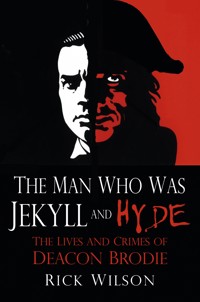
Erhalten Sie Zugang zu diesem und mehr als 300000 Büchern ab EUR 5,99 monatlich.
- Herausgeber: The History Press
- Kategorie: Sachliteratur, Reportagen, Biografien
- Sprache: Englisch
He was a respected cabinetmaker and councillor by day – but Deacon William Brodie changed into a sinister, thieving monster when darkness fell on the old city of Edinburgh. Cleverly employing his respectable reputation to access the richest members of society before stealing from them as a masked burglar, he used the resulting illicit money to fund yet another life – with five children and two mistresses. But Brodie – whose chilling story inspired Robert Louis Stevenson to create the classic tale of Dr Jekyll and Mr Hyde about a century later – came fatally unstuck when an accomplice informed on him. Then neither his ill-gotten gains nor his plans to cheat the hangman could save him. Rick Wilson traces the increasingly desperate double life of Brodie, from his first taste of crime through to his public disgrace and execution … hanging on the very gallows he allegedly conceived himself.
Sie lesen das E-Book in den Legimi-Apps auf:
Seitenzahl: 301
Veröffentlichungsjahr: 2015
Das E-Book (TTS) können Sie hören im Abo „Legimi Premium” in Legimi-Apps auf:
Ähnliche



















For Daisy and Corin
ACKNOWLEDGEMENTS
Thank you to – Dutch writer Marco Daane for his insights on Deacon Brodie’s Amsterdam arrest; antique journo Bill Sinclair for his antiquarian Edinburgh journals; Ian Nimmo, past chairman of the Robert Louis Stevenson Club, for all his borrowed knowledge; Edinburgh University’s Owen Dudley Edwards for his thought-provoking views; Keith Walker, Napier University information services adviser, for his ‘enlightening’ help; tour leader Magnus Moodie for his Old Town guidance; David S. Forsyth, National Museums Scotland, for pointing me to Brodie’s forged keys and dark lantern; and John and Felicitas Macfie for showing me around their house that once housed RLS.
CONTENTS
Title
Dedication
Acknowledgements
Introduction
1 The Brodie Root of Jekyll and Hyde
2 His Life and Loves
3 The Birth of his Criminal Half
4 Escape – and Capture
5 The Last Letters of his Life
6 The Trial: You Stand Accused
7 Death (or not?) by Hanging
Bibliography
Plates
About the Author
Copyright
INTRODUCTION
Who was Deacon Brodie? Many people profess to know the name, but a surprisingly large number are unsure if they know his story. Not to be smug about it: that number would have included this writer before embarking on this project.
The daytime William Brodie was a superficially charming gentleman and city councillor who commanded the timorous respect of fellow citizens as he went about his business of winning work for his cabinet-making company. Certain things about him, however, betrayed the fact that he was something more than a good, solid, upright Edinburgher. In what was a fairly grey-toned eighteenth-century Scotland he could seem like a bit of a dandy, with his cocked hat, flowered waistcoat and silver buckled top-quality shoes; not to mention a livid scar on one cheek – the result of a dispute over loaded dice in a card game. Even a stranger might have reckoned there was at least a boyish naughty streak there.
But it was far more serious than that. Despite showing occasional flashes of fatherly tenderness for favoured members of his five-strong illegitimate brood, he was basically a selfish and ungrateful soul with an insatiable appetite for money, who once said he would rather go to sea than develop the business left to him by his father – along with a huge fortune – as he had seen that big treasure prizes were being taken by sailors of every rank. Nor was he grateful for his privileged position on the city council that, in the days before corruption as we now know it, afforded him, as deacon of wrights, an endless conveyor belt of business opportunities. These, crucially, included crime. For as his day job gave him access to clients’ shops, houses and safe keys – from which he made copies – by night he morphed into a cloaked, sinister burglar who skulked around the closes of old Edinburgh with a dark lantern and darker intentions.
Eventually found guilty of a long series of robberies that had shocked and mystified the city’s population, this was an extremely aberrant man who was to fall foul of his own greed and deep psychological complexities – including an enthusiasm for theatricality – that prompted him to become another person in the same body. So perhaps that should be persons, plural. By his own confession he was a ‘very ingenuous fellow’, but he was also a gambler, a spendthrift, a deceiver of two mistresses and generally – perhaps the biggest societal sin of this particular period – a betrayer of his own class and upbringing. Not for murder, but for this – as well as his audacious attempt to rob the Excise Office of Scotland – he and an accomplice were hanged on a scaffold said by some to have been designed by himself a year before.
But another piece of joinery figures large in his tale. One of his cabinets was to be the catalyst that ‘fathered’ Dr Jekyll and Mr Hyde in Edinburgh. A century after its creation in Brodie’s workshop in the Lawnmarket, the cabinet stood at the foot of Robert Louis Stevenson’s bed in the New Town, and the then-young author, reminded every day of its provenance, became so obsessed by the Brodie story – and thus by any human being’s capacity to be more than one personality in one body – that he was moved to no fewer than three creations based on him. These were two plays and a horror-story novella that became an immediate bestseller and introduced the world to the character(s) whose names have figured ever since in everyday English speech.
Talking to the Museum of Edinburgh about details of William Brodie’s life, including the family Bible from whose birth register all reference to him had been excised, we learned that in planning to mount an exhibition entitled ‘Edinburgh, City of Stories’ it had invited friends of the institution to vote for their favourite tale out of three – Burke and Hare, Greyfriars Bobby or Deacon Brodie. The vote went to Greyfriars Bobby, but surely its proponents were barking up the wrong tree? For as we were saying, if more people knew more about the Deacon, his remarkable tale would doubtless have easily swung the vote.
Why is it so remarkable? There are many reasons – because of the stark differences in his two personalities; because he eluded truth and justice for so long; because he was not all evil, having a gentler side for friends (and families); because his upbringing gave him a false expectation that he would survive all that life would throw at him, regardless of his crimes; because he did not, in the end, survive them – not his flight to Amsterdam as he prepared to take a ship to America and probably not his final demise, despite stories of collusion with the hangman, a protective steel collar around his neck and a doctor standing ready to revive him.
But mainly it’s because he symbolised – at an extreme level – that alarming human ability to be a split personality, and as such could fairly be seen as the driving impulse behind Stevenson’s still-resonant creation of Dr Jekyll and Mr Hyde.
Not convinced? You are herewith invited to read the story with sceptical eye, be carried along by it and see if, in conclusion, you disagree.
1
THE BRODIE ROOT OF JEKYLL AND HYDE
When I was sick and lay a-bed,
I had two pillows at my head,
And all my toys beside me lay
To keep me happy all the day.
The night was a different matter. In that famous poem from his A Child’s Garden of Verses, Robert Louis Stevenson fondly described the eponymous Land of Counterpane as ‘pleasant’. But it was not always so. Sometimes, as he snuggled under his sleep-time bedspread – or counterpane – in his second-floor room in the family house in Edinburgh’s Georgian New Town, the bronchitis-affected young Robert struggled to hold back the darker side of his fertile, vivid and often fevered imagination.
It was another early affliction that he would one day turn to his own fictional advantage, but it was often scarily real at the time, exacerbated by the looming presence in his room of a tall, double-doored cabinet, which, though he once called it ‘a very pretty piece of work’, was pregnant with sharp meaning for him. It had been bought by his grandfather, was then owned by his father, and had an origin of unusual interest for someone who was to become a writer of spine-chilling human experience and swashbuckling adventure.
Why was it so meaningful? It had been made nearly a century before by one of Edinburgh’s most notorious characters, a man whose double life still fascinates today: William Brodie. Known more commonly as Deacon Brodie – with his title as convenor of the city’s Incorporation of Wrights and Masons serving almost as a forename – he sparked outrage in Edinburgh by dramatically betraying his class in having another, much darker side at play against his daytime persona, which was all about respectability. He had sartorial flair, a ready if thin-lipped smile, a family fortune, quick-witted conversation for clients and neighbours, a seat on the town council and – most impressive of all – a serious employer-career as the city’s most respected cabinet-maker, who would often be expected to access his customers’ shops and homes to work in situ.
It was that circumstance that helped him to become an entirely different animal by night. He was good with his hands, having acquired his skills as well as his company and fortune from his much-respected father, Francis, but it was not just woodwork that went on in his shop in the Lawnmarket (still identifiable today with the words Brodie’s Close above its arched entrance). What also went on there was the repair of locks and keys, and not always for legitimate purposes. Having surreptitiously made wax or putty impressions of his clients’ door keys, he then made accurate copies of them; so that after nightfall – dressed in black clothes and clutching a dark lantern – he would return to their premises as a common thief to steal their money, shop stock or valuable possessions.
Perhaps ‘uncommon thief’ would be a better expression, for these crimes mystified their victims, the citizens and authorities for a long time, as there was never any sign of forced entry; it looked almost as if the robber was a ghost that could pass through walls. And in the meantime, Brodie used his ill-gotten gains to maintain an extravagant lifestyle that threatened to drain his huge £10,000 legacy – an out-of-control gambling habit that included cock-fighting, cheating with loaded dice and the expensive maintenance of two mistresses (who did not know of each other) with whom he had a total of five children. But it couldn’t go on forever. His first big mistake was going for a degree of delegation in recruiting three unreliable helpers, all of whom were to eventually betray him after his second big mistake, mounting an audacious but abortive raid on the depository of the very taxes of Scotland – the Excise Office at the back of Chessel’s Court in the Canongate. The handsome building can still be found there today.
What did Brodie look like? One contemporary said that, set inside a big wig, his face looked like that of a fox, narrowing on each side down to his chin – a good picture indeed for someone so wily. But there was more detail. When he had been named as the prime suspect in all these crimes, especially the tax office raid, and the hunt was on to catch him as he took flight down through England and across to the Continent, the following description of him appeared in the Edinburgh press, as given in the Sheriff Clerk’s appeal for his arrest, on 12 March 1788:
WILLIAM BRODIE is about five feet four inches – is about forty-eight years of age, but looks rather younger than he is – broad at the shoulders and very small over the loins – has dark brown full eyes, with large black eye-brows – under the right eye there is the scar of a cut, which is still a little sore at the point of the eye next the nose, and a cast with his eye that gives him somewhat the look of a Jew – a sallow complexion – a particular motion with his mouth and lips when he speaks, which he does full and slow, his mouth being commonly open at the time, and his tongue doubling up, as it were, shows itself towards the roof of his mouth – black hair, twisted, turned up, and tied behind, coming far down upon each cheek, and the whiskers very sandy at the end; high topped in the front, and frizzed at the side – high smooth forehead – has a particular air in his walk, takes long steps, strikes the ground first with his heel, bending both feet inwards before he moves them again – usually wears a stick under hand, and moves in a proud swaggering sort of style – his legs small above the ankle, large ankle bones and a large foot, high brawns, small at the knees, which bend when he walks, as if through weakness – Was dressed in a black coat, vest, breeches, and stockings, a striped duffle great coat, and silver shoe buckles.
After he was arrested – in a rented room above a pub in Amsterdam – and brought home to be tried and hanged, the remarkable story of Brodie’s double life and demise before 40,000 citizens, on a gibbet often said to have been designed by himself, made him a permanently potent part of Edinburgh’s lore that still held its folk in thrall a century later. Robert Louis Stevenson was one such person, almost obsessed not just with the literary potential of such human duality – didn’t everybody have a devil like Brodie’s balancing on one shoulder? – but by knowing that the cabinet with which he shared his early bedroom at No. 17 Heriot Row had been designed and made by that bad piece of work himself.
This powerful block of furniture appeared not just in his reality but also in his dreams, even later in life; it is often claimed to have inspired him to write at least two of his creations: first, a play entitled Deacon Brodie or the Double Life (co-written with his occasional collaborator W.E. Henley) that was presented to lukewarm receptions on stage in New York and London, where George Bernard Shaw called it ‘childish and unbelievable’, but second, and more importantly, his allegorical novella Strange Case of Dr Jekyll and Mr Hyde that horrifically highlights the good and bad sides of a respectable person. This not only became an instant bestseller but also lent its title to everyday use in the English language: anyone showing contrasting personality traits is a ‘Jekyll and Hyde’ character. It seemed to touch a nerve in a moment of sociological identity crisis, while the strict mores of Victorian respectability were being challenged by a wave of technological change.
‘I want to write about a fellow who was two fellows,’ the author asserted to friends early in his career. So he spent many years seeking an effective story to play with the idea that even good people were capable of heinous behaviour, or, as he later put it himself: ‘I had long been trying to find a body, a vehicle, for that strong sense of man’s double being which must at times come in upon and overwhelm the mind of every thinking creature.’ There is little doubt that, for him, the Brodie theatrical creation was a big step towards ‘finding’ Jekyll as the holy grail.
Stevenson’s stepson Lloyd Osbourne wrote:
I don’t believe that there was ever such a literary feat before as the writing of Dr Jekyll … Louis came downstairs in a fever; read nearly half the book aloud; and then, while we were still gasping, he was away again, and busy writing. I doubt if the first draft took so long as three days.
The good doctor’s birth might have been an easier creative development than the constantly revised and reconceived Brodie play, but it was still a harsh experience. The pangs started in the author’s Bournemouth health retreat in the autumn of 1885, when his American wife Fanny was alarmed at his moaning and thrashing about in bed in the small hours. She recalled: ‘I was awakened by cries of horror from Louis. Thinking he had a nightmare, I awakened him. He said angrily: “Why did you wake me? I was dreaming a fine bogey tale.” I had awakened him at the first transformation scene.’
He nonetheless managed to salvage many scenes from this nightmare to form the basis for the novella that has since become iconic, still a best-seller today and adapted to many feature films and countless stage plays. After it was written ‘in a fever’, there was more drama between the couple when he read the ‘finished’ story out loud to Fanny – who then suggested that he’d got it wrong, that it should have been more allegorical. He flew into another rage, threw the manuscript on the fire and ran out of the room. An hour later he was back, shouting, ‘You were right, you were right!’ – and immediately began scribbling again, completing a second version in another three frantic days, fuelled – some say – by drugs essentially meant for his lung condition.
What had been the problem? ‘In the first draft’, according to Stevenson’s cousin Graham Balfour, in his The Life of Robert Louis Stevenson (1901), ‘Jekyll’s nature was bad all through and the Hyde change was worked only as a disguise.’
It was a lesson the author obviously took to heart, for in a subsequent reworking of the Brodie play he expressed his concern ‘not to make Brodie pure evil’. He was certainly getting the hang of this split-personality theme that emerged again and again in his life and work. Some examples follow:
We have all our secret evil. Only mine has broken loose; it is my maniac brother who has slipped his chain.
(Deacon Brodie play, 1888, Act III speech)
Many a citizen was proud to welcome the Deacon to supper, and dismissed him with regret at a timeous hour, who would have been vastly disconcerted had he known how soon, and in what guise, his visitor returned.
(Robert Louis Stevenson on Deacon Brodie in Edinburgh Picturesque Notes)
I saw for the first time the appearance of Edward Hyde … When I looked upon that ugly idol in the glass, I was conscious of no repugnance, rather of a leap of welcome. This, too, was myself. It seemed natural and human. In my eyes it bore a livelier image of the spirit, it seemed more express and single, than the imperfect and divided countenance I had been hitherto accustomed to call mine. And in so far I was doubtless right. I have observed that when I wore the semblance of Edward Hyde, none could come near to me at first without a visible misgiving of the flesh. This, as I take it, was because all human beings, as we meet them, are commingled out of good and evil …
(From ‘Henry Jekyll’s Full Statement of the Case’, chapter ten of Strange Case ofDr Jekyll And Mr Hyde)
It was on the moral side, and in my own person, that I learned to recognise the thorough and primitive duality of man; I saw that, of the two natures that contended in the field of my consciousness, even if I could rightly be said to be either, it was only because I was radically both.
(From the same passage as above)
But the greater question about these works that has long been open to debate is: was his haunting by the Brodie story and the Brodie bedroom cabinet the essential inspirational root for Jekyll and Hyde? It is often assumed to be the case by Robert Louis Stevenson enthusiasts, but the Edinburgh place where the six-drawer cabinet is now accommodated – in the Writers’ Museum in Lady Stairs Close off the Lawnmarket, just opposite the one-time workshop of Deacon Brodie – seems to hedge its bets about that, while allowing it to be a prompter for the Brodie play. Mounted on the wall beside the exhibited curiosity, which can still send shivers running down a viewer’s spine, is a caption that reads:
Cabinet of mahogany veneer, one of only two known pieces of furniture made by William Brodie (1741–1788). Deacon of the Incorporation of Wrights and a member of the Town Council of Edinburgh, Brodie led a double life by becoming a burglar by night, a crime for which he was eventually hanged.
The cabinet was in Stevenson’s own room as a child, at 17 Heriot Row, and fuelled his imagination. Later, he collaborated with WE Henley in writing a play on Brodie’s life, in which the cabinet was featured thus:
‘And then, you know, there is the tall cabinet yonder; that it was that proved him the first of Edinburgh joiners, and worthy to be that Deacon and their head.’
(Deacon Brodie or The Double Life)
No mention here of Dr Jekyll, and some are not even convinced by the Brodie case. For others who can accept some influence, crediting the cabinet and its maker as the catalytic spark for the creation of Jekyll is definitely a step too far; they tend to reject this idea as overly convenient and romantic. But surely the best authority on what inspired the author to create Dr Jekyll would be the author himself, and here (just as the question is being addressed) comes a fortuitous development. A friend who has long been a student of Robert Louis Stevenson draws our attention to a yellowed, barely legible newspaper cutting he has just found in his garage during a house move. It contains the following words spoken by Stevenson to a New York Herald reporter asking him in 1887 about the genesis of Jekyll and Hyde:
EVOLVED IN DREAMS
Robert Louis Stevenson Describes How He Finds His Plots
Reporter: ‘There is a great difference of opinion as to what suggested your works, particularly the Strange Case of Dr Jekyll and Mr Hyde and Deacon Brodie.’
RLS: ‘Well, this has never been properly told. On one occasion I was very hard up for money and I felt that I had to do something. I thought and thought and tried hard to find a subject to write about. At night I dreamed the story, not precisely as it is written, for of course there are always stupidities in dreams, but practically it came to me as a gift, and what makes it appear more odd is that I am quite in the habit of dreaming stories. Thus, not long ago I dreamed the story of Olalla which appeared in my volume The Merry Men, and I have at the present moment two unwritten stories which I likewise dreamed.
‘The fact is that I am so much in the habit of making stories that I go on making them while asleep quite as hard, apparently, as when I am awake. They sometimes come to me in the form of nightmares, in so far that they make me cry out loud. But I am never deceived by them. Even when fast asleep I know that it is I who am inventing and when I cry out it is with gratification to know that the story is so good. So soon as I awake, and it always awakens me when I get to a good thing, I set to work and put it together.
‘For instance, all I dreamed about Jekyll was that one man was being pressed into a cabinet when he swallowed a drug and changed into another being. I awoke and said at once that I had found the missing link for which I had been looking for so long, and before I again went to sleep almost every detail of the story, as it stands, was clear to me. Of course, writing it was another thing.’
Reporter: ‘Deacon Brodie?’
‘I certainly didn’t dream that, but in the room in which I slept as a child in Edinburgh there was a cabinet – and a very pretty piece of work it was too – from the hands of the original Deacon Brodie. When I was about nineteen years of age I wrote a sort of hugger-mugger [confused] melodrama which laid by my coffer until it was fished out by my friend WE Henley. He thought he saw something in it and we started to work together, and after a desperate campaign we turned out the original drama of Deacon Brodie as performed in London and recently, I believe, successfully in this city.
‘We were both young men when we did that and I think we had an idea that bad-heartedness was strength. Now the piece has been all overhauled, and although I have no idea whether it will please an audience, I don’t think either Mr Henley or I are ashamed of it. We take it now for a good, honest melodrama not so very ill done.’
So where is the magic link between Mr Brodie and Mr Hyde? His mention of ‘a man being pressed into a cabinet’ is a pretty clear one. But there are several other clues to the relationship in the novel.
The respectable Dr Jekyll discovers that he is able to transform himself into Mr Hyde by means of a potion and so yield to his evil side – a world of self-serving pleasure and crime that includes murder. He later writes that, as the other half of his personality, Hyde steadily became the more dominant one – ever more powerful and uncontrollable.
In his real-life experience, something similar seemed to happen to William Brodie as he became – despite having some redeeming traits such as love for his families, some erudition, a sense of humour and a superficially charming way with people – totally possessed by his wicked other side.
The similarities between him and Stevenson’s fictional bad guy are often noticeable in the novel. At one point, for instance, Mr Utterson, the lawyer, comments: ‘This Master Hyde, if he were studied … must have secrets of his own; black secrets by the look of him; secrets compared to which poor Jekyll’s worst would be like sunshine … it turns me cold to think of this creature stealing like a thief.’
In his 1955 book The Fabulous Originals, Irving Wallace points out what he believes are more borrowings from Brodie’s life, such as: Hyde was once discovered in his laboratory disguised by a mask and Brodie often employed crepe masks in his double life; after the murder, Hyde had a song upon his lips as he compounded the draught, and Brodie had a song upon his lips on the eve of his greatest crime; Hyde dressed himself in black, as Brodie did – shedding his daytime white jacket and breeches – when morphing into his bad self and heading out on a robbery; Brodie used various houses, just as Jekyll and Hyde lived in various houses.
And where were the houses? There has long been a question mark over the Jekyll setting. It is supposed to be London, but Scots readers in particular tend to recognise that ‘the black old streets in which Hyde slinks on his evil path amidst carefully undescribed squalor and committing, for the most part, carefully unspecified sins, are Edinburgh streets’. So asserted author Moray McLaren in his 1950 centenary book Stevenson and Edinburgh, adding:
The heavily furnished, lamp-shaded interior of Dr Jekyll’s unostentatiously prosperous house is the inside of any well-to-do professional man’s home in the New Town of Edinburgh. The contrast is not so much between black evil and golden goodness as between dark dirt and gloomy respectability. The stage throughout is only half lit. It is an Edinburgh Winter’s Night tale.
***
That prosperous New Town house was familiar enough to Stevenson, as it was in such a home that he lived from the age of six to his university years. Today, the elegantly Georgian No. 17 Heriot Row, built in 1804, remains very much as he left it – minus the furniture he had taken to Samoa on moving there for his health in 1890 – and the current owners, John and Felicitas Macfie, are devoted not just to the building’s continuing welfare but to the idea that genuinely interested people can share it to some extent. While stressing that it is a private home and not a museum, they are relaxed about opening it up to bed-and-breakfast guests and special-occasion parties, and they kindly gave this writer a tour that included the very bedroom where Robert Louis Stevenson had those very dreams in full view of that very ‘inspirational’ cabinet.
It is a modest room, about 10ft by 20ft, with one square, cross-hatched window facing out on to the street. It is easy to picture the ‘two pillows at my head’ by that window and take in his view back into the room, where that cabinet – to the right of the door as he looked ahead – would have stood directly in front of him with a gap between it and the bed.
It is easy to imagine, too, how it would have occupied and dominated his waking moments as well as his dreams; how its big, brown bear-like silhouette might have ignited nightmares – which in turn would have prompted his flight to nursemaid Allison Cunningham (Cummy, as he knew her) in her back room with a view over to Fife, just a few steps along the adjoining corridor. That’s where she, and often his father Thomas – famed builder of remote Scottish lighthouses – would show their softer side, comforting the troubled boy and telling him romantic stories that would fire his fertile imagination in, we assume, a different way from the bad dreams.
Indeed, there was much comfort and beauty there for him – not least in the drawing room with its Victorian furnishing, grand piano and three tall windows looking out over the site of that famous gas lamp, whose human lighter inspired him to write the words:
For we are very lucky, with a lamp before the door,
And Leerie stops to light it as he lights so many more;
And O! before you hurry by with ladder and with light,
O Leerie, see a little child and nod to him tonight!
It was here, in this room, that his literary talent was first recognised – by one of his mother’s friends. His mother, Margaret, ‘had been ridiculing him in the way that mothers of teenage boys do, in their exasperation,’ says John Macfie, ‘when Robert appeared – having overheard it – and protested: “I’m not as bad as you’re painting me!” He was then persuaded to read out one of his poems to his mother’s friend, the wife of a London university professor, who was visiting, and she was so impressed that she introduced RLS and his work to various London literary circles. That was the start of his becoming known outside his home.’
And he sensed there was much more to be experienced beyond that front-door lamp. Gradually, he grew away from the ever-so-Presbyterian Cummy and, when he got off to university, ‘he felt then free to keep bad company’. How bad was it? ‘Pretty bad,’ says Macfie, a lawyer in his day job, with six children ranging from 22 to 7 years old. ‘He relished the dark and the light; loved picturing himself – this rebellious teenager – sitting in a brothel parlour by the stove, with long hair and a red velvet jacket, writing bad poetry and being mothered by the girls.’
The source of this revelation? The man himself. He admitted in his letters that he kept ‘very mixed company’ that would be regularly renewed by the actions of the police and magistrates. It got to the stage that, addressing a friend, he volubly appreciated his elegant home not for its beauty or comfort but for the fact that its stairs up to his bedroom were made of stone rather than wood; so that when he came home in the dead of night, there would be no creaking to be heard.
When Stevenson escaped from his douce middle-class life into the murky, sexy Old Town underworld, it was, of course, that split-personality syndrome rising to the surface as it would repeatedly for the rest of his life – and as it surely did, even more dramatically, with Deacon Brodie. ‘I think what RLS was going through was similar to that which had gripped Brodie,’ says John Macfie. ‘It was the adrenalin rush of being bad – of maybe being caught, maybe not. It was exciting for him – for them – to get ever-nearer to the edge.’
Indeed, he almost saw the other side of that coin as sinful in its own way. The sins he attributed to Jekyll were the essential Edinburgh ones of secrecy and puritanism that governed his youth, and – like many other socially inhibited people of that time and place – the author was tempted every so often to reject it. His consequent bad behaviour is quite widely acknowledged by writers and students of his life and work. Examples? The Edinburgh crime writer Ian Rankin wrote, ‘As a teenager, he would tiptoe from the family home at dead of night and make his way to the more anarchic and seamy Old Town where drunks cavorted with harlots and a man could let his hair down.’ This is echoed by the Boston College ‘horror professor’ Raymond McNally, who said RLS defied ‘the staid British Victorian traits of propriety and piety by engaging in his own secret life of narcotics, alcohol and sexual decadence’, adding: ‘He was overtly respectable but loved to frequent – in his words – the whores and thieves in the lower part of town.’
His wanderings into the dark side were not like Hyde’s joyless lust for evil, however; they were powered by bohemian romanticism verging on fantasy. And the ghost of Deacon Brodie would have been ever-present here for him too, walking at his shoulder in smirking silence, risen from the living man’s recall of long Old Town walks with Cummy in his childhood ‘where he could still see the narrow, alley-like sidestreet that was Brodie’s Close, and the court and mansion, with its elaborate oaken door, where Brodie and his sister had entertained Scottish gentry’.
Here society’s contrasts were tightly focused – especially before the advent of the population-splitting New Town in the mid-eighteenth century – where rich and poor, good and evil had long lived alongside each other around that narrow ridge of rock on which most of the city’s history had been played out. The human capacity for these differences to be contained within individual hypocritical personalities simply fascinated Robert Louis Stevenson. In his mind they were all dramatically personified in Brodie, who strutted these streets by day – with a fancy walking stick for effect – and lurked within its shadowy closes by night, clutching a dark lantern under a black cloak.
The closes were the narrow alleys that separated the towering buildings known in these days as ‘lands’, where some floors were so unreachably sky-high – up to twelve levels – that older folk became marooned, with only more youthful, helpful others to depend on for provisions of water, food and coal. ‘It was at one point the worst housing in Europe,’ comments John Macfie.
***
But do we have a straight lineage from Brodie to Jekyll/Hyde? A particular strand tends to be drawn on – often by zealous student observers – to claim the idea of a direct literary inspiration. But surely most writers themselves will shy from crediting this or that spark as an immediate prompting for any idea, believing more in an amalgam of influences. In the case of Stevenson’s Treasure Island, for instance, a variety of prompters are put forward for the island model: a map he spontaneously drew to entertain his stepson Lloyd in the late Miss MacGregor’s cottage in Braemar, ‘with the rain hammering against the window’; his regular views of the seabird-whitened islet of Fidra off the shore of North Berwick; and those of another muddy, nameless islet he knew in the fast-flowing Allanwater near the cave that ‘inspired’ his home for Ben Gunn. Talking of which, in the actual town of Bridge of Allan where he spent many a family holiday, there was (and still is) a chemist’s shop he frequented, where the hunched apothecary is said to have given him a model for Hyde.
And in the same way, all kinds of other factors from the author’s experience have crowded into the scenario of Jekyll (pronounced in Scots like ‘treacle’). There were his ‘Brownies’ – the little people who visited his dreams with their own ideas worth developing; there was the influence of family friend James Simpson, whose story of conducting the first trial of chloroform in 1847 surely influenced his thinking about powerful personality-changing potions; and, yes, there was Brodie.
He has sometimes been called ‘the father’ of Jekyll and Hyde, and a few scholars have taken issue with that, just as they might with the title of this book – The Man Who Was Jekyll and Hyde – arguing that he was, of course, a different person (or persons, if you like); but it can’t be denied that William Brodie was, as literary influences go, quite exceptional; in a class of his own. It seems justifiable then, without even trying to claim him as direct inspiration, that this concept can be comfortably embraced with a mere smidgen of poetic licence.
So let’s say it: the lineage, or building blocks, of the Jekyll tale came in large degree from the real-life double-life man, through the Brodie bedroom cabinet and stage-play, and out through the dream-with-cabinet into the creation of the split-personality doctor.




