


8,99 €
Mehr erfahren.
- Herausgeber: Jonathan Ball
- Kategorie: Sachliteratur, Reportagen, Biografien
- Sprache: Englisch
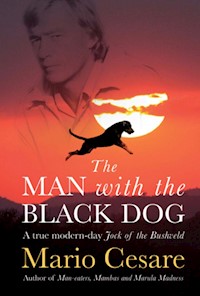
'They say a man has only dog in his lifetime, only one dog with which he will share that special bond ...' Mario Cesare was twenty-five years old and managing a game reserve in the rugged Tuli Block in Botswana when he first took possession of a shy black pup that he named Shilo. The pup attached himself to Mario almost immediately and very soon he became known by the locals as 'The Man with the Black Dog'. Very few dogs that live in Africa's big game country die of old age, but Shilo was the exception that proved the rule. Shilo's incredible versatility ranged from skilfully tracking big game in the hot arid bushveld to retrieving wild fowl in the icy wetlands if South Africa. He was also a constant companion, a devoted protector and for more than fourteen years he and Mario, had innumerable adventures together, encountering crocodiles, buffalo, lion, leopard, baboons and poachers. The Man with the Black Dog is permeated with the same love and empathy that made Jock of the Bushveld a classic and it too is a very South African story. Seldom has an account of a man and his dog revealed so much of the flavour of life in such a wild location and although over a century has passed since the transport wagons carved their trails to and from Delagoa Bay, the scent evoked of dust and rain remains the same and the grey ghosts of kudu and elephant still melt into the bush.
Das E-Book können Sie in Legimi-Apps oder einer beliebigen App lesen, die das folgende Format unterstützen:
Veröffentlichungsjahr: 2011
Ähnliche


















.
.
‘They say a man has only one dog in his lifetime, only one dog with which he will share that special bond …’
Mario Cesare was twenty-five years old and managing a game reserve in the rugged Tuli Block when he first took possession of a shy black pup that he named Shilo. The pup attached himself to Mario almost immediately and very soon he became known by the locals as ‘The Man with the Black Dog’.
Very few dogs that live in Africa’s big game country die of old age, but Shilo was the exception that proved the rule. Shilo’s incredible versatility ranged from skilfully tracking big game in the hot arid bushveld to retrieving wild fowl in the icy wetlands of South Africa. He was also a constant companion, a devoted protector and for more than fourteen years he and Mario had innumerable adventures together, encountering crocodiles, buffalo, lion, leopard, baboons and poachers.
The Man with the Black Dog is permeated with the same love and empathy that made Jock of the Bushveld a classic and it too is a very South African story. Seldom has an account of a man and his dog revealed so much of the flavour of life in such a wild location and although over a century has passed since the transport wagons carved their trails to and from Delagoa Bay, the scent evoked of dust and rain remains the same and the grey ghosts of kudu and elephant still melt into the bush.
Mario Cesare’s career has taken him and his beloved companion Shilo, from Timbavati and Mala Mala to the Olifants River and beyond, and he delights in recounting the pleasure he derives from his work. His latest task is developing and nurturing the Olifants River Game Reserve as the fences of the Greater Kruger National Park area fall, restoring some of the old migration routes, and undoing generations of damage.
.
In Memory of Shilo
.
The Man with the Black Dog
Mario Cesare
Jonathan Ball Publishers
Johannesburg and Cape Town
PREFACE
Until one has loved an animal,
A part of one’s soul remains unawakened.
ANATOLE FRANCE
Dig deep enough and you will invariably find that everyone has a story to tell. Sadly, however, the vast majority of people never get to tell theirs. Their lifelong learning literally dies with them, and what was once born of flesh and blood becomes constituent of the surrounding dust. As dramatic as this may sound, it’s true.
I also believe that the matrix of our environment governs what we become. No living organism is above this law; none of us can escape its influence on us, and no two of us are identical. As individuals we adapt and respond to the various stimuli out there in varying degrees and in various ways. Essentially it is what makes each of us unique, shapes us and moulds our way of thinking from the earliest age, particularly the way we interact with each other and the myriad other creatures with which we share the planet. In my case this has stemmed from a love of animals and the natural environment, which grew into an all-consuming passion and a career in nature conservation.
Many of my childhood escapades, both imaginary and real, were fuelled by what I gleaned from the pages in books. The common element in the character make-up of most of the story books and plays I grew up with was animals, mainly dogs. In some, they played a minor role, but mostly they were integral to the story, the principal characters. In those days children in suburbia knew less about wild animals and the circle of life than they do today, but dogs we could associate with. From the scruffiest little terrier to the largest canine couch potato, they were part of our everyday lives, and almost everything we did, we did together.
* * *
Since primitive man first brought wolf cubs back to his cave, dogs have been one of life’s greatest gifts to mankind. This book is largely about the privilege of having shared a part of my life with a very special one of these gifts. I don’t wish to hint at being an expert on dogs, far from it; however, of my love for our canine friends in general, and more particularly this one, there can be no question, and for this, there is no measurable qualification necessary.
From my earliest memory, dogs stand out as having played the most important role in bringing me closer to nature. Even while I could not have been more than a clumsy cub to them, the dogs I knew as a child always treated me as a kindred member of their pack, even taking me on forays into the surrounding veld when they went exploring, which pricked my interest and stimulated an awareness of the environment. This was the beginning of an insatiable appetite for adventure and the outdoors.
Next to the classic dog tales of yore – Old Yeller, White Fang, Lassie and Jock of the Bushveld, to name but a few – Shilo’s tale is a comparatively modern account of the life of a game ranger and his dog in the African bush. In fact, the odyssey of Shilo had already become part of my life years before the movie of Jock of the Bushveld was made. The revival of this iconic tale on the big screen prompted numerous game rangers and wannabe game rangers to go out and acquire ‘Jock’ look-alikes. While their Staffies may have resembled Jock in looks, alas, for most that’s where the romantic notion and similarity ended.
* * *
This book is more than a nostalgic collection of vignettes on the life and adventures of a game ranger’s dog. It is a tribute to the greatest dog I’ve known, an unfolding journey through life, from my and Shilo’s earliest days together, which has inevitably included many exciting interactions with the rich diversity of wildlife we encountered, from elephants in Botswana’s Tuli Reserve, to leopards in the Lowveld, and from teal in the wetlands of the Drakensberg, to trout in the frigid streams of the snow-covered highlands near Lesotho. Naturally, along the way, I have included stories of pluck and peril involving other dogs and the valuable lessons learned, while inescapably, attentive readers will find jostling for their attention many more observations and relevant anecdotes arising from a career that now spans decades in wildlife conservation.
This memoir would be incomplete without the people, the dogs and incidents that helped shape my early thinking before Shilo became an integral part of this multifarious way of life.
In the fourteen years we spent together, Shilo was never away from my side for more than a few days at a stretch, and that only happened on two unavoidable occasions. To the locals who didn’t know my name, and even to some of those who did, I was ‘the man with the black dog’. Shilo was my constant companion in the bush, a brave colleague and one of the finest wildfowl retrievers I have ever known. Above all, he was the embodiment of unconditional love and devotion.
Many of our wonderful experiences together are liable to emerge from my memory at any time with all the freshness of the day they happened. However, there has been the odd occasion of frustration, when I found myself wanting of more expression with the pen, to capture the emotions and sentiment of the moment. Suffice it to say, I have endeavoured to paint a picture of our life together, to re-live that beautiful relationship as it unfolded, and trust that through the coming pages, you will too.
1
AS FAR BACK AS I CAN REMEMBER
I have often wondered what path my life would have taken if I had been born in the bush, under a mosquito net, in a simple thatch-roofed bush camp on the banks of some remote river. Or in a small town steeped in pioneering history, on the border of a big five game reserve, or on a game farm – or any farm, for that matter.
The Queen Victoria maternity hospital in the city of Johannesburg was about as far away as you could get from that romantic scenario. It was there on an icy cold June morning in 1956 that I took my first breath of Africa’s air. Insulated and sterilised as it was within the confines of that first world environment, outside its walls lay the rest of Africa.
Until a couple of years later, I don’t remember much at all. We lived in an apartment in the suburbs, and although there’s not much about the inside of the flat I’m able to recollect, the outside of the block remains vivid in my mind. I remember a sandy coloured facebrick building that surrounded a concrete courtyard on three sides. On the side that got the most of what little sun shone into the gloomy quadrangle there were rows of washing lines which stretched from one end to the other, and except for those mornings when they were festooned with laundry, the yard was empty and bleak.
All the kids who lived on that block played in this common yard; basically it was the only recreational area we knew at the time. To spice things up occasionally there was the scowling, crook-backed milkman who would chase us away from his delivery van, brandishing a small stick. Our high-pitched squeals, a mixture of fear and excitement, echoed around the hollow courtyard as we ran on chubby little legs that carried us nowhere fast. I suspect that although he was a scary looking character, he was harmless, but we didn’t think so then. However, the cranky old milkman was the least of my worries; it wasn’t him I was scared of, I dreaded something else, and although I certainly didn’t think so at the time, they were much smaller and quite inoffensive.
In the corner of the courtyard near the back entrance was a grey-plastered, windowless room with an enormous padlock on a stout wooden door with a sign of a skull and crossbones fixed firmly in the middle of it. We never did figure out what it was inside that never stopped droning, but imaginations ran wild. Next to this room was a small roofless enclosure where the dustbins were kept … a place to be avoided. This was where the green-eyed fluffy monsters I feared so much would hang out. They were quick and lithe, I never heard them approach, and never knew they were there until I’d feel the soft ghost-like brush of fur as they sneaked up from behind and painted my legs with their tails. More than anything, it was the serpentine gyrating of those tails and not so much the feel of their fur that I ran screaming from, and there was no rational explanation for this phobia. Although this fear of cats that haunted my little mind more than anything else as a toddler rapidly disappeared as I grew up, it remains the most vivid of my earliest memories. I could never have dreamed then that my future life would inexorably be entwined with some of the biggest cats on earth – wild African felines many times the size of those fluffy monsters.
* * *
My happiest memories were always those of the little adventures I had outdoors. I enjoyed accompanying my father to his ten-acre plot of land near the Klip River valley, about 40 kilometres south of Johannesburg. ‘The farm’ as he called it, gave him a much-needed respite from the pressures of working in the cacophonous chaos of the five-star hotel kitchen he managed. Although he dabbled a little with intensive livestock farming, and loved to grow heaps of vegetables and herbs, he never made much money from it. He was proud of what he grew, and derived enormous pleasure from supplying friends and family with fresh veggies, as he invariably gave away far more than he ever sold. There were obvious therapeutic benefits simply to getting his hands dirty with the rich red soil.
Driving through the countryside with the wind whistling through the small triangular windows of the car was always exciting. I remember you couldn’t hear this sound driving around town, it was only when the car was going relatively fast on long journeys that the wind whistled through. For me it was a most comforting sound, mostly because I associated it with escaping from the concrete courtyard and cats’ tails for something far, far more pleasurable.
I loved the farm, particularly the farm animals my father kept there. Although there were those who found the smell of their dung and urine in the barn and the kraal unpleasant, it was never offensive to me. On occasion when my father wasn’t watching, I’d sneak into the milking shed to eat some of the cow’s dairy meal, which they were given when being milked. I remember that although crunchy and very dry, it tasted good, not unlike some breakfast cereals sold today in supermarkets at ten times the price. The feed shed next door was filled with bales of fodder and farm implements; it was a great place to look for chickens’ eggs, and I would treat each search like a treasure hunt. Many of the eggs I’d find were still warm to the touch.
Of course there were cats on the farm, much wilder than those in the suburbs, and besides the odd glimpse of them around the feed shed, they avoided any contact with people, which suited me just fine. These were working cats which, besides the odd saucer of milk, were never fed, apparently they made a good living off the rats and mice they caught, as well as the odd sparrow that wandered too far into the grain store.
The farm dogs were my best, two huge Alsatians – maybe they seemed so big because I was so small. I distinctly remember the black one was called Satan; he was as black as soot with wolf-like eyes and a very red tongue. The other dog, Wolfie, was light brown with silvery grey guard hairs on his back that stood up when he was angry and made him look so much like the wild grey wolves depicted in story books.
Wolfie was less restrained than evil-eyed Satan; he was always the first out to greet me, rushing up to me with his tail wagging so hard it would sometimes knock me over, his muzzle tickling as he sniffed me from head to toe. My mother was never comfortable with the Alsatians around me, but I loved being with them. One day I followed Wolfie barefoot into a paddock where my father’s Jersey bull was kept. I remember not being able to get back out because of the devil thorns in my feet, and each attempt at walking only gathered more thorns. I stood there crying helplessly until an uncle of mine, who was only fifteen years old at the time, came to my rescue. He hoisted me up onto his shoulders and carried me out to safety at a run. Jersey bulls are notoriously short tempered and not to be trifled with, but this enormous animal didn’t frighten me, it was just a big cow that nobody ever milked … and I liked cows. Often I’d stay out all day, seldom bored; only hunger would bring me back to the house.
* * *
Our first house was a classic old brick and sandstone Victorian-styled home, complete with wooden-framed sash windows and corrugated iron roof. Two tall date palms stood sentinel over the formal, well-established garden which was liberally planted with masses of hydrangeas and roses of every colour and variety. Rockeries with a selection of aloes and other succulents were incorporated into the terraced layout leading up to the entrance. Halfway to the front door was a large triple-tiered fountain filled with lilies and goldfish, the focus of the local hamerkops which (although primarily frog-eaters) found the bright orange fish provided easy pickings. The paved pathway ended at a wide stairway flanked by Roman-style cast concrete pillars and wrought iron lattice work that supported the roof trusses over the red polished floor of the stoep. Inside, the ornate pressed ceilings looked down on spacious rooms with beautifully polished wooden floors and fittings of Oregon pine, oak and teak. There was a fireplace in the lounge, which we never used, and a huge free-standing coal stove in the kitchen, where we spent many cosy winter evenings huddled together, sipping Milo while listening to ghost stories and plays on Springbok Radio. Television was still a dirty word in South Africa in those days.
Set on an acre stand, which even then was considered large by urban standards, our new home opened up exciting possibilities. Most importantly for me, the space meant the family could now own a dog, a big energetic dog if we wanted. With so much room it could run around, dig holes and play with us to its heart’s content. Secretly I wanted my own dog, and though I was too young to take on such a responsibility at the time, I remained determined in my quest. On the day we went to choose a dog at our local SPCA I was so excited that I’m sure some of this enthusiasm must have rubbed off on my parents, because we ended up adopting two! Both were fully grown dogs, and although clearly mongrels of some distant Rhodesian ridgeback heritage, they were good-looking dogs. One of them, obviously the older of the two, was heavier set with large jowls. My father wanted to call him Mussolini, but my mother would have none of it, so we named him Frenchie. The younger dog was leaner and boisterous to a fault, he was called Reggie, and though he’d play a little rough at times, my mother was far more relaxed with him than she was with the two Alsatians on the farm.
Besides the loquat trees which grew along one side of the grapevine-shrouded driveway, the back yard had been planted with a variety of fruit trees. There were apricot, peach, pear and plum trees as well as two massive figs from which my mother would make tons of the most delicious whole-fig jam. To this day, although it remains my favourite, I am reluctant to buy any, not because there’s nothing commercially available these days that comes close to my mom’s fig jam, but because once the jar or tin is opened, I cannot resist, and usually consume the whole lot in a day!
Recently while shopping at Woolworths, I noticed that a single pomegranate, no bigger than a cricket ball, cost R25! I vividly recalled the long row of pomegranate and quince trees that formed a huge hedge between us and the neighbours. I clearly remember that we never enjoyed the fruit, finding that despite patiently peeling away the loose, bitter folds surrounding the sweet pips, we inevitably bit into them and got more bitterness than sweet. Eating this fruit was just not worth the effort, so the ripe ones would simply fall onto the ground and rot. I still believe that pomegranates are rather overrated as a fruit and overpriced as a result. And so it was with most of the quinces, which the older folk seemed to enjoy and preserved, but which as children we found much too tart to eat fresh.
Next to the row of quince trees, up against the fence, was a thick stand of bamboo. Young boys from all over the neighbourhood would often visit us asking to cut a few of the dry stalks, which were then split and used for building lightweight frames to make kites. We also used this versatile material for crude bows and arrows, spears, swords, tomahawks and tepee frames which kept us amused for hours. Needless to say, we spent a lot of time in and around this stand of bamboo. One day while digging up a few roots and corms for a friend who wanted to take some home to plant his own bamboo stand, I discovered gold!
Everyone knew my mother was an avid coin collector, so, as a rule, any unusual-looking or foreign coin found its way to her collection. But nothing brought in from the far-flung corners of the globe that she’d acquired to date would match the one we found ten metres from our own doorstep!
Standing at the back door so as not to muddy up the kitchen, we handed her what we thought was just another common coin; even so, it was always intriguing to see what it was. She took the little mud-covered coin and washed it in the kitchen sink while four grubby kids and two muddy pawed dogs crowded around the doorway. The grime washed off easily, and seconds later my mother held out a gleaming gold coin as immaculate as the day it was minted! I remember she didn’t smile immediately; instead her mouth hung open in surprise. Although at the time we couldn’t know what it was, my mother did, she knew coins … she knew that the gold coin that lay glinting in the palm of her hand was one of the legendary Kruger pounds!
‘Where did you find this?’ she whispered, turning it over slowly in her fingers.
‘In the bamboo patch,’ I said.
Under my mother’s supervision we spent the next two days digging in that spot. The bamboo roots formed an underground lattice of tough corms that proved extremely difficult to penetrate. Nevertheless, we persisted until there was an excavation the size of a small kitchen table and about as deep as a wheelbarrow – nothing!
* * *
To this day I cannot help wondering who the hapless traveller was that dropped that coin from their saddle-bag at the turn of the nineteenth century, and how he or she must have felt at the loss of something so valuable. Or could this have been just one of the thousands of coins reputed to have made up the famous Kruger millions, which have never been found? Just one from such a trove might never have been missed! However, the reality was that at the beginning of the twentieth century the amount of gold used to mint a single Kruger pound equated to a labourer’s earnings for a year, or the down-payment for a small farm. Those were also the days when the last remaining hartebeest roamed freely above the rich goldfields of the Witwatersrand and foothills of the Magaliesberg. I later learned that a small herd of sable antelope, the first ever recorded on the South African highveld, were seen where the old Johannesburg stock exchange used to stand. These must have been interesting and exciting times indeed.
Years later, on one of my rare visits to Johannesburg from the bush, I took a trip down memory lane, curious to see what had become of the house I’d grown up in. Not wanting to arrange a formal visit with the new owners, I simply walked up the driveway of the block of flats next door and peeped over the fence. From there I could see that a lot of changes had been made. The palm trees and garden had been replaced by lawn, and most of the fruit trees I remembered were gone; only the bamboo stand was still there, growing thick and strong as if in timeless defiance. I could see the exact spot where I had found the Kruger pound nearly fifty years previously. As I leant reflectively over the fence I remembered the mini ‘zoo’ I kept in the yard next to the garage. Besides dogs, hamsters, tortoises, rabbits, white rats and a small aquarium of tropical fish, my passion was a huge walk-in aviary that housed small seed-eating birds, including a variety of wild finches, waxbills and quails.
I suspect it may have been here that a certain seed took root. I’d constantly strive to emulate an environment as close to their natural habitat as possible. It was both creative and rewarding. I would get enormous satisfaction when they eagerly inspected the natural materials I regularly selected and brought in for them from the veld close by. The shyer species were particularly fond of the gnarled hollow tree trunks and thatching grass I provided, some of which they would use to build nests with and breed in – and to me a breeding bird was a happy bird. A huge treat on rare occasions was a chunk of termite mound, which I broke into smaller pieces to reveal the termites scurrying about. It brought out the hunting instinct of even the most delicate little seed-eating birds; even those few birds that weren’t partial to termites enjoyed ‘ant heap time’ – perhaps they simply loved being in amongst the frenetic activity with all the other birds.
Today I find myself doing much the same, striving to maintain an environment in which wild animals are happy and are able to coexist inter-dependently with all the natural props and materials they need to thrive … except that my ‘aviary’ is now much, much bigger, and largely self-sustaining. So, whether watching a herd of over a hundred elephants enjoying a mud bath at one of the waterholes on the reserve today, or a couple of dozen waxbills and finches splashing around in a freshly filled bird bath in my aviary all those years ago, the deep sense of satisfaction in me would have been the same. It was already clear back then what path I would be taking in life, and although I knew it was not going to be paved with gold in a fiscal sense, I feel my life is richer for having chosen to walk it.
2
GOD’S IMPALA
At a moderate stretch of the imagination the South African highveld may once have resembled the pampas of Argentina or the prairies of the midwestern United States. Essentially a high-altitude, naturally treeless plateau of undulating fertile grassland, lightly sprinkled with small bushes in those areas with shallower soils, it is not quite the sweeping, umbrella-thorn-studded savanna usually portrayed as typically African in wildlife documentary films.
The highveld we see today has been greatly altered, for the most part thanks to man’s progress and greed. Gold and coal mining activities gave rise to rapid urban development and industrial growth, and it is growing still. Pioneer farmers made their contribution by planting cereal crops on the rich soils and establishing unattractive groves and plantations of eucalyptus, pine and wattle trees. Initially intended for windbreaks, shade and timber, these invasive and thirsty aliens have now all but taken over the outlying areas of highveld. It is extremely disconcerting to see drainage lines, wetlands and river ecosystems of the higher lying rural areas so suffocated and deprived of water that they cannot function normally, and how quickly vast tracts of grassland have become a bastardised mix of semi-sterile, austral-alpine-afro habitat as a result.
While it is clear that the ‘horse has bolted’, a concerted effort at reining this problem in is now under way. A government-sponsored task force known as ‘Working for Water’ is implementing a rigorous eradication programme targeting established aggressive alien trees, which will then aim at systematically controlling their further spread. This gallant effort is being driven more out of concern for the rapidly diminishing wetlands and subterranean water levels than the degradation of indigenous vegetation itself. Nonetheless, as these are inexorably linked, it is only through the restoration of the natural habitat that the water table will be improved.
* * *
Man’s influence on the highveld has not been all bad, however, courtesy of the gardeners of Johannesburg. A combination of favourable climatic conditions and care has allowed their gardens, avenues, green belts and recreational areas to flourish. Collectively this growth has now erupted into a forest of vegetation, evident from satellite images taken in winter which clearly reveal the green island of Johannesburg in a surrounding sea of khaki. Besides the associated endemic fauna and flora, a plethora of smaller indigenous and exotic wildlife is being attracted to this ‘jungle’, and their numbers grow by the day. I may be going out on a limb when I say that it boasts the richest diversity of plant and animal species of any city in the world. I suppose it could be described as an ‘urban semi-evergreen temperate-forest ecosystem’ … and if I’m off the mark, I’m sure it won’t be by very much.
On the extreme southern edge of Johannesburg’s suburban sprawl, isolated pockets of indigenous bush can still be found. These islands of woody vegetation associated with the conglomerate rock outcrops of the Klipriversberg range intrude into the otherwise featureless grassland. The variety and contrast of this mini-bushveld ecosystem have attracted a host of interesting smaller species of wildlife.
I loved this little patch of wilderness. It was where I began exploring the veld, at times with a friend, but mostly on my own. I learned the habits of some of the more secretive wildlife that occurred there. We never needed to carry water, the Klipriversberg had a number of small streams, which ran so clean and clear that we simply drank from them when we were thirsty. These waterways were also the habitat of crabs, frogs and minnows, and I knew just where and how to collect them when needed for school projects. Needless to say my biology teachers loved me. Not all the creatures within the range were small, nor were they easy to see. Common duikers weighing up to 20 kilograms were the largest wild mammal to occur there. However, these fleet-footed antelope were also extremely wary and used their knowledge of the thickets to evade our clumsy attempts to get a good look at them. We’d hear them more often than we saw them. One morning I was eventually able to touch one … but it was not as I’d envisioned the encounter was going to be. Strangled to death in a wire snare, the small grey form of a once beautiful little buck now lay stiff and cold. I was horrified, but it was more than the death of the little duiker that shocked me; it was how it had died. Suddenly I felt that this piece of bush had been violated, and so did the many others I notified. That day the story made it into The Star newspaper.
Though the Klipriversberg area was some consolation for me back in my youth, I always longed for the ‘real’ bush. If you wanted to visit a ‘real’ game reserve in the sixties, the Kruger National Park would probably have been the chosen destination. These trips would more often than not include the rest of the family, so you and your siblings would invariably spend the entire trip vying for window space in order to get the best view of the wildlife from the confines of the car. This visual contact through a glass barrier would be the limit of your interaction with that wonderful environment. Although I never visited the Kruger as a child, I tried to imagine what it may have been like from outings with my rather large family to the Lion Park and Krugersdorp Game Reserve. From this I extrapolated an uncomfortably cramped and claustrophobic experience, not quite like going to the drive-in-movies with your girlfriend, but rather like the time you found yourself stuck in a car at the drive-in with a crowd of indifferent people, when all you actually wanted to do was watch the show.
Besides the emerging concept of private game reserves like Thornybush and Mala Mala, in the late sixties there was really nowhere else to go, unless of course you were one of the privileged few who owned or had relatives who owned a piece of land in the Timbavati, Klaserie or Sabi Sand game reserves. Game farms and game lodges as we know them today were virtually non-existent. To get an invitation to a bushveld farm was mostly through someone with relatives or friends who farmed with domestic animals somewhere in the bushveld. These were usually free-range stock farms which shared the habitat with the endemic wildlife. Nobody I knew when I was a youngster knew anyone who actually ‘farmed’ with game. In the main, wild animals were regarded as direct competition to livestock, so they weren’t accorded the conservation status they enjoy these days. For the most part I am pleased to say this has now changed dramatically, due largely to the soaring demand for wilderness and wildlife in order to satisfy the eco-tourism, safari and trophy-hunting industries (ironically enough, particularly the latter). Game reserve properties, particularly those with the ‘big five,’ have become precious … and so it should be.
As a youth I regarded the bushveld as hallowed ground, where I was beginning to believe only an ordained few were allowed access. I yearned to be in the bush, to be part of it, to take in the smells, feel the heat and listen to the sounds. I suspect that even then it was much more than simply wanting to hunt an antelope. The highveld abounded with blesbok and springbok, yet I had no real interest in hunting either species. I wanted to be in the particular environment where impala and kudu occurred, the criteria associated with their chosen habitat and the aura of those surroundings mattered more to me than simply shooting a buck.
* * *
Hein Brundyn lived across the street from me. He attended an Afrikaans school, but despite our different home languages, communication was never a problem and we were good friends. I suspect that our common interest in the bush had more than a little to do with transcending this ‘barrier’. He often mentioned his uncle’s farm situated in the heart of the bushveld near Marken, a tiny village about 110 kilometres northwest of Potgietersrus, now Mogopane. I would hang on his every word when he tried to describe the bushveld to me, even though he didn’t know all the English names of the wild animals – Afrikaans was just fine with me. For years I never knew impala by any name other than rooibok, directly translated to mean red buck. How descriptive Afrikaans names are.
One day he invited me to join him on a visit to his uncle’s farm. This would be my first trip to the bushveld. Although it wasn’t the ‘big five’ lowveld bushveld I’d dreamed about, it had wild animals roaming around in it; to me it was the bushveld in every sense of the word. I was fourteen years old … it was high time.
Heading north on the train via Pretoria to Potgietersrus, it wasn’t long before acacia trees, mostly sweet thorns, began to appear on the rolling grassland vista outside the window. Gradually the sparse thornveld of the Springbok Flats gave way to typical bushveld savanna, as more bushes and umbrella thorn trees began to dominate the hilly landscape. With midday approaching the train began to slow, and we came to a stop at Potgietersrus station. We hurriedly alighted with our bags, then looking around and feeling the relatively warm air, the realisation suddenly hit me, at last I was standing in ‘real’ bushveld!
A broadly smiling man of about fifty by my juvenile reckoning beckoned us over to his pick-up truck behind the station; it was Hein’s uncle, Boet Danie. Apparently there were more than two hours of driving yet to do before we got to the farm, but I didn’t care, it was all a new experience for me and I was loving every minute of it.
It was a good thing the rickety old Datsun 1300 wasn’t noted for its speed – this allowed my eyes to linger that little bit longer at the scenery. Of course I also scanned the bush for wildlife, but my city eyes, unaccustomed to knowing what to look for, didn’t pick up as much as Boet Danie’s did. Besides a family of warthogs trailing a troop of nervous baboons that dashed across the road in front of us, a few smaller mammals, and some interesting birds I’d never seen before, we didn’t see very much. As the sun began to sink behind a small flat-topped mountain range, and the shadows lengthened, the little truck came to a dusty stop in front of an old dimly lit farmhouse. The smell of paraffin from gently glowing lamps hung in the warm evening air; we had arrived at our destination.
It was immediately obvious that Hein’s uncle had fallen on hard times. A succession of poor rainfall years had completely bankrupted him, and as a result he and his wife were living on bare necessities. Having spent part of my youth growing up on the wrong side of the tracks, so to speak, I remembered all too clearly the times my parents struggled to make ends meet. I knew what it was like to be poor … well, I thought I did, until I met Boet Danie, and real adversity stared me in the face. Nothing I’d experienced was quite in the same league as the conditions that Hein’s uncle and aunt were living under. Despite this, these God-fearing people were inherently hospitable and far too proud to say no to two young boys with bottomless pits for stomachs wanting to visit them. Moreover, their warm welcome was humbling and their faith resolute: God would provide, they insisted.
All things considered, He must have done. We had a clean warm bed at night and we didn’t want for food; nearly everything we ate came off the farm. The evening meals would invariably consist of a basic mutton stew, maize porridge, pumpkin, rice or potatoes, followed by home-baked bread with thick cream for butter and home-made chunky peach jam. Breakfast was always maize porridge, milk and sugar or fried eggs, followed by bread, cream and jam. During the day we were out most of the time, so we would simply help ourselves to bread, cream, jam and oranges whenever we came back to the house. I remember there were always plenty of oranges.
We didn’t eat badly at all; what we lacked in selection we made up with volume, and although we never went hungry, a little more variety would have been nice. Mutton was the only meat we ate, except on the one Sunday when we had chicken, and it soon became apparent why. The day before our arrival, Boet Danie had slaughtered one of the eleven fat-tailed sheep he owned. The carcass was then hung in a small dark rondavel that served as a cool-room-cum-pantry. Muslin was placed over it to keep the flies off until the air had dried the outer skin and sealed the carcass. Needless to say, the objective was to cook and eat as much of the sheep as possible before it got too high, common practice in the days before refrigeration.
* * *
Hein and I spent every day in the bush with Petrus, one of the farm labourers’ sons, who was about the same age as we were. Not only was he good company, he also knew the bush like the back of his hand. Unfortunately, besides his native Sotho, Petrus could speak only limited Afrikaans, so I found it extremely frustrating not being able to tap into his encyclopaedia of bush knowledge. Nevertheless, I found the bush was all that I’d dreamed about and more; it was much thicker than I’d imagined, and moving through it quietly wasn’t as easy as I’d thought it would be. The trees appeared a lot bigger when you actually walked amongst them, and the more prominent ones made useful reference points, particularly the gargantuan baobabs. These awesome old relics epitomised a time dimension that I knew little about, but could certainly feel. Two ancient specimens that grew on the farm were thought to be the biggest and oldest in the area, both trees predated the names and dates carved on their trunks by at least a thousand years. If only they could speak, I thought, what a fascinating account we’d have of what they’d seen pass under those branches!
The well-worn sandy trails that wound through the bush revealed the tracks of a number of different wild animals that inhabited the area. Some we knew, others Petrus helped us identify. Among the more common hoofed spoor, we came across warthog, common duiker and steenbok, but we had yet to see a track or sign of impala. Then, near a grove of buffalo thorn trees one morning, we saw the spoor of much larger antelope – kudu, Petrus announced. This was the first time I’d ever laid eyes on their tracks; at least four kudu had passed through a few days previously. I tried to form a mental image of these iconic antelope browsing where I was standing now, and remember how small it made me feel. We heard the occasional duiker when they noisily broke cover well ahead of us as we walked, easily evading our clumsy attempts at hunting them. The baboons made a mockery of us, barking from the mountain cliffs, warning everything of our presence. Between these sharp-eyed primates, the ‘go-away’ birds and our amateurish approach, we’d have starved to death had we to survive on what we managed to shoot.
Undaunted, we persisted … still, there was no sign of impala.
* * *
Evenings back at the farmhouse were much shorter than we city boys were used to. There wasn’t much to do after supper except talk about the day, wash the dishes and clean the old guns; sometimes we’d listen to the radio or play checkers until it was time to go to bed. The paraffin lamps and candles didn’t produce much light, so reading wasn’t really an option. One evening, after a few unsuccessful days in the bush, we got around to discussing the possible reasons for not being able to ‘bring home the bacon’.
Boet Danie was not a great hunter, but he knew the habits of the local wildlife, particularly those that occurred on his farm. Smoking an after-dinner pipe on the stoep, he shared his experiences as we sat wide-eyed and all ears to hear what he had to say. One of our problems was that traditional cattle fences, which were only about a metre high, offered no major obstacle to antelope such as kudu and impala, which simply leaped over them and went pretty much where they wanted to. The other was that game on farmland was hunted and had become extremely wary. Some diurnal species adapted to the hunting pressure by becoming crepuscular feeders; yet others, under extreme pressure, became nocturnal.
Warthogs and bush pigs were regular pests in the fields, Boet Danie said, taking a pull on his pipe. Then, looking out into the darkness, he spoke again, this time with less contempt. Kudu, on the other hand, were great wanderers, and unless there was a crop of tomatoes or a field of lucerne to visit at night, you’d never see them; they’d leave as quietly as they had arrived, without a sign.
You could tell Boet Danie had great admiration for kudu. Later in life I’d know why. Impala were more predictable, he said, and not nearly as wary; they stayed close to surface water and were less nomadic, not moving around as frequently as the kudu did. This was the reason why we had not seen them or their spoor anywhere, though they were not as a rule difficult to find. The impala were simply not there; they could be on the farm next door or miles away. He looked solemnly at me: ‘If either of you come across impala, it is a sure sign God has sent them to you, treat them like manna from heaven; don’t hesitate to take one.’
It was essential to leave as early in the morning as possible. By getting out at least a couple of hours before any breeze picked up we would greatly improve our chances. ‘Use only the footpaths and tracks,’ Boet Danie said. ‘Walk quietly but not stealthily; avoid walking through thick bush if you can help it. Game gets used to seeing people walking on these paths, so don’t change your pace if you see anything, walk on past without making eye contact if possible, then, when you’re some way off, strategise and begin your stalk.’ Boet Danie yawned, then, looking at our eager faces, he smiled, knocked his pipe out against the outside wall and said goodnight.
* * *
That night I found it difficult to fall asleep. Instead of counting sheep as I should have, my mind was focused on impala and what Boet Danie had said. It was still dark when I shook Hein awake, but he groaned that it was too early for him and that he’d catch up with me later. I got dressed, picked up the shotgun and my shoulder satchel, which I filled with a handful of homemade rusks and a few oranges from the kitchen, opened the back door and stepped into the yard. A smiling Petrus, his white teeth gleaming in the half light of dawn, was already there waiting for me. He had brought nothing except a stick, so I gave him the satchel to carry as this had proved to be a cumbersome piece of kit when ‘leopard crawling’.
By the time the sun began to show itself we had covered quite some distance in the bush – unannounced. Boet Danie was right; we were able to move relatively quickly and quietly along the farm tracks. The baboons hadn’t yet wiped the sleep out of their eyes, and the go-away birds were more concerned with finding breakfast than with shouting at us. In the early morning light we could clearly make out the spoor of a number of small nocturnal creatures like porcupines, scrub hares and common duikers on the open strips of road on either side of the dew-soaked middelmannetjie, but, still there was no sign of impala.
I was about to suggest to Petrus that we try to bag a couple of guineafowl for the pot instead, when his left hand went up, halting me in mid-stride, his right-hand index finger pressed over his lips. ‘Shhhh,’ he said. Bending over slightly he pointed to the road, and I could see the unmistakable tracks of larger antelope. ‘The impala are back!’ he whispered. According to Petrus there were approximately five of them, only a few minutes ahead of us. I looked up at the sky, remembering Boet Danie’s words, then promptly exchanged the birdshot for a buckshot cartridge and loaded the old single-barrelled Harrington and Richardson.
The tracks showed that the impala had followed the road for a short distance and then turned off, following a faint game trail that headed into a patch of thick bush. On my stomach now, I leopard-crawled for a few metres then paused and looked up, repeating the procedure again a few times until I saw a slight movement up ahead. I was so focused on the objective that it hadn’t occurred to me I was sopping wet from the morning dew. Through a saucer-sized opening in the bush, a tail flicked, white in contrast to the background patch of ochre red and the two small vertical black bars characteristic of the rear end of this antelope. Although it was enough to enable me to make out one of the impala, I knew that in order to use the shotgun effectively, I had to get much closer. I needed to be within 25 metres of the impala to make the shot. Although making up those last few metres was painstakingly slow, the effort paid off; the small herd of impala was still totally unaware of me. With my heart thumping in my ears, I pulled the hammer back and steadied myself, then, taking careful aim, squeezed the trigger.
When my eyes had stopped jangling in their sockets, and I was able to focus after the shoulder-numbing recoil, a rooibok lay dead in the yellow grass.
Petrus, who had kept a discreet distance behind me while I was crawling through the grass, wasted no time rushing to the scene. He whooped for joy, dancing around the impala like you see Red Indians do with captive cowboys in the movies, and then hugged me, rattling off something in exuberant Sotho.
My reactions were somewhat mixed. I shook from the surge of adrenaline; it was the first antelope I’d ever killed. Sure I was happy, happy that we had succeeded in putting meat on a needy table, and that I had pulled off a clean shot doing so. However, now able to get close to the impala, being able to touch it and marvel at its beauty and perfection was an incredibly humbling experience. Lying there, it seemed so big, no doubt enhanced by the early morning sun on its glossy coat which accentuated the vivid contrast to its surroundings. Closer examination revealed that except for a few small ticks at the root of its tail, the impala was spotlessly clean and free of any blemish. I also remember the feeling of regret and sadness that came over me when I saw its glazed eyes staring up at the heavens. I could have sworn a hint of doleful acceptance lingered … or, was I just wishing there was?
* * *
I have never forgotten that impala God ‘sent me’. However, I rather suspect it was sacrificed in answer to a prayer from Boet Danie, whose needs at the time were much greater than mine. To this day I have a tremendous empathy for these beautiful ‘red buck’, and little respect for those in the conservation world who treat them with disdain and regard them simply as ‘goats of the bush’ deserving nothing but indiscriminate reduction of their numbers. In my career as a wildlife conservationist it has been my duty from time to time to cull impala in the course of herbivore population management, but I have done, and still do so, most reluctantly.
3
THE CALL OF THE WILD
Ever since I can remember I aspired to become a game ranger. I knew it wasn’t going to be easy; particularly back in the mid-1970s when the prospect of a career in one of the more popular national parks was fraught with even more obstacles than it is today. To add to the challenge, game ranging was usually a lifetime’s dedication, a job that was taken and stuck to until retirement, so vacancies were almost never advertised – in fact, they were often filled through nepotism before they were empty. At one stage I was told there was a seven-year waiting list … whatever that meant.
Besides a couple of private game reserves in the lowveld, career opportunities were limited to the national parks or the provincial conservation bodies. I exhausted every avenue to get a foot in the door, offering to do the most menial tasks. I made proposals that fell only just short of selling my dignity to prove to them I was passionately committed and dedicated to a life in conservation, that I was more than willing to start right at the bottom and work my way up … all to no avail.
My passion knew no bounds; it was also fraught with a degree of idealistic expectation and determination that clouded reasoning. When I was fifteen years old an aunt submitted an application to Mala Mala Game Reserve on my behalf; not surprisingly I never received a reply. However, to their credit, I was later to find that they kept it on file for years.
Having heard nothing positive from any prospective employers, I obtained a passport, bought a train ticket and journeyed up to Rhodesia, now Zimbabwe. I’d heard the prospects of becoming a game ranger or tsetse fly control officer were more promising ‘up north’. Whatever the outcome was going to be, I knew this was something I just had to do; I needed to put my mind at rest, to know I wasn’t wasting my time pursuing a pipe dream.
Although I found their cadet ranger training programme most promising, it would have meant emigrating from South Africa. This was the only time I was sternly warned – emigrating wasn’t an option; my parents were dead against that idea. Despondently I returned to the classroom, buried my nose in my books and focused on finishing school. I then planned to study further in order to try and get a bigger veldskoen in the door, so to speak. But this was interrupted by the South African border war, and compulsory military commitments in Namibia and Angola, an interruption that would steal nearly two years of my life.
The odds of being accepted in one of the most sought-after careers in the country were stacked heavily against me. I was only nineteen years old, had no tertiary education yet, or any family employed in conservation. To add to this, English was my first language, I was single, inexperienced, city-born, and had a strange foreign-sounding name that Afrikaans-speaking people would always pronounce ‘Kessarrie’. You could hardly blame the old regime for sending me the employment world’s version of carefully worded ‘Dear Johnnie’ replies each time I applied.
* * *
Knowing that I would be desperately unhappy working in an urban environment, I refused to allow these setbacks to swallow my soul; as far as I was concerned it was merely a question of time and persistence. In the meantime, I needed to consider the alternatives. Although I hadn’t given up trying to become a game ranger, I still needed to earn a crust, so I looked for a job that would at least take me outdoors and fund the odd weekend excursion into the ‘wild’. I considered working on a cattle farm in the bush: there appeared to be an increasing interest in keeping game on cattle farms, which was a cause for optimism. However, although the seed was planted in some minds, nothing had really got off the ground.
Eventually I applied to Eskom, though the vision I had of standing in a hard hat working on massive power lines in the middle of the wilderness while wildebeest grazed in the background turned out to be anything but. After a couple of months I still found myself toiling away in dirty workshops with dingy offices whose grimy walls were festooned with calendar-girl pin-ups. Most of my time was spent running around doing the most menial tasks, helping to repair oily transformers, sorting nuts and bolts for rigging, cleaning and polishing things. I was told this was part of the training and that I’d be at it for a while. I was able to retain my sanity by spending every spare day getting as far away from Johannesburg as possible. This respite was facilitated in no small measure by a Zundapp 50cc motorcycle which my father had given me for my sixteenth birthday. This incredibly reliable piece of German engineering took me thousands of trouble-free kilometres around the country, particularly remote parts of the country. There was a modicum of comfort in knowing that I could simply pack a saddle bag, fill the tank and head out into the country any time I wanted to.
The aviary I started when I was ten was still my chief hobby, and when I was not collecting eggs, capturing and breeding wild birds for my aviary, I was ringing raptors with researcher Desmond Prout Jones, who was not only a respected authority on raptors, having published a number of papers and a book on fish eagles, but also an honorary nature conservator for the Transvaal division of Nature Conservation, and was one of only eleven people in the country at the time with a bird-ringing permit. However, though all this was most impressive for a young protégé, to me, none of these attributes were as important as the fact that he had time for me. Recognising my interest in the natural world, he would involve me at every level of his part-time work for the department, particularly on raptors. Des took me in under his wing, and pretty soon I’d gained enough knowledge to be of some assistance to him – well, at least he always told me so. Whether the praise was deserved or not was insignificant, it gave me heaps of encouragement and made me feel I was doing something important. A couple of years later, Des happily wrote my very first reference.
Understandably, there will be those who find it incomprehensible that ‘stealing’ birds’ eggs for a hobby, trapping birds for captive breeding, using mice or doves as bait to catch raptors in order to place rings on their legs, and shooting game birds for the pot, could possibly be done by someone with compassion for wildlife and a desire to conserve nature. However, it needs to be said that this is how many conservationists have developed their relationship with nature. Any good hunter will closely study the animal he intends to hunt, as getting to know their habits will improve his chances of success. Inevitably, this close study also reveals intimate aspects of the life of the quarry, and the accumulation of this knowledge invariably culminates in an admiration for the hunted by the hunter, at times paradoxically expanding to love and respect.
By way of extreme example, the San Bushmen have worshipped the eland for aeons, and many still do, regarding them with a god-like reverence. These huge, majestic antelope were as central to their culture and spiritual beliefs as the bison were to the Sioux Indians in North America, yet they also hunted, killed and ate them. When they were not hunting them, they dreamt about them and decorated the walls and ceilings of their homes with beautifully painted images of them. These illustrations capture their subjects in such fine detail that they can only be interpreted as an expression of the artists’ passion. Thankfully many fine examples of these illustrations survive to this day. As do both the American bison and the African eland.
For another personal, somewhat less dramatic example of the respect inherent in this relationship, I am reminded of an incident that occurred during my military service. More often than not, the training of infantry riflemen, whether for conventional or bush warfare, took place in rugged, naturally beautiful areas of the country. For the most part these areas were remote, and, except for a few training exercises, were otherwise left relatively undisturbed, so there was usually some game about. One day while on manoeuvres near Bloemfontein, I was leading a platoon up a steep rocky hillside that rose from a sea of relatively flat grassland. Nearing the crest, I came across an enormous bird sitting on a large clutch of eggs and recognised it immediately as a spurwing goose. To my surprise only a very few of my fellow soldiers knew what the huge bird was, and two of them were maize farmers’ sons. They knew about geese – all grain farmers know about wild geese and the effect these birds have on crop yields.




