


9,99 €
Mehr erfahren.
- Herausgeber: The History Press
- Kategorie: Sachliteratur, Reportagen, Biografien
- Sprache: Englisch
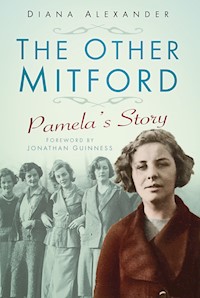
Pamela Jackson, née Mitford, is perhaps the least well known of the illustrious Mitford sisters, and yet her story is just as captivating, and more revealing. Despite shunning the bright city lights that her sisters so desperately craved, she was very much involved in the activities of her extraordinary family, picking up the many pieces when things went disastrously wrong – which they so often did. Joining her sisters on many adventures, including their meeting with Adolf Hitler in Nazi Germany, Pamela quietly observed the bizarre, funny and often tragic events that took place around her. Through her eyes, we are given a view of the Mitfords never seen before. 'Loyal to the core,' she possessed 'the constancy and kindness that underpinned the wilder exploits of the Mitford family. Indeed, innocence, along with courage and kindness, was one of her remarkable qualities. But it was the innocence of a woman who had lived and suffered, loved and lost, and overcome adversity'. Journalist Diana Alexander, who was Pamela's friend for many years, here reveals the unknown Mitford, or, as her lifelong admirer John Betjeman described her, 'Gentle Pamela'.
Das E-Book können Sie in Legimi-Apps oder einer beliebigen App lesen, die das folgende Format unterstützen:
Veröffentlichungsjahr: 2011
Ähnliche



















For Malcolm who has constantly encouraged me in this project.
For Kate and Emily, who knew and loved Pam, and for Daisy and Ruby who would have loved her had they known her.
Acknowledgements
I should like to thank: Jonathan Guinness, Lord Moyne, for his help and encouragement and for writing the foreword to this book; Deborah, Duchess of Devonshire, for allowing me to use the Mitford Archive photographs and Helen Marchant for arranging this; Max Mosley and Lady Emma Tennant for talking to me about their much-loved aunt; and Dee Hancock for her unstinting interest and valuable information. Also the many other people who have so willingly contributed to this book. These include: William Cooper, Christopher Fear, Celia Fitzpatrick, Stephen and Freddie Freer, Lorna Gray, Julian Leeds, Pat Moodie, George and Margrit Powell, Guy Rooker, Michael Russell, Joan Sadler, Pat Saunders, Deirdre Waddell and Christine Whitaker.
I could not have written The Other Mitford without reference to the following books about the Mitford family:
The House of Mitford by Jonathan Guinness, Letters Between Six Sisters edited by Charlotte Mosley, The Mitford Sisters by Mary Lovell, Wait for Me by Deborah, Duchess of Devonshire and As I was going to St Ives: A Life of Derek Jackson by Simon Courtauld
Contents
Title
Dedication
Acknowledgements
Foreword by Jonathan Guinness
Introduction
One
Not an Easy Childhood
Two
The Other Children
Three
Growing Up
Four
Teenage Sisters
Five
Out into the World
Six
Derek
Seven
The Turbulent Thirties
Eight
Woman the Wife
Nine
The War and its Consequences
Ten
Pam’s War and its Aftermath
Eleven
Post-War: A Time for Moving On
Twelve
After Derek
Thirteen
Middle-Aged Mitfords
Fourteen
Back on English Soil
Fifteen
Living the Life She Loved
Sixteen
Home Economics
Seventeen
Sisters, Sisters
Eighteen
Almost the Final Chapter
Nineteen
Contented Old Age
Afterword: The Story of the Brooch
Appendix: Pam’s Recipes
Plates
Copyright
Foreword
by Jonathan Guinness
‘This is my sister Pam,’ said Deborah Devonshire as I introduced a friend to them both. ‘She’s just back from Switzerland and she can tell you the menu of every meal she’s had on the way.’ For Pam was legendary for never forgetting food. Her symbol in Charlotte Mosley’s collection of the six sisters’ letters, corresponding to Unity’s swastika, Jessica’s hammer and sickle and so on, is crossed spoons. Perhaps this was the occasion when Pam had brought to Chatsworth in her luggage a dozen eggs which when hatched would grow into the elegantly coiffed Appenzeller Spitzhaube chickens which were then new to this country.
Until now Pam has been the only one of the six Mitford sisters not to be the subject of a book to herself, and in filling this gap Diana Alexander has, as it were, earthed the Mitford story. ‘My wife is normal,’ wailed Lord Redesdale. ‘I am normal, but my daughters are all off their heads.’ Well, not all, actually. Pam could run a farm or a household to perfection: she coped for thirteen years with a millionaire husband who was physics professor, steeplechase jockey, and air ace but also dangerously mercurial and liable to behave outrageously. Their marriage broke up but he retained deep fondness for her through four later marriages, leaving her a fortune in his will.
In managing Derek, Pam perhaps benefitted from having suffered from Nancy as her older sister. For Nancy was an accomplished tease and Pam, as next oldest, was the one who bore the brunt. But Nancy was also very funny, and what Pam and the others all learned was to ride with the punch, to enjoy the jokes without being too upset by the unkindness.
Pam’s childhood polio certainly set her back educationally, but I’m not sure she was dyslexic. If so, it was a very mild case. She was a rather erratic speller, but so was Evelyn Waugh. She was not as avid a reader as the others, but Tales of Old Japan was not the only one of her Redesdale grandfather’s books she absorbed: she knew them all, including his substantial Memories. She learned German without having a single lesson and spoke it well enough to guide Nancy through East Germany when Nancy was researching her biography of Frederick the Great.
What I most respected in Pam was her love of the truth. When I told her I was intending to write the story of the Mitfords her first words were: ‘Yes: the real story, what actually happened.’ She was then endlessly helpful and her reminiscences, never in any way slanted, conveyed a sense of reality that took one back in time. It was this regard for truth that triggered an occasion mentioned in the Letters when Pam seems to have lost her temper, a rare event. Diana describes it in a letter to Deborah. Pam had been with Nancy and Jessica who had agreed with each other that the Mitford childhood was miserable. This, Pam had said indignantly, was quite untrue, and as she told the story to Diana she flushed and there were tears in her eyes.
Pam was always there when needed. She was staunch when Diana was clapped into Holloway without trial at what is supposed to have been Britain’s finest hour; she immediately took in Diana’s two babies and their Nanny. Then many years later, when Nancy was dying and all the sisters took turn at looking after her, it was always Pam whom she most wanted. When she herself was growing old, her many friends and relations loved the stories she told and her sense of humour, less sophisticated perhaps than that of her sisters, was always fun. Diana Alexander gives us a good taste of it.
Introduction
So much has been written about the Mitford sisters, both by others and by themselves, that it would seem unlikely there is much left to say. It is incredible, therefore, that one of the sisters is still virtually unknown and there has certainly never been anything published in which she is the central figure – until now.
Pamela was the second of the six ‘Mitford Girls’ – a phrase coined by future poet laureate John Betjeman – and she had a tough childhood owing to the jealousy of her elder sister Nancy, who bitterly resented the new baby. Pamela had polio as a child which held back her physical progress; she was also probably dyslexic, a condition which was not recognised at the beginning of the twentieth century and was the reason why she was the only one of the sisters – apart from Unity, whose suicide attempt put paid to any authorship by her – who never wrote a book.
Pamela was a superb cook, a knowledgeable farmer and an imaginative gardener but, most important of all, she was the member of this extraordinary family who most resembled her mother, Lady Redesdale, whose mantle she gradually assumed, picking up the family pieces – and there were many – being there when help was needed and bringing the practical side of her nature to bear on the others’ problems.
Unlike most of the sisters she never espoused a cause, never brought any grief to her parents and, together with her youngest sister Deborah, was the only one who would have admitted to a happy childhood; and this was in spite of the treatment meted out to her by Nancy who also led the other siblings in the often cruel teasing. Of all the sisters she possessed the most contented personality. When, in the 1930s, the other ‘gels’ were forever in the news, Lady Redesdale once ruefully remarked: ‘Whenever I see a headline beginning “Peer’s daughter” I know it’s going to be about one of you children.’ But she wasn’t thinking of Pam.
This is not to say that Pam was in any way dull. Her humour was not as sharp but she loved hearing the others’ jokes; she could tell a funny story as well as anyone – usually about something which had happened to her – and her memory for past events (particularly meals) was legendary in the family. She never had any children but her nieces and nephews loved her because she never patronised them and was always ready to listen to what they had to say. In a strikingly good-looking family she more than held her own: she had the cornflower blue eyes inherited from the Mitford side and a face whose serenity not only reflected her personality but made her a close rival to Diana, always known as the beauty of the family. Although the others felt she was not as quick off the mark as they were, clever men were captivated by her. John Betjeman twice proposed to her and was twice rejected and she finally married Derek Jackson, one of the most eminent scientists of his generation, who also became a war hero and a successful amateur jockey. True, they were eventually divorced, but of his six wives she was married to him the longest and they became great friends after their divorce, even causing speculation among the sisters that they might remarry.
In spite of being rather shy, Pam possessed a tremendous spirit of adventure. During the year she spent in France she had a ride in a tank, which she declared was much more exciting than any of the social events to which she was invited and wished she could do it all over again, and during the 1930s she motored alone all over Europe.
Shortly after her marriage to Derek she became one of the first women to fly across the Atlantic in a commercial aircraft, taking it all in her stride. Prior to that she had enjoyed gold-prospecting with her parents in Canada (although this was never a successful enterprise) and later had managed the farm belonging to Bryan Guinness, Diana’s first husband.
It was not long after this that she really began to come into her own as the rescuer of her other siblings. During the war she gained much kudos within the family by having the two baby Mosley boys to stay with her and Derek while their parents were in prison for pro-German activities before the war. When Nancy was dying from a particularly painful form of cancer, it was Pam who she wanted with her when the pain was at its worst, and it was also Pam – since she was so practical – who played an important part in looking after Lady Redesdale just before her death.
After her divorce from Derek she went to live in Switzerland, where it was a joke among the sisters that she knew all the Gnomes of Zurich. When she returned finally to England she settled down to a contented old age at Woodfield House in the tiny Cotswold village of Caudle Green, midway between Cheltenham and Cirencester.
It was here that I first met her as I also lived in Caudle Green, and for twelve very happy years I worked as her cleaning lady and also became her friend. When I first arrived at Woodfield House, I had no idea that Pamela Jackson was one of the Mitford sisters and when the penny dropped, I simply could not believe that this lovely, amusing and compassionate lady really was the ‘Other’ Mitford, and very few people knew it.
I should say here that I was not a professional cleaning lady (though I must have been quite good at it because Pam was something of a perfectionist) but was at home with my young children as they grew up. It was not easy to pursue my previous job as a journalist because childcare was not available in the 1970s as it is today, but I could fit in the cleaning while the children were at school and in the holidays it was a treat for them to come with me because, like all children, they loved Pam.
All the time I was there I realised the unique position I was in and I couldn’t wait to write about this missing Mitford. I met her sisters and her friends and I talked to her at length about her life and her family. Apart from short features in magazines, however, there was never time in my busy life to write about her in the detail I felt she so richly deserved. Three years ago I retired from full-time journalism and knew that now was the time. This, then, is the result.
But first, and bearing in mind that the Mitford sisters are still mainly remembered by what is now the older generation – though Nancy’s novels have recently been republished, Debo’s life story, Wait for Me, has received enormous publicity, there are new books about Nancy and Jessica, and the Mitford bandwagon seems to roll on and on – it might be useful to put Pam in context by describing some of the other members of her remarkable and eccentric family.
The Mitford story really starts with the two grandfathers, Algernon Bertram Mitford, the first Lord Redesdale, known as Barty to his family and friends, and Thomas Gibson Bowles, whose nickname was Tap. The Redesdales originated from Northumbria, taking the title name from the village of Redesdale, while Thomas Bowles was the illegitimate but much-loved son of a Liberal politician. Their backgrounds were very different but the two men got on well together, at one time both serving as Conservative Members of Parliament. They are both important in the Mitford story because it was largely from them that the girls who became writers inherited their talents. Barty, who spent some time in the diplomatic service, wrote about his experiences in both China and Japan and his Tales of Old Japan became a classic which has seldom been out of print. Tap branched out in a different direction, founding first the magazine Vanity Fair and then The Lady, which is still going strong today.
You might wonder what these two men had passed on to Pam, who found writing quite taxing, but it was their spirit of adventure which she inherited. Barty travelled to the far-flung corners of the world and numbered explorer Richard Burton among his friends, while Tap was an intrepid sailor who had a master mariner’s certificate and, after his wife’s untimely death, spent much time at sea, taking his children with him. Pam would not have been out of place in either of those worlds.
It was through the somewhat unlikely friendship of their fathers that David Freeman Mitford and Sydney Bowles first met and their marriage was very much one of opposites. His volatile nature was tempered by the very pronounced sense of humour which he passed on to his children; although they quaked at his rages, all agreed that no one could make them laugh more than him, especially when he and Nancy got together. He loved country life and field sports, especially fishing, but was not good with money, usually selling his properties when prices were low and buying again when they had risen. Sydney, on the other hand, was much more serious, although she too had a good sense of humour. She had kept house for her father since the age of 14 and as a consequence had a very real sense of the value of things and nothing was ever wasted. Nancy and Jessica in particular felt that she was a rather vague and distant mother, and this image of her comes over in the character of Aunt Sadie in Nancy’s novels, The Pursuit of Love and Love in a Cold Climate. They seldom realised how devoted she was to her unruly children and how devastating she found their behaviour as young adults.
Pam inherited her striking good looks and her love of the countryside from her father but, of all the sisters, she was most like Sydney in character, being utterly practical (which the others, except Debo, were not), careful with money, an excellent cook and provider, and, latterly, the one to whom they all turned when they needed help.
Pam’s siblings need little introduction since much has been written about them already, but for those not familiar with the Mitford Industry, as the family called it, here are some brief sketches:
Nancy, the eldest of the sisters, was born in 1904. With her dark hair and green eyes she did not inherit the Mitford looks and her sense of humour was more sharp and cruel than that of her siblings. Although she became a very successful writer, she was never quite satisfied with her lot and certainly life dealt her some severe blows. She married Peter Rodd but the marriage was not a success and finally broke up, after which she made her home in France. The great love of her life was Gaston Palewski, one of General de Gaulle’s right-hand men. Known in the family as The Col, he is immortalised as Fabrice in The Pursuit of Love. Nancy’s novels and biographies made her rich but not happy. She will ever be remembered as the creator of U and Non-U (upper-class and non-upper-class speak) in a book called Noblesse Oblige.
Tom, the only boy in the family, was born in 1909. He cheerfully put up with his noisy, teasing sisters, partly because of his equable nature and also because he was the only one of the family to go away to boarding school. He was not as pro-Nazi as Diana and Unity, but he was sympathetic to Germany and chose to fight in Burma rather than Europe. He died of wounds in 1945, a tremendous family tragedy, which meant that the Redesdale title passed to a cousin.
Diana, who was only a year younger than Tom – the two were very close as children – was deemed to be the beauty of the family. She couldn’t wait to leave home and at the age of 19 married Bryan Guinness, heir to the brewing empire; but later she met Sir Oswald Mosley who became the love of her life. He was forming the British Union of Fascists at the time and Diana became one of his devotees and also one of his mistresses, for faithfulness was not in his nature.
She divorced Bryan and from then on devoted her life to Mosley and his cause, marrying him in secret in Germany in 1936 after the death of his first wife. The Mosleys were imprisoned during the war and afterwards went to live permanently in France. Diana possessed the family gift for writing and as well as reviewing books for various publications, wrote books of her own. Having been deemed by one of her nannies as too beautiful to live, she died aged 93 in the Paris heatwave of 2003, surviving Mosley by more than twenty years but never renouncing his views.
Even in this eccentric family Unity was felt to be unusual. She also inherited her father’s good looks – and his height. ‘Poor Unity, she is rather huge,’ said Lady Redesdale when Unity was fitted for her bridesmaid’s dress for Diana’s wedding. But it was her physical appearance which first brought her to Hitler’s notice, leading to an extraordinary friendship between the daughter of an English country gentleman and the German Führer. Unity’s strong opinions led her to attempt suicide in 1939, which left her brain-damaged.
In the family, in spite of the fact that she could be moody and sulky, Unity was loved for her originality, the laughter she generated and the tricks she got up to. Relationships among the sisters fluctuated depending on what stage they had reached or what cause they were supporting at the time, but the close ties between Unity and Jessica never wavered until the outbreak of war and Unity’s suicide attempt, which separated them forever. In spite of their totally opposing views, for Jessica espoused the communist cause, they remained firm friends and missed each other badly when those beliefs finally drove them apart. Unity died after an attack of meningitis in 1948.
Even more than Unity, Jessica was a discontented teenager who longed to get away from home and go to boarding school. She ran away to Spain with her cousin Esmond Romilly, who supported the communists in the Spanish Civil War, and later married him. After moving to America, Esmond joined the Royal Canadian Air Force on the outbreak of war but was lost on a mission over the North Sea. Jessica later married Bob Treuhaft and became a member of the Communist Party and a campaigner for civil rights. After the success of her autobiographical book Hons and Rebels, she was able to make a career out of writing. Always the rebel, she remained almost permanently at odds with the rest of her family, yet she kept in touch with all her sisters, except Diana. She died of cancer in 1996.
Deborah (or Debo) never gave her family cause for anxiety. She was a happy child who openly loved her parents but her birth was not greeted with great joy since her parents were still hoping for another boy. She eventually wrote several books, mainly about Chatsworth House, which became her home, culminating in her acclaimed biography Wait for Me.
Debo married Lord Andrew Cavendish, who succeeded as Duke of Devonshire when his elder brother was killed in the war, and they inherited Chatsworth – and a lot of death duties. That these were paid off and that Chatsworth is now probably the leading privately owned stately home open to the public is in huge measure down to Debo’s enormous energy and imagination.
In spite of her optimistic and equable nature, she, too, endured tragedy since she had three stillborn babies and another that died shortly after birth; she did, however, produce Peregrine, the present Duke of Devonshire, Emma and Sophia. In later life she became the family peacemaker, which was not an easy task.
The sisters’ high-profile lifestyles were further enhanced by their equally high-profile family and friends. They were cousins of the Churchills, related to former prime minister Harold Macmillan and numbered most of the literary figures of their generation among their friends. Diana was probably the only person in the world to be friendly with both Churchill and Hitler, and she and Unity knew most of the German High Command. Debo’s friends included Ali Khan, the Kennedy family, Prince Charles and the late Queen Mother.
Since there were sixteen years between Nancy and Debo, the sisters spanned an unusual and changing swathe of history: the eldest three were born as the long, easy-going Edwardian afternoon was drawing to a close and when Britain still ruled over a vast empire on which it seemed the sun would never set; Unity when the lights were going out all over Europe; Jessica when the ‘war to end all wars’ was in its final stages; and Debo at the beginning of the roaring twenties. They witnessed changes of the sort that had never been seen before – women’s suffrage, Irish Home Rule, the General Strike, the Slump and yet another war; and they all lived to see a world which had changed beyond recognition from the one into which they were born. But they have never lost their popularity, in spite of the generations who have never heard of the Mitford sisters, and Nancy’s novels still fly off the shelves of leading booksellers. Even Andrew Marr saw fit to devote a section of his excellent history The Making of Modern Britain to this extraordinary family.
It is tempting to ask ‘why?’ Many devotees will have their different reasons and many theories have been advanced by those more qualified to speculate on the phenomenon of the Mitford family. My task is to tell the story of Pam who, because she never sought the limelight, has somehow fallen below the radar. I hope to show that in her quiet and understated way, she was just as interesting as her more flamboyant siblings.
Nicknames
Most families have nicknames for at least some of their members, but all the Mitford family had a series of names which they called one another at different times. I have by no means used all of them, but most of them are worth listing if only to show their diversity.
Nancy was called Koko in early childhood by both her parents and her father sometimes called her Blob-Nose. Her older siblings, Pam, Tom and Diana, called her Naunce or Naunceling; Jessica called her Susan; and after she went to live in France, Debo would refer to her as the French Lady Writer, the Old French Lady or simply Lady.
Practical Pam was always known as Woman to the others, who also called her Wooms or Woomling.
Tom was Tud or Tuddemy, which stood for Tom in Boudledidge, the secret language made up by Unity and Jessica.
Diana was Dina to her father while her mother called her Dana. She had a rather large head as a child so Nancy called her Bodley, short for The Bodley Head; she was Nard or Nardy to Pam, Tom and Unity; Jessica called her Cord or Corduroy; while to Debo she was always Honks. History does not relate where these last three nicknames originated.
Unity was most often called Bobo, a derivative of Baby, which her parents called her when she was small. She and Jessica called each other Boud (pronounced Bowd), presumably because they were the only two speakers of Boudledidge. Diana and Jessica took to calling her Birdie, a derivative of Boud. Not many people actually called her Unity – except Hitler.
Jessica quickly became Decca, though her mother called her Little D; Nancy called her Susan, and Jessica and Debo called each other Hen or Henderson, partly on account of their devotion to poultry. Occasionally, and mysteriously, she was called Squalor; equally mysterious was Pam’s nickname for her of Steake, pronounced Ste-ake.
Debo was called Stubby during her early years by her mother, on account of her (compared to the others’) stubby little legs. Pam changed this to Stublow, which she used at intervals for the rest of her life when writing to her youngest sister. Nancy often called her Miss or Nine, telling her that this referred to her mental age. On one occasion Debo, having written an unusually long letter to Nancy, ended by saying that if she didn’t finish soon Nancy would be forced to change her name to Ten.
The children called their father Farve and their mother Muv, but also referred to them as TPOM (The Poor Old Male) and TPOF (The Poor Old Female). Sydney was also known as Fem or the Fem. The children thought these names were very much their preserve, but one day Sydney was telephoned by Violet Hammersley (one of the family’s oldest friends, and christened The Wid by the children since she always wore mourning clothes after her husband’s death), and she instantly recognised the gloomy voice. Forgetting herself entirely, Sydney said, ‘Hello Wid’; ‘Hello Fem’ was the instant reply. David and Sydney were also known jointly as The Revereds.
Those who married into the family were given nicknames, too. Nancy’s husband Peter Rodd became Prod and her lover, Gaston Palewski, was known as The Colonel or Col; Derek Jackson who married Pam was Horse; Oswald Mosley was Sir O, Sir Oz, Sir Ogre, the Leader or Kit, which was Diana’s pet name for him; Debo’s husband Andrew, Duke of Devonshire, was sometimes known as Claud on account of his receiving letters mistakenly addressed to Claud Hartington Esq., when his title, before he inherited his father’s, was Lord Hartington.
It is fortunate that the absolutely excellent The Mitfords: Letters Between Six Sisters – correspondence between the Mitford Girls over a period of almost eighty years – was edited by Charlotte Mosley, a member of the family by marriage. At least she could refer to Debo, the last surviving sister, when sorting out this plethora of nicknames.
One
Not an Easy Childhood
‘Another beautiful little girl, sir!’ said the midwife to the handsome man with the fair hair and piercing blue eyes, who stood by his wife’s bedside as she was safely delivered of their second child. The year was 1907 and the most unusual aspect of this birth was that the father was actually present, as he was at the births of all his seven children. Although he may have hoped for a boy to carry on the family name, he was not unduly perturbed. His wife was a healthy young woman; there would be more opportunities for a son.
Had he been able to look into the future, the Hon. David Freeman Mitford would have had much to worry about for he would have seen that he and his wife Sydney would produce four more girls and only one boy, Tom; and this son would be killed at the end of the second great conflict to engulf the century which had only just begun. Most of his girls would become famous or infamous during their lifetime: two would be well-known writers, two would become high-profile friends of Hitler and one would marry a duke. One of the writers would run away with her cousin to fight for the communists in Spain and one of the Nazi sympathisers would try to kill herself. Even if he had had a crystal ball and seen what was ahead for his large family, would he have believed it? In his case the truth was to be far stranger than fiction.
For the moment he need not have worried, for the child which he was shortly to hold in his arms was the one who would never cause trouble. If a fairy godmother was present at her birth, she endowed this baby, Pamela, not only with beauty – she had her father’s fair hair and bright blue eyes – but also with a nature so agreeable and courageous that she was able to weather the many storms of life which were to befall her and her exceptional family. Although she did not have his volatile temper, Pam, more so than her siblings, took after her father, in the sense that she never craved the bright lights of city life and was most at home in the heart of the English countryside. Often in conflict with his other daughters, except Deborah the youngest, he and Pam seldom disagreed and she avoided the brunt of his towering rages. The fairy godmother had done her work well – but she had reckoned without Pam’s elder sister, the dark-haired, green-eyed, sharp-witted Nancy.
Nancy famously remarked that the first three years of her life were perfect. ‘Then a terrible thing happened, my sister Pamela was born.’ She claimed that it put her into a permanent rage for about twenty years. What initially upset her most was that the nanny of the time immediately transferred her affections to the new baby and Nancy was heard by her mother to say: ‘Oh Ninny, how I wish you could still love me!’ When nanny was sent away as a result she became even more sad, since she realised, even at such a young age, that she was in some way responsible for the dismissal.




