


13,99 €
Mehr erfahren.
- Herausgeber: The History Press
- Kategorie: Sachliteratur, Reportagen, Biografien
- Sprache: Englisch
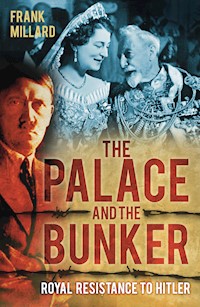
The part played by the many German and Austrian royal families in opposing Hitler has hitherto been overlooked. Prince Louis Ferdinand of Prussia was deeply involved in the German resistance movement and was questioned by the Gestapo following the 20 July plot on Hitler's life; Otto von Habsburg, heir to the Austro-Hungarian Empire, was sentenced to death and escaped through Europe to America, where he helped coordinate attempts to liberate his homeland; his Hohenberg cousins (children of the Archduke Franz Ferdinand) were incarcerated in Dachau; Crown Prince Rupprecht of Bavaria was exiled to Italy where he was pursued by the SS – his wife and children were captured and sent to concentration camps; the exiled Prince Hubertus zu Löwenstein travelled between the USA and Britain assembling German exiles into groups representing the real Germany – that could assume power when Hitler was defeated. The sweeping away of German and Austrian monarchs in 1918 made the rise of Hitler possible; their successors helped make possible his defeat.
Das E-Book können Sie in Legimi-Apps oder einer beliebigen App lesen, die das folgende Format unterstützen:
Veröffentlichungsjahr: 2011
Ähnliche



















For Charles
ACKNOWLEDGEMENTS
Without the help, assistance and encouragement of the following persons this book could not have been written. With due respect I record the help and generosity of:
His (late) Royal & Imperial Majesty Dr Otto von Habsburg of Austria-Hungary
HRH Georg Friedrich Prince of Prussia
HRH Duke Franz of Bavaria
HRH the Duke of Edinburgh
HIH Archduke Franz von Habsburg
HH Georg Duke of Hohenberg
HSH Princess Sophie von Hohenberg de Potesta1
HSH Princess Konstanza zu Löwenstein
Fr Rudolf zu Löwenstein OP
Baron Victor Kuchina von Schwanburg
Fr Dr Richard Ounsworth OP
Eva Demmerle (biographer of Dr Otto von Habsburg)
Carmen Schramka
Ulrich Feldhahn MA
Professor Caroline Barron
Quentin Gelder
Kevin Barrett
Peter Wise (author of A Matter of Doubt: the Life of Claude Bernard)
Dan Wise
Sue Woolmans
Viktoria Kish
Kevin Wheatland
Bill Baker
Jamie Young
Kenneth Fuller
Barry Smith
Jo Josh
Archivists, librarians and staff at the Royal Archives at Windsor Castle, the German Historical Institute, Churchill Archive, Dachau Archive, The National Archives, the British Library, Institute of Historical Research London, Bodleian Library Oxford and F.D. Roosevelt Library USA.
Notes
1 Her Serene Highness is currently engaged in a legal battle at the Court of Human Rights in Strasbourg for the return of the Hohenberg family home of Konopište in the Czech Republic, confiscated after the First World War.
FOREWORD
The Palace and the Bunker: Royal Resistance to Hitler is actually two books in one, each dependent on the other. The Bunker: the Shadow Over Europe relates to how and why Hitler was able to come to power in Germany and threaten the world, whereas The Palace: Hitler’s Royal Enemies relates, as the title suggests, to certain princes who opposed the Nazis. The Bunker section represents a synthesis of information and ideas from many sources distilled into a single volume. It is an exploration of a difficult subject in the context of German history and aspiration. Each section provides context for the other. The first section is vital because without a knowledge of the political and powerful cultural influences on young Germans in the inter-war years, together with an understanding of the effects of war, revolution and the Versailles Treaty upon people, economics and politics, it would be impossible to understand the world in which our protagonists moved.
This book includes four case histories of princely involvement in resistance against the Nazis. They were not the only princes who opposed Hitler; members of the Württemberg and Saxon royal families, for example, suffered for their stand against the National Socialist tyranny. These individuals all represented ancient and distinguished families, many with long histories of rule within Germany or Austria, with their own place within the history of the Germanic peoples going back into the early Middle Ages.
The princes are figures in a frightening landscape, consisting not only of National Socialism and its influences, but also the wider world with its own unsavoury influences on the Nazis that gave them some of their most dangerous ideas. These influences on Hitler, however, affected many others who did not themselves become evil, genocidal maniacs afterwards. So we must look to reception and interpretation as much as transmission in trying to understand how and why Nazism took hold, and why it existed in the first place. Nazism was an alternative to princely rule; they could never exist side by side as Hitler well knew. Where it was attempted in Italy Hitler poured scorn on it as unworkable and proclaimed that he would never have divided ‘his’ power in that way.
This book is full of heroes; not only royalty but also businessmen, diplomats, soldiers, politicians and ordinary citizens. Furthermore, not all German princes were opposed to Hitler from the start, some saw National Socialism as a possible useful bulwark against Bolshevik influence in Germany and even supported it by joining the SA or SS. These included the Princes of Hesse-Kassel and Prince Augustus Wilhelm of Prussia. Not only was Hitler never going to restore the monarchy as they hoped, but he was fundamentally opposed to the hereditary principle altogether and only courted the monarchists as he courted any group that might help him to power. Similarly his encouragement of ‘positive’ Christianity was far from Christian. Indeed, Hitler used many stepping stones on his way to power and in doing so crushed each one of them in turn.
I came to the subject of the lead up to the Second World War with little prior knowledge; my research has been a stimulating exploration into a world, which, though past, remains with us in many ways. I hope that this volume conveys something of what has been for me an often dark but always interesting journey with many surprises. There will, no doubt, be errors (all mine), but hopefully none of substance.
I have included an analysis of the Allied perspective of Germany and used a lot of English and American sources because this book is aimed primarily at an English-speaking audience, but also because some of what we find distasteful about Nazi Germany – social Darwinism, white supremacy, eugenics and aggressive secularism – were phenomena of the age and not confined within German borders. On the other hand, some modern virtues such as natural medicine, organic farming, environmentalism, animal welfare, anti-smoking legislation and additive-free foods were actively promoted by Nazi leaders.1 The common thread in Germany, though, was the genetic health of the Aryan race.2 Nazi ideology did not exist in isolation from the rest of the world; it just found its most extreme expression in pan-German nationalism, and particularly in racial theory. The Nazis applied sharp measures from blunt logic with ruthless and meticulous efficiency. There was madness both in Nazi ideas and in their obsessive demonic application, but that does not mean the rest of the Western world was sane.
I humbly and respectfully offer this book to the reader and dedicate it to the subjects of my study, for whom I have the greatest respect, to my son Charles, my wife Katrina and to royal families everywhere.
Notes
1 See Proctor, Robert, Racial Hygiene: Medicine Under the Nazis (Harvard, 1989) and Nazi War on Cancer(Princeton, 1999).
2 Ibid., Professor Proctor’s recent research has shown that the Nazis were not anti-science and many scientists worked for the regime with highly successful results.
CONTENTS
Title
Dedication
Acknowledgements
Foreword
Introduction
IThe Bunker: the Shadow over Europe
1 The German Tragedy
2 The Origins of National Socialism in Germany
3 Europe and the West
4 The German Resistance Movement
Conclusion
IIThe Palace: Hitler’s Royal Enemies
5 Prince Louis Ferdinand of Prussia
6 Crown Prince Rupprecht of Bavaria
7 Hubertus zu Löwenstein-Wertheim-Freudenberg
8 Habsburgs and Hohenbergs
9 European Royalty and the Nazis
Conclusion
Bibliography
Copyright
INTRODUCTION
Where love stops, power begins, and violence, and terror.
C.G. Jung
In 1933 David Lloyd George confided in Prince Louis Ferdinand of Prussia, the kaiser’s grandson, ‘We over here never expected nor intended the fall of your dynasty.’ He believed as others did that, although public opinion in Britain would have prevented a peace with the kaiser or his eldest son (Louis Ferdinand’s father), it would have been acceptable for Louis Ferdinand’s elder brother Wilhelm to come to the throne following Regency under his mother. ‘If your family had remained in power in Germany,’ he went on, ‘I am certain that Mr Hitler would not be giving us any headaches right now.’1 In April 1945, at the conclusion of the Second World War, Winston Churchill declared that:
This war would never have come unless (sic), under American and modernising pressure, we had driven the Habsburgs out of Austria and the Hohenzollerns out of Germany. By making these vacuums we gave the opening for the Hitlerite monster to crawl out of its sewer on to the vacant thrones.
In the following April he repeated his message:
I am of the opinion that if the Allies at the peace table at Versailles had not imagined that the sweeping away of long-established dynasties was a form of progress, and if they had allowed a Hohenzollern, a Wittelsbach and a Habsburg to return to their thrones, there would have been no Hitler. To Germany a symbolic point on which the loyalties of the military classes could centre would have been found and a democratic basis of society might have been preserved by a crowned Weimar in contact with the victorious Allies.2
This was not a retrospective judgment on the part of the UK’s wartime prime minister; in 1934 he had expressed the same view to Germany’s ex-chancellor, Heinrich Brüning, adding that he believed that constitutional monarchy in Europe was the best form of government to counter the twin threats of fascism and communism.3 Brüning himself reflected in November 1949:
When I think over these years, I come more firmly than I did at the time to the conclusion that only the restoration of the monarchy in some form by a plebiscite could have prevented Hitler from coming to power … It was my last weapon and to keep it sharp I had to be very cautious, and somewhat vague in talking about it.4
Adolf Hitler also believed that he would not have achieved power if German and Austrian royalty had remained in place. ‘It would never have been possible for a united German Reich if the princes had not been swept aside,’ he remarked.5 Furthermore, during the war Hitler summoned a former Social Democrat minister in order to inform the confused politician that his researches had shown that the Social Democratic Party (SPD) had ‘done Germany the service of deliberately and permanently abolishing the monarchy, and that, in his view, special thanks were due to them on that account’.6
Although there were those who believed there was a case for the forced personal abdication of Kaiser Wilhelm because (rightly or wrongly) they blamed him for the outbreak of war, the Emperor Karl von Habsburg of Austria-Hungary had sought peace with the Allies through the mediation of his wife’s relatives shortly after his accession, and the heir of Ludwig III of Bavaria, Crown Prince Rupprecht, was similarly a would-be peacemaker. Furthermore, it could be argued that the absence of the German monarchs after 1918 led to an absence of cohesion, direction and national pride, which led in turn to division, disorder, and the surfacing of aggressive nationalism.
Though the monarchies of the central European powers vanished almost overnight, the heirs to the great dynasties continued to work towards their restoration, but preferably as modern constitutional monarchies rather than as absolute rulers, reflecting the new reality. In the political chaos that dominated Germany after the First World War monarchists saw the restoration of the monarchies as a potentially stabilising factor, and later on royalty was seen by many people, including leading Social Democrats, as a foil to a possible takeover by extremist political groups, particularly the National Socialists.
Hitler was as negative towards the old princely order in Germany as he was towards those who had ushered in a republic in November 1918. The heirs to the Hollenzollerns of Prussia and the Wittelsbachs of Bavaria, and those to the Saxon, Hanoverian and other princely houses, retained royal ambitions, and similarly Otto, the Austrian heir to the (blessed) Emperor Karl, expected an eventual return to monarchy, though not absolute and not the old pre-war empire. The fluctuating political situation in Germany between the wars sometimes favoured the monarchists, but more generally turned on the republic’s responses to the political extremes of communism and the far Right. Elements of the right-wing of German politics sometimes courted the monarchists in common cause against the communists.
It is true that a few princes allied themselves with, or were ambivalent towards, the Nazis (the National Socialist German Workers’ Party, or NSDAP) before 1933, but most were deeply suspicious of Hitler and many openly opposed his politics.7 Some young princes (like many other young Germans) joined the National Socialist Party as a means of establishing or advancing a career, or out of fear of Bolshevism or dislike of the Weimar Republic. Some of them, however, continued their support into the 1940s and attained positions of rank within the party. Princes who supported Hitler included Prince August Wilhelm, Prince Philipp Landgrave von Hesse-Kassel and Prince Christoph von Hesse-Kassel.8
Princely opposition had consequences after Hitler became Chancellor of Germany in 1933. The Führer had stated that the age of princes was over. He despised royalty and particularly regarded the Habsburgs and their German counterparts as weak and politically finished. He himself courted the monarchists in Germany, but only for his own political ends, never at any time ever considering restoring monarchical power, especially not at the expense of his own. He mocked Prince Rupprecht of Bavaria for asking him to step down as Chancellor of Germany and make way for a monarchy as the best way to save Germany. Why should he leave office and forsake power for a dukedom, he asked.9
Dachau, Flossenbürg and Sachsenhausen became the residence of several princes, including the children of the Archduke Franz Ferdinand. Other anti-Nazi princes were assassinated, such as Prince Georg of Saxony; some plotted against the regime from within, such as Prince Louis Ferdinand of Prussia; others were exiled, such as Crown Prince Otto von Habsburg, Crown Prince Rupprecht of Bavaria and Prince Hubertus zu Löwenstein-Wertheim-Freudenberg, who as refugees urged the Allies to rid the world of the Nazis.
The anti-Nazi princes were cultured humanitarians of conviction and deep faith. Their role in opposing the Nazis is not easy to assess. Perhaps the results of their opposition were inconsequential as compared with the military activities of the Allies, but their moral authority was immense. Their quiet defiance must have played its part in undermining the pretended authority of the dictator.
Notes
1 Prince Louis Ferdinand of Prussia, The Rebel Prince: Memoirs of Prince Louis Ferdinand of Prussia (Chicago, Regnery, 1952), p. 41. Prince Louis Ferdinand wrote that not even the socialists wanted the Hohenzollern dynasty abolished and that the solution mentioned by Lloyd George would have been acceptable to them also.
2 Sir Winston Churchill Archive Trust, The Chartwell Trust, CHAR 20/216, message sent to the British ambassador in Brussels on 26 April 1945. See also Churchill, Winston S., The Gathering Storm, p. 10.
3 Patch, William L., Heinrich Brüning and the Dissolution of the Weimar Republic (Cambridge, 2006), p. 8.
4 Brüning, H., Die Brüning Papers, ed. Peter Lang (Frankfurt, 1993), p. 182.
5Hitler’s Table Talk, ed. Hugh Trevor-Roper (New York, Enigma, 2000), p. 186.
6 Wheeler-Bennett, Sir John, The Nemesis of Power: the German Army in Politics 1918–1945 (London & New York, 1953, rev. 1964), p. 231, footnote. See also: Speer, Albert, Inside the Third Reich (London, Sphere, 1970), pp. 95–6.
7 Kaiser Wilhelm II realised what Nazi rule meant after Kristallnacht when he declared that he was ashamed to be German. His eldest son, Crown Prince Wilhelm, supported Hitler’s candidacy for the presidency, but that was probably more to do with his antipathy towards Hindenburg, who he felt had betrayed the imperial family in 1918, than affiliation with the Führer who deprived the prince of any influence or dignity once he gained power. One of the kaiser’s sons, August Wilhelm, became a member of the SA contrary to the wishes of his father and was used by Göbbels for propaganda, but was considered gullible both by his family and those he regarded as his new friends.
8 See especially: Petropoulos, Jonathan, Royals and the Reich: The Princes von Hessen in Nazi Germany (Oxford, 2008). The quasi-aristocratic Herman Göring was largely instrumental in wooing potential upper-class supporters. Sally Baranowski writes that upper-class salons and personal contacts between the likes of Göring and August Wilhelm generated financial help and lent respectability to the party, Baranowski, Shelly, Nazi Empire: German Colonisation and Imperialism from Bismarck to Hitler (Cambridge, 2010), p. 168. Until, that is, Hitler no longer required his princely followers in whom he had no trust. He then forbade their active military service and imprisoned several of them in concentration camps.
9Hitler’s Table Talk, ed. Hugh Trevor-Roper, p. 243.
I
THE BUNKER: THE SHADOW OVER EUROPE
1
THE GERMAN TRAGEDY
What is this new spirit of German nationalism? The worst of the old Prussian Imperialism, with an added savagery, a racial pride, an exclusiveness which cannot allow to any fellow-subject not of ‘pure Nordic birth’ equality of rights and citizenship within the nation to which he belongs. Are you going to discuss revision [of the Treaty of Versailles] with a Government like that?
Austen Chamberlain1
Historians ascribe motives to actions, yet we are but dimly aware of the multiplicity of influences on our protagonists or the deeper hidden thoughts that have informed their decisions. If we can be better apprised of the truth through interpretation all well and good, but the work of the historian must be more about detection and awareness than interpretation – especially interpretation based on a personal viewpoint obscured by an intervening political chronology. Just as on the eve of the First World War it would have been impossible to predict the circumstances of a second world war, so post-Second World War and post-Cold War it is not easy to reflect on the inter-war period without a hindsight that hinders more than assists our understanding of the people and events of which we speak.
In 1914 the German and Austrian monarchies may not have been as autocratic as has been popularly believed, but they still existed as a real force in national and international affairs. As to whether the German or Austrian emperors were culpable for the outbreak of an internecine war, the scale of which had not been experienced before, is quite another story. The Archduke Franz Ferdinand was trying to revive the Dreikaiserbund (understanding between the three emperors in Germany, Austria and Russia) right up until his assassination, which cut off the head (so to speak) of the very means of preventing the war that resulted. His grandson George von Hohenberg said, ‘we stumbled into the war, without knowing what was happening to us. It was the incomprehensible suicide of Europe.’2
Nations responded differently to the cultural pessimism of the fin de siècle and the inhumanity of the First World War. Britain, France and Germany were each affected in different ways. The fundament, however, was a spiritual void as modern man lost touch with his soul and searched for it everywhere, including the gutter, and in his despair began to worship the body as if it were immortal. The depression that gripped France in the after-gloom of defeat in the Franco-Prussian war visited itself on Germany from 1918. However, pessimism in general intruded into the heart of every nation, eroding former trust in religion, national duty and an expected eventual golden destiny for the human race. There had been lamentation in Germany that old Germany was disintegrating (after 1871) in spite of its new unity. It seemed pulled apart by modernity – by liberalism, secularism and industrialisation – and there appeared to be a decline of the German spirit and idealism because of politics and materialism. Paul de Lagarde complained of cultural discontent in England as well as Germany: ‘Everywhere one gets the sense that their hope is but a phrase, and that only their despair and resignation are truth.’3 The trauma of the First World War added to a movement that questioned all the values and apparent certainties of the past. The differences between how it manifested in each state was a response to their particular experiences of war and its aftermath, informed by pre-existing national aspirations and sentiments.
‘Bismark had created a state that had no constitutional theory; its justification, he thought, was that it worked,’ writes Richard Stern Fritz. He continues:
Power thinly disguised on the one hand, and spirit emptied of all practicality on the other – these surely were two aspects of imperial Germany. The link between the two realms was the idealization of power; the middle classes, in Max Webber’s phrase, ‘ethicized’ Bismark’s achievement of power. This also encouraged a certain idolatry of idealism in politics ... Lagarde, Langbehn, and Moeller, outsiders all, appealed as idealists, whether their ideas had a shred of practicality or not.4
The ‘war guilt’ that German politicians were forced to accept at the Treaty of Versailles is still almost a given, but Prince Hubertus zu Löwenstein wrote that although ‘no particular “war guilt” reverted to Germany … It was Hitler’s unchaining of the Second World War retrospectively, so to speak, made Germany appear responsible also for the first.’5 Crown Prince Rupprecht of Bavaria regretted that the idea of Germany’s war guilt still had considerable currency in 1922. He also believed in the kaiser’s ‘will to peace’. ‘During the Moroccan Crisis the Kaiser at a confidential conference with the commanding generals exclaimed “I fervently hope peace can be maintained”. This never got into the papers, I believe,’ the Crown prince commented to the New York Times correspondent.6 The Emperor Karl of Austria also rejected German war guilt and believed in the kaiser’s ‘goodwill’. He further maintained that the kaiser had been too much in the thrall of his generals, Eric Ludendorff in particular.7 It is hard for anyone brought up in France, Britain or the United States to contemplate that the First World War was not the kaiser’s war of course, but that says more about how deeply ingrained are our prejudices than anything about the true origins of the war.
Löwenstein reflected that his father’s generation had not experienced war and were not prepared for what followed, its outbreak or its attendant risks. He comments that within days the civilised nations of Europe were engulfed in a wave of mass hysteria: ‘Germans, Russians, French, British – depending on which nation you belonged to yourself – changed overnight into veritable beasts, devils in the guise of men. The ties of history, culture, and blood were forgotten as though they had never existed.’8
A similar sentiment was expressed in the pages of the New York Sun at the outbreak of hostilities:
One day there is civilization, authentic, complex, triumphant; comes war, and in a moment the entire fabric sinks down into a slime of mud and blood. In a day, in an hour, a cycle of civilization is cancelled. What you saw in the morning was suave and ordered life; and the sun sets on howling savagery. In the morning black-coated men lifted their hats to women. Ere nightfall they are slashing them with sabres and burning the houses over their heads.
Modern civilization is the most complex machine imaginable; its infinite cogged wheels turn endlessly upon each other; and perfectly it accomplishes its multifarious purposes; but smash one wheel and it all falls apart into muddle and ruin. The declaration of war was like thrusting a mailed fist into the intricate works of a clock. There was an end of the perfected machine of civilization. Everything stopped. We are savages once more. For science is dead. All the laboratories are shut, save those where poison is brewed and destruction is put up in packages. Education has ceased, save that fierce Nietzschean education which declares: ‘The weak and helpless must go to the wall; and we shall help them go.’ All that made life humanly fair is hidden in the fetid clouds of war where savages (in terror and hysteria) grope for each other’s throats.9
It was not the expected quick war promised by the politicians. When the German advance was arrested the two sides dug in. But for the German army, after failing to break through with their 1914 offensive, the war was effectively lost to them. What followed was mutual siege warfare across the trenches. All the Allies really had to do was hold out until their adversary had exhausted himself on their lines and retired out of a lack of will, munitions and rations. However, without the means to sustain a long war themselves the Allies, like the Germans, chose to throw munitions and human beings at the enemy in an attempt to break through and avoid national bankruptcy. The peace moves by the Emperor Karl were the last best hope of saving Europe from catastrophe and prolonged economic decline.
By November 1918 the intricate machinery of German civilisation had been smashed seemingly beyond repair as the country descended into chaos and civil war. When the German High Seas Fleet surrendered at Scapa Flow, Admiral of the British Fleet David Beatty was highly suspicious: ‘It seemed too wonderful for an extremely powerful fleet to give themselves up without a blow! One thing I do know – that if we had been in the position of those Hun we would have had a good run for our money before we got “put under”.’10 So incredulous was the admiral that he ordered the German battle flags lowered while their ships remained fully armed and ready for action. He could not believe that his powerful and respected adversary could be so beaten in spirit.
In the early 1930s Marshall Hindenburg confided in his chancellor, Heinrich Brüning, that he already knew the war was lost as early as February 1918, but wanted to give General Erich Ludendorff ‘one more chance’. Brüning was appalled that a commander-in-chief could ask for 100,000 lives to be sacrificed for an offensive that he did not think could succeed.11 Commenting on the government of Germany, which had surrendered to the Allies, Eric Ludendorff said in 1919:
The power of the state failed, as nobody can doubt, because in its external and internal policy, before and during the war, it had not recognized the exigencies of the struggle for existence in which Germany has always been involved. It had demonstrated its inability to understand that politics is war and war is politics … Finally the political leadership disarmed the unconquered army and delivered over Germany to the destructive will of the enemy in order that it might carry through the revolution in Germany unhindered. That was the climax in the betrayal of the German people.12
The First World War left Europe in ruins, where even the victors were shattered and entire nations left psychologically – as well as economically and militarily – damaged. If whole peoples can be shell-shocked, the French, British, Belgians and others were almost as damaged as their former enemies, which might somewhat explain their subsequent attitudes and actions.
On 9 November 1918, against a background of naval mutiny, popular uprisings, disorder and the takeover of Munich by the Independent Socialists two days before, Phillip Scheideman, one man acting alone without consultation with his fellow Social Democrats, announced a German republic from the Reichstag building. From this illegal act and the equally illegal grant of power by Prince Maximilian von Baden (who had falsely announced the abdication of the kaiser) to MSPD leader Friedrich Ebert, the Weimar Republic was eventually born. This had followed the receipt of a note from President Woodrow Wilson of the USA, which suggested that the abdication of the kaiser (voluntary or otherwise) was a pre-condition of peace. Winston Churchill records, ‘The prejudice of the Americans … had made it clear that [Germany] would have better treatment from the Allies as a republic than a monarchy.’13 It was also a reaction against an intended announcement by the extreme left-wing Sparticist movement of a socialist republic. The Social Democrats did not want the fall of the monarchy, but laboured to convince the kaiser to abdicate so that his line would continue to reign in Germany.
Prince Louis Ferdinand of Prussia doubted that the fall of the monarchy in Germany was the result of any revolutionary fervour on the part of the people:
The Revolution of November 9, 1918, was neither a social upheaval nor was it directed primarily against our dynasty or against any ruling family in Germany. It was a revolution of hunger, caused by the desperate desire of the people for peace at any price especially after President Wilson had proclaimed his fourteen points. The great majority of the people had no political grudge against the German dynasties.
He added that the German people had a ‘lack of talent for revolutions’ because of their inherent love of order.14
The consequences of this act and the ending of the war were far reaching. At the Versailles Conference that followed the Allies not only demanded territorial concessions and financial reparations, but also an admission of war guilt, before the lifting of a blockade that had caused great hardship in Germany and the official ending of hostilities could take place. The politicians believed that by bowing to the perceived wishes of the Allies in assuming the full government of the Reich and creating a non-militaristic republic that they would be able to negotiate the peace. There was no negotiation; Germany was handed the terms of surrender and, without the means to defend their country, the ministers were forced to accept. As a result of this grossly unequal agreement a myth grew up that the German army, which still occupied large areas of enemy territory in November 1918, was stabbed in the back by the politicians in Berlin who had declared the republic and made peace with the Allies out of their own personal ambition and not in the interests of the Reich.15 This myth filled many people on the Right in Germany with a loathing for the republic and fed right-wing paramilitary groups the emotional ammunition for counter-revolution. Prince Hubertus zu Löwenstein, however, reminds us that the republic was declared against a background of social and political collapse in Germany and with the knowledge that the left-wing extremist Spartacists, led by Rosa Luxemburg and Karl Liebknecht, were about to declare a socialist republic (Freie Sozialistische Republik) in Germany that evening, and fearing it would be the prelude to a communist revolution.16
When the republic could not pay its reparations, French and Belgian troops entered the industrial Ruhr region and took over production, which led to a temporary passive resistance by German workers supported by their government. Prince Hubertus zu Löwenstein described the invasion of the Ruhr district in early 1923 as an international tragedy, ‘The permanent damage done thereby to the young German republic was never quite repaired. Adolf Hitler had every reason to be grateful for it.’17 In 1923 Leon Trotsky ordered the German KPD to take advantage of the economic chaos in Germany to launch a full-blown revolution. Communist-inspired insurrection took place in Saxony and Thuringa. Chancellor Gustav Streseman was at heart a monarchist, but he was also a pragmatist. On 26 September he ordered the end of passive resistance in the Ruhr as useless.
Arthur Moeller van den Bruck wrote in his preface to his book, Das Dritte Reich (The Third Reich):
If the Third Reich is to put an end to strife it will not be born in a pace of philosophic dreaming. The Third Reich will be an empire of organization in the midst of European chaos. The occupation of the Ruhr and its consequences worked a change in the minds of men. It was the first thing that made the nation think. It opened up the possibility of liberation for a betrayed people. It seemed about to put an end to the ‘policy of fulfilment’ which had been merely party politics disguised as foreign policy. It threw us back on our own power of decision. It restored our will. Parliamentism has become an institution of our public life, whose chief function would appear to be - in the name of the people - to enfeeble all political demands and all national passions.18
It was in 1923, with the Reich government in disarray over the occupation of the Ruhr and with Mussolini’s ‘March on Rome’ as inspiration, that Hitler and Ludendorff launched an abortive putsch in Munich, intending to march on Berlin and seize power.19 Hitler was imprisoned and used the time to write his book Mein Kampf. The failure of the rising also led to a change in tactics that added the ballot box to the NSDAP armoury.
During the 1920s the organisation of the party was refined and centralised. Under the Strasser brothers, Gregor and Otto, with their party headquarters in Berlin, the northern and western branches of the NSDAP achieved a large, well-organised membership by presenting a programme that emphasised the socialist aspects of the party.20 However, the size and strength of the northern group threatened Hitler’s personal authority and, when Gregor was offered the vice-chancellorship of Germany, the possibility of his acceptance threatened to split the party. As a result, Hitler asserted his leadership at the Bamberg Conference in 1926, condemning the ‘national bolshevist faction’ in the party. Otto was forced out of the NSDAP and Gregor was later murdered in the Night of the Long Knives. Although Hitler owed much to the two brothers, he could allow no rivals to overshadow him.
After 1923, the year ‘of crises’, which featured hyperinflation, the occupation of the Ruhr and civil unrest, conditions improved in Germany due to the receipt of foreign loans, the US Dawes Plan of 1924 and the Young Plan that followed it in 1929, and also due in no small part to the chancellorship of Gustav Stresemann and his tenure as Foreign Secretary. The period between 1923 and 1929 was known as the ‘golden era’, but was brought to an end with the Wall Street Crash and the economic turmoil that followed, which included the suspending and calling in of loans to Germany.
Economics had severe political consequences throughout the world at this time. For example, the Hawley Smooth Tariff (17 June 1930) raised US import duties to ‘stratospheric’ levels, preventing foreign nations from easily acquiring dollars to repay war debts, choking international trade and postponing the recovery of many countries across the world.21 Michael E. Parish points out that less than three months after the first US Neutrality Act became law Mussolini’s forces marched into Ethiopia on 3 October 1933. One week after the enactment of the second Neutrality Act (7 March 1936) German troops occupied the Rhineland. Four months later the Spanish Civil War began. In May 1937 the third Neutrality Act was passed, Japanese-Chinese conflict intensified and the road to Munich was wide open.22
Carl Jung commented that with the Depression in Germany, ‘The whole educated middle-class was utterly ruined, but the state was on top, putting on more and more of the “istic” rouge as war-paint. The country was in a condition of extreme misery and insecurity, and waves of panic swept over the population.’23 The reasons for a move towards authoritarian government in Germany and elsewhere are not hard to find. Nicholas Lewin points out:
In those times confusion and anarchy were real threats to society and the rule of law. The fact that later horrors have overshadowed the excesses after World War I should not blind one to the thousands killed by Lenin’s consolidation of power after the civil war or the brutality of the revolution in Hungary and the murders on both sides as the communist revolt was put down in Bavaria.24
The Weimar Republic was far from universally popular, not even in its glory days in the mid-1920s; too many members of the Reichstag would have favoured its abolition and during the Depression fewer and fewer members were committed to its preservation. Nationalists, communists, Nazis – all wanted to replace outmoded democracy with strong, heroic authoritarian government of the people, but not by the people. Gustav Le Bon in his book, Psychology of the Masses, referred to crowds as irrational and hysterical. What then was democracy but the irrational and hysterical rule of a heroic nation that deserved proper leadership, not the dictatorship of the mob?
National Socialist government was by no means inevitable, and by the time that Hitler became chancellor the vote for the NSDAP had peaked and was beginning to wane as the economy began to pick up. Extreme politics was shunned again especially as political violence grew. The fallout of the sudden decline in Germany’s fortunes led not just to a return to civil unrest, but a rise in the popularity of extremist political parties (such as the NSDAP and communists), reflected in election results at the expense of the traditional parties. In the Reichstag elections of 1928 the National Socialists only achieved twelve seats. However, in the election of 1930, at the height of the economic crisis, they won 107 seats.
By the early 1930s the Weimar Republic ran out of track when the Reichstag became packed with members who didn’t believe in it, and many of whom did not even believe in democracy. Democracy was thought outmoded as compared with what appeared to be strong effective dictatorships promoting national interest. It became increasingly difficult for democrats to form a government without negotiating with their natural enemies. German politics had been moving in the direction of more authoritarian government since the collapse of the Grand Coalition in 1930, due to a rejection of a cut in unemployment benefit that could no longer be afforded by the state. A proposal supported by the Social Democrat chancellor was defeated by his own party, prompting his resignation and the fall of the coalition government. Chancellors of ensuing administrations without clear mandates found it increasingly necessary to bypass parliament to get legislation enacted using (or misusing?) emergency powers enshrined in the Weimar Constitution.
Hindenburg appointed Heinrich Brüning of the Centre Party as chancellor of a minority government with the onerous task of making the cuts thought necessary to bring the German economy on track. His first bill of economic reform was passed narrowly by the Reichstag, but the second was rejected, prompting a general election that increased the extremist vote – especially of the Nazis. With Hindenburg’s support and the backing of the Social Democrats, who saw the administration preferable to that of the NSDAP, Brüning continued to govern. He despised the Nazis and had the SA and SS banned. Among his other reforms he ordered bankrupt estates to be broken up into small farms, which alienated the Right. It seemed to Hindenburg and his advisor, General Schleicher, that Brüning’s government was swinging too far to the Left. Brüning was on the verge of his greatest triumph in getting the Allies to agree in principle to end reparations when he received news that he had been ousted. He had hoped to bring back the Hohenzollerns as constitutional monarchs to prevent extremist parties like the Nazis from being able to introduce dictatorial government to Germany. In spite of authoritarian elements, Brüning’s administration was the last hope of preventing a right-wing government of some kind in Germany and the last chance of excluding the Nazis from mainstream politics.




