


Erhalten Sie Zugang zu diesem und mehr als 300000 Büchern ab EUR 5,99 monatlich.
- Herausgeber: The History Press
- Kategorie: Sachliteratur, Reportagen, Biografien
- Sprache: Englisch
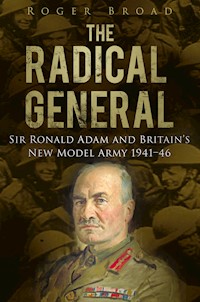
Britain's great battlefield generals of the Second World War like Montgomery and Slim would have failed had not General Sir Ronald Adam been appointed Adjutant-General in 1941. As the army's second most senior officer, he was responsible for providing the man- and womanpower for battle. He revolutionised recruitment practices and introduced scientific selection procedures to find the officers, NCOs and technicians that a modern army needed. Adam also recognised that soldiers needed to believe in the cause they were fighting for. This too led to controversy when the soldiers began to debate political issues about post-war Britain. Did Adam's espousal of such discussion groups lead to the Labour landslide in 1945? How did this career soldier of conventional background, when given the authority, come to tread on so many toes, kick so many shins and break up so much of the War Office's most revered items of mental and organisational furniture? This book reveals the true story of a Modern Major-General.
Sie lesen das E-Book in den Legimi-Apps auf:
Seitenzahl: 498
Veröffentlichungsjahr: 2013
Das E-Book (TTS) können Sie hören im Abo „Legimi Premium” in Legimi-Apps auf:
Ähnliche



















CONTENTS
Title Page
Acknowledgements
List of illustrations
Abbreviations
Brief chronology
1. The puzzle
2. From India to India
3. The Somme and the Asiago
4. Rising star
5. Stumbling to war
6. Return via Dunkirk
7. Guarding the North
8. Pegs and holes
9. Officer-like qualities
10. Dynamite
11. The humane touch
12. Frictions
13. The legacy
14. Cultural diplomacy
15. Lifelong learning
16. How radical was he?
Notes
Full chronology
Plate Section
Copyright
ACKNOWLEDGEMENTS
The author is above all grateful to Isobel and Bridget Forbes Adam for the loan of documents and photographs relating to their father’s career and for their discussions on various aspects of his life. Professor Brian Holden Reid gave helpful advice and most generously read the manuscript and made many valuable suggestions, as did Michael Berendt, Don Hatwell and Robin Bridgeman. Dr Lisl Klein provided valuable material and good advice about Chapters 8–10. Discussions with Lord Judd, Dr Harriet Harvey-Wood, Sir Michael Howard and Lord Thomas of Swynnerton gave valuable insights. Professor David French made generous and lengthy replies to the author’s questions, and Professor Martin S. Alexander, Georgina Natzio, Max Schiavon and Professor Brian Bond provided valuable information. The London Library and the British Library have been as invaluable as ever. Special thanks are due to the following for permission to research in and to quote from their archives: Patricia Methven, Lianne Smith and colleagues at the Liddell Hart Centre for Military Archives, King’s College, London; The National Archives; Dr Lynsey Robertson and colleagues, Churchill College Archives Centre, Cambridge; Richard Davies, Special Collections, the Brotherton Library, University of Leeds; the Joint Services Command and Staff College; Christine Coates, TUC Collections, London Metropolitan University; Paul Evans, Librarian, Royal Artillery Museum, Woolwich. The author is also grateful for help from Prof. Clare Ungerson; Matthew Wheeler, CILIP; Jessica Womack, London University Institute of Education; Adèle Torrance, Reference Archivist, UNESCO; Mrs P. Hatfield, Archivist, Eton College; Bianca Taubert, Curator, Adjutant-General’s Corps Museum; Mark Ogden and Peter Bloor, British Council; Malcolm Harper, United Nations Association; Emma Goodrum, Archivist, Worcester College, Oxford; Dr Alastair Massie and Richard Dabb, National Army Museum; Neil Robinson, Marylebone Cricket Club; the Explore History Centre of the Imperial War Museum; the Wellcome Library; Olivier Entraygues, the Commonwealth War Graves Commission. The author is grateful to the following for permission to quote from their books or for those books and papers of which they are copyright holders: Prof. Brian Holden Reid, Prof. David French, Dr Jeremy Crang, Dr Georgina Natzio, Prof. Martin S. Alexander, Prof. Saul David, Prof. S.P. Mackenzie, Prof. Brian Bond, Sir Michael Howard, Dr Nick Smart, Lord Bridgeman, David Grigg. The following publishers for permission to quote from their books: Pen & Sword Books, Paget, Julian: The Crusading General; Hodder and Stoughton, Sir John Colville, Fringes of Power; Harper Collins for extracts from books by J.G. Ballard, Sir John Colville, David Fraser, Sir Max Hastings and Woodrow Wyatt. Among online sources: unithistories.com and generals.dk proved very valuable. The author wishes to thank Jo de Vries, Paul Baillie-Lane and Jay Slater at The History Press for their steering of publication and Amanda Dackombe for her careful editing. Rohan Bolton’s preparation of the index is exemplary. As ever Sarah provided support and forbearance.
ILLUSTRATIONS
The author thanks the following for permission to reproduce photographs and drawings: Isobel Forbes Adam (Adam with Northern Command staff; sketch by S. Imogen Browne) and the Trustees of LHCMA, King’s College, London (RHA officers, Officers of N Troop, Maxse Redoubt sketch; 1940 Allied officers; Dunkirk map).
LIST OF ILLUSTRATIONS
1 Self, Shorncliffe, summer 1907.
2 Delhi Durbar 1911, gallop past by RHA: ‘the horses ventre-à-terre’.
3 The officers of N (‘Eagle’) Troop, RHA, India, c. 1912. Left front: Adam; right front: Brooke.
4 The British other ranks of N Troop, India, c. 1912.
5 Sketch by Adam of enemy lines, the Somme, 18 May 1916.
6 Hankelow Court in the County of Chester.
7 Allies 1940, before the deluge: from left, Admiral Abrial, Lt-Gen. Dill, Lt-Gen. Brooke, Lt-Gen. Adam, French President Albert Lebrun, Gen. Pagezy, Gen. Lord Gort, General Voruz.
8 The retreat to Dunkirk.
9 Troops on the beach at Dunkirk waiting for evacuation.
10 The French destroyer Bourrasque sinking, loaded with soldiers.
11 Insignia of III Corps, BEF: woven in green on white ground.
12 Insignia of Northern Command, 1940–41: green felt on blue ground.
13 Adam with his senior staff, Northern Command.
14 Adam, GOC Northern Command, and Brooke, GOC Home Forces, inspect coastal defences in 1940.
15 A recruit taking a mechanical ability test.
16 WOSB leaderless group initiative test in a London suburb.
17 ABCA information display.
18 ABCA discussion in the Middle East on post-war medical services.
19 The chairman of the British Council on a visit to Moravia, 1948.
20 General Sir Ronald Forbes Adam, GCB, DSO, OBE, 1947.
ABBREVIATIONS
AA
anti-aircraft
ABCA
Army Bureau of Current Affairs
AC
Army Council
ADGB
Air Defence of Great Britain
AEC
Army Educational Corps
AG
Adjutant-General
AT
anti-tank
ATS
Auxiliary Territorial Service
Bde
Brigade
BEF
British Expeditionary Force
Brig.
Brigadier
Bty
Battery
BWP
British Way and Purpose
Capt.
Captain
CB
Commander of the Order of the Bath
CIGS
Chief of the Imperial General Staff
C-in-C
Commander-in-Chief
CO
commanding officer
Col
Colonel
DCIGS
Deputy Chief of the Imperial General Staff
DDMO
Deputy Director of Military Operations
DGWE
Directorate-General for Welfare and Education
DSO
Member of the Distinguished Service Order
DSP
Directorate for the Selection of Personnel
ECAC
Executive Committee of the Army Council
ENSA
Entertainments National Service Association
F.-M.
Field-Marshal
GCB
Grand Knight Commander of the Order of the Bath
Gen.
General
GHQ
General Headquarters
GOC
General Officer Commanding
GSC
General Service Corps
GSO
General Staff Officer
KCB
Knight of the Order of the Bath
LLD
doctor of laws
Lt
Lieutenant
Lt-Col
Lieutenant-Colonel
Lt-Gen.
Lieutenant-General
Maj.-Gen.
Major-General
MC
Military Cross
MLNS
Ministry of Labour and National Service
NAAFI
Navy, Army and Air Force Institutes
NCO
non-commissioned officer
OBE
Member of the Order of the British Empire
OCTU
Officer Cadet Training Unit
OR
other rank
OTC
Officers’ Training Corps
POM
potential officer material
POW(s)
prisoner(s) of war
PSO
Personnel Selection Officer
RA
Royal Regiment of Artillery
RAC
Royal Armoured Corps
RAEC
Royal Army Educational Corps
RAMC
Royal Army Medical Corps
RASC
Royal Army Service Corps
RE
Royal Engineers
RFA
Royal Field Artillery
RGA
Royal Garrison Artillery
RHA
Royal Horse Artillery
RSM
regimental sergeant major
RTC
Royal Tank Corps
Sgt
sergeant
TA
Territorial Army
UNA
United Nations Association
UNESCO
United Nations Educational, Scientific and Cultural Organisation
WEA
Workers’ Educational Association
WO
WAR Office
WOSB
War Office Selection Board
YMCA
Young Men’s Christian Association
BRIEF CHRONOLOGY
1885 (30 Oct.)
Ronald Forbes Adam born in Bombay
1898–1902
At Eton College
1903 (2 Sep.)
Entered Royal Military Academy, Woolwich
1905 (27 Jul.)
Commissioned as 2nd Lieutenant in Royal Artillery;
1911(May)
Lieutenant, posted to N Battery, Royal Horse Artillery, India
1914 (Sep.)
Regiment sent to France
1915 (Mar.)
Captain, second-in-command, 41st Bty, 42nd Bde, RFA
1915 (Oct.)
CO, 58th Bty, 35th Bde, RA
1917 (Jan.)
Major, CO, 464th Bty, 174th Bde, RFA
1918 (Mar)
Brigade major, RA, XIV Corps, Italy
1918 (Oct.)
GSO2, RA, XV Corps, Italy
1921 (Dec.)
GSO3, WO
1923 (Jan.)
GSO2, Staff College; temporary lieutenant-colonel
1926 (Mar.)
CO, 72nd Field Bty., 16th Bde., India; brevet lieutenant-colonel
1932 (Oct.)
GSO1, Staff College; colonel
1936 (Oct.)
DDMO, temporary brigadier
1936 (Nov.)
Commander RA,1st Div,
1937 (Sep.)
Commandant, Staff College; temporary major-general
1938 (Jan.)
Deputy CIGS; temporary lieutenant-general
1939 (Oct.)
GOC, III Corps, BEF; lieutenant-general
1940 (Jun.)
GOC, Northern Command
1941(Jun.)
Adjutant-General to the Forces
1942 (Apr.)
General
1946 (Jul.)
Retired from army
1945–53
Member of Council, Tavistock Clinic, London
1947–53
Director General, British Council
1948–67
Council member, Institute of Education, London University
1949–67
Member of governing body, Birkbeck College, London
1957–60
Chairman, UK Branch, UNA
1982 (26 Dec.)
Died at Faygate, Sussex
1
THE PUZZLE
After his release from a Japanese prison camp in 1945 the sci-fi-writer-to-be J.G. Ballard spent the holidays from his English boarding school with his grandparents. He recalled that, ‘They were obsessed with the iniquities of the post-war Labour government, which they genuinely believed to have carried out a military putsch to seize control of the country, using the postal votes of millions of overseas servicemen.’1
This was an extreme example of the sorrow, bewilderment and anger felt by many in Britain and abroad when Winston Churchill, the inspirer of resistance to tyranny, had on the morrow of victory in Europe been cast aside by the electorate with a landslide majority for the Labour Party. Against an unexpected and unwelcome reality many find reassurance in a scapegoat. The reality in this case was that the electorate did not believe that Churchill was the man to lead a peacetime government. As the wartime Coldstream Guards captain and later military historian Sir Michael Howard wrote, ‘However great our admiration for Winston Churchill, few of us saw any reason to be grateful to the Conservative Party for its management of national affairs during the 1930s.’2
Others closer to the centre of public affairs than Ballard’s grandparents also needed a scapegoat to explain this unpalatable truth. Some blamed the voting outcome on the Army Bureau of Current Affairs (ABCA), which had issued fortnightly discussion pamphlets for the troops. In fact, few of the 118 pamphlets issued were controversial. One was suppressed before publication; that on the Beveridge Report on social security was withdrawn in favour of a more closely supervised version. Nonetheless, the Royal Army Educational Corps (RAEC) was pursued for years by the gibe that its only battle honour had been the general election of 1945. This charge had a small element of truth, for there was Left-wing influence in the army’s educational service, although its extent is debatable.
Who was responsible for this? Apart from Sir James Grigg, the war minister – a very conservative figure – and parliamentary undersecretary Lord Croft – even more so – the soldier in overall charge of army education (among many other responsibilities) was Gen. Sir Ronald Forbes Adam, Bt, Adjutant-General (AG) to the Forces in 1941–46. In modern usage he was the army’s director of human resources. Did he, wittingly or unwittingly, orchestrate the Ballard grandparents’ ‘putsch’? If so, why and how?
Despite holding the second highest post in the British Army for five years at a crucial time, Adam is little known compared with Britain’s other generals of the Second World War. Those flamboyant in style – such as Montgomery, Slim and Alexander – are famous, as is Alanbrooke. Such others as Auchinleck, Browning, Horrocks, O’Connor, Leese, Paget and Hobart have featured in history books and memoirs. Other widely recognised names are Gort and Wavell, who suffered eclipse through personal misjudgement or military or political mischance. Percival is remembered for surrendering Singapore. Battles lost and won are stirring stuff and their outcome overtly affects history. Yet without competent organisation, adequate supplies of matériel, and enough men trained for warfare, all the battlefield generals’ plans and campaigns could have been the reverse of glorious. Without Adam’s achievements as AG in 1941–46 the British Army would have been in little better shape later in the war than the disasters from 1940 to mid-1942 showed it to be. Without him, many of those of battlefield renown would not have achieved success or gained acclaim. It is not that Adam’s role is forgotten; more overlooked: organisation and administration are usually regarded as boring stuff.
TWO PRE-WAR TASKS
On his appointment as AG in June 1941 Adam had been a soldier for nearly forty years, rising steadily if unspectacularly until, in 1938, he was appointed to the new post of Deputy Chief of the Imperial General Staff (DCIGS). Here, within the financial constraints and the policy vagaries of the time, he made a major contribution to getting the British Army ready for war. That it was still not ready enough was outside his control. Apart from this official task he took on the unofficial role of maintaining peace between the Chief of the Imperial General Staff (CIGS), Lord Gort, and the Secretary of State for War, Leslie Hore-Belisha, who barely spoke to each other. He then, for seven months in 1939–40, commanded III Corps of the British Expeditionary Force (BEF), held mainly in reserve. As the Allied forces in the north of France crumbled, Adam was ordered by Gort, now commander-in-chief (C-in-C) of the BEF, to establish a perimeter around Dunkirk, a move that – along with much courage, German errors and sheer luck – enabled 340,000 British and French soldiers to escape by sea. This reinforced Adam’s reputation for solid competence. Then for a year he commanded the land defence of north-east England against the expected invasion.
After a brief euphoria in the latter half of 1940, morale in the army slumped – much less so in the navy and air force, which had visible successes. This was not helped by the army’s selection of men for duties fitting their abilities being haphazard and inept; the picking out of men for training as officers was arguably even worse. The problems of creating a modern army of soldier-citizens, motivated and with high morale, had not been faced in the years of peace.
By the time Adam left Northern Command to become AG in June 1941 he had learnt much to convince him of the need for three major reforms. The first in time was putting the selection and training of officers on to a scientific basis, including the employment of psychiatrists and psychologists to help judge the quality of potential leaders. This upset conventional minds, political and military.
Next came another change that was deeply upsetting to traditionalists: initially bypassing the individual regiments and corps by sending recruits through the same basic training, during which their intellectual capacity, psychological balance, existing and potential skills, combatant temperament and leadership qualities could be judged, again using scientific methods. Only then were they posted to a regiment or a corps for further training that tried to reconcile the army’s needs, their abilities and, if possible, their wishes. Many of Adam’s fellow officers believed this undermined, in particular, the infantry’s regimental system.
Finally, apart from improving morale through better welfare provision for soldiers and their families, Adam believed that to motivate the citizen-warriors of a democratic state, they needed to understand the nature of the war and the enemy they were fighting. So talks and discussions on the war, on the aims of British policy and other current affairs became an integral part of army life. Faced with an enemy promoting a fascist ideology of dictatorship and intolerance, the Army Council (comprising Britain’s political and military leadership) agreed that Britain should promote its own ideology of democracy through its main weapons: open discussion and debate. But encouraging the common soldiery to think about and to discuss public affairs disturbed some. ‘Theirs not to reason why, theirs but to do and die’, was an attitude with many sympathisers almost a century after the Charge of the Light Brigade at the Battle of Balaclava in the Crimea. Yet the days of obedient cannon fodder were over.
With the War Office Selection Board (WOSB) Adam introduced science and objectivity in place of hunch and prejudice; in the General Service Corps (GSC), analysis and reason in place of tradition and sentiment; with ABCA, open discussion and debate into an organisation based on hierarchy and obedience. All three reforms ruffled feathers, but there can be no doubt that without them the British Army could not have made such a valuable contribution to final victory. Adam was fortunate in having solid support – particularly against Churchill in his more wayward moments – from Sir Alan Brooke, the CIGS from 1941 onwards, and from Grigg.
NOT THE SUMMIT
Was being AG during those dramatic years the summit of Adam’s achievements? In having direct command over men and matters it was, but it was far from being the sum of his life. After leaving the army in 1946 at the age of 60 he continued to show great energy and initiative. During the next decade he was chairman and director-general of the British Council and an executive board member and chairman of UNESCO. He chaired a Board of Trade enquiry into the linoleum industry; he also chaired the Library Association and was on the council of the Institute of Education at London University. He sat on the boards of Birkbeck College and the Tavistock Clinic, and was principal of the Working Men’s College. A leisure interest led to him being president of the Marylebone Cricket Club (MCC; the world-famous cricket club at Lord’s). Concern about international dangers took him to the presidency of the United Nations Association (UNA) and to co-operate on a book on nuclear disarmament. Not until he was 84 years old did he give up his public responsibilities. He lived another thirteen years, and died in Sussex in his 98th year, his mind and handwriting still clear, and taking a long daily walk.
Adam is the exception that proves the rule of the ‘Peter Principle’ that in a hierarchy an employee tends to rise to the level of his incompetence.3 His capacity for detail and hard work took him through a rising variety of staff jobs, made him an excellent DCIGS, a fine corps commander, an able general officer commanding (GOC) at Northern Command, and an outstanding adjutant-general. But the very qualities that suited him so well for these roles make it unlikely that he would have made a good CIGS or a theatre or army commander. He was a very good number two to the army, and there is nothing shameful or to be regretted about that. He rose to the level of his competence and flourished in it. The only occasion when he might have risked this achievement was in May 1940, when he was ordered to join a Franco-British force to try to break out southwards across the German thrust to the Channel. Events foiled this, and Adam was deprived of the one chance to prove or disprove his capacity in an important battle command.
Yet it remains a puzzle as to how a man of conventional enough background to achieve high army rank, who in a very conservative institution rose steadily with a reputation as a capable administrator with a shrewd diplomatic ability – ‘a safe pair of hands’ – should suddenly, when given the need, the opportunity and the authority, start to tread on official toes, kick not a few shins, and break up some of the War Office’s most elegant and revered Victorian furniture, with admirable effect. And, notwithstanding criticism from Churchill downwards, Adam succeeded in most of what he set out to achieve, even though his successors backtracked on his more imaginative reforms. The British Army and the British people were fortunate in having a man of such judgement as ‘Bill’ Adam at their service in so many roles, over so many years.
2
FROM INDIA TO INDIA
For several generations India was the birthplace of many British soldiers. During the Second World War they ranged from Terence ‘Spike’ Milligan, gunner and Goon, to Percy Hobart, armoured warfare expert and developer of ‘Hobart’s funnies’ for D-Day – amphibious and flail tanks, flame and mortar throwers, armoured bulldozers. Spike’s father was a quartermaster-sergeant, Hobart’s a senior official in the Indian Civil Service. Soldiers, administrators and judges were the formal core of the British Raj. The informal underpinning was provided by engineers, teachers, missionaries, doctors, the occasional journalist such as Rudyard Kipling, and businessmen.
Among the last was Frank Forbes Adam. Born in Scotland in 1846 and educated at Loretto, the then recently established Edinburgh independent school, he went out to India at the age of 26 as a merchant, a description he continued to apply to himself in later life. He prospered as a partner in Graham’s Trading Company, carrying on Britain’s imperial trade. In 1883 he married Rose Kemball, the daughter of a Bombay High Court judge. Later in the decade he reached the apex of the Indian west-coast business world as president of the Bank of Bombay and of the Bombay Chamber of Commerce, and membership of the Port Trust. He was also part of the formal structure of the Raj as a member of LegCo – the Legislative Council, the nominated body consulted by the governor about provincial matters. His prominence in the business community and his public service were recognised by his appointment in 1888 as a Companion of the Indian Empire and a knighthood in the same order two years later.
On 30 October 1886, at the cool hill station above Bombay, the Adams’ first child, Ronald Forbes, was born. Because of the high mortality rate among European children, it was common for the infants of the prosperous to be sent to Britain early on. Ronald went to England at 3 years old to the care of relatives. Fortunately, Frank Forbes Adam, unlike his contemporaries in government service, had some control over his own career, and this separation did not last long. In the following year, Sir Frank and Lady Adam returned to Britain with their second and third sons, Eric Forbes, born in 1888, and Colin Forbes, a year later. Where the Forbes name originated is uncertain, although it was initially used as a further given name. The family settled in Cheshire, at Hankelow Court, in the village of that name. The house is described by the architecture historian Sir Nikolaus Pevsner as a ‘brick, black and white house from 1870s, enlarged 1901’; in short, mock Tudor.1 Sir Frank began a second phase to his business career in Manchester, then the world centre for the textile trade. In 1896 the family’s fourth child, Hetty, was born.
The family’s return to Britain meant that the boys, apart from Ronald for a year, were spared the fate of many of their Indian-born contemporaries of being sent ‘home’ when very young to stay with relatives, at boarding school or even with foster parents, and not seeing their parents for years until rare home-leave brought them back to Britain. For mothers particularly this caused much anguish; for many children it caused lifelong psychological trauma. However, Ronald and his brothers did not escape boarding school at a young age. In the 1890s British schools, both private and state, were with few exceptions based on the precept ‘spare the rod and spoil the child’, certainly in spirit, frequently in practice. This applied at Ronald’s prep school in Sussex, Fonthill, which his brother Colin described as having been in Ronald’s time something of a ‘Dotheboys Hall’ (à la Nicholas Nickleby), although improved in his own days a few years later. Colin assigned his brother’s reticence and taciturnity to the treatment he received there.2 One attribute Ronald did acquire at Fonthill was the very precise and clear handwriting that he kept all his life. Once at Eton from September 1898 until December 1902 he was, according to a 1976 interview, ‘very happy’, and is recalled as saying, ‘I made up my mind pretty early that I would go into the army’.3 His brothers outshone Ronald academically. Both were King’s Scholars at Eton, and both went on to King’s College, Cambridge. Eric joined the Foreign Office, dying at 37, and Colin the Indian Civil Service until ill health forced a return to Britain a few years later. They were the family’s sprinters, with Ronald the long-distance runner, in achievement and longevity.4 Hetty lived to age 81, Colin to 93; Ronald outlived all his younger siblings. Considering that, in the view of the military historian Basil Liddell Hart, ‘the Army was the vocation of the sons who were not likely to shine in other professions’, Ronald did well.5
‘THE SHOP’
Ronald wanted to join the Royal Regiment of Artillery (RA), which meant entering ‘the Shop’, the nickname for the Royal Military Academy at Woolwich, where gunners and engineers trained. (Cavalry and infantry trained at the Royal Military College at Sandhurst.) To prepare for the entrance exam he was early in 1903 sent for six months to Adams and Millard, a British-run examinations ‘crammer’ in Freiburg, Germany. He mixed with very few Germans and learnt no German. But those months in Germany helped get him into the Shop as a ‘gentleman cadet’ at the age of ‘seventeen years, eleven months and three days’, as the records meticulously detail.6 His own recollection was of scraping in bottom or second to bottom in the entrance list; the Woolwich records are a little more generous: thirty-third out of thirty-nine. In Freiburg, Adam had gone to a fencing master who also taught him the sabre, with which German students fought duels (although Ronald never did). At the Shop new cadets had to provide a display for the seniors: ‘box or fence or sing or dance or do something […] a sort of initiation rite’. His swordplay helped establish his credentials with his seniors. Otherwise Woolwich provided a general education, regular riding school, general drill and gun drill. It was a strenuous course physically and – some assert – intellectually, and the position in which the cadets were placed at the end usually affected the rest of their careers.
But, according to the biographer of Noel Mason-Macfarlane (Adam’s future brother-in-law), there was an ‘undemanding mental climate’ at Woolwich. Mason-Mac’s more intellectual approach was looked upon as something of an oddity, ‘an attitude which, as far as his brother officers were concerned, was to pursue him for the rest of his military career’.7 Sir Frederick ‘Tim’ Pile, a contemporary of Adam and who, in the Second World War was GOC AA Command, found that his:
two years at Woolwich were the greatest possible fun […] the education at the Shop was a general education with a leaning towards military affairs. One thing they did not teach you was anything about one’s job as an officer. One learned quite a lot about field engineering. One great military campaign was studied and no doubt the cadet could have won that campaign pretty easily. One learned to dress smartly and to sit on a horse with reasonable security, but what happened when one took one’s battery on parade was never revealed.8
Aged 19 years, 9 months and 27 days Adam passed out, once again placed exactly thirty-third out of thirty-nine, and was commissioned as a 2nd lieutenant. Woolwich graduates could go three ways: the ‘top slice’ went into the Royal Engineers (RE) for further study and better pay, the remainder to the Royal Field Artillery (RFA) or, if placed very low, to the Royal Garrison Artillery (RGA). As Adam put it, he ‘managed to get posted to the Field Artillery’, on 27 July 1905. After a month at the School of Gunnery at Shoeburyness, in Essex, he returned to Woolwich for four months at the Ordnance College. Posted to the 54th Bty of the 39th Bde, RA, he spent three years at Shornecliffe, in Kent, and then as long again in Edinburgh.
A tall, handsome young officer with the seemingly obligatory moustache of the time, there was more to his life than drill and gunnery: his photograph album for the late 1900s recorded shooting parties, polo, fox-hunting, balls and country house parties when on leave in Cheshire.9 In early 1911 he started to keep a diary: January is blank, February and March had sparse entries; from then on the daily entries were fuller. In September there was a seventeen-day gap, just with an entry, ‘Shooting diary’.10
The entries for the spring months recorded military life in Edinburgh: parades, orderly officer duty, musketry and gun drill took up the mornings. Almost every afternoon and evening Adam was out riding, or playing rugby, polo, hockey, cricket or golf, or billiards in the mess. At night (sometimes well towards dawn) he went to plenty of parties and balls. On 13 February he met a Miss Redford: ‘Very pretty girl and nice; must get some dances with her first opportunity’. That opportunity came three days later, when, after sitting out three dances with a Mrs Arbuthnot, he ‘danced the rest with Dulcie Redford […] an excellent dancer and prettiest girl in Edinburgh’. Early in March he is dancing mainly with her; on 21 March he had twelve dances with her. On 11 April he, ‘Danced all except 2 with Dulcie. Grand finish to grand day.’ She appears again on 25 April, but following the receipt on 13 May of orders to India, he said goodbye to her five days later. The diary recorded the letters he wrote to family and friends, showing that after a weekly letter to his mother and a frequent one to his friend Audley, Dulcie was the addressee most often noted. On 31 December 1911 the diary ends: ‘My first year’s effort at keeping a diary, fairly useful but find it rather a d-d nuisance’. There’s no more diary; no more Dulcie.
BACK TO INDIA
The posting showed that Adam’s achievement in getting into the RFA was only a first step. Now a lieutenant, his Indian posting was initially at Ambala, 125 miles north of Delhi. A few months later he was posted to N Troop, Royal Horse Artillery (RHA) with the Secunderabad Cavalry Brigade in south India. Just as the RGA was considered the boring end of the RA, so the RHA was its elite. It customarily used the cavalry term ‘troop’ for what was officially a battery. N Troop had appropriate Indian links as it had originated in 1811 as the First Troop, Horse Brigade, Bombay Artillery.
The RHA traces its origins back to the early seventeenth century and was firmly established during the Napoleonic Wars. Its role was to provide mobile battlefield support for the cavalry. Unlike the infantry and cavalry, where the purchase of commissions lasted until the Cardwell reforms in the 1870s, advancement in both the Royal Engineers and Royal Artillery always depended on ability; courage and dash were not enough – and even less, wealth and position. Gunners always held that they were special, in a scientific arm. To be picked out for the RHA was an extra distinction. For all ranks, driving a 1 ton gun and limber across country under fire was extremely difficult and required a high level of skill and training.
And, of course, there had to be those slight differences of dress that so delight soldiers: the RFA wore flat buttons, those of the RHA were rounded, artillery officer Harry Siepmann noted.11 Another distinction he recalled was that the RHA had, ‘the privilege of advancing at the trot and going into action at the gallop, whereas we field gunners were supposed to advance at a walk and go into action at no more than a trot’.12 The RHA’s historian Shelford Bidwell stressed that this was, ‘a service in which every man had to be alert and had his special part to play, in which the slightest mistake might cause a bad accident or, worse, deprive the infantry or cavalry of fire support when it was most needed’.13
The requirements regarding horsemanship and gunnery were the same as in Wellington’s day, although the weaponry had evolved with more accurate breech-loading guns and more deadly ammunition. The skills required meant that the RHA was in demand for tattoos and similar ceremonial displays, and it retains that role in the twenty-first century. Adam may not have been placed high in his class list but he had other abilities that were recognised, horsemanship among them. Yet he had not learnt to ride as a child; it was the army that taught him.14
In these relaxed Edwardian years the army was undergoing desirable although inadequate change. The Conservative government had tried to get the army to accept the lessons of the Boer War but it was too close to the vested interests. As with the earlier reformers Cardwell and Childers, it took a Liberal war minister, Lord Haldane, to impose change. His legacy was the Imperial General Staff, the Territorial Force (later Army; theoretically only for home defence), and the Officers’ Training Corps (OTC) at public schools and universities to provide a reserve of partly trained officers or to prepare some for military careers. These reforms laid the basis for the British Expeditionary Force (BEF) of 1914. Although the Liberal government was generous to the navy (and responsive to populist press campaigning) in financing dreadnoughts and other modern ships, it was parsimonious towards the army, spending less each year between 1907 and the start of the war, although it did increase the budget to cover the creation of the Royal Flying Corps in 1913. There was not enough money to increase pay or pensions, replace old weapons or provide ammunition for a long campaign.
‘BROOKIE’ AND ‘GEORGE’
In India, Adam met a man who would become a lifelong comrade-in-arms and friend, Alan Brooke, two years his senior. At Woolwich, Brooke probably worked too hard, his biographer wrote. He dropped back two places and failed to get into the Royal Engineers – for his and Britain’s benefit, for sappers rarely reach the highest ranks. Adam, named by his parents ‘Ronald’, was known to his army friends as ‘Bill’; even more obscurely, ‘Brookie’ always called him ‘George’. For young officers life in India was comfortable and enjoyable, the demands of drill – ‘We prided ourselves on our gallops past’, Adam recalled – and duty being compensated by leave and opportunities for sport, notably polo and shooting. N Troop comprised six 13-pounder guns. The officer complement was a major, a captain and three subalterns, with 205 British other ranks and 234 horses. On a duty rotated among the junior officers, Adam spent a year in command of the battery’s ammunition train, with Indian non-commissioned officers (NCOs) and soldiers. In Britain, an Army Service Corps (ASC) contingent of 108 Indians manned the train, with 137 horses.15 The Indian personnel were more numerous and their animals more varied.
There was a great deal more to gunnery than a smart turnout and spectacular gallops. It was, as noted, a scientific arm. Just as gun technology had in Adam’s young days moved on from 1815, it had moved on even more dramatically since its earliest days. Nonetheless, many things remained the same. In 1588 Cyprian Lucar translated and published Niccolò Tartaglia’s 1537 treatise on ‘The properties, office and duetie of a gunner’:
A Gunner ought to be a sober, wakefull, lustie, hardie, patient, prudent and quick spirited man, he ought also to have a good eyesight, a good judgement, and a perfect knowledge to select a convenient place in the day of service, to plant his Ordinance where he may doe most hurt into the enemies, and be least annoyed by them, and where his Ordinance may not be surprised by the enemie.
A Gunner ought to be skilfull in Arithmeticke, and Geometrie, to the end he may be able by his knowledge in those artes to measure heights, depths, breadthes, and lengthes, and to drawe the plat of any peece of ground, and to make mines, countermines, artificiall firewoorkes, rampiars, gabbions or baskets of earth, and such like things which are used in times of warre to be made for offensive or defensive service.16
Tartaglia prescribed eight other paragraphs of advice and instruction to a Gunner, including that, ‘A Gunner ought also to procure with all his power the friendship and love of every person’. This must have been a difficult ambition regarding an ‘enemie’ to whom a Gunner is trying to ‘doe most hurt’.
Adam’s army record shows that he reached Higher Standard level of proficiency in Hindustani, the lingua franca of the British military in India. He also studied Persian in the afternoons, when the weather was too hot for other activity. Why he undertook this study is not recorded. It could have been a possible career move: southern Persia was within the British sphere of influence and a British company was starting to exploit the oil resources. Or, perhaps it reflected a need for mental stimulus in the then philistine atmosphere of the British Army.
THE DURBAR: PARADE AND PAIN
During his first tour in India Adam took part in the Imperial Durbar of 1911 when the new King-Emperor George V visited his Indian domains. After a thirteen-day march (on horseback for the RHA) the brigade spent fifteen days in Delhi in early December. After four days of rehearsals, the troops lined the streets for the monarch’s arrival – ‘got absolutely weary of sitting on horses […] got back worn out and leg very sore’, the diary recorded. The leg kept him off duties for three days; he had earlier had a sty and a boil on his face. Although in the 1970s Adam recalled the magnificence of the Indian princes’ parade with elephants, at the time he was understandably unappreciative of the imperial splendour, the silk-lined ceremonial tents in the great temporary city to house 250,000 visitors, the bejewelled maharajahs and rajahs, and the 2,000-strong military band. Yet his suffering seems to have been in a good cause for the honour of the regiment. The Times of India was wildly enthusiastic:
The Royal Horse Artillery went in like the wind, the horses ventre-à-terre joyously tugging at their traces, the guns leaping after them like things of life. In a sense it was almost a matter of regret that the horse gunners were in the van: the spectacle they provide is so superb that everything else suffers by comparison.17
When the King-Emperor George V started back to Britain, the gunners had a thirteen-day march back to barracks.
ON SHIKAR
During Adam’s time in northern India he and some other subalterns went big game hunting, an occupation very attractive to the British and Indian elite in an age when the concepts of conservation and endangered species were embryonic. A bullock or goat was tethered at a particular spot, with the hunter in a platform in a nearby tree; an electric light could be switched on when a tiger, panther or other predator approached and seized the prey. On Adam’s first time out, a tiger was too far away from him and was shot by another officer. Another time he wounded a panther and had to follow it across a ravine for the kill. On another occasion, in southern India, he got two panthers, which were skinned and turned into rugs that he kept for many years. This time there were no trees and he was hiding behind a rock. While there had been little danger when he was in the tree, if a panther had come at him from behind this time in this exposed position, ‘It would have been too bad’. Asked by historian Peter Liddle a late-twentieth century question as to whether he had any remorse at killing such ‘magnificent beasts’, he gave a robust early-twentieth century reply: ‘Well, a panther is really a most awful nuisance to the villagers because he takes their goats. Lies up and captures their goats as they are driving them back in the evening and it is a real menace to the countryside.’
A pointer to Adam’s character is that the 1911 diary contains precise notes on various aspects of army life in India, such as a diagram of ‘wireless apparatus’, notes on the frequency and composition of horse feeds, and a list of the clothing, equipment and supplies needed on shikar. He also recorded his wage bill in barracks for his seven servants, from a bearer (20 rupees) to a grass cutter (5 rupees), a total of 66 rupees (a nominal £4.26).
Life for the BORs – the British Other Ranks – was very different. Their lot was of up to fifty men living in what was described as a ‘bungalow’, but was, ‘more of the nature of an aircraft hangar’, very solidly built, about 250ft long, about 100ft wide and between 30 and 40ft high. They were very light, very cool and well ventilated.18 There was little privacy. Including compulsory church attendance on Sundays, there was no escaping parades. Even the two weeks leave granted each year was often spent in barracks, except for those who had saved enough from their meagre pay to escape briefly. Food was poor in quality and inadequate in quantity. Permission to marry was controlled, and warrant officers and senior NCOs had priority for married quarters. Many BORs hardly spoke to a white woman in years; association with ‘native women’ was strictly discouraged except where brothels were unofficially tolerated. One compensation was that there were people even lower down the social scale: the ‘natives’, or at least those with whom they came into contact. These provided services that British working-class men could not command (except perhaps from mothers and wives): laundry, ironing, boot polishing and barrack cleaning. And, as Kipling celebrated, there was the regimental bheesti, the water-carrier. The writer was cynical about the attitude of the British public towards ‘The Soldiers of the Queen’ and of the successor king: ‘For it’s Tommy this, an’ Tommy that, and “Chuck him out the brute!” But it’s “Saviour of the Country” when the Guns begin to shoot.’19
THE ‘FISHING FLEET’
For officers, apart from sport and hunting, more recreation was to be found in the officers’ mess; and in Adam’s case at the Secunderabad Club. His mess there was quite large because of the field artillery brigade stationed there. Mess dress was, of course, as formal as in Britain except that in hot weather the officers wore white. The club demanded even more decorum than the mess. Only the senior officers would have their wives with them: ‘it was an understood thing that a subaltern in the Horse Artillery did not get married’. There were dances where young officers could meet the daughters of the senior British officers, officials and businessmen. But it was nothing like Edinburgh. A noted feature of imperial social life was the annual ‘fishing fleet’, when young middle- and upper-middle-class British women, suitably chaperoned, would go out to India for a few months in the cool season with a view to finding a husband.
Alternatively, when young men were on home leave from the army, administration or business, they might spend their time meeting young women suitable as potential brides. After two years in India, Adam got home leave in 1913, during which he found himself a suitable bride, Dorothy, the radiantly beautiful daughter of stockbroker F.I. Pitman. They got engaged; the arrangement of a wedding was left for his next home leave. Brookie also wanted to marry and needed to seek permission. He and Adam decided to apply together to their CO. “‘Who’ll break the ice?” said Adam. “I will”, said Brooke, and he did’, Adam recounted.20 Brooke was back in England on leave and got married on 28 July 1914.
Although expected at Delhi headquarters, which had cable connections to the War Office, the news of the declaration of war a week later came as a great shock at regimental level (it took three weeks for British newspapers to reach India). N Troop was mobilised on 9 August, was ready six days later and sailed from Bombay on 9 September. In Brooke’s absence, Adam was back in command of the ammunition train and got the 17 wagons, 29 mule carts, 120 men, 98 horses and 58 mules on board ship. On reports that the German cruiser Emden was in the Indian Ocean, the ships dispersed from their convoy and met again at Port Said. Meanwhile, Brooke, posted back east, rejoined the unit in Egypt. Then, landing in France at Marseille, the troops travelled north for a three-week hardening course near Orléans. It went into the line on 5 November near Berguette.21
During these years Adam appears as a conventional young officer from a conventional background with the aptitudes, attitudes, tastes and pleasures of one of his time and class. Academically indifferent, he struggled to get into Woolwich and did not shine in his studies there. But his postings when commissioned suggest other qualities that registered with his superiors. Nevertheless, there is no indication of any particular concern for the morale and well-being of the ordinary soldiers that he was to display thirty years later.
So, in 1914, Britain’s ‘contemptible little army’ – in the phrase attributed to the kaiser – went to war. The bilingual Siepmann contended that a more accurate rendering of the original German is ‘an absurdly small army’.22 If so, the kaiser’s comment was factually correct when the British Army was compared with its Continental allies and enemies. But accuracy in translation offered no opportunity for the British survivors of those first weeks of modern warfare to adopt with perverse pride the title, ‘The Old Contemptibles’.
Though not among the earliest arrivals in France, Brookie and ‘George’ were at the front within a few weeks: two energetic, eager young officers, firm friends and comrades-in-arms. Neither they nor anyone else could have imagined that, thirty years on, they would cement that alliance as Number One and Number Two in the British military hierarchy.
3
THE SOMME AND THE ASIAGO
The cavalry in general and the RHA in particular largely lost their historic roles between 1914 and 1918. These were based on an assumption of open field campaigning, without fixed battle lines and defences, apart from the occasional strongpoint or fortified town. They soon proved almost irrelevant on the Western Front. Throughout, the war horses provided the main haulage almost up to the front line, although tractors and traction engines proved essential for the increasingly heavy guns and other equipment deployed. Lorries more and more took over other transport tasks, and cars carried senior officers. Within a few months of the outbreak of war, the enduring image of the Western Front was established: hundreds of miles of trenches from which men of both sides periodically climbed to die in their thousands in fruitless attempts to break through the enemy’s lines. Although the cavalry were constantly on tenterhooks to play their role when the ‘big push’ would break through the enemy defences, when the final, and successful push did come in the late summer of 1918 it was tanks and artillery that proved the decisive mobile factor. The cavalry did at last have a role exploiting the breakthrough, and suffered terribly from machine-gun fire.
War based on a static front line had been presaged on a lesser scale in the Russo-Japanese War in 1904–05. That conflict showed the importance of machine guns (which the Germans inevitably grasped more readily than the British1) and of indirect fire, by both these guns and by artillery. Indirect artillery fire, with a forward observation post passing back information on targets and their bearings to the hidden artillery, replaced the historical line-up of guns visible to the enemy. In the Far East, barbed wire had come into use to defend entrenched positions, and mortars and grenades to attack them. The importance of signals, increasingly by telephone, was recognised by the more far-sighted European soldiers.2 Early British and French reluctance to adapt to the new world cost many lives. Protection of soldiers became necessary – steel helmets and gas masks appeared in 1915. Warfare had come a long way from the legendary eighteenth-century gallantry of, ‘Tirez les premiers, Messieurs les Anglais’ (the well-known French phrase, loosely translated as ‘English gentlemen, please fire first’).
Late in October or early November 1914 at Neuve Chapelle, the newly promoted Capt. Ronald Adam rode up to an abandoned house to set up an observation post (OP): ‘I think we were in full view of the enemy. About 500 yards from the trenches or it may have been 700 yards’ – not an impossible range for a good marksman. On the top storey he installed a telephone and registered the battery on the German front line.3 He then took his section of two guns 3 miles further south to where they could enfilade the German trenches: ‘it was a pretty dangerous position because we had to sandbag ourselves properly in because of ricochets and bullets flying around most of the time’.
The accelerated promotion of wartime as armies expand and men die was already apparent: instead of the usual eleven years in the RA to get a captaincy, Adam achieved his in a little over nine, in October 1914. Another personal change was that when on leave in England the following January he got married to Dorothy, who became a ‘VAD’, a member of a Voluntary Aid Detachment of St John Ambulance.
It was barbed wire and trenches that did much to stabilise the front line from Switzerland to the North Sea, and cut out opportunity for strategic surprise. Much artillery fire was devoted to trying to cut the enemy’s wire before infantry attacks, though with uncertain results. But artillery, a subsidiary arm in pre-war days, came into its own. The European war saw siege warfare on an unprecedented scale. Heavier and heavier guns and howitzers were brought into use by both sides in attempts to break the deadlock. This meant that the RHA became little distinguishable in function from the field artillery. The number of regular and Territorial RHA batteries went up only from forty to fifty during the war, whereas RFA batteries more than doubled in number from 404 to 876. The previously disdained RGA increasingly took its place on the battlefield to provide the heavy guns now demanded; it went up from just three batteries to 401.4 The coastal artillery’s experience of dropping heavy shells accurately on to distant targets proved far more useful in Flanders fields than the RHA’s historic flexibility and speed. There was little call for smart gallops past in France. At the beginning of the war, anti-aircraft (AA) batteries did not exist; by its end there were 289. Overall, the RA nearly quadrupled from 447 batteries to 1,616. British production of artillery pieces expanded dramatically from only 91 guns and howitzers in 1914 to over 10,000 in 1918 – bringing the total to 25,000 during the war years. Gunnery of all nationalities was trying to ‘doe most hurt into its enemies’, in Lucar’s translation.
The expansion of the infantry was even more marked – elevenfold from 161 regular battalions to 1,750 at a wartime peak. In numbers of men it rose from 299,000 when the regulars, reservists and Territorials were all mobilised in August 1914 to a peak of over two million in mid-1917 and down to 1.6 million by the Armistice. Despite the great increase in numbers of men and battalions, the number of infantry regiments was unchanged; additional battalions – in some cases more than twenty – were formed within the existing regiments. This attempt to maintain the local connections of the infantry was undermined by the increasing need as the war went on to cross-post men to make up losses in particular regiments. By 1917 the revered regimental system was effectively finished, though carried on in name and sentiment. The cavalry, with little scope for action in Europe, did not expand at all. When tanks were introduced in 1916 they were initially manned by the Machine Gun Corps. In numbers the RE were the great gainers, rising tenfold to 237,000 during the war years, a reflection of technological advance and of the use of saps (deep tunnels packed with explosives) to undermine enemy positions.
During the war RA personnel had risen from 93,000 when mobilised with reservists and Territorials in August 1914 to 549,000 by November 1918, excluding the nearly 43,000 dead and the many more thousands medically discharged. Of the fighting arms 7.6 per cent of casualties were gunners compared with 86 per cent infantrymen. It became the norm to replace men lost and guns destroyed, with postings from one battery to another, from brigade to brigade, and from division to division. Adam’s own moves illustrate this. By March 1915, as a captain, he was second-in-command of the 41st Bty, 42nd Bde, RFA; in July he became adjutant to the 3rd Bde, RFA – his first step to an administrative career; from October he was CO of the 58th Bty, 35th Bde, RFA. This constant movement between units designated only by numbers shows the gulf between the artillery and the infantry, whose units were known by names of sometimes historic origin. Their numbers – the Seventh of Foot, the Sixtieth Rifles, and so on – still existed but were formal only. This difference and Adam’s own experience were to prove significant when he achieved high rank and position three decades later.
DIARY
Adam was not involved in any noted battles in 1915: not at Neuve Chapelle in March, nor at Aubers Ridge, Festubert or Loos. For him, it was a relatively quiet year. This changed in 1916.
Despite the King’s Regulations ban he began keeping a diary again, of which two notebooks started after Easter 1916 survive.5 His entries during the next few weeks illustrate his routine. On 30 April: ‘Fired 518 rounds plus 553 later at night. Apparently the huns did nothing.’ On 2 May he went down to the infantry and ‘did trench crawl as usual. Nothing interesting’. On 8 May there is the first reference to the Maxse Redoubt, the observation point named after the brigadier-general commanding the 18th Div., the XIII Corps, of which Adam’s battery formed part. On 17 May his battery was heavily strafed early in the morning, with two German heavy batteries firing about 200 rounds in four gun salvos. Adam counted seventy craters around the battery and at least half of those fired were duds. ‘No danger luckily but some narrow squeaks.’
Tartaglia’s sixteenth-century rules did not only demand skill in ‘arithmeticke’ and ‘geometrie’ but ‘knowledge in those artes to measure heights, depths, breadthes, and lengthes, and to drawe the plat of any peece of ground’. Adam showed himself adept at the last in a series of meticulous sketches of the enemy lines.6 OP officers may have had binoculars, compasses and range finders, but for their records they relied on the eye and hand; photographs would not have been clear enough. On 18 May Adam noted: ‘Did landscape sketch from Maxse.’ This was to prove important six weeks later.
In his diary Adam was careful to write nothing that might be of use to the enemy, should his notebook fall into their hands. There is no mention of how many of the British shells were duds (a massive problem until well into the war), nor anything about the number or the quality of British guns, nor, except in passing, reference to any individual lost or any detailed mention of British casualties.
From 2 June Adam had a short time out of the war with ten days’ home leave. He had to sleep on deck on the cross-Channel ship. In London the following day, he and Dorothy lunched at St Ermin’s Hotel. Then they did some shopping, went to a comedy by J.M. Barrie called A Kiss for Cinderella, and had supper at The Savoy. Three days later they took a train to Bournemouth, staying at the Canford Cliffs Hotel – ‘Lovely spot’ – and bathing and walking until the 10th when they motored to Southampton, where ‘Doff and I parted’. He boarded a ship, this time with a cabin, and two days later: ‘Found battery well.’ Most of his diary entries are equally terse.
THE SOMME
The following days were mainly spent at Maxse, registering guns and preparing for what was to become known as the Battle of the Somme – that ‘big push’ that was expected to change the face of the war. It did, although not as expected.
The army’s preparations for the assault included amassing substantial ammunition: for each 18-pounder, with which the 58th Bty was equipped, 354 rounds were stocked at the guns, another 1,000 near the guns, and 250 at divisional dumps; in all, 1,604 rounds per gun. Yet Adam’s own battery was a minor element among the artillery on the British sector of the Somme front, which totalled 808 18-pounders, 202 4.5in howitzers, 182 heavy guns and 245 heavy howitzers. There were 1,447 British guns in all, with 90 French guns in support.7
Adam’s own position was in the OP, telephoning target coordinates back to the subalterns in command of the guns. His 1 July entry reads:
Day of attack up at Maxse at dawn, foggy day so could not see much of attack at first. Good view later of 21st Div, 7th Div and 18th attacking. Our special attack in evening. Saw Manchesters attack and a lot of casualties. They got Reitange and Bois Francais.
The following day he recorded that Fricourt was captured – all featured on his Maxse sketch. Sixty years later he described how his battery of 18-pounders was ‘in a rather extraordinary position because we enfiladed the German trenches which turned just south of us away from the general line at right angles’. Before the offensive, the position had come under howitzer fire with shells falling all around the guns, without any of them being hit. The gun emplacements and the ammunition dumps to the rear were well sandbagged for protection.
On that first day he saw many British infantry to his right mown down by a machine gun before fresh troops came to take the enemy trenches and still the gun. His own battery could not intervene because the British troops were too close to the enemy wire and were outside his battery’s sector. Frustratingly, while his battery was moving forward to occupy a captured German reserve trench, some tempting targets were missed because there was no telephone yet from his forward OP. This was his memory in his 90th year. The fog of war intervened, according to his diary: after the capture of Fricourt the battery was ready to move at 1 p.m. on 2 July and advanced two hours later via ‘Happy Valley’. At Mametz he arranged and marked the position, but they were then ordered back to the old position. ‘No sooner back & the teams taken away then ordered to advance.’ But at least the 18th Div. achieved its first-day objectives, although at a loss of 30 per cent casualties, dead and wounded.
Eight days later, Adam noted that: ‘Welsh supposed to attack Mametz wood early bombardment with no success as they never started.’ The following day: ‘Mametz wood attack a total failure owing to lack of push by 38th. Battery shelled all night. Gnr Kingston wounded.’ The next day: ‘38th took most of Mametz.’
Who Gnr Kingston was – to merit a diary mention – is unknown, possibly his runner or batman. Adam named few of his fellow soldiers, with Kingston alone as one who suffered misfortune. Likewise, he told little of his own unit’s casualties and, apart from the Manchesters’ ‘lot of casualties’, nothing about the 19,000 Britons who died on the first day of the Somme, with twice as many wounded. Men became inured to suffering. In any case, each battery, company and section – and indeed each man – knew little of what was going on outside his immediate area until rumour and report brought news.




