


Erhalten Sie Zugang zu diesem und mehr als 300000 Büchern ab EUR 5,99 monatlich.
- Herausgeber: Paraclete Press
- Kategorie: Sachliteratur, Reportagen, Biografien
- Sprache: Englisch
Originally published in French in 1894, Sabatier's was the first modern biography of Francis of Assisi. It was a worldwide bestseller, and in 2003 when this new edition was first published, it again sold more than 60,000 copies and was a selection of History Book Club. This new 120th anniversary edition includes a dozen additional annotations and a new preface by the editor, putting Sabatier's influential work into its historical context, showing why it is still the most essential life of the saint.
Sie lesen das E-Book in den Legimi-Apps auf:
Seitenzahl: 373
Veröffentlichungsjahr: 2014
Das E-Book (TTS) können Sie hören im Abo „Legimi Premium” in Legimi-Apps auf:
Ähnliche


















Praise forThe Road to Assisi
“This new and updated edition . . . is nothing short of astonishing in its power to touch the heart and revive the soul.”—St. Anthony Messenger
“This book brings forth this popular saint in a way in which we come to know him more intimately than ever before. Everyone touched by this ‘perpetual outsider’ will want to read it.”—M. Basil Pennington, O.C.S.O.
“The Road to Assisi . . . offers an excellent introduction to the text, helpful sidebars and notes, and fascinating illustrations, [aiding readers] in engaging ‘personally with Francis, the human being.’ ”—Publishers Weekly
“Paul Sabatier’s groundbreaking 1894 biography Vie de S. François d’Assise is essential reading for anyone interested in the life and times of the great charismatic of Assisi. The Road to Assisi offers a clear and temperate introduction to Sabatier’s passionate, often controversial engagement with the radical life and message of St. Francis. Highly recommended.”—Valerie Martin, author of Salvation: Scenes from the Life of St. Francis.
“Today, under the editorial guidance of Sweeney, this balanced, long-out-of-print work is again in the hands of readers.”—Library Journal
“Sabatier’s 19th century biography still reads like the classic it is. One could hardly ask for a better combination to introduce Francis to a larger public.”—Mark Galli, author of Francis and His World and managing editor for Christianity Today
“[This] remarkable new publication from Paraclete Press has something to say to you . . . a refreshing and eye-opening work.”—The Episcopal New Yorker
“The Road to Assisi presents Sabatier’s biography for today’s reader. With helpful explanations and annotations by Jon M. Sweeney, Sabatier’s narrative is supplemented with the insights of many other scholars and writers.”—The Presbyterian Outlook
Jon M. Sweeney is an independent scholar and writer of popular history. He writes and reflects on religion and culture in books, articles, reviews, blogs, and on television. Jon was the cofounder and editor-in-chief of SkyLight Paths Publishing in Vermont for many years. Since 2004 he has been the Editor-in-Chief at Paraclete Press.
When The Road to Assisi was first published in 2003, it was a selection of History Book Club, Crossings Book Club, Literary Guild, and Book-of-the-Month Club. Widely reviewed, the book brought new attention to Paul Sabatier’s essential biography of St. Francis; it sold through several hardcover and paperback printings prior to the creation of this new edition.
Since 2003, Jon has published widely on the lives of Francis and Clare, and written about the spirit of the early Franciscan movement. He has led discussions, preached, and lectured about Francis in a variety of venues including Washington National Cathedral. His books include The St. Francis Prayer Book, The St. Clare Prayer Book, and Francis and Clare: A True Story. He has translated and introduced The Little Flowers of Saint Francis and Francis of Assisi in His Own Words: The Essential Writings (all published by Paraclete Press). Jon is also the author of The Pope Who Quit: A True Medieval Tale of Mystery, Death, and Salvation (published by Image/Random House), which was optioned by HBO, Inc. He has appeared on CBS News, WGN-TV, WTTW, Fox News, and CBS Saturday Morning. Jon lives in Ann Arbor, Michigan, is married, and the father of three children.
Paul Sabatier (1858-1928) was raised in the Cevennes, a mountainous region of southern France, educated in Paris, and served as pastor in Strasbourg. In mid-life, he dedicated the rest of his life to research and writing. His life of Francis, Vie de S. François d’Assise, was first published in 1894 and then quickly translated into English, Swedish, German, and Italian. Within a few years, it was a bestseller around the world. Sabatier’s pioneering work has influenced, and made possible, the work of generations of scholars and biographers since his time.
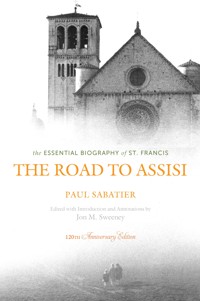
the ESSENTIAL BIOGRAPHY of ST. FRANCIS
THE ROAD TO ASSISI
PAUL SABATIER
Edited with Introduction and Annotations by
Jon M. Sweeney
120THAnniversary Edition
2014 First Printing This Edition2004 First Paperback Printing2003 First Hardcover Printing
The Road to Assisi: The Essential Biography of St. Francis 120th Anniversary Edition
© 2014, 2007 by Jon M. Sweeney
ISBN: 978-1-61261-463-2
Scripture quotations are taken from the New Revised Standard Version of the Bible, copyright 1989, Division of Christian Education of the National Council of the Churches of Christ in the U.S.A. All rights reserved. Used by permission.
The Paraclete Press name and logo (dove on cross) is a trademark of Paraclete Press, Inc.
The Library of Congress has catalogued the first edition of this book as follows: Sabatier, Paul, 1858–1928.
The road to Assisi : the essential biography of St. Francis / by Paul Sabatier ; edited with introduction and annotations by Jon M. Sweeney.
p. cm.
ISBN 1-55725-401-x
1. Francis, of Assisi, Saint, 1182-1226. 2. Christian saints—Italy—Biography.I. Sweeney, Jon M., 1967 – II. Title.
BX4700.F6S19 2003
271′ .302—dc21
2003002011
10 9 8 7 6 5 4 3 2 1
All rights reserved. No portion of this book may be reproduced, stored in an electronic retrieval system, or transmitted in any form or by any means—electronic, mechanical, photocopy, recording, or any other—except for brief quotations in printed reviews, without the prior permission of the publisher.
Published by Paraclete PressBrewster, Massachusettswww.paracletepress.com
Printed in the United States of America.
For Sarah-Maria and Joseph,the spirit of St. Francis.
—J.M.S.
CONTENTS
Preface to the 120th Anniversary Edition
Introduction
The Annotated Life of St. Francis of Assisi
1. His Youth and Family
2. Stages of Conversion (Spring 1204–Spring 1206)
3. The Church About 1209—Part One
4. The Church About 1209—Part Two
5. Struggles and Triumph (Spring 1206–February 24, 1209)
6. First Year of Apostolate (Spring 1209–Summer 1210)
7. St. Francis and Innocent III (Summer 1210)
8. Rivo-Torto (1210–1211)
9. Portiuncula, Early Companions, and Their Work (1211)
10. Brother Francis and Sister Clare
11. Francis’s Love for All Creatures (Autumn 1212–Summer 1215)
12. His Inner Life and Wonder-Working
13. The Chapter-General of 1217 and the Influence of Ugolino
14. St. Dominic and St. Francis
15. The Egyptian Mission: Preaching to the Sultan (Summer 1218–Autumn 1220)
16. Crisis in the Order (Autumn 1220)
17. Francis’s Doubts and Weaknesses
18. The Brothers Minor and Learning (1222–1223)
19. The Stigmata (1224)
20. The Canticle of the Sun (Autumn 1224–Autumn 1225)
21. His Last Year (September 1225–End of September 1226)
22. Francis’s Will and Death (End of September–October 3, 1226)
Four Tales fromTHE LITTLE FLOWERS OF ST. FRANCIS
1. The Source of Joy, or, Francis and Leo Walking in the Freezing Rain
2. Francis Saves and Nurtures the Turtle-Doves
3. How Francis Delivered a Brother from the Hold of the Devil
4. When Francis and Rufino Preached in Their Breeches to the People of Assisi
A Few Notes about the Editing of Sabatier
Glossary of Terms
Summaries of Major Characters
Sources/Recommended Reading
Index
PREFACE TO THE120TH ANNIVERSARY EDITION
You don’t have to read this preface in order to appreciate Paul Sabatier’s biography of Francis of Assisi. That is the beauty of this book—it stands on its own 120 years after it was first published.
But for those who are interested, Sabatier was one of the bestselling writers of history of his generation, as well as the father of modern Franciscan studies. With the first publication of this biography in French in 1894, the Protestant pastor-turned-independent scholar became the spark and founder of a global renaissance of interest in the Little Poor Man. What we see today as a vast industry of debate, books, conferences, and centers of inquiry focusing on discovering the “real” Francis, began with Sabatier.
Not that everyone approved of his biography. The Vatican placed it promptly on the Index Librorum Prohibitorum. There were two reasons that a work might be placed on The Index: one was a fear that it would foster immorality in its readers; this could never have been said of Sabatier. The other was the belief that it contained theological errors; this was the case made by the Vatican. How could a Protestant pastor presume to write the history of a Catholic friar and saint? This placed Sabatier in the good company of other thinkers and writers so accused, such as Johannes Kepler, Immanuel Kant, Blaise Pascal, and John Milton. The Index was formally and finally abolished by Pope Paul VI in 1966.
Despite the negative attention—or because of it—Catholics read this biography from the beginning in large numbers. Sabatier’s Life of St. Francis of Assisi was not only a bestseller, but its author was nominated for a Nobel Prize for Literature. The book was translated into a variety of languages, including Russian, supervised and funded by Leo Tolstoy himself. Hundreds of books by other writers followed in the two decades after Sabatier’s was published, in every major European language, including some making bold claims of new research and discoveries (including Sabatier himself). The hubbub culminated in 1926 with robust celebrations and commemorations of the septcentennial of Saint Francis’s death. Sabatier himself would die two years later, in 1928.
To this day, scholarly debate continues about Sabatier and the image of Francis he portrayed. Historians will continue to debate the finer points, but no one can argue with the draw of this compelling life of Francis.1 In fact, we are soon approaching the next centennial notch on the Franciscan calendar and will be celebrating the 800th anniversary of the Poverello’s journey to heaven in little more than a decade. I am looking forward to it. Sabatier’s name will continue to resurface in those days. He is the grandfather of all of us with a passionate interest in what happened in Umbria that changed the world long ago.
In the original (2003) Introduction to this work, I mentioned the influence of the French historian Ernest Renan upon Paul Sabatier (see pages xviii-xix, below). It was the modernist Renan, whose own bestseller The Life of Jesus (1863) caused a sensation and brought historical Jesus research into mainstream culture, who first urged the younger Sabatier to turn his sights upon Francis. In an anecdote that has often been repeated, several of Renan’s students were gathered around their master when the aging teacher told them of the projects for which he had the desire, but not the time, to pursue. Renan then instructed each of them to carry on a piece of his work. He pointed the young Paul Sabatier to Francis.
So it was that after several years in the pastorate Sabatier followed his passions for research, writing, and Italy to Umbria and began work in earnest. He visited archives and libraries that had never been scoured for original sources. He brought a modern sensibility to his understanding of those sources. The world was more than ready for a Francis to whom they could relate. They wanted to know the man behind the legends. This biography was first published when Sabatier was only thirty-six, at his expense.
Sabatier’s greatest contribution to our understanding was his rediscovery—and giving prominence to—pre-1266 sources for understanding Francis’s life. It was in 1266 that the Franciscans, at their general chapter meeting in Paris, ordered Franciscans everywhere to destroy writings about Francis that pre-dated their minister-general Bonaventure’s recently penned biography of him. I have written elsewhere about the negative consequences of this proclamation.2 It is no exaggeration to call it “an action that was, and still is, without precedent in the area of historiography.”3
The sources Sabatier rediscovered were chiefly the writings of Francis’s closest friends, including the friars Leo, Rufino, and Angelo, which were solicited at the general chapter meeting of 1244 when a call went out to all the friars to write down their memories of Francis. These intimate (and often opinionated) accounts were captured in The Legend of the Three Companions and The Mirror of Perfection, two texts that Sabatier used extensively to tell Francis’s story. He also raised the work of Thomas of Celano to a new level of appreciation, particularly his Second Life of Francis (1247), which also made extensive use of the testimonies of Leo, Rufino, and Angelo. Sabatier insisted that all of these accounts, as well as Thomas’s First Life of the Poverello, held a special place of importance, more than Bonaventure’s ever could, written as they were by men who knew Francis and shared his convictions.
Bonaventure wrote his account decades after many witnesses to the events were dead and gone, and in many ways he smoothed over the edges of the real Francis. Bonaventure did more than tell a story; he made it didactic. Reading Bonaventure’s biography is like taking the guided tour rather than feeling the energy and unpredictability of Francis and his early companions. In other words, Bonaventure and the Franciscans of 1266 were attempting to “control the narrative,” to use today’s parlance, and it took more than six centuries before a historian came to rescue Francis and history from the mistake. If it were not for Sabatier, Jacques Le Goff, one of the most prominent medievalists of the late twentieth century, would never have summarized: “Francis had in his immediate circle many biographers who not only had documentary information on him but were also concerned with painting him in the truth, simplicity and sincerity that always radiated naturally from him.”4
Every generation discovers Francis anew. There seems to be no end to what we find. And then, of course, today we live in a world that has finally seen a pope take the name, Francis. Why did it take so long—and by a Jesuit, even, not a Franciscan?
The world witnessed the first Franciscan pope centuries ago. After succeeding Bonaventure as minister-general of the Franciscan order in 1274, Girolamo Masci was elected pope in 1288, taking the name Nicholas IV, little more than half a century after Francis was recognized as a saint. Perhaps the shoes have always been too big to fill.
There was only one journalist who immediately and presciently grasped the situation as white smoke rose from the chimney of the Sistine Chapel on March 13, 2013. It was an Argentinian journalist, Sergio Rubin, who knew the man that had just been elected pope quite well. Rubin said:
So, it is the first time a pope has taken this name. That means he wants to give a message: the message of Saint Francis, a man who arrived to the Church in a great moment of opulence, bringing with him humility and love for the poor to revitalize the Church, to give some fresh air.5
And that was before Pope Francis ever emerged at the balcony to greet the crowd.
It may be too much to ask that one person revitalize the church that Christ founded and redirect it to the holy, simple intentions that were its original purpose. But as this biography of Francis of Assisi makes clear, Francis did just that in the early thirteenth century, sometimes in spite of his closest friends and followers, and almost without realizing it.
1 See for instance Jacques Dalarun’s The Misadventure of Francis of Assisi: Toward a Historical Use of the Franciscan Legends, trans. by Edward Hagman, OFM Cap; St. Bonaventure, NY: Franciscan Institute Publications, 2002; chapters 1–3; and Neslihan Senocak’s The Poor and the Perfect: The Rise of Learning in the Franciscan Order, 1209-1310; Ithaca: Cornell University Press, 2012; 8-16.
2 See chapter 13, “Burning Books,” in Francis and Clare: A True Story; Brewster, MA: Paraclete Press, 2014. (This book was originally published in 2007 under the title, Light in the Dark Ages.)
3 Jacques Dalarun, The Misadventure of Francis of Assisi; 25.
4 Jacques Le Goff, Saint Francis of Assisi, trans. by Christine Rhone; New York: Routledge, 2004; 13.
5 Quoted in Pope Francis: The Pope from the End of the Earth, by Thomas J. Craughwell. Charlotte, NC: Saint Benedict Press, 2013; 25.
INTRODUCTION
Paul Sabatier (1858–1928) was the first modern biographer of St. Francis of Assisi. A French Protestant, Sabatier was motivated to write about the saint out of love for his unusual and creative life.
It can be a very personal and moving experience to write about the little poor man from Umbria. Over the centuries, many authors have been profoundly affected as they have “lived” with Francis while recounting his life. Nikos Kazantzakis, the twentieth-century Greek novelist, said that, while writing his novel Saint Francis, “often large teardrops smeared the manuscript.”
It is not simply that Francis’s ideals are worth recounting, but that his life was so extraordinary. He was fully human—like each of us in our awkwardness, insecurities, and fear—but he was also perhaps the purest example we have seen of a person striving to do what Jesus taught his disciples.
To write about Francis is to wish the same courage and heart into ourselves. This wishing—these good intentions—are often the stuff of our spiritual lives, as perhaps when we touch an icon, or wake up early before the rest of the house is awake to pray in solitude, or when we truly hunger for righteousness, as many of our liturgies say. Reading and writing about Francis can be our attempt, like a medium or sacrament, to enlarge our own capacities to be like him.
Paul Sabatier was born in the Cevennes, a mountainous region of southern France, in August 1858. He was educated in theology in Paris and after preparing for the ministry became pastor of St. Nicolas, Strasbourg, a post he held until he was almost forty. After a brief sojourn as pastor of St. Cierge back in the Cevennes he then devoted the rest of his life to historical writing and research. His book, Vie de S. François d’Assise, was first published in French in 1894. Thirty-two years later, a scholar of Franciscan studies wrote: “Countless thousands of readers have derived from . . . Sabatier . . . their first impulse towards interest in the saint, which has frequently developed into a complete surrender to his fascination and charm” (SETON, p. 252).
Sabatier’s brother, the more famous of the two men, was old enough to be his father. Louis Auguste Sabatier (1839–1901) was a theologian and professor of dogmatics in the theology department at the University of Strasbourg and, later, was a member of the newly formed Protestant faculty in Paris. A Huguenot, Auguste found that his loyalty to French causes ultimately led to his being forced by the Germans to leave Strasbourg in the early 1870s. About fifteen years later, Paul Sabatier also fell out of favor with his German superiors, declining to become a German citizen, and left his pulpit in Strasbourg only to return in 1919 as a professor of church history. He dedicated his book on Francis to the people of Strasbourg. However, we might thank the Germans for forcing Sabatier into retirement from the active ministry (he was also plagued by health problems), leaving him the freedom and time to live in Italy, to do research, and to write his great biography.
Sabatier was moved by Francis, the man, and he wanted to create the first telling of his life that reflected the possibilities afforded by modern scholarship. He was the first person to scour the libraries of Italy to uncover original documents, and he employed textual and historical criticism as well as psychological insight. Modern scholarship, so-called, was new in Sabatier’s time, in the second half of the nineteenth century. As a student, Sabatier listened to the lectures of the dynamic historian and critic Ernest Renan (1823–1892). It was Renan’s groundbreaking—or notorious, depending on your perspective—work exposing naïveté in most precritical studies of the historical Jesus that motivated Sabatier to write his modern life of Francis, looking for the man amidst the layers of myth and legend. It was Renan who said: “No miracle has ever taken place under conditions that science can accept. Experience shows, without exception, that miracles occur only in times and in countries in which miracles are believed in, and in the presence of persons who are disposed to believe in them.” Renan’s book Vie de Jésus was published only thirty years before Sabatier’s life of Francis; comparisons between the two works were inevitable. “So the sensation of delight or anger with which [Sabatier’s] book was received is easy to explain” (BPL, p. 274).
These were the heady, early days of ultimate confidence in the power of science and logic to make faith unnecessary. But Sabatier did not follow Renan in discarding the reality of the mysterious. (Renan, for instance, explained Francis’s stigmata as a deliberate hoax perpetuated by Brother Elias.) He did, however, accept the basic notion that many things can be seen only with eyes of faith; many realities may be understood only with a heart disposed to realize them.
Sabatier believed that to deny all of the miraculous in the lives of the saints was to deny a life-transforming faith. In the introduction to the first edition of his life of Francis, he separated himself from Renan, his teacher, when he wrote the following:
Happily we are no longer in the time when historians thought they had done the right thing when they had reduced everything to its proper size, contenting themselves with denying or omitting everything in the life of the heroes of humanity that rises above the level of our everyday experiences.
No doubt Francis did not meet on the road to Siena three pure and gentle virgins come from heaven to greet him; the devil did not overturn rocks for the sake of terrifying him; but when we deny these visions and apparitions, we are victims of an error graver, perhaps, than that of those who affirm them (SABATIER, p. XXX).
Sabatier’s book was first published in French in 1894 (although early copies were distributed in the closing months of 1893), and quickly became a bestseller, almost unheard of for a work of its kind in those days. English, Swedish, German, and Italian editions followed within the next several years. When Sabatier died in the spring of 1928, forty-five editions had been published in the French language alone.
Scholarly reaction to the book was immediate and, most of it, favorable. Sabatier was quickly seen as one of his generation’s most important historians. Both Catholics and Protestants admired the work, but the official Roman Catholic response was to condemn it. Historical and textual criticism applied to the legends of the saints was not looked upon favorably at the close of the nineteenth century. The book made the infamous Roman “Index” (Index Librorum Prohibitorum) of forbidden books in the same year that it was first published.
Catholic authorities saw too much of a rebel in Sabatier’s portrait of Francis. Always careful to portray this—the greatest of saints of the people—as a supporter of the Church, its doctrine, and hierarchy, popes and other staunch protectors of the faith have often proclaimed: “How foolish they are, and how little they know the saint of Assisi, who for the purpose of their own errors invent a Francis—an incredible Francis—who is impatient of the authority of the Church. . . . Let [Francis], the herald of the great King, teach Catholics and others by his own example how close was his attachment to the hierarchy of the Church and to the doctrines of Christ” (Encyclical Letter of Pope Pius XI, written in 1926 for the 700th anniversary of the saint’s death; see SETON, p. 251).
Sabatier certainly shows us a Francis who is often going his own way. However, he is also careful to show both sides of the story, as when he wrote this passage: “One of Francis’s most frequent counsels bore upon the respect due to the clergy. He begged his disciples to show a very particular deference to the priests, and never to meet them without kissing their hands. He saw only too well that the brothers, having renounced everything, were in danger of being unjust or severe toward the rich and powerful of the earth” (SABATIER, pp. 168–69).
As is true of any great work, Sabatier’s life of Francis has given birth to hundreds of others, and also has enlightened his critics. Since the closing years of the nineteenth century there has been appreciation for Sabatier’s book, but plenty of criticism as well. Many Franciscan scholars have disagreed with some of his conclusions, primarily the subtle ways in which the French Protestant portrays Francis as a forerunner of the Protestant Reformation of the sixteenth century. Other scholarly reactions have ranged widely. For instance, while some reviewers have deplored Sabatier’s critical stance in reference to the Francis legends—thinking it wrong to view a medieval saint through a modern lens—others, including the popular medieval scholar and sometime critic of institutional religion G. G. Coulton, have taken Sabatier, his contemporary, to task for not being critical enough, for continuing to perpetuate credulity.
Sabatier’s Francis is a gentle mystic and passionate reformer guided by an unwavering vision of fulfilling the ideals of Christ: the brotherhood of all people, evangelical poverty, and forgiveness, all with a Christ-filled intoxicating joy. An anti-intellectual at heart, Sabatier’s Francis confounds the wise with his clarity of vision and dedicated praxis, and even occasionally by his holy foolishness. In Sabatier’s book, the simple beauty of Francis’s life and message is set clearly against the obscuring of that message in the years following the saint’s death. The narrative builds to, and reveals, this eventual sadness. Francis the prophet is set against the priests of his day, and even against many of the Franciscan brothers and priests that followed in his footsteps.
Contemporary theologian Lawrence Cunningham writes: “Sabatier’s mentor, Renan, once quipped that Jesus preached the Kingdom of God and the world ended up with the Catholic Church. Sabatier’s biography was a variation on this theme: Francis had preached a lay Christianity bent on radical spiritual renewal, and Europe ended up with the Franciscan order” (CUNNINGHAM 1, pp. 865–68).
Sabatier also portrays Francis as an important forerunner of the Italian Renaissance. The “birth of the individual,” long recognized as one of the key signposts of the Renaissance, is exemplified in the life of Francis. One Dutch scholar summarizes this, saying: “Perhaps Sabatier has contributed more than anyone to the shift in the nature and the dating of the concept of the Renaissance. It was no longer a growth of the mind . . . but a growth of the heart: the opening of the eyes and the soul to all the excellence of the world and the individual personality” (HUIZINGA, pp. 263–64).
Jacob Burckhardt, renowned historian of the Italian Renaissance, wrote a generation before Sabatier: “At the close of the thirteenth century Italy began to swarm with individuality; the ban laid upon human personality was dissolved; and a thousand figures meet us each in its own special shape and dress” (BURCKHARDT, p. 81). Burckhardt, however, does not in his secularism credit the revolution of spirit brought about by Francis with sparking a new individuality; for Burckhardt, the emergence of the individual in the early Renaissance period was the result, above all, of political change.
In his perspective on the life of Francis, Sabatier stood somewhere between the dry academics—Renan and Matthew Arnold, for instance, writing in the decades before Sabatier—and the absolutely devoted—Thomas of Celano, St. Bonaventure, and the other hagiographic and piously written “lives” of the saint. Since minutes after Francis’s death—when the canonization process began in earnest and Assisi was quickly established as one of the most important places for tourism and pilgrimage in all of Christendom—until the late nineteenth century, the life of Francis was clouded in myth. The Golden Legend, a popular late medieval collection of tales from the lives of the saints, for instance, records this about Francis: “The saint would not handle lanterns and lamps and candles because he did not want to dim their brightness with his hands.” Also: “A locust that nested in a fig tree next to his cell used to sing at all hours, until the man of God extended his hand and said: ‘My sister locust, come here to me!’ Obediently the locust came up and rested on his hand. ‘My sister locust, sing! Sing, and praise your Lord!’ The locust began to sing and did not hop away until the saint gave permission” (VORAGINE, p. 225).
Tellingly, Thomas of Celano, the first biographer of Francis, wrote in the prologue to his first life of the saint, “Pious devotion and truth will always be my guide and instructor” (ARMSTRONG, p. 180). Before Sabatier, historical evidence and hagiography were necessarily intertwined.
It is also important to realize, before reading Sabatier’s book, that he stood in a long line of speculative Protestant tradition rich with disdain, even sarcasm, for the lives of the saints. For example, one popular Protestant book of the seventeenth century recounts “miracle” after “miracle” of Francis and the Franciscans only to show their ultimate foolishness. One sample miracle account reads this way:
Frier Francis, in celebrating of mass, found a Spider in the Cup, which he would not cast away, but drank it off with the bloud, afterwards scratching his thigh, where he felt it itch, the Spider came out of his thigh without hurting the Frier.
And the interpretation reads this way:
Knave might have let this lie alone, for a Spider is not such poyson, as to deserve such a lie: For a cup of strong Wine without a Miracle is antidote enough against one (ALCORAN, pp. 59–60).
G. K. Chesterton, whose own book on Francis shows a deep level of personal understanding of his life, summarizes the many possible perspectives from which to write a modern life of St. Francis. Contrasting the viewpoints of the academics with those of the faithful, he writes: “A materialist may not care whether the inconsistencies are reconciled or not. A Catholic may not see any inconsistencies to reconcile.” In his book, Chesterton opts for a perspective that is “sympathetic but skeptical,” an approach similar to that of Sabatier.
Clearly, Sabatier loved his subject. But also as clearly, Sabatier was a thoroughly modern man who wanted to satisfy his own modern curiosities about miracles, influences, and conflict in Francis’s life. The result is an engaging and fascinating portrait. Whereas, as Chesterton says—“Renan and Matthew Arnold were content to follow Francis with their praises until they were stopped by their prejudices”—Sabatier follows our subject throughout his extraordinary life, in all of its perplexities. It is Sabatier’s passion for Francis that reassures us as we read his critical approach to the saint’s life.
Sabatier became the leader, after a decade or so of mixed reaction, of a renaissance of interest in Francis. He corresponded with hundreds of students, readers, and scholars in several languages. He spent his last years back in the Cevennes in a villa near Chabrillanoux. At Sabatier’s death in 1928, the Boston Public Library purchased his library from his widow. The 1931 volume of More Books: The Bulletin of the Boston Public Library announced the addition of the collection, summarizing the importance of Sabatier’s Life of St. Francis of Assisi:
Sabatier’s book brought back the reality of the “Little Poor Man” to multitudes. Once more, that strange figure in a small Italian town, who took upon himself to live the life of Christ and who succeeded in it better than any other person before or since, was before the public. Instead of the founder of a religious Order, Francis of Assisi became again “the jongleur of God”; a man who hated money and all other possessions, who prostrated himself before the meanest leper—who was so drunken with love and compassion for Christ that he could not distinguish his joy from his tears (BPL, p. 273).
No reader will understand the life of St. Francis without first understanding that religion—especially Francis’s very personal faith—is to be understood intimately. Again, to use a phrase from Chesterton (because he is so accurate in these matters), “it is only the most personal passion that provides here an approximate earthly parallel” to understanding the life of Francis.
The primary difficulty that remains for any reader about to encounter Francis for the first time is this: Was Francis real in the sense that his life can have any relationship to the meaning of my own? I hope, at least for my own sake, that the answer is increasingly “yes.” Francis’s spirit lives on in extraordinary people today. Standing as we do with the benefit of hindsight, the similarities between the little poor man from Assisi and other notable spiritual figures, such as Mahatma Gandhi, for instance, are many. Despite different religious underpinnings, we can almost see Francis when we see photographs of the sandled, loin-clothed Gandhi negotiating with the rulers of Europe. In other contexts, Francis has been compared to Dorothy Day, founder of the Catholic Worker movement in twentieth-century America, and Mother Teresa of Calcutta, just to name a few. We each have the capacity to be a saint like him; Francis certainly believed so.
I hope that this book will serve as an informational and engaging introduction to the life of St. Francis for the reader interested in his life for the first time. But more important, I hope that The Road to Assisi will be a vehicle for you, the reader, to engage personally with Francis, the human being. As Nikos Kazantzakis summarized the meaning of Francis’s life in the Prologue to his novel on the saint, each of us has “the obligation to transubstantiate the matter which God entrusted to us, and turn it into spirit.”
What keeps the life and message of St. Francis from moving us to action? What keeps it from moving me to action, to change my life to be more like him? These questions are similar to those of art historian James Elkins, in the preface to his engaging book Pictures & Tears. Elkins wants to understand why art does not more easily “move” us. Allow me to quote one long paragraph in conclusion, with the hope that the parallels will be obvious:
Our lack of intensity [in viewing paintings] is a fascinating problem. I’d like to understand why it seems normal to look at astonishing achievements made by unapproachably ambitious, luminously pious, strangely obsessed artists, and toss them off with a few wry comments. . . . What does it mean to say that you love paintings (and even spend your life living among them, as professionals do) and still feel so little? If paintings are so important—worth so much, reproduced, cherished, and visited so often—then isn’t it troubling that we can hardly make emotional contact with them? (ELKINS, p. IX)
THE ANNOTATED LIFE OF
ST. FRANCIS OF ASSISI
Italy, Central Europe, and The Holy Land ca. 1200 C.E.
CHAPTER ONE
His Youth and Family
Assisi is today very much what it was six or seven hundred years ago. The feudal castle is in ruins, but the aspect of the city is just the same. Its long-deserted streets, bordered by ancient houses, lie in terraces halfway up the steep hillside. Above it Mount Subasio proudly towers, at its feet lies outspread all the Umbrian plain from Perugia to Spoleto. The crowded houses clamber up the rocks like children a-tiptoe to see all that is to be seen; they succeed so well that every window gives the whole panorama set in its frame of rounded hills, from the summits of which castles and villages stand sharply out against a sky of incomparable purity.
He was born about 1182. The biographies have preserved to us few details about his parents. His father, Peter Bernardone, was a wealthy cloth-merchant. We know how different was the life of the merchants of that period from what it is today. A great portion of their time was spent in extensive journeys for the purchase of goods. Such tours were little short of expeditions. The roads being insecure, a strong escort was needed for the journey to those famous fairs where, for long weeks at a time, merchants from the most remote parts of Europe were gathered together.
Sabatier’s life of Francis was originally published in 1894. If written today, his first sentence would read: “Assisi is today very much what it was more than eight hundred years ago.”
The original Assisan castle was built around the time of Charlemagne, who first razed, and then rebuilt, Assisi. When Francis was a teenager, a horde of Assisans stormed the castle, associated as it was with despotic power (whoever invaded or ruled Assisi took possession of it), and destroyed most of it. One hundred and seventy years later, the new rocca was completed. The castle was once called Rocca d’Assisi, the fortress of Assisi, and today, Rocca Maggiore (“larger castle”).
Mount Subasio (4,230 ft.) gives foundation to the ancient city of Assisi. Most of the beautiful pink, grey, and white limestone of the Assisan buildings was originally quarried from Subasio. A national park sits atop Subasio today; tourists often climb to the top for the spectacular views.
Among all these merchants the richest were those who dealt in textile stuffs. They were literally the bankers of the time, and their heavy wagons were often laden with the sums levied by the popes in England or France. Bernardone often made these long journeys; he went even as far as France, and by this we must surely understand Northern France, and particularly Champagne, which was the seat of commercial exchange between Northern and Southern Europe.
He was not there at the very time of his son’s birth. The mother, presenting the child at the font of San Rufino, had him baptized by the name of John, but the father on his return chose to call him Francis. Perhaps, indeed, the name was only a sort of grateful homage tendered by the Assisan burgher to his noble clients beyond the Alps.
Merchants, indeed, played a considerable part in the religious movements of the thirteenth century. Their calling in some sense forced them to become colporters of ideas. What else could they do, on arriving in a country, but answer those who asked for news? And the news most eagerly looked for was religious news, for people’s minds were turned upon very different subjects than they are now. They accommodated themselves to the popular wish, observing, hearkening everywhere, keeping eyes and ears open, glad to find anything to tell, and little by little many of them became active propagandists of ideas concerning which at first they had been simply curious.
Not all of the medieval popes were located in Rome. From 1309 to 1377, the kings of England and France defied the Church in Rome and established a succession of seven popes who ruled from Avignon, in France. This was followed by “The Great Schism,” when, from 1378 to 1417, two, and during one period, three, popes ruled, supported by differing factions of the Church.
Champagne is not just a bubbly wine. (Although it was at the Abbey of Saint-Pierre, in the province of Champagne, that Dom Perignon, Benedictine monk, invented bottled champagne in the early 1700s.) Champagne became a part of France about 90 years after Francis’s death. As Sabatier mentions, for almost 200 years, beginning around 1150—or, at about the time of Peter Bernardone’s birth—Champagne was the international center of European trade. Not far from Paris to the west, or the German cities of Mainz and Cologne to the east, the province of Champagne in northeastern France also sat strategically on the main north-south trade route between Flanders, on the North Sea, and the cities in the north of Italy. Merchants would gather from all over Europe, guaranteed safe travel by the counts of Champagne, to trade with each other; these sessions would last for as long as two months at a stretch.
The importance of the part played by the merchants as they came and went, everywhere sowing the new ideas that they had gathered up in their travels, has not been put in a clear enough light. They were often, unconsciously and quite involuntarily, the carriers of ideas of all kinds, especially of heresy and rebellion. It was they who made the success of the Waldensians, the Albigensians, the Humiliati, and many other sects.
Thus Bernardone, without dreaming of such a thing, became the artisan of his son’s religious vocation. The tales that he brought home from his travels seemed at first, perhaps, not to have aroused the child’s attention, but they were like germs a long time buried, which suddenly, under a warm ray of sunlight, bring forth unlooked-for fruit.
The boy’s education was not carried very far; the school was in those days overshadowed by the church. The priests of San Giorgio were his teachers, and they taught him a little Latin. This language was spoken in Umbria until toward the middle of the thirteenth century; every one understood it and spoke it a little; it was still the language of sermons and of political deliberations.
He learned also to write, but with less success; all through his life we see him take up the pen only on rare occasions, and for but a few words. In general he dictated, signing his letters by a simple T, the symbol of the cross of Jesus.
The part of his education destined to have the most influence on his life was the French language, which he may have spoken in his family. It has been rightly said that to know two languages is to have two souls. In learning the language of France the boy felt his heart thrill to the melody of its youthful poetry, and his imagination was mysteriously stirred with dreams of imitating the exploits of the French cavaliers.
His father’s profession and the possibly noble origin of his mother raised him almost to the level of the titled families of the country. Money, which he spent with both hands, made him welcome among them. Pleased to enjoy themselves at his expense, the young nobles paid him a sort of court. As to Bernardone, he was too happy to see his son associating with them to be overly concerned as to the means. He was miserly, as the course of this story will show, but his pride and self-conceit exceeded his avarice.
Pica, his wife, a gentle and modest woman, about whom the biographers have always been too silent, would not despair of her son. When the neighbors told her of Francis’s escapades, she would calmly reply: “I am very sure that, if it pleases God, Francis will become a good Christian.” The words were natural enough from a mother’s lips, but later on they were held to have been truly prophetic.
The son of Bernardone not only patterned himself after the young men of his age, he made it a point of honor to exceed them. With eccentricities, buffooneries, pranks, and prodigalities, he ended by achieving a sort of celebrity. He was forever in the streets with his companions, compelling attention by his extravagant or fantastic attire. Even at night the joyous company kept up their merrymakings, causing the town to ring with their noisy songs.
At this very time the troubadours were roaming over the towns of northern Italy and bringing brilliant festivities and especially Courts of Love into vogue. If they worked upon the passions, they also appealed to feelings of courtesy and delicacy; it was this that saved Francis. In the midst of his excesses he was always refined and considerate, carefully abstaining from every base or indecent utterance.
Already his chief aspiration was to rise above the commonplace. Tortured with the desire for that which is far off and high, he had conceived a sort of passion for chivalry, and fancying that dissipation was one of the distinguishing features of nobility, he had thrown himself into it with all his soul.
But he who, at twenty, goes from pleasure to pleasure with the heart not absolutely closed to good, must now and then, at some turning of the road, become aware that there are hungry folk who could live a month on what he spends in a few hours on frivolity. Francis saw them, and with his impressionable nature for the moment forgot everything else. In thought he put himself in their place, and it sometimes happened that he gave them all the money he had about him and even his clothes.
One day he was busy with some customers in his father’s shop, when a man came in, begging for charity in the name of God. Losing his patience Francis sharply turned him away; but quickly reproaching himself for his harshness he thought, “What would I not




