


8,00 €
Mehr erfahren.
- Herausgeber: Infinity Books Ltd, Malta
- Kategorie: Sachliteratur, Reportagen, Biografien
- Sprache: Englisch
“It requires great skill on the writer’s part, to read a thriller knowing beforehand its end and yet move from page to page with expectation and suspense. This is what Fr. Marius Zerafa has succeeded in doing. It must be the freshness of the diary, the soul searching, the subtle approach to the personalities involved and above all, his sense of love for what is beautiful, through a cultivated patriotism, all linked up by a golden thread to what is eternal. Fr. Zerafa has made me relieve the tension and the relief of the St. Jerome saga. May I add that this book is a living statement to those, who, like Fr. Zerafa, without rhetoric have done so much for our country’s heritage.”
Prof. Guido de Marco
________________
In 1984, the St. Jerome, an autograph painting by Michelangelo Merisi da Caravaggio, was stolen from the magnificent Co-Cathedral of St John's. All efforts to trace this great work of art proved fruitless and, despite the involvement of Interpol and the police, the trail went cold for the following two years. Until, one evening, Fr. Zerafa, then Director of the Museum, was contacted by the thieves with the message: "We have the painting. We want money. Don't contact the police...or else…”
Fr. Marius J. Zerafa O.P, S.Th.L, & Lic. Dr.Se.Soc., B.A. Hons. (Lond.), A.R.Hist.S (Lond.) born Malta 1929. At 16 joined Dominican Order. Studied at Oxford, Rome, London, Paris and Florence.
Joined Malta Museums Dept in 1970 and became Director in 1981. Resigned at age 61, but still lecturing at University and other cultural centres.
At present Professor of Sacred Art at Angelicum University, Rome.
Das E-Book können Sie in Legimi-Apps oder einer beliebigen App lesen, die das folgende Format unterstützen:
Veröffentlichungsjahr: 2023
Ähnliche


















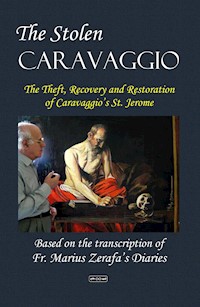
The Stolen
CARAVAGGIO
The Theft, Recovery and Restoration
of Caravaggio’s St. Jerome
Copyright © 2020 Fr. Marius Zerafa and Giuseppe Guarino
All rights reserved
ISBN 9789995794880
Published by Infinity Books Ltd – Malta
www.infinitybooksmalta.com
A Strange and Eventful Story
In 2004, in Malta, Grimand Co Ltd published the “Caravaggio Diaries.” A noteworthy book, which includes a large number of pictures that enrich a story told in a very captivating manner.
In the fall of this year I had the pleasure to meet Fr. Zerafa in Malta and, during a delicious lunch offered by Lydia (Dr Lydia Oukhaneva), our common friend, in her lovely restaurant in Marsa, I dared ask if he might be interested in publishing a new edition of his diaries. He said yes. He added that since then he has written two new chapters which he would like to add to the book to reveal facts that could not be told back in 2004.
The former publisher gave quickly and with no reserve his OK for the new project. We warmly thank him for his generosity.
It is a privilege for us to release this book on “The Stolen Caravaggio”. We hope that it will do justice to this “strange and eventful tale!”
Giuseppe Guarino
Gzira, Malta
18th October, 2019
The 2004 book published in Malta by Grimand Company Ltd in association with the Caravaggio Foundation
The author
FR. MARIUS J. ZERAFA
0.P, S.Th.L. & Lic., Dr.Sc.Soc, B.A. Hons. (Lond), A.R.Hist.S. (Lond).
Born in Vittoriosa, 13th October 1929, son of Joseph Zerafa M.B.E. and Maria nee Boffa, nephew of Sir Paul Boffa Kt., O.B.E, M.D. Prime Minister of Malta.
Father Marius joined the Dominican Order at the age of sixteen. Soon after that, he was sent to England and furthered his studies at ‘Blackfriars’ in Oxford, (1945-52). He then went to Rome (1952-54) where he obtained the S.Th.B. and Dip. Sc.Soc. He returned to Rome for another two years (1960-62) gaining his Lectorate ad Licentiate in Sacred Theology and a Doctorate in Social Sciences. Later he was awarded a Diploma in Art History from the Rome State University and a BA (Hons) degree in Art History from the University of London
He has followed courses at the Sorbonne and at the Ecole de Louvre Paris (1963 and 1966); at the University of Florence (1965 and 1968); at the Brera, Milan, and at the Fondazione Cini, Venice (1965), He is a member of the Accademia Tiberina, Rome has been awarded the French decoration "Chevalier dans l'Ordre des Arts et des Lettres' and is also an Associate of the Royal Historical Society, London – since then, he has been made an `Officer of the Order of Merit`, and `Cavaliere al merito della Repubblica italiana`.
Fr. Zerafa joined the Museums Department in 1970 as Assistant Curator of Fine Arts and was responsible for the setting up of Malta's National Museum of Fine Arts, Valletta, later becoming Director of Museums in Malta and Gozo. It was during this period that he was involved in the recovery of the painting, St. Jerome, by Caravaggio.
Fr. Zerafa has been invited to lecture at the Smithsonian, Washington, at Fordham University, New York, at Moscow State University, and, for two years, at St Michael`s University, Toronto.
He was Chairman of Government and other Committees and is still Chairman of the Archdiocesan Commission for Sacred Art. He is also a member of the Cultural Patrimony Commission and is chaplain to the Third Age University and the British Legion.
Fr. Zerafa retired from the Museums Department though he continues to lecture at the University of Malta, the Alliance Française and other cultural centres. He has taught at various schools and colleges and is at present Professor of Sacred Art at the University of St. Thomas, Rome.
Father has carried out restoration on Mattia Preti and other masters. His own paintings and sculptures are to be found in collections in Malta and abroad.
His writing includes articles on Social Doctrine and Art History and contributions to Art Encyclopaedias.
The Arts, reading and travelling are listed as some of Fr. Marius' favourite recreations and he is known to be happiest in the company of faithful friends and students whether on study tours, lectures or informal meetings at the cafés outside his priory.
It was Fr's invaluable advice while working on www.caravaggio.com and with the Caravaggio foundation that inspired the final publication of the story of the theft and recovery of the Caravaggio paintings.
Stolen Caravaggio
The Times - Tuesday, July 10, 1991
Sir, - Sometime ago I was irked by Fr. Marius Zerafa's comment "one day the whole story will come out" in his letter entitled "Stolen Caravaggio" (May 18).
Now I am all the more irked that neither Fr. Zerafa nor the Minister of Education and the Interior, nor for that matter the Director of Information enlighten an "intelligent" public to the true facts about the stolen Caravaggio.
Given the circumstances I feel it would be most correct to demand explanation from either Fr. Zerafa, or the Minister of Education, or, for that matter, the Director of Information.
Shall I stand to be entertained to be deluded once again by a conspicuous absence of a reply? I sincerely hope not!
Yours truly,
"STORY TELLER",
Sliema.
STQARRIJA FIL-PARLAMENT DWAR IS-SEJBIEN
TAL-PITTURA TAL-CARAVAGGIO
ONOR. EDWARD FENECH ADAMI - Prim Ministru
"Nixtieq nirringrazzja, b'mod partikolari, lid-Direttur tal-Muzewijiet Patri Marius Zerafa (Onor. Membri: Hear, hear) ghall-interess li ha u ghall-pacenzja kbira li mexa biha, il-prudenza u s-sehem shih li kellu biex illum l-investigazzjonijiet taw dan ir-rizultat posittiv..."
STATEMENT IN PARLIAMENT ON THE RECO-VERY OF CARAVAGGIO'S PAINTING
HON. EDWARD FENECH ADAMI - Prime Minister
I would particularly like to thank the Director of Museums, Fr Marius Zerafa (Hon Members: hear, hear), for his patience, interest and the competent manner in which he pursued this matter greatly contributing to this positive result.
The Diaries
1984 - 1999
December 1984
Thursday, 27th
_________________________________________________
The year 1984 is drawing to a close. After 25 happy years at the Dominican Priory in Valletta, I have just moved to the Jesus of Nazareth Priory in Sliema. It has not been an easy passage, but I have fought ‘the good fight’, things have run their course, my faith has kept me. Tonight I will sleep in my new room -still in a mess- but enjoying a lovely view over Marsamxett Harbour.
Saturday, 29th
_________________________________________________
Finished painting my new room this morning and then went to Valletta where I was awarded a trophy ‘Artist of the Year’ by the Art Association ‘Nghinu bl'Arti’. A wet dreary day. The Minister who had to preside arrived late - as usual.
After the presentation, I came back home hoping to have a good rest. This was not to be. At about 7 pm I received an urgent phone call from Mrs. Cutajar, [wife of Dominic, curator of the Museum of St. John's Co Cathedral]. She was obviously shaken - something terrible had happened - too terrible, it seemed, to repeat over the phone. The Cutajars live close to the Priory. I asked them to come over at once. Dominic was in very bad shape - all he could utter was “Hadulna 1-Caravaggio” (they have taken 'our' Caravaggio). I was afraid he would collapse. Somehow, I managed to calm him down. In broken sentences he told me what had happened. A tourist had come to the Museum to see the ‘St. Jerome’ but a chain stretched across the entrance to the room, with a label 'WORK IN PROGRESS', had barred her way. She went to Dominic's office to complain. Dominic knew very well that no work was going on at that time. As he went into the room where the painting was meant to be, he got the shock of his life.
The heavy frame had been lowered from its place on the wall and was lying on the floor. The canvas had been cut away from its stretcher. The painting was nowhere to be seen.
The tourist was visiting St. John's Museum on the last Saturday of 1984. As normally happens at this time of year, almost all of the guides were taking up their annual leave. On this day, only one custodian was available and he was downstairs at the desk. The thieves, evidently aware of this situation, took advantage of it, and made off with the painting.
This was the beginning of a seemingly unending saga, seriously punctuated with episodes of worry, agony and anger.
Interlude – Pictor celeberrimus
Caravaggio, or to give him his full name, Michelangelo Merisi da Caravaggio, hardly needs an introduction. In his own lifetime, he was referred to as pictor celeberrimus or pictor egregius. He had led an exciting life and his wild escapades had eventually led him to Malta where he had been received as a Knight. The Order of St. John wished to honour him 'as Apelles had been honoured in Greece'.
While on the Island, he painted two portraits of Grandmaster Alof de Wignacourt, a 'Sleeping Cupid', other portraits and sacred subjects including works that are in foreign museums or that are considered lost.
In Malta we are fortunate to have his masterpiece ‘The Beheading of St. John’ which he painted during his first year in the Order. It is the only painting he ever signed – f Michelang – ‘f’ denoting ‘fra’, (brother) probably to demonstrate that he had made it as a Knight of Malta.
This work of art adorned the Oratory of St. John's Co-Cathedral where Caravaggio had also been received into the Order. It would have served to remind the young knights that they were likely to die in defence of their faith. The defence of the Island against the Islamic Turks was one mission particularly assigned to the Christian Knights. (One of the figures in the group around the martyred St. John, the ‘jailer’ with a bunch of keys in his belt, has been described as being dressed as a Turk.) Later on, the painting would look down on the assembly of Knights gathered to expel this pictor egregius, ‘tamquam membrum foetidum et putridum’ (like a fetid and putrid limb) who had left the Island without permission after being imprisoned for yet another crime.
In the ‘Beheading...’, Caravaggio not only showed his particular technique - painting ‘alla prima’ (without prepara-tory drawings), on a canvas prepared in red and glazed in black – but also gave a most superb example of his, then novel, use of light. He employs this ‘luce di cantina’ effect (a source of light entering a dark room or cellar spotlighting the subject) to model his figure, compose his groups and give a sense of drama to the violent action taking place before our eyes. Quite often this lighting effect is illustrative of the light of grace.
Caravaggio’s monumental figures go about their given tasks while an old woman expresses horror at the drama taking place on stage. All action focuses on the figure of St. John – a victim (wearing the sacrificial lambskin) that Caravaggio could have identified with. The artist himself was under sentence of death. This too may, perhaps, explain why he signed his name in the blood oozing out of the neck of the saint.
‘The Beheading of St. John’, was described as the ‘quadro del secolo’ when it was restored in Rome in the 1950’s.
This great masterpiece can now be seen in its true splendour after its recent restoration in Florence in the late 1990’s.
‘The Beheading...’ has tended to overshadow yet another Caravaggio masterpiece – a smaller painting – the 'St. Jerome’. This is a beautiful pyramidal composition and a brilliant exercise in the study of light and in the fine rendering of the features of the saint. It is also a magnificent study of old age, meditation and sanctity. An old man is seated at a table that is cleverly used by the artist to create depth in the picture. A still life – a crucifix, candlestick, skull and stone completes the scene. Light falls upon an open book and a weathered hand draws one's attention up to a beautifully-modelled head. It was painted for a Knight and must have belonged to Ippolito Malaspina whose crest was inserted at the lower right hand corner of the painting. The Knight Malaspina left the ‘St. Jerome’, together with a number of other paintings, to St. John's Co-Cathedral.
The painting of ‘St. Jerome’ was hung in the Chapel of Italy within St. John's Co-Cathedral. It is probable that it was raised to a position above the passageway when Preti carried out structural alterations in the Cathedral.
The painting of ‘St. Jerome’, had remained in the chapel of Italy for years until the St. John's Museum was inaugurated, a worthy monument to its founder Mgr. Edward Coleiro. Mgr. Coleiro was a very good friend with whom I worked for many years – ever since we organised the cultural lectures at the Catholic Institute and held the first Biennale of Sacred Arts in St. John's that has been such a success. We often disagreed but I always had the highest respect for his honesty and for his energy.
Unfortunately a foreign expert had decided that the ‘St Jerome’ be moved from the Chapel of Italy and presented as an Omaggio (tribute) to St. John's Museum.
Malta had already been through a difficult period when, after its restoration in Rome, ‘The Beheading of St. John’ had been temporarily moved to the National Museum. Now once again, a religious painting was being moved from a church to a museum. Few seemed to mind but some did complain for a number of reasons.
The ‘St. Jerome’ was placed in a small room at the end of a long corridor, which was quite often left unattended. To make matters worse, the bright light coming in from the balcony opposite was most disturbing and the vertical opening of the doorway hardly did justice to the horizontal format of the picture. A jarring salmon pink curtain that hung behind Caravaggio's study of the saint, and the Prussian blue carpet that led up to this Baroque painting, did not improve matters at all. At one time, the curator had put up a glass screen to protect the painting but had been asked to remove it.
The minutes of a St. John's Committee meeting record my motion to inscribe a plaque stating that the ‘St. Jerome’ was on loan from St. John's Co-Cathedral. At a later date, the minutes should also include my offer to provide an iron grille to be placed at the entrance to the room where the painting was in. My first motion was acted upon but not the second. It was not that I ever suspected that the painting would be stolen but I was worried that it was not properly supervised and that it might be vandalized – until that terrible evening on the 29th of December in 1984 when Dominic came to the Priory to tell me that the painting had been stolen!
There was little one could do at the time.
December 1984
Saturday, 29th
_________________________________________________
I got Dominic to get into his little red car and drove at once to the Police Depot. Once there, we reported the theft and insisted that the airport and harbour be properly supervised to ensure that the painting would not leave the Island. We then drove to the Minister's house, but he was not in so we waited outside in the bitter cold till about midnight. As soon as the Minister arrived we gave him a full account of what had happened. The Minister promised to phone me at noon tomorrow. (He did not.)
Sunday, 30th
_________________________________________________
Sunday!
Dominic and I went to St John's Museum - re Caravaggio. The Archbishop came to the Museum. He wanted to see where the painting had been hanging at the time of the theft.
A Mosignor butts in saying, “…These things did not happen When I was in charge!” I shut him up.
Monday, 31st
_________________________________________________
Went to Police Headquarters again this evening. Gave further details... Took a member of the CID along with us to a friend who worked in the printing trade. We wanted to see whether placard, ‘WORK IN PROGRESS’ used in the theft would give us the any clues.
We discovered that such notices are quite easily available on the market.
And so 1984 has come to an end. The ‘St. Jerome’ has disappeared and there seems to be little hope that we will ever see it again.




