


15,59 €
Mehr erfahren.
- Herausgeber: McNidder and Grace
- Kategorie: Sachliteratur, Reportagen, Biografien
- Sprache: Englisch
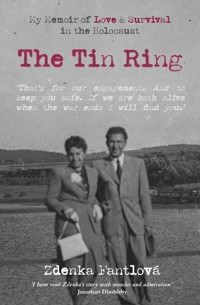
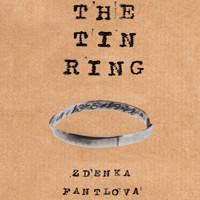
The Tin Ringis a moving memoir of love, loss and hope. This new edition has been published in celebration of Zdenka's 100th birthday. Zdenka's peaceful life was changed forever when she was sent to Terezin concentration camp. Here, she was given a humble engraved tin ring by her first love Arno. She survived six concentration camps, endured horrors the like of which most of us can't begin to comprehend, yet never lost the will to live. When Arno gave her the ring he said, 'That's for our engagement. And, to keep you safe. If we are both alive when the war ends I will find you.'The ring was the symbol of his love – a tin ring – that gave her the hope to endure unimaginable suffering and survive in the belief that they would one day be re-united. Zdenka protected this little tin ring with her life and with astonishing determination. Never falling into destructive self-pity, her compassion for other people, her sense of humour and the ability to take remarkable risks, are just part of Zdenka's indomitable spirit. Zdenka survived six concentration camps including Auschwitz, Gross Rosen, Mauthausen and Belsen – the worst of all. In the last chaotic days of the war in Belsen she crawled to a Red Cross post. There she was saved by an unknown British soldier to whom the book is dedicated.
Das E-Book können Sie in Legimi-Apps oder einer beliebigen App lesen, die das folgende Format unterstützen:
Seitenzahl: 382
Veröffentlichungsjahr: 2022
Ähnliche















Praise for The Tin Ring
‘Zdenka Fantalová is an extraordinary witness to the cultural outpouring that happened in Terezín (Theresienstadt) during WWII. She was the central interviewee in the BBC documentary, The Music of Terezín, which I directed and documents the extraordinary artistic creativity that took place there. But The Tin Ring reveals the rest of the story from an irrepressible spirit of those times.’Simon Broughton, director and producer
‘Zdenka’s ordeal ended in Bergen-Belsen, as, almost, did her life. Her will to live saved her, as did a piece of advice given to her father when he was arrested. “Just keep calm.” She did. It is a story that astonishes all who hear it.’Eileen Battersby, literary correspondent, The Irish Times
‘What an incredible story of one woman’s fight for survival against unimaginable horror. This is such a courageous book.’Susan Thomas
In a personal letter to Zdenka, Prime Minister Boris Johnson said: ‘I know you do this with no thought of praise or reward, but allow me to offer my own gratitude for so bravely keeping your story alive and educating people across the country about the atrocities of the Holocaust. Without survivors like you having the courage to tell their stories, we might never understand what you, and millions of others, experienced. Your strength of character and optimism are an example to us all.’Points of Light Award, 2020
‘It would be impossible not to be profoundly moved by the poignant and harrowing story of this now elderly woman. This truth serves as a repudiation of the visceral hatred and violence represented by Auschwitz, Treblinka, Bergen Belsen and all the other monstrous Nazi extermination centres. The Tin Ring takes us into Dante’s Hell but here is someone who has survived and emerged to give the lie to Hitler’s confident belief that he could act with impunity and never be held to account; someone who is able to speak for the countless mothers, sisters, wives, and lovers whose kith and kin were slaughtered; someone able to channel the suffering, pain, and their shocking loss into a defiant testimony. Zdenka’s story reminds us how great is the power of true humanity; the greatness of the power of love; the triumph of life over the ideology and culture of death. Here is a love story to rebuke the evil hate story of the Shoah.’David Alton, Lord Alton of Liverpool
‘I found this book inside the Manchester war museum and I’m glad I did, it’s a truthfully heartbreaking story that I’d not come across before. I encourage anyone/everyone to read this, in fact - I’ve lent this book out so many times I’ve now lost my copy!’Sarah Marie
‘Zdenka Fantlová and her story made a lasting impression. She survived six concentration camps, endured horrors the like of which most of us can’t begin to comprehend, yet never lost the will to live or her optimism for a better future. During her time in the camps she kept a little tin ring, made for her by her boyfriend. She risked her life to keep this humble object that meant so much to her.’Fiona Bruce, journalist and television presenter
‘The story of The Tin Ring is a testimony to the human spirit, the will to live and, above all, Zdenka Fantlová’s fight for survival. Zdenka protected this little tin ring and her life with astonishing determination. Never falling into destructive self-pity, her compassion for other people, her sense of humour and her ability to take remarkable risks are just part of Zdenka’s indomitable spirit.’Rapport Magazine, 2020
‘Zdenka’s writing made me feel so deeply connected. I don’t think there are words to express how moving and incredible her story is so I would just like to say thank you for giving people like me a tiny taste of understanding as to what people went through. It has definitely changed me and given me deeper empathy. No matter how hard our situation seems we can always rise above it and that we are capable of far more than we can ever imagine. I have also learned how important it is to always show respect and consideration to people as we can never imagine what they have experienced in their lives. Thank you so much for giving me this experience and I definitely recommend this book.’Carmen Dyer
‘Truly amazing and inspirational. Zdenka really is so incredible. Thank you so much for publishing such an extraordinary life story.’Peter Devonald, scriptwriter and producer
‘The life and fate of Zdenka Fantlová is unbelievable and yet that is what happened. Such was the world in a time of the deepest spiritual darkness in human history… I am full of admiration for her human greatness and nobility.’Milan Jungmann, Prague Literary Review
‘I have just read The Tin Ring which moved me to tears several times. The appalling horrors of the holocaust must never be allowed to fade. Words are inadequate to express my thanks to her for writing a book which portrays her courage and fortitude in the face of the most appalling circumstances. A book that is written without bitterness or rancour. A life-enhancing book which has made me realise how fortunate we are and the few things that really matter.’Berenice Roetheli, London
‘A story unlike no other survival story from the inconceivable horrors of life in Nazi concentration camps. A story which needs to be heard and shared. Utterly incredible, utterly inspiring, completely life-changing.’Becky Bye, Goodreads
‘Zdenka received a standing ovation of several minutes and then, she moved to a table where, for over an hour, she signed her books and talked to the schoolchildren and their teachers and parents, who were queuing round the hall to buy a copy of The Tin Ring.’Winchester Literary Society
‘An unforgettable memoir which deserves to be read for its unique story and for its shared message about the unrelenting human spirit.’Publisher’s Weekly
‘Zdenka Fantlova is a remarkable individual. She has somehow emerged from the horrors of both Auschwitz and Belsen with her spirit unquenched. The Tin Ring is a humbling and inspiring testament to that astonishing achievement.’Jonathan Dimbleby
THE TIN RING
MY MEMOIR OF LOVE AND SURVIVAL IN THE HOLOCAUST
Zdenka Fantlová
To an unknown member of the British Army, who, through his humanity, saved my life in Bergen-Belsen in April 1945
Recommendation
by Renos K Papadopoulos PhD Professor and Director of the Centre for Trauma, Asylum and Refugees, University of Essex, UK
This book is unique in many ways. Not only is it an autobiographical narrative of exceptional quality and sensitivity, not only does it relate events and experiences of an extraordinary life full of suffering, passion and resilience, not only does the author emerge as a most remarkable human being brimming with compassion, curiosity and zest for life but, above all, this book, in a most subtle way, is also highly original in its approach and this deserves to be acknowledged, appreciated, welcomed and applauded.
During a discussion, following the staging of an one-woman theatrical piece based on The Tin Ring, an eminent representative of a humanitarian organisation had the courage to voice a concern, characterising this book as ‘dangerous’. The essence of his concern was that the main emphasis of the book is on hope and love and, therefore, there is a danger that its readers underestimate both the inhumanity and horrors of the events narrated as well as the devastating and damaging effects these have on their victims. This concern is understandable and valid. Testimonies of unspeakable brutalities, such as those committed by Hitler’s Nazis, should convey in no ambiguous terms the clear message that these heinous acts should not be forgotten, that there should be no impunity for their perpetrators and that their destructive outcomes should always be remembered so that we endeavour to prevent their repetition.
However, what is of great importance is the manner in which the destructive effects on the victims is conveyed and the specific type of emphasis given. Usually, such accounts are based on an assumption of a seemingly logical equation that relates directly and causally the degree of brutality of the acts, to the degree of the damage inflicted on the victims: the more callous the events, the more serious the injuries (physical and psychological) suffered by the victims. Consequently, in order to condemn the viciousness of the perpetrators we tend to show how badly the victims have been scarred. Invariably, psychological dimensions of the traumatisation of the victims are advanced to underscore the gravity of the perpetrators’ destructiveness.
Zdenka Fantlová writes with simplicity and directness, she conveys the pain and suffering she has endured in its raw nature, without sentimentality or exaggeration and yet, at the same time, she emerges not as a victim to be pitied, not as a broken person who has been reduced to an invalid as a result of her endless ordeals but as a person with intact human dignity and, if anything, even becoming stronger having survived these unthinkable horrors. Through the pages of this book, the reader witnesses unmistakably that the author, incredulous as it may be, succeeds in retaining a unique and admirable ability to reflect on her life and tribulations even while in the midst of the most unbearable losses, deprivation and humiliation. At no time does the reader sense that Zdenka abandons herself to becoming a mere victim of the cruel circumstances that her life brought her, to reacting impulsively to her immeasurable pain and anger; instead, she succeeds in preserving an inconceivable love for life and an unshakable belief in her own survival. She even writes explicitly that, whilst experiencing all the victimisation, she felt that she had a choice between accepting the identity of a victim and not accepting it.
This is truly astonishing and it is this that constitutes the main unique feature of this book. Books of this genre tend to emphasise either the severity of the damage inflicted on the victims or the heroism and resilience of the survivors. The complexity of this book consists in the inclusion of both whilst, at the same time, the clear message that emerges (and not trumpeted about in the book) is about the strength of the human spirit that can endure and survive even the most adverse possible conditions.
Such emphasis can, indeed, appear as ‘dangerous’ to all those whose job is to mobilise support for victims. To put it crudely, people are not likely to give money to support persons who survived adversity and are now faring well. People tend to support appeals that depict broken victims in desperate need for assistance. Images of starving children, severely injured persons, mourning mothers of killed children, destroyed homes and neighbourhood, miserable conditions of makeshift temporary shelters, all these touch people’s hearts and make them donate to humanitarian causes.
Thus, this book, whilst being a personal narrative of an amazingly rich and excruciatingly painful life, it problematizes us and urges us to consider the complexity of such events and experiences. Without minimising the horrors, it is not dominated by them, without diminishing the enormity of the pain, it is not driven by it.
Another unique feature of this book, that needs to be highlighted, is the fact that it is written many years after the time of the events recounted. Given that it is now nearing seventy years since the end of the World War II, it is very likely that this may be the last book written by an actual survivor. However, what is more important to discern is that the great majority of the holocaust books are written by survivors who use their testimonies to create a space for them to reflect on what happened to them and to construct their new identity as survivors, in other words, their own writing is used almost for their own therapeutic purposes.
There is nothing wrong with this. However, this is not the case with Zdenka Fantlová. Because of her remarkable stance throughout her ordeal as well as the years that have passed since the events had occurred, this book is not a draft attempt used to formulate her ideas and emotions but the ripe product of a mature reflection that has been forged over the years of self-examination. In this sense, this book is also unique.
Above all, this book is an extremely rare testimony of defiance against brutalisation and humiliation, it is a humble expression of the power of endurance and love, it is written with sincerity and sensitivity and it is a book that makes us think and question life and human relationships in surprisingly refreshing ways.
Foreword
A suitcase – a simple suitcase with a name and a number scrawled on it. Neil Molloy stared at it. It seemed to stand out from all the hundreds of others piled high in the Holocaust Museum in Auschwitz concentration camp. Maybe it was the smell of old leather, the dust, the enormity of the significance of this huge pile of suitcases that prompted him to take a photograph of it. Neil is a sculptor in the University town of Durham. On his return home, he looked at the photograph and decided to make a stone copy of that suitcase. When it was finished, he carved the name and the number – just as it was on the original – Zdenka Fantl – S716.
Henry Dyson, Keeper of Fine Arts at the University of Durham was told about the suitcase and went to see it in Neil’s studio. The simplicity and the starkness of its message moved him greatly. Henry decided that this solitary stone suitcase should be the centrepiece of a Holocaust Memorial. So he commissioned Neil to add a bag of clothes, a book, a shoe, an abandoned umbrella, scattered at random on the grass in the garden of St Aidan’s College. This simple, uncluttered memorial serves to remind the generations of students of what happened in the Holocaust and, we hope, it will inspire them to make sure that it never happens again.
Zdenka’s suitcase has become an emblem – a symbol of strength of will and determination to survive against all odds. It is unique, and yet it is one of millions. All old now; all bearing the name of the owner. One of thousands of suitcases now stacked in Holocaust museums all over the world; an emotive reminder of genocide; the destruction of human beings – not only Jews, but homosexuals who had to wear a pink triangle; gypsies; disabled people; Jehovah’s Witnesses – anyone deemed unfit to be a member of Hitler’s master race.
A suitcase! Isn’t it strange how a suitcase – a transient, frail receptacle, can become the guardian of memories? A veritable museum of historical treasures; a custodian of art and music. Without that suitcase, I would never have recorded her wonderful little book, The Tin Ring, for the blind. Without that suitcase, I would never have known its author, Zdenka Fantlová; I would not have written to her, met her, and come to love and admire her.
Without that suitcase, I would not have the privilege and honour of calling her my friend. How did it happen?
I first saw the stone suitcase when I stood in a group on the grass at St Aidan’s College in Durham on Sunday, October 12th 2014. Representatives of the University, the faculty, the students, Christians, Muslims, Jews, clergy of all faiths, all watched in silence as the Jewish Prayer for the Dead was read. It was deeply moving. Yet one important person was missing. The owner of that suitcase, Zdenka Fantlová, the author of The Tin Ring.
On a flight to Switzerland, Zdenka had seriously injured her arm, which necessitated immediate surgery. She was not well enough to come to Durham for the Dedication Ceremony. Although I did not know her, I keenly felt her absence and decided to write to her and describe the event to her. A few weeks later, she telephoned me.
“Were you pleased with the stone replica of your suitcase?” I asked. “I haven’t seen it!” she replied.
Horrified, I realised that no one had thought to send her a photograph of the memorial. I quickly printed copies and sent them by special delivery as I knew she was leaving for Prague that week. On her return, she contacted me again, we met and there began a deep and lasting friendship.
Now it is 2022 and Zdenka is celebrating her 100th birthday. The past few years have been overshadowed by the pandemic. Like so many elderly folk, she has lived without the frequent visits of friends and admirers. It has not been easy for her. In the pre-Covid years, I have watched her talk to young people, inviting them to her home, telling them her story and urging them to make sure they tell their friends and their children what happened to her, how she survived but was left alone in the world as none of her relatives had survived. She always urged her young readers to make sure the horrors of the Holocaust “would never happen again.”
Zdenka Fantlová is indomitable – an inspiration to us all.
If ever you are going through a stressful time, please read and digest the words she often writes when autographing The Tin Ring.
“Life is wonderful with all its ups and downs. Every day is a gift.”
Ann Rachlin MBE, March 2022
Preface
When I came back to my home town after fifty years’ absence, three of my former schoolmates asked me the same question: “What on earth happened to you and your family after the Germans took you off to the concentration camp in January 1942? What was your day-to-day life like, and how is it that you are the only one of your family to have survived – in fact, the only one of all those they took from this town?”
This set me thinking. If people of my own generation, even my closest friends, knew nothing of the life we led between 1942 and 1945, what notion of it could the younger generation have?
Those of us who actually survived the German extermination camps are the sole eye-witnesses of that era. There are not many of us still alive. And when the last of us dies we will take all our experiences to the grave with us. No one will ever be able to read about them or judge what it was like for us or what we thought about our world. Each of us endured and survived it in different ways.
Our memories form part, though only a small part, of the whole historic truth. I decided to attempt a portrayal of those events in which I became enmeshed as a seventeen-year-old girl.
Contents
Introduction
Travelling with an invisible map
The train from Prague stopped at the station in a provincial town. Several people got out, hurried across the platform, melted through a subway into the surrounding streets and sped homewards.
Among them was an elderly woman in an autumn suit, hatless and carrying only a shoulder bag. She had no luggage. She made her way slowly through the booking hall like someone who is in no hurry. There was no one to meet her, but she had not expected anyone. Coming out she took in the autumn air before stopping short at the wide steps that led down to the street. She cast her eyes around uncertainly, as if she had arrived here for the first time. Perhaps she was even a little nervous about going any further.
At the bottom of the steps stood a young lad leaning on his bicycle. He watched her for a moment and decided that the woman had no idea where she was or where she wanted to go. With a mixture of curiosity and goodwill he asked:
“Are you looking for somebody?”
She reacted slowly, as if woken from a dream. “Yes, I am.”
“Do you know where they live?” “I do,” she answered quietly.
“And do you know the way? If not, I can take you there.”
“Thank you. You’re very kind but I can find my own way,” she said with a smile. Seeing he was not wanted, the boy got on his bike and rode off. The woman walked down a few steps and stopped again.
Here on the left there used to be an institute for the blind, she thought, searching her memory like someone snatching at a dream-vision glimpsed in the ragged web of morning slumber. There had once been a lawn in front of the building, she recalled, with sandy paths and a wire fence all around. Next to the fence there always stood a blind man wearing the institute’s uniform and playing a harmonica. A sad, slow, invariable tune. He must have liked it. He seemed to be playing for his own pleasure.
But the blind man had vanished long ago. So had the lawn with its paths, and the institute itself.
Finally she walked down the rest of the steps and made her way into town. She knew the route exactly, as if following an invisible map. At times she felt she was returning from an afterlife. Everything was so familiar to her, each street, each stone, as if she were an old dog sniffing its way. She might have been invisible herself, for all the notice people took of her. At every step the scene was exactly as in the old days – and yet quite different. She passed a cemetery where they sold candles and asters on All Souls’ Day. An inscription over the entrance had reminded visitors that the world was not their home forever:
What you are now, so once were we.
What we are now, you too will be.
She walked through a narrow gate leading into what had once been the medieval walled town. Beyond the gate stood an inn. Na Strelnici: “Hunter’s Inn”, with its own theatre, where a travelling company played when it came to town.
She remembered how during the day the actors would take their posters around and sell tickets from house-to-house for the evening show. They were like visitors from another world. It was always a great event when the players were in town. The auditorium was filled with wooden benches, yet there was never an empty seat. Even children were allowed in, if accompanied by a grown-up. All the old popular plays were in the repertoire: The Miller and His Child, Lucerna, The Fire-Raiser’s Daughter, A Night in Karlštejn Castle, and so forth.
As long as the curtain was down there was a continual bustle, but as soon as it rose and the lights went out a mysterious world of unpredictable events emerged, holding all spellbound. From the stage there drifted a smell of glue, make-up, old costumes, wigs and all the other theatrical aromas combined. In its centre stood a large brown prompter’s box. This was hard to see around, and you could hear each sentence of the play from inside before the actors even opened their mouths. But this bothered nobody; the magic of the performance was undiminished.
It was only a stone’s throw from the theatre to the main square, the very centre of the world. People strolled there on evenings, and on Sundays, past the church, town hall, stores, savings bank, the Bata shoe shop and the florist’s shop, U Holubu, that smelled like a perfumery.
Next door to the florist’s shop stood Mr Jirsák’s drapery store, where one used to get snippets of material for pasting onto puppets and making dolls’ clothes.
One reminiscence set off another in the old woman’s mind, like a ball of thread unravelling.
At the Štadlers’ corner shop Mrs Mansfeldová sold not only sweets but tickets for the Lidobio, “People’s Cinema”. Children could sneak in secretly, wearing Mother’s hat, to see adults-only films like The Bengal Lancers and Grand Hotel, or a Charlie Chaplin film.
The woman stopped in front of a new self-service store. It was not there before. In her mind’s eye she saw a different picture. Here was where Miss Kamenná, known as Kamenka, had a little shop that sold balls of embroidering wool and cheap oddments for handiwork. And hoops, with sticks to drive them. On the other side was Mr jakobe’s shop that smelled of leather satchels and new school bags.
Next to him was Mr Flajšhans, with his textiles and haberdashery. He always stood in front of his shop, intoning in an old Czech dialect:
“Don’t go down to the river, it’s deep there, mighty deep!”
Directly opposite was the apothecary, “At the Sign of the White Stork”. This shop smelled like a hospital. One came here to collect medicine whenever someone was ill. Behind the counter was a long row of china jars with labels in Latin. The chemist in his white coat would make up the prescribed mixture, weighing out the ingredients on tiny apothecary’s scales. Next door was the grocery where one could buy, the notice proclaimed, both homemade and imported goods. The proprietor had a cage in his back yard where he kept fox cubs. Poor things, they must have gone crazy, locked up like that. He always tried to entice her in to “see his puppies”. But she wouldn’t be enticed. What she would have really liked was a bag of peanuts, but he never offered her those. So she only went to the grocer’s when she had to, to buy extra fine (“thrice-ground”) poppy seed for the kitchen.
Next door, Stancl the confectioner had the world’s best sweetmeats. One often bought them for after Sunday dinner. And what “afters” they were! Chocolate cream puffs, rum cake, cream tart, whipped cream rolls, marzipan potatoes with chocolate filling and all kinds of things. Ice-cream was scooped up from a china pot with a big wooden spoon. What ice-cream it was!
On the corner was Mr Tajbl’s drugstore. Two huge jars of jellies stood on the counter. One lot white, and one pink. Sometimes he would spare a few for the children.
Opposite him, in a narrow street alongside the town wall, had been a dark little shop where one had to walk up two stone steps and pull a bell string at the door. There, as a child, she used to buy her fortune in a magic envelope for one Czech crown, and quivered to see what the card would foretell. At the next corner was an inn and a pork butcher’s shop, where, at five o’clock each afternoon, was sold the best meatloaf ever. It was brought to the counter on a silver tray, smoking and smelling heavenly. A portion wrapped in paper just had to be tried as soon as you were outside the shop.
There was an open market every Friday on the square. Farmers’ wives came from all around to sell their butter, blueberries, mushrooms, geese, ducks, hens and pigeons. They spread their wares out on sacking over the cobblestones, a different row for each. A row of butter, another row of blueberries, and so on. The butter came in two-pound lumps, with a pattern cut on the top, all wrapped in huge green leaves. Blueberries were measured out from baskets by the litre with long-handled tin scoops and poured into the customer’s pot.
Her mother used to have her own little knife for tasting the butter. She went up the line sticking it into each block, shutting her eyes and passing judgement.
“No, not this one. Let’s try the next.”
Only after trying several samples would she make her purchase. The old woman remembered that as a little girl she was dreadfully embarrassed and ashamed of her mother. She hated market days. Anca, the servant girl, had to come along to carry the shopping home in string bags.
The biggest excitement was the monthly fair on the square. There were dozens of stands set up, one selling bags of Turkish delight, another roasted almonds. There was always a stand with a parrot pulling horoscope cards out of a box so that people could buy them and see what fate had in store for them. Earthenware pots and pans for dolls’ houses were laid out on sacking in another spot. Next to those was a stand full of coloured balloons. But the biggest draw of all was the wizened old blindfolded sorceress, Klamprdonka. She sat on a high chair in her bright skirt and black shawl, answering the questions her master put to her.
“Tell us, Klamprdonka, what has this gentleman got in the left pocket of his jacket?”
And she always knew. It was real magic and everybody clapped.
A few blocks further on there was a big empty space called Na pátku, where the Kludský circus would put up its marquee festooned with coloured electric bulbs. There were elephants, lions whining wearily in the cage, and a ringmaster calling the crowds in:
“Come and see what you have never seen before, ladies and gentlemen! Trained lions, an elephant dancing on bottles, acrobats performing miracles on the tightrope! Not for three crowns, not for two crowns, but for just one single crown! Come along, come along, you won’t be disappointed!”
People poured in excitedly, scared stiff in case the acrobats fell off the high wire. There was a whiff of some alien world about the Na pátku ground. When the circus troupe left, the gypsies arrived. As a youngster, she had envied them their caravans and curtained windows, their life of wandering from place to place, and how the gypsy girls went around barefoot in long skirts with hair flying. That, she thought, was the real bohemian life.
If you went from the circus site along the old moat road you came to the great Sokol hall with its spacious sports ground. The gymnasium provided moral as well as physical exercise and even trained youngsters for the nationwide Sokol sports festivals at Strahov in Prague.
The Sokol hall was also the centre of the town’s culture and entertainment, and the setting for great occasions. The famous actor, Vojta Merten, came from Prague to give the children a great theatrical treat, a play entitled How Kašpárek – the traditional Czech boy-hero – Rescued the Princess from the Clutches of the Wicked Black Magician. As a little girl she had been terrified when she saw Kašpárek starting to climb through a window into the Magician’s chamber; she had sobbed aloud and run up to the stage to tell him not to go inside. Kašpárek interrupted the performance, came to the footlights, and reassured her that everything would turn out all right. When they got home afterwards her brother tattled on her and she was scolded for crying in public and holding up the show.
All kinds of social events took place in the Sokol hall. One day it would be an amateur theatrical performance. Another time, the great Jan Kubelík appeared as a guest artist, playing his violin. Sometimes they showed films, sometimes they held dancing classes or end-of-term balls. At Shrovetide there would be a masked ball and a firemen’s ball. And then all the national celebrations.
On 7 March there was a school festival for President Masaryk’s birthday. A male choir would sing “Glory to You, Our Nation’s Greatest Son!” For Independence Day, 28 October, the hall was decorated with the national colours and flags, two palm trees were set up on each side, under the platform, and the national anthem rang out. Everyone felt proud of his country and determined to lay down his life for it. On the day itself there was a great parade with Sokol members and World War I legionaries forming a long procession that marched proudly in time to a brass band. Red-blue-and-white flags flew from every roof and window.
Crowds lined the pavements where they passed and shouted the Sokol greeting “Zdar!”
Those were the great occasions, the important days. The year was full of them. From the Great Hall of the Sokol building you could cross into the Little Hall where puppet performances were held for the children every Sunday at two o’clock. Wooden benches were set out for the spectators and a red curtain decorated with golden tassels hid the stage. When the bell had rung three times, the lights went out and the curtain rose. Everyone opened their eyes wide and held their breath.
Sometimes the curtain rose on a rustic room where Hloupý Honza – “Simple Simon” – was setting out to explore the world with a sack of sweet buns on his back. Sometimes it revealed a village green where people were discussing how best to help Simon kill the dragon. Or it might be a dark corner of the woods, with danger lurking everywhere. The finest sight of all, a royal chamber with majestic thrones in red and gold on which the king and queen were sitting, wearing their crowns. Every Sunday it was a different tale. Kašpárek releasing the princess from the spell. Kašpárek killing the wicked dragon, or finding the stolen treasure. Kašpárek and the robbers. Kašpárek and Kalupinka. Kašpárek was the greatest hero in the world. No one was ever like him.
The old woman walked on a little further until she found herself in front of a new residential block. But what she saw in her mind was very different. This had been the garden known as Prajzler’s. Inside a wooden gate, there had been rows of vegetables growing – carrots, radishes, lettuce, kohlrabi, strawberries and everything imaginable. They were on sale in a little wooden shed on one side. In front of it was a huge water tub; Mrs Prajzlerová would pull out of the vegetable beds whatever was asked for, lettuce or radishes, and rinse them in the water. And one could take them home as fresh as fresh could be.
“Home”? Why, naturally. Home is forever. The firm ground beneath our feet; certainty and order, now and forever. The whole family together. There is no other way of life.
Or, is there?
She walked on through the streets, past homes and gardens which had long since vanished. What had replaced them were empty spaces, houses pulled down to make room for traffic and street-widening, a new circular road. The old stream that once flowed past, lined at Easter with catkin-covered pussy willows, had been filled in. New supermarkets, new notices, new people. Not a single familiar face. No one recognised her. At times she felt she had strayed into the wrong town. All that was left were the low hills on the horizon and the hazy blue woods around about. They alone had resisted time and progress. So she was right, after all. She reminded herself why she had come, and walked on to a point where three narrow streets used to meet.
On one corner used to be a fire station. On the opposite one, a tobacco booth. The third street led to the river. But everything had sunk into the abyss of time except for one building. “Our” home. Emerging suddenly from her memory was a large, turn-of-the-century three-storey house with a baroque balcony. All the neighbouring buildings on both sides had vanished. Now this one stood alone, like a silent witness of a different age, of long ago happenings. It seemed to have risen up from the very depths of her mind’s well, long overlaid with layers of five different lives spent in other lands, other epochs, amongst other folk.
It struck her how much this home of hers had aged. It was like meeting a close school friend years later and finding that the youngster was now old and greyhaired. She could only wonder at the apparition, from which plaster had fallen to reveal bare bricks. The windows were grey and dusty, as if time had made them sightless. The front steps were all broken, and cobwebs filled the doorway. She stood silently before it as we stand by an overgrown grave that holds the remains of someone we have loved.
She felt she had arrived here from far away, from beyond the boundaries of space and time. No one ever came out of this house now, no one ever went in. She alone stood here. A living person watching a dead building. The longer she stood and gazed, the more confused she was by the gulf between what she remembered and what she saw in front of her. The house symbolised something from a life long gone. What had happened here seemed almost five centuries removed. Time itself seemed unreal. Had we merely fluttered like blown leaves, landing at random? Did we feel at home only when we had firm ground underfoot and a loved one by our side?
She felt like someone waking from a dream, confused about who or where she was and needing to wait a little for the scattered pieces to settle down again in their right places.
At the back of the space where she stood she noticed a little pile of planks. The builders had evidently left them there for tomorrow’s work.
She sat down on them as, in years past, she might have settled on a tree trunk felled in the forest, and asked herself: “How did it all happen? Where were we, before we came here? Where did it all start?”
1
Grandfather
It really began with Grandfather, as the parish records of Cerhonice show.
Josef Mautner, originally of Blatná in southern Bohemia, makes his first appearance in Cerhonice in or after 1865 as proprietor of the taproom of the manorial brewery in the lord’s house. Later he also leased the manorial inn at No. 10 Cerhonice. He was a corn dealer, too.
According to tradition, he was on close terms with the Cerhonice Administrator, Father Hugo Zahnschirm. Father Hugo was a monk of the Premonstratensian order from Schlägl monastery in Upper Austria, to which Cerhonice had belonged from 1688 until 1920. In Cerhonice, the Administrator, as the Abbot’s deputy, represented the feudal authority.
Legend even has it that the pair of them, Mautner and the Administrator, used to sit conferring together on the two celebrated oval stones in front of the Cerhonice manor house.
Despite being a Jew, Mautner was not only the Administrator’s advisor in commercial matters, but brokered all the affairs and appeals of the manorial staff and the common folk of Cerhonice. What Mautner said was accepted.
He evidently did well in the village. As early as 15 March 1868 Josef Mautner and his wife, Rosalie, bought from Jan Toman, a cottager, one part of his garden opposite the castle near the Pruhony road. In exchange for it he gave Jan Toman nine roods of good arable land in the Pod Pruhony area. This became known as Jew’s Field.
On the plot he acquired Josef Mautner built a large brick house with several living rooms, a shop and a small reception hall. Next to it he put up a barn for six head of cattle and a number of sheds. A well was sunk in the courtyard.
The shop was approached from the village green by several sets of wide stone steps. As well as having a trading licence, Josef Mautner also obtained a licence to sell beer, so that from 1880 onwards there were virtually two inns in Cerhonice.
Mautner’s taproom was in fact part of the family home, with doors leading onto the hallway, the shop, the reception room and a small annex at the northwest corner of the building. The shop sold all manner of daily necessities. The reception hall, quite a spacious one, hosted dance evenings – musiky – up until World War II.
In 1890 Josef Mautner lost his first wife; his second, Josefa, became joint owner of No. 50. She bore him one daughter, Barbora, or Betty, on 21 March 1897. Betty grew up to be a beautiful girl with dark eyes and braids rolled up into two little buns over the ears, as was the fashion then.
Old Mautner died around 1910.
They were a good, caring Jewish family. In the little corner room Josef’s unmarried brother Jáchym had lain bed-ridden in pain for many years, paralysed by a stroke and tended by his sister-in-law.
The Mautners of Cerhonice came to a tragic end. From the beginning of World War I Josefa suffered fits of deep depression. During one bout, in the spring of 1916, she left the house early in the morning and ran to the Lomnice stream at Mirotice, more than three kilometres away, near the Karlov estate of the Schwarzenbergs. There she was found drowned in a deep pool.
So Betty was left entirely on her own. She was 18.
2
A fateful meeting
Arnošt Fantl was a fine young man with blonde hair and smiling blue eyes, who had just started an apprenticeship in brokering iron ore to steel factories and travelled around the area visiting customers.
One day, bound for Cerhonice on foot, he saw black clouds gathering in the sky. He was still in the fields when a great storm broke. Running through the rain, he could hardly see his way. At last he made it, soaked to the skin, into the first inn he could find in the village. Bursting through the door, he stood dumbfounded. For there behind the bar stood the lovely Betty, with her mass of brown hair, in a white blouse. Her black eyes rested on him for a moment. He stared back at this vision as if struck by lightning.
After he had had a meal and dried himself he knew he had to catch a train back home to Blatná. When the storm had passed, he persuaded Betty to accompany him to the station. She agreed, and as the train went off she stuck out her tongue at him. It was love at first sight and he knew that beautiful Betty was the only one for him.
He visited her whenever he had the time, and she fell deeply in love with him. Apart from being so fond of him, she was no longer on her own now and had someone she could entirely depend on.
In due course Arnošt helped Betty to sell the inn property, No. 50 Cerhonice, to one Anna Smolová of Malcice, with a few acres of land thrown in.
So ended the Mautner dynasty in Cerhonice. Betty moved to Blatná and very soon, in 1918, she married Arnošt. The wedding was at the Hotel Bristol in Prague. She looked wonderful in white, with a veil and a wreath on her head. The rabbi who conducted the wedding ceremony included these words of rare wisdom in his address:
“Happiness,” he said, “is something you will only find at home. You would be looking for it in vain anywhere else.”
But he hardly needed to tell them that. They were ardently in love and blissfully happy. They were my parents.
For their honeymoon they went to Vienna – the first time they had ever left the Cerhonice region. Vienna was all bustle, with its fine buildings, theatres, coaches, shop windows, music and culture. They were entranced.




