


17,99 €
Mehr erfahren.
- Herausgeber: ibidem
- Kategorie: Sachliteratur, Reportagen, Biografien
- Serie: Ukrainian Voices
- Sprache: Englisch
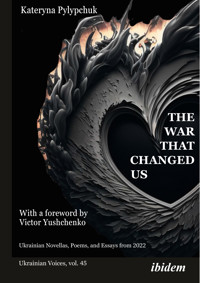
At 5:08 a.m. on February 24, 2022, Kateryna woke up in Kyiv to the sound of bombing. This marked the end of her world, work plans and ideas, travels … All that remained was to save herself and her children. The inevitable changes, which shook something deep and significant within her, became an impetus to write about what had caused her and all Ukrainians so much pain. She wrote, one after another, novellas, poems, and essays that reflect the story of the war during the first months of Russia’s full-scale invasion. This book contains words woven with emotions and experiences of ordinary people who have become heroes. The main goal of this collection is to help people all over the world better understand what each Ukrainian felt and how this war changed us all.
Das E-Book können Sie in Legimi-Apps oder einer beliebigen App lesen, die das folgende Format unterstützen:
Seitenzahl: 204
Veröffentlichungsjahr: 2023
Ähnliche


















ibidem Press, Stuttgart
Contents
Foreword
38 minutes
The day before it
Carpe diem
Multi-sensuality
The way back home
The Black Hole
Baby
The Heroes
Ivan Kupala Night
… Мааам …
Holodomor
The wreath
Galloping across Europe
The scouts
Carthage must be destroyed
The Ukrainian Warriors of Light
The window
Sophia
Forgetting
The hryvnia
Motanka
Lightning never strikes the same place twice
Letter from the other end of the Earth
Today they‘ve shot us with missiles
Island of Happiness
Guardian Angels
Solomiya and Francesco
If people could understand
Smile of the Gods
She who knows the place of war
Anhelinka
Jobs
Taiwan Soul
Thank you very much
Making Love with Words
A Second Chance
Clock of the war
About author and reviews
Foreword
For many in the Western world, Russia’s invasion of Ukraine in 2014 and then massive escalation in 2022 was unexpected. For Ukraine, it was just the latest in a centuries-long struggle against imperialist Russia’s unending desire to colonize Ukraine and destroy Ukrainian identity, language, culture, and history. But, in another surprise for the world, the Ukrainian army succeeded in not only defending Ukraine from all-out invasion, but also freeing territories that had been seized by Russia, and liberating people who had become hostages of Russia’s occupying forces. But the war tragically continues, with ever more russian conscкipts and mercenaries attacking every day, with frequent barrages of missile and drone strikes. We now see Ukraine’s armed forces defending the longest frontline since the Second World War—3,300 km of land border, and almost as long a sea border.
The war continues, and it cannot but affect each of us. It changes us. Despite Russia’s efforts to destroy Ukraine’s identity, the Ukrainian nation is becoming ever more consolidated, united, and determined to survive and flourish. We have never been so close to national unity as today. Every day our political and civil society leaders, journalist’s and cultural figures speak out, and the world is actually listening. Together, we are conveying a single message—Ukrainians are fighting not only for ourselves but for each of you—for your freedom and independence, for democracy, justice, and a rules-based world order.
Kateryna Pylypchuk’s collection of short stories and essays about ordinary Ukrainians—The War That Changed Us—is an attempt to reach out, to tell real, living stories of once ordinary, now heroic Ukrainian people facing extraordinary hardship. Kateryna is following a long and important tradition of Ukrainian writers and poets who also tried to break through barriers to tell of Ukraine’s struggle against Russian colonial oppression, of individual Ukrainians who have sacrificed to preserve their families and communities, their history, culture, and nation.
Our poet laureate and kobzar, Taras Shevchenko, wrote 170 years ago: “My beloved country is innocent, for which the Lord punishes you… He punishes you severely… For Bohdan and for the mad Peter.“ His argument even then was that Russia and the betrayal of its promises were the roots of Ukraine’s many misfortunes.
Seven decades later, another patriot, the President of the Ukrainian People’s Republic 1918–21, Simon Petliura, advised Ukrainians to stay “away from Moscow.“ He contended that “the biggest obstacle to the recognition of Ukraine’s sovereignty is the hypnosis of the name of russia. This hypnosis must be dispelled… The matter of the division of Russia must be raised as a matter of peace for the whole world, as a matter of European balance…"
During Ukraine’s struggle for its independence in the 1930s and 40s, Ukrainian freedom fighter Stepan Bandera said: “If another form of russian imperialism replaces Bolshevism tomorrow, it will also, first of all, turn to with all its might against the independence of Ukraine and its enslavement. The russian people will continue to carry that imperialism, will do everything to keep Ukraine enslaved…”
Then Vyacheslav Chornovil, a dissident of the 1960s to 1980s and one of the leaders of the Ukrainian popular movement Rukh, a great Ukrainian humanist, wrote: “Over Ukraine hangs the two-headed shadow of russian imperialism, which is just waiting for the final collapse of our society to launch its predatory claws into the living body of our people. May God grant us to love Ukraine more than anything today—so that we don’t have to love it bitterly after losing it…” “The time has come for a great choice: either unity and victory and the path to light, or defeat, shame and again a long road to freedom…”
The moral of this long historical Ukrainian saga is simple: if we, Ukrainians, cultivate a deep national consciousness in ourselves, which becomes the meaning of our identity and conscience, then we will truly speak with one voice, and be united and whole as a people and nation. This is the greatest and indeed the only guarantee of our eternal independence from our imperialist neighbor.
For us it is obvious that Russia has already lost its war against us, but, to be honest, it should be said that Ukraine has not yet won. We still have a long way to go. But, we are confident of our eventual victory, because we know the deep commitment of our army and our society cannot and will not be overcome. When ordinary Ukrainians give up everything to fight for their freedom and dignity, victory is the only option.
As you read our living history in the pages of this book, you will discover more about the traits of the Ukrainian people, their heroism and their hospitality, their exaltation of freedom and their creativity, their love for tradition and customs, and their dreams of a brighter future. We welcome you to these pages, and we welcome you to Ukraine.
Viktor Yushchenko
Kateryna Pylypchuk and Victor Yushchenko holding the first Ukrainian edition of The War That Changed Us, published in Kharkiv and printed in Kyiv, during blackouts and missile attacks.
November 18, 2022
Museum “Code of the nation”
Kyiv oblast, Ukraine
“38 minutes.”
Illustration by Kateryna Pylypchuk made with Midjourney AI
38 minutes
Attention! Air raid warning. Proceed to the nearest shelter.
It smells like coffee. Frogs are croaking. Bazhana Avenue is buzzing. Someone needs to finish a repair, so the sound of a drill from one of the lower floors doesn't stop for a moment.
And it's nine-thirty already. There's no sound of a siren, though a message came to my mobile at 9:23: “Proceed to the shelter. Missiles are launching from the territory of the Russian Federation."
I have a place in the apartment where the rule of three walls applies. There's a cardboard bed I bought online. According to the ad, it's convenient to set up and then fold, take it under your armpit, and carry it with you. In practice, it stands in the corridor, set up and made up because the sirens sound so often that I can't fold it up and take it anywhere. It's my bedroom, my office, and my living room now. Sometimes it's a children's room too because Petrik often takes that bed and falls asleep in it when the siren sounds at midnight.
It's firm, but it breaks my body after lying on it for a couple of hours. Especially when the sirens sound one after another at night, and I have to return to the cardboard bed. There's only one thought in my head—someone is worse off now. There isn't even cardboard there, just a bare floor in the basement, mixed with the smell of fungus and human sweat, and somewhere added to it is the smell of blood and ashes.
For a couple of nights, I imagined how people slept in the bomb shelter under the Mariupol Drama Theater. There were over a thousand of them. Old, young, sick, pregnant, women, military, civilians… A song sounds, the sound of reinforcing bars scraping against the wall—a boy tries to cross out the new number of sticks not to lose track of the days spent here, underground. There are no sounds of rockets or bombs flying by, but it shakes well when it hits. People are no longer afraid of this; they are used to it. They believe in the fluidity of things, they believe in tomorrow. They believe in salvation.
A girl, using a flashlight on her half-charged phone, draws with coloured pencils that she found by chance in the side pocket of someone’s school backpack on the basement wall an image of Mary. The holy figure, drawn by a child's hand, receives large eyes full of tears from the girl. She seems to mourn along with thousands of residents of the city bearing her name. She had protected them with the grace of her name. But now, russians have invaded the city so brutally that she can only silently wait and, together with the residents of Mariupol, pray for her son's salvation.
And there was a time when I couldn't fall asleep during an air raid around 2 a.m. I imagined how the guys on the front line were already up or hadn’t gone to bed yet. They were charging new howitzers and preparing for a new day of struggle. They were already in formation or still holding the line, while I was thinking about some dream. I know that someone in the dispatch center pressed the siren button to notify us that the rockets had been launched. And someone is incessantly typing these messages in the chats: “Air raid.” “Report of rockets launched”… that someone doesn't sleep at all… at all.
At 10:01 a.m., notifications sound on all messengers, and you can hear a voice, either of Arestovych or another man, saying the usual words, “All clear from the air raid.“ And as if by command of this voice, the anxiety disappears from the body. Vital systems are reactivated, engines are started, and the internal clock begins to tick. Life can go on.
Until the next siren.
14/06/2022
“The day before it”
Illustration by Kateryna Pylypchuk made with Midjourney AI
The day before it
And again the morning is purple.
“Mom, I’ll play outside with my kite…”
Flames of haze in the sky painted circles
It is close….
….The Sweat… waking up…
Blackened fields, the abandoned mowings
Ash is up there, the noise of the birds wings,
Scary mud is around, thunders,
It is close….
….goosebumps and chills…
I am standing—I’m eight years old,
Where I was born—there is an obscure.
And again sounds of steps on and on,
It is close…
….It is coming… closer…
“Mom, I’ll play outside with my kite…”
The monad will be turned out tomorrow
This is war— coming up from that side
It is close…
… the day before it. I saw it…
06/10/2022
“Carpe diem”
Illustration by Kateryna Pylypchuk made with Midjourney AI
Carpe diem
A philosophical novella about the meaning of life
No, I live! And I will live forever,
I have something in my heart
that does not die.
Lesia Ukrainka
Seize the day!
Horace
‘‘Carpe Diem”—translation from the Latin: “Seize the day”; “Enjoy the pleasures of the moment”
People say that there is some kind of universal “monad inverse law”. This happens when radical changes occur when everything important yesterday becomes totally empty and meaningless today. When you were somebody yesterday, and today you are a nobody. Such events are often accompanied by the realization of mistakes, the awareness of having chosen the wrong partners, and the completely unexpected appearance of people in your surroundings. It is sometimes due to an illness or the loss of loved ones. But it was the war that turned my monad upside down.
I opened my eyes and saw my grandmother’s old gramophone on the wardrobe, then a little further some old icons on the shelf; family photos from World War II hung on the walls.
I heard voices from the street—it was my husband helping my grandmother chop firewood or, rather, talking about the importance of stocking up on firewood in wartime, while she was wringing out the wet laundry into an old bowl. The sporadic sound of water dripping rapidly and the drops of water hitting the side of the aluminum bowl emit sounds of different pitches; it’s impossible to confuse them with anything else. I knew that she must have already fetched some cold water from the well and soaked everything that we’d brought in our emergency suitcases from Kyiv. “So that it doesn’t stink, my dear daughter,” my grandmother used to say, “You need to keep the laundry in cold water until dawn, then wring it out properly, and hang it in the yard, in the fresh air, so that it absorbs the smell of freshly harvested stubble and is covered with frost. Then it smells nicer.” Next to me, my two sons were still sleeping on a narrow bed in a tiny room, which was considered a large master bedroom because it stretched along a wall outfitted with a stove. They were wearing jeans and sweatshirts. The older boy was hugging the younger one as if they had no one dearer than each other. Normally, not even one person would be able to get a good night’s sleep on that bed, but they slept like logs. During those first six days of the war, my husband and I also got used to sleeping on such an iron bed. But, it was actually quite soft, because my grandmother lovingly laid a few “leibyks” on the metal springs. That’s what they called outerwear in the village. A leibyk could be a jacket or a fur coat, even a coat or a vest. In fact, my grandmother had so much outerwear in her house that she could have dressed the whole village if she’d wanted to. Therefore, this treasure was laid on the metal springs instead of a mattress. The wall, which had been burning hot last night, was cold, so it was no longer possible to sleep; the frost began biting at my fingertips. Although I slept in my tracksuit, which felt like a second skin by now, I knew that I had to get up, cover the children with my grandfather’s old black sheepskin coat so that they wouldn’t freeze, put on my grandmother’s leibyk, and leave the room.
In my grandmother’s pantry, there was a hand washer she had built herself. A traditional tear-off calendar hung on the wall next to the washer. Grandma regularly removed the pages every morning when she got up to get some water. I washed up, took a towel, and began reading the note on the calendar: “March 1. On this day, people hang something red-coloured to ‘cheer up Grandma Marta’. “I felt a bit faint. Spring was here! And I hadn’t even noticed! Here in the village, we’ve become used to counting the days of the war, and we’ve stopped thinking about what day of the week it is, or what month it is out there. Every day, as soon as we get up, we switch on the small, old, pot-bellied TV with its long antenna, which we turn in all directions. Sometimes we get more “snow” on the screen, sometimes less. The TV plays non-stop until the president’s evening address, where he reminds us what day it is for us here in the village, and what prospects we have in this terrible war. “Remember that you have to die1” echoes in my head every night when I try to fall asleep, fully aware that this night could be the last.
Stepping out onto the porch, I breathed in the clean, spring, country air, which I had long forgotten since I began traveling around the world. Back in February, I was in Dubai, where my partners and I opened a new office, and in December I met with the Prince of Monaco in Paris. Before that, in September, I signed some contracts on the Cote d’Azur, and in July, I relaxed with my children at Mediterranean resorts. But, this was no longer of any importance. These memories had slipped deep into my subconscious mind, and I wanted them to stay there. The reality was completely opposed to the world I’d known just a few days ago. But, for some reason, there was no fear. On the contrary, the walls of the old house seemed somehow magical and unreal. I wanted to believe that when building the house a hundred years ago, my great-grandfather inserted some prayers within the walls. He was a priest and seemed to know that the house would stand for very long and that it would protect all of us—his yet unborn descendants—from the russian invasion. My grandfather was a priest, a choirmaster, a beekeeper, and also an underground leader of the OUN UPA. He built his house between the two world wars. During World War II, it housed the leaders of the Ukrainian independence movement. The authorities wanted to confiscate the house, but my great-grandmother agreed to work on a kolkhoz2to cover the value of the property. So the house survived and remained in our family. These walls have witnessed it all.
I saw something red in my grandmother’s hands. She was standing in the yard, wringing water out of the red cloth into a bowl. My husband was standing nearby, chopping wood with an axe. I approached my grandmother and hugged her around the shoulders. She smiled: “Sweetie, spring has come, and we almost missed it. Today we’ll entertain Grandma Marta.” I watched as my grandmother hung my expensive red designer dress on the line; I had hastily put it into my emergency suitcase, along with my stiletto heels and a clutch bag, naively believing that I might need this kind of outfit.
All of a sudden, it seemed that I’d almost let this moment slip between my fingers, the moment when my life abruptly changed directions. It’s difficult to describe the sensations that I felt passing through my body when I realized this inevitability. It’s as if a part of me just disappeared somewhere. I realized that probably the person I’d been before the war had died. Only the shell remained, and another person was being born within it.
I began to carry firewood to the barn, thinking that we might need it to heat the house and cook meals for the entire family. I thought about life, and that we had to continue living, even if it felt as if life was already over. Because, in fact, everything was just beginning.
My robust hourglass of life was turned upside down because that’s the only way the sand can keep running from top to bottom, that’s the only way to measure the passage of time. When we think of death, life becomes extremely real. When we realize that the soul is immortal, death becomes a part of our lives.
17/07/2022
1 “Remember that you have to die” (“Memento mori” Lat.)—during the time of the Roman Empire, this phrase was repeated by slaves who were specially assigned to victorious commanders. In moments of victory, the slaves whispered these words to the commanders as a reminder of their mortality.
2 Translator’s note: kolkhoz is a collective farm in the former Soviet Union
“Multi-sensuality”
Illustration by Kateryna Pylypchuk made with Midjourney AI
Multi-sensuality
Until February 24th, we could see our future. Probably at least five years ahead. Planning for six months ahead and preparing for what would happen in a month or two was a joy, with a pleasant dopamine buzz in our stomachs.
On the day when russia stunned us by bombing the city, this ability disappeared in an instant. We were blinded, deafened, and stopped feeling tastes and smells. In this state, most of us began to move chaotically or, on the contrary, lay still.
Sometime in the middle of spring, the ability to see colors suddenly returned to me, I felt the scent of apple blossom, fresh honey, and incense. We were still in Lviv on Easter, and then a few days later, we finally returned home, to Kyiv.
The first thing I did when I entered my apartment was sit down at the piano. I played the hymn of the Sich Riflemen, and then a song came to me. It returned my ability to create music, which was the tears, screaming, and crying, reproduced in it. At home, my ability to express my emotions returned to me.
At the end of May, when the chestnut trees blossomed and my city began to breathe a little freer, I felt that I could hear better now. Not just my own music, which flowed from within me, but also the sounds that surrounded me. At first it was complete silence, then I began to catch details in it: here are the frogs croaking on the water, and here is the garbage being picked up somewhere in the early morning. And that… sounds of demining. They wrote in Telegram that these were planned work of sappers in a certain direction. Here's a car with a broken muffler passing by, a motorcyclist… And now there's the sound of an air raid siren, so powerful and infinitely long that it just shuts off the brain and you can't hear it, even though the phone vibrates in case you lose touch with reality. Yes—and the missile defense system has been activated. Now there will be a message sound—they write where the rockets are flying from. There was a day when I even had to hear the whistle of guided missiles, and again, like at 24 in the morning—explosions… The prose of life… Why not describe it? It's just a matter of starting.
And I did it.
At the end of June, I discovered the ability to write prose within myself. In that moment when my thoughts slid into words on a blank sheet, I unexpectedly discovered another new superpower within me: the ability to feel the pain of Ukrainian people from a distance. Like an antenna, I felt as if I was there in Mariupol, in Izium, in Kremenchuk, as if I was escaping from the North Saltivka or seeking refuge in Europe, as if it was me… Now I have the ability not just to live my own life, but also to see and feel the present moment that the people around me are living.
My former flat-sightedness has transformed into voluminous multi-sensuality. Do you remember when we used to draw graphs in school? The x-axis, the y-axis, the movement of a body from the origin in predetermined coordinates. If you were to graph my life leading up to the war, the vector would show a steep movement from the origin to point 42 (my age), where the x-axis would represent the time passed and the y-axis would represent the quality of my life within that interval. Therefore, February 24th would be located high and to the right, taking into account all my previous accomplishments and international activities.
Now, imagine that this graph has simply been reflected downwards. The direction of the movement remains the same, but now it is negative along the y-axis instead of positive. Moreover, the y-axis no longer represents the quality of my life; it has lost its value. From that moment on, the line of my life multiplied in the planes of alpha, beta, gamma. And now, I live not only my own life, but the lives of other people as well. At each branching point, the movement inward now indicated my level of empathy. The war awakened a new level of this superpower in me and turned it on to the fullest. To live in order to understand the feelings of others and empathize with them in the moment became an indicator of my multi sensuality.
And what about ordinary life? Plans for the future, meetings, travels, birthdays, dress shopping, theater and cinema outings that once lived on my y-axis above the zero mark. All of this remains with me, but now it operates on a schedule of violet stabilization outages. The light turns on—and the y-axis lights up! We plan, work, prepare, persuade, charge up, and donate. The light turns off—and we enter the multiverse, searching for meanings, diving into the darkness of our subconscious depths, where our neurons have already woven their fantastic protective nets, connecting all Ukrainians together in one multisensory network.
Try it.
Touch a Ukrainian with your finger—and each of us will feel it.
One will love you—and all Ukrainians will love you.
If one Ukrainian hates someone—all will hate them.
That's who we are now, after February 24th.
A neural network of multi-sensual people that recharges every 4 hours.
09/11/2022




