


4,99 €
Mehr erfahren.
- Herausgeber: The Lilliput Press
- Kategorie: Sachliteratur, Reportagen, Biografien
- Sprache: Englisch
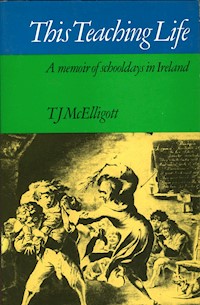
These vivid recollections by Tom McElligott span five decades and eighteen institutions throughout Ireland, from university in Cork to St Kieran's Kilkenny, Glenstal Co. Limerick, The Royal Cavan, Ballymena Academy, Wilson's Hospital, Headfort, Newbridge, Mountjoy and others. Here a peripatetic lay teacher documents the emergence of his profession against a background of religious control, compulsory Irish and rapid social change, throwing a fascinating light on boarding-school education from the 1930s to the 1970s. With wry humour, affection and an elegiac candour, Tom McElligott describes the physical conditions, personalities and ethos of the wide variety of schools at which he taught, salting his narrative with excerpts from school inspectors' reports of a previous era and imparting the flavor of life in provincial town and countryside, from New Ross to Skibbereen, Antrim, Westmeath, Kildare and Dublin. While savouring the past the author looks forward to a secular age in which the limits of class, creed and gender will be transcended. In an appendix he sketches six pioneering Irish educationalists-Cannon of Sandymount High, Cregan of St Patrick's, Cathcart of Sandford Park, Gahan of Sutton Park, Donogh O' Malley and Edward Walsh-and takes note of some schools that have fostered independence of mind and spirit.
Das E-Book können Sie in Legimi-Apps oder einer beliebigen App lesen, die das folgende Format unterstützen:
Veröffentlichungsjahr: 1986
Ähnliche


















THIS TEACHING LIFE
A memoir of schooldays in Ireland
Tom McElligott
ACKNOWLEDGEMENTS
This is not in any sense a formal study of the life led by a secondary teacher. Rather is it intended to be a discursive narrative of some of the events marking such a life.
I owe a debt of gratitude to many to whom I had written or who, in conversation, suggested matter for inclusion. I wish in particular to thank Mr Michael Hewson, Director of the National Library, and his staff; Mrs Helen Kilclyne, Roscommon County Librarian; Brother Felin Burns, Superior-General, De La Salle order; Oliver Marshall, Librarian, Department of Education; Father S. Clyne, Principal, St Patrick’s College; Dr John Coolahan, University College, Dublin; Dr Brendan Kennelly, Trinity College, Dublin; Mr Conall Cannon, Headmaster, Sandy mount High School; Con Burns, N.T.; Brother Patrick Hederman, O.S.B.; Rev. P. Skelly, O.P.; Terence de Vere White.
CONTENTS
Title Page
Acknowledgements
ONE Cork: Early Days and University
TWO Good Counsel College
THREE St Fachtna’s – Lota House
FOUR St Kieran’s – Glenstal – Scoil Éanna
FIVE The Royal School – Kostka College
SIX Ballymena Academy
SEVEN Wilson’s Hospital – Headfort
EIGHT Newbridge College
NINE St Paul’s – Mountjoy/Mount Temple
TEN Valediction
APPENDIX A Six Pioneering Educationists
Patrick F. Cannon
The Reverend Donal Cregan
Donogh O’Malley
H. R. Cathcart
Ruarc Gahan
Edward M. Walsh
APPENDIX B Four Schools of Distinction
Mount St Benedict
Tarbert
Scoil Íte
Newtown
Copyright
ONE
Cork: Early Days and University
ANYONE LIVING IN CORK in the years before 1921 must have some memories of the British occupation. I can recall only curfew, the most serious aspect of which, for those of us who were very young at the time, was that all hurling on the road had to end on summer evenings by 8 p.m. My parents had passes issued by the British military permitting them to use the Gaol Walk which led from the Western Road to where we lived on Highfield Avenue. I found it dangerously exciting when, clutching the hands of my parents, I heard the challenge of a sentry ring out ‘Who goes there?’ to be answered by a reassuring voice, ‘Friend’.
My parents grew up not too far from one another in north Kerry. My mother was born in Rathmore and my father in Listowel. Almost thirty years were to pass before they met and then it was in Cork city where my father was in the RIC and stationed at Union Quay. He resigned on the occasion of his marriage in 1910 and by the time that I came into the world he had been working as an accountant with Messrs Sutton on the South Mall for some years.
Among my earliest memories is that of waiting for him while sheltering in a doorway on the Mall with my mother. It must have been near closing time in the office when a lorry with Auxiliaries pulled out of Pembroke Street and stopped almost opposite us. The ‘Auxies’ jumped down, took the whips from the jarveys who had a stand near Parnell Bridge and began to drive the passers-by off the street.
Lesen Sie weiter in der vollständigen Ausgabe!
Lesen Sie weiter in der vollständigen Ausgabe!
Lesen Sie weiter in der vollständigen Ausgabe!
Lesen Sie weiter in der vollständigen Ausgabe!
Lesen Sie weiter in der vollständigen Ausgabe!
Lesen Sie weiter in der vollständigen Ausgabe!
Lesen Sie weiter in der vollständigen Ausgabe!
Lesen Sie weiter in der vollständigen Ausgabe!
Lesen Sie weiter in der vollständigen Ausgabe!
Lesen Sie weiter in der vollständigen Ausgabe!
Lesen Sie weiter in der vollständigen Ausgabe!
Lesen Sie weiter in der vollständigen Ausgabe!




