


9,59 €
Mehr erfahren.
- Herausgeber: Pushkin Press
- Kategorie: Sachliteratur, Reportagen, Biografien
- Sprache: Englisch
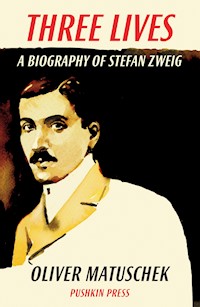
Drawing on a great wealth of newly available sources, this definitive biography recounts the eventful life of a great writer spoilt by success-a life lived in the shadow of two world wars, and which ended tragically in a suicide pact. Matuschek examines three major phases in the life of the world-famous Austrian author-his years of apprenticeship, his years of success as a professional working writer in Salzburg, and finally his years of exile in Britain, the USA and Brazil. Including the sort of personal detail conspicuously absent from Zweig's memoir, and incorporating newly discovered documents, Matuschek's biography offers us a privileged view into the private world of the master of psychological insight.
Das E-Book können Sie in Legimi-Apps oder einer beliebigen App lesen, die das folgende Format unterstützen:
Veröffentlichungsjahr: 2011
Ähnliche


















OLIVER MATUSCHEK
THREE LIVES
A BIOGRAPHY OF STEFAN ZWEIG
Translated from the German by Allan Blunden
PUSHKIN PRESS LONDON
Contents
Title Page
Introduction Three Lives in Retrospect
PART I
A True Brettauer at Heart
We Called It “School” …
Golden Pages
The Observer
“Why Don’t You Go to India?”
Trials and Tribulations of a Writer
Emotional Turmoil
In the Hero Factory
At the Top of the Tower
PART II
The House on the Hill
Steffzweig and the Radioten
“Hounded Like a Wild Boar”
Lapses
PART III
Life on the Edge
The Gathering Darkness
A World of Tomorrow?
Sources and Literature
Index
Image Rights
Copyright
THREE LIVES
Stefan Zweig (left) with his first wife Friderike Maria and his brother Alfred, photographed in Bad Gastein in the summer of 1929
Introduction
Three Lives in Retrospect
The outward impression that one gets of this singular man blurs many a notion that one has formed of the writer Stephan Zweig. A meeting with him is in no sense a disappointment, it is just very different from what one expects. His demeanour is so cautiously reserved and unassuming, that in conversation about ordinary everyday things one forgets about the powerful and vigorous language of his short stories and novels, his poems and plays. One is quite won over by the enchanting simplicity of his appearance and character.1
Egon Michael Salzer in the Neues Wiener Journal August 1934
In July 1940 the journalist H O Gerngross met in New York with one of the most famous European writers of his day, Stefan Zweig. The two men talked about times past and future plans, about brilliant successes and dark forebodings. With the Anschluss of 1938 Zweig’s native Austria had been incorporated into the German Reich; his books were banned in both countries, and as a Jew he could not even think about returning home. At the time of the interview the Second World War had been raging for almost a year, and the Netherlands, Belgium and northern France had just been occupied by the German Wehrmacht.
Despite all the setbacks and defeats, Zweig planned to carry on devoting all his energies to writing and producing new books for his reading public, even if that audience was a great deal smaller now in Germany as a result of the book bans. The journalist Gerngross tells us that he saw “on the little writing table in the hotel room and on the chair next to it, [ … ] sheets of paper, squared sheets of paper from an ordinary tear-off pad. They are covered with that neat, elegant handwriting that we know so well. And the purple ink is still there.” In the preceding decades Zweig had penned thousands of manuscript pages and letters in this, his preferred shade of ink. But now he was preparing a work of a different kind. As Gerngross reveals to his readers:
Stefan Zweig is taking a break from literature and belles-lettres. A biography of Balzac, planned for many years, remains unfinished, not least because the author is now denied access to the archives in Paris. The novella (a form of which Zweig is the master) no longer seems to him the right form of expression for today, because of its preoccupation with the problems of the individual. And yet he is currently writing the most personal book he has ever produced—the story of his life. He has already decided on a title for this autobiography: My Three Lives.2
And in due course Gerngross published his article in the émigré newspaper Aufbau under the title ‘Drei Leben’. Looking back on his life story, Stefan Zweig viewed it in terms of three distinct phases. The first life, which had begun in 1881 with his birth as the son of a weaving-mill owner in Vienna and ended with the First World War, had been lived in the seemingly secure world of the affluent bourgeoisie. His second life had begun, full of hope, in his new elective home of Salzburg, and had brought him an unparalleled rise to eminence as one of Europe’s most widely read and translated authors, before ending with his departure from Austria. His third life, which he spent in exile, had not long begun at the time of the interview: it would turn out to be the shortest of the three.
As he was writing his memoirs Zweig soon realised that he was not really telling the story of his life, but rather painting a panoramic picture of the age. Many of his own experiences are woven into the narrative, but his private life as such is completely glossed over. His two wives and some of his closest friends do not get a single mention in the entire manuscript. So the intended title now seemed less appropriate than originally thought, given that a book entitled My Three Lives would clearly have led readers to expect a much more personal account than the one Zweig had actually written. In the end the work appeared after his death as Die Welt von Gestern—the final (and very appropriate) title chosen by the author.
For any examination of Zweig’s life—including the present study, therefore—his own book of memoirs is clearly of central importance. But for anyone who wants to understand not only the writer and contemporary observer Stefan Zweig, but also the man and his private life, in order to paint a more accurate picture of his “three lives”, there is now a wealth of published material available, starting with the collected edition of his works and diaries, and including various volumes of letters and exchanges of letters from the vast correspondence that Zweig conducted throughout his life. And yet many questions remain unanswered. The much-quoted words “Your writings, after all, are only a third part of who you are” appear in a letter written to him in 1930 by his first wife Friderike. The passage in question reads like a daunting warning to anyone bold enough to research the biography of Stefan Zweig: “Thinking yesterday about your friends, it troubled me to think that nobody—apart from me—really knows you, and that one day the most fatuous and foolish things will be written about you. But then you let very few people get close to you, and when it comes to the real you, you are a closed book—and understandably so. Your writings, after all, are only a third part of who you are, and nobody has managed to extract from them even the bare essentials needed to understand the other two-thirds.”3
It is true that even in his younger years Stefan Zweig rarely spoke openly about himself. Even to people who knew him well he came across as buttoned-up, and in many ways he remained a riddle even to his close friends. But happily Friderike did not keep her knowledge to herself. In addition to a number of historical accounts she also wrote several books of memoirs in the post-war years, which contain important clues and aids to interpreting the life and work of her former husband, and which have played—and continue to play—a key role in biographical research. Her book Stefan Zweig, wie ich ihn erlebte [Stefan Zweig as I Knew Him] was published in German as early as 1947. Five years later, following numerous shorter newspaper articles and interviews, extracts from the correspondence they had conducted between 1912 and 1942 were published in book form. Friderike Zweig was now living in the USA, where she died in 1971, but over the years she visited her former homeland on several occasions, giving lectures in Vienna and other places and reading from her works at well-attended literary events. In 1961 her book Stefan Zweig—Eine Bildbiographie [Stefan Zweig—A Biography in Pictures] appeared, followed three years later by Spiegelungen des Lebens [Reflections of Life], which is more of an autobiographical work, although several important chapters are devoted to Stefan Zweig.
As we now know, Friderike Zweig’s publications are tainted by a blend of more or less adroit manipulation and concealment of facts (and this for more or less understandable reasons). The first thing to say is that she never wrote her accounts with the intention of producing works of scholarship, but instead recounted her memories in the style of fictional narrative, with an eye to the interests of her readers. And for many of the events she described she no longer had much, if indeed anything, in the way of documentary sources, so that she was forced at times to rely on her own memory. Consequently it is easy to understand how errors have crept in when describing events that took place in some cases several decades earlier. More problematic are the instances of deliberate interference with existing texts, where Friderike has arbitrarily removed references to particular individuals or qualified certain statements without any acknowledgement—even though she specifically states, in the foreword to the published edition of the correspondence, that no changes have been made to the original text of the letters. The substitution of the occasional expression, as for example when the derogatory Austrian term “Piefkes” in one of Zweig’s letters becomes “Reich Germans” in the printed version, may well be a useful aid to understanding for many readers;4 but the extent of the manipulation goes far beyond such minor emendations. In particular those passages where Stefan Zweig’s second wife Lotte was mentioned fell victim to Friderike’s censorship. As nearly all the known letters have survived, many problematic passages have now been revised and the original versions used as a basis for the present biography.5
Like the published correspondence, Friderike’s volumes of memoirs also proved quite popular with the reading public, and only a few individuals were in a position to voice informed criticism of their reliability at the time of their publication. One such person was Stefan Zweig’s elder brother Alfred, who had left Vienna in 1938 and settled in New York, where he lived until his death in 1977. The walls of his apartment overlooking Central Park were hung with numerous photographs of family members. Many of these pictures showed his famous brother Stefan, who had committed suicide in 1942 together with his second wife Lotte. Far from his European homeland, Alfred not only had to contend in the post-war years with repeated and thoroughly objectionable questions from every possible quarter about his brother’s Communist activities (since people were constantly confusing Stefan Zweig with Arnold Zweig), but also had to fend off other attacks as a result of Friderike’s activities.
It should be said at this point that relations between Alfred Zweig and his sister-in-law Friderike had never been particularly good, let alone cordial. But by the time she published her memoirs the relationship had become openly hostile. Alfred saw every single book that Friderike wrote as a direct attack on members of his family. Here was this woman, presuming to give a detailed account of her former husband’s childhood and his life in the family home, as if she had been there and seen it all in person—whereas she had not even met Stefan properly until he was thirty. Furthermore she described his father as “sickly” and the mother as “wilful”, in order to cast herself as some kind of redeeming figure in the story of her husband’s life, while at the same time suppressing details of their life together in Salzburg, which had had its fair share of tensions and conflicts.
In many of her observations about Stefan’s family there may well have been a grain of truth, but Alfred steadfastly refused to accept her accounts as they stood. He was not interested in writing a book of his own to set the record straight, and legal action would probably not have achieved anything. But he stated his views on Friderike’s books at every available opportunity, commenting on and correcting her claims wherever he could.
It was not just Friderike’s written pronouncements that so incensed Alfred—her behaviour in general prompted a waspish response from him on many occasions. During the post-war years, for example, Friderike consistently made herself out to be Stefan Zweig’s widow, a claim that was entirely without foundation and wholly false. Their marriage had been legally dissolved in November 1938, and even though Stefan had expressly permitted, and indeed desired, that Friderike should continue to use his surname, she was unquestionably his divorced wife from that time onwards. But even in her certificate of naturalisation for the United States, which was issued on 9th June 1948, her family status is officially listed as “widow”. None of this would really be worth mentioning, had Friderike not used this false declaration to try and suppress and cover up the fact that Stefan Zweig had remarried after their divorce. But since his second wife had died with him in a suicide pact, the role of widow remained vacant, so to speak—until Friderike came along to fill it. For Alfred Zweig this was a morally repugnant piece of behaviour, which could only strengthen him in his determination to set his own truth against Friderike’s version of events.
Of course Alfred had his own interest in protecting his family and himself, so that the pendulum often swings too far the other way in his portrayal of events—which should not be forgotten when relying on his account. In his will he had instructed that all family papers in his possession along with any of his brother’s remaining letters should be destroyed after his death, which is evidently what happened, with one or two exceptions. In preparing the present study, however, the author has had extensive access for the first time to unpublished correspondence of Alfred Zweig’s, which survives in three large bundles of letters running to several hundred pages. These comprise the following:
—The letters that Alfred Zweig wrote to Stefan’s heirs and his second wife Lotte. Many of them deal with issues relating to the family fortune and the management of the weaving mill once owned by the Zweigs, which had brought them a measure of affluence and of which Alfred had been the director.
—Letters to Richard Friedenthal, who had been a friend of Stefan’s, and later took on the task of managing his literary estate. For a long time Friedenthal was planning to write a substantial biography of Stefan Zweig, for which Alfred supplied a great deal of inside knowledge and material; more especially he furnished a commentary on Friderike’s writings aimed at correcting what he saw as misrepresentation. Despite amassing a great deal of material and doing extensive spadework, Friedenthal never did get round to starting the book.
—The correspondence with Erich Fitzbauer, who had founded the International Stefan Zweig Society in Austria in the late 1950s and dedicated himself to its work. Here too Alfred supplied important information about the history of his own family and the biography of his brother, even donating a number of original private documents to the Society.
The attempt to discover new facets to our picture of Stefan Zweig and his immediate circle was also greatly assisted by the active support of his heirs, who agreed to talk about their personal memories for the purposes of this project, and also granted access for the first time to letters written by Lotte Zweig. Stefan Zweig’s literary estate, including source materials and extensive preliminary studies for his Balzac biography, other manuscripts and notes (in part unpublished) as well as thousands of letters written to him by famous or well-known contemporaries, had already been given by his heirs, in successive stages, to the Reed Library at the State University of New York in Fredonia, so that the present study was also able to draw on this material.
In addition, various original documents in private collections and in other public libraries and archives from London to Jerusalem, from Switzerland to the USA, and from Austria, Germany and Brazil have also proved to be valuable sources. The research for this book turned up many an unexpected find—such as the transcript of a television interview that Zweig gave to the BBC in London in June 1937. Previously the only record of this event was a photograph showing him facing the camera in the studio, but the questions and answers had in fact been transcribed at the time, whereas the broadcast itself—one of the earliest television programmes made—went out live, and was not recorded. The present volume is also illustrated with photographs found in some of the albums from Alfred Zweig’s estate that had escaped destruction. Some of them are published here for the first time, and form a fascinating addition to the other photographs from private and public collections reproduced in these pages.
In many instances the new information gleaned from the wealth of additional source material only affects matters of detail, but sometimes it has helped to fill in some of the larger missing pieces in our picture of Stefan Zweig. Certainly his family, whose individual members played key roles in his ‘three lives’, can now be portrayed in much more detail than has hitherto been possible. Here, then, was an opportunity to paint a personal portrait of Stefan Zweig the man, and of his “three lives”, without losing sight of one of the most successful writers of his time. As Zweig himself once put it, on the threshold of a new literary endeavour: “Let us put it to the test.”6
NOTES
1 Salzer 1934.
2 Gerngross 1940.
3 Friderike to Stefan Zweig, 18th July 1930. In: Briefwechsel Friderike Zweig 2006, p 228.
4 Stefan Zweig to Friderike Zweig, 12th August 1925. In: Briefwechsel Friderike Zweig 1951, p 189 (here incorrectly dated 3rd August 1925). Compare the version reprinted in Briefwechsel Friderike Zweig 2006, p 174 f.
5 A completely revised and annotated edition of a portion of the correspondence between Stefan and Friderike Zweig (Briefwechsel Friderike Zweig 2006) has since been published.
6 10th September 1912, Zweig GW Tagebücher, p 9.
PART I
Stefan Zweig with his nanny Margarete
A True Brettauer at Heart
If I were to gather together my own childhood experiences, they would have their share of sunshine and clouds; but they would lack that clear, calm radiance that rustling Nature has shed upon you. The lot of a city dweller can be just as tragic, and yet never as great!1
To Hermann Hesse 2nd March 1903
OF ALL THE PEOPLE in Stefan Zweig’s family and immediate circle during the early decades of his life, the figure of his father emerges as the least sharply defined. Only one letter of his has ever come to light, other documents written in his hand are virtually impossible to find, and even in the stories told by the family he nearly always plays a secondary role. The surviving photographs only serve to confirm the impression of an unremarkable man: in a whole series of portrait photos in the popular carte de visite format, taken at intervals over several decades, Moriz Zweig cuts a consistently unimposing figure. Neither his pose nor his expression changes, despite the long intervals between photographs and the different photographers involved. Only the cut of his beard alters in line with changing fashions—and his face looks a little more tired from one picture to the next.
Moriz Zweig was born on 28th December 1845 in Prossnitz in Moravia. The spelling of his first name varies: in the printed announcement of his engagement and on his gravestone it is spelt “Moritz”, while in the obituary published by the family we find “Moriz”. As he himself wrote “Moriz”—when countersigning his son’s school reports, for example—and the name is also spelt thus in all official documents, this is the form that we shall use here.2 The family history records the Zweigs as resident in his birthplace since the middle of the eighteenth century, but in all probability they had been living there for much longer. His father Hermann, like his ancestors before him, traded in assorted goods—in particular textiles—on a growing scale and over an ever wider area, and in 1850 he took the plunge and moved from the provincial town to Vienna, together with his wife Nanette and the rest of the family. Here Moriz attended the upper secondary school, learnt French (eventually becoming completely fluent in the language) and a little English. Following the Zweig family tradition, he became a trader in textiles when he left school. In 1878, using his share of the family fortune and the first money he had earned for himself, he was able to buy what was then a very modest weaving mill in Ober-Rosenthal bei Reichenberg in northern Bohemia (present-day Liberec). The mill lay in a region that was one of the country’s most important industrial centres, and known, not without reason, as the ‘Manchester of Bohemia’. Moriz Zweig’s investment in the latest mechanical looms from England quickly paid dividends, and the business grew in just a few years from a traditional manufactory to a thriving industrial enterprise. Despite his business commitments, Zweig continued to spend most of his time in Vienna, where in due course a branch outlet was established for the sale of the finished textiles. The mill in Bohemia was run by a company secretary, who enjoyed the complete confidence of his employer and remained with the company for many decades.
Despite his considerable successes, Moriz Zweig was cautious, not to say very cautious, in all his business and private affairs. This circumspection was not just a personal characteristic of his, but a general family trait common to all its male members. The family’s rapid rise, within a few generations, from the ghetto of a provincial town in Moravia to ownership of one of the country’s most successful weaving mills was highly gratifying to all those involved, but success did not breed excess, and the family was never given to vulgar ostentation or display. Moriz Zweig was very proud of the fact that he never had to sign a promissory note, that even in times of financial difficulty he never had to take out a loan, and that his account always remained in credit. It need hardly be said that he banked with the most respected banking houses of his day. Backward-looking though his attitude to money may have seemed in later years, when investing in other companies and speculating on the stock market had become second nature to the modern businessman, it looked like the future in his own day: for whatever opportunities and enticements the business world offered, the absolute first priority was to safeguard the family’s fortune and social status, which was dependent not least on the value and stability of its capital assets. It was important to have something to fall back on. The conditions for leading a “quiet” life in this sense were favourable, as long as one was comfortably off.
As a young man Moriz Zweig witnessed for himself the growth and expansion of modern Vienna. The railway network had long since been extended to connect the capital with the Crown Lands, which had further stimulated economic growth. Extensive residential areas had been built in the industrial centres to house the immigrant workers, and the construction of public and private buildings on Vienna’s Ringstrasse was seen as a further monument in stone to the expansionist boom years of the Gründerzeit. After the initial euphoria this ambitious project was hit by a number of setbacks: the stock market collapse of 1873 briefly shook the business world to its foundations, and a number of entrepreneurs were plunged into ruin by the financial crisis. But the Zweig family appears not to have suffered any significant losses.
Moriz Zweig’s retiring ways were manifested not only in his business dealings, but also in his private life. He never played a prominent role in professional or business associations or on the city’s social circuit. He never accepted any award, and instead of cutting a figure at smart receptions he preferred to stay at home in the evenings and play on his beloved piano. The diary entry made by his son Stefan many years later, in December 1915, shows very clearly where this diffidence finally led him: “Father’s seventieth birthday. A very quiet affair, no emotion, no fuss or finery. One felt how cut-off we are from our world. Perhaps that’s how I will end up too. People can be a disappointment. Sometimes I understand the old man, even though I don’t want to become like him.”3
In August 1878 Moriz Zweig announced his engagement. His future wife, Ida Brettauer, was nine years his junior and “a good match”, as the saying went, who was in line to receive a not insubstantial dowry. Like Moriz, she was not a native of Vienna, but had moved to the city from Italy when she was sixteen. Her father, Samuel Ludwig Brettauer, worked in banking and finance, and had settled with his family in Ancona, on Italy’s Adriatic coast, prior to Ida’s birth on 5th May 1854. Brettauer’s wife Josefine, a Landauer by birth, came from Hürben in the vicinity of Augsburg, while he himself hailed from Hohenems in Vorarlberg. Hence the fact that German was spoken at home among the immediate family while Ida was growing up, even though they were living in Italy. In addition to the languages of their native and adoptive countries, all the members of the family also spoke French. Multilingualism and a cosmopolitan approach to life came naturally to the Brettauers anyway. The wider family, with its lawyers, bankers and merchants, was scattered across many countries in Europe and as far afield as America. In good times it numbered presidents, aristocratic houses and even the Vatican among its clients. The substantial successes that the family chalked up to its account—in the most literal sense—engendered a self-confidence and poise that could easily be interpreted by outsiders as snobbish conceit. In this respect Ida Brettauer ran true to type, and she changed little after her marriage to Moriz Zweig. As his later daughter-in-law Friderike put it, Moriz played the part of a retiring and conciliatory “prince consort” in the marriage—her point being that Ida Zweig was unquestionably cast in the role of queen.
The wedding had taken place in September 1878, and on 13th October of the following year the first child of this unequal couple was born in Vienna. It was a boy. Given the name Alfred, he promptly assumed the role of heir apparent—to stick with the dynastic metaphors—because it was already clearly understood that this boy, health permitting, would one day take over the running of the family business.
A little over two years later, on 28th November 1881, in the family’s apartment at Schottenring 14 in the 1st District, a second child was born. It was another boy, and he would be called Stefan.
A matter of days after he was born there was a major incident in Vienna that sent a shockwave of horror through the city. On 7th December escaping gas from the stage lighting in the Ringtheater caused fire to break out during a performance of Jacques Offenbach’s opera Tales of Hoffmann. The decision to evacuate the building was taken much too late, and the operation was severely hampered by the fact that the doors of the auditorium only opened inwards. As a result of this serious design fault the doors were jammed shut by the jostling crowds, and in the ensuing panic as people tried to escape, appalling scenes of carnage were witnessed. Estimates of the number of dead range between three hundred and five hundred. The Zweigs were particularly affected by these events because their apartment overlooked the theatre, so that the disaster unfolded literally before their eyes. They looked on aghast as the flames took hold and the chaos spread. With that strange mixture of helplessness and fascination that those who observed the disaster must have felt, the parents even fetched Alfred, then just two years old, to watch from the windowsill. He later said that the images of the blazing building were his earliest memories.
Moriz Zweig
Ida Zweig
Ida Zweig’s second pregnancy had run its course without any notable problems, but following the birth of the child she was found to be suffering from a severe hormonal imbalance. Not long afterwards she fell ill with sclerosis of the middle ear. This insidious condition, which can be caused by hormonal factors, manifests itself in a chronic inflammation of the tympanic cavity, which causes sclerosis of the mucous membrane and disrupts the delicate mechanism of the ossicles so that they can barely function, if at all. Since the onset of deafness was gradual, the doctors and their patient initially underestimated the seriousness of the disease and its possible repercussions. After some lesser problems, Ida Zweig’s hearing faded rapidly and irretrievably in just a few months; medical science had not yet devised an effective therapy or surgical procedure. The young wife soon needed an ear trumpet to follow conversations, and attending larger social gatherings became a test of her patience and powers of concentration. All thought of going to concerts, operas and theatre performances had to be abandoned. But in due course a pleasurable alternative presented itself—after initial scepticism, she developed a lifelong passion for the cinema, where the silent films of the day could be understood perfectly well even without the musical accompaniment.
Despite her handicap, Ida Zweig retained her essentially cheerful temperament throughout her illness. But as a result of the deafness her more contrary inclinations became more pronounced. Normally fairly placid by nature, she could erupt into terrifying rages if pushed too far. She was always seen as something of a curiosity among her social acquaintance—and not just because of her illness. Added to that, it must have seemed quite odd to some outside observers in those days that she frequently served such exotic dishes as risotto and artichokes at her table—in memory of her native land.
For almost the entire year she kept her more valuable jewellery in a safe (where most of it went missing in 1938), ordinarily wearing just some modest brooches, rings and necklaces. She dressed relatively plainly for everyday wear, but always in a manner that befitted her station, of course. Ida Zweig was not a conspicuously elegant lady, but until 1914 she remained a customer of the city’s foremost dressmakers; and doubtless she was also a familiar visitor to the shop on the ground floor of the building where they subsequently lived in the Rathausstrasse, which traded in furs “En gros et en détail”, as the sign above the entrance proclaimed.
As the wife of a mill owner she had assembled a circle of acquaintances around her who regularly met for tea. But it would be an exaggeration to describe this as a “salon”. The Zweig family home was frequented not by composers, painters, actors and writers, but rather—much as one would expect—by lawyers, industrialists and bankers of their acquaintance, together with their wives. Looking back in later years Alfred Zweig described them as “Jewish bourgeoisie of the first rank throughout”, adding that the family always maintained its distance from Christian social circles, as was the unspoken rule in Vienna.4
The fact that the family was Jewish was neither denied nor particularly emphasised. Stefan’s birth had been registered under the serial number 1968 for the year 1881 by the Jewish religious community, but so far no documents have come to light that would enable us to determine what role, if any, the Zweigs played in the life of the Jewish community. And the testimony of family members gives us hardly anything to go on here. The family no doubt attended the synagogue for the main Jewish feast days and festivals but at home in December neither the Jewish Festival of Lights, Hanukkah, nor the Christian Christmas was celebrated. The latter was entirely normal in other Jewish families who had moved away from their faith. The only concession to the season was a small Christmas tree decorated for the servants—and presents were also given to the domestic staff, to the enormous chagrin of the two Zweig boys.
In material terms the boys wanted for nothing. To the extent that they spent time with the children themselves, the parents took great care to treat them both equally. But for most of the time the two boys were entrusted to the care of a nanny. In fact, in what is probably the earliest photo of Stefan, taken when he was around nine months old, he is seen not with his mother or both parents, but with his Slovakian nanny Margarete. In the years that followed the two brothers had their photograph taken frequently. The velvet suits with the enormous-looking bows knotted around their necks, which they are wearing in one of the photos, were probably their—not very comfortable—everyday wear. Stefan in particular, with his round face, chestnut-brown hair and big, dark eyes was regarded as an adorable child by those who had not witnessed one of his feared temper tantrums. On one occasion, indeed, a member of the Austrian imperial household stopped her carriage in order to speak to the sweet little boy who was walking in the park with his father—a memorable occasion that went down in family history.
In 1886 the Viennese painter Eduard Kräutner was commissioned to paint a portrait of Stefan in his sailor suit with an anchor embroidered on the chest. The oil painting he produced for the parents was almost a photographic likeness of the boy. Only his faint smile had been brought out a little more strongly by the artist, an experienced practitioner of his craft, who produced hundreds of these portraits.
Since Ida Zweig’s hearing difficulties often left her a little disconnected from everyday family life, her mother was more than happy to step in when needed to help with the children’s upbringing. When the family moved in 1895 from the Schottenring to a larger apartment at Rathausstrasse 17, Grandma Brettauer, who had lost her husband in the meantime, lived in the neighbouring apartment on the same floor, so that she was now very close to her two grandsons in every sense. Alfred Zweig remembers her as a “very capable Bavarian Hausfrau of the old school, [who] knew everything there was to know about looking after children, especially when they were ill”.5 Despite her down-to-earth manner, she too exhibited all the inborn snobbery of the Brettauers. Even as a grown man and a world-renowned writer known by the Zweig family name, Stefan would come up against the self-regard of his relations on his mother’s side: “This pride in coming from a ‘good’ family was deeply ingrained in all the Brettauers, and if one of them in later years wished to show me special regard he would remark, condescendingly, ‘You’re a true Brettauer at heart,’ as if to say to me approvingly, ‘You turned out all right.’”6 Still, his unusual profession (and not least, no doubt, its unexpectedly lucrative earnings) had earned him the highest respect even in this branch of the family.
For all the care lavished on the boys by their grandmother, their upbringing was really the responsibility of the governess specifically appointed for the task. In the years before Alfred entered grammar school, the Swiss governess Hermine Knecht was the two boys’ constant companion. Little is known about these years in Stefan’s life, but many of his childhood experiences must have consciously exercised him for many years to come. At all events, for Zweig the writer they later became an almost inexhaustible source of material for new stories. In the collection Erstes Erlebnis—Vier Geschichten aus Kinderland he presented his readers with a series of tales in which anyone who knew about the author’s origins could probably detect autobiographical influences of one sort or another. Even Alfred Zweig thought he recognised many similarities with his own family home.
Admittedly it was not so much the agreeable aspects of childhood that yielded material for psychologically interesting characters. The stories in the collection are prefaced by a poem that in its very first verse conjures up a mood of dark melancholy:
O childhood, how oft I stood behind your bars,
Confined, imprisoned, and in tears,
While outside, on wings of blue and gold,
Soared the great bird Unknown.7
One already senses that attempts to break out of this cosseted and doubtless also boring world promised more excitement, in any case, than the dull daily round, with its formal etiquette and velvet suits.
The boy called Edgar, who appears in this collection as a character in the story Brennendes Geheimnis, has also been seen often enough—and surely with good reason—as Zweig’s “doppelgänger from those early days”,8 a view endorsed by his friend Erwin Rieger in his authorised biography of Zweig. Yet we should beware of seeing overly direct parallels, because it is more the atmosphere and the details, rather than the actual narrative content, which mirror the family’s life during those early years in Vienna. For example, the nightly injunction “Neuf heures! Au lit!”,9 delivered in affected tones by Edgar’s mother at nine o’clock to indicate that it is time to go to bed, was no doubt not unfamiliar to Alfred and Stefan Zweig, given that French was spoken in the family home on a routine basis. If their mother, aunt and grandmother were having a conversation which they did not want the children or servants to understand, they would simply slip into Italian without missing a beat. The same thing happened when they got together with other family members, as Stefan later recalls apropos of a visit to an aunt in Paris.
The summer months brought a special change of scene, as the family went away on holiday. The first half of the holidays was normally spent in Marienbad, where Ida Zweig went every year to take the waters. On these occasions it was not just the small family of four that made the journey, for they would be accompanied by a small entourage consisting of at least one male and one female servant for the parents as well as a governess for the children. Following the death of her husband, grandmother Brettauer quite often travelled with them, bringing along her own domestic servants. In Marienbad the family party normally took rooms in the luxurious Hotel Gütt or in the Fürstenhof, taking easily to the social life of the town, with its daily round of therapeutic treatments and spa concerts.
The young Stefan found the dining arrangements here thoroughly humiliating. Instead of eating with the adults in the main dining room, as he was used to doing at home, the children ate in a separate, smaller dining room. There were other children there, together with their governesses—but this exclusion from the world of his parents ran completely counter to his normal view of life.
When they came to the end of their time in Marienbad the family moved on with their retinue to one of the popular holiday resorts of the day, either by the sea or up in the mountains. In the mid-1880s their destination of choice was Selisberg on Lake Lucerne. In later years the Zweigs travelled as far afield as the Belgian coastal resort of Blankenberghe and Innichen in the South Tyrol. A trip on the Rhine in the summer of 1884 must have made such an impression on the young Stefan—who was not even three years old at the time—that when he visited Mainz thirty years later he astounded his hosts by his detailed recollections of the city as it had looked back then, before the original railway station near the River Main had been replaced by a new building in another part of the city.10
With Stefan’s enrolment in the primary school in the Werdertorgasse in 1887 his circle of contacts expanded for the first time beyond his immediate family, for as a child he had had very little to do with children of his own age, apart from his brother and a few cousins. Stefan was a good pupil, but in his early years at school he did not stand out from his classmates as being special or gifted in any way. But at least the good marks he received for ‘General behaviour’ suggest that he did not make a bad impression either. And yet he never took to school the whole time he was there. He was only thankful that he learnt to read at an early age, and thereafter could escape into alternative worlds. We do not know, unfortunately, what books, if any, were read in the family home. The family took a daily newspaper, of course, and there will have been some books in the house. It seems likely at least that a man with artistic interests like Moriz Zweig will have spent some of his leisure hours reading the literary classics. Certainly the two sons kept a small library of books during their childhood and youth, which, in addition to the texts they needed for school, contained all manner of modern works—including Friedrich Gerstäcker’s tales of adventure in far continents, and the works of Charles Sealsfield. The two Zweig boys were also acquainted with Julius Stettenheim’s indestructible war reporter Wippchen, as well as Winnetou, Old Shatterhand and Kara Ben Nemsi from Karl May’s recently published novels. Stefan was particularly taken with a book whose author and title he could not recall in later years, but whose contents remained imprinted on his mind: it was a colourful account of travels in Mexico and the distant countries of South America.
Stefan and Alfred Zweig
NOTES
1 Stefan Zweig to Hermann Hesse, 2nd March 1903. In: Briefe I, p 57.
2 See for example Prater/Michels 1981, Fig 11. Stefan Zweig also wrote his father’s name consistently as “Moriz”, cf Zweig 2005, Figs 9–16.
3 28th December 1915, Zweig GW Tagebücher, p 242.
4Alfred Zweig: Familiengeschichte.
5 Alfred Zweig: Familiengeschichte.
6 Zweig GW Welt von Gestern, p 24.
7 Zweig 1927, p 7.
8 Rieger 1928, p 23.
9 Brennendes Geheimnis. In: Zweig GW Brennendes Geheimnis, p 27.
10 Frank 1959.
We Called It “School” …
To see in them a set of youths who never put down the lyre, so to speak, would not be entirely correct.1
Friderike Zweig
THE SONG ABOUT “HAPPY, blessed childhood” that Stefan Zweig had to learn in one of his early years at school tells a completely different story to the account he later gives of this time in Die Welt von Gestern—school was boring, soulless and dull. Even when approaching the age of sixty he could not recall a single happy memory. So much time had passed, yet he could not even bring himself to see his teachers as figures of fun. Not that they were colourless ciphers—far from it. It was just that the routine of school life, which had followed the same sacrosanct pattern for decades, had so accustomed them to a rigid, authoritarian style of teaching that they simply reeled off the antiquated syllabus and took no account of their pupils as individuals. The teachers had long since accepted this system, and their pupils accepted it sooner or later as well—at least, that’s how Zweig presents it in retrospect. At the height of his distrust of the authoritarian school system he even goes so far as to observe, in an allusion to the work of Sigmund Freud, that it is no coincidence that it was a former grammar-school pupil who chose to study the origins and consequences of inferiority complexes at such length.
After primary school Zweig attended the Maximiliangymnasium, later renamed Wasa-Gymnasium, for the eight years from 1892 to 1900. His accounts do not go into detail about the teaching as such, though we do learn something about the syllabus. In their classes on literature, a subject that was already of special interest to him, they had to listen to well-worn lectures from the teacher with titles like “Schillers Naive und sentimentalische Dichtung” the same lectures he had been giving for decades. The syllabus made no allowance at all, he tells us, for the study of more modern authors such as Baudelaire or Walt Whitman, let alone contemporary writers.
Zweig’s later close friend, the writer Felix Braun, who attended the same school a few years after him and was taught by the same teachers, offers a rather different perspective. He credits German teacher Professor Lichtenheld with having introduced him to classical and modern literature and thus pointing him in the direction of his future career. Of this same teacher Zweig, on the other hand, says in typically over-egged fashion that he was a “decent enough old chap”,2 but he had never even heard of Nietzsche or Strindberg, whose works the boys read in secret behind their desks.
Then again his classmate Ernst Benedikt does his best in his memoirs to put a more cheerful gloss on these years when he tells us he can still hear Stefan’s “soft, giggling laughter at the unintentional and irresistible drollness of our Latin teacher, whose stocky, satyr-like build [ … ] and malapropisms were still a source of merriment to us years after we had left school.”3 The teacher in question, Karl Penka—or Penka Karl, as he called himself—had written a number of academically respected works with titles such as Die alten Völker Nord- und Osteuropas und die Anfänge der europäischen Metallurgie [The Ancient Peoples of Northern and Eastern Europe and the Beginnings of European Metallurgy] and Origines Ariacae. Linguistisch-ethnologische Untersuchungen zur ältesten Geschichte der arischen Völker und Sprachen [Origines Ariacae. Linguistic-Ethnological Studies in the Ancient History of the Aryan Peoples and Languages]. That these dusty topics excited little or no interest among his pupils was, and remains, hardly surprising.
In 1922 Zweig received a warm invitation from the school to its fiftieth anniversary celebrations. But instead of attending the festivities as guest of honour and giving the requested speech, he exacted a belated vengeance by writing a poem for the souvenir publication that left no doubt about his feelings: “We called it ‘school’, and meant ‘learning, fear, strictness, torment, coercion and confinement’,”4 we read in the opening lines. The following verses concede that when we leave school we still find “nets laid thick about our will”, but the overall tenor of the poem is that school, and the constraints of school, are a poor preparation for life.
At the age of thirteen Zweig gave up learning the piano, having realised by now, despite intensive practice, that he would never attain the perfection of his father, who could play even the most difficult pieces by ear, without a score. To spare himself further disappointment, and because he preferred to spend his time reading literature anyway, he managed to persuade his parents to stop his piano lessons. We do not know if he ever played a musical instrument again. A number of years were to pass before he took a serious interest in music again, although he went to the occasional concert. His father, on the other hand, was and remained a passionate music-lover; he had once attended a performance of Richard Wagner’s Lohengrin conducted by the composer himself, and was still talking about it decades later. When his wife could no longer accompany him because of her hearing problems, Moriz Zweig was frequently seen heading off to the opera or theatre with his two sons in tow.
When it came to ice skating, dancing and riding a bicycle (which he never learnt to do all his life) Stefan showed as little aptitude as he did for all athletic pursuits—and even less interest. No evidence has been found to support the claim that he worked as a swimming instructor during his time at school and university at the Jewish sports club Hakoah Wien.5 Since he did not feel particularly drawn either to Jewish associations or to sports clubs, and since he certainly had no need of the income, the claim can safely be dismissed as a rumour. Let us hope so at least, given that he did not even learn to swim until long after his student days were over …
He had started to collect stamps during his early years at school. At the age of twelve he switched with the same enthusiasm to collecting autographs, which promised to be a lot more exciting. Wherever and whenever they could, Zweig and his classmates stalked their victims at the stage doors of the city’s theatres and opera houses. Vienna was well blessed in those days with theatrical venues, and actors and singers were universally revered as gods—which made the boys’ forays a great deal easier. Gripped by a genuine mania for all things theatrical, even the grown-ups were keen to sniff out every last detail of their favourite performer’s professional and private lives. This was taken to ludicrous extremes, as Zweig later describes in Die Welt von Gestern:
To have seen Gustav Mahler in the street was an event that one proudly reported to one’s schoolmates the next day as if it were some kind of personal triumph, and when as a boy I was once introduced to Johannes Brahms, and he patted me affably on the shoulder, I went around for several days with my head in a spin as a result of this momentous occurrence. At the age of twelve I had only a very vague idea of what Brahms had accomplished, but the mere fact of his fame, and the aura of creative genius, had a shattering effect on me. A new play by Gerhart Hauptmann in the Burgtheater got our whole class worked up for weeks before the rehearsals began; we would sneak up on actors and extras in the hope of being the first to discover the plot and the cast—before anyone else! We even had our hair cut at the Burgtheater barber’s shop—such were the ridiculous lengths to which we went—simply in the hope of picking up some tittle-tattle about Wolter or Sonnenthal; and a boy from one of the junior classes was once specially cultivated by us older boys and bribed with all kinds of little favours simply because he was the nephew of a lighting superintendant at the opera house, and he sometimes smuggled us secretly onto the stage during rehearsals—where the thrill we felt, setting foot on that stage, was more than Dante felt upon entering the heavenly spheres of Paradise.6
Pursuing actors and singers was one way of adding to his autograph collection; the other was to write to famous authors and ask them for an inscription or an album piece. Zweig must have fired off many such requests in all directions, and eagerly awaited the arrival of each day’s post. But to his disappointment he received virtually no answers to his letters. In desperation he had the idea of calling himself “Stefanie Zweig”, thinking that a woman would be more likely to receive a reply; but this proved to be a fallacy, as the continuing lack of post demonstrated. When eventually he had a reply from Julius Stettenheim, he received not only the handwritten poem he had hoped for, but also the solution to his problem, wrapped up in verse:
As cheap as popularity comes
It’s not as cheap as some might think.
One’s asked to write a line or two
But in the letter so silver-tongued
You’ll search in vain for the postage stamp
Which costs a tidy sum each year.7
The poem excited a good deal of merriment in the family, and Alfred Zweig could still recite it by heart at the age of eighty. But, as he went on to say, the number of replies really did increase once Stefan began to follow Stettenheim’s advice and enclose return postage with his letters to authors—placing considerable strain on his pocket money as a result.
This interest in writing, and in the writers themselves, began to take up more and more of Zweig’s leisure time. As well as new volumes of poetry he buried himself in a comprehensive illustrated history of literature, which he virtually learnt off by heart. He not only read the texts, but also pored intently over the reproduced samples of the authors’ handwriting. He was able to make comparisons with the autographs and writing samples he had already collected, and he tried his hand at copying the signatures. For a while he contemplated writing a work of his own on the history of literature, but then concluded that an academic approach, and a historical-biographical format, were not really where his interests lay.
Poetry appealed to him much more, particularly when he started to make his own discoveries in this field. As well as some older volumes of poetry he had also got hold of the recently published works of Rainer Maria Rilke—and had also read some works by a certain “Loris”, which had made a profound impression on him. Concealed behind the pseudonym was none other than Hugo von Hofmannsthal, then considered something of a phenomenon in literary circles. Initially it was commonly supposed that the author of such perfectly formed works must be an older man, who—for whatever reason—had decided to adopt a nom de plume. Hermann Bahr later told Zweig about his first encounter with Hofmannsthal, and what a surprise it had been. Having read a text sent to him by the aforementioned Loris, Bahr had immediately written to the unknown author requesting a meeting. Great, then, was his astonishment when, at the appointed hour and place, the Café Griensteidl in Vienna, a grammar-school boy in short trousers appeared before him and introduced himself. The word “wunderkind” sprang inevitably to mind.
Zweig’s own admiration and respect for the genius of Hofmannsthal, who was just seven years his senior, amounted to an almost unbounded reverence. So it was somewhat galling that Hofmannsthal, with whom he was in contact in later years by letter and in person, showed not the slightest interest in Zweig’s own writing and did not rate him much as a person either.
As a young author Zweig had readily taken to letter-writing as a means of communication. He kept up a steady stream of correspondence, not just to request autographs from writers, but also to obtain all kinds of information about the literature of the day. And many of his letters were concerned with the publication of his own works. Initially he signed his letters “Stephan” Zweig, but around 1900 he decided to use the form “Stefan”, as it appeared on his birth certificate; and in later years he would react angrily when even his publishers sometimes used the “ph” spelling.
Before long he was writing up to three letters a day, and had to ask his correspondents to be patient if he was unable to acknowledge their contributions immediately. But in point of fact anyone who responded to his requests could be certain of hearing back from him promptly. After the author and archaeologist Georg Ebers had responded to the fifteen-year-old’s question about his then very popular historical novels, he received a poem of several verses singing his praises by way of thanks, to which the young Zweig appended the following self-deprecating remark: “By sending me such a friendly reply you have acted very impractically, because—as you see—here I am, back again with more questions!”8
A favourite correspondent during these early years was Karl Emil Franzos, the Berlin-based founder and editor of the twice-monthly journal Deutsche Dichtung. Zweig regularly offered him poems, essays and other short pieces, taking the liberty of adding (as indeed he could afford to) that payment for any submissions that might be accepted was entirely irrelevant. Not every idea was destined to succeed. Among his many offerings was a rather more substantial novella entitled Peter der Dichter. It told the story of a young working-class poet who achieves great success with his work, and is even lionised as the fashionable poet of his day, but who in the end cannot adapt to his new role in unfamiliar social circles and finally returns to his working-class roots. But the work seems never to have made it into print, and the manuscript has been lost. It probably shared the same fate as a historical drama about the Swedish king Gustavus Adolfus, which Zweig had written at the age of seventeen with much labour and intensive study of source material, only to throw it on the fire after several self-critical rereadings.
Another piece offered to Franzos was a story described by Zweig himself as a “Jewish novella”, which, as he had discovered, was virtually impossible to place in the daily press. He had found that most newspapers avoided the genre for political reasons, and he did not want to give the work to a Jewish journal because, as he said to Franzos, it contained “absolutely no national calling or message”.9 For his part he wanted the story—entitled Im Schnee—to be seen as a work of art and nothing more. But Franzos would not take it on either, and a few days later he sent the manuscript back to Zweig, who appeared unfazed:
I was not at all surprised when you returned my MS. As soon as I had posted it I had a strong sense of all its many faults and weaknesses. I know very well that this novella is like most of my things, hasty and dashed-off, but—and I don’t know what to call this quirk of mine—I find I cannot change a thing once I have written the last word, and normally I don’t even bother to check the spelling and punctuation. It’s just my careless and headstrong way of working, of course, but I am fully aware that it will prevent me ever producing anything of any substance. I haven’t mastered the art of being conscientious and painstaking. [ … ] I know what it’s like, in a minor way, to write with gritted teeth, and I’ve burned hundreds of my own manuscripts; but I’ve never changed or revised a single line. It’s unfortunate, but it cannot easily be changed, because it’s not just some superficial quirk, but something that may be deeply rooted in my character. And so it’s lucky for me that writing is not going to be my vocation, and that I haven’t given a moment’s thought to becoming famous or even well-known.10
The last sentence sounds coyly disingenuous to anyone who knows how serious and tireless was Zweig’s commitment to literature. There can be no doubt that he was driven in part by dreams of fame. But even Alfred Zweig reports that at the time his brother was not at all sure what profession he would be taking up. Writing was still just a hobby for him.
But from his remarks on the subject of manuscript corrections it is clear that literature, and in particular his own writing, was becoming the focus of Stefan Zweig’s future plans. Although he had said, in the letter quoted above, that he was incapable of revising his own texts, he was also coming to realise that even the greatest poets do not necessarily produce perfection with their first drafts. Indeed, he now developed an enormous fascination for tracing the evolution of a work through successive drafts. That fascination was fed by the first more substantial manuscripts he had added to his autograph collection. Straightforward signatures soon ceased to be of interest, and he was much more excited by a manuscript page peppered with the author’s own emendations than by letters or the finished draft of some poem or other text. Franzos himself was not just a writer but a fellow collector of autographs, and in another letter to him Zweig first formulates his own priorities as a collector: “Mindful of your great renown as a collector of autographs, which will soon rival your illustrious renown as a writer, I take the liberty of sending you a number of quite interesting letters, which are of little value to me as a collector of manuscripts and original poems. I am very happy to let you have them.” The material he was offering to swap was impressive enough. Zweig lists the items in a postscript to the letter: “4-page letter from Wieland to Gleim (very interesting), Goethe discussing




