


Erhalten Sie Zugang zu diesem und mehr als 300000 Büchern ab EUR 5,99 monatlich.
- Herausgeber: Eye Press
- Kategorie: Sachliteratur, Reportagen, Biografien
- Sprache: Englisch
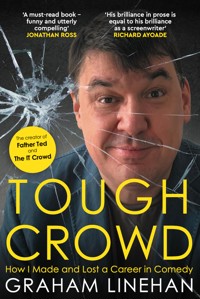
'A must-read. Funny and utterly compelling' Jonathan Ross Having cut his teeth in music journalism, Graham Linehan became the finest sitcom writer of his generation. He captured the comedy zeitgeist not just as the co-creator of Father Ted but also with The IT Crowd and Black Books, winning five Baftas and a lifetime achievement award. Then his life took an unexpected turn. When he championed an unfashionable cause, TV commissioners no longer returned his emails, showbiz pals lost his number and his marriage collapsed. In an emotionally charged memoir that is by turns hilarious and harrowing, he lets us into the secrets of the writing room and colourfully describes the high-octane atmosphere of a sitcom set. But he also berates an industry where there was no one to stand by his side when he needed help. Bruised but not beaten, he explains why he chose the hill of women and girls' rights to die on – and why, despite the hardship of cancellation, he's not coming down from it any time soon.
Sie lesen das E-Book in den Legimi-Apps auf:
Seitenzahl: 432
Veröffentlichungsjahr: 2023
Das E-Book (TTS) können Sie hören im Abo „Legimi Premium” in Legimi-Apps auf:
Ähnliche

















Praise for Tough Crowd
‘One of the very best television comedy writers of all time delivers a book which is a must-read for anyone who has ever wondered: a) how to create a hit sitcom and b) how it feels to lose everything. It’s funny, complicated and utterly compelling’
Jonathan Ross
‘One of the most compelling and unflinchingly honest memoirs I’ve read in many years. It’s also the funniest’
Andrew Doyle
‘Graham Linehan has long been one of my favourite writers – and this book shows that his brilliance in prose is the equal to his brilliance as a screenwriter. It unfolds with the urgency of a Sam Fuller film: that of a man who has been through something that few have experienced but has managed to return, undaunted, to tell us the tale’
Richard Ayoade
‘Hilarious, raw and touching. A must-read for anyone who wants to know the backstory behind Father Ted – and why he gave up the life of a luvvie to fight the threats posed by trans ideology to women’s rights and child safeguarding’
Helen Joyce
‘This book is great company, and reminds us that Graham is first and foremost a writer, and a very funny one indeed. It is a not inconsiderable relief, in fact, to see that he has not lost the gift’
Simon Evans
‘A brilliant account of the evolution of a comedy writer, but also an extraordinary and chilling portrayal of cancel culture. I found it unputdownable’
Lissa Evans
Published by Eye Books Ltd
www.eye-books.com
Copyright © Graham Linehan 2023
Cover design by Ifan Bates
Front cover photo by Simon Edge
Back cover photo by the author
Typeset in Palatino LT Std and Century Gothic
All rights reserved. Apart from brief extracts for the purpose of review, no part of this publication may be reproduced, stored in a retrieval system, or transmitted in any form or by any means, electronic, mechanical, photocopying, recording or otherwise without permission of the publisher.
Graham Linehan has asserted his right under the Copyright, Designs and Patents Act 1988 to be identified as author of this work.
British Library Cataloguing in Publication Data
A catalogue record for this book is available from the British Library
ISBN: 9781785633065
For my daughter
‘The people who must never have power are the humourless’
Christopher Hitchens
‘If you’re going to tell people the truth,be funny or they’ll kill you’ attributed to Billy Wilder
Contents
Prologue: The End
1 Waiting for the Internet
2 In Praise of Older Men
3 The Golden Ass
4 Taking Our Shot
5 We’ll Always Have Paris
6 Getting the Gang Together
7 ‘Put on the Strokes Tape’
8 The Cat and the Piano
9 Shame About Yer Man
10 Short Form
11 Who Do You Think We Should Get?
12 Do Not Cast Milo O’Shea
13 Upstairs, Downstairs
14 It All Comes Together. No One Cares
15 The Internet Is Coming
Interlude
16 Cancer Becomes the Least of My Problems
17 My Career Comes to a Screeching Halt
18 The Resistance
19 The Best Matador in all Madrid
20 The Assassination of ‘Father Ted the Musical’
21 Green Shoots
22 Charge!!!
Acknowledgements
prologue:The end
Some time before I lost everything, I heard laughter drifting up to my office at the top of the house, a sound I could never resist. My family were my favourite audience, and if they were already laughing, well then, even better. Normally, I’d gallop down, asking what was so funny, to join in or see if I could steal something to turn into a joke or a sketch or a scene or a show. But this time I just stood at the top of the stairs and listened. This was after the first year of relentless harassment, while I was still dissecting the workings of the trap I had walked into, and the limits of friendship had allowed it to snap shut on my remaining testicle, the one that the cancer had somehow not stumbled upon during a recent tussle with its immediate neighbour. I didn’t yet know how firmly the trap held me, but it certainly held me at the top of those stairs.
It was still early days in my exile from the dinner party circuit; work, opportunities and social engagements had only just ceased to darken my door. Sure, no one was saying anything, no one was helping – my friends were, in fact, giving me odd looks, ghosting and blanking me, not returning calls, giving my wife shit on the phone, writing nasty letters about the importance of kindness, and perhaps worst of all, sympathetically nodding while telling me why they couldn’t get involved – but I still believed it was only a matter of time before these friends and colleagues from the entertainment industry would fly to my aid. The satirists, the stars, the progressives, the feminists... Those I’d made famous, and who had made me semi-famous in return. I thought they’d be along any minute.
But no one around me expressed an opinion about the issues I was desperately asking them to address: women losing their words, spaces and sports, and the systematic dismantling of basic principles of safeguarding that protect the most vulnerable. My nerves were shredded, waiting for my friends to turn up and them not turning up. So when I heard my family laughing from downstairs I knew I couldn’t go down because it would all be written on my face and I’d do to the atmosphere what the internet did to privacy: kill it stone dead.
It was out of the question. It’d be like Lurch from The Addams Family walking into the room. So I sat down at the top of the stairs and listened to them, smiling, glad that there was still at least some happiness in the house. Maybe the dog joined me, or one of the cats. It wasn’t so bad.
‘A nursing home on one side and a graveyard on the other,’ the lettings agent had said, forcing a laugh. ‘Not ideal, I know.’
‘No, no. What could be more convenient?’ I said.
It’s early in 2020. My modest flat, which is a few hundred yards down the road from my family, is on a corner of the building and does indeed have a nursing home to one side and a graveyard behind it. When I’m preparing food, I look out of a window at the nursing home; when I’m eating, I look at the graveyard. It’s quite the rollercoaster! Every day, I lock eyes with one elderly patient propped up on pillows, staring straight back at me through his window. I waved once and got no response. He’s either suffering from dementia or he knows who I am and doesn’t have the strength to raise his middle finger.
In the earliest hours of the morning, the nurses at the nursing home (it would be odd to have nurses at a graveyard) gather outside to gossip and smoke. Because I’ve stopped watching the news, the soft trill of their conversation acts as a sort of virus-progression barometer. If I wake up to the sound of laughter, then all is well and Covid has not yet suffered the journey to Norwich, a journey which, to be fair, is a bit of a bugger, even for so-called worldwide pandemics. Norwich isn’t on the way to anywhere, so not many can be bothered to make the trip.
My building is at the ancient, overgrown, neglected end of the graveyard, which is a little too symbolically on the nose for this writer’s comfort. At the other end of it, the newbie dead are still rocking their Sunday best, but in my corner, squirrels cavort over the disintegrating remains of the long-gone. In the early evening, junkies dart through the staggered gravestones, like dark fish at the bottom of a rock pool, shouting over distances because one is always faster than the other. I don’t know it yet but this flat is where I’ll spend the next two years, my TV writing career in tatters, stunned at my inability to make people care about the daylight theft of women’s rights, or the greatest safeguarding scandal since Rotherham, or the greatest medical scandal since thalidomide.
When I began talking about the issue, there were still five years to go before the resignation of Nicola Sturgeon and the closure of the Tavistock gender clinic, J.K. Rowling had not yet broken cover to take over as the number one target of trans rights activists, and terms like ‘assigned at birth’ and ‘cervix-haver’ had only just begun to turn up in NHS documents. On the rare occasions it was noticed at all, the trans issue was seen as a sideshow.
‘Why are you focusing on this tiny minority?’ people would say.
‘Women are not a tiny minority,’ I’d reply.
Kinder people than the friends I lost often say, ‘I don’t know how you can withstand the abuse,’ but the truth is that I don’t see it. I got the gist a while back and now I would no more google my name than stick my tongue into a plug socket. Besides, I’d had online abuse before, in various forms and for various reasons. I’d even had it before it went virtual, in the form of physical bullying, a phenomenon that must seem both quaint and terrifying to the emotionally tender youth of the modern middle class.
There’s a story that I first heard attached to the actress and model Pia Zadora, a briefly famous starlet who won Worst Actress and Worst New Star at the Golden Raspberry awards in 1982. The legend goes that her performance in a stage production of The Diary of Anne Frank was so underwhelming that when the Nazis barge in at the end of play and demand ‘Where is she? Where is Anne Frank?’ an audience member shouted, ‘She’s in the attic!’ But Zadora was never in a stage version of Anne Frank – the story was applied to each fresh female actor who had somehow brought the public’s withering gaze upon her head. It’s a joke, really, a combination of gossip and joke, with a scorned and discounted woman providing the punchline. And yet, for all that, it’s funny. An audience member turning you in; it’s the worst possible review, and the best example of the term, often said with a shrug by comedians consoling or warning one another about a difficult gig: ‘Tough crowd.’
There was certainly no shortage of people shouting, ‘He’s in the attic!’ I was astonished at the pain of each fresh betrayal. I couldn’t seem to get used to the experience. When the internet turns on you, as it had the moment I entered into the debate around women’s rights, it isn’t pretty, but I thought I had a couple of advantages. I had an audience that I had already won over by co-writing some well-loved sitcoms, Father Ted being by far the most famous, but also The IT Crowd, Black Books and Count Arthur Strong, and more importantly I had smart, compassionate, progressive friends within the industry who would soon be swooping in to add their voices to mine.
Unfortunately, the fight against gender ideology wasn’t funny, and when I wasn’t being funny, the public took the opportunity to tune me out. Sitcom writers are not particularly noticed at the best of times, but I never thought I’d become so imperceptible that friends and even family members failed to notice what I was going through. I was targeted by a convicted criminal who had the police in his pocket, and a media eager to find some dirt on me, and it was at that precise moment that all my showbusiness friends simultaneously lost my phone number. One day, I looked at my sunken eyes in the mirror and realised I was becoming one of those depressing BBC docudramas about comedians catching cancer or falling off the wagon or whatever. The big difference with my story was that over the last five years, cancer of the testicles had been the most positive thing that had happened to me.
There is no definitive moment that I became perceived as toxic. But there’s no doubt about the sheer scale of the media machine that made it happen. If anyone edits my Wikipedia page to say ‘campaigner for women’s rights’ rather than ‘anti-transgender activist’, the edit reverts back within fifteen minutes. Gender-goofy newspapers like The Guardian and The Independent only interview colleagues of mine in the hope they can get them to condemn me, which many are delighted to do. The LGBTQ+ website Pink News has to date written more than seventy-five hit pieces on me, all of them designed to paint my perfectly commonplace beliefs as evidence of bigotry and madness.
But that’s Pink News. I expected a little more digging, a little more discernment from those who knew me well. Unfortunately, friends, colleagues and family members alike decided to treat malicious gossip as gospel. In those early days, I didn’t yet know what a ringing disappointment people would turn out to be. There was a spring in my step, and not just because I was lighter by a testicle that had, overnight, grown until it weighed as much as a Rolex. I thought I could offer something to the increasingly febrile debate, perhaps bring some clarity and humour to the increasingly angry exchanges. The beliefs of the other side were so insane that I thought my friends would quickly realise how crazy it all was and start lending a hand.
My first writing partner, Arthur Mathews, and I once wrote a sketch that neatly sums up my situation at this time. An English Civil War captain, played by Simon Pegg, is leading his men into battle. He tells them: ‘Beyond those trees lies our enemy, five thousand men, maybe more! But it is important we keep our heads. Now listen carefully, for this is the most important thing I will ever tell you, and I shall not say it again!’
At this point he mumbles something unintelligible and yells: ‘CHARGE!’
Having had no time to absorb either his speech or the situation, the soldiers watch him run towards the enemy lines, where he is instantly shot and killed.
The End.
1waiting for the internet
During the decades in which I grew up, the internet was dispersed among a great number of physical locations and then further dispersed among the items one browsed in these specialist sites. For instance, if you wanted to read something, you visited a ‘bookshop’, if you wanted to listen to music, you visited a ‘record shop’, and so on. The world was not delivered to our doorstep, was not yet compressible into a space smaller than a fingernail. We had to schlep everywhere to enter the distracted bliss that now charges by the side of our beds.
I spent my childhood exploring minutely every record, book and comic shop on my way home from school – anything that might alleviate the grinding boredom that came with being alive in Ireland before broadband. So unconsciously impatient was I for laptops and game consoles and social media and all the rest of it that I remember standing at a Speak & Spell in an early electronics shop, refusing to accept defeat as I pounded a series of unsuccessful answers into it. Something in me sensed it was the future, even as it repeated words through a voice synthesiser seemingly made of rubber bands.
Spell ‘orange’.
O-R-A-N-G-E.
That is incorrect. Spell ‘orange’.
O-R-A-N-G-E.
That is incorrect. Spell ‘orange’.
I thought, hang on a sec. Is it saying ‘porridge’?
P-O-R-R-I-D-G-E.
That is incorrect. Spell ‘orange’.
O-R-A-N-G-E.
No. The correct answer is D-R-A-W-B-R-I-D-G-E.
After this, endless hours flipping through books in Easons, comics in The Alchemist’s Head and albums in Freedbird, Comet and Golden Discs, always pausing for maybe a little bit too long at the Scorpions cover that showed a woman with chewing gum stuck to her boob. That was the ‘internet’.
When I wasn’t scouring the pre-internet internet for distraction, I observed and stored for later use how adults made their own entertainment. One day, my mum’s sisters came over and got roaringly drunk on vodka and tonic, a lanky bottle of Smirnoff demolished over the course of an hour, with ensuing rowdy gossip, heated accusations and screaming laughter. My dad couldn’t believe the family he’d married into. ‘They’ve drunk the whole thing,’ he said, sneaking up to Mum during a pause in the mayhem and marvelling at the bottle’s sudden weightlessness. My aunts finally staggered from the house like puppies released from a greyhound trap, ‘talking absolute nonsense’, as my mum put it. Later, my parents discovered that, weeks before the invasion of sozzled aunts, my younger brother John and his teenage friends had themselves drunk the vodka and replaced its contents in a panic. So my mum’s sisters had managed somehow to get hammered by pounding down multiple glasses of tonic and tap water.
Excess forms the basis of my earliest memory: me and a gang of toddler hooligans devouring every last scrap of jam from the jar at some sort of home nursery. The childminder had taken the fatal decision to leave us alone for half a second, so we stomped into the kitchen like the Seven Dwarves and had our pre-school way with the contents of her fridge. A better-behaved child screamed at us in pure terror: ‘You’re not supposed to eat the jam from the jar!’ Every toddler fears getting in trouble more than they fear death, and the trouble that ensued made such an impression on me that decades later I gave that line to Dougal, the childishly innocent junior priest in Father Ted. The only other clear memory from my early childhood is seeing The Wombles live. The Wombles were a gang of pre-internet furries who cleaned up litter. ‘Remember you’re a Womble,’ they sang, as if anyone could forget such a condition.
I soon found myself in a boys’ school run by priests from the Society of Mary, otherwise known as the Marist Fathers. Nothing untoward to report; they weren’t that sort of priest. I was far more frightened of my fellow pupils. The friends I found, fellow wimps, nerds and awkward types, had all come to settle in each other’s company like marbles in a wine glass, together partly because no one else would have us. Grateful not to be the target for once, I even took part in the derision aimed at one boy who would later become my best friend. The call of the herd was never easy to resist, even before the internet boosted its signal.
I was bullied because I was tall and too frightened of my own anger to fight back. After a motorbike accident, my cousin Jim spent the rest of his short life being cared for by my aunt Stella and my cousins – his sisters, Ann and Mary. It was the family’s great tragedy and also affected my mother, who had given birth to my brother John six weeks before the accident. She suddenly saw life-altering violence as something that could appear unexpectedly and out of nowhere, as it had for Jim. I absorbed her fear and this left me wide open to bullies who, unlike me, didn’t see every thrown punch as having the potential to send someone on a one-way trip to an industrial-grey wheelchair in their sitting room.
To escape reality, I entered into various fantasy worlds like a million other bullied kids who saw Star Wars at the right age. I won’t go on too long about Star Wars except to say ‘dirty spaceships’. That’s what did it for me. I’d never seen scratched and dirty spaceships before then. None of us had. At one point Dad casually pointed out Tatooine’s twin moons and I gasped. Oh, yes! I remembered. It’s set in space! Another example of world-building I’ve always loved was the Sandmen riding in single file ‘to hide their numbers’. These brush strokes were the real reason we loved it so. Tropes from Westerns and war movies ingeniously repurposed, with The Empire Strikes Back inserting Wagnerian fire and awe into the formula. To a child who thought that Scooby Doo was as good as things got, it was immersive on a near-psychedelic level, the nine-year-old’s equivalent of taking dimethyltryptamine. When my father asked for my thoughts as we left the cinema, I said, quite earnestly, ‘It changed my life.’ My dad roared with laughter.
If I’d realised then that hyperbole often left one with nowhere to go, I might have made a better critic. And yet it was true. Instantly, I became a science fiction fan. The books from SF’s first and second golden ages imagined futures that would never arrive and their authors wrote them in a world that still contained beatniks and the Ku Klux Klan. Some of them were completely impenetrable as a result. You kiss a lot of frogs as a science fiction fan, but I found a few favourites, often those who put character and humour first. Kurt Vonnegut, Alfred Bester, Philip K. Dick, John Sladek, Harry Harrison… I gravitated towards pyrotechnics of some sort, humorous, imaginative or violent.
The British weekly comic 2000 AD was a dizzying combination of all three and its arrival came as an unwelcome shock to my poor dad, who had successfully banned from our household its ultra-violent predecessor Action a few years earlier. He was delighted when the controversy around the title forced it out of the market. (The tabloids called it ‘the sevenpenny nightmare’ – which makes me feel a hundred years old.) But the team merely rebranded as 2000 AD, killer robots taking the place of football hooligans, and continued as if nothing had happened. Both comics were a blast. Not a Paddy joke to be seen in the letters pages, and the creators were obviously telling the stories they longed to read themselves. Part of its genius was its title, a date which seemed to me impossibly far away, and does again, now.
In Dublin in the eighties, the pornography section of the internet was located in the top rack of magazines in Easons. Playboy and its competitors were banned, but some loophole allowed magazines about ‘glamour photography’ and a naturist magazine called Health and Efficiency, or H&E. This latter title played the nasty trick of always having a very pretty nude woman on the cover, while inside it was actually about naturism. I found this out to my horror when once I slotted myself in between a pair of glamour photographers and leveraged a suddenly useful height advantage to snatch a copy of the magazine into my trembling hands. Finally, I would see What It Was All About.
Me at ten, thinking about space
© Author’s family
To my dismay, the first and only thing I saw within was an old man holding hands with his grandson, both naked. They were both looking straight at the camera. The grandad had a white beard and white hair, and his penis was also surrounded by white hair, so for a moment it looked like there were three people looking at me: one bearded man, one child, and one very small, bearded child. To go from thinking myself unobserved to having three people looking at me was such a terrible shock that I never opened the magazine again. I can still see them sometimes. Their faces are burned into my retina like I killed them in Vietnam.
The hardcore pornography section of the pre-internet internet was beneath a loose floorboard in a small abandoned house at the end of our road. I realise this sounds a little too neat to be true but what can I tell you? That’s where it was. A small, thick booklet, written in German, illustrated with photos of men and women presumably up to no good. I say ‘presumably’ because although we knew it was somehow sexual – why else had the book been hidden? – we weren’t sure exactly how. People in crowded rooms, some in masks or bound in ropes, others on their hands and knees as if looking for a contact lens… It was like an escapologists’ convention after a free bar. Also missing were any boobs. It was all faintly unpleasant and didn’t converge with our developing sexualities. Perhaps I’m wrong and some of my friends went on to become aroused at knots. Little did we know that hole under the floorboards would become one of the few places where you can’t find grimly alienating pornography. These days, the porn finds you.
My absorption in fantasy worlds and their makers was total. I became fascinated by author Harlan Ellison especially. A legendary figure among SF fans, Ellison was a pugnacious brawler in the Norman Mailer style, scandal and gossip following him like tiny dogs follow romance authors. But he was a humanist above all and his outrage at the murder of a barmaid called Kitty Genovese made a great impression on me. On 13 March 1964, Genovese, who was twenty-eight, was stabbed to death in the courtyard of a New York apartment building, reportedly within earshot of three dozen witnesses who did nothing to help. Ellison famously called these witnesses ‘thirty-six motherfuckers’ and railed about their cowardice in an essay. When I caught up with it sixteen years or so later in a collection of his journalism, I raged along with him. But the truth of the matter was not as clear as Ellison made out – some people did indeed try to help Genovese – and his intervention could be read as an early example of a celebrity jumping to conclusions before all the facts were in. But I admired the clarity of his moral vision, and how he had zeroed in on a single point which seemed like simple common sense to me, especially as it seemed no different from what my dad had always taught me: when a woman cries for help, you help.
Ellison’s fiction was as dark as the space between stars, but I rejected science fiction’s endless dystopias except as entertainment. For me, the future was bright. After all, technology – in the form of computer games, my record player, and even the technology required to hold together the pages of a book – was the only thing plucking me out of regular old ‘meatspace’, as esoteric nerds sometimes call that part of existence that persists outside our screens.
I was staring at screens before it became fashionable. While still in school shorts, I would save money by skipping the first bus – the one that ferried me from my school slightly further into town before another took me on the nightmare journey out of it to my home in suburban Castleknock – and I’d use the spare coins to jolt awake a few games in an arcade. An entire cabinet housed each title – Defender, Galaxian, Space Invaders, APB, Narc, Joust. Compared to today’s games, these titles were laughably basic. But I’d have continued feeding them coins had they just been wooden boxes illuminated by lightbulbs, which I guess is exactly what they were.
While still a good Catholic boy, I would see books in Easons with titles like The Exorcist and Rosemary’s Baby and Let’s Go Play at the Adams’ and think of their authors, ‘All these people are going to hell.’ I suspected the success of these evil books indicated some sort of deal with the devil, perhaps only undertaken at an unconscious level. You did evil things, like write an evil book, and you were rewarded. Maybe you didn’t even start with evil books. Maybe you started smaller, so to speak, and things got out of hand. Masturbation was bait, resting on Satan’s mousetrap. If I didn’t stop doing it, I was going to become a bad person, write evil things, make a lot of money, and end up in hell. What kind of demonic freak was I, that I could enjoy thoughts of SEX? Every time I fell to the temptation of treating my genitals as if I was trying to get a tune out of them, I’d spend a good half hour apologising to Our Lord afterwards.
‘Bishops love sci-fi, Ted!’ My confirmation, with Mum and Dad
© Author’s family
But that ended the day the more respectable pre-internet internet arrived at my home. It took the form of an actual, real-life encyclopedia salesman. My mum still has the proof in the form of a set of the World Book Encyclopedia in brown not-leather in a little cabinet into which the volumes fit snugly. (I wonder what great deal he gave them on that item.) The World Book was our family’s Wikipedia. Except, unlike Wikipedia, its authors had to get it right, because it was a book.
My dad once told me that his friends at school considered him a bit of a ‘holy Joe’ and it says much about that lovely, gentle man that his contemporaries felt this way about him in 1950s Ireland. I joined him in his fear and awe at the majesty of God’s love. He used to take me on long, aimless drives in which I suspect he had every intention of telling me the facts of life, but he just couldn’t bring himself to spill the beans. The only thing I remember was when he pulled the car over after twenty minutes of frustrated silence and said: ‘Look…you know James Bond?’
‘Yeah?’
Long, long pause.
‘Don’t be like him.’
We stared at each other for a few moments.
‘OK,’ I finally said. It was at best a hypothetical scenario.
And yet, my devout dad, who thought there was a danger that I with my lopsided head would one day go on to conquer the beaches of Monte Carlo, shook hands with the encyclopaedia salesman and paid him to plant the tree of knowledge in our house. One day, trembling with Catholic terror and tormented by persistent thoughts of becoming a glamour photographer, inspiration struck me and I looked up ‘masturbation’ in the World Book Parents Guide, which accompanied the set. The entry read ‘Masturbation: Perfectly normal. Nothing to worry about,’ and in that instant I stopped believing in God.
I had bitten the apple, and realised I was ‘completely normal’ and ‘nothing to worry about’. Along with the relief came resentment at everything religious faith had put me through. I felt as if I had been the victim of a hoax that was centuries in the making. There was no point, it seemed to me, in waiting for a reward that might never come. What a confidence trick to spend your life on your knees for non-sexual reasons, perhaps never realising that it was the only life you had! Impossible, absurd, I wasn’t going to stand for it. I met the Devil on the crossroads and he gave me a typewriter (Dad in his innocence, grabbed it from work for my birthday). I used it to start writing short stories. I was going to become a bad person, write evil things, make a lot of money and maybe end up in hell, but definitely continue masturbating.
2in praise of older men
The cellar at the International Bar in 1989 was a dive in the truest sense of the word. We were subterranean creatures: writers and staff of Ireland’s only music magazine, Hot Press, in the corner booth, a handful of committed regulars hunched over the bar. I’m sure the women who joined us would rather have been upstairs, perhaps enjoying the last bit of light of a summer’s day, rather than downstairs with all the cigarette smoke that, unlike us, had nowhere else to go.
When the smoking ban came into force ten or so years later, everyone suddenly realised that for decades the curtains of cigarette smoke hanging heavily in every pub had been camouflaging the stench of urinal cake and of the things the urinal cake was camouflaging. In the cellar of the International, smoking was partly a form of olfactory ju-jitsu. The men’s toilets were right there, behind a thin door. Every time it opened and shut, it was like an old lion coughing in your face. I didn’t notice. I was puffing away like everyone else and too enraptured with the entirely novel experience of intelligent, funny adults listening to me and enjoying my company.
A big fortnightly broadsheet, Hot Press was Ireland’s answer to the UK’s New Musical Express and Melody Maker. I say ‘was’, but any remaining British music weekly ‘inkies’ (named after the cheap newsprint that left dark grey smears on your fingertips) are shadows of their former selves, while Hot Press is still going strong. I was twenty-one years old and the writers and staff at Hot Press were mostly about ten years my senior. They liked my work, and would quote funny lines of mine back to me. This was so dizzying that I would take the 39 bus into town every time I thought I might catch some of them in the office, or hitch a ride with my tortured, generous and loyal best friend, Ken.
Only a year or two before this, while I was still at school, the PE teacher had noticed I was dodging rugby through the operation of various ingenious, P.G. Wodehouse-style schemes. Somehow, at a school where it was mandatory to play rugby for my entire childhood, I managed to make it to my later teens without ever so much as learning the rules. Nonetheless, I soon found myself forced into playing an actual match with real opponents from another school. At one point the referee bumped into me and apologised. This small yet unprecedented show of courtesy from an adult was so intoxicating to me as a lonely teenager that I tried to hover near him for the whole match so he’d do it again. Basic politeness at that stage of my life was hard to come by, so I followed it all over the pitch.
Suddenly, I didn’t have to follow rugby referees around for companionship because I was now surrounded by writers like Damian Corless, Declan Lynch, Bill Graham, Cathy Dillon, Liam Mackey and George Byrne, none of whom ever made me feel small or unwelcome. They cleaned it up for the page (Ireland’s defamation laws are some of the toughest in the world) but in person they were scabrous and gossipy. Waves of laughter lapped up the cellar stairs with the smoke. There was never anything too serious going on, apart from a thwarted attempt to form an office union. I was told later the words ‘But we’re a family!’ were used, perhaps for the first time in history, but certainly not the last.
We particularly enjoyed meeting anyone coming back from the shattering experience of interviewing Van Morrison. Niall Stokes, the editor, an affable Irish version of the classic hippy entrepreneur, right down to the brown-tinted shades and ponytail, would send unfortunate journalists to do the occasional profile of the great man and it never turned out well. Van’s temper and irascibility were legendary. A story goes that he was once midway through a celestial guitar solo in front of a spellbound stadium crowd when a long-suffering roadie noticed something wrong with the drum rider. The roadie attended to it, ninja-like, but on his return, his foot caught in Van’s guitar lead and it popped out of the amp. Van the Man was suddenly playing a silent guitar to a puzzled stadium crowd. Legend has it that the roadie saw that this had happened, continued running, hopped down off the stage, and just went home.
A series of lucky accidents had brought me into contact with Hot Press, the International pub and the man who altered the course of my life, Arthur Mathews. After school was done with me, I was ineligible for admission to the leading universities since Stephen King novels were not yet on the syllabus, so I applied for a communications course in an ‘off-Broadway’ college. As I was waiting for my interview with my file of terrible short stories and what I hoped was a clear commitment to becoming either a writer or a glamour photographer, another young man sitting next to me leaned over and said, ‘Can I ask you a question?’
‘Yes?’ I said.
‘What’s communications?’
I told him. And we bothgot in.
A few months into the first term, I learned that a member of the Hot Press team, the aforementioned Damian Corless, did weekly classes for the journalism students in the same building. I collared him one day and lied by telling him I had a number of film and music reviews written up. He encouraged me to bring them in, so I raced home and wrote them. I think I wrote three and they published two of them later that week. Seeing my name in print was intoxicating – so much so that I immediately left the communications course, thinking I’d hit the big time. From that day on, I found it difficult to write anything I wasn’t being paid to write. No more short stories from me! I had written about five at this point, carefully crafting each of them so they would be far harder to read than they were to write.
Soon I became Hot Press’s regular film critic, seeing new releases every few mornings in deserted Dublin cinemas. Film criticism was my dream job until I had it. Before long, I realised that ninety-five percent of films were dreadful, and I was reviewing them at a time when Hollywood was not in the rudest of health. It was the late eighties and films about rivalries between fighter pilots did not set me alight as did Taxi Driver and The Deer Hunter from the previous decade. It’s such an odd thing, but movies of the seventies don’t seem to age, whereas movies from every decade since seem to date faster than bananas.
Whenever I watch films from the seventies I feel like I’m still standing on the cusp of adulthood. Those films were what made me fall in love with the cinema. There are few moments more powerful than the tiny drops of red wine falling onto the bridal gown in Deer Hunter – unseen by the wedding guests, but not by the audience – condemning the young, happy couple to almost unimaginable bad luck. By the late eighties, when I was trying to write about them, such moments were vanishingly rare. Have you seen Weekend at Bernie’s? I have. And Weekend at Bernie’s II. My exhaustion was apparent in my shortest review, which was just the single word: ‘Shit.’
On the plus side, at far too young an age to be taken seriously, I interviewed some of my heroes: Peter Greenaway, John Cleese, Paul Schrader… Only Schrader treated me with the contempt we both felt I deserved. Everyone else was lovely. Maybe sometimes too lovely. At eighteen, I was still fairly innocent, so I thought nothing of it when one interviewee asked me to his hotel room, left the room to take a shower and then returned casually towelling his Christmas decorations. ‘I know you’re cool with stuff like this,’ he said.
I guess I was being ‘me-tooed’. It was like H&E magazine all over again!
At this time, U2 were right at the apex of their fame – this was their Joshua Tree era – and they triggered a gold rush in Ireland’s music scene, producing countless Next Big Things who announced their arrival on the scene with a free bar. There were only a handful of worthwhile bands about the place. The Would Be’s and A House were my favourites, the latter one of the most exciting live acts around, singer Dave Couse the only person I knew who could make you pogo by playing an acoustic guitar. Guernica sounded like a slower, glummer Joy Division – they were, after all, called Guernica – and their lead singer, Joe Rooney, would later go on to stand-up comedy and a part in Ted as Father Damo, Father Dougal’s rebellious friend who prefers Oasis to Blur. There was also a band who had the genius idea of calling themselves Free Beer because it meant people would always turn up to their gigs.
Arthur Mathews was one half of the Hot Press art department with Paul Woodfull, or as we knew him, Paul Wonderful. If there was a typo in the magazine that needed correcting, they had to retype that word, print it out, cut around it with scissors and then stick the tiny piece of paper to the magazine with their actual hands. Can you imagine such a thing? As a result, the weekend before publication was a grindingly laborious nightmare for anyone unlucky enough to be pulling the shift. I was the only one there by choice, because Paul and Arthur would carry on a sort of running comedy routine all night. The Hot Press writers were all genuinely witty people, but Paul and Arthur were on another level.
Their Taekwondo sketch was my favourite. Two rough Dublin blokes in charge of a self-defence class, nailing a type of martial arts mysticism that Danny McBride zoned in on decades later in his brilliant low-budget comedy The Foot Fist Way.
‘Taekwondo comes from two words,’Paul would explain pompously in his tough-as-nails Dublin accent. ‘Tae meaning “head” or “intellect” and kwondo meaning “to batter”.’
A traditional Hot Press Christmas treat was ‘The Border Fascist’, a fake rural newspaper over a two-page spread, written almost entirely by Arthur, full of brilliant fake news stories and ads. A headline like ‘Local Man Declares War On China’ would cover the clearly pointless and futile expedition – the man sets out, in my memory, by bus – with great sympathy and enthusiasm, ending with the words ‘We at the Border Fascist wish him the best of luck in his exciting venture’.
‘His exciting venture.’ A comedy of understatement but given further character and charm through Arthur’s deep affinity with the voices of his childhood. Arthur was a Louth boy with a funny bone located somewhere between the flat, surreal hilarity of the Viz letters pages and the withering contempt of a John Lydon interview. His comic personality was forged in the punk wars, so he had a deadly eye for human weakness to go along with the tea and biscuits. Arthur never said a thing out loud that wasn’t funny. He chose his words carefully when speaking but writing a comic idea, he’d rattle out three pages while I was still taking off my coat. I realised quickly that he had the spark of the divine in him. I know I treated him like he was sent from God, which must have been annoying.
He had an ease with his creative side that was inspiring and somewhat frightening. He had no fear of the empty page, because he could fill it up so quickly. On the other hand, I had just spent three years reverse-engineering every film and comedy show I had seen and delivering judgement on them like a twenty-one-year-old tyrant, so I was more self-conscious as a result, seeing the creative process from the other end of the telescope, as a member of the audience. I knew it had to be perfect and I knew that ninety-nine percent perfect wasn’t good enough. If something is very good, or very funny, or very nearly makes sense, I know what to do to bring it over the line and make it ring, so it was rewriting that gave me most pleasure. But to rewrite, something had to be written in the first place, and it was that part of the process I hated. Arthur had the good fortune to be inspired by the empty page, and I was inspired by Arthur.
Creatively, I’ve always been a magpie. My creative process is like my dad’s golf swing, which was composed of a number of stages as he applied every tip he had picked up from the great golf coach Harvey Penick’s Little Red Book in sequence. Dad had a swing like a clockwork toy as a result, a thousand things coming together in one halting yet fluid movement that over and over again put a tiny dimpled ball near the quiet spot he wanted it to go. I too am a creature of my influences. I saw in Arthur’s instinctive understanding of Irish manners a way I could also indulge my love of innovative comedy like The Simpsons (younger readers may not believe it but for many years, The Simpsons was unmissable) and it was a successful partnership partly for that reason. I was made of Mad Magazine, Matt Groening’s Life in Hell, The Young Ones, Woody Allen, Gary Larson’s Far Side cartoons and a million other influences, none of them Irish. Arthur’s comic sense was forged in the punk wars; I found mine by picking through the postmodern rubble they left behind.
Woody Allen said the only kind of love that lasts is unrequited love and it always makes me think of Arthur. It is not an exaggeration to say that I worshipped the man. Once, a gang of us were going out for lunch and he deliberately fell down the stairs to make us laugh. The thing that killed me was the confused look on his face as he fell. He pretended to be annoyed and disoriented at something we had all seen him decide to do. It was punk rock in that gonzo New York Ramones style. Blank generation, Richard Hell and the Voidoids. In comedy, I’d only previously seen that kind of purposeful chaos from Steve Martin, and now here was someone I actually knew who could make me laugh like I was at the movies.
Hot Press let me write the way I wanted, and as a result I started becoming a minor celebrity in Dublin. I even started meeting women, which I guess counts as this book’s first major ‘twist’. I think enough time has passed for me to say this now without getting anyone in any trouble, but when I started to make a name for myself at Hot Press, I had sex on the floor of the Dublin branch of Forbidden Planet. That’s right, I had sex with an actual woman in a comics shop – something that would get me crowned King of the Nerds if it also didn’t also disqualify me from the demographic. Sadly, it wasn’t as romantic as it sounds, as the floor was covered in some sort of angry corrugated fibre made for foot traffic. It was anti-sex carpeting. Anti-sex carpeting in a comics shop! The least likely place for anyone to have sex in the world!
Despite my sudden and unexpected popularity among a category of human I hadn’t spoken to throughout my teenage years, my heart belonged to Arthur. Most of my time was spent trying to elicit laughter from him, which was fast becoming my favourite sound. Arthur and Paul formed a U2 parody act called the Joshua Trio, with me stepping in as a sort of comedy roadie. I helped write sketches that recreated key moments from U2’s career, such as bassist Adam Clayton’s arrest for possession and God’s appearance to Bono in the desert (we took some liberties with the real story).
Paul Wonderful was quiet-voiced and shy in person but in front of an audience he lost his inhibitions and forever contrived of ways to take off the little clothing in which he had arrived on stage. Playing Bono as Jesus after the forty days, with a ragged, dirty shawl thrown about him, he once arrived on a small pub stage riding a donkey that he hadn’t told the proprietor would be part of the act. He also brought us to see the Christian rock outing Up with People while dressed in his stage clothes, so to anyone who didn’t know he was Bono, which was everyone, he just looked like he was dressed as Jesus.
Up with People was essentially an evening of American Evangelical propaganda/messaging/celebrating, depending on how far from us you were seated. Paul’s appearance scandalised the audience of parents and teachers who, dragging their bemused children behind them, parted before us like the Red Sea to reveal our seats. I don’t remember much about the gig except one song was called ‘What Colour Is God’s Skin?’, a question answered in the chorus by ‘It’s black, brown, it’s yellow, and it’s red and it’s white. Everyone’s the same in the Good Lord’s sight!‘ Yellow? Red? Who’s that then!?
Paul was one of the first to take rock songs and give them jazz or folk arrangements as a way of taking them down a peg or two. This was partly out of frustration at U2’s ubiquity in Ireland and Bono’s quasi-religious between-song patter. ‘Three chords and the truth’ was an example of one of the great man’s aphorisms that Paul delighted in mocking. It was affectionate, though, and there was a rumour Larry was seen at one of the Trio’s gigs.
This weekly gig at the Baggot Inn was where I began to learn how to craft comedy for an audience. I even gave stand-up comedy a go, but I was no prodigy, and felt much more comfortable handing the jokes over to someone else. I may have intuited early on that stand-up is not a job for sensitive types with a lot of stored-up anger from being bullied at school. Even if you’re only doing jokes about how cats are like women and dogs are like men, you reveal a lot about yourself when you take a stage. You can’t help it. The very decision to do it says something about you, and that might not be something you’re ready to know. But I loved writing jokes. There are so many impediments to a joke landing that every laugh feels like a triumph. When I would later ask Arthur to join me in London to write comedy, my confidence was still riding high from the memory of those nights with the Trio. Without even realising it, I was already moving away from music journalism. I’d become dangerously accustomed to the music people make when they find something funny.
3The Golden Ass
I’m a poker player and a vital part of the poker skillset is to stay alert to the whims of Lady Luck. I’ve always lived by advice on the game I read in a David Mamet essay: ‘Opportunity knocks, but it doesn’t pester.’ When I got the offer to write for a new music magazine in London, I leapt at it, feeling that, having achieved a kind of microfame among about a thousand people as Hot Press’s boy wonder, I could set my sights on a bigger game. I was filled with the kind of bravado I would come to recognise as that which precedes a truly terrible bluff.




