


Erhalten Sie Zugang zu diesem und mehr als 300000 Büchern ab EUR 5,99 monatlich.
- Herausgeber: Biteback Publishing
- Kategorie: Sachliteratur, Reportagen, Biografien
- Sprache: Englisch
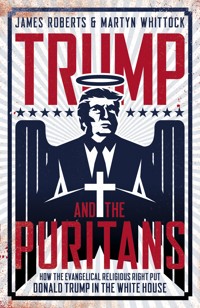
The year 2020 is a hugely significant one for the United States of America, marking as it does the 400th anniversary of the arrival of the Mayflower Pilgrims to the New World and their establishment of a 'godly' colony in (what was for them) the 'American wilderness'. But it is also the year of the next Presidential election, one where the current occupant is expected to stand for re-election. Many millions of Americans will not see this as a random juxtaposition of events, since for them the unlikely person of Donald Trump is the one chosen by God to implement a twenty-first-century programme of godly rule and the restoration of American spiritual exceptionalism that is directly rooted in those far-off times when Puritan settlers (who followed in 1630) first established a semi-theocratic 'New Jerusalem' in the 'New World'. The USA is the home of more Christians than any other nation on earth. In 2014 research revealed that 70.6 per cent of Americans identified as Christians of some form with 25.4% identifying as 'Evangelicals'. Eighty-one per cent of them, around 33.7 million people, voted Trump in 2016. How can it be that self-described Christians of the 'Evangelical Religious Right' see, of all people, Donald Trump as their political representative and thus defender of their cause? Trump and the Puritans argues that while Donald Trump is no Puritan, the long-term influence of these 17th century radicals makes the USA different from any other Western democracy, and that this influence motivates and energizes a key element of his base to an astonishing degree and has played a major part in delivering political power to Trump.
Sie lesen das E-Book in den Legimi-Apps auf:
Seitenzahl: 435
Veröffentlichungsjahr: 2020
Das E-Book (TTS) können Sie hören im Abo „Legimi Premium” in Legimi-Apps auf:
Ähnliche



















iii
v
To Claire, Antonia and Ann-Marie. Greatest gifts, greatest blessings, my daughters.
James Roberts
To John Chettleburgh, Steve Oldrieve, Stuart Brown and Andrew Sharland, who share my interest in theology and politics and the interaction of the two. With thanks for their friendship.
Martyn Whittockvi
CONTENTS
ACKNOWLEDGEMENTS
We are grateful to many people who assisted in the writing and production of this book. We wish to especially thank Ali Hull, with whom we first discussed the connection between Trump and the Puritans over an animated lunch at Clevedon, on the Somerset coast; and James Macintyre, whose introduction made this possible.
James: I would especially like to thank: Glenn Edwards, photographer – together we have seen the worst. Colleagues and friends, disputatious yet congenial: Brendan Walsh, Alban McCoy, Clifford Longley, Christa Pongratz-Lippitt, David Harding, Mike Holland, Catherine Pepinster, Ruth Gledhill, Liz Dodd, Maggie Fergusson, Christopher Lamb, Iain Millar, Joanna Moorhead, Rose Gamble, Ignatius Kusiak, Guy Keleny, Isabel Gribben, Pippa Lee, Marcus Tanner and Raymond Whitaker. My wife Remi, who knows the last shall be first.
Martyn: I would like to especially thank my wife Christine, for her never-failing support, interest, patience and willingness to listen to my latest ideas. And our daughters Hannah and Esther, who xhave been members of many an animated discussion and whose interest in politics and theology greatly inform such conversations.
We also wish to thank Robert Dudley, our agent, Olivia Beattie and James Lilford and the team at Biteback for all of their advice, encouragement and support.
PREFACE
The ‘Trump phenomenon’ is often described as the US version of a populist trend that has impacted on many areas of contemporary global politics. Exploring it is a key part of understanding the modern world and its complexity. As the US gears up for the 2020 presidential election – and as the polarisation of US politics increases – the nature of this phenomenon, its origins, its impact on the USA and its long-term effects are the subjects of analysis, speculation and heated debate. We hear it and read it via the broadcast news, in our newspapers, across the internet and on social media. Again and again people ask: ‘What is going on in the USA? Why is it happening?’
Despite the global political similarities, Donald Trump’s success is also rooted in a peculiarly American experience, since a very large and influential part of his support base lies among Christians of the so-called ‘evangelical religious right’. The influence of US evangelical Christians on national politics has never been more pronounced than it is today. From the appointment of Supreme Court judges, to US relations with Israel, from support for the wall, xiito abortion legislation, the power of this extraordinary lobby is seen in the changing politics and policies of the nation. In this, religious faith has an impact that is quite unique to the USA among 21st-century Western states; and it stands in comparison with the impact of Islam in other countries. There is clearly something distinctive about US culture and politics that sets it apart from comparatively developed democratic societies and states.
Remarkably, 2020 is not only the year of the next US presidential election, it is also the 400th anniversary of the arrival of the Mayflower Pilgrims in North America and the beginnings of Puritan New England. In addition, both the election and anniversary occur in the month of November. Is this mere coincidence, synchronicity or a providential arrangement of events? While readers will have their own opinions, there are clearly those in the modern USA who would consider this juxtaposition of dates as being something more than mere random chance. To them, God’s providence is shaping the pattern of modern history. But, regardless of differing conclusions reached concerning the significance of the autumnal coming together of events in 2020, there is undeniably an historical link between the origins of Puritan settlement of North America and the remarkable events that have shaken the nation since 2016. What is going on in the modern USA has very deep roots. They are roots that stretch back into the almost mythological origins of the nation in the seventeenth century.
That is the contention of this book. The evidence we explore reveals how the original Puritan settlers (at Plymouth Colony and, especially, in Massachusetts Bay Colony) contributed something undeniably potent to the development of the eventual United xiiiStates, which emerged in the eighteenth century, expanded in the nineteenth and became a superpower in the twentieth. In the twenty-first century, modern America is still negotiating a way through the legacy of these events of 400 years ago. And this is so, despite the huge ethnic, demographic, political, constitutional, cultural and religious changes that have occurred in the intervening years. In short, huge numbers of US voters are still, in effect, doing ‘Puritan politics’.
As a result, this book provides an exploration of one of the most important forces driving the support for Donald Trump, which is delivering millions of election-winning votes: America’s Puritan heritage. Support for Trump among evangelicals is the latest manifestation of this key strand within the cultural DNA of the USA. As a direct result, the long-term influence of the Puritans makes the USA different to any other Western democracy; it motivates and energises a key part of the Trump base; and it has played a major role in delivering political power to the President.
Our exploration will bring together historic evidence and the latest journalistic analysis. The Mayflower Compact meets the tweets of @realDonaldTrump and New England Puritan ideology meets the political goals of modern evangelical conservatives. It is through untangling these ancient narratives and tracing their path through four centuries of history that we can begin to understand that, while aspects of the Trump phenomenon can be compared to wider global developments, what is occurring is still unique to the modern United States.
We believe that anyone wanting to fully understand what is currently happening in the USA must take this into account if they are xivto fully appreciate what is going on. Trump and the Puritans takes readers from the formative years of the seventeenth century to the remarkable events that have led to the current situation in the USA.
In carrying out this exploration we are grateful to a huge range of people, sources, assessments and evidence streams, which have made this possible. We have endeavoured to formally identify our sources in our endnotes. We have also attempted to be fair and balanced in a field of politics that has become increasingly heated over recent years. We hope that we have achieved this and that readers will gain a deeper (and historically more connected) insight into this crucial area of US politics. It goes without saying that all errors are our own.
James Roberts Martyn Whittock
INTRODUCTION
A RATHER UNEXPECTED ALLIANCE
AN IDEA THAT WENT BADLY WRONG
In the US presidential election year of 2004, The Guardian dreamed up a scheme to recruit thousands of readers to persuade American voters in swing states to reject sitting President George W. Bush and vote, instead, for the Democratic candidate, Senator John Kerry. ‘Operation Clark County’ would involve recruiting 50,000 readers to write letters to voters in Clark County, Ohio. In 2000, Bush defeated Democrat Al Gore in the tightest of races. Four years later The Guardian wanted to help the Democrats oust him. In 2000, Gore won Clark County by a mere 1 per cent – just over 300 votes. So, The Guardian contacted the director of the Clark County board of elections and paid $25 for a copy of the electoral roll. The scheme seemed set to change US history.
Unfortunately for The Guardian and ‘G2’ editor, Ian Katz, who came up with the idea, soon after the first 14,000 letters started arriving in the county in the rural Midwest, an un-anticipated response took shape. It was expressed succinctly in a headline in the 2local newspaper, the Springfield News-Sun: ‘Butt Out Brits, voters say’. ‘Each email someone gets from some arrogant Brit telling us why to not vote for George Bush is going to backfire, you stupid, yellow-toothed pansies’, was one reaction. Clearly, the scheme was not exactly going to plan. In late October The Guardian called a halt to ‘Operation Clark County’. In November, Bush won 51 per cent of the vote there, with a swing of 1,600 votes in his favour. The hapless Katz said afterwards that it would be ‘self-aggrandising’ to think The Guardian’s intervention made any difference to the result, but one wonders. Influencing voters by telling them how they should vote can be a far from straightforward venture, but some of those committed to such an approach have not been deterred.
Twelve years later, interventions by ‘Brits’ on behalf of Democratic hopeful Hillary Clinton against the Republican candidate Donald Trump were more sophisticated. Birmingham-born and Cambridge-educated comedian John Oliver successfully imported a very British brand of mockery to the US. His late Sunday night HBO TV show, Last Week Tonight with John Oliver, was launched in 2014 and rapidly garnered an audience of over 4 million. Donald Trump was manna from heaven for Oliver’s satire and, after ignoring the billionaire tycoon in the early primaries, he turned to deploying all the comic savagery he could muster once it was clear Trump might win the Republican nomination. Oliver’s fans found his show fearless, and it was widely applauded: it was nominated in six categories at the Emmys in 2016 and went on to win three awards. On the online news forum Daily Beast in February 2016, Marlow Stern declared that Oliver had ‘destroyed’ Trump. But Oliver hadn’t destroyed him. After Trump’s victory over the favourite, Hillary 3Clinton, in November 2016, Oliver urged his viewers to spend their time and money to help ‘support organisations that are going to need help under a Trump administration’, including the major abortion provider, Planned Parenthood. A horrified Oliver declared that ‘a Klan-backed misogynist internet troll is going to be delivering the next State of the Union address, and that is not normal’.1
Oliver was discovering that while there was a large sector of the American population – particularly in New York where he had made his home – who viewed the world with his level of knowing, not to say, British style of comedic sophistication, there was an equally large population in the so-called ‘flyover states’ that was suspicious of this apparent sophistication and was unconvinced by its presumption of moral superiority. The geographical and social pattern of ‘east/west versus the middle’ and ‘city and suburbs versus the countryside’ that would become even more entrenched in the November 2018 mid-terms had claimed another victim. However, by the time Oliver had become aware of this phenomenon – and long before 2018 – Hillary Clinton had made her own spectacular contribution to dividing the USA. And, unwittingly, to her own defeat.
A DEFINING MOMENT – THE BIRTH OF THE ‘DEPLORABLES’
On 9 September 2016, while addressing the LGBT Gala at the Cipriani Club in New York City, from a podium bearing the words ‘Stronger Together’, Hillary Clinton let the cat out of the bag. After praising her warm-up speaker for ‘her advocacy on behalf of the transgender community, particularly transgender women of colour’, 4she moved on to attack the running-mate of her rival for the presidency, Donald J. Trump. She described how Mike Pence, whom she did not refer to by name, had ‘signed a law that would have allowed businesses to discriminate against LGBT Americans’. As the audience understandably booed their disapproval, she expanded on her point:
And there’s so much more that I find deplorable in his [Trump’s] campaign: the way that he cosies up to white supremacists, makes racist attacks, calls women pigs, mocks people with disabilities – you can’t make this up. He wants to round up and deport sixteen million people, calls our military a disaster … Our campaign slogan is not just words. We really do believe that we are stronger together.2
Clinton nodded to the gender issues that were already starting to provoke debate in the US and in the UK, musing that ‘somewhere not far from here … is a young girl who is just not sure what her future holds because she just doesn’t feel like she’s herself and no one understands that’. Then she went on to make a number of campaign promises:
So, together we’re gonna pass the Equality Act to guarantee full equality. We’re going to put comprehensive, quality, affordable healthcare within reach for more people, including for mental health and addiction. We’re gonna take on youth homelessness, and as my wonderful, extraordinary, great daughter [Chelsea Clinton] said, we are going to end the cruel and dangerous practice 5of conversion therapy [whose proponents claim to ‘cure’ gays of their homosexuality]. We’re going to keep working toward an AIDS-free generation, a goal that I set as secretary of state, and with your help we’ re going to pass comprehensive gun laws…
The chants of ‘Hill-a-ry! Hill-a-ry!’ bounced around the hall, and she seized the moment: ‘We are living in a volatile political environment. You know, to just be grossly generalistic, you could put half of Trump’s supporters into what I call the basket of deplorables. Right?’
The laughter and applause allowed her to pause, before she rose to a triumphant climax:
The racist, sexist, homophobic, xenophobic, Islamophobic – you name it. And unfortunately there are people like that. And he has lifted them up. He has given voice to their websites that used to only have 11,000 people – now have 11 million. He tweets and retweets their offensive hateful mean-spirited rhetoric. Now, some of those folks – they are irredeemable, but thankfully they are not America.
So, there were some Trump supporters – half of them – who were ‘not America’; but the other half were redeemable, and could still belong to Hillary’s America if they came to see the error of their ways.
But the other basket … that other basket of people are people who feel that the government has let them down, the economy has let them down, nobody cares about them, nobody worries 6about what happens to their lives and their futures, and they’re just desperate for change. It doesn’t really even matter where it comes from. They don’t buy everything he says, but he seems to hold out some hope that their lives will be different. They won’t wake up and see their jobs disappear, lose a kid to heroin, feel like they’re in a dead-end. Those are people we have to understand and empathise with as well.
In other words, Hillary calculated that if she could win over the votes of the half of Trump’s supporters who might be wavering, she would become the next President of the United States. It seemed a reasonable calculation, but she had just made a terrible tactical error. The ensuing applause at the Cipriani Club covered up the fact that she had made a disastrous miscalculation. Because there, more exultant than anyone in the hall, was Steve Bannon, co-founder of the hard-right news website Breitbart News, who the previous month had been named chief executive officer of the Trump campaign. He knew the group she was referring to. He was well acquainted with those Clinton had named ‘the basket of deplorables’. He knew they despised the Washington elites, both Republican and Democrat, because they considered them as serving just two masters: their own self-interest, and Wall Street. Since the financial crash of 2008, caused by Wall Street financiers and bankers who had been rescued from ruin by trillions of dollars of public money – and who had by-and-large emerged relatively unscathed from the catastrophe of their own making – many of those in ‘the basket of deplorables’ had held this elite – politicians and their Wall Street allies – in contempt. They believed, not without some cause, that the hardship 7they were now enduring was a direct result of the financial rescue of the billionaires. The bitterness was tangible and Bannon knew all about it. And he knew how to use it.
The ‘continuing progress’ that Clinton claimed America was rooted in was not progress as far as these Trump supporters were concerned, with its ‘Equality Act’ and emphasis on group identities. This liberal-secular agenda, which President Barack Obama had promoted for eight years, was not their agenda. As Clinton noted, they had seen their communities decline inexorably and could do nothing about it. The values that they had been taught were the route to success in an America they believed in – blue-collar fathers and mothers making sacrifices to raise their family in the hope that their children would have a better life, an easier life, than the life of their parents – no longer applied. They could sacrifice as much as they liked, and dream as much as they could dream, but the odds were now so heavily stacked against them that the hope that had nourished their striving was, in this new America, a fantasy. The door to the American Dream was locked and bolted. Across the so-called ‘Rust Belt’ of the USA – from Pennsylvania, through Ohio and Michigan, to northern Indiana and eastern Illinois and Wisconsin – the abandoned factories spoke eloquently of their experience of America. The same could be said of the boarded-up shops in the small towns of West Virginia whose coal mines had closed. But it was not only in these states that the mood was angry and alarmed. In the white picket-fenced, small-town communities across much of the Midwest, emotions were also running high. And, for many, the frustration with the economic situation was matched by a deep ideological disquiet, which was becoming anger.8
To many living outside the seaboard states, it seemed that the foundation of their traditional hope – their Christian faith that was mirrored in the public conversations of what they still considered to be ‘a Christian country’ – was now held in contempt in most of the media that hosted the national conversation. To them, for every voice upholding traditional Christian faith and traditional morality, there seemed to be two that derided it. Hillary Clinton’s politics explicitly embraced every minority group imaginable but failed to see the ones – in their view – that were the least complaining and most deserving: themselves. As they saw it, in a world of liberal identity politics they had been denied an identity that they themselves would recognise. Her invitation to them to join her was seen immediately for what it was: an attempt to split the Trump vote. From their perspective, her attempt was risible and presumptuous. Clinton had posted her invitation into a chasm.
Unbeknown to her, however, she had presented this part of the electorate with a priceless gift. She had provided them with a group identity. From now on all Trump supporters, ‘redeemable’ or ‘irredeemable’, would feel the power of belonging. They had a team. They were the ‘deplorables’. The term quickly became a badge of honour that was worn with pride. Inadvertently Clinton had given them a label and it unwittingly assisted them in focusing much of their anger on the kind of America that had gained public approval since 2008.
After the passing into law of what Hillary and her supporters in the US and elsewhere called ‘marriage equality’ – a term that many ‘deplorables’ regarded as a form of Newspeak – President Barack Obama ordered that the White House be bathed in the colours of 9the rainbow. In the eyes of many this was a tender act of solidarity. After centuries of the darkening of marriage through prejudice and exclusion, America had taken a step towards a new era of equality, perhaps the most important one since the Supreme Court’s Roe v. Wade ruling in 1973, which affirmed a woman’s right to abortion.
In the eyes of the ‘deplorables’, however, the rainbow White House was a transparent act of liberal-secular passive aggression. Under the guise of inclusiveness, the government was excluding the huge section of traditionally Christian Americans who believed that marriage was, by definition and nature, an institution that joined together one man and one woman. Hillary Clinton took it for granted that she and her supporters were on the right side of history; implying that humanity was on a path from lesser to greater moral virtue and that she and her allies were leading the way. However, she and her supporters collided with an entrenched position that had millennia of history in Judaeo-Christian scripture and tradition behind it: ‘In the image of God he created them; male and female he created them.’3 To the most active defenders of this belief system, it seemed that the liberal secularists had thought that they could overthrow this ancient natural order without looking back. The future belonged to liberal secularism. But now ‘they’, the ones left behind by history, Americans who felt they had had ‘the land of the free and the home of the brave’ pulled from under their feet, to be replaced by an a-patriotic and unrecognisable patchwork of banners and loyalties, suddenly had a flag around which they could rally, along with the Stars and Stripes. The battle was joined over traditional Christianity, US patriotism and economic anger. And its articulation as a distinct cause gave the opposition to Clinton the 10sudden appearance of ‘a crusade’. Albeit a crusade whose banner was being held aloft by a rather unlikely Christian crusader: Donald Trump. Homemade roadside signs, such as that observed outside Luverne, Alabama, read: ‘THANK GOD WE ARE DEPLORABLE.’4 It would prove to be a heady and unorthodox kind of moonshine that was being distilled in the ‘flyover states’.
THE MYSTERY OF DONALD TRUMP, THE ‘CHRISTIAN CRUSADER’
Across much of the world Donald Trump is a hate figure. The people who floated the Trump balloon above Westminster in London in July 2018 and the 100,000 who demonstrated against his UK visit, which was marked both by a meeting with the Queen and by the launching of the balloon, were hardly able to explain their hatred beyond saying that Trump was ‘horrible’ – a word frequently used when those protesting against the presence of the US President were asked to explain why they disliked him. He excited similar levels of opposition when he visited London again in 2019.
Harvard students who were so traumatised – the day after the presidential election – that they were excused completion of their assignments were similarly unable to explain why they were so incapacitated. But what was clear was that behind the opposition and the trauma was a mystery and an enigma. How could a man with such well-documented personal failings, whose personality traits were so unappealing to so many, be elected President of the United States?
And, as the identity of his supporters was examined more closely, how could it be that self-described ‘evangelical’ Christians could 11see such a man as their political saviour? These Christians would be asked many questions along the lines of: ‘Aren’t you all about forgiveness? About loving your enemies? About helping the poor? How do you reconcile these teachings of Jesus with backing a man like Trump?’ And their answers were sometimes as simple and instinctive as the views of those who launched the Trump balloon in London. But not often. For the most part, evangelicals who were Trump supporters knew exactly why they voted for him.
The phrase ‘it’s the economy, stupid’ was coined by James Carville, Bill Clinton’s election strategist in 1992, as part of a Democratic strategy to remind voters about the weak George H. Bush economy. However, the world has moved on since then. It is now clear that voters care about other things too, and they care about some things even more than the economy, and whether they will be better or worse off. They care about what they consider to be the distinctive culture and values of the country in which they live, and if they think these values are under attack or being eroded, they will vote to defend them even if this defence carries an economic price. Trump’s slogan ‘Make America Great Again’ brilliantly referenced both the American economy – he would bring jobs lost as a result of globalisation back to the United States – and American culture. Being American, he insisted, was no longer something to be apologetic about: he would bring back pride in being American (as he and his supporters defined it). As they saw it, the ‘American way of life’ was something that could be defended before the whole world because it was the best way of life that the world had so far produced. Among these Americans, there had always been an ill-disguised suspicion that the patriotism of the previous President, 12Barack Obama, had not run very deep.5 This made Obama popular in the UK and Europe, where patriotic nationalist fervour had long been regarded as a rather suspect emotion among more educated people, particularly following two nationalistic world wars that had torn Europe apart. But in America it became clear that patriotism had been bottled up, rather than diffused or deflected. And in Europe, too, it is rapidly becoming clear that the potency of competing nationalisms is far from being defused.6 When Trump uncorked that particular bottle in the USA, the energy released was – in rally after rally – quite appalling, or quite magnificent, depending on one’s viewpoint.
In Britain, the Brexit vote uncovered a hidden nationalist patriotism on the part of many Britons. Those whose loyalty to a more narrowly defined version of country and culture took precedence over their acceptance of British-European identity and an administration based in mainland Europe (that might or might not deliver greater prosperity) momentarily had a chance to speak in the referendum of June 2016. They duly delivered a kicking to the leaders of most UK parties, their EU partners and the other half of a deeply divided electorate, taking many by surprise. But even here there was a fundamental difference between the US election of that same year and the Brexit vote. In the US election, God was an acknowledged player. In the Brexit vote, he wasn’t. That is not entirely true, however. A fringe group of numerically small, but energetic, UK Christians made much of their claims that the EU represented an anti-Christian fulfilment of biblical prophecy.7 It was an extreme (and much disputed) millenarianism that would have been understood across the Atlantic but would have mystified 13the vast majority of Leave voters, had they even been aware of these particular accusations against the EU. Things were – and are – different in the USA.
The presidential inauguration of Donald Trump, on 20 January 2017, featured six religious leaders, more than any other inauguration in history. One of the five Christians who prayed with Trump was Paula White, a televangelist who had been his spiritual adviser since 2002. ‘Let these United States of America be that beacon of hope to all people and all nations under your dominion, a true hope for human kind,’ she prayed, ‘in the name of Jesus Christ. Amen.’8 Seven months later, on The Jim Bakker Show, she said that Trump had been ‘raised up by God’, and that ‘we are scaring the literal hell out of demonic spirits’. This was spoken in the context of Trump’s nomination of the so-called ‘originalist’ Neil Gorsuch to the Supreme Court. ‘Originalists’ interpret the US constitution as stable and unchanging, in a political version of the biblical fundamentalism espoused by many traditional Christians in the USA. Paula White’s enthusiasm revealed that a major hope among those often termed the ‘Christian Religious Right’ or ‘evangelicals’, regarding the Trump presidency, was for nominees whose rulings would accord with their faith. ‘If we get two more [Supreme Court justices] we will be able to overturn demonic laws and decrees that have held this nation in captivity,’ White declared.9
Franklin Graham, son of Billy and head of the Billy Graham Evangelistic Association, took his inauguration text from the New Testament letter, 1 Timothy 2: 5–6a: ‘For there is one God and one mediator between God and mankind, the man Christ Jesus, who gave himself as a ransom for all people.’10 Many in the UK (whether 14of faith or no faith) would have struggled to see this as a preparation for an endorsement of President Trump. In the USA, too, the approach has been questioned. As the presidency progressed, Graham was persistently challenged to defend Trump from a Christian point of view. While not defending Trump’s history of alleged immoral behaviour and intemperate comments, Graham held that God had placed Trump in the White House, despite his character flaws, because he was the man who could get God’s work done at this – in Graham’s view – absolutely critical point in US and world history. US liberals were incredulous.
It was indicative of what some contemporary evangelical Christian commentators have called the ‘Cyrus Factor’ – a reference to a king of Persia described as an instrument of God in the Old Testament – whereby God might choose to use an imperfect person in order to accomplish a divinely ordained task. We shall return to this view of Donald Trump as we explore and seek to understand other areas of support for him within the so-called ‘evangelical religious right’, for it is one of the powerful forces driving support for him from within this influential section of US society. It also helps to explain some, otherwise inexplicably sanguine, approaches to his actions and alleged behaviour that shock many other observers. As such, we need to put a marker on it now, because referring to it will help explain many of the more puzzling areas covered in this book. For, so long as Donald Trump promises to deliver on areas considered as quintessentially ‘home territory’ to traditional right-leaning evangelical voters, other areas (alleged or self-evident) of his life – conduct, speech and policies (that might otherwise give cause for concern) – can be ignored or marginalised.15
Meanwhile, Britain has drifted ever further away from its cousin across the water. Franklin Graham was invited by the Lancashire Festival of Hope to preach at Blackpool’s Winter Gardens in September 2018. In July, Blackpool Transport banned adverts for the event being placed on the side of the town’s buses, citing ‘heightened tensions’. Gordon Marsden, Labour MP for Blackpool South, called on the government to deny Graham a visa. ‘Graham’s visit to Blackpool is likely to cause considerable offence,’ he said. The Muslim Council of Britain said the government had a duty to deny Graham a visa. Otherwise, it claimed, ‘it will send a clear message that it is not consistent in challenging all forms of bigotry’. Two more MPs, Paul Maynard and Afzal Khan, opposed the visit, while the Blackpool Methodist Circuit said it ‘cannot support any preaching or teaching that promotes homophobia or is likely to be damaging to interfaith dialogue’.11 Three Blackpool churches planned to parade a four-metre model of Jesus wearing a rainbow sash through the town centre on the weekend of the visit. The differences between the UK and USA could not have been more clearly articulated. A report in The Guardian on 9 September 2018 described Graham as ‘a prominent US evangelical preacher with links to Donald Trump and a track record of Islamophobic and homophobic statements’. Graham has said that Islam is evil, and that Satan is the architect of same-sex marriage and LGBT rights.12
In Britain in the week before the November 2018 mid-term elections in the US, the broad position of most commentators regarding Trump was less heated than the opposition to the Graham visit, but still hopeful that the President would be reined in. A Democratic majority in the House of Representatives would do this 16job nicely, was the rough consensus. The astonishing successes of the US economy since Trump’s election were acknowledged, but praise and enthusiasm for these achievements were distributed with care.
Trump, meanwhile, embarked on what must have been an exhausting programme of carefully targeted rallies at which he appeared to draw energy from the massive turnout they all commanded. His aim was to endorse candidates in tight races, hopefully swinging the vote to the Republicans and thereby maintaining the party’s majority in both Houses of Congress.
At Pensacola, Florida, on 3 November, he gave his full and enthusiastic support to Ron DeSantis for governor against Andrew Gillum, and to incumbent governor Rick Scott running against three-term Democratic incumbent Bill Nelson in the Senate race. He duly disparaged Gillum and Nelson. But he saved his most extraordinary rhetoric for the end:
For years you watched as your leaders apologised for America. That’s what they did. They apologised for us. They apologised for your great country. Now you have a President who is standing up for America … We love our country. We really love our country … Reject the Democrat politics of anger and division.
‘Reclaim our proud and righteous destiny as Americans,’ he told the crowd. Florida was a place, he claimed, of ‘pioneers and visionaries, who raised up gleaming cities by the sea’. Several times he urged his supporters to get out and vote in order to defend the America that he was describing. For the people of the past did not make the sacrifices of blood, sweat and tears that had built the state just so 17that people today could ‘sit at home, while others try to erase their legacy, tear down our history and destroy our very proud American heritage’.
Getting further into his stride, he delivered exactly what the crowd had been waiting for:
For the sake of our freedom and for the sake of our children, we are going to work, we are going to fight and we are going to win, win, win. We will not bend, we will not break, we will never give in, we will never give up, we will never back down, we will never surrender. And we will always fight on to victory. Always. Because we are Americans and our hearts bleed red, white and blue. We are one people, one family and one glorious nation under God.13
For Britons, the exaggerated (almost Churchillian) register is recognisably Trump. Less recognisable is another set of references: ‘pioneers’, ‘visionaries’, ‘gleaming cities’, ‘righteous destiny’, ‘one glorious nation under God’. These ideas reverberate in American history from well before the Second World War, when Churchill honed his own form of rhetoric. Trump’s words evoked a much older tradition; one that can be traced back to the Puritan settlers. In this way he was appealing to a Puritan heritage in a way that is unthinkable and incomprehensible on the UK side of the Atlantic. And when Trump says ‘we will never surrender’, he was stating that this legacy will never be abandoned. It will never be replaced by an ideology that sees America as anything less than exceptional and a ‘righteous shining city’ (as he and his supporters define it), that can inspire the less fortunate, less virtuous, darker world to follow its guiding light. In this he was plugging into a 400-year-old 18tradition and forging an unlikely connection with the Puritans. For, among the many factors which explain the Trump phenomenon, the support of evangelical Christians is a vitally important one. About 81 per cent of American evangelical Christians, or about 33.7 million people, voted Trump in 2016.14 This base remained solid, even after two turbulent and controversial years, with a Fox News poll, prior to the November 2018 mid-terms, indicating that the approval rating for Trump remained as high as 73 per cent among this group of voters.15 In understanding the power of this highly influential lobby and its outlook, we need to view things through the lens of the seventeenth century and its consequences.
The Trump presidency is seeing nothing less than a struggle for the soul of America. In 2017, Mike Huckabee (Governor of Arkansas 1996–2007 and a Republican presidential candidate in 2008 and 2016) asserted that ‘he [Trump] truly understands and welcomes godly advice and he sees the value of prayer’. Furthermore, Huckabee stated: ‘I believe Trump’s historic battle for the White House in 2016 metaphorically reminds us that America too is in a historic battle not only for its political future but also for its very soul.’16
The aim of this book is to show how the four-centuries-old Puritan legacy serves to illuminate both the parameters of the ‘struggle’, and the ‘soul’ itself that is being so bitterly contested in the USA.
273NOTES
1 Marlow Stern, ‘John Oliver: We must fight Trump, a “Klan-backed misogynist internet troll”’, Daily Beast, 13 April 2017, https://www.thedailybeast.com/john-oliver-we-must-fight-trump-a-klan-backed-misogynist-internet-troll?ref=scroll (accessed November 2018).
2 The speech, according to a pool report, reported by Time at: http://time.com/4486502/hillary-clinton-basket-of-deplorables-transcript/ (accessed November 2018).
3 Genesis 1: 27, Holy Bible, New Revised Standard Version, Anglicised Edition (Oxford: Oxford University Press, 1995). All Bible quotations in this book are from this version of the Bible, unless otherwise stated.
4 Michael S. Williamson/the Washington Post via Getty Images, https://www.vox.com/policy-and-politics/2018/10/29/18015400/2018-midterm-elections-results-white-evangelical-christians-trump (accessed November 2018).
5 One of the factors feeding into the so-called ‘birther’ conspiracy theories in 2008 and after, which falsely claimed that Barack Obama was not actually born in the USA, alongside related claims designed to undermine his credentials as a US citizen.
6 Witness the impact of Front National in France, Jobbik in Hungary, Law and Justice in Poland, AfD in Germany and the rise of the far right in Austria, Sweden and elsewhere; also, the vote to leave the European Union in the UK.
7 In the UK, these particular Christians would describe themselves as ‘Bible-based evangelicals’ but certainly do not represent all those who would also use the same descriptor of themselves. This is because there is not the same degree of theological and political homogeneity among this group of believers as in the USA.
8 Ruth Gledhill, ‘“Most Importantly, We Will Be Protected By God.” Donald Trump Inauguration’, Christian Today, 20 January 2017, https://www.christiantoday.com/article/trump-inauguration-live-blog/104035.htm (accessed July 2019).
9 Leah MarieAnn Klett, ‘Televangelist Paula White Says Opposition to Donald Trump Stems from “Demonic Spirits”’, The Gospel Herald Society, 22 August 2017, https://www.gospelherald.com/articles/71284/20170822/televangelist-paula-white-opposition-donald-trump-stems-demonic-spirits.htm (accessed July 2019).
10Holy Bible, New International Version (Colorado Springs, CO: Biblica (worldwide), Grand Rapids, MI: Zondervan (USA), 1973, 1978, 1984, 2011).
11 Harriet Sherwood, ‘Muslim group calls for preacher linked to Trump to be denied UK 274visa’, The Guardian, 9 September 2018, https://www.theguardian.com/world/2018/sep/09/muslim-council-insists-evangelical-preacher-franklin-graham-be-denied-uk-visa (accessed November 2018).
12 Ibid.
13 For the full speech transcript see https://factba.se/transcript/donald-trump-speech-maga-rally-pensacola-fl-november-3-2018 (accessed November 2018).
14 This is based on figures indicating that, in 2016, white evangelical Christians constituted 17 per cent of the US adult population and 26 per cent of actual voters (so the figures quoted above could be higher since not all evangelicals are white). See Dylan Scott, ‘White evangelicals turned out for the GOP in big numbers again’, Vox, 7 November 2018, https://www.vox.com/policy-and-politics/2018/10/29/18015400/2018-midterm-elections-results-white-evangelical-christians-trump (accessed November 2018). The size of the Trump vote from this section of society is based on figures from the exit poll conducted by Edison Research, for the National Election Pool, a consortium of ABC News, Associated Press, CBS News, CNN, Fox News and NBC News. These voters responded by self-identifying under the category: ‘Would you describe yourself as a born-again or evangelical Christian?’ Some later reports suggested that this response only reflected the views of ‘white evangelicals’. However, there was no ethnic characteristic in the wording of the exit poll question.
15 Dylan Scott, ‘White evangelicals turned out for the GOP in big numbers again’.
16 Stephen E. Strang, God and Donald Trump (Lake Mary, FL: Charisma House Book Group, 2017), p. xii.
CHAPTER ONE
CREATING A PURITAN BRAND
The year 2020 is a defining one in the USA. For a start, it is the year of a much-anticipated presidential election. Will the controversial incumbent of the White House win a second term as leader of the most powerful nation on earth? After four bitterly contested years as President, the matter is once again to go before the US electorate. Furthermore, Donald Trump’s call for a return to ‘civility’ in the political debate – in the run-up to the mid-term elections in November 2018 – only led to gasps of disbelief among his opponents (including ex-President Barack Obama) as they claimed that he was the one who had so effectively coarsened it in the first place. Things have not got calmer since. America is once again at a political crossroads.
However, as if that was not enough to make 2020 stand out in modern US history, the year also marks the 400th anniversary of the arrival of the Mayflower Pilgrims in the New World and their establishment of a ‘godly’ colony in what was for them the ‘American wilderness’. Many millions of Americans will not see this as a random juxtaposition of events, since for them Donald Trump is 20the one chosen by God to implement a 21st-century programme of godly rule and the restoration of American spiritual exceptionalism that is directly rooted in those far-off events, when Puritan settlers (who followed in 1630) first established a semi-theocratic ‘New Jerusalem’ in the ‘New World’. For millions of key voters, the link is providential, not random. These are Christians of the evangelical religious right. And if we fail to grasp this, then key elements of the Trump phenomenon and key motivations within powerful sections of his support base will remain a mystery to us.
The alliance between Trump and the evangelical religious right is of great importance due to the large numbers of voters involved (as we saw in the Introduction). For, in a way surprising to many outside the USA and despite recent numerical decline, the number of Americans identifying as Christian remains huge. The USA is home to more Christians than any other nation on earth. In 2014 an extensive programme of research revealed that 70.6 per cent of US adults identified as being Christian. And of the total US adult population, 25.4 per cent identified as ‘evangelicals’.1 While the meaning of this term may be open to interpretation, those who use it in the USA as an identifier generally subscribe to a broad raft of beliefs: acceptance of the Bible as the inspired ‘word of God’ (which often has a fundamentalist and literal interpretation of the scriptures); traditional concepts of marriage, family and gender; and traditional attitudes towards the practice of sexuality, almost always involving classifying homosexual practice as sinful, with acceptable (heterosexual) sexual relations being reserved for within marriage. This is a collection of beliefs that would have been both recognised and accepted by most seventeenth-century Puritan believers. As 21a result, ‘Christian politics’ is a game-changer in any US election. And for those classified as ‘evangelicals’ this remains broadly recognisable as ‘Puritan politics’.
For people in the UK the latter point will be even more surprising than the former, since while the Christian Church is no longer a major influence in UK politics, the idea of anything remotely resembling ‘Puritanism’ deciding the future of government would be incomprehensible. This is because US and UK Christians have drawn hugely different lessons from their common history and understanding about ‘Puritans doing politics’. In the UK, the Puritans are a tainted brand – to put it mildly. We might admire their dedication to ‘purifying’ the church and their love of the Bible, but all that stuff about banning Christmas, plays, music and sport on a Sunday afternoon looks very joyless, judgemental and dull. Not to mention the slaughtering of Catholics in Ireland, which has left a legacy of bitterness that is still with us in 2020; and continues to deeply divide the way that that island views its history. And anyway, British people might say (assuming they have thought much about it at all) surely all that ‘Puritan politics stuff’ fell apart when King Charles II was restored in 1660. Indeed, in 1659 one contemporary commentator said of the Puritans, who had dominated politics since the execution of King Charles I in 1649, ‘the Lord has blasted them and spit in their faces’.2 On 30 January 1661, which was the twelfth anniversary of the execution of Charles I at Whitehall in 1649, the body of Oliver Cromwell was exhumed from its grave in Westminster Abbey.3 The corpse was then put through the indignities of a posthumous ‘trial’ for high treason and ‘executed’. This took the form of the body being hanged in chains at Tyburn, 22as a common criminal, and afterwards disposed of by burial in unconsecrated ground. When one of the surviving regicides was on his way to suffer retribution at the hands of exultant royalists, following a predictable trial verdict, somebody in the crowd yelled out: ‘Where now is your Good Old Cause?’4 It seemed a reasonable question, if rather unkind to pose it in such a blunt fashion to a man on his way to be hanged, drawn and quartered. But, all in all, it was clear that Puritans and politics had parted ways. Puritans were a thing of the past; and the future, in what would become the United Kingdom, would have little time for its Puritan past. After the restoration of the Stuart monarchy in 1660, dissenting non-conformists (the heirs of the Puritans) focused on rather less ambitious projects, such as social reform. British Puritans – and their association, in the popular consciousness at least, with drab-coloured clothes, stiff white collars and joyless souls – have been confined to the history books. And only a minority of 21st-century British people mourn their disappearance.
This is not so on the other side of the Atlantic. There the Puritan brand is still doing very well indeed. This is because it was Puritans (of one form or another) who set up their own version of an ideal community in New England in the seventeenth century (a ‘New Jerusalem’ in the ‘New World’), which has become such a key part of the cultural DNA of the USA since then and remains so today. What’s not to like about a turkey dinner at Thanksgiving, which was originally celebrated by Puritan Europeans and Native Americans sitting down at the same table in 1621? Millions of school kids, dressed up in Puritan garb at their school pageants, can’t be wrong, can they?
On top of this, the Puritan brand has left more than just a taste 23for turkey and cranberry sauce in the modern USA. The Pilgrim settlers at Plymouth Colony (in 1620) and even more so at Massachusetts Bay (in 1630) believed that they were founding, as the latter explicitly put it, ‘a city on a hill’; a beacon of godliness, Bible Commonwealths in which all life would be lived in accordance with the Christian scriptures. It is not hard to see how this has morphed over four centuries into a belief in ‘American exceptionalism’ and even into strident calls to ‘Make America Great Again’.
This formative experience in the seventeenth century has been one of the major factors in making the USA stand out from all comparable Western democracies. While a lot of water has flowed under the bridge since the 1620s and 1630s, something crucial and distinctive has fed into the national identity of what is now the USA as a result of its early history. This has led to a situation where a particular form of Christianity (‘evangelical’) remains highly influential as a confident, energetic, committed and active force within modern US culture and voting. The evangelical population has a significant political effect since its turnout is fairly reliable. This is especially the case if the electoral contest is tight. In 2016, about 81 per cent of white evangelicals supported Donald Trump.5 Trump’s victory illustrates how there is an unbroken stream of politically influential and biblically conservative Protestantism that flows from the seventeenth century to today, despite all the inflowing streams of other forms of Christianity (e.g. Roman Catholicism and Eastern Orthodox), not to mention other hugely influential faiths, such as Judaism and, more recently, Islam. As a result of this seventeenth-century formative experience, there is something very distinctive indeed about the modern USA. It points to the power 24of history in shaping a national identity. And in America’s long run of history, the Puritans played and play an influential part.
In order to explore the importance of this legacy, it is necessary to examine who these Puritans were and why they ended up in North America; the kind of society they created; the mindset they embodied; and their importance for the future trajectory of what would become the United States of America. In other words, to analyse their contribution to the historic and cultural DNA of the USA. We will then (in Chapter Two) see how this Puritan past was celebrated, as well as adapted, and how it contributed to the character of the communities emerging in the British colonies in the eighteenth century, in a way that was out of proportion to the numbers of people originally involved. We will also explore the state of the Puritan legacy as the newly formed United States ended the eighteenth century, and how this legacy was highly influential in the moulding of the young country. Then (in Chapter Three) we will see how this heritage was adapted, celebrated and manipulated in the maturing United States as the westward drive turned it into a continental power, before (in Chapter Four) examining the way in which what is now often described as the evangelical religious right emerged as a recognisable group (with political influence) in the twentieth century. And we will assess how this significant group is indebted to the peculiar Puritan roots of the USA. From this foundation we will be better placed to explore how Donald Trump has tapped into this support base and why these voters see in him a politician who expresses their hopes and anxieties. This is the essence of Trump and the Puritans. But first, we begin with the arrival of the Mayflower Pilgrims. For, small as their numbers were, they 25were the start of a much larger influx of settlers who would create a distinct culture in New England.
1620: A YEAR THAT CHANGED NORTH AMERICA
In November 1620, an exhausted group of immigrants arrived at Cape Cod, now in Massachusetts, in New England. These were the Mayflower Pilgrims. They arrived on a ship that had never crossed the Atlantic before and had been delayed by a couple of months, so they landed just as the New England winter was starting. The Mayflower was grossly overcrowded and was carrying 102 passengers and about thirty crew. This was the same number of people they had set sail with; while one passenger had died on the voyage, a baby had been born while at sea. That single death was a taster of much worse to come.




