


Erhalten Sie Zugang zu diesem und mehr als 300000 Büchern ab EUR 5,99 monatlich.
- Herausgeber: Phillimore & Co Ltd
- Kategorie: Sachliteratur, Reportagen, Biografien
- Serie: Phillimore Editions
- Sprache: Englisch
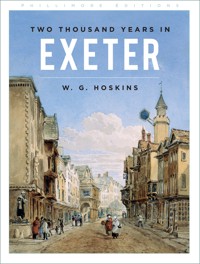
Exeter is one of the oldest cities in Britain: people have lived here without a break for more than two thousand years. The High Street has been in continuous use as a thoroughfare throughout that long period. For centuries Exeter was one of the largest and wealthiest cities in the kingdom and has always been the mother city of the South West. In this book, first published in 1960 and acclaimed as a 'small masterpiece', the author traces the essential historic development and character of a leading provincial centre. He describes its adventure from a Roman camp to a modern city, with particular reference to its social history, to the lives and surroundings of ordinary people, to the buildings and landscapes of the past. Above all, he is concerned with the recent past and devotes three thorough chapters to the 19th and 20th centuries. W. G. Hoskins died in 1992. The task of bringing the work up to date and preparing text and illustrations for this new edition of a classic work has been undertaken by Hazel Harvey, a distinguished local historian of Exeter. Much of Exeter has been destroyed, but much of the historic past of this entrancing city still remains. Hoskins' incomparable text is supported by a new selection of illustrations and maps, with an appendix on the street names of the city and place names in the neighbourhood. This book will be as valuable to the visitor as to the citizen of Exeter, for it tells where to look for the memorials of the past and for the history that lies behind them.
Sie lesen das E-Book in den Legimi-Apps auf:
Seitenzahl: 364
Veröffentlichungsjahr: 2023
Das E-Book (TTS) können Sie hören im Abo „Legimi Premium” in Legimi-Apps auf:
Ähnliche



















About The Author
William George Hoskins was born in Exeter in 1908. Educated at Hele’s School and the University of the South West, he went on to teach at the then University College, Leicester (1931-51) where he founded the influential School of English Local History, the first department of its kind in Britain. In 1951 he became Reader in Economic History at Oxford, and during his time there Devon (1954) and The Making of the English Landscape (1955) appeared, both highly influential works, both still in great demand.
Returning as Professor to Leicester University, after a few years he withdrew to his beloved Devon to campaign against wholesale redevelopment, destruction, and to champion similar environmental causes. He enjoyed a national reputation and high regard, which led to radio, television and press appearances, this Devon man changed our approach to the study of local history, and aroused our concern about the conservation of our environment.
He died at Cullompton, Devon, in January 1992.
About The Editor
Hazel Harvey came to Exeter in 1961 to teach at the University. The first edition of this book was newly published and fascinated her with its account of the city’s rich heritage. She is president of Exeter Civic Society and is the author of several booklets in the Society’s Discovering Exeter series and books on the Royal Devon & Exeter Hospital and the history of St Sidwell’s School. She contributed a weekly piece on Exeter’s heritage to the local paper for five years. In 2011 Phillimore published her acclaimed The Story of Exeter, which was reprinted in paperback in 2015.
Pre-war Exeter showing narrow South Street at the bottom of the photograph, Bedford Circus at the top, St Mary Major church next to the Cathedral’s west front, and the cathedral’s Norman towers and long Gothic nave.
First published 1960
Second impression 1963, reprinted 1969, 1974 and 1979
Revised and updated edition published 2004 by Philimore
This paperback edition published 2023
The History Press
97 St George’s Place, Cheltenham,
Gloucestershire, GL50 3QB
www.thehistorypress.co.uk
© Susan Hewitt, 2004, 2023
© Chapter XI and captions to illustrations, Hazel Harvey, 2004, 2023
The right of Susan Hewitt and Hazel Harvey to be identified as the Authors
of this work has been asserted in accordance with the
Copyright, Designs and Patents Act 1988.
All rights reserved. No part of this book may be reprinted
or reproduced or utilised in any form or by any electronic,
mechanical or other means, now known or hereafter invented,
including photocopying and recording, or in any information
storage or retrieval system, without the permission in writing
from the Publishers.
British Library Cataloguing in Publication Data.
A catalogue record for this book is available from the British Library.
ISBN 978 1 8039 9066 8
eBook converted by Geethik Technologies
Printed and bound in Great Britain by TJ Books Limited, Padstow, Cornwall.
Contents
List of Illustrations
Preface to the First Edition
Introduction to the Revised Edition
I BEGINNINGS: CAERWYSC AND ISCA
The Antiquity of Exeter
The Site of Exeter
The Coming of the Romans
Roman Roads and Streets
II EXETER UNDER THE SAXONS
The Dark Centuries
The Saxon City and its Setting
The Earliest Churches
The Danes
III THE NORMANS AND AFTER
The Siege of Exeter, 1068
Cathedral and Parish Churches
The Growth of Exe Island
Exeter Castle
The Building of Exe Bridge
IV EXETER IN THE MIDDLE AGES
The Earliest Mayors
Beginnings of a University
Parish Boundaries
The Underground Passages
Some Medieval People
The Labourer and his Wages
Some Medieval Buildings
Medieval Sanitation
The Magdalen Hospital
The Courtenays and the River
V EXETER PEOPLE IN THE SIXTEENTH CENTURY
Wealth and Poverty
Some Exeter Mayors
The Reformation
Some Old By-Laws
The First Tennis Courts
Exeter in 1587
VI CIVIL WAR AND COMMONWEALTH
The Line-up in Devon
The Siege of 1643
The Siege of 1645-46
Printing in Exeter
VII A GEORGIAN CITY
Two Visitors to Exeter
Exeter Merchant Families
Church and Chapel
A Changing City
VIII THE EARLY NINETEENTH CENTURY
Smells and Culture
A New Kind of City
The Working Class
The Cholera Epidemic
IX VICTORIAN EXETER
Mostly about Money
Exeter Politics
The Coming of the Railway
A Victorian Failure
A Victorian Success Story
Wages and Prices
Victorian Fortunes
Entertainment in Former Days
The Coming of the Motor Car
X EXETER SINCE 1914
High Street in 1919
Between the Wars
The Burning of the City
The Silent Revolution
Exeter in 1960
XI EXETER SINCE 1960BY HAZEL HARVEY AND COLIN HEWITT
Exeter Street-Names and Place-Names
Suggestions for Further Reading
List of Illustrations
Frontispiece: Aerial view of pre-war Exeter
1. Prehistoric Exeter
2. The topographical setting of the Roman fortress
3. The excavated bath house, 1973
4. The excavated under-floor heating system
5. Bath house arch
6. Fragment of multi-coloured mosaic
7. Steps leading to the basilica
8. Decorative tile antefix
9. The early Roman town, c.AD 75-150
10. Earth bank inside the city walls
11. The later Roman town, c.AD 150
12. The South Gate
13. Statue of young Boniface
14. A Saxon burial in the Cathedral Close
15. Silver penny issued 997-1003
16. Late Saxon Exeter, c.880-1068
17. St Pancras church
18. St Mary Major
19. Heavitree Yew
20. Norman Exeter, c.1068-1220
21. The gate-house of Rougemont Castle
22. St Mary Steps font
23. Tillet block
24. French puzzle jug found in South Street
25. The medieval Exe Bridge, 1662
26. Edmund Street, 1825
27. Remnants of St Edmund’s church
28. Old Exebridge and public garden
29. St Nicholas Priory Guest Hall
30. The Great Conduit in the High Street
31. The house at the corner of Frog Street and Edmund Street
32. The House That Moved illuminated, 1981
33. St Mary Arches church
34. Nos. 11-12 West Street
35. The Elephant Inn, c.1960
36. House on the corner of St Martin’s Lane
37. Toilets on the leat
38. Nos. 225-6 High Street
39. Bartholomew Terrace
40. Stepcote Hill, 1834
41. 19th-century copy of Hooker’s 1587 map
42. Exeter Ship Canal, c.1850
43. Larkbeare, ‘The Elizabethan House’
44. Fumigating Butcher Row
45. The Tudor House
46. Junction of Magdalen Street and South Street, c.1960
47. Valiant Soldier Inn
48. Poltimore House, 1960
49. The Custom House
50. Kennaway’s Wine and Spirit Merchants
51. Bellair
52. George’s Meeting
53. Mount Radford House
54. The Mint Wesleyan Chapel
55. The Royal Devon and Exeter Hospital
56. The second Exe Bridge
57. New London Inn, c.1870
58. The High Street and the Guildhall, c.1830
59. The opening of Rougemont House and Gardens, 1912
60. Charles Tozer’s map of Exeter, 1792
61. Colleton Crescent
62. Southernhay West
63. The Higher Market
64. Rear of the Higher Market
65. The Lower Market
66. Tuckers Hall
67. Cholera victim’s coffin carried along Goldsmith Street
68. Exeter Quay, c.1835
69. Willey’s Foundry, 1962
70. Willey’s coin-in-the-slot gas meter, 1947
71. The Theatre Royal
72. Removal of the wooden pontoon bridge, 1905
73. The Arcade
74. Corner of High Street and Bedford Street, 1908
75. Deller’s Café
76. The old City Library, Castle Street
77. Bedford Circus after the air raid, 1942
78. Preston Street, c.1890
79. Lants Almshouses, c.1930
80. Paul Street Car Park
81. ‘Come to Exeter and watch the natives pull it down’
82. Nos. 74 and 76 East Wonford Hill
83. Devon and Exeter Institution and Law Library
84. Prospect of Exeter, c.1825
85. Marsh Barton Industrial Estate, 2003
86. Royal Devon and Exeter Hospital, 1996
87. The House That Moved in transit, 1961
88. Paul Street junction with Goldsmith Street
89. Demolishing the city wall for Western Way
90. Miller’s Crossing foot and cycle bridge
91. Aerial view of Western Way and Exe Bridges, 2003
92. High Street, mid-1960s
93. High Street, 2004
94. The Public Library
95. Skyline at Exwick and flood relief works
96. Renslade House, New Bridge Street and old Exebridge
97. Renslade House and Exebridge North
98. The cathedral from Bedford Street
99. University of Exeter
100. The Phoenix Arts Centre
101. Plaque marking W.G. Hoskins’ birthplace
Preface to the First Edition
There is no adequate history of Exeter and to write one would be a life-work and fill two or three substantial volumes. Since the scale of the present book is relatively small, though no doubt quite sufficient for the general reader, a great deal of Exeter history has necessarily been left out. In this book I have concentrated upon the social history, on people and their doings, and on the kind of buildings and environment which they once enjoyed. Much of the material in this book is new, based upon researches over several years in the city archives and in the Public Record Office.
Once more Mrs Margaret Gray has laboured at the typescript of the book and eased the path of authorship. But I owe most to my wife for producing the domestic conditions in which continuous writing is possible, almost a luxury in these hard-pressed times.
I was born in Exeter, and my father before me, and his father before that. My great-grandfather came to the city as the son of a failing farmer in the bad years of the 1820s, so we have been here a long time. As a native I have been critical of much that is done now in the name of progress (whatever that vague word may mean) but that is the privilege of belonging to the family. One can be critical in ways that would ill become a stranger. Like most Exonians I do not like to hear my native city criticised, but I am ready to do it myself if the occasion demands it. Paradise itself can be no better than Exeter on a summer morning; but even Paradise no doubt has some small faults.
Acknowledgements
In preparing the book I have had some valuable help. Mr Paley, of the city reference library, has been of the greatest possible assistance in answering particular queries, thereby saving me much time; while Mr McKinley, formerly of the city muniment room, was also unfailingly helpful in producing information from the records in his care. For information about some of the old buildings in the city, and on some of its recent social history, I owe much to Mr A.W. Everett, an Exonian with an unrivalled knowledge of the topography of the old city.
I have also consulted the city surveyor (Mr John Brierley) and the city planning officer (Mr Harold Gayton) on many points. They have given me every assistance in their power, for which I am most grateful. Neither they nor anyone else, however, must be held responsible for any views expressed in this book. The historian must make up his own mind on controversial questions in the last resort, and I alone am responsible for what is said in these pages.
W. G. HOSKINS
October 1960
Introduction to the Revised Edition
W. G. Hoskins’ Two Thousand Years in Exeter has become the definitive history of the city by its most loyal son. It is a privilege to have been invited to update it some forty years after it first appeared. There have been major archaeological discoveries shedding light on the city’s early years, although Hoskins was amazingly prescient about what might be found. Tangible evidence now allows the Roman military presence and the early years of Christian practice to be included in Exeter’s history.
Exeter is regularly assessed as having a high quality of life. Hoskins would have agreed. After he retired from university teaching and returned to Exeter in 1968, he frequently headed letters to his friends ‘From the Elysian Fields’ or ‘The Shores of Paradise’.
Some information included in the first edition has now been omitted or modified in the light of later developments, but generally I have been reluctant to make changes to Hoskins’ authoritative text.
Acknowledgements
W. G. Hoskins’ daughter Susan Hewitt and her husband Colin encouraged the production of this revised edition and made many useful suggestions. Colin Hewitt supplied the paragraphs in Chapter Eleven on developments in public transport since 1960. I am grateful for advice from Stuart Blaylock, Richard Parker, Peter Weddell and Mark Stoyle on topographical matters, John Yonge on maps, and Ian Maxted of the Westcountry Studies Library and David Adcock of Exeter City Council on illustrations. Peter Thomas was particularly helpful in supplying historic photos from the Isca Collection. My son Francis helped put the new text on disk and my husband David revised the index as well as helping in many other ways.
I am particularly grateful to all those who supplied illustrations so willingly, rightly believing that it was a privilege to help reissue this classic book. I am indebted to Current Archaeology (illustration 3); Devon & Cornwall Constabulary (86); Exeter Archaeology (4-8); Exeter City Council (14, 15, 23, 24, 29, 49); Steve Hall, editor of the Express and Echo (85, 91); Deryck Laming (34, 39, 43, 45, 52, 61, 62, 83); George and Pauline Smith (13); Peter Thomas, The Isca Collection (frontispiece, 18, 30-3, 35, 37, 46-8, 50, 54, 57, 59, 63-6, 69-72, 74-82, 87-9, 92); University of Exeter (99); and the Westcountry Studies Library (12, 25, 26, 38, 41, 42, 53, 56, 58, 60, 68). Maps 2, 9, 11, 16 and 20 are from C.G. Henderson’s chapter on Exeter in the Historical Atlas of South-West England (ed. R. Kain and W. Ravenhill, 1999); Colin and Susan Hewitt provided photos 17, 21, 27, 28, 55, 90, 93-8, 100 and 101. Photos 10, 19, 28 and 36 are by Hazel Harvey.
HAZEL HARVEY
June 2004
CHAPTER ONE
Beginnings: Caerwysc and Isca
The Antiquity of Exeter
HOW OLD IS EXETER as an inhabited place, and where did it originally start? Is it possible to answer these questions? Everybody knows that Exeter was a Roman town, but was there any settlement of people here when the Romans arrived in the South West in the year 49—more than nineteen hundred years ago?
There is good reason to believe that the site of Exeter, or part of it, was occupied some considerable time before the Romans appeared on the scene. This takes us back to a time well before written records, and we depend therefore on certain material evidence for our scanty knowledge of this distant time. This material evidence is mainly that of coins which have been found within the city during various kinds of excavations in the past 200 years; and there is also the evidence of ancient tradition.
Let us take the coins first. In the year 1810, a considerable number of Hellenistic coins—that is, coins of Greek types from the eastern Mediterranean struck after the death of Alexander—were found in Broadgate while workmen were digging at a depth of twenty feet. These coins, the largest discovery of their kind yet made in this country, could be dated as belonging to the third, second, and first centuries before Christ. They suggested some sort of trade at Exeter with the Mediterranean countries some time between, say, 250 B.C. and the birth of Christ.
This discovery was so remarkable and unexpected that many scholars refused to believe the evidence. Two distinguished numismatists in 1907, examining them again, decided that the coins had been planted on the site in order to cause confusion, or that some private collection had been lost there. In either event, they decided that the coins were not evidence for the existence of a trading settlement on the site of Exeter at that early date.
Since they wrote, however, two things have happened to alter the picture. In the first place, other Hellenistic coins have been found in Exeter and, secondly, many more have been found at various places along the south coast of England—for example, at Penzance, at Mount Batten (now part of Plymouth), and near Poole Harbour in Dorset. We must, therefore, accept the conclusion that there was considerable trading between the Mediterranean countries and southern Britain a century or two before the birth of Christ, and that Exeter (under some other name) was one of the places engaged in this trade.
Roughly speaking, then, we may say that there were people living in Exeter about 200 years or more before the Romans came, and that Exeter as an inhabited place is about 2,100 years old. It may be somewhat older than this, but no evidence for an earlier date has yet come to light within the city. Excavations in 2003 on the site of the new Crown Courts, however, unearthed traces of Iron-Age occupation—pottery and ditches—on the bank of the Larkbeare stream which led down to the Exe.
Nor do we know what the earliest traders dealt in which would interest Mediterranean countries. It was not likely to be tin—not in Exeter at least, as there is no evidence whatsoever of tin being worked on Dartmoor in prehistoric times. It was more likely to have been cattle and hides, for which Exeter may even then have been the chief market of the whole region. We know that Cornish tin was being exported as early as the fourth century B.C. Continental merchants fetched it possibly from St Michael’s Mount, carried it by ship to the west coast of France, and so overland to the mouth of the Rhone and the markets of the Mediterranean countries. It is most likely that the same thing happened at Exeter with cattle, hides, and leather, except that the Continental merchants came in all probability from immediately across the Channel, from such places as Rouen in Normandy, the shortest sea-crossing. It seems very likely then that the processing and marketing of hides and skins, which is still a major undertaking on the Marsh Barton Industrial Estate, is the oldest industry in the city, going back two thousand years.
What else can we say about this early Exeter? One thing is that the High Street is the oldest thoroughfare in the city. It began as an ancient ridgeway some time in the Iron Age, if not earlier, again some two or three centuries before Christ. These ridgeways—roads which run along the back of prominent ridges in order to avoid marshy ground and river crossings as far as possible—are among the oldest roads we have. At Exeter, the ridgeway came down over Stoke Hill (from where we do not yet know). At the top of Old Tiverton Road, where the roundabout now is, it forked. One trackway ran along the top of the conspicuous ridge of Mount Pleasant and so along Polsloe Road (all this line lies on a high ridge to those who keep their eyes open), ending somewhere near Heavitree Church or perhaps going down to the river bank.
The main trackway, however, continued straight down Old Tiverton Road, down what is now Sidwell Street, and so into High Street. This must have been the main route of those early traders. It is significant that the biggest finds of ancient coins were made within a few yards of the High Street.
The earliest inhabitants of Exeter probably lived in the area between Fore Street and Bartholomew Street, in what was hardly more than a native village, despite its widespread trading activities. Exeter has been so much built over in the past two thousand years that it is very difficult to see its original topography—its steep hills, its deep-sided valleys, and its ridges and spurs. But if we think away, so to speak, the modern houses and streets and levels, we find that the ridge along which the High Street ran ended in a spur overlooking the river. The tip of this spur is what is now the disused churchyard of Allhallows-on-the-Walls, ending at the turn in the city walls known as the Snail Tower. On this spur the British had an earthwork—a hill-fortress—of the same type as those we see on the hill-tops of Hembury or Woodbury, though not so grand or formidable. This was their fortress in times of emergency. It seems probable that the earliest inhabitants lived in huts on the leeward side of this spur, on ground sloping gently down to the riverside. Centuries later, this part of Exeter was still known as Britayne (before its name was changed to Bartholomew Street) for it preserved the memory of the time when the ancient British lived there.
The people who lived in Exeter before the Romans came were Celtic. They belonged to a tribe known as the Dumnonii, whose territory covered the whole of South-Western England from Land’s End right up to the Parrett Valley in West Somerset. It is possible that Exeter was their tribal capital even before the coming of the Romans, but certainly it became so immediately under Roman rule.
The early inhabitants of Exeter could hardly have numbered more than a few hundreds, about the size of a large village today. The richer among them were traders but most of them were farmers and fishermen. The Exe in those early days teemed with salmon, perhaps as thickly as the rivers of British Columbia today. At any rate, the word Exe derives from a British word Eisca, meaning ‘a river abounding in fish’, and these fish were beyond doubt salmon.
Fishermen must have been a considerable class in the town population. Then there were the farmers, cultivating small plots of ground around the settlement, most probably the level ground now called St Sidwell’s, and perhaps raising cattle on the hill slopes to the north and in the marshes near the river in summer. All trace of these ancient farms has disappeared long ago, with the building-up of the city.
The Site of Exeter
There were many good reasons why a village and a trading settlement should have grown up where Exeter stands today. Here a long ridge of dry ground approaches the river, ending in a spur. This ridge formed a small plateau just about 100 feet above the river level, and on this plateau the city later grew. Not only was the plateau well above the river, but it consisted of gravel soils, lying on top of harder rocks. So it not only gave dry soils for building, which were particularly important when the buildings consisted of timber-frame huts with mud walls, but also an unlimited supply of fresh water not far below the surface. Without water no inhabited place could survive for three days; but Exeter has always had an abundance of water from springs and shallow wells sunk through the gravel to the rock below. Hooker, the first historian of Exeter, writing 400 years ago, puts it like this:
The situation of this city is very pleasant and agreeable, being set upon a little hill among many hills, for the whole country round about is mountainous and full of hills. It slopes towards the south and west parts in such a way that be the streets never so foul or filthy yet with a shower of rain they are cleansed and made sweet. And although the hills are commonly dry yet nature is so beneficial to this little hill that it is in every quarter full of water-springs, and by that means the whole city is thoroughly supplied with wells and tyepitts* to the great benefit and commodity of the city.
In former times, the great majority of houses, especially in the main streets of Exeter, had their own wells. These were fourteen feet down, and at that level they contained four to six feet of fresh water. Practically all these wells have been filled in and would be very difficult to find today, but one was found in 1933 in the Cathedral Close. It may still be seen in the basement of the Well House pub. It is said to be Roman.
Not only did the first inhabitants of Exeter enjoy a high, dry site with an unlimited supply of fresh water for all purposes, but they picked a site which was liberally endowed by nature with all the things necessary for existence. The river produced fish in abundance; corn came from the fertile red lands just outside to the east; and from the pastoral hills to the west came a plentiful supply of meat. All through its history travellers have remarked upon the abundant supplies of meat and fish to be found in Exeter. From the wooded hills to the north of the village came timber for building and fuel for winter fires.
But early Exeter was more than an ordinary British village. It had some overseas trade and here the river was the important factor. At Exeter the wide river suddenly narrowed, just as it does at Topsham today. It was probably the first place at which the Exe could be crossed by means of a ford at low tide, and later on it became the first point at which a bridge could be built. It was not until towards the end of the 18th century that another bridge was built below Exeter, at Countess Weir. Furthermore, Exeter stood at the tidal limit of navigation for ships. There is no doubt that the overseas traders who visited Exeter in prehistoric times unloaded their ships at the point where the Custom House now stands. At this point the red sandstone made a hard bench on which traders could congregate, for most of the estuary-banks right down to the sea must have been soft mud under natural conditions, and were flanked by wide marshes. At Exeter there was a good landing-place, and a landing-place moreover at a break in the cliffs which front the river for a considerable distance above and below the city. At Mount Dinham the cliff wall is about seventy feet high, and along the Quay, below Colleton Crescent, it is about fifty feet.
Just where the Custom House stands today was a break in the cliff wall. The observant visitor can still see this natural feature. Not only that, but a stream, which rose in a spring where the cathedral now stands, flowed down a valley (now filled up and called Coombe Street) and entered the river near the present Quay. This meant that goods landed on the natural quay formed by a ledge of red sandstone could be carried into the city without climbing a steep hill, by simply following the little stream upwards from the river-bank until the level plateau was reached.
Again, the site of Exeter lay some ten miles up river from its mouth and this was important when invaders were most likely to come by sea and to attack coastal settlements. At Exeter one was safe from such attacks, or at least there was ample warning of strange ships coming into the estuary. From the volcanic hill we call Rougemont one could look right down to the mouth of the shining estuary and a strange fleet could be spotted hours before it could attack. For all these reasons Exeter made a good trading-place, and above all, of course, it had something to sell—the products of a rich and varied countryside. And so the stage was set for the village to grow into a town, and later still into a rich medieval city, on its hilltop in the far West of England.
The Coming of the Romans
The ancient British name for Exeter seems to have been Caerwysc, meaning ‘the fortified town on the Exe’, but an even older name occurs in the tradition of a siege by the Roman general Vespasian in the year 49. The tradition tells us that there was already a settlement here when Vespasian was sent westwards, and so supplements the evidence of the Hellenistic coins. At the time of this siege Exeter is said to have been called by the rather formidable name of Caer-pen-huel-goit, which means ‘the fortified town on the hill near the high or great wood’.
Such long descriptive place-names are a characteristic of Wales to this day, and it is quite likely that Exeter had some such ancient names as this in prehistoric times. ‘The fortified town on the hill’ aptly describes the first site of Exeter, with its earthwork on the end of the ridge or hill. ‘The high or great wood’ probably refers to the wooded hills to the north of the city, what we now call Stoke Hill and Pennsylvania, which would have been densely wooded in prehistoric times. Stoke Woods today are a remnant of this great wood of two thousand and more years ago.
The tradition of a siege by Vespasian has generally been discredited by modern historians, mainly on the ground that it appears in the writings of a chronicler (Geoffrey of Monmouth) who is known to be very inaccurate, if no worse. He tells us that Vespasian was sent down by the Emperor Claudius to subdue South-West Britain, and that he besieged Exeter for eight days without success. A British king then arrived from the east with an army and fought with Vespasian. Despite great losses on both sides neither got the victory. The next morning, by the mediation of the British queen, the two leaders made peace.
Archaeological excavations in the 1970s found evidence to support this medieval tradition, in the form of extensive remains of a Roman military fortress built on the hill-top where Exeter subsequently developed as a city. In 1970 a sunken car-park was planned for the Cathedral Green. The Victorian church of St Mary Major near the west front of the cathedral was demolished to make way for it. In Chapter Two we shall see that this revealed traces of the Anglo-Saxon abbey and early Christian cemeteries, but here we must list the important Roman discoveries, which transformed our understanding of Exeter’s origins. Previously there had been only isolated discoveries relating to the arrival of the Roman army. A tile found in Seaton had shown that the Second Legion (the one commanded by Vespasian) was stationed there in AD 49. Vespasian’s biographer records that he fought thirty battles in his campaigns in Britain, conquered two powerful tribes and captured more than twenty native fortresses.
2 The topographical setting of the Roman fortress c.AD 50-75
3 The excavated legionary bath house by the cathedral’s west front in 1973. It was then covered until funds were available to exhibit it.
The 1970s brought opportunities for large-scale excavations, not only in the Cathedral Yard but also in the Guildhall area before the shopping precinct was built there. Other excavations took place in Paul Street, Fore Street, Catherine Street and Gandy Street. The Archaeological Field Unit found abundant traces of wooden barrack-blocks packed side by side in the present city centre, the line of the fortress walls and the position of its defensive towers, and, in the Cathedral Yard, substantial remains of a splendid stone-built legionary bath-house, from about AD 55. The bath-house is the oldest cut-and-mortared stone building in Britain. The legion moved on to South Wales after about twenty years, leaving Exeter as a tribal capital like Winchester or Silchester. It was now known as Isca Dumnoniorum—‘Isca, [capital city] of the Dumnonii’—though the natives no doubt kept their own name for it for many centuries after this. The Romans converted the fortress into a town on the Italian model, with a regular grid-iron street plan, fine public buildings including baths (smaller than the legionary bath-house), a basilica or town hall, a forum—the main square and market-place—and other features of a provincial city.
4 A clear view of the under-floor heating system of the legionary baths. This caldarium (hot room) is the largest yet discovered in Britain. Walls of the later basilica cut across it (in the centre of the picture).
5 One of the seven arches carrying hot air from the caldarium to the tepidarium.
They also did something which determined the layout of Exeter for the next thousand years or more. They built a substantial bank around the town, a rampart of earth about five feet high and over twenty feet wide at the base, with a walk along the top. This bank enclosed a much larger area than that of the fortress or even of the Roman town, especially on the eastern side where it must have been drawn across waste ground well outside the built-up area. This bank was constructed about A.D. 120 or a little later. And finally, about the year 200, the bank was superseded by a wall. The line the Romans drew for their bank and then their wall became also the line of the walls of the medieval city, a line which largely survives to this day.
6 This fragment of multi-coloured mosaic from the legionary bath-house is the earliest piece of mosaic found in Britain.
The walls erected by the Romans followed strong natural defences on two sides. On the north-western side (from what is now Northernhay down to the Snail Tower near Allhallows churchyard) the wall ran along the top of a precipitous slope dropping down to the old Long Brook. This brook was covered in during the 1840s and when the railway reached Exeter in 1860 the valley was also largely filled in. Just below the Central Station, for example, the made-up ground is over fifty feet in depth. The Long Brook still flows underground, reaching the mill leat at the end of Exe Street, at what used to be known as the Horse Pond.
At the Snail Tower the walls turned sharply and ran south-east down the spur, but kept well above the river on a low cliff which can still be seen at the Cricklepit Mills. Beneath this cliff there stretched a great marsh or swamp over which the tide flowed back and forth in Roman times. Centuries later this marsh was reclaimed by constructing a network of leats which drained it and also produced power for several mills. The drained area became known as Exe Island. But under natural conditions in Roman and Saxon times it was a formidable barrier against attack from this side.
7 Steps leading to the basilica (civilian town hall); probably a pillared private entrance for the magistrates.
8 Decorative tile antefixes from the roof of the legionary bath-house, apparently re-used for the basilica.
9 The early Roman town Isca Dumnoniorum c.AD 75-150. Water was brought in from the St Anne’s Well area along the St Sidwell’s ridge and circling around Rougemont.
10 Earth bank still standing inside the city walls at 14 Cathedral Close.
11 Later Roman town c.AD 150 to early 5th century. Stone gate-houses and the stone city wall were built in the early 3rd century.
On the other sides of the city the wall did not follow any marked natural feature. Having climbed the steep hill from the Quay (parallel with Quay Lane today) it then ran over fairly level ground (past Southernhay, which did not then exist), turned near the East Gate and then ran up the side of the volcanic hill of Rougemont to complete the circuit. Altogether the wall enclosed an area of just under 93 acres. The total circuit was about 2,600 yards, of which five-sixths are still preserved and mostly easily visible.
Considerable portions of the original Roman masonry can still be seen, especially in West Street and in Southernhay. The Roman work is composed of volcanic stone from Northernhay, quite unlike the rough red sandstone used in medieval times, and is much more finely jointed than the later work. The bank which preceded the wall can best be seen in Rougemont, backing the city wall, and in the garden of the Bishop’s Palace (private).
Roman Roads and Streets
Exeter, though rather smaller than the average tribal capital, was the most important place in the South-West and Roman roads converged upon it. The main route came in from the east. It came up the main street of Heavitree, or very nearly on this line, sighted upon the brow of the hill at Livery Dole.
Here it forked, just as the road does today, one line running down Heavitree Road and up what was Paris Street, to the east gate of the Roman town, and the other running down Magdalen Road. The latter was the main approach to Exeter for many centuries, indeed for well over fifteen hundred years. When kings visited Exeter they always came this way to the South Gate, which was the most important entrance to the city and was often known simply as the Great Gate.
This road—Magdalen Road and Magdalen Street—still runs almost dead straight like a true Roman road. But originally, before the Magdalen Road bridge was made about 1832, it plunged down into a deep valley, almost a ravine, and up the other side before it reached the level ground outside the South Gate.
The Valiant Soldier inn, on the corner of Holloway Street and Magdalen Street, stood at what was an important road junction in Roman times. Here three Roman roads met. One came up from Topsham, which was the outport of the city at that time. Another was the main road just described, coming down from the Midlands and Bath. And the third was Quay Lane, which was the direct way from the quay up to the city at the South Gate. The old way from the quay, along the coombe (Coombe Street) into the town, was cut off by the building of the walls. Not for many centuries were the walls pierced to make an additional gate—the Water Gate—so as to re-open the ancient way in.
Roman roads also ran westwards and northwards out of the city. The western road left by the West Gate and went over Haldon to Teignbridge. The northern road left by the North Gate and so over St David’s Hill towards North Tawton, probably crossing the Exe at or near the present Cowley Bridge. Another minor road left by the East Gate, went up St Sidwell’s and over Stoke Hill, where traces of it may still be seen on the slopes dropping down to Stoke Canon bridge. As there was a Roman signal station on the top of Pennsylvania (just behind what was the Panorama Café), Longbrook Street must also have been a Roman road, of a purely local importance.
Within the city itself we know very little of the Roman street-plan. Short stretches of street have turned up here and there, but most of the grid-iron plan was destroyed long ago by the excavating of cellars in the rich medieval city. High Street was a Roman street, just as it had been the principal track in earlier centuries.
12 The South Gate of Exeter: the principal entrance to the city from Roman times onwards. Demolished in 1819.
The main street out to the west was Smythen Street, with its continuation in Stepcote Hill. It is possible also that Waterbeer Street is Roman in origin, as it runs parallel with High Street. In the summer of 1959, too, some excavations in Bartholomew Street East revealed another short piece of Roman street, running roughly parallel with the present street towards Mary Arches Street about twenty-five yards back on the south side. In time we shall probably be able to piece together these fragments of the street plan of the second century and to draw the complete Roman layout.
Roman Exeter had three cemeteries, outside the north, east, and south gates. That outside the north gate lay just to the north of St David’s church and may be the earliest, as many coins of the first century have been found here. The fact that it lay near St David’s Hill is evidence for the latter being a Roman road. All the cemeteries were naturally located near a road, for ease of access. The eastern cemetery lay in the neighbourhood of Well Street and York Road, in St Sidwell’s, and the southern one in Magdalen Street or very near it, in the neighbourhood of the Acorn roundabout today. The Romano-British buried their dead well outside the inhabited area, unlike the Christian inhabitants of the city who buried all their dead (except a few rich enough to be buried in a church) in the Cathedral Yard. For at least a thousand years this was the only burial-place for the whole city, until the Bartholomew Yard was opened in the year 1637.
* A tyepitt was a deep well.
CHAPTER TWO
Exeter under the Saxons
The Dark Centuries
THE ROMANS WITHDREW FROM BRITAIN to defend their homeland early in the fifth century. What happened in the British towns after that still remains largely a mystery. In most towns there can be no doubt that all civilised life broke down. The handsome public buildings fell into ruin, streets were left unrepaired, and as time passed became blocked with fallen masonry just like a modern town after an air-raid. Many towns were completely deserted by their inhabitants, especially those on the eastern side of Britain which was wide open to the Anglo-Saxon barbarians from across the North Sea.
In the far west of Britain, however, life probably went on without a break—though not as before. Exeter was never completely deserted, although the built-up area almost certainly shrank in size, and life became more squalid and poverty-stricken. Exeter was too far west to be troubled by the barbarians from ancient Germany (just as it was in 1914-18, but not in 1939-45), and the walled town offered some security in any event.
But it is clear that civilised life must have broken down even in the quiet West, or so we think because there is a complete disappearance of coins before the end of the fourth century. Coins imply trade and a settled and stable government. At Exeter there are practically no coins after about A.D. 380. About 1,100 Roman coins have been found in the city. Probably hundreds more have been found and never recorded, but those of which we have a record furnish a good sample. They show Exeter at its most prosperous in the first half of the fourth century—no fewer than 300 coins belong to this period—but then follows a striking fall. After about 380 only two coins have been recorded.
There is a total silence in the history of Exeter for almost three hundred years: not a single reference in any document anywhere, not a coin or a piece of pottery, not a fragment of a building.
And yet the city must have lived on all through these dark generations. There may be two reasons why we have found nothing to fill this great gap. One is that the inhabited area was so shrunken that we have not yet come across it in excavations, and the other is, that the material culture—the houses, their utensils, their coinage or lack of it—was so miserably poor that it has all perished long ago. Coins and pottery and stone buildings survive long enough to be recognised, but the British who lived on amid the ruins of Roman Exeter were squalid slum-dwellers, possessing nothing that would last their own lifetime, let alone many centuries after them. It is possible, too, that their remains have in fact been unearthed from time to time, but, being so poor, have not been recognised for what they were.
13 Statue of the young Boniface in Newcombes Meadow, Crediton.
14 A Saxon burial in the Cathedral Close. The coffin had been laid on a bed of charcoal, a common practice in Middle and Late Saxon England. The grave had been cut into the floor of the Roman basilica.
At any rate, the next definite record of the existence of Exeter as a town does not occur until about 680. Then we are told, in a life of St Boniface, who was born near Crediton, that he received his first education in the abbey at Exeter. When had the Saxons reached Exeter, and when was the abbey founded?




