


Erhalten Sie Zugang zu diesem und mehr als 300000 Büchern ab EUR 5,99 monatlich.
- Herausgeber: Jonathan Ball
- Kategorie: Sachliteratur, Reportagen, Biografien
- Sprache: Englisch
On 6 September 1966, Prime Minister Hendrik Verwoerd was assassinated in Parliament by a deranged parliamentary messenger. The architect of apartheid was dead, sending shockwaves throughout South Africa and the world. Today, half a century later, the effects of Verwoerd's grand ambition linger on, and it is vitally important to reappraise the lasting impact – both physical and psychological – of the institutionalised racial inequality that he so industriously inculcated. In Verwoerd: Architect of Apartheid, Henry Kenney interprets Verwoerd in the context of his times, explaining the man and assessing his role in shaping South Africa's history. Originally published in 1980, Kenney's incisive study examines the rationale behind the policy of apartheid and probes the ideas of its chief architect and ideologue. Writing more than a decade after Verwoerd's assassination, Kenney skilfully distances himself from his subject and offers a dispassionate insight into the peculiar workings of the apartheid system. This is a fascinating study of a man who identified obsessively with the Afrikaner people, while aware that his foreign birth set him apart. This new edition contains an introduction by David Welsh, Professor Extraordinaire at the University of Stellenbosch, providing valuable political background and updating the book for a contemporary generation. This republication will satisfy an enduring interest in, and fascination with, the man responsible for, among other things, the policy of Bantu education, the creation of a Republic and the mad calculus of "separate development".
Sie lesen das E-Book in den Legimi-Apps auf:
Seitenzahl: 664
Veröffentlichungsjahr: 2016
Das E-Book (TTS) können Sie hören im Abo „Legimi Premium” in Legimi-Apps auf:
Ähnliche



















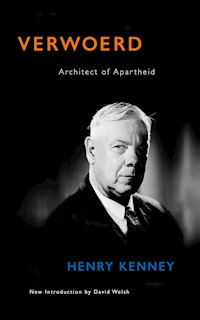
VERWOERD
ARCHITECT OF APARTHEID
HENRY KENNEY
New Introduction by David Welsh
JONATHAN BALL PUBLISHERS
Johannesburg & Cape Town
Preface
This book is an appraisal of Hendrik Verwoerd’s career in the context of his times. For a man who so dominated South Africa in his heyday, surprisingly little has been written about Verwoerd. There are two book-length studies, each highly unsatisfactory. One is by the former South African Labour M.P., now living in exile, Alex Hepple, and appeared the year after his death. It is readable, partisan, inaccurate and portrays Verwoerd as an authoritarian racist who could not change. At the other extreme is an effort which is so different from Hepple’s that one wonders at times whether it is about the same man. Perhaps the flavour of G.D. Scholtz’s two-volume, 600-page labour of love can best be conveyed by saying that it should have been subtitled The Man Who was Never Wrong.
Now, more than a decade after Verwoerd’s death, there should be room for a relatively detached assessment of his contribution to our history. This is both a work of synthesis and analysis. It is a synthesis because it is based on the numerous secondary sources now available, contemporary newspapers and parliamentary debates. The pedants who may complain that this is not a work of “original research” will be correct – but irrelevant. This is not the kind of book I have tried to write, and I freely concede that the definitive work on Verwoerd still lies in the future. It is an analysis because I have tried to clarify, at least for myself, some of the main issues of South African history in this century. Sadly, some of the most widely cited and seriously considered interpretations of our recent past have been by “radical” writers, who have been treated with more respect than they deserve by historians at our English-speaking universities. Marxist jargon seems to have an endless capacity to confuse and intimidate. I have addressed myself to the issues raised by “class analysis”; I am sure I have left no doubt about what I think of this way of rewriting history.
I wish to thank my friends and former colleagues, Brian Kantor and David Rees, for commenting on parts of the manuscript, for frequent discussions, and for encouragement when the going was not too easy.
My father’s encouragement was continuous and often strenuous. He contributed in other ways which can hardly be enumerated in a preface.
I also wish to thank Alison Lowry for her editorial work, in spite of the occasional act of censorship, for which I forgive her.
Finally, I was granted interviews by some prominent public figures concerning their impressions of Verwoerd. I do not know whether all of them would appreciate being mentioned in this preface. I have decided to take no chances, but am grateful to them all for their courtesy.
Introduction to the 2016 edition
Henry Kenney’s appraisal of H.F. Verwoerd, originally published in 1980, has stood the test of time as one of the best books written about a South African politician. It is a far better book than the hagiographic two-volume biography by G.D. Scholtz or the tendentious account by Alex Hepple. The merit of Kenney’s book is its balance and its accuracy. To this writer’s knowledge, no reviewer or other critic has been able to find a serious fault or omission. The republication 50 years after Verwoerd’s death comes at an appropriate time, enabling the reader to realise what apartheid meant, and how far South Africa has since changed. In his lifetime Verwoerd enjoyed a large cult following. By 2016 their numbers have dwindled into insignificance. Rather than “solving” the racial issue, Verwoerd compounded it, leaving later generations with the massive problem of repairing the damage.
The subtitle Architect of Apartheid needs qualification. Some years before Verwoerd’s entry into politics, the design of apartheid had been sketched, and principles had been laid down. Verwoerd’s role was more that of master-builder than architect. This is not to deny that Verwoerd added distinct touches to the design.
Dr Nico Smith, a Dutch Reformed Church clergyman, quoted Verwoerd as saying that he wanted to implant the concept of apartheid so deeply into society that no future government would be able to undo what had been done.1 Smith did not provide details of when and where he heard this, but it may well have been at a meeting of the Afrikaner Broederbond, of which both he and Verwoerd were members. (Smith later resigned from the Broederbond and became a doughty opponent of apartheid.)
Whether Verwoerd’s boast, as reported by Smith, will be realised, if only in part, remains to be seen.
* * * * *
Hendrik Frensch Verwoerd was born in the Netherlands in September 1901.2 His parents were strong supporters of the Boer cause in the Anglo-Boer War, so much so that they decided to emigrate to South Africa, arriving in November 1903. The young Verwoerd grew up in a household that was fervently pro-Afrikaner. Verwoerd senior, a building contractor by profession, was a devout Christian, eager to undertake missionary work for the Nederduitse Gereformeerde Kerk (N.G.K.).
After some years in Cape Town, whose white population was predominantly English-speaking, the family moved to Rhodesia in 1914. Hendrik, who had spent over a year at Wynberg Boys’ High School, was now enrolled at Milton High School, near Bulawayo. He shone as a pupil – and even played the quintessentially English game of cricket! But he disliked the imperial atmosphere of the school, and avoided singing the (British) national anthem.
His stellar performance resulted in the headmaster’s offering him a bursary, which he declined, since the family had been called to the Orange Free State by the Church. The headmaster took a dim view of this, deeming the Free Staters to be “those rebels” and chasing Verwoerd out of his office. One asset derived from his years in English-medium schools was an ability to speak fluent English.
In the Orange Free State, the Verwoerds found themselves in a thoroughly Afrikaans environment, and Hendrik attended an Afrikaans school in which he flourished, passing the matriculation examination with the top marks in the province.
Verwoerd’s intention was to study Theology at Stellenbosch University, where he enrolled in 1919. His progress was rapid: a BA degree in 1921 and an MA in 1922, both cum laude. By 1924 he had completed his doctoral dissertation entitled “The Blunting of the Emotions” (translation). By this time, his intellectual interest had switched to Psychology. Nevertheless he had applied to the N.G.K. authorities to enter the Theological Seminary. There are differing accounts of the fate of his application, both of which agree on Verwoerd’s stubbornness in refusing to cooperate with his interlocutors. Piet Meiring recounts his father, P.G.J. Meiring, chairman of the examining board for aspirant candidates, asking Verwoerd the standard question of why he wanted to enter the ministry. Verwoerd responded that this was his business and no concern of the board. Meiring senior was infuriated, and sharply rebuked him, whereupon Verwoerd withdrew his application. Dominee Meiring was furious, subsequently describing Verwoerd as “cleverer than is good for him”.3
In spite of this episode, Verwoerd seems to have remained within the Christian fold, although not a regular churchgoer, possibly because of pressure of work. He never, however, invoked supposedly biblical legitimations of apartheid in his speeches.
He was actively involved in student affairs, becoming chairman of the Student Council in 1923 and being active in the debating society. As the “cradle of Afrikaner nationalism”, the student environment consolidated his political views. His strong opposition to white/black contact was evident. Moreover, his concern with the poor white problem had been sharply increased by his first-hand observation of poor white living conditions in slums near Cape Town. He was horrified to discover that white and Coloured families were living in the same houses. No wonder, he concluded, that young Afrikaners could see no objection to marrying their former playmates.4
In addition to these extramural interests, Verwoerd made rapid progress up the academic hierarchy: he was made a temporary assistant in Psychology in 1923, a lecturer in 1924, and professor at the end of 1927. It was an astounding ascent, which, without casting doubts on his ability, probably owed something to the university’s eagerness to appoint bright young Afrikaners to senior positions. Remarkably, Verwoerd switched disciplines, becoming Professor of Sociology in 1932.
The publication, in 1932, of The Poor White Problem in South Africa: Report of the Carnegie Commission found that in 1929/30, conservatively over 300 000 whites, mostly Afrikaners, out of a total white population of some 1.8 million, were “very poor”. The severe drought and economic depression of the early 1930s substantially increased the numbers of very poor people. Their lack of skills and low educational standards meant that they could hardly compete against poor blacks (whose numbers were even larger). The Carnegie Commission recommended that poor whites be protected against this competition, but “merely as a measure of transition” for a period in which the poor white could adapt himself to new conditions.5
The poor white problem, with which Verwoerd already had acquaintance, created the opportunity for him to launch himself on the national stage. This occurred in 1934 when the N.G.K. organised a volkskongres on the problem. Verwoerd was a dominant figure in the proceedings. The core of his paper read: “If someone has to be unemployed, a white man or a native, it is best in the current circumstances and with the existing differences in living standards more economical for the nation that the native should be unemployed.”6
The justification for Verwoerd’s proposal was hard to follow, but it chimed with popular white sentiment – and helped to boost his reputation as a rising star in Afrikaner nationalism. He was appointed deputy chairman of the Congress’s continuation committee, and successfully pressed the United Party government to establish a Department of Social Welfare.
Another notable feature of Verwoerd’s contribution was his repudiation of the popular nostrum that the solution of the problem was sending poor whites “back to the land”: they should be rehabilitated where the greatest chance of success existed, namely, in the urban areas.7
* * * * *
By the mid-1930s it was becoming even clearer that Verwoerd saw his future as lying in volksdiens – service to the (Afrikaner) volk – and it was no giant leap to recognise, in South Africa’s circumstances, that involvement in politics was the best strategy.
His opportunity arrived in a roundabout way.8 It was apparent to the Nationalist leadership that Fusion in 1934 (the joining together of Smuts’s South African Party and General J.B.M. Hertzog’s National Party to form the United Party) had devastated the NP in the Transvaal. Indeed, in the 1938 election the NP won only a single seat, held by the redoubtable J.G. Strijdom. It was no less apparent to the NP leader, D.F. Malan, that the centre of political gravity in the country was shifting to the Transvaal. Without a sizeable contingent of Transvaal MPs, the NP had little hope of winning a general election.
A small group of Cape Nationalists (meeting on a train in 1935) concluded that without a pro-NP Afrikaans daily newspaper in the Transvaal the possibility of a breakthrough was slender. The solution? To establish such a newspaper, which was achieved in 1937 after a struggle to raise the capital necessary for such a venture. Much of the money derived from Cape sources.
Paul Sauer, a Nationalist MP and a confidant of Malan, suggested Verwoerd as the founding editor of Die Transvaler, as the newspaper was named. By 1936–37 Verwoerd was widely known in Nationalist circles: he had become a member of the Broederbond and was also a leading figure in anti-Semitic agitation.
Verwoerd did not require much persuasion to leave the relatively cloistered isolation of academia and ply his skills where he believed them to be most needed. Like D.F. Malan (founding editor of De Burger in 1915), Verwoerd had no journalistic experience. Sauer had suggested that he be appointed as assistant editor so that he could devote more time to party matters, but Verwoerd, self-confident as always, would not hear of this. He did, however, undertake to take a crash course in journalism at Die Burger’s offices in Cape Town. Essentially, however, Verwoerd never learned the journalist’s craft; with the connivance of the NP, he saw his primary role as a polemicist for the party. Much of his time would be devoted to party activity.
Strijdom, the leading figure in the Transvaal NP, was at first hesitant about Verwoerd’s appointment, fearing that he was one of those “liberal” Cape Nationalists who lacked the fiery republicanism that Strijdom himself displayed. The new editor soon showed that these apprehensions were misplaced. From the start of his editorship Verwoerd’s republicanism rivalled Strijdom’s – which caused some concern to Malan, who was anxious not to offend Afrikaners whose commitment to a republic was at best uncertain. Indeed, he had hoped that, as a Cape man, Verwoerd would do precisely what Strijdom feared.
Verwoerd’s editorial in the first issue of Die Transvaler, on 1 October 1937, was unambiguous in laying out the role he envisaged for the newspaper:“Die Transvaler comes with a calling. It comes to serve the volk, to make the sound of true and exalted [verhewe] nationalism reverberate as far as its voice can reach. Its inspiration will flow from this calling; the struggle will determine its character [translation].”
In a further article in a supplement, Verwoerd addressed a topical theme among Transvaal Nationalists: the Jewish “question”. Jews, he claimed, had established themselves as a separate group with indifferent, even hostile, attitudes to the national aspirations of Afrikaners. Their dominance in trade and industry made it difficult for Afrikaners to acquire their rightful share. It followed that Verwoerd was staunchly opposed to Jewish immigration from Nazi Germany. The reaction of the Jewish community was swift: Jewish advertisers boycotted Die Transvaler, thereby denying it much revenue that it desperately required.9 For some time thereafter advertising contributed no more than 15 per cent to the newspaper’s income – far less than a prospectively profitable newspaper should receive.
Undeterred, Verwoerd laid down political criteria for the acceptance of advertisements: no recruiting advertisements for the Union Defence Force would be accepted; and readers were urged not to patronise shops that did not advertise in Die Transvaler.10
The Second World War greatly exacerbated tensions between Afrikaners and English-speaking whites, but also among Afrikaners. Pro-Nazi groups such as the Greyshirts, New Order and others arose. Most important was the Ossewabrandwag (OB, or Oxwagon Guard), led by a self-confessed pro-Nazi, J.F.J. van Rensburg. The forces of Afrikaner nationalism were divided, and by 1941, when it appeared as if a German victory was probable, the divisions seemed unbridgeable. The attempted reunification of Hertzog’s followers and the NP broke down amid acrimony, and when the OB, with which an uneasy coexistence had been brokered, cut loose and threatened the NP’s political dominance of Afrikaner nationalism, the gloves came off.11
Vain attempts were made to create a unified Afrikanerdom throughout 1941–42. Verwoerd viewed these efforts with concern. He believed that real unity must be based squarely on NP principles: compromises would be fatal. To him it appeared that Malan, in his efforts to accommodate Hertzog, was watering down his (mild) republican convictions. The issue was resolved when the entire hereniging (reunification) was aborted. The disagreement with Malan, however, left its scars.
Initially Verwoerd welcomed the advent of the OB, seeing it as a channel for attracting young people to the cause, but he was adamant that the sole responsibility for political affairs resided with the NP. Unlike a number of senior NP figures, Verwoerd never joined the OB, although his wife did and attained the rank of kommandant.
During 1941, relations between the NP and the OB deteriorated steadily and eventually broke down altogether in September. In his editorials, Verwoerd made clear his rejection of the OB’s tactics and the Nazi tendencies of some in the leadership, notably Van Rensburg: totalitarian dictatorship was unacceptable to Afrikaners. Equally deplorable were the attacks on individuals committed by the Stormjaers, a strong-arm unit associated with the OB. In response to Verwoerd’s attacks, two attempts to kidnap – and either beat up or even kill him – were made, the first on 22 September 1941, and the second late in 1944.12
It was not only pro-Nazi ideologies that caused Verwoerd concern; he feared also that he might be interned under the wartime emergency regulations, and took steps to ensure his family’s welfare.13 It is doubtful, however, whether the Smuts government had any such intention. Verwoerd had made it clear, as had the NP, that political change could be achieved only by constitutional methods.
This view, however, did not prevent Verwoerd from an entanglement with the law, albeit on his own initiative. In an editorial on 31 October 1941, The Star (Johannesburg) accused Die Transvaler of “Speaking up for Hitler”, claiming that Verwoerd was making propaganda for the “evil forces” of Nazism. Verwoerd took umbrage and decided, without consulting the proprietors of Die Transvaler, Voortrekkerpers, to sue The Star and its proprietors for libel. Judge P.A. Millin of the Supreme Court found that indeed Verwoerd had been a propagandist for Nazism, and that no libel had been committed. Costs were awarded against Verwoerd, and these were heavy, far beyond his ability to pay. Fortunately for him, both Voortrekkerpers and Nasionale Pers (proprietor of Die Burger), together with some admirers, put up the funds. Malan considered that Verwoerd had acted unwisely by not separating his editorship from his personal views, but he acknowledged that Judge Millin did not understand the Afrikaner struggle.14
It was noted at the time that Millin was Jewish, spoke no Afrikaans and was mildly liberal – a combination of attributes unlikely to have allowed Afrikaner nationalists to believe him capable of delivering a fair judgment against a leading Afrikaner nationalist in an essentially political case. Verwoerd’s counsel wanted him to appeal, but after consultation, presumably with the directors of Voortrekkerpers, it was decided not to do so.
Years later, in 1948, by which time Verwoerd was in the Senate and opposition members taunted him with the judgment, Verwoerd responded by challenging his critics to page through Die Transvaler’s editorials, which showed how “we attacked National Socialism in the strongest and most unambiguous words” (translation).15
Far from damaging Verwoerd’s standing in the ranks of Transvaal Nationalists, the case enhanced his and the newspaper’s reputation as doughty fighters for Afrikaner interests; but more cautious Nationalists, like Malan and other leading Cape Nationalists, were no doubt confirmed in their view of his impetuousness. But his sheer intellectual ability and value as a propagandist trumped the doubts.
By the early 1940s, Verwoerd was well entrenched as a leading figure in the Transvaal Nationalist hierarchy. He and J.G. Strijdom, who was leader of the provincial party and chairman of Voortrekkerpers, formed a formidable combination. Much of Verwoerd’s activity was political work. Moreover, he was active in the Broederbond, becoming a member of its Uitvoerende Raad (Executive Council) in 1940, and serving on it until 1950, when his appointment as Minister of Native Affairs required his resignation. He continued to participate in its ordinary activities.
Only a few glimpses of Verwoerd’s activities in the Broederbond appear in its official history, written by E.L.P. Stals.16 In December 1943, however, the state’s intelligence service managed to bug a plenary meeting held in Bloemfontein, attended by some 300 members. According to E.G. Malherbe’s account, Verwoerd is reputed to have said that “[T]he Afrikaner Broederbond must gain control of everything it can lay its hand on in every walk of life in South Africa. Members must help each other to gain promotion in the Civil Service or any other field of activity in which they work with a view to working themselves up into important administrative positions.”17
Unsurprisingly, no confirmation of this and other speeches was forthcoming, least of all from the Broederbond itself. But the statement was never denied.
An abortive Broederbond initiative in which Verwoerd was involved was the Afrikaner Eenheidskomitee (Unity Committee), set up in 1940 in an attempt to coordinate the various factions of Afrikanerdom. During 1940 it produced a draft republican constitution, mostly the work of Professor L.J. du Plessis and Verwoerd.18 The draft included a clause recommending that Afrikaans be made the official language, with English relegated to the second language. The draft was never accepted by the NP. Malan would almost certainly have rejected it, but his allowing it to be regarded as a basis for discussion gave the OB the opportunity to disseminate it. It was to cause the NP embarrassment, despite their disavowals.19 Verwoerd’s involvement in producing the draft was, to this writer’s knowledge, never publicly revealed.
P.J. Meyer, a member of the Broederbond’s Uitvoerende Raad from 1952 to 1972 (as chairman from 1960 to 1972) was a powerful figure in Transvaal Nationalist politics who knew Verwoerd well. His view was that Verwoerd regarded his membership of the Broederbond as a secondary interest, his primary focus being on the political struggle. According to Meyer, he never showed the slightest inclination to transform the Broederbond into a stut-organisasie (support organisation) of the NP. Other parties who sought to do so were similarly denied. Meyer claims that, in 1942, Verwoerd accused him, then assistant secretary of the Broederbond, of being too partial to the OB.20
The general election on 7 July 1943 was a “khaki” election, being contested during wartime. On the face of it, the Smuts government won a huge victory that contributed to the complacency of the United Party, which was to prove fatal in the 1948 election. The NP won only 43 seats, compared with 27 in 1938, but the number of votes it won increased from 247 582 in 1938 to 316 320 (35.8 per cent of the total vote). Moreover, it won 11 seats in the Transvaal, suggesting that Strijdom’s and Verwoerd’s efforts had borne some fruit.
Malan had regarded the election as an opportunity to establish the NP as the main political front of Afrikaner nationalism; and he had largely succeeded, having rejected offers of electoral pacts from the Afrikaner Party (the small residue of Hertzog’s followers) and the OB. Several thousand OB followers opted to boycott the election, as did Oswald Pirow’s New Order. It is impossible to estimate how many seats this cost the NP.
Malan, nevertheless, derived some comfort from the possibility that wartime governments frequently fell after the conclusion of war, and that he could henceforth attack the United Party government as volksleier (people’s leader) of a unified Afrikaner nationalism. The Afrikaner Party had been comprehensively eliminated as a political force, and the OB, although still dangerous, was beginning its downward spiral.
By 1943 the tide of war was turning against Germany, and the possibility that a German victory would hasten the advent of the republic was fading. While Verwoerd had been convinced that the defeat of Britain would make attainment of a republic easier, he declined to link the two possibilities.21
The tenor of Verwoerd’s republicanism can be gauged from an editorial in December 1943: “One fact must be very clearly understood. There can be no true republic inside the British Empire. That would only mean that the Governor-General would be renamed as President and that he would be elected rather than appointed. Regarding the nature of the state, its social and economic relationship with Britain, the relationship between population groups and to internal policy differences and the solution of the country’s problem no difference would be made. The republican ideal’s fulfilment cannot mean only the achievement of complete constitutional independence, but also requires radical economic reform in the interests of the ordinary person and the country as a whole. That is not possible within the capitalist British Empire [translation].”22
The comment reflected the rejection of what radical Nationalists termed the evils of “British-Jewish capitalist democracy”.
Apart from the republican issue, Verwoerd found plenty of opportunities to flay the lacklustre Smuts government, which, apart from Smuts himself and a few others, was notable for its mediocrity. The cabinet, said Verwoerd, consisted of “imperialists and Anglicised Afrikaners”.23 Much of Die Transvaler’s editorial comment targeted the racial issue, and every instance of racial “mixing” – in parks, on tennis courts, in universities, army units and elsewhere – was denounced as compromises that would lead to racial “equalisation” and, ultimately, to verbastering (miscegenation).
Verwoerd maintained his concern for poor whites, even as rising prosperity in the late 1930s and during the war years was reducing the scale of the problem. Urbanisation, however, was a “natural and unavoidable process”. The entry into commerce and industry could contribute to Afrikaner self-reliance. He pointed out that reluctance to accept urbanisation as permanent disadvantaged Afrikaners in entering urban occupations, and hindered the verafrikaansing (Afrikanerisation) of trade unions.24
Verwoerd’s decision in 1947 not to report any news about the Royal tour was controversial. He ignored Strijdom’s opposition. He believed, probably with some justice, that Smuts, who had invited the Royal Family, did so in the hope of gaining political advantage, but also to express his thanks to King George VI for his support during the war.25 Whether Verwoerd’s gesture resonated among diehard Nationalists, or whether Smuts gained any more votes, cannot be known.
* * * * *
By 1947 anticipation of the following year’s election was mounting. Although few, including Malan, anticipated a victory, some of the omens were auspicious: the NP had won four by-elections between 1943 and 1948, and reduced United Party majorities in others. Moreover, it was evident that public discontent with shortages of food and housing was widespread. It was probable that the NP would make significant gains, though, it was believed, falling short of a majority.
Verwoerd had been urged by some Nationalists to contest a seat in the 1943 election but Strijdom had insisted that his role as editor of Die Transvaler was more valuable. No such consideration applied in 1948 and, with the permission of the newspaper’s directors, Verwoerd was nominated as NP candidate for Alberton, one of Johannesburg’s southern suburbs, with a sizeable working-class population. He lost narrowly, by 171 votes, against the United Party’s S.J.M. Steyn. A victorious NP candidate offered to stand back and allow Verwoerd to take his place, but Verwoerd declined because, he said, he had neither been nominated nor elected by the voters of the constituency in question, Ventersdorp.26 He had to be content with a seat in the Senate, in which he served until 1958. His ambition to become a member of the House of Assembly, nevertheless, remained strong.
There had been serious divisions in the NP prior to the election. The issue was Malan’s decision to offer to cooperate with the Afrikaner Party, led by Klasie Havenga. Strijdom, supported by Verwoerd, took immediate umbrage, arguing that many OB members had moved to the Afrikaner Party as the OB itself declined. How, Strijdom argued, could the NP enter a pact with a party that welcomed pro-Nazis who rejected the idea of democracy? Malan, however, remained adamant, believing that, small though its support base might be, the Afrikaner Party could just tip the scales in favour of the NP. (Some maintained that a stayaway by OB supporters actually cost Verwoerd victory, but it is impossible to confirm this.)
Further wrangling was caused by the issue of which seats the Afrikaner Party should be allocated to contest. Whether the pact with the Afrikaner Party gave the NP the electoral edge cannot be conclusively confirmed, but seasoned politicians like Ben Schoeman believed this to be so.27
One consequence of the disagreement over the pact was a further deterioration of relations between Malan and Strijdom – Strijdom even threatened resignation as Transvaal leader unless he got his way. For the radical Transvalers, Malan’s advocacy of the republic was too tepid, and his insistence that the republic should remain within the Commonwealth was unacceptable. For his part, Malan had not forgotten the destructive role that they, as well as some Free Staters, had played in eliminating Hertzog as a significant political force in the early 1940s. Nor was Malan prepared to accept the exclusivist brand of Afrikaner nationalism that they, especially Verwoerd, had propagated. Eager to pick up some English-speakers’ votes, Malan insisted that the policy of equality between Afrikaans and English be maintained, and that the issue of the republic be downplayed in the election campaign. Furthermore, the anti-Semitism propagated by Verwoerd and, especially, Eric Louw was to be toned down (much to Louw’s displeasure).
Further serious wrangling was caused by the issue of appointments to the new cabinet. This was the prerogative of the Prime Minister, but a Nationalist Prime Minister had to reckon with provincial sensitivities in the party. Since the NP had won more seats in the Transvaal (32 plus four Afrikaner Party seats), it seemed right to the Transvaal Nationalist hierarchy that they should receive the lion’s share of posts – five. But this was not to be. Strijdom had reckoned that he, Verwoerd and Ben Schoeman were obvious choices, with Tom Naudé and De Wet Nel as others. Nel had been a party organiser and was a reputed expert on “the native problem”. He was close to both Strijdom and Verwoerd.
Malan had other ideas: the Transvaal would receive only three posts, one of which would go to E.G. Jansen, leader of the NP in Natal, but an MP for a Transvaal constituency. Strijdom was outraged, and Verwoerd was erg omgekrap (seriously annoyed) at his omission. Schoeman wanted Strijdom to refuse a cabinet post unless Verwoerd was also included; if he did so then he, Schoeman, would decline to accept a post. Strijdom, however, responded that it would not be in the interests of the party. In any case, Verwoerd would certainly get his opportunity later.28
The opportunity came sooner than expected. Jansen owed his position as Minister of Native Affairs to Malan’s controversial distribution of portfolios and to his having served in that capacity between 1929 and 1933. The mild-mannered Jansen lacked the fire and decisiveness necessary for the portfolio in the crucial period South Africa was entering. Moreover, he appeared to have shown little interest in Native Affairs between 1933 and 1948.
By 1949 some of the hardliners, led by De Wet Nel, were critical of Jansen’s performance. He had botched his reaction to the Fagan Report (the Native Laws Commission) of 1948, and, worse, it became known that he was contemplating property rights for urban Africans, which flew in the face of the apartheid dogma that urban Africans were “temporary sojourners”. Nel and his group appealed to Malan to replace Jansen with Verwoerd.29
Schoeman denies that Nel’s delegation made much impression on Malan, but, in 1950, when Jansen was appointed Governor-General, he thought of replacing him as Minister of Native Affairs with his trusted Cape colleague, Paul Sauer, who had chaired a party commission on racial policy in 1947. Sauer, however, let it be known that he would resign rather than accept the portfolio.
Malan was shocked by Sauer’s refusal and its accompanying threat. Who, then, should get Native Affairs, Malan asked Schoeman. Schoeman made a strong pitch for Verwoerd, conceding that he knew little about Africans, but praising his exceptional capability and energy. Malan acknowledged that he was intending to elevate Verwoerd to cabinet status, but in another portfolio. But he agreed to consider Schoeman’s suggestion.30 Verwoerd was duly appointed Minister of Native Affairs in October 1950, a position he held until he became Prime Minister in 1958.
Before he left office, Jansen had made three important decisions: first, the appointment of W.W.M. Eiselen, the son of German missionaries, as Secretary for Native Affairs in 1949; second, setting up the Commission on Native Education (1949–1951), of which Eiselen was chairman, and De Wet Nel and other senior Nationalists were members; and third, setting up the Commission for the Socio-Economic Development of the Bantu Areas within the Union of South Africa, with F.R. Tomlinson, an agronomist, as chairman, and (inevitably?) De Wet Nel among its members. It reported in 1954.
Eiselen’s previous career had been as a professor and thereafter chief inspector of African education for the Transvaal. His appointment as Secretary for Native Affairs was part of a concerted move to shift holdovers from the previous government, and to replace them with people committed to carrying out the new policy. Of the 26 senior officials in the department, only two had Afrikaans surnames – and both of them had alleged liberal tendencies. The Public Service Commission had refused to recommend Eiselen’s appointment, but pressure from Jansen himself and some Nationalist MPs enabled the commission to be overridden.31
Eiselen’s appointment was important for Verwoerd, whose knowledge of Africans was slight. As an ethnographer, virtually all of Eiselen’s research concerned traditional institutions.32 His principal focus was cultural, rather than racial, and his respect for traditional cultures was genuine.33 The focus on these traditional cultures was exactly what Nationalists wanted, as they strove to shore up chieftainship and the communal occupation of land, and to demarcate ethnic divisions among Africans. That Africans, whether urban or rural, must retain a sense of ethnic (so-called tribal) identity would be a hallmark of Verwoerd’s policy.
It is evident that Eiselen mentored Verwoerd, who described him as his “right hand”. They had, moreover, been colleagues at Stellenbosch in earlier times. Fred Barnard, Verwoerd’s private secretary, describes their working relationship: “For me it was always sheer delight to see these two in action; Verwoerd always in highest gear in front; Dr Eiselen always in lowest gear, the thinker, in the background. Hour after hour, until late at night, they could puzzle over a problem, debate and reason until a solution was found. Better cooperation over the years between these two workhorses could hardly be imagined [translation].”34
The essence of Verwoerd’s approach was that Africans should be culturally anchored in the reserves, subsequently called “homelands”. Development should take place in a matrix formed by tradition, but not stultified by it. The linchpin of the administrative system for Africans should be the traditional chieftainship (nowadays termed “traditional leadership”). The Bantu Authorities Act of 1951 sought to reinstate the authority of chiefs. The same legislation abolished the Natives Representative Council, whose elected members were educated people, some of whom belonged to the African National Congress (A.N.C.). The NP deemed them unrepresentative of the various African groups.
The strategy behind Verwoerd’s plan is apparent in a long speech delivered in Parliament shortly after his appointment as Minister of Native Affairs:
Up to now the native policy of the Union … operated on the basis of two concepts of policy: the one depending on the recognition of the tribal system, as a static system, which would sooner or later disappear together with the Bantu national character of which it is the vehicle, and the other resting on the acceptance of the proposition that socio-economic progress of the Bantu people is only possible in its being linked up with Western-oriented forms of control. From that we should have had the result of more and more demands for complete political equality with the whites. That in turn would have brought with it eventual non-European domination … [I]t is clear that the key to the true progress of the Bantu community as a whole and to the avoidance of a struggle for equality in a joint territory or in common political living areas lies in the recognition of the tribal system as the springboard from which the Bantu in a natural way, by enlisting the help of the dynamic elements in it, can increasingly rise to a higher level of culture and self-government on a foundation suitable to his own inherent character.35
It is clear that Verwoerd’s policy derived less from solicitude for Africans’ supposed “inherent character” than from an effort to protect white rule. Some Nationalists, mindful of earlier, post-1902 attempts by the British to anglicise Afrikaners, invoked official solicitude for traditional African culture as a well-intentioned attempt to protect Africans from “de-nationalisation” – the word used by Afrikaner nationalists. But any analogy between the Afrikaner and African experiences breaks down: Afrikaners had acquired the vote.
The “dynamic elements”, referred to above by Verwoerd, had for the most part departed from their rural communities and headed for the cities. Nelson Mandela and Oliver Tambo are classic cases in point. The further consequence was that the urban areas would be the site of the most acute contestation between black and white, as had been the case with urbanising Afrikaners. For the NP it was critical that this potentially volatile situation be defused, and Verwoerd was the man to do so.
The view that urban Africans were “temporary sojourners” had had a long history. Despite its repudiation by Smuts and, more emphatically, by the Fagan Report in 1948, it was resurrected by the NP in its programme for the 1948 election. The size of the urban African population had increased dramatically during the war years, growing from 1.14 million in 1936 to 1.79 million, or by over 57 per cent, in 1946, thereby slightly outnumbering the white urban population.36
Verwoerd accepted existing estimates that one-third of the African population resided in each of the following areas: in the reserves, on the platteland and on white-owned farms, and in the urban areas. Apartheid, he claimed, acknowledged that a section of the urban population was “detribalised”. However, “many so-called urbanised natives still have their roots in the native areas and have their tribal ties, many more than is usually appreciated”.37
* * * * *
Henry Kenney’s analysis of the legislation initiated by Verwoerd is comprehensive and needs no repetition here. What follows are brief analyses of the ideological contexts within which policies were implemented.
Fundamental to Verwoerd’s thinking was a particular view of the distribution of land in South Africa. In a letter to Robert Menzies, the Australian Prime Minister, written in August 1960, he wrote:
It must be remembered that both the Bantu and the White are foreign to South Africa. Each settled portions of what was, fundamentally, empty land. It has been the policy of the White man throughout the centuries to preserve the black man’s areas for him, and during the last fifty years to add to it at the White man’s expense. It is true that in the White man’s areas large numbers of Bantu have been allowed to enter, at first as refugees from black tyrants for protection, later to seek work and food in order to escape poverty through their own lack of knowledge and initiative. Their numbers were further increased in those areas by health and other services. It is against all sense of justice and would be a form of bloodless conquest if the White man should now have to give away the political control of his country to those at present in his midst as a result of his humane and Christian treatment38.
Many whites shared this blinkered, self-serving view of history, despite the work of historians such as W.M. Macmillan and C.W. de Kiewiet, who had described the large-scale alienation of African land. This Xhosa lament tells the African side of the story: “When the white man came he had the Bible and we had the land; now we have the Bible and he has the land.” By tradition, the reserves had served the twofold function of reservoirs of labour and standing pretexts for the withholding of political rights from Africans. “They have their own areas” now became the mantra of the white supremacist claim to continuing domination.
A major concern for Verwoerd in his first years as a minister was the attempt to “freeze” the number of Africans who were permanently domiciled in “white” urban areas. The principal instrument for achieving this was the massive tightening of influx control and the extension of passes, now called reference books, to women (see Kenney, pp. 169–170). Urban Africans, moreover, were to be divided along ethnic lines; freehold property rights (acquired decades before) were terminated, and secondary schools and other training facilities would henceforth have to be located in the homelands. As far as possible, African labour must be migratised.39
Verwoerd went even further, shortly after his appointment, proposing that legislation should be enacted that imposed a complete ban on Africans in the Witwatersrand, and particularly in the municipal area of Johannesburg. Ben Schoeman, then Minister of Labour, did not mince his words, declaring that such a measure would have a deadly effect on economic growth. Hard words were exchanged with Verwoerd, and Malan had to make peace. Verwoerd had to be content with the imposition of extreme measures of influx control.40
Further skirmishes with Verwoerd occurred a few years later, when J.G. Strijdom was Prime Minister. At an informal meeting of cabinet members, Verwoerd said that while he recognised that total territorial separation of Africans was impracticable, it could be put to “our people” as an ideal to be striven for; it would encourage them to support government policy even more strongly. Schoeman lashed out vigorously, deeming the proposal to be “blatant fraud” to which he would not be party. Again, hard words were exchanged, and this time Strijdom had to make peace.41
Yet another dispute arose when Verwoerd proposed that no Africans were to be allowed to work in the western Cape, where Coloured labour was to be exclusively used. Schoeman considered this to be a “stupid proposal”, and that as far as he was concerned, the Railways would continue to employ Africans. Verwoerd was furious and accused Schoeman of always stabbing him in the back. Yet again, Strijdom had to act as peacemaker.42
In future years Schoeman and Verwoerd managed to put aside their differences, to the extent that Verwoerd even retained him in his cabinet after 1958 when he became Prime Minister. This was surprising: Schoeman was certain that he would be omitted, but Verwoerd told him that he was irreplaceable and urged him to let bygones by bygones.43
African education was another major target of Verwoerd’s plan (see Kenney, pp. 155–161). There was a long tradition among Nationalists of antipathy towards African education; educated Africans tended to be more resentful of white domination and, moreover, the expansion of educational opportunities would diminish the supply of farm labour. Even the introduction of school feeding schemes was opposed.
The new dispensation, introduced in 1953 as the Bantu Education Act, sought to realign African education in accordance with the wider programme of apartheid. Previously, most African school education had been in the hands of missionaries under the general control of provincial education departments. Much the same was true of Fort Hare University College, established in 1915 under missionary auspices, which admitted not only Africans but also Coloured and Indian students (plus a handful of whites).
The allegation against the existing system, levelled by many Nationalists, including Verwoerd, was that it produced “Black Englishmen”. Not only were they being severed from their ethnic traditions, but they were also liable to be in the forefront of those demanding equal rights. Moreover, the overwhelming predominance of English as the medium of instruction tilted the cultural balance in the wider society against Afrikaans.
The legislation of 1953 sought to remedy all these evils: control of African education was to be removed from the missions, churches and the provinces and taken over by the central government. A separate Ministry of Bantu Education was established in 1958, headed by W.A. Maree, an ideological clone of Verwoerd.
In a major speech in Parliament in 1954, Verwoerd spelled out the aims of the new system.44 No other speech of his was to cause more of an uproar. For decades afterwards, Africans were to cite extracts to demonstrate that apartheid meant the intensification of oppression. One sentence, in particular, was often quoted: “There is no place for [the African] in the European community above the level of certain forms of labour.” The following sentence, seldom quoted by his critics, read: “Within his own community, however, all doors are open.” This was hardly a quid pro quo, since the reserves/homelands were backwaters, even rural slums, incapable, even on the most optimistic projections, of providing satisfying life-chances for educated people for years to come.
* * * * *
The report of the Tomlinson Commission, published in 1955 as Socio-Economic Development of the Bantu Areas within the Union of South Africa (UG 61/1955) was intended to be a milestone in the implementation of apartheid (see Kenney, pp. 142–154). Verwoerd himself was opposed to the Commission’s very existence, believing that he and his officials were capable of providing all of the data that were necessary. Moreover, he considered that policy proposals – many of which were contained in the report – were exclusively his domain. Apart from rejecting its principal proposals, Verwoerd showed his vindictiveness by launching a series of personal attacks on the Commission’s chair, F.R. Tomlinson, a scrupulously honest person. Verwoerd accused him of embezzling Commission funds, ordered him to refrain from public comment on the report, and blocked his career advancement in the public service. Moreover, Verwoerd put pressure on two departmental officials to retract their support for certain proposals and to sign a minority report (which Tomlinson believed to have been drafted by Verwoerd himself).45
Essentially, Verwoerd repudiated the Commission’s key proposals: that white capital should be permitted to invest in the reserves/homelands; that individual tenure should replace communal tenure; and that ₤104 million should be spent on development over the following decade. (A former senior leader of the NP told this writer that implementation of these recommendations, while not “solving” the racial problem, might have mitigated it – and possibly also improved living conditions in the homelands.)
What Verwoerd could not repudiate, however, were the demographic projections contained in the report. Indeed, Verwoerd’s underestimation of African population growth and his overestimation of the homelands’ capacity to absorb a growing proportion would eventually destroy his grand vision. The Tomlinson Commission accepted a projection that by 2000 the population would be: 4.58 million whites, 21.36 million Africans, 3.9 million Coloureds and 1.38 million Asians. It over-optimistically projected that by 2000 the increased carrying capacity of the homelands would enable them to accommodate 70 per cent of the entire African population. This, however, was subject to the proviso that the Commission’s reforms were implemented. It estimated that 6.5 million Africans would remain in the “white” areas, a figure that would exceed the projected white population – unless the unlikely event of mass immigration boosted it to 6.15 million.
Even before the Commission had reported, Verwoerd had in 1952 used projections calculated by the noted economist J.L. Sadie to argue that “white civilisation” would be better able to retain its position if the situation in 2000 were “six million against six million” than if African entry to the cities were to remain unchecked.46
Verwoerd advanced two (dubious) reasons why the substantial number of Africans in the “white” areas should not be a source of concern: first, of the 6.5 million, 4 million would be in the rural areas, mostly on white-owned farms, “where the problem of apartheid presents no difficulty to us and where apartheid is maintained locally”. This meant that the strength of the colour bar was so rigidly enforced that there was no question of equality. Secondly, those Africans in the urban areas would as far as possible be migrant workers oscillating between the “white” areas and their homelands. All of the 6.5 million “will have their anchor in their homeland …”. What could be wrong with a policy that resembled the gastarbeiter (guest worker) system, in which workers from the poorer parts of Europe worked for spells in the richer states without shedding ties to their homelands? He could not know that in time most of the gastarbeiters settled permanently in the states where they worked.
It was a bogus argument on several levels, not least because Africans in the “white” areas were, in fact, South African citizens, whose labour over decades had contributed massively to the growth of white-owned enterprises. As Kenney aptly remarks, Verwoerd’s policies were “an elaborate system of make-believe which delayed … the inevitable confrontation with reality” (p. 48).
Anton Rupert, the doyen of Afrikaner entrepreneurs, advocated a 50/50 partnership between white businessmen and blacks in the homelands. Verwoerd rejected the proposal out of hand. Coming after previous clashes with Rupert on policy issues, Verwoerd now cut all ties with Rupert, saying, according to Paul Sauer, that he “never again wanted to hear anything good about Rupert”. He even refused Rupert’s offer in 1961 to pay for an advertisement in the British press warning against the losses Britain would suffer if South Africa were expelled from the Commonwealth. The advertisement, nevertheless, appeared, to Verwoerd’s fury.47
* * * * *
By 1958 Verwoerd had built up something of a cult following among whites – and not only Afrikaners. Here was a man, they reasoned, who had cut through all the waffle and implemented a programme that would “save the white man”. He was redoubtable, brooked no opposition and offered a system that was ethically justifiable. So they said. These views were not shared by many Africans, other than chiefs whose status and power had been enhanced by the Bantu Authorities Act. A significant minority, including the important Zulu chief, Mangosuthu Buthelezi, dissented.
Among the more bizarre aspects of Verwoerd’s make-believe vision was his projection that by 1978 (the annus mirabilis!) the flow of Africans to the “white” areas would reverse, and Africans would start returning to their respective homelands. By what kind of statistical legerdemain – or, perhaps, merely stargazing – he had arrived at this date is not known. Apparently it arose out of the demographic speculations that accompanied the report of the Tomlinson Commission.
1978? It seemed improbable as Africans continued to stream to the “white” areas. By the early 1960s, some Nationalists were expressing their doubts. Even De Wet Nel, the Minister of Bantu Administration and Development and a staunch supporter of Verwoerd, had become cynical, and let slip in a parliamentary debate that the 1978 fable should not be taken too literally. For this the unfortunate Nel was given a tongue-lashing by Verwoerd.48 But the reinstatement of the annus mirabilis did not survive Verwoerd’s death in 1966; his successors abandoned it completely.
Verwoerd as Prime Minister
J.G. Strijdom had succeeded Malan in 1954, but his health was poor, and by mid-1958 it was clear that he was a very sick man. He died on 24 August 1958, sparking a fierce struggle for the succession.
Earlier, in April, the NP had won the election, pushing its total of seats held to over 100, and, for the time, winning more votes overall than the United Party. Verwoerd now became MP for Heidelberg (Transvaal), having persuaded Strijdom that he should enter the House of Assembly. No doubt he felt that he could exert more influence in the House than in the decorous environment of the Senate.
But there was a far more powerful reason: Verwoerd realised that his chances of succeeding Strijdom would be slim since the NP caucus would hesitate before electing a Senator. Hence the imperative for becoming a member of the House of Assembly.49 His ambitiousness had long been evident: even as a young student he had told a classmate that he had set his sights on someday becoming Prime Minister.50
Even as Strijdom lay on his deathbed, manoeuvres over the succession began. This may have been in poor taste, but the high stakes involved made it inevitable. There were three candidates: Dr. Eben Dönges, Cape leader of the NP; C.R. Swart, Orange Free State NP leader; and H.F. Verwoerd. Dönges and Swart were senior, both having been ministers since 1948, and Dönges an MP for 17 years, and Swart for a total of 33 years. Dönges had been responsible for piloting some of the most odious pieces of apartheid legislation through Parliament, including the Population Registration Act and Group Areas Act, both enacted in 1950.
By 1958 the political centre of gravity had moved to the Transvaal: it held 48 seats in the House of Assembly, compared with the Cape’s 33. Moreover, a majority of the new Senators – appointed when the Senate was enlarged in 1955 to enable legislation removing Coloured voters from the common voters’ roll – were Transvalers. It would be the NP caucus, comprising members of both Houses of Parliament, that would elect the new Prime Minister.
Of the party’s 176 (including MPs and Senators), 74 were Transvalers. It would be the first time in the NP’s history that its leader would be elected.
Provincialism had long been a factor in the internal politics of the NP. Partly, this was attributable to the federal structure of the party, which gave the provinces their own power bases, and partly it was attributable to their differing political histories. Ben Schoeman’s insider account of the election provides interesting insights: Schoeman himself wanted to block Verwoerd’s candidacy “at any price”. Albert Hertzog, leader of the pro-Verwoerd camp, canvassed him for support, saying, according to Schoeman, that Verwoerd was a Transvaler, and that Transvalers should stand together. Schoeman gave him short shrift, saying that he deplored provincialism.51
In the first round of voting, Verwoerd received 80 votes, Dönges 52, and Swart 41, whereupon Swart dropped out. In the second round Verwoerd received 98 votes and Dönges 75. Verwoerd was aware that in the first round a majority had voted against him. He must also have known that only three cabinet ministers had supported him. The flood of rumours that had accompanied the election and its outcome heightened the tensions in the party.
According to Dönges’s biography, the Broederbond, the N.G.K., Afrikaner business interests and party loyalists exerted their influence to assert that party unity was the most important consideration. They feared that the intensity of provincial rivalries was so strong that discontented Cape supporters could break away. There was even talk that if this were to occur Dönges might form a pact with the United Party. This was far-fetched, and Dönges, who had pledged his loyalty to Verwoerd immediately after his defeat, would never have agreed to anything of the kind.52
Verwoerd was fully aware of the internal tensions and realised that he had to tread with extreme care when it came to cabinet appointments. It required a balancing act between rewarding his own supporters and not further alienating those who had opposed him. He increased the size of the cabinet by two additional ministers and created eight deputy ministerial posts.
One of the beneficiaries of Verwoerd’s gratitude was Albert Hertzog, an eccentric individual who had laboured hard among Afrikaner mineworkers, and whose support for the NP had been important in the 1948 election. He had also been a key organiser on behalf of Verwoerd in the prime ministerial election. Schoeman was shocked when he heard of Verwoerd’s decision, remarking that Strijdom, who loathed Hertzog, would turn in his grave. Verwoerd reacted defensively to this outburst, saying that he was giving him the portfolios of Health and Posts and Telegraphs “where he could do no damage”.53
Dönges, who had had a torrid time as Minister of the Interior, coveted the Finance portfolio. Verwoerd offered it to him on condition that he accepted Jan Haak as his deputy minister. Haak had been Verwoerd’s strongest canvasser in the Cape in the prime ministerial election. Dönges was not biting: he offered Verwoerd a perfunctory excuse for refusing the arrangement, but his real reason was that he did not want a Verwoerd man continually looking over his shoulder – which presumably had been Verwoerd’s intention. Stalemate had been reached, whereupon Verwoerd summoned Dönges to his official residence and gave him an ultimatum. Dönges was not fazed, and threatened to tell the press that he had been offered Finance but that Verwoerd had withdrawn the offer because Dönges had refused to accept a deputy.54 Verwoerd backed down – a rare event.
If cabinet-making required some delicate footwork on Verwoerd’s part, he was soon able to establish not only control, but also domination. He kept a watchful eye on what was happening in each department. He was an assiduous reader of newspapers and clipped items to which he would draw the relevant minister’s attention. The cabinet was welded into a tightly cohesive body in which few, if any, ministers dared challenge Verwoerd’s authority.
* * * * *
Two visions had long animated Verwoerd: first, a republic outside the Commonwealth, and second, the implementation of measures that would make South Africa “safe for the white man”.
By 1958 much of the preliminary spadework for “Bantu” policy had been achieved. Regarding other minority categories, Asian and Coloured people, uncertainties remained. At least the goal of repatriating Asians to India had been recognised as an impossibility and abandoned, although the “Indian problem” remained. Coloured voters had been removed from the common voters’ roll in the Cape, but the problem of the political future of the Coloured people remained – and would cause headaches for the NP in future.
As far as Africans were concerned, however, their future, at least in Verwoerd’s mind, was clear. The “negative” phase of apartheid was over; all manner of protective barricades to protect whites had been entrenched. Verwoerd’s programme, now termed “separate development”, would unfold.
In 1959 he introduced the Promotion of Bantu Self-Government Bill, which provided for the creation of eight “Bantu” ethno-national territorial units, and for the elimination of the (white) African representatives in Parliament and the Cape Provincial Council (see Kenney, pp. 197–200).
The Bill had not been discussed by the NP caucus prior to its introduction on the day before the Easter parliamentary recess – deliberately planned, according to Japie Basson, an NP backbencher. Basson was flabbergasted to hear from De Wet Nel, now Minister of Bantu Administration and Development, that the haste had been due to “pressure from Bantu leaders”.55 This was a highly improbable explanation.
More plausible is that Verwoerd knew that he was running the risk of alienating some of his own supporters. The possibility, which he acknowledged, that the Bantustans (as they became colloquially known) might eventually become independent was a startling idea for many Nationalists, while the abolition of the Native Representatives was considered by some to be premature. Basson, however, was the solitary Nationalist openly to oppose the abolition, for which he was expelled from the party.
Verwoerd, however, was adamant: not only was the existence of the Native Representatives a symbolic denial of his grand vision of political separation, the individuals concerned represented for the most part “semi-educated” Africans. Moreover, he was profoundly irritated by the likes of Margaret Ballinger, an outstanding parliamentarian whose knowledge of African life and conditions, and of Africans’ aspirations, was far greater than Verwoerd’s or De Wet Nel’s. She had entered Parliament in 1937 after a career as an academic historian. Twenty years of hostility from the Nationalists had made her impervious to their attacks and the many stories of how she allegedly stirred up African agitators. She observes in her memoirs that she was to Verwoerd “the tool – or the inspirer (the accusation varied with the occasion) – of a handful of agitators …”56
Verwoerd was building yet another castle in the sky, even at a time when unrest was occurring in Sekhukuneland, Zeerust and Pondoland, much of it a reaction to the Bantu Authorities Act. Moreover, protests were incubating in urban areas, as the Sharpeville and Langa episodes in March 1960 would show. He told Parliament in 1959: “My belief is that the development of South Africa on the basis of the [Promotion of Bantu Self-Government] Bill will create so much friendship, so much gratitude, so many mutual interests in the process of the propulsive [sic] development that there will be no danger of hostile Bantu states, but that there will arise … a commonwealth, founded on common interests …”57
This was a severe case of self-delusion.
Always apprehensive of offending the extreme right-wingers in the NP, Verwoerd managed to get away with only minimal damage. As a bonus, the legislation split the already enfeebled United Party wide open, leading 12 of its ablest MPs to resign and form the liberal Progressive Party. These included the indomitable Helen Suzman, who admitted that Verwoerd was the only man who had ever scared her stiff.58 She did not flinch, and continued, in and out of Parliament, to publicise the human misery that Verwoerd’s policies caused. Surprisingly, Verwoerd respected her, praising her (privately) as an outstanding parliamentarian with well-considered views.59 So far as this writer knows, she was the only opposition member ever to earn such praise from Verwoerd. She did not return the compliment.




