


15,00 €
Mehr erfahren.
- Herausgeber: Kapaibooks
- Kategorie: Sachliteratur, Reportagen, Biografien
- Sprache: Englisch
The new biography of Vladimir Putin offers an insight into current international politics through deep understanding of Russian culture and history. The book reveals who the real Putin is and why Russia is what it is. The reader will follow the footsteps of Putin through the history and collapse of Soviet Union to the gilded powerhouse of the Kremlin. Read how the Russian politics works and who decide on Russia's foreign policy.
Das E-Book können Sie in Legimi-Apps oder einer beliebigen App lesen, die das folgende Format unterstützen:
Seitenzahl: 316
Veröffentlichungsjahr: 2020
Ähnliche



















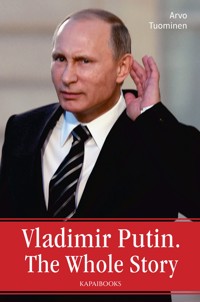
Vladimir Putin
The Whole Story
Arvo Tuominen
Translated byTimothy Binham
Copyright © Arvo Tuominen
Translated by Timothy Binham
Cover photograph: Lehtikuva / AFP Photo / Alain Jocard
Published by Kapaibooks
Helsinki, 2020
www.kapaibooks.com
ISBN 978-952-69600-2-9 (EPUB)
ISBN 978-952-69600-3-6 (Mobi)
All rights reserved.
No part of this book may be reproduced in any form or by any means, without written permission from the author, except for the use of brief quotations in a book review.
Contents
INTRODUCTION
“NO ONE IS FORGOTTEN, NOTHING IS FORGOTTEN”
A FIVE-KOPECK COIN AND A MIRACULOUS ESCAPE
FINLAND’S ROLE IN THE SIEGE OF LENINGRAD
ANOTHER BLOODBATH
PUTIN AND MANNERHEIM
FIRST, SECOND, THIRD – SOLD!
FROM THE FINNISH WINTER WAR TO THE ANNEXATION OF CRIMEA
GREAT INLAND POWER
FACING ASIA AND THE EAST, WITH ITS BACK TO EUROPE AND THE WEST
MARE NOSTRUM
THE BALTIC IS A NATO SEA
SEVASTOPOL WALTZ
BREAKING THE ICE
GEOPOLITICS AND THE WHITE TIGER
NOTHING BEATS A TANK DRIVER WHO WRITES POETRY
V DAY IS NO LAUGHING MATTER
HOW COME STALIN IS SO POPULAR?
JUDO ON THE GEOPOLITICAL TATAMI
THE UNPREDICTABLE PUTIN AND THE MADMAN THEORY
MIRROR IMAGES
FROM THE STREETS OF LENINGRAD TO THE PALACES OF THE KREMLIN
ON THE CAREER TRACK
JAMES BOND IN THE GDR
RETURN TO ST PETERSBURG: THE ASCENT BEGINS
MAKING OF A PRESIDENT
PRESIDENT PUTIN
THE MUNICH SPEECH WAS NOT A DECLARATION OF WAR
ALL EYES ON THE OLYMPICS
THIRD TERM: THE RISE OF CONSERVATISM
FOURTH TERM: LOOKING TO HIS LEGACY
PUTIN AND FINLAND
GOOD NEIGHBOURS
NYET, NYET NATO
NATO AND ARCTIC FOXES
THE BOY IN THE BOOT
THE ROAD TO HELL IS PAVED WITH GOOD INTENTIONS
THE BIGGEST SCAM EVER
THE REVOLUTION DEVOURED ITS CHILDREN
WESTERN SUPPORT FOR YELTSIN’S ILLEGAL ACTIONS
THE DEMISE OF THE SOVIET UNION WAS A SETBACK FOR CAPITALISM
YELTSIN’S NEOLIBERALISM CONTINUED AS PUTINOMICS
FROM YUGOSLAVIA TO UKRAINE
“WE’LL WIPE THEM OUT IN THE SHITHOUSE”
A WARNING FROM PUTIN
ANOTHER WARNING FROM THE AMERICAN AMBASSADOR
SIAMESE TWINS AND THE LACK OF RESPECT
RUSSIA TAKES CRIMEA AND LOSES UKRAINE
MOSCOW’S THREE VLADIMIRS
VLADIMIR THE GREAT LECHER
LENIN LIES IN HIS MAUSOLEUM
OBLOMOV IS ALIVE AND WELL
PUTIN INVESTS IN RURIK
LUTHERANISM HAS ITS ADVANTAGES
ESPIONAGE IS A CAREER CHOICE
THERE’S NO ESCAPING SPIONOMANIA…
…EVEN UNDER THE FLORIDA SUN
THE HONEY TRAP
A BOTCHED POISONING?
POLONIUM FOR LITVINENKO
SNOWDEN’S BOMB
PUTIN’S RIGHT ARM
NAPOLEON AND PUTIN
AFTERWORD
A RUSSIAN KEKKONEN
“THE POSITION OF THE RUSSIAN GOD IS NOT A SINECURE”
POST-PUTIN RUSSIA
THE CULMINATING POINT IS PAST
STOCKTAKING
BIBLIOGRAPHY
INTRODUCTION
Vladimir Putin has been the leader of Russia for so long that it is difficult to imagine the country without him. The day when he must stand down is approaching, however, for no matter how fit the man is both physically and mentally, eventually even Putin’s step will shorten and his memory will start to fail.
Putin did not rise to power in the same way as an ordinary politician; he was selected for the job by the ‘family’ of his predecessor Boris Yeltsin. The voters were merely left to corroborate the decision. On 26 March 2000, Putin garnered 52.94% of the popular vote. No doubt the election of his successor will follow a similar pattern: a jury of some sort will sift out its candidate, who will initially be appointed Prime Minister to build up a reputation with good deeds. After that, the presidential election will be a mere formality.
In the early years of his career, the reticent and soft-spoken Vladimir Putin seemed like an accidental president who would not be able to hang on to power for long. This is not how things turned out, however. Putin grew with his task and is now one of the most influential politicians of our era. The image projected by the media is that Putin is responsible for everything that goes on in Russia, though in fact he is not quite that omnipotent.
In a radio speech on the BBC in October 1939, Winston Churchill called Russia “a riddle, wrapped in a mystery, inside an enigma.” The Second World War had just begun, and Churchill was preoccupied with the question of the Soviet Union’s intentions, especially its relations with Nazi Germany. This was, after all, the most interesting question of all for Britain, Europe, and the whole world at the time.
Matryoshka dolls usually consist of an odd number of nesting wooden dolls, a traditional symbol of eternal life in Russia. Nonetheless, the end of the Putin era is nigh.
Churchill also said: “I cannot forecast to you the action of Russia [...] but perhaps there is a key. That key is Russian national interest.” Churchill held that the broader national interest was more important than the subjective perspective of individual leaders, decision-makers, and ordinary citizens. Consequently, he saw Joseph Stalin not as a crazed despot but as an enforcer of the Soviet Union’s geopolitical interests.
Of course, the subjective views of political leaders are not entirely insignificant, but the demands of geography and national interest provide a more rational basis for assessing the development of Russia or any other nation. Given that Vladimir Putin himself has repeatedly spoken of geopolitics, I will devote a considerable portion of this book to this topic.
Although Russia’s current active cross-border foreign policy is widely ascribed to Putin, it was in fact launched before he became president. Its father can be identified as Yevgeny Primakov, who was appointed foreign minister in 1996. He developed what is known as the ‘Primakov Doctrine’, according to which Russia would no longer consent to be tethered to the West – especially the United States. Instead, the country would position itself as an independent centre of power in the world, contributing to the development of a multipolar world as an alternative to American hegemony.
Putin accomplished an extraordinary social rise from a working-class home to become one of the world’s most powerful leaders in the gilded cage of the Kremlin, from which the road leads either to freedom or to prison – depending on whether his successor grants him immunity, as Putin did to Yeltsin.
In 2014, Sergei Lavrov, who succeeded Primakov as foreign minister, summed up his predecessor’s doctrine as follows: “The moment he took over the Russian Foreign Ministry heralded a dramatic turn of Russia’s foreign policy. Russia left the path our western partners had tried to make it follow after the breakup of the Soviet Union and embarked on a track of its own.”
As president of the Russian Federation, Vladimir Putin is sometimes depicted as a particularly unpredictable individual who repeatedly produces surprises and keeps the world on its toes. Nonetheless, Russia is not the ‛Land of Red Dusk’ of the Soviet period any more, as it is possible to travel there freely and a great deal of information is accessible. The “riddle wrapped in a mystery inside an enigma” today is therefore Putin, as we know little about him as a person. This is of course as you might expect of an intelligence officer.
The purpose of this book is not only to analyse the ‛enigma’ named Putin but also to describe the class journey made by the only surviving son of a poor family from a cramped communal apartment in Leningrad to the gilded halls of the Kremlin, and of all that happened on the way.
To be sure, heaps of books have already been written about Putin, but so far none by Finns, nor from the perspective of Finno-Russian relations. After all, we share 1,300 kilometres of common border and a great deal of common history, which is why there is a need for us to have our own perspective towards our neighbour and its leader. Moreover, of all the Russian leaders so far, Putin is most familiar with Finland and the Finns, which is by no means insignificant from our point of view. He is also the first Russian leader born in Saint Petersburg since Nicholas II.
WITH VERA IN THE KITCHEN
When studying Russian in St Petersburg in the summer of the year 2000, I would sit watching television in my landlady’s kitchen, sipping vodka and nibbling at zakuski. Putin already appeared fairly regularly on television to pronounce on a variety of subjects, which inspired me to make a prediction: “ras Putin, vsegda Putin” (once a Putin, always a Putin). As it turned out, I was right. My landlady was an admirer of General Alexander Lebed – after all, Lebed was charismatic, an eloquent speaker with a fine voice: in short, a hero. By comparison, Putin in those days was as grey as a mouse. My landlady was therefore certain that Putin would only be a transitional leader, and that Lebed would be the next president. The ‛ras Putin’ joke was a pun. Rasputin was a faith healer who amassed a great deal of political power in the tsar’s court after having cured Crown Prince Alexei of haemophilia. Scientists have subsequently deprived Rasputin of his miracle worker’s cape by finding a medical explanation for his stanching trick. The court physicians had prescribed the new wonder drug aspirin to the crown prince at the time. It was later discovered that aspirin thins the blood and therefore aggravates haemophilic tendencies. Rasputin thus worked his ‛miracle cure’ simply by using his mysterious aura to banish the court physicians and their aspirin, as the bleeding stopped as soon as the medication was discontinued.
In 2000, Alexander Lebed was Governor of Krasnoyarsk Province. The general was interviewed regularly on TV, as he had clear opinions, terrific charisma, a great sense of humour and a strong will. He also spoke Russian so clearly that even I could understand him. Lebed had been a boxing champion in his youth, had received the title of Hero of the Soviet Union in the Afghanistan war, and had come third in the presidential election of 1996, won by Yeltsin with the backing of the oligarchs. At the time, the Russians still generally expected Putin to be a mere flash in the pan, and that Lebed would win the 2004 election and put the country’s affairs straight. It was said by some that Lebed would be Russia’s own Pinochet and restore order, as people were tired of the svoboda (freedom with chaos) of the Yeltsin period. Fate intervened, however, for Lebed died from injuries sustained in a helicopter crash on 28 April 2002. Naturally, this gave rise to a spate of rumours of the type “Why was Alexander Ivanovich Lebed killed?”, but the investigators found no indication of foul play. Flying in dense fog, the helicopter had hit an electric power line. The accident was thus simply the product of the indifference so typical of Russia.
In the photograph, General Alexander Lebed celebrates his third place in the 1996 presidential election. Despite attempts to persuade him, the highly popular Lebed, who was Governor of Krasnoyarsk Province at the time, decided not to run in the 2000 election, as Putin had been groomed for the job.
Lebed was an unusual politician in that he had no political allies. He was thought of as a man of action and something of a loose cannon who might cause problems for the oligarchs, since he owed them nothing. The oligarchs could barely hide their relief when Lebed died.
Subsequently, however, Vladimir Putin has thoroughly fulfilled the hopes that some people had pinned on Lebed. As the economy grew, so did Putin’s stature. The rise in oil prices made regular salary payments possible, improving the standard of living. Putin brought the oligarchs to heel, led the country into war and started building up Russian influence on other continents.
The aging statesman still has plenty of new challenges to tackle. Not least of these is his succession, on which Putin commented in an interview in the Corriere della Sera in summer 2019: “It’s premature to talk about this. There are still five years of intense work ahead, and considering the dizzying speed with which the world is changing, it’s difficult to make predictions. Believe me, I have lots to be getting on with in my current role.”
In the early years of his presidency, Putin seriously sought integration with the West and even toyed with the idea of joining the European Union. Putin understood that Europe and Russia belong together, as they always have done, for better or worse. However, EU membership never materialised, as instead of seeking cooperation, NATO began to expand its territory into Central and Eastern Europe and the Baltic states. The Kremlin realised that it would be left alone. Russia therefore formulated a new foreign policy introduced by Putin in a speech at the Munich Security Conference in 2007. The Kremlin began to work on an alliance of its own, the Eurasian Union.
WHEN THE WORLD FELL APART
In his much-quoted Munich speech, Putin described the collapse of the Soviet Union as the greatest geopolitical catastrophe of the 20th century. It was certainly a geopolitical catastrophe for Russia, as following the disintegration of the Soviet empire, 20 million Russians were left outside the country’s borders.
When a state loses large chunks of territory, the natural reaction is a phantom pain of the sort felt by someone who has lost a limb. The countries that gained their independence from the Soviet Union also suffered from “post-traumatic stress disorder”, as Tarja Halonen, President of Finland from 2000 to 2012, once described the situation in Estonia.
Following the collapse of the Soviet Union, Russians could travel freely to the West for the first time in the country’s history. This took some getting used to on both sides of the border. For example, Russian tourists were humiliated in the Finnish border town Lappeenranta by shopkeepers who affixed signs to their doors saying, “One Russian at a time”. The rapid rise of the Russian economy and living standards in the first decade of this century was reflected in a change in attitudes at both national and individual level. Russia forcefully demanded that its interests be considered in international affairs, while Russian tourists were sometimes known to jump the queue at international airports and places like the prestigious Stockmann department store in Helsinki. The state and its citizens were throwing their weight around in rather similar ways.
When Boris Yeltsin, who was a charismatic figure but had lost his support by the end, handed over power to Vladimir Putin, the mouse-like successor was thought to be merely a transitional president.
At the time that Putin came to power, Russia was in bad shape. If the Soviet Union had been an experiment with a system of pure government without markets, the 1990s in Russia were an experiment with a system with markets but no government.
To be sure, the capitalist revolution was a tentative one, if only because there were no guidebooks in libraries on how to accomplish it, whereas there were whole shelves filled with books on how to make a communist revolution. The economic reformers who came to power in the early 1990s therefore did what they could with the help of western advisers – not surprisingly, with dire consequences.
The blame for the failure of this revolution was laid on the United States on the grounds that the shock therapists had been recruited from there, but the real culprits for the privatisation of natural resources that amounted to theft, the rise of the oligarchs and the poverty of ordinary people were Russia’s own leaders. The result, however, was that America, admired nationwide when the 1990s began, was widely hated in Russia by the end of the decade.
The Americans themselves were self-critical. In 2000, the United States Congress published a report according to which the Clinton administration had wasted a historic opportunity to help transform Russia into a democracy by putting too much trust in Russian leaders such as Yeltsin, Chernomyrdin and Chubais. The report asserted that the funds allocated to the reconstruction of Russia had been stolen because of the negligence of the United States government.
By the time that Putin became president in 2000, the economy was improving apace, largely due to a rise in the world market price of oil. Around the same time, the administration started reining in the market and bringing the oligarchs into line. Street crime virtually disappeared. After two terms as president, Putin was succeeded by Dmitry Medvedev, under whom the country drifted into another economic crisis. Medvedev was a one-term president, and Putin took over again after him. This tandem arrangement gave rise to protests, to which Putin proved to be highly allergic. He began to restrict the operation of undesirable organisations, relying increasingly on anti-western forces and the Orthodox Church. In the midst of all this, he seems to have forgotten the lessons of the Soviet era, according to which throttling the constant confrontation of opposing views, civic debate and the quest for truth will bring society to a halt.
Growing with the job and helped by the price of oil, Vladimir Putin has moved up to the heavyweight category in world politics. The photo shows his image immortalised in a 16 kg kettlebell.
Although economic growth in Russia has been slow for the last ten years (as it has elsewhere), the Putin years have witnessed, among other things, the complete transformation of St Petersburg and Moscow. These cities no longer differ all that much from metropolises in the West. Their inhabitants drive Mercedes cars, sip coffee at Starbucks and other icons of globalisation; hipsters dress the same way as in Berlin (and better than in Helsinki). You might say the socialist hangover very quickly gave way to a capitalist high.
On the nature of this change, Putin himself has said: “Whoever doesn’t miss the Soviet Union, doesn’t have a heart. Whoever wants it back, doesn’t have a brain.” Putin started his presidency as a western-minded leader who tried to maintain contact with the intelligentsia in his country even though he felt that it had let him down. In later years, he has relied more on security forces than on civil society. Elections are little more than vertically directed spectacles, and new political groups have to pass a ‘filter’ to be recognised. The mainstream media is commercial through and through, but loyal to Putin. Putin has also enjoyed extremely high popular support all these years, for there is always strong demand for a powerful leader in Russia.
THE ERA OF CONFRONTATION WAS NOT OVER
When the Cold War ended, it was widely believed that nations would coexist peacefully like brothers henceforth. That is not how things turned out. States still have their own interests, and they conflict with the interests of other states.
In the early years of the Putin era, Moscow seriously sought integration with the West. This failed as a result of what the Kremlin saw as cold treatment and the enlargement of the European Union and NATO into Central and Eastern Europe and the Baltic States. The Kremlin felt that it had been left as a wallflower.
The prediction made in 1997 by George F. Kennan, the father of the policy of containment of the Soviet Union, was fulfilled. Kennan thought NATO’s eastward enlargement “the most fatal mistake in US policy since the war”. He thought this decision would harm the development of Russian democracy by restoring the Cold War atmosphere. The Russians could only interpret NATO’s expansion as a military action, and would have to look for other security guarantees.
The American and European allies saw the end of the Cold War as a military victory and an opportunity to fill the resulting void in the former East Bloc. Since the United States had a significant number of voters whose roots were in Poland or other East European countries, and given that their vote depended on NATO policy, it was easy for Clinton to go back on his word and carry out NATO’s eastward enlargement.
Yeltsin sought to obtain from Clinton a promise at least not to allow the Baltic countries and Ukraine to join NATO – to no avail. Naturally, once Russia had regained strength, the Kremlin drew its own political conclusions from all this, as revealed by Putin in his Munich speech in 2007. The rest is history. The Russo-Georgian War began in 2008. It sent the message that the West had no business coming any closer. The annexation of Crimea in 2014 marked not only the end of Russia’s efforts to join the club of European nations, but also its acceptance of its own geopolitical isolation. When the conflict with the separatists in East Ukraine began, the West in turn sent a “don’t come any closer” message to Russia by stationing more weapons and troops in nearby NATO countries.
The Ukrainian conflict and the pitiful fate of the Minsk Agreement have merely served to strengthen Russia’s conviction that it is impossible to work together with the West on equal terms. Consequently, the Kremlin has sought friends and influence elsewhere.
One such instance is Russia’s role in the Syrian conflict, where it has backed the regime of Bashar al-Assad against the rebels and their supporters in the West. Not that Putin ever cared much for al-Assad personally, but the United States just happened to be on the other side. Both countries were thus following the same principle in international politics: “Your enemy’s enemy is your best friend.” Moreover, Russia has historical ties with Syria, and Syria’s location is strategically important for Russia. Putin also wished to send the message that Russia, too, can be an important player in the Middle East – and on the wider world stage, in both military and diplomatic terms.
The confrontation has continued to escalate. For example, Russia considers the western NGOs operating in its territory to be Trojan horses, and has countered their activities by waging an internet war, trolling, and interfering in elections in Europe and America. The clamour seems to be growing louder on both sides.
Russia’s fear that the West would like to replace the Russian leadership (as it would) is understandable enough. The country has had experience with such meddling since 1917, when Germany sponsored several Russian opposition groups and separatist movements, including the Bolsheviks. The Germans even arranged for Lenin, who had been in exile in Switzerland, to return to St Petersburg via Germany, Sweden and Finland. These machinations proved extraordinarily successful, as they weakened Russia and induced it to accept the forced peace of Brest-Litovsk in March 1918.
The aim of the sanctions policy orchestrated by the United States has been to persuade the people to rise up against Putin. Since this has led nowhere, relations are hardly likely to improve for as long as Putin is in power. It is hard for the Americans to admit failure.
AMERICAN MANIFEST DESTINY AND RUSSIAN VICTIMISATION
After the Cold War ended, the American political scientist Francis Fukuyama proposed a theory according to which history ends with western liberal democracy, since this is the peak of ideological evolution that all systems seek to emulate. Our values are universal, and if someone won’t accept them voluntarily, then we’ll force them to do so.
In a previous era, Lyndon B. Johnson justified the participation of the United States in the Vietnam War as follows: “We fight because we must fight if we’re to live in a world where every country can shape its own destiny. And only in such a world will our own freedom be finally secure.”
The idea of manifest destiny has been evoked in the United States to justify the country’s participation in numerous wars, from the Balkans to Syria and from Afghanistan to Iraq. In many of these wars, it has been assisted by European allies – including Finland in ‛peace enforcement missions’ in Afghanistan.
The United States has spent almost six trillion dollars (that’s twelve zeros) on wars since September 11, 2001. This expenditure has become unsustainable from the point of view of national security. The US has therefore sounded the retreat, whether from Europe, the Middle East or Afghanistan. It is focusing on cleaning up its own house and surviving the challenge mounted by China for taking over the position of the strongest country in the world.
This means that Europe should start managing its own defence, since this would free it to develop its own arms industry and pursue its own defence policy. The current American NATO umbrella – Article 5 – could more accurately be called Article F-35. If there is no military threat, however, enhanced European defence cooperation may not be possible, the EU being an unusual union in that it does not protect its members from external aggression.
Russia, on the other hand, sees itself – as it has done throughout its history – as an empire suffering and sacrificing itself for others. Russia also sees itself as a victim, for it considers itself maligned and misrepresented. Now that the United States and China are redividing the world, Russia is much more a party to this process than Europe.
Although geographically Russia sits astride Europe and Asia, culturally it represents classical European culture. In fact, the cultural divide between Europe and the United States is more fundamental than that between Russia and Europe. Whereas in Europe government is thought to be responsible for protecting the needs and rights of its citizens, in the United States government is seen as a necessary evil. In Russia, the protective role of government is even more pronounced than in Europe.
There are historical and cultural reason for these differences. On the Old Continent, money and work are means to a greater end, whereas in the United States they are ends in themselves. In Europe, work is not only a means to amass wealth, but also to find meaning in life. This is also the case in Russia, which thus forms part of the European community of values in this respect.
Our politicians’ constant appeal to the idea of a community of values between America and Europe is thus on the whole unjustified. In fact, it is just a way to sugar-coat military cooperation.
Putin has emphasised that the core values of the Russian people are “God, family and property”. This comes remarkably close to the phrase “for home, religion and fatherland” introduced by Finland’s Commander-in-Chief Mannerheim during the Winter War of 1939–1940. Mannerheim, in turn, obviously picked up the phrase from the Russian Imperial Army (his former employer before Finland became independent) which declared that it fought for “Faith, Tsar and Fatherland”.
Putin’s former chief ideologue Vladislav Surkov, later sidelined, sought to draw a line between Russia on the one hand and Lutheran and Catholic Europe on the other by saying that if the Russians hadn’t been Orthodox, their identity would have been different, but by professing the Orthodox faith they had set themselves against the West in one way or another.
According to Alexander Dugin, also known as Putin’s Rasputin, world history since Antiquity has been shaped by the struggle between the ‘Atlanticist’ and ‘Eurasianist’ secret orders.
A DIFFERENT OPERATING SYSTEM
There are naturally plenty of differences between Europe and Russia (as there are, for that matter, within Europe and Russia). The Cyrillic alphabet is unfamiliar to most Europeans, as are the Russian language, the Russian way of life – leaning as it does towards collectivism – and the Orthodox religion. This unfamiliarity tends to give rise to prejudices among us Finns, who are Lutheran and use the Latin alphabet. It may be a good idea to try to rid ourselves of these prejudices, if only to make way for new ones.
Compared with Lutheran Europe, Russia has a different operating system. If ours could be characterised as an Apple world, in which everything is made easy for the user, then Russia is like the early Microsoft world, which acted up constantly and required many adjustments. Catholic Europe is another story altogether, a third operating system that is the most influential of all.
All the same, Russia is a European nation. What are Tchaikovsky, Mussorgsky, Repin, Malevich, Dostoevsky, Tolstoy and Tarkovsky, if not European artists? Russia, however, is unique in that it never underwent a Reformation, and the Age of Enlightenment never took root there.
Setting Europe and Russia against one another only has the effect of pushing Russia into China’s arms. Hostility towards Russia and Putin only strengthens the verticality of power in Russia. For these reasons, the Russian policy pursued by the West has not been a huge success, even by its own standards.
The prevailing prejudice is that Russia does everything wrong. This is obviously not true, for if it were, the whole country would not exist. It is true than many things are done differently in Russia and that the Russian way of life is different from that of the West, but the same could be said of China, for example. And yet we do not ask the Chinese to think or act like us, as we tend to expect of the Russians. The reason is simple: the Chinese look different, so we let them think and live in a different way, whereas the Russians look like us, so we can’t let them do the same.
Henry Kissinger put it aptly when he said, “Countries would fare better if they accepted each other’s existence — and differences”.
After the events in Crimea, the Finnish diplomat and economist Jaakko Iloniemi commented that if Putin was seeking respect with his actions, all that he got was respect mixed with fear. In Russia, however, this kind of respect is considered qualitatively better and more permanent than respect obtained by any other means. Meanwhile, Putin’s ‛unpredictable and dangerous behaviour’ is based on cold-blooded calculation and the desire to maximise his international influence with small stakes and tough talk. Take away the fear from a system built on fear, and the whole system will start to crumble.
Right or wrong, the Russians consider their country to be a power player that deserves to be heard on the international arena. Many Russians believe that the West, and particularly the United States, is actively trying to weaken their country. They give less thought to the causes of American supremacy or to what could be done to narrow the gap.
Since sanctions were imposed, Russia has sought complete self-sufficiency. The photo shows the interior of Putin’s new Russian-made Aurus, the presidential state car. The first half of the name comes from the Latin aurum for gold and the second half from the word Russia. It is good enough for Putin, although Russia has yet to build a mass-produced car that would satisfy consumers.
“THE WEAK GET BEATEN UP”
Almost 80 years after Winston Churchill’s speech, Russia is no longer the ‘riddle inside an enigma’ that it was in 1939. In fact, Churchill himself suggested a solution to the riddle right after the Second World War: “I am convinced that there is nothing they admire so much as strength, and there is nothing for which they have less respect than for military weakness.”
Vladimir Putin confirmed this observation in 2004, when Chechen terrorists occupied a school in Russia, cramming their hostages into the gym. The operation to free the hostages resulted in the death of more than 300 children and adults. After the event, Putin said the Russians should show no weakness, because “the weak get beaten up”.
In the West, Putin is blamed for everything that happens in Russia, the Kremlin’s ideology is confused with Putinism and Russia is maligned as ‘Putinland’. At the same time, critics warn readers not to confound Putin with the Russian people, whom they love and admire. But in reality, Putin and the Russian people are one and the same. This is shown by all the opinion polls conducted in this millennium. His decisions have the nation’s support.
Whether Russia’s policy has been a success is debatable, considering that the country has managed to make enemies of its blood brothers and linguistic relatives, the Ukrainians. The Orthodox Church of Ukraine, too, switched allegiance from Moscow to the Patriarchate of Constantinople. Even among the ethnic Russians in Estonia, no one wants to leave for Russia.
The brain drain from Russia to the West is extensive. According to statistics in the receiving countries, 10,000 highly educated Russians leave for the United States and 20,000 for Germany every year. According to Russian statistics, the number is 4–5 times smaller, yet another indication of how hard it is to pin down Russian reality.
Although the occupation of Crimea and the pacification of Syria were victories for Russia, Putin must have pondered the words of King Pyrrhus of Epirus: “One more victory like this and I am lost.” These wars have brought the country to the limits of what it can sustain. And yet it still seeks out new battlegrounds in South America and Africa.
This book is not merely the story of its protagonist, President Vladimir Putin. In it I also seek to depict the Soviet Union in which he was born and the Russia he is trying to rule. I insist on the word ‛trying’, for Russia has about as many factions as the Kremlin has towers – 20. The president’s task is to reconcile the interests of these groups and to find a common policy.
In writing this book, I have tried to follow the advice of my late friend Arvo Salo: “A good story is born if you put in one third of your own text, borrow another third and steal the rest.” I have stolen the best ideas in this story from Professor Timo Vihavainen.
Where western churches focus strongly on the Passion of Christ, the Orthodox church puts the emphasis on the Resurrection and Christ’s victory over death. Death is seen as the Redeemer, which is why a Russian funeral is a more joyful occasion than a Finnish wedding.
“NO ONE IS FORGOTTEN, NOTHING IS FORGOTTEN”
As you grow older, your childhood experiences are left behind, but in fact they still affect your life in many ways and in different situations. The way you experience the world around you, how you act in relation to others, and how you expect others to act in relation to you, depends largely on your own experiences. However, even though childhood has an undeniable influence on adult life, it does not dictate anyone’s fate.
The childhood of Vladimir Putin was overshadowed by memories of the siege of Leningrad, the death of a million people – including his two-year-old brother –, bombed-out buildings, alcoholic war invalids in the backyard, his father’s leg, mutilated by a grenade. All this influenced Putin’s personality and is reflected in his decisions. It is therefore appropriate to start our inquiry into his personal history from the war years in order to understand the environment he grew up in.
As a result of the siege, the people of Leningrad learned to prepare for the worst. They became enthusiastic allotment gardeners, which is why a fair share of the food in St Petersburg today is still locally grown. Recalling his childhood, President Putin once said: “My parents would work in the garden in the summers from early morning until late at night, and they required me to do the same. So I know very well what it’s like.”
When Putin became president, he immediately set out to make sure that the nation would be self-sufficient in the event of any crisis. He set up Goserezerv, a State agency charged with maintaining emergency reserves of essential supplies. As its director, he appointed Alexander Grigoryev, a former KGB colleague from St Petersburg. Having familiarised himself with his new job, Grigoryev reported to Putin: “Our strategic reserves have virtually all been stolen under Yeltsin.”
The situation has changed now, which is why the West’s sanctions have not had the expected effect. Russia is an exceptionally self-sufficient country. It also has substantial financial reserves. Putin learned to prepare for the worst in his childhood.
Putin’s father, Vladimir Spiridonovich Putin, never told his son war stories – not for any lack of stories to tell, but because he did not wish to transmit his traumas to his son. Nevertheless, it is known that the elder Putin participated in the defence of Leningrad against Nazi Germany. By an irony of fate, when his son started his foreign intelligence training, he was placed in the department specialising in Germany.
Putin must have been disappointed to be posted to the East German city of Leipzig. West Germany undoubtedly would have been more to his taste, for Putin’s hero was Maxim Isayev, the protagonist of the TV series Seventeen Days of Spring, who works in the German Reich’s intelligence service where he has risen to the rank of colonel under the alias Max Otto von Stierlitz. He has been working in Germany as a Soviet spy for some twenty years and has been a member of the National Socialist party since 1930. He is therefore an extremely successful infiltrator and has a brilliant track record as a Soviet agent. Moreover, the theme music of the series is quite achingly beautiful.
Before the Second World War, Leningrad was a lively cultural centre of 3.4 million inhabitants. By the end of the war, its population had shrunk to a mere 600,000 (Lurie 2014). However, the city rose from the ashes, reaching its former size by the late 1960s. Once again named St Petersburg, the city today has a population of 5.5 million.




