


Erhalten Sie Zugang zu diesem und mehr als 300000 Büchern ab EUR 5,99 monatlich.
- Herausgeber: Saqi Books
- Kategorie: Sachliteratur, Reportagen, Biografien
- Sprache: Englisch
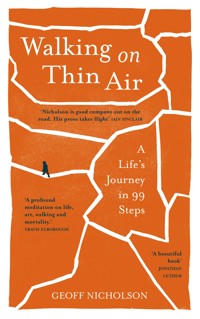
Geoff Nicholson has been walking his whole life. Wherever he is and wherever he goes in the world, he walks and writes about what he sees and feels. Here he reflects on the nature of walking, why we do it, how it benefits us and, in some cases, how it can damage and even destroy us. Geoff's recent diagnosis with a rare, incurable form of cancer has made him all too aware of his own mortality. Sooner or later there will be a last step, a last excursion, a final drift, for him just as there will be for all of us. Geoff vows to continue to walk for as long as he can. This moving, vital book describes his own walks and relates them to the walks of street photographers, artists and writers, such as Garry Winogrand, Diane Arbus, Sophie Calle, Jorge Luis Borges and Virginia Woolf, among many others. Walking on Thin Air is a book about mortality and, above all, a celebration of being alive.
Sie lesen das E-Book in den Legimi-Apps auf:
Seitenzahl: 178
Veröffentlichungsjahr: 2023
Das E-Book (TTS) können Sie hören im Abo „Legimi Premium” in Legimi-Apps auf:
Ähnliche


















GEOFF NICHOLSON is the author of more than twenty books, which have been widely translated with one made into a Hollywood film. These include the acclaimed novel Bleeding London (shortlisted for the Whitbread Prize), as well as the classics of psychogeographical non-fiction, The Lost Art of Walking and Walking in Ruins. Nicholson has written for the Guardian, Telegraph and New York Times, and is currently a contributing editor to the Los Angeles Review of Books. He lives in Essex.
www.geoffnicholsonwriter.com
ALSO BY GEOFF NICHOLSON
Fiction
Street Sleeper
The Knot Garden
What We Did on Our Holidays
Hunters and Gatherers
The Food Chain
The Errol Flynn Novel
Still Life with Volkswagens
Everything and More
Footsucker
Bleeding London
Flesh Guitar
Female Ruins
Bedlam Burning
The Hollywood Dodo
Gravity’s Volkswagen
The City Under the Skin
The Miranda
Non-Fiction
Big Noises
Day Trips to the Desert
Andy Warhol: A Beginner’s Guide
Frank Lloyd Wright: A Beginner’s Guide
Sex Collectors
The Lost Art of Walking
Walking in Ruins
The London Complaint
The Suburbanist
THE WESTBOURNE PRESS
An Imprint of Saqi Books
Gable House, 18-24 Turnham Green Terrace, London W4 1QP
www.westbournepress.co.uk
www.saqibooks.com
Published 2023 by The Westbourne Press
Copyright © Geoff Nicholson 2023
Geoff Nicholson has asserted his right under the Copyright, Designs and Patents Act, 1988, to be identified as Author of this Work.
This book is sold subject to the condition that it shall not, by way of trade or otherwise, be lent, re-sold, hired out, or otherwise circulated without the publisher’s prior consent in any form of binding or cover other than that in which it is published and without a similar condition including this condition being imposed on the subsequent purchaser.
All rights reserved.
A full CIP record for this book is available from the British Library.
ISBN 978 1 908906 57 1
eISBN 978 1 908906 58 8
Printed and bound in Great Britain by Clays Ltd, Elcograf S.p.A
‘I walk slowly, like one who comes from so far away he doesn’t expect to arrive.’
JORGE LUIS BORGES
1
This is a short book about walking and mortality. I like to say that I’ve walked all my life. I know that can’t be literally true since there was obviously a time when I was too young to do any walking at all but, according to my mother, I started walking very early and I haven’t stopped since. I’ll continue as long as I can, but being mortal, I know that sooner or later I’ll stop, that there will be a last step for me, a last excursion, a final drift, just as there is for everybody. All things good and bad, and that includes living and walking, must come to an end. Would we really want it any other way?
2
I’m a walker who writes and a writer who walks. I’ve never been one of those ‘sacramental’ or ‘spiritual’ walkers like Bruce Chatwin or Peace Pilgrim (born Mildred Lisette Norman), much as I admire them, and I’m not one of those ‘stunt’ walkers, walking backwards across America, like Patrick Harmon in 1915, or walking 1000 miles in 1000 consecutive hours, like Captain Barclay in 1809. I’m not exactly a psychogeographic walker like Guy Debord or Iain Sinclair or Will Self or Rachel Lichtenstein or Teju Cole, though I do a lot of the things that psychogeographers do, which is also to do a lot of the things that flâneurs do, though I don’t claim to be a Baudelaire. I do what I do. I go to places, I walk when I’m there, I look around, I write about what I see and feel. It’s not the only thing I do with my life, but it’s probably the best part.
My life hasn’t been especially nomadic. I’ve lived for long periods in Sheffield, London and Los Angeles, with occasional short spells living in Cambridge, Colchester, Halifax and New York. I’m currently living, for one reason and another, in semi-urban Essex. As a tourist or working writer, I’ve found myself in Munich, Berlin, Paris, Guadalajara, Alice Springs, Tokyo, as well as in various deserts – the Sahara, the Australian Outback, several American deserts. Wherever I’ve been, I’ve walked, and in some cases I’ve gone to places specifically to walk and then write about them. It’s a life, and sometimes, more often than you might think and very much to my surprise, it’s a living.
3
The majority of my walking has been done in what we might call the built environment, in cities rather than in nature, though as that list suggests, I also love deserts, and my favourite, the one where I’ve spent most time and done the most walking, is the Mojave, just a couple of hours from Los Angeles. In fact, its proximity to the desert was one of the things that first attracted me to LA.
The Mojave contains Death Valley, one of the great places on earth, and I especially love walking there. I’d enjoy it more if there were fewer other visitors, but if fewer people visited, there wouldn’t be guided trails, signposts and a ranger station. The risk of death would be considerably higher.
A few years back I was walking by the Ubehebe Crater, (pronounced you-be, he-be) a half-mile-wide, seven-hundred-foot-deep cavity, created by the coming together of magma and ground water. The name, which may come from the Paiute or the Timbisha Shoshone language, is generally accepted to mean big basket or coyote’s basket.
I was not rash enough or intrepid enough to walk all the way to the bottom of the crater and back up again, but I decided to walk around the rim, which is a reasonable excursion, and described by the National Park Service as ‘moderately difficult due to the initial climb and loose footing.’
Moderate difficulty I could cope with, or thought I could. In fact, I’d done the walk a few years earlier and found it fairly comfortable, but on this second occasion I found it very hard work indeed. I didn’t give up because you can’t when you’re halfway round the rim of a volcanic crater. But by the end I was exhausted, really suffering, sweating, heart pounding, painfully gasping for breath.
I didn’t think too much about it at the time. I accepted my tiredness and lack of puff as just another wretched symptom of getting older. But a little while later I went for one of my regular medical checkups in LA, and the doctor was concerned about my red blood cell count. It was low, not dangerously so, he said, but we needed to keep an eye on it, which we did.
A couple of years later, a different doctor in a different country, England, decided that my blood cell count was now indeed dangerously low. And after a variety of tests, he was able to put a name to my condition: CMML – Chronic Myelomonocytic Leukemia, a cancer of the bone marrow, that being the place where blood cells are made. CMML is sometimes described in the literature as a ‘rare type of blood cancer’ – not rare enough, obviously. And made even less desirable when I learned that Silvio Berlusconi also shared the condition.
Its origins seem to be genetic, a mutation of a chromosome, so none of this was my fault, not caused by my bad habits and less than healthy lifestyle, but it was serious. I was told it was treatable, but not curable. The treatment started out with occasional blood transfusions, then moved on to weekly injections of EPO, the regime I’m currently following. EPO – erythropoietin – is a hormone which stimulates red blood cell production and allows the blood to carry more oxygen. This has all kinds of benefits, not least for walking. It’s also the stuff that elite cyclists use when they want to cheat.
The prognosis is not great. At some point the leukemia will change from chronic to acute, and this can happen after months or after a couple of decades. This is very bad news, a death sentence according to some opinions. At that point, a bone marrow transplant is an option, but not one I think I’ll be taking. As I write this, a few years after my initial diagnosis, I feel pretty good most days. I get tired sometimes, more often than I used to, but doesn’t everybody? And of course, I continue to walk.
4
Once every three months or so I go to see a consultant at the hospital in Colchester, which is close to where I now live. I usually travel there by train, which requires me to make a fifteen-minute walk up quite a steep hill from the station to the hospital. It’s not punishing by Ubehebe Crater standards but it’s a proper hill. You can work up a sweat, you breathe hard along the way; or at least I do. Nevertheless, my continuing ability to walk up the hill seems to impress the doctors. I feel oddly comforted by this. Sooner or later, I suppose things will change, walking will become much more difficult and walking up that hill will eventually be impossible. For now, however, I carry on walking because it’s what I do, what I’ve always done. And I continue to write and read and think and talk about it, and if much of my interest seems arty or literary or bookish, well, that’s who I am.
I wouldn’t say that intimations of mortality and potential immobility have put a spring in my step, but they have concentrated my mind. Every walk, any walk, now seems just a little more intense, a little more urgent, than it used to. I concentrate more, think more, feel more. Some walkers might describe this as mindfulness. I prefer to think of it as business as usual, even though I know it isn’t, not really.
5
I get a bit weary of being told about the multiple health benefits of walking. I regularly read or hear how good walking is for maintaining a healthy weight, increasing heart and lung capability, strengthening bones and muscles, building up stamina, preventing high blood pressure, high cholesterol and type 2 diabetes. I’ve read that it’s good for easing knee, hip and back pain, warding off dementia, improving sleep, boosting immunity and energy, even increasing the chances of getting pregnant.
I don’t doubt that most, perhaps all, of this is true, but being ‘good for you’ and ‘causing improvements’ suggests there’s a measurable baseline, and I’m never sure there really is. You end up saying something like, however bad you are, you’ll be worse if you don’t walk. Who would argue?
I’ve never been a true invalid, I’ve never been a spectacularly healthy specimen, and we could argue about what that even means, but I won’t. Suffice it to say that being a walker and being unhealthy, are not mutually exclusive, but no doubt I’d have been less healthy if I’d done less walking.
I also often hear that it’s best to walk in a ‘natural’ environment, but increasingly I don’t know what a natural environment is. Is it a park? A wood? A place designated as an ‘Area of Outstanding Natural Beauty’? Well maybe, I actually live in one of those AONBs at the moment, but this is an official government classification, and that seems to me only natural in a very specific limited sense. How about a mangrove swamp? A pitiless tract of desert? A volcano? These are all natural, aren’t they? Just how natural do you want? How good is it to walk in those places?
However, even if all the professed physical benefits are absolutely true, that has very little to do with why I walk. I walk because I want to, because I like it, and I know that I’ll be miserable if age and decay prevent me from walking. For that reason, I’m much more persuaded that walking is good for mental health. Here the literature will tell you that walking is good for reducing stress, depression and anxiety. I can attest that in my own case walking does a world of good for all these things, especially depression. I often walk to cheer myself up.
It’s also said that walking is good for ‘creative thinking’. Again, I’m not absolutely sure what that term means, but I’ve certainly had one or two good ideas while out walking. Could I have had these, or similar ideas, sitting at a desk or lying in bed or while propping up a bar? Maybe, maybe not, but I have no idea what experiment you could possibly conduct to prove or disprove any of this.
6
I’m far more comfortable with the idea of walking as a form of meditation. I don’t get into a fugue state when I walk, but often, especially at the beginning of a walk, I feel much more alert, more perceptive, much more interested and involved in what I’m seeing and doing. This applies just as much when I’m walking in nature as when I’m walking in an inner city. By some definitions, this might, I suppose, be called ‘mindfulness’.
There are various kinds of more formal walking meditation, often deriving from Buddhism, known as kinhin in Japanese. There’s circumambulation, the act of walking around a sacred space. But I always think of John Cage who, in an interview with a journalist, was asked about sacred mushrooms, and he was having none of it, and he said he rejected the idea of some things being sacred and some things not. I profoundly agree with this to be true. Admittedly I would in general prefer to walk in the Peak District than through the nearby industrial estate, but I’m not averse to walking through industrial estates, and true enlightenment might not even recognise the difference.
There’s some slight evidence that Qigong, a form of walking, breathing, meditation and martial art, has some effect in increasing the death of cancer cells. There’s far more general evidence that walking is some help for some kinds of cancer. The Journal of Cancer Survivorship publishes a lot of articles suggesting that pretty much any kind of exercise improves survival rates for cancer sufferers, but few cancer sufferers are going to be kickboxing and windsurfing. Walking is the one we tend to go for.
7
In the end, we may all be prepared to agree that walking is a good thing. However, contrarian that I am, I keep a scrapbook containing cuttings of all the terrible things that can and do happen to people while walking: being mowed down by cars or motorcycles, bikes or electric scooters, in one case by an ambulance. Walkers get mugged, they get lost in the wilderness, they’re attacked by bees and dogs and cows and bears and even other walkers. People fall into ditches, or off cliff edges; they fall down manholes while texting. They die by inhaling the ‘bloom’ of toxic algae. In extreme cases, walkers are hit by a stray bullet or killed by treading on a landmine or by being stabbed to death by a motiveless lunatic.
I try not to be too morbid about it, and I never take pleasure in other people’s misery. Chiefly I do it to remind myself, and others, that walking is not an entirely tame, easy, altogether safe activity. We walkers take some comfort in risk.
8
Neville Cardus (1888–1975) is widely regarded as one of the greatest cricket writers there’s ever been. He was a dandy both in his prose style and his life. He used to carry an ebony walking stick, but only for ornamental purposes. He didn’t need it for walking; he needed it to pose.
Cardus listed walking as one of his hobbies, and he did come up with one of the great observations about walking and physical decay. He said that the body ages but the mind doesn’t. ‘I want to go for an eight-mile walk. My mind goes for an eight-mile walk. My damn legs won’t go.’
When I first read that I didn’t know what on earth he was talking about, but now I understand all too well.
9
Jorge Luis Borges was a collector of walking sticks. He needed them, of course, because towards the end of his life he was blind. Sources differ on when he completely lost his sight, but it seems to have been around the age of fifty-five. From then on he used a stick and needed somebody to help him walk. And he never learned braille, so he also needed somebody to help him read, or at least read to him. I’m not sure whether walking or reading would have been the greater loss, but Borges never seems to have had much trouble finding people to help him with either activity. All manner of people – Alberto Manguel, Norman di Giovanni and Robert Robinson among them – went to visit him, walked with him and read to him. Some, I’m sure, gave him a walking stick or two to add to his collection.
Borges’s poem ‘Things’ describes the objects he possesses, the ones that will still be around after he’s died. First on the list of things is his walking stick, or cane depending on the translation.
Borges was extremely quotable on the subject of walking: ‘Which one of us has never felt, walking through the twilight or writing down a date from his past, that he has lost something infinite?’
Infinity: in the end I think that was Borges’s chief subject. It’s a tricky one for a walker, because all walks by definition are finite. You may not know how far you’re going to walk or where you’ll end up, but there’s always an end; you can’t walk forever.
At the very end of his life, Borges was living in Geneva but still had an apartment in Buenos Aires. Knowing he was in bad health and with not long to live, he tried to arrange to sell the Buenos Aires property and have its contents shipped to Geneva, but he ran into trouble with his nephew, his sister’s son. The nephew claimed that the apartment belonged jointly to Borges and his sister. You’d think there must surely have been some legal documents that clarified the position one way or another, but apparently not. More complicated was the matter of the contents, especially about who owned some silverware and a chiffonier that had belonged to the Borges grandmother. The dispute was an ugly one, however, among the things over which there was no dispute were Borges’ books and his walking sticks.
10
There’s an interview Tom Waits did with Terry Gross on National Public Radio in which she asked him whether, when he started listening to ‘older music’ it affected the way he dressed or spoke or behaved. Waits replied that it did. He bought an old hat and an old car, and he sported a walking stick.
Gross interrupted to ask what kind of walking cane it was, did it have a silver top? ‘No, no,’ said Waits, ‘an old man’s cane from a Salvation Army. Yeah … It gave me a walk, I guess. It just gave me something I liked identity-wise.’
A walking stick may well give you an identity, but you have to ask yourself whether it’s the identity you want. In the years right before she died, Queen Elizabeth used a ‘thumb stick,’ longer and sturdier than an ordinary walking stick, keeping the walker more upright, good for the posture and good for preventing back ache. In some parts of the world, including the Cairngorms, these are known as snake sticks, the idea being that should you encounter an adder on your walk you simply turn the stick upside down and the handle fits snuggly around the snake’s head. I imagine this isn’t a problem the queen had to deal with.
11
There was a time, a good few years back, long before my cancer diagnosis, when I was suffering from all kinds of problems with my left leg. I’d wake up on certain mornings and I’d be completely unable to walk. I’d be crippled for three or four days, then it would pass, and it was as though nothing had happened. It was hard to live with, but it was even harder to find a doctor who could identify what I was suffering from. I was diagnosed as having tendonitis, bursitis, plantar fasciitis – all good names, and all of which essentially mean that you’ve got a pain in your leg. Putting a name to the condition helped a little, but I couldn’t find a doctor able to cure it.
Eventually, when I was living in Los Angeles, I went to see a doctor who specialised in these kinds of problems, and he came highly recommended. In fact, mounted on the wall of his waiting room were endorsements from Brian Wilson of the Beach Boys and Shirley MacLaine. These were wildly enthusiastic and laudatory, but it occurred to me that they both had a lot more money to throw around than I did and, given that they both had a reputation for, shall we say, eccentricity, their endorsement might not be completely applicable to my own situation.




