


Erhalten Sie Zugang zu diesem und mehr als 300000 Büchern ab EUR 5,99 monatlich.
- Herausgeber: The History Press
- Kategorie: Sachliteratur, Reportagen, Biografien
- Sprache: Englisch
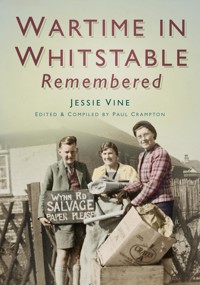
Jessie Vine's memoir begins in the last few days of peace in 1939. As the Anderson shelter is installed in the back garden of their Rochester home, Jessie, with her young daughter Joy, eagerly awaits her husband Tom's homecoming, as his ship returns to Chatham Dockyard. And then, when war seems inevitable, Jessie organises an evacuation from Rochester to Whitstable, where she rents a bungalow in the suburb of Tankerton. Tom soon goes back to sea, and the perils of war. They do not see him again for two years. In the meantime, Jessie helps out at a local school, while organising endless collections of salvage. When time allows, mother and daughter cycle all over East Kent to hunt down old film. With these prizes, Jessie compiles a unique photographic diary of life on the home front, which she sends to Tom at sea.
Sie lesen das E-Book in den Legimi-Apps auf:
Seitenzahl: 199
Veröffentlichungsjahr: 2012
Das E-Book (TTS) können Sie hören im Abo „Legimi Premium” in Legimi-Apps auf:
Ähnliche



















CONTENTS
Title page
Introduction
1 Happy Days
2 The Exodus
3 Billeting
4 The Mistake
5 The First Warning
6 Settling Down
7 Lily
8 Blackout Journey
9 A Home of Our Own
10 At the Time of Dunkirk
11 Off to War
12 Neighbours & Rations
13 Neighbours & Salvage
14 Photography
15 United in Trouble
16 Sharing the Oranges
17 The Bombing Escalates
18 As Time Goes by
19 Thoughts of the Navy
20 Homecoming
21 Milestones
22 Paris Liberated
23 The Peace Pageant
24 What Happened Next
Appendix: Tom Vine A Whitstable Man's War
Copyright
INTRODUCTION
This book is the second volume of my late maternal grandmother's memoirs. The first volume Dover Remembered, published by Meresborough Books in 1984, came out in her lifetime, and she therefore had complete control over every aspect of the project. (Although this book is out of print, second hand copies seem to crop up regularly in bookshops and on Internet sites). Wartime in Whitstable Remembered or, as it was originally to have been called, ‘A Navy Wife's War Remembered’, was begun by her in the late 1980s, and intended to be a logical follow-up. Sadly, my late grandfather's poor health meant that the project had to be cancelled, and although she completed a typed manuscript, the book was taken no further. My grandfather, Tom Vine, did have a small involvement in this second book, completing three drawings for it, but his contribution was nothing like that to be found in the Dover volume. My beloved Grandad passed away in July 1991, at the age of eighty-four, and the Whitstable project was put in a drawer and forgotten.
As family archivist, I later inherited all of my grandmother's photographs and manuscripts (there are at least two other unpublished, illustrated books of poetry) and the Whitstable project was among them. With the current interest in all matters concerning the Second World War, I thought it timely to pursue the publication of this forgotten second volume, and The History Press were immediately keen to take it on board, hence the book you now hold in your hands. What clinched the deal though, was the vast archive of family, and other unique photographs that I would be able to liberally spread throughout the text.
Dover Remembered covered Jessie's childhood, in her hometown, from her birth in 1907 until roughly 1920, and the aftermath of the First World War. Wartime in Whitstable Remembered picks up the story of her life again in 1939. Therefore, I thought it useful, and also of interest, to include the key events in the life of Jessie Vine (née Tomlin) as part of this book's introduction.
The Tomlin family moved from no. 33 Trevanion Street, to no. 12 Effingham Crescent, at sometime during the 1920s. This was effectively a move across town, and also a deliberate relocation to a ‘better’ area of Dover. Jessie's first job was as a window sign-writer for Woolworth's in Dover. She prospered in this endeavour and was given advancement within the organisation, which meant that she had to travel all over East Kent to other branches, including Canterbury.
Throughout this period, Jessie continued to date her childhood sweetheart, Tom, who had by now signed up for a twenty-five-year stint in the Royal Navy. Being painfully shy, he never actually called for her at no. 12, but would wait at the end of the street, until she noticed him. My grandfather's first significant ship posting was aboard HMS Cumberland, and this took him away from Jessie for months, even years at a time.
During Tom's absence, my grandmother sought alternative employment, and became a professional companion to a Mrs Du Pre, which meant her moving out of the area for the duration. The house she stayed at, when not on tour with her mistress, was Wilton Park, Beaconsfield in Buckinghamshire, which was usually referred to as the ‘White House’. This three-storey Palladian mansion had been built in 1779 by Josias Du Pre and had remained in the same family ever since. Jessie had a room on an upper storey at the front of the house, overlooking the extensive landscaped gardens.
Later on, in 1939, Wilton Park would be leased to the War Office and, by 1942, had become a prisoner-of-war camp for high-ranking enemy officers, such as Rudolf Hess. So who knows, the former Vice-Chancellor of Nazi Germany may have stayed in the same room as my grandmother once had. Sadly, the ‘White House’ was demolished in 1968, to be replaced by what has been described as ‘an ugly fifteen-storey accommodation block’.
My grandmother's new career as a lady's companion wouldn't last for long, however; love was calling in the form of a young, muscular Naval rating. Tom and Jessie finally married on 11 November 1932 and they honeymooned locally. For the first few months of their marriage, the couple lived at the Tomlin family home in Effingham Crescent. Before long, Jessie again sought new employment, and this time, decided to stand on her own two feet. Having inherited many, if not all, of her father's tailoring skills (from all those many hours of watching him at work atop his bench), she decided to strike out on her own and begin a one-woman dressmaking business. Her business card read as follows, ‘Let Jessie Tomlin make your frocks, and ensure quick service, modern styles and reasonable charges.’
My grandparents subsequently found a flat in Russell Street, Dover, but a move to Rochester, in order to be nearer the dockyard at Chatham was also in the offing. This would enable my grandfather to better continue participating in the RN Barracks Field Gun Crew, which competed at Olympia every year. (Later on, as Petty Officer, or Chief Petty Officer, my grandfather would go on to train that same competitive crew.) Another tour of duty aboard HMS Cumberland subsequently beckoned, but by the time Tom came home again in early 1935, it was to a rented house in City Way, Rochester.
This was a house they shared with Tom's sister Ivy, her husband Sid Hookham (another Naval man) and their young son Bob. My mother, Joy, was born in October 1935, at the RN Hospital in Gillingham. There were terrible complications during the birth, and my grandmother very nearly died. As a result, she had to spend months in hospital afterwards and, although she mostly recovered, was not able to have any further children. In the meantime, my mother was raised by Connie Tomlin, who was the wife of Jessie's brother, Charlie. These temporary foster parents then lived in Howard Avenue, which backed on to the house in City Way. Incidentally, Joy was named after one of Colonel and Mrs Du Pre's three daughters.
A significant event in Tom's life was being given the honour of hauling the gun carriage that carried the coffin of George V at his state funeral. He was one of many such Naval ratings to have taken part, but his position was in the front row, as left-marker, because of his height and strength. The funeral took place on 28 January 1936, and the procession saw the coffin of the late king, atop a gun carriage, being taken from lying-in-state at Westminster Hall, to the funeral service at St George's Chapel, Windsor.
Even though my grandfather had become a Petty Officer by this time, for the funeral procession, he had to assume the traditional ‘square-rig’ of a Naval rating. The men in front of the gun carriage had to maintain the strain and the direction of the assemblage, while those behind it acted as brake-men, preventing the carriage from running away, or the connecting ropes from slacking in the middle.
After the event, my grandfather was awarded the Royal Victorian Medal (silver) by the future Edward VIII. He was also given a commemorative photograph album, to acknowledge his service on that day, which contained a personal handwritten message from Queen Mary herself. These treasured items are still in my possession today.
Also, in 1936, Sid Hookham was posted to Malta, and took his family with him. At around the same time, Tom, Jessie and their tiny daughter Joy moved to a semi-detached bungalow at no. 9 Howard Avenue, near to where a number of relatives already resided.
By 1938 Tom was touring the world in the converted training ship HMS Vindictive, which allowed him to regularly ‘pop-in’ on his sister's family in Malta. Meanwhile, back in Howard Avenue, my grandmother had her hands full with my high-spirited mother, as she became an active toddler.
Paul Crampton, 2012
1
HAPPY DAYS
I raised the clothes prop as high as it would go, until the galvanised line was stretched as taut as possible, and the newly washed clothes were swinging in the breeze of that bright July morning. I had awakened very early indeed, about four o'clock, and could not rest content any longer because of the rising tide of excitement and anticipation of the coming day. It was to be a very special day.
While I scrubbed more garments in the hot suds in the kitchen sink, I was unconsciously singing softly to myself,
Blow him again to me
While my little one, while my pretty one
Sleeps…
Sleep and rest, sleep and rest
Father will come to thee soon
Father will come to his babe in the nest
Silver sails from out of the west.
Blow him again to me,
While my little one, while my pretty one
Sleeps…
But there were no silver sails around him wherever he was, but funnels, superstructure, guns and the grim paraphernalia of warfare. I paused in my work and continued to sing, tapping out the rhythm on the galvanised washboard that was pressed to my waterproof apron, and I drifted away for a few moments in daydreams. ‘While my little one sleeps’ – but Joy wouldn't wake for another hour or so. I peeped in at her, soundly sleeping, clutching her doll, all so peaceful. She would also be having an exciting day.
Having finished all my laundry work, and feeling satisfied that it would soon be dry and ready for ironing, I knew that I had ample time to get everything around the home ship-shape by midday. I liked it all to be bright and cheerful with flowers for his homecoming, with slippers at the ready, pipe rack in evidence, and civvy clothes laid out on the bed.
Tom would be so pleased to abandon his uniform and pretend that he was a landlubber for a while, do a bit of gardening, and a few odd jobs around the bungalow that had been awaiting his attention. A sailor's wife is usually a very versatile person, having learnt by virtue of necessity to find out how to do jobs for herself, but there are always a few things that needed a man's touch.
HMS Vindictive, the training ship, berthed at Malta, during the mid-1930s.
I heard a few scuffling noises coming from the bedroom, and peeping in, there she was, my little girl, sitting up sleepily rubbing her eyes, her bonny curls all awry like a cloud of spun silk.
‘Do you remember what's going to happen today?’ I asked. With a squeal of delight, and a sudden brightening of expression, she said, ‘Yes, Daddy's coming home today. I wonder what he'll bring this time?’
Children have a wonderful memory for things like that, and Joy knew that her Daddy would never forget to bring her presents. Tom was on a three-month cruise in the Mediterranean, on HMS Vindictive, with the young cadet officers-in-training straight from Dartmouth Naval College. He was, at that time, a Petty Officer Gunnery Instructor. The ship was due in at Chatham Dockyard for summer leave.
My four-year-old and I had breakfast and were just about to commence the usual chores, when two men arrived.
‘Are you ready for your Anderson shelter, ma’ am?’ One of them called.
‘Oh, yes please. Do you want to start now?’
And they did – working quickly and efficiently, digging a large hole in our little patch of garden. The Anderson was a shell of corrugated steel, 6ft long and was supposed to be buried 4ft deep in the earth. The width, just over 4ft, was enough to allow sleeping arrangements to be made. We found out later, that water seeped in freely, and if folk had to spend long hours inside, then it would have become a health hazard. However, as a protection from bombs, it would have served its purpose, unless there was a direct hit.
I was concerned for my washing just then, for the upheaval of the dry soil was creating dust clouds all around the centre of activity. We had all experienced a very dry spell of weather and our few pansies were struggling for existence. Only the weeds seemed lively, but then they always do.
Young Joy helps the men to install the Anderson shelter in the back garden of no. 9 Howard Avenue, Rochester. The rear elevations of houses in City Way can be seen in the background.
Joy's concern was lest the men should spoil her newly made sand pit, but the men assured her that it would be safe, so she wanted to help them dig. In fact, it soon became clear that she was torn between two desires: one, to watch the men's activities, and the other, to wait at the gate for her Daddy's arrival. Therefore, her time was spent alternating between both interests, her chubby little legs carrying her with remarkable speed from one place to the other so as not to miss anything.
Glancing at the clock inside, I saw that the morning was still young. Yes – all was tidy, I thought to myself, and doesn't the place look different with this additional furniture. I gazed lovingly at the new three-piece suite with pride. It had only been delivered the previous day, and I had shuffled it round and about, placing and replacing until I was satisfied. On each of Tom's three-month cruises, I had aimed to save up to buy a new item that would be a surprise for him on his arrival home.
It wasn't easy to save, but I had been brought up to watch the pennies and by dint of much perseverance, I had managed it, and here it was! No hire purchase for me – it had all been paid for. And how very nice it looked, with its lovely blend of fawns and greenery, and it also looked so inviting. Oh yes, Tom would like it!
I set to work preparing a favourite dinner and soon the succulent aroma was making the workmen in the garden sniff the air longingly, so I took them out a pot of tea, and looked at their progress. It was amazing how rapidly they had worked.
Jessie tries out the newly installed Anderson shelter, during the last months of peace in 1939.
‘We've done a good many of these up to now,’ said the older man, as he paused for a while. ‘Perhaps they won't be needed after all. But there you are; just in case. Neville Chamberlain says it's going to be alright now, so please God, war won't come!’
‘Amen to that,’ I replied, ‘there are so many servicemen's families around these parts and they are all anxious, but then, I suppose it's the same all over the country. Everyone will be affected.’
‘Yes, that's right,’ the older man replied, ‘but let's give you some advice about this ‘ere shelter.’ He gestured towards the newly erected structure. ‘First, you should set about getting yourself some duckboards, for on this slope, you'll certainly get waterlogged, and you may want to put some bedding in there. And it's a good idea to get some quick-growing plants growing on the top; after all, it's covered with soil!’
When the men had finally left, I looked at the monstrosity that now filled up most of the garden space, and it brought the whole realisation home to me: of changes looming on the horizon; of how the whole nation had been anxiously watching events of the previous few months. Earlier in the year before, Austria had been annexed by Germany, and during this year of 1939, nerves were being stretched taut.
In retrospect, the people criticised the agreement made between Chamberlain, Daladier, Mussolini and Hitler on 29 September 1938. It all seemed to have been a useless venture, and had proved nothing at all, except that Hitler was a sham and Neville Chamberlain had been conned. Of course, he had meant well, but was too trusting, and Hitler was no gentleman. As Caesar had said of Cassius, ‘such men are dangerous’. The appeasement policy had also prompted some scathing remarks from the Rt Hon Winston Churchill.
Mr Chamberlain had said, waving the paper on which Hitler had placed his signature, ‘all this will be over in three months,’ and he went on to use these words, ‘this is the second time that there has come back from Germany to Downing Street, peace with honour. I believe it is peace in our time.’ The cheerful gesturing of the famous umbrella became a joke. Events in Europe continued to upset both people and statesmen alike, and everyone began to wonder what would happen next.
Conscription had started in the spring of 1939, and evacuation schemes had been planned. Thousands of civilian respirators had already been manufactured and widely distributed at the time of the Munich Crisis. The very thought of being gassed, like the poor wretched Tommies in the trenches of the First World War absolutely horrified us, especially when we were given more details. We were told that poison gas could smell like pear drops, or musty hay, or even geraniums.
The Navy recruitment photo that featured Tom, and of which Jessie was so proud!
Tom arrives home from Chatham Dockyard following his 1939 cruise aboard HMS Vindictive.
For now though, I had to clear my mind of these unsettling thoughts on this special day – I had to check on the liver and bacon casserole that was simmering in the oven, and then put the sugar sprinkling on the apple pie. Tradition demanded that there would always be an apple pie made when a sailor came home from the sea. In fact, the standing joke was that apple pie would be the second thing he asked for.
I just couldn't contain myself to stay indoors any longer. And so, I quickly laid the table and, taking a final look around, together with a satisfying pat of the cushions, went out to the front gate to join Joy. We waited, stooping occasionally to pull up a stray weed here and there, all the time keeping a keen lookout up to the end of the road, where his taxi would soon be appearing. Oh dear, how time drags when one is waiting!
A blackbird in the tree next door eyed me quizzically; he was trying to tell me that I had forgotten his usual tit-bits. I thought back to other homecomings, and that familiar aroma that always enveloped Tom when he came straight from shipboard: a curious mixture of carbolic soap and strong tobacco. Sailors are among the cleanest people in the world – woe betide any who defaulted, but they seldom ever did; their messmates would quickly see to that.
A passing neighbour asked if I was expecting my husband home, and told me she was on her way to collect her gas mask.
‘I hate the idea of these respirators,’ she said. ‘Do you know that they even have them for young babies? But perhaps we'll never need them anyway.’
I hoped that she would not stay there chatting when Tom arrived. I kept on looking to the end of the road, and was so glad when she eventually moved away. ‘Goodbye Mrs D!’
Most of the people near about, being Navy folk, took a keen interest in Tom, because his picture had been seen all over the British Isles and also the Empire, when the Admiralty had photographed him for a recruiting poster about eighteen months earlier. In fact, it was on exactly the same day that the Crystal Palace in London had burned down. Tom had to dress in the rig of a Chief Engine-room Artificer for the occasion and, as he was actually a gunnery man, all the badges on his own uniform had to be replaced by those of an ERA I had the job of doing that! He went to London for the photographic session, for which he was posed at the salute. They also attempted to sink his identity to some extent, by making his otherwise blond hair appear as dark. Afterwards, I had to replace the original badges. Imagine my surprise and dismay then, when I had to go through the same performance all over again in the following week, when the Admiralty decided they wanted to do a repeat session.
I was very proud of that recruiting poster, especially when I saw it in full length on the screen at the local cinema. On the few occasions that Tom had been home from leave, and had accompanied me to the pictures, I found myself gesturing towards him when the recruiting poster appeared, as if to say, ‘look, here he is in the flesh!’ In turn, poor Tom, ever the self-effacing and shy man that he was, would sink ever further into his seat, desperate for the moment to pass.
My chatty neighbour waved her hand encouragingly when she moved to the corner of the road, and then my heart leapt – such a sight was nearing the gate. It was difficult to make out at first, but then I could gradually see what it was. There were several basketwork chairs lashed to the top of a taxi, piled high and all in a heap, and it took quite a while to get them all down. The cheery-looking driver had probably seen it all before, while bringing sailors home from foreign parts, and no longer registered any surprise at all the things he would be expected to carry.
It wasn't exactly the greeting that I had anticipated, for most of the neighbours were peeping out to see what all the commotion was about, and Joy was dancing round with delight at seeing three chairs of different sizes, which she declared were, ‘one for Daddy Bear, one for Mummy Bear and one for Baby Bear.’
Once they'd been unloaded, it didn't take very long to get those bulky pieces of furniture into the bungalow, and then for us to have our hugs and kisses away from other people's eyes.
We quickly fell into a steady routine for three people instead of two, and spent some delightful days of summer, enjoying happy country walks among the birds, trees and flowers. Nature seemed at its very best, with simple delights and surprises to be found everywhere. We took picnics and spent many hours just lazing the time away, while Tom would sketch everything in sight. This was his favourite hobby, especially when we came across old buildings. What a wonderful change from the sea: that unpredictable element that can be so beautiful and then so fiercely cruel.
Tom, Joy and I were happy – very happy, and I desperately tried to forget that war-fever was already spoiling so many other people's way of life. But I wasn't letting it spoil ours for the brief time that we had together, so I hid our gas masks in a cupboard and decided not to tell my husband that I had been to the council offices to find out what sort of war work could be done by a woman with a small child – if war should come. Yes, I had to forget all of that for a while and pretend that the rumblings and rumours of war had never happened. As things turned out, Tom would be on the ship in Chatham Dockyard for a few weeks, until the next cruise started, so there would be weekend leave to look forward to and, in all probability, most nights at home for that period, so why worry about the possible war just yet?




