


Erhalten Sie Zugang zu diesem und mehr als 300000 Büchern ab EUR 5,99 monatlich.
- Herausgeber: Cross Networking
- Kategorie: Sachliteratur, Reportagen, Biografien
- Sprache: Englisch
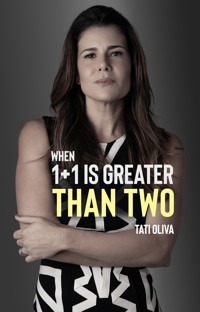
In the market for over 10 years, Cross Networking is the first Brazilian agency specialized in strategic partnerships. The idea came from the experience of businesswoman Tatianna Oliva, who saw the opportunity to connect brands to create unique and meaningful projects that make a difference for the business. In the book, the author's first, Tati discusses her trajectory, which paved the way for her career as an entrepreneur, her philosophy and some of the cases that prove that partnerships are the future of business in the era of shared economy.
Sie lesen das E-Book in den Legimi-Apps auf:
Seitenzahl: 104
Veröffentlichungsjahr: 2021
Das E-Book (TTS) können Sie hören im Abo „Legimi Premium” in Legimi-Apps auf:
Ähnliche



















Contents
Cape
Preface by Miguel Patrício
Starting Early
The discovery of two passions
The seed of partnerships
A connections startup
Cross Networking in action
Passion for brands
Everything at the same time now
Vision for the future
Landmarks
Cover
Table of Contents
Title Page
Copyright Page
Acknowledgments
Body Matter
Copyright © 2018 by Tati Oliva
All rights of this edition reserved for Tati Oliva.
Updated spelling according to the Portuguese Spelling Agreement of 1990, which came into force in Brazil in 2009.
editorial coordination: Lizandra Magon de Almeida (Colmeia Edições)
technical consulting and writing: Alice Salvo Sosnowski
(O Pulo do Gato Empreendedor)
graphic design and layout: dorotéia design/Adriana Campos
cover: Cássio Oliveira
translation: Daniel Haswell
International Data for Cataloging in the Publication (CIP)
Angélica Ilacqua CRB-8/7057
Oliva, Tati
When one plus one is greater than two / Tati Oliva – São Paulo, SP : Edição do Autor, 2021.
162 p. : il. ; 21 cm.
ISBN 978-65-00-16242-4
1.Business 2. Entrepreneurship 3. Business Women 4.Biography I. Title II. Oliva,
Tatianna, 1974 -
21 - 01 CDD 22. ed. – 658.4092082
Indexes for systematic catalog
1. Entrepreneurship
2. Business Women
Charlene K. Lemos, CRB-8/7344
Promoting partnerships is our purpose.
We believe a partnership is a sincere act of exchange where we share our best, receive the best from others, and thus we all become better. Every new day. With each new challenge.
We are a place of happy people, which transforms relationships into understanding, understanding into opportunities, opportunities into ideas, and ideas into innovative business solutions. After all, our business is to do things differently and find ways in which everyone really wins.
It is in our essence: it’s only good when it’s good for everyone. And if it’s good for everyone, it’s #CrossNetworking.
Acknowledgements
They say that we cannot leave this world without doing three very important things: planting a tree, having a child, and writing a book.
I believe I am doing my part. I have already planted several tree seedlings on my farm, next to my husband Zé Victor Oliva, who always warns me about the importance of watering our affections.
Together, we also had two wonderful daughters: Maria and Manuela, who give me a sense of accomplishment and inspire me daily to be a better human being.
confess that I never dreamed of writing a book, but my desire to inspire people to seek out sharing and purposeful partnerships led me to, once aging, leave my comfort zone and take action.
This would not have been possible without the invaluable help of my family. I also had the support of my partners and mentors who encouraged me in this project: José Victor Oliva, Juan Vergara, Miguel Patrício, Cristina Franco and Luiza Helena Trajano.
I would also like to thank the friends, clients and colleagues who made themselves available to make this book happen: Andrea Galasso, Fábio Brandão, Marcos Angelini, João Campos, Zeca Rudge, Marianna Sanches and many others who had a fundamental role in this work.
To all my team, Cross Networking partners, my guardian angel Isis de Angelo, and Alice Salvo Sosnowski for being able to translate ace in the hole.
Without you all, I wouldn’t have completed this mission! Maria, Manuela, João and Antonio: I hope you are proud of me.
May this book fulfill its purpose of inspiring more partnerships, exchanges and prosperous relationships between companies, brands, and people!
Preface
Although it seems obvious, the idea that in a partnership both parts can win is always often viewed with skeptical eyes. Tatianna has dedicated her professional life to developing partnerships among companies, brands, and even personalities. Her book “When 1 Plus 1 Is Greater Than Two” tells the story of how she evolved to make Cross Networking a very successful company – and in it she shares examples of successful company – and in it, she shares examples of successful partnerships that she led. This is great inspiration for those who lead brands, brands, business, or are just looking for inspiration from na incredile female leader.
Miguel Patrício – Chief Executive Officer
The Kraft Heinz Company
I am a caiçara from Santos. I lived in São Paulo from age 3 to 10, but I always identified with the sun and the spirit of the city where I was born. I was registered on December 30, 1974 as Tatianna Tavares de Moraes Sanches - Tavares, from my mother, Maria Ângela Tavares, and Sanches, from my father, Cláudio César de Moraes Sanches.
Caiçaras are the traditional inhabitants of the coastal regions of the southeastern and southern Brazil who are descended from Africans, indigenous people, and Europeans.
I am the middle child: my youngest sister, Lucianna Sanches Fuchs, lives in the United States, is a designer, and has a 6 year old daughter named Joanna. My older sister, Marianna Sanches, is a publicist and mother of Isabella, who is 15 years old. My two nieces are my godchildren. I also have two girls, Maria and Manuela, who are the people who most inspire me to be a good example.
Do you think that is a lot of women? Well, I’m used to the ladies. It has always been like that in my house - even the pets, from fish to parrots, were female. My father always said he was the blessed fruit among women. He jokes to this day that he is paying for all his sins by having to manage such a household.
The childhood memories I carry are mainly linked to my maternal family, that was always very large and united. My paternal grandfather, Osvaldo, died before my parents were married, and my only uncle, Osvaldinho, my father’s brother, died young, at age 53.
My mother, on the other hand, has seven brothers, and it was these grandparents, uncles and a true “cousin-land” that surrounded me as I grew up. My grandfather Décio was always our reference: a stern man, very demanding, always keeping an eye on everyone. He controlled expenses and took care of the entire family’s income tax returns. He didn’t let anyone smoke in the living room or leave the dinner table without asking to be excused.
We lived next door to his house, in a four-story building on Canal 3. My father lived between Santos and São Paulo. He was a businessman, art dealer, and a real bon vivant. In love with old cars and motorcycles, in the 1990s he created a motorcycle club, known all over Brazil, called Rebel Bikers, with more than 500 members. He is an educated man who speaks with ease both about art and business. He enjoyed the nightlife, without neglecting his health, since he was also dedicated to sports.
He never wanted my mother to work, but he insisted on educating his daughters differently: he showed us the world so that we could make our own choices. He took us to concerts, the world of the arts, and the world of business. He was the one who taught us to dive, how to ride a jet ski and motorboat, and to understand automobile mechanics. I lost count of how many times we traveled together and he made us change the flat tire of the car. Does that sound like an exaggeration? But one of his phrases marked my childhood and explains his philosophy: “My daughter has to be independent.”
In the name of autonomy, my father demanded a lot from us. I remember once when he bought a fax machine, at the time a technological novelty, and gave me the mission to learn how to use the device and then teach the rest of the family. He warned me:
“You can take as long as you’d like, but when you explain it to us you have to know everything.”
I kept procrastinating to read the manual. When I went to the arena, I missed my third question. There was a huge fight over that. These teachings, which appear to be exaggerated and foolish, were very important in my life.
We spent seven years in São Paulo, and lived in the Jardins neighborhood, because of my father’s work. Being self-employed, he ran after opportunities and faced all the oscillations required of those who make this professional choice. An employee at a company suffers internal and external competition and a series of other pressures, but knows that, at the end of the month, their salary and benefits are guaranteed. For an independent professional, as well as for the entrepreneur, it is different. The variation between good and bad days is more intense and many lessons are learned from this seesaw, such as flexibility, creativity, and resilience.
We had moments with lots of money, cars in the garage and credit cards with high limits; and moments when any type of excess had been cut. Between ups and downs, our economic life was healthy. We never lacked anything, but this financial instability bothered me. My father and, especially, my mother softened the situation, turning this experience into training for our independence. I had no idea at the time, but I lived in an incubator, and was undergoing the initial tests of an entrepreneurial life.
I learned a lot about business with my father - even the figures with whom I had contact came through him, like the renowned publicist Mauro Salles, who my father introduced me to when I said he was interested in this professional field. His son, Paulo Salles, who is unfortunately now deceased, is the godfather of my daughter Manuela. He was one of the people I consulted when I decided to start my company.
My mother’s way of being was the opposite: a more peaceful warrior, a great supporter of her daughters, and extremely affectionate and positive, with the enviable habit of always looking on the bright side of everything. Even in the most challenging phases, she was always smiling and supporting the whole family. Contrary to popular saying, I strongly assert that, next to a great man, there is always a great woman. My mother is a dear, who taught me to carry only what is really important. Basically, I owe a lot of what I am to both of them, who inspired me a lot with their antagonistic personalities.
First solo flight
When I turned 15, I told my father that I wanted to do an exchange program. I had desired an experience abroad for some time. He told me to finish high school before going after my dream. That was what I did.
While studying, I researched and chose the United States. I wanted to study English, but I also wanted to experience American culture, like we see in the movies. I fled from New York, Miami and Los Angeles, more globalized cities, to have the real experience of the typical American. At that time, I identified more with that culture, which has entrepreneurship in its veins, which pushes people forward, and forces them to be successful. That was also my spirit: I really wanted to have my own things, to be independent, and to progress.
When I finally finished high school, I went to collect my promise:
“Dad, I want to go to Seattle”.
I embarked towards my dream, and the experience exceeded my expectations, since I faced all the shocks imposed by the difference in the environment, history and reality. I lived in the home of a family that was not mine, I had roommates from Indonesia and France, and I felt the fear of violence. The week I arrived, the police went to campus to warn of attacks by a man in the region. As with almost everyone who invests in an exchange program, my body also reacted to American food, adding ten pounds to my weight.
Over time, I missed home and the phone bill went up. I spent, on average, $400 a month to keep up with what was happening here. I really grew up in an extremely close family. I missed not only them, but also my country’s culture, its people, and its way of being, which was so much a part of my essence.
I had taken the TOEFL and was thinking of settling in New Jersey to continue studying, but when I stepped back in Brazil, there was no way. I decided: “I don’t want to live anywhere else in the world.” I always think: “Travelling is great, but I’m always excited to come home.”
Heating up the engines
When I got here, I faced that difficult phase that every young person faces: what do I want to be. It is a raw deal, at 18, to have to decide what you want for the rest of your life.




