


Erhalten Sie Zugang zu diesem und mehr als 300000 Büchern ab EUR 5,99 monatlich.
- Herausgeber: The Lilliput Press
- Kategorie: Sachliteratur, Reportagen, Biografien
- Sprache: Englisch
In the summer of 1939, as a two-year-old in London, I was given away by my parents to a Chelsea friend and taken on the Irish Mail to Dublin. Thus begins this extraordinary memoir by travel writer and novelist Joseph Hone, one of eight children farmed out by impecunious and inebriate parents, who was raised at Maidenhall in County Kilkenny by the historian and essayist Hubert Butler and his wife Peggy, sister of Tyrone Guthrie of Annaghmakerrig in County Monaghan. The story is told through a cache of letters discovered on Hubert Butler's death between he and his friend 'Old Joe', Little Joe's grandfather and biographer of Yeats and George Moore, upon whom fell the financial responsibility for his grandson's upbringing. This account of Joseph Hone's childhood and youth during the 1940s and 50s in rural Ireland, among the privileged and artistic elite of his generation living down-at-heel if comfortable lives in a newly emergent state, is an enthralling reminder of the happenstance and precariousness of all our lives. Like William Trevor, Joe was boarded out at Sandford Park in Dublin and then at St Columba's, both of which he documents in loving and comic detail, gaining as much stimulation from his home environment as from the excesses and disappointments of these single-sex establishments. He writes with feeling and insight of the lives of those in his circle and beyond – his teachers and foster parents and friends – working as an assistant for John Ford during the making of The Quiet Man, and finding himself as the writer he was to become. This numinous work of autobiography and self-interrogation bears comparison with Nabokov's Speak Memory or Frank O'Connor's An Only Child. It will take its place as a classic of the genre while illuminating unknown corners of Ireland's cultural landscape.
Sie lesen das E-Book in den Legimi-Apps auf:
Seitenzahl: 529
Veröffentlichungsjahr: 2009
Das E-Book (TTS) können Sie hören im Abo „Legimi Premium” in Legimi-Apps auf:
Ähnliche


















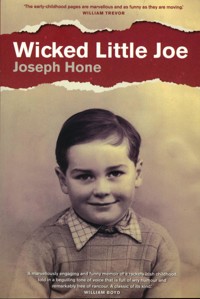
Wicked Little Joe
A Tale of Childhood and Youth
Joseph Hone
In memory of SMB and HMB and for our grandchildren – Harry, Cordelia and Jack
For the field is full of shadows as I near the
Shadowy coast.
And a ghostly batsman plays to the bowling of
A ghost.
And I look through my tears on a soundless-
clapping host,
As the run-stealers flicker to and fro,
To and fro –
O my Hornby and my Barlow long ago!
Francis Thompson
Contents
Title PageDedicationEpigraphONETWOTHREEFOURFIVESIXSEVENEIGHTNINETENELEVENTWELVETHIRTEENFOURTEENFIFTEENALSO BY JOSEPH HONECopyright
ONE
In the summer of 1939, as a two-year-old in London, I was given away by my parents to a Chelsea friend and taken on the Irish Mail to Dublin. On arrival she didn’t abandon me in the Left Luggage. That, indeed, would have been carelessness. Instead I was deposited at my grandfather’s house in Killiney next morning. He must have groaned at my arrival – he was prone to groan. With the arrival of my sister Geraldine and twin brothers, Antony and Camillus, landing on his doorstep in the two subsequent years, his groans must surely have become cries.
These babies became like time bombs for him, to be passed on as quickly as possible among equally alarmed friends and relations. My grandfather – (known as ‘Old Joe’, so that I became ‘Little Joe’) son of a respectable, well-to-do Dublin banking, merchant and artistic family, friend and biographer of Yeats and George Moore – was reduced to the status of a baby-hawker. Literally so, for when his ‘Mary Poppins’ friend, P.L. Travers, wanting to adopt a child, came to Dublin in 1940 to inspect the goods – in this case the twins – he said to her, ‘Take two, they’re small.’
How had all this come to pass?
Some years ago, after my foster parents Hubert and Peggy Butler died, I was told by Bernard Meehan, the archivist of Trinity College Library in Dublin, that among literary and other papers which Hubert, the acclaimed Irish essayist and scholar, had sold to the College, there was a file about me. When I was next over I picked it up. Marked ‘Little Joe’, it was stuffed full of letters to Hubert and Peggy – with carbon copies of all Hubert’s replies – from my real parents, Nat and Biddy, my grandparents, Old Joe and Vera, from my great-aunt Olive, from Peggy’s theatre director brother Tony Guthrie, from Pamela Travers, from cousins, friends, headmasters, housemasters, a doctor-psychiatrist and others who had become involved in the seemingly all-absorbing cause of dealing with ‘Little Joe’, clearly an exceptional case, a real cracker in the difficult, troublesome boy department.
A glance through the file was enough. I saw the wispy heads of unhappy genies emerging, and firmly closed the bottle. I didn’t want to revisit my childhood. Or at least the unhappy part of it, for it hadn’t always been unhappy. In fact I had a very lucky and stimulating upbringing with the Butlers and the Guthries, in Maidenhall and at Annaghmakerrig, two lovely book-and-theatre-dominated country houses in County Kilkenny and County Monaghan, south and north in Ireland. But my origins, and being farmed out to strangers, my Dublin schooldays, my later meetings with my real parents – all this had certainly been trying. Let those bad genies rattle their chains in the bottle.
These days they would say I was ‘in denial’; so be it. I see no good reason why one should uncork bad times, unless a later refusal to do this has formed a ‘block’, preventing one from getting on decently with one’s life. And this has not, I think, been my case. Rather the opposite. The bad memories alone, when I touched on them – of a groaning, penny-pinching grandfather, of a sad grandmother, of irresponsible, drinky, unhappy-go-lucky parents, of my being moved from odd pillar to odder post among put-upon friends and relations; memories of a sadistic headmaster, of vomit-making school food and cold showers – all this long ago made me want to repress these shabby parts of my life, so freeing me to make something brighter of it.
To forget a past that was sometimes as unhappy as mine seemed to me then, and now, to be a very good idea. To deny is often to survive. To dwell on the shipwreck is likely to sink with the wreckage. Besides, as far as my schooldays went, every prep-school boarding boy of my generation, lonely, with parents inevitably absent, has a horror story – more likely a dozen – to tell. A commonplace experience then. And apart from sometimes speaking of the comic side of my family and schooldays – almost as a party piece – I have never wanted to think of, or trade upon, the sadder aspects of my early life. So I thought, let the no doubt troubled child I was then stay interred in the often-troubled tomb of youth.
On the other hand, having reached an age so distant from those times, and thus surely immune to any of its resurrected pains, I thought perhaps I owed it to myself, and as much to my minders – whose real purposes and actions I didn’t understand then, or may have wilfully misunderstood or subsequently exaggerated – to take a proper look through the file. It might well have a purely archaeological interest now.
After all, it isn’t everyone in their early seventies who discovers a fat file containing long-hidden secrets of their childhood, reflected in letters between various intelligent, well-meaning or irresponsible people who together, in thinking they were doing their best for me, made my early life more difficult than it was already.
But perhaps I’m wrong. Perhaps, marshalling the evidence in the file and in other family letters, I may come to see the good sense of their behaviour towards me. Or perhaps the file will justify my feelings that I was badly handled by all of them?
That’s a thought. The proof of my pudding, like revenge, could well be a dish best relished cold, as all my minders are now. I can’t hurt them. But perhaps, whether they were right or wrong in their behaviour towards me, in reading through the file and seeing their efforts on my behalf I may come to understand their confused supervision of me, as I was rarely able to do at the time.
So why not call up those spirits from the vasty deep – the dramatis personae of my early life – as witnesses for the prosecution, adding my own defence now? Why not resurrect the minders’ view of me, and my own view of the child I was then, and how I was looked after, and see where the balance of judgment might lie?
So last year I opened the bottle and let the first genie out. And there he was, a wispy figure emerging, my grandfather, in a letter drawn out at random, written in 1951 to Hubert Butler, an old friend of his, who lived at Maidenhall in County Kilkenny and had been in effect my foster father since 1939:
Yes, it would be very nice for Little Joe if I could send him to Paris for a fortnight – if you could tell me how to find the money. £30 at least. But how?
1.To make it.
2.To save.
3.To borrow.
4.To beg.
1. My productive capacity has been about £50 p/a for the last six years. I wd. be delighted if you could suggest any means by which I could bring it up to a £100. Even tho’ that wd. be but a few drops in the bucket out of which I’m pouring pints per annum. I have been spending 75% to 100% above my income. And over 20% of this has been on Little Joe’s expenses and nearly another 15% has gone to Nat [my father]. This year with tax and increasing charges for Joe I am running at a rate of at least 150% above my income. My income earned is about £1000 after income tax and the rates on South Hill.
(I am speaking of Vera’s money as well as mine.)
2. There are possibilities (I admit) here. I could save about £150 p/a by cutting out cigarettes, my sub. to the Kildare St Club and such hospitalities as we offer. We could do without a servant, until Vera broke down – another £150 I suppose. Vera and I could go into petit bourgeois lodgings and tell David he will have to fend for himself henceforth. But we did tell him (when times were better) that we could see him through the architectural course. We cd. cut off all aid to Nat. But the likely result of this is that Biddy who, with me, is his only visible means of support, would leave him, and he wd. return to my doorstep. Than having him here hanging about, I wd. much rather go into lodgings (I do not say Vera would) or die. And moreover the cost of keeping him with us wd. be as much as I give him now, so this is really ruled out. So what do you suggest in this line? Cigs, etc. We are quite old and haven’t many small pleasures, and are not strong enough for golf or walks in the country.
3. Borrowing. I have been doing this for many years at a accelerated rate. This includes of course selling investments, since the bank has to be paid back from time to time. Counting Vera’s little heritage, about a third of which has gone, she and I have enough to last us, say, eight years, without substantially altering our manner of life: this is assuming that values do not fall much further. Our capital has decreased on paper value by 15% at least in the last 4 months, since the socialists retired. And bills and taxes do not rise much further; also assuming that Little Joe is presently ‘settled’ and numerous other things. We cd. in short gamble on both being dead in eight years, for our only assets wd. then be the house we live in and the furniture. Do you advise us to resign ourselves to this course? It looks as if you were doing so. We have in the sense I have explained to you enough money to send Little Joe to Eton for 2 years. Neither of us has any expectations. I had one of £3000 but have anticipated it in purchasing this house.
4. To beg. Where? No doubt at the end of 8 years my brother and sister, who have always been most generous wd. not let us starve, if they live and have themselves anything left. I have laid my cards on the table.
He had indeed. Though perhaps he was hiding one or two under the table. When he died, eight years later (in that at least his forecast was correct) in 1959, he left an estate valued at nearly forty thousand pounds. Approaching half a million in today’s values I imagine.
My grandfather’s lengthy correspondence with the Butlers largely revolved around money: how much he was to pay for my keep with them, how much he had paid, or had overpaid, or how much he had forgotten to pay, or how much he would, or could not pay. Another letter, from 1944:
My dear Peggy
Did you get the letter from me with the cheque? I can’t remember if I posted it. I had it in my pocket leaving here on Thursday and it was gone when I returned in the evening. I suppose I did post it but I can’t recall the act.
My grandfather was a vague man.
He first drove a car – I was told by my aunt Sally – on a family holiday in the 1920s, all the way from Dublin to Galway without stopping. But this was only because he didn’t know how to stop the car, which he did in the end by running straight into the hotel porch, demolishing a pillar or two and sending the porter flying.
Old Joe. And he always seemed very old to me. I see him writing, in one or other of the four attractive houses I knew him in, usually at the kitchen table, where there was heat from the stove and so no need to waste fuel on a fire for his wife Vera in the drawing-room. A tall, thin figure stooped over dip-pen, paper, and a cut-glass inkwell – and a tumbler of well-watered Mitchell’s Green Spot whiskey to hand if it was after six o’clock. A high brow leading to a bald crown, but with streams of wispy white hair flowing out above his long ears, one or often two pairs of spectacles, one perched on wild eyebrows, the other against luminously pale-blue eyes. A tattered, ashdusted, elbows-out pullover and befuddled tie, the trousers of an old suit hitched up by another tie, slippers where the heel-ends had long since been pushed down, embedded in the insoles; a forgotten cigarette drooping from thin lips, coughing slightly, or quietly humphing and sighing, or starting to groan when he took his cheque book stubs to the dilapidated drawing-room sofa after lunch, where the two smelly dachshunds, Gretel and Hilda, were already in somnolent residence.
Sitting at one end, he would settle his legs down over the dogs and start his count through the stubs. And then the groans. The dogs, disturbed, responded with their own moans and growls, so that soon the three of them had set up a dirge of throaty complaint, like notes from a diseased organ, each dog an organ pedal now, responding in a different plaintive key as he moved his legs here and there over them.
Most afternoons, having read the stock market prices in The Irish Times and dealt with his cheque stubs, he would settle himself to the grim task of making a tally, on the back of the cheque book or an old envelope, of all his worldly assets. First noting the cash in his pockets, perhaps a crumpled ten-shilling note and two sixpences; then making a column of his declining stocks and shares, his São Paulo Tramway stock particularly – this last producing a bad groan, a sudden movement of his thighs and loud yelps from the dogs. Clearly São Paulo trams were going down the tubes.
But there were other, firmer, assets to be cheered by – I saw the back of some of these cheque books and old envelopes later. They ran on the lines of: ‘Two old Victorian dining-room chairs (not needed) – ten pounds? Old brass-headed double bedstead (hardly needed) – five pounds? Clothes horse: two pounds. A good desk (but one drawer missing) in basement – ten pounds. Old dress suit, starched shirt and dancing pumps (cert. not needed) – three pounds. Old shoes and hats – two pounds? Set of Hegel’s works, (slightly foxed) – three pounds? (Possibly more).’
And then another column – ‘This month’s liabilities’ and renewed groans: ‘Sawyers Fish Mongers – one pound seventeen and sixpence. Smyths of the Green, groceries – three pounds, ten shillings and ninepence. Mitchell’s, whiskey and cigs – two pounds fifteen shillings and tenpence. Kildare St Club sub – five pounds. School fees, Little Joe – seventeen pounds, ten shillings’. A sudden groan, anguished movement of the legs, dog yelping madly, a cacophony of outrage.
My grandfather was worried about money. In a letter to Peggy Butler, dated March 1945:
Dear Peggy
Hubert says he can’t keep Little Joe at the price I am paying, and because I cause you annoyance by suggesting economies, as for instance having the child here for a few days when you went away.
I can’t afford more. In fact I can expose my books and accounts which show that properly speaking I have never been able to afford anything, since all Little Joe’s expenses come out of capital … I cannot take the child, here, except for occasional spells. I made this clear at the very beginning when the subject was brought before you by Pamela Travers. We were not then fitted to do so, and are now even less fitted, from the point of view of physical health and nerves alone, as any doctor would testify. These seem to be facts, and I suggest we should discuss what can be done with Little Joe in their light. I could, in the meanwhile, make an estimate of the total capital I could be prepared to put aside for Little Joe, say from this summer until he is 17 or 18, when he will have to make his own living. Getting into the merchant navy might be considered, as their career starts at 14, I think, and would therefore leave more over per annum …
Getting me off his hands and his bank balance at the earliest opportunity became a constant preoccupation of my grandfather’s. There is no correspondence relating to it in the file, but I clearly remember seeing and then being told about the brochure and admission forms which my grandfather, in the light of this last letter, must have immediately requested. It was from a merchant navy training institution for orphaned or indigenous boys, not set on dry land but on an old ship of the line, the HMS Conway, moored in Colwyn Bay, North Wales, and thus a situation ideal from my grandfather’s point of view, in that, apart from entry at fourteen, I would be well and truly off his hands, marooned offshore on the Napoleonic Wars hulk for several years. That I somehow escaped this fate must count as one of my earliest lucky breaks.
At the same time, this failure to transport me to Van Diemen’s Land, as it were, resulted in ever more tortuous and argumentative letters between my grandfather and the Butlers; an increasingly contentious financial correspondence between them, as if they were Rothschilds and Warburgs arguing over millions rather than two quite well-off but rather miserly families disputing the toss over a few pounds, shillings and pence. An offended tone is there from the start in the first letter I have of my grandfather’s, in 1942:
Dear Peggy
I’m enclosing Joe’s keep in advance for September & October, £6.10.0. I don’t know why you say I have been in arrears with payments. I have as a rule paid them in advance; once in the Kildare St Club I paid half a year in advance to Hubert. I was (in this payment) a few weeks early in paying, and now I will be a week or ten days late, with this unexpected ‘taxi’ bill. Please admit that you are wrong as to this, whatever you may think of my feelings.
Sometimes these letters, in his attempts to straighten things out, are reduced to pure financial farce. Another letter, later in 1942:
Dear Peggy
I am enclosing £5.15.0 on account of Joe’s expenses to and from Ballingarry. I am not sure from yr. previous card whether I was to pay the whole £1 charged return fare from Bennettsbridge to Kilkenny, as you say the escort on the way back did not charge anything. On yr. account (or Hubert’s) it would seem that he did charge; but that the other escort (outward journey) did not. I suppose the escort (return journey) was going to you anyway, so had the benefit of the car. I am puzzled. So I send you both the account and the postcard. If I still owe you the 10/- I will add it to the November cheque. (I have paid the monthly sum for Oct. already.) Please return the account, as I keep a list of these expenses, so that my heirs, executors and assignees may see what a miser I was.
This is worthy of Kafka or Beckett. Who were the two mysterious ‘escorts’ on these outward and return journeys? – one who charged for his services, the other who didn’t, and who ‘had the benefit of the car’? Sam Beckett was an old friend of my grandfather’s. I wonder if Sam got ideas for some of his more puzzling plays from Old Joe? – perhaps during the long walks they used to make together in the 1930s, up and down the Tipperary mountains. I can add that the one pound return rail fare charged to the Butlers, Bennettsbridge-Kilkenny, seems excessive for 1942, since the two stations were only five miles apart. These financial arrangements, with their consequent puzzlements and misunderstandings between my grandfather and the Butlers, are endless. They clearly absorbed a great deal of their time, which might have been better spent in writing their books and essays. Another letter, from November 1944:
Dear Peggy
I don’t quite understand about the expense for Little Joe. I mean the ‘12½% boarding’. And the fee I take it is £5.5.0 for the three months. What will be the total cost? Could you let me know approximately? I mean within £2 or so, for his three month stay in Dublin. You know we think he is much better with you than in any other imaginable place. If I was endowed with £1,000 [he has crossed out £2,000] for his upbringing I could not think it better spent than you wd. spend it on him, and whatever happens we will always feel grateful to you for all you have done for him.
Only as I have explained, I am not so endowed … and have to consider, as far as can be possible, preserving enough money, so that my old age and Vera’s will not be one of penury … so you must not think me mean if I do ‘talk of money’ in connection with Little Joe.
Well, both parties went on with their ‘talk of money’. It seems their lives, and certainly mine, clearly depended on this. And it was sometimes angry talk. From another cloudy letter to Hubert Butler, early in 1945:
Dear Hubert,
I was in bed when Vera got the telephone. She came up and said it was Peggy. ‘Peggy says they are taking a holiday to friends, and Joe is invited. But before going Hubert said we’d better phone and consult the Hones about the cost of Joe’s travelling.’ I said ‘Do you know what the cost will be?’ And Vera returned to the phone and came back with the answer that she didn’t know, but ‘supposed about the same as the fare to Kilkenny’. I said ‘All right but perhaps you’d better ask if there will be any motor sharings as well.’ Peggy replied that ‘There wd. be four motors for Joe to share in and also his part in any incidental expenses.’ I said then ‘We may as well have him here’, as I thought at the time we’d have a servant in, and besides Vera wd. like to see him.
At this you Butlers got very angry – why I can’t imagine, since you had at first invited me to make the decision. It was you I gathered who suggested I might like to make the little economy, and now you write as if I was trying to make the economy at your expense.
There are other things to discuss in regard to your letter, other grievances; but this I wd. like to clear up first, for if we can’t clear up so simple a question, how can we clear up anything?
Quite so. My grandfather, in the light of his earlier letter querying the excessive return rail fare to Kilkenny, was understandably chary about lashing out another pound for a brief trip on Irish railways, especially since it might well include the mysterious ‘escort’ again, who this time, thinking he was onto a very good thing, might have charged the Butlers, and thereafter Old Joe, two pounds. And then there is the curious business of my ‘sharing in the expenses of four motors’. One can hardly blame my grandfather for querying this. Four motors? Quite a cavalcade, in petrol-starved wartime Ireland – and surely, aged eight, I would only take up small room in one of the motors? And then the consequent ‘incidental expenses’. My word! On such an apparently extravagant holiday these might be substantial, a Monte Carlo sum. I can imagine my grandfather in his nightcap, turning on his sick bed, groaning, seeing red for the next six months on his overdrawn bank account. Grievances indeed! And grievances taken onto a philosophical, even a religious plane in a further letter, to Peggy Butler, in May 1945:
My dear Peggy
The first thing to remember in this discussion is the obvious thing, that neither you nor I created this world. Little Joe was born under unfortunate auspices with no silver spoon in his mouth. This is not necessarily fatal to him. Many people so born have done well. But it is a fact to be remembered in discussion with me, as when you say my object is merely to save money. No, it is a question of what I can properly spend on him, having regard to my other obligations. So no doubt with you.
He is in fact in childhood at ‘the caprice of the stock market’ … I can make no promises about him; nor can you. It can never be a question of more than six months or so ahead. Hubert’s notion of calling in his parents is quite illusory, unless he believes in miracles, which he doesn’t. He can write if he likes to them, but it will only waste the postage stamp.
‘At the caprice of the stock market’ indeed. Was my grandfather’s meanness nature or nurture? Or was it not meanness at all, but simply understandable self-preservation? Certainly it was hardly nurture. His father, William Hone, retired early from the law, was well off. A family photograph, taken in what must have been the early 1920s in the garden of Palermo, his large Killiney house, when he would have been in his late seventies, shows him to be a short, stout, genial Victorian paterfamilias, moustached and watch-chained. He is surrounded by some of his extensive family, including my father Nat and my aunt Sally as children, sitting on the grass in front. William Hone’s wife Sarah is not there. One of the seven beautiful Cooper sisters from Cooper Hill in County Limerick, she died at only twenty-nine, having given birth to my grandfather Joseph, and three others – my great-aunt Olive, and my two great-uncles Patrick and Christopher. Also in the picture is Maria, the formidable-looking housekeeper. There they all are, in rather stiff, outdated Edwardian clothes – a collection of quietly confident, high-bourgeois Dubliners.
No, it can’t have been from his family that Old Joe got his terrible nervousness about money. It may have been due to the fact that throughout his life he rarely earned more than a guinea or so, for his lengthy book reviews for The Irish Times, The London Mercury, and The Times Literary Supplement, and lived off what was initially a substantial, but after the Great Depression in the 1930s an ever-reducing capital. And I, of course, came to be a major cause of this reduction: I and my first three siblings – Geraldine, Antony and Camillus – turning up on his doorstep, me as a toddler and the others in squirming bundles. This was surely a major factor in his miserliness.
In this anybody would have sympathy for him. He had paid expensively for the upbringing and education of his own three children – Nathaniel my father, my aunt Sally and my uncle David. To be landed with the financial and other responsibilities of looking after four more children, albeit his grandchildren, in his early old age, could well make the best of us feel put upon – and miserly. Besides, Old Joe, who was young once – though it was hard to credit this by the time I met him – was bad with children. The whole business of family and children, it seems, was quite alien to him. Beatty Glenavy (of whom more later), a great friend of my grandparents, once showed me a nicely wicked cartoon which my grandfather’s friend Max Beerbohm had done of him and his wife Vera on their honeymoon night in Paris in about 1910: they were shown in a great canopied four-poster bed, Joe nervous in a pointy nightcap, Vera small and apprehensive, bedclothes up to her neck, with the caption, ‘What do we do now, Vera?’ I never saw the cartoon again. It must have disappeared into Beatty’s estate when she died.
Yes, Vera, my grandmother. In age, the skin tight against her high cheekbones, the flesh retreating everywhere, leaving her teeth half bared; a skeletal, mournful expression, sometimes wide-eyed in horrified astonishment; put-upon, restless. Or motionless, sitting on a stool gazing into the fire, bony knees steeply raised, legs crossed and intertwined like a contortionist’s, a cigarette in her long fine fingers, smoke curling round her head, gazing quizzically through the mist.
A woman who never found herself? Or never knew what she was looking for? Or who was admired so much in youth that her beauty may have seemed all-sufficient? For there is no doubt that Vera had been very beautiful. Dark-haired, large clear blue eyes, that wonderful bone structure, an innocent face; she wore anything with a sophisticated, easy grace. The face I have seen in some of William Orpen’s several fine portraits of her: ‘The Blue Hat’ – sold for a fortune a few years ago – and ‘The Roscommon Dragoon’, where she’s wearing a military uniform with unconscious panache. Orpen couldn’t stop painting her when he and my grandparents were neighbours in Edwardian Dublin; dozens of sketches and several portraits. Orpen was certainly enticed by her beauty, and possibly by the hope of her as mistress? But that wasn’t on. Vera was happily married at that point and of Puritan New England stock. Or was she? It may have been, as it was with me, uncertainty about her own family background that gave her that sometimes deeply mystified, perturbed look.
For with Vera there was not the long family tree of the Dublin Hones but one with the main branches missing. Little of her antecedents were ever revealed to me, so I assumed there was something to hide. Her family name was Brewster. I remember as a child hearing of the film, The Brewster Millions, and thinking that Vera must be part of these millions. I couldn’t understand the penny-pinching so predominant in her household.
That Vera had a mother and father must be beyond dispute, but neither was ever spoken of in the family. She had been brought up in New York by her aunt Julia. This was freely admitted, because aunt Julia, taking the stage name of Julia Marlowe, was the foremost classical actress of her time in late-nineteenth-century America.
A 1940s reminiscence of aunt Julia, when she was at the height of her fame in the early 1900s, by the American playwright George Middleton describes her as having ‘Loose black hair enfolding her pale face, the rich mouth and large wise eyes that looked out provocatively at me, when I was twenty-two, as she lay propped up in bed, with a crimson coverlet pulled up to the book of verse she was reading in that priceless voice of hers.’
She must have been a sensuous woman as well as a fine actress, a point at least partly confirmed by a studio photograph taken in 1897 when Julia, in her twenties, had just made her first great impact on the New York stage. It shows a biggish girl, staring straight to camera with shadowed, slumberous bedroom eyes, dark coiled tresses falling down over a wide décolleté, one bare arm, saucily at her hip, draped with a shawl. Yes, quite the temptress, except for the voluminous dress she’s wearing – a heavy damask outfit, roped at the waist, a rope which then coils round her hips, falling away into a tassel of woolly bobbles. A bedspread, it seems. Not a great come-on, considering she was playing Juliet in the photograph.
This was a role she made so famous in America in her youth that, having married her older actor-manager Henry Southern, she played the lovelorn girl, with Henry as Romeo, until the two of them were at either end of their sixties. They toured America in their later years in these roles, in their own Pullman car, usually just playing the balcony scene – conclusive proof of the star-crossed lovers’ deathless love, since both actors were now presumably quite long in the tooth and wrinkly round the gills. This didn’t deter the audiences one bit. Southern and Marlowe brought the house down, from Albany to Albuquerque.
All this mummery made aunt Julia a very rich woman – the more so on the death of Henry, upon which she retired and spent the rest of her life in grand hotels, with a bevy of Pekinese dogs, in Switzerland, and every winter at the Cateract Hotel at Assuan in Upper Egypt. However, playing against type in their famous roles as lovers, they failed to have children. And so it was that aunt Julia took charge of Vera and her younger sister Grace, bringing them up and becoming their foster mother.
But who were their real parents? – there’s the rub. The file and other family letters give no indication. Years ago I had some information on this, from Beatty Glenavy in Dublin. Beatty, née Beatrice Elvery, a fine painter who married Gordon, Lord Glenavy (and was mother to Paddy Campbell, the witty columnist and stammering TV panel-game star, and his younger brother Michael Campbell, the fine novelist). Beatty was a great friend of my grandfather’s before and after he married. She told me how Joe and Vera had met in Paris in 1910. Aunt Julia had brought Vera over to Paris on a Grand Tour of sorts, staying at a grand hotel and buying her expensive hats and clothes in shops on the rue St Honoré. Here they met Old Joe (or Young Joe, as he must have been then) himself in Paris at the time with his friends Willie Yeats and John Synge.
Vera and Joe were smitten. They must have made an attractive and unusual pair, this American beauty and the tall, gauntly distinguished-looking Irishman. Marriage was proposed. This was not taken well by Joe’s father in Dublin, who, Beatty told me, got the unlikely idea that Vera and her aunt were American fortune hunters out looking for a rich catch in Europe. Aucontraire, Julia Marlowe was much richer than any of the Hones.
In the event, Joe and Vera had to get married secretly, in 1911, Beatty explained – with a week’s notice, in a suburban church, by special licence from the Archbishop of Dublin, at eight in the morning, with Beatty and the church verger as the only witnesses – Beatty supplying the ring, a curtain ring, which she’d bought the previous day in a local haberdasher’s.
Apart from retailing this drama, it was Beatty’s view that Vera was possibly aunt Julia’s illegitimate daughter, not her niece – aunt Julia’s husband Henry Southern, Beatty implied, not being much of a Romeo in that department. But then who was the real father? Beatty didn’t know.
Years later I had some further information from my uncle David in Dublin. It seems Vera’s mother was aunt Julia’s flighty younger sister who, having married conventionally (to a man of German extraction, called Burster, not Brewster) had given birth to Vera and her sister Grace, but had then abandoned husband and children and run off with a cad to Florida, never to surface again, either in reality or in the family annals. Everything was hushed up and aunt Julia then took charge of the two ‘Orphans of the Storm’ – a family embarrassment that repeated itself with me and my six brothers and sisters fifty years later. Which still leaves the question – what happened to the conventional husband, Mr Burster, father of my grandmother? He, too, has been erased from Vera’s family record. In any event this difficult, cloudy background, rather like my own, may have had a lot to do with Vera’s later sessions by the fire, on a stool, legs entwined; her puzzled, nervous look, gazing into the flames.
My grandparents were nervous people.
My aunt Sally once told me that the Hones were nervous people generally, a fact perhaps confirmed by my grandfather who, instead of living in his own lovely house, South Hill, overlooking Killiney Bay, leased it out in 1939 and lived the rest of his twenty years in leased accommodation: four houses in Ireland, in Dublin and the countryside, with earlier winters spent in rented houses in Provence and Italy.
These continual domestic upheavals suggest a certain nervous restlessness. Or perhaps that he wanted others to take the financial responsibility for the upkeep of the houses he lived in, and might avoid having to do the same with his own house? Certainly even as late as 1946, when he and Vera were in their seventies and apparently settled in Ballyorney House, a lovely if quite unsuitably isolated rented place beyond Enniskerry in the Wicklow mountains, he was still considering moving abroad.
In a letter to Hubert Butler, in the early 1950s, he writes:
Vera and I may have to spend our declining years abroad, what with the cold (May, what a May) and the prices of houses in Ireland. I asked the landlord of Ballyorney for what price he would sell the house, and he suggested £7,000! The rent is £130 p/a and for £7,000 one can still get £240 a year in gilt edged securities, nearly twice as much; formerly it was the other way round.
I think Old Joe was nervous and miserly simply because he was totally unfitted for ordinary life, which he felt was going to ambush and bankrupt him at any moment, as indeed it nearly did with the arrival of all those babies on his doorstep. Apart from money, his mind moved on higher things: Swift’s deeply pessimistic reflections, Berkeley’s philosophic riddles, Nietzsche’s deterministic superman, Yeats’s ever-twirling gyres. Old Joe was a philosopher. He spent a good deal of his later years compiling a philosophical dictionary in a big red ledger with his equally philosophic friend, the writer Arland Ussher. At Joe’s death they had reached the letter ‘B’. Dealing properly with Aristotle, Aquinas and St Augustine had obviously taken up a good deal of their time.
Clearly, dealing with the world as it unfortunately is taxed Old Joe. In looking at an egg he was seeing something else – a rough beast inside, about to be born, before slouching towards Bethlehem. Or the egg was a potato. This he certainly thought, for on one of my grandmother’s rare evenings out of the house, when they came to live in Dublin, she told him to boil himself an egg for supper in the kitchen. He put a new potato in the electric kettle, without water, turned it on, went away and forgot about it. The kettle had no automatic switch-off, so that it and part of the dresser were badly burnt on my grandmother’s return.
My grandfather was a preoccupied man.
Apart from his various philosophic concerns, money and me, he had a fourth even more taxing problem to contend with – dealing with his son, and my father, and my mother Biddy. He writes to Hubert in June 1945:
There is nothing to say of Nat and Biddy. You always assume they can make ‘moves’, as you might, or I might. What moves can they make? I have never heard of them making a move in their lives, except for getting married.
And again, in September 1945:
We are faced with great difficulties as Nat may come back. Biddy is said to have left him definitely. Enough of that, but as you know it will be risky to have the child with us if Nat is here.
And again in June 1946:
I am afraid a hornet’s nest has been stirred up by this planning for Little Joe. Nat arrived here Friday evening unannounced … He said he had come over to see about the child, in view of my letter … He had enquired in London about ordinary private schools … I suppose the vague idea was that he and Biddy cd. get some money into their fingers if any change was made … I am not giving him any money for Little Joe or for himself, beyond his fare back, which I must, as it is quite impossible here – he drives us all to distraction. I don’t mean he is rowdy, but it is the utter sense of futility that is produced.
And again, with more anguish, in a letter to Peggy in March 1950:
Thank you for your kind letter abt. the child. May I write to you in two or three days’ time? Nat is over here. I can’t tell you the whole story in a letter – it is dreadful. But it is about Biddy and I am to pay the piper as usual, but this time not … He is talking about taking the child to England and putting him to work (Nat hasn’t a penny or a job at the moment). This is of course to play on Vera’s feelings abt. Little Joe, so as to induce us to part with money. It is hell – no amnesty for us in the Holy Year … I wish I could see you and Hubert but you could do nothing – no one can. I cannot write to you of Nat’s visit, of all that was said and of all that we heard. I just have to give my memory of it a respite.
And with more anguish still, later that same month, to Peggy:
Of course you are quite right and it is obvious common sense to keep Little Joe here for the Easter holidays. Don’t think we did not argue that. But Nat made it a point that the only chance of getting Biddy back was that he should be able to say Little Joe would come over … I did not bring Nat over here, and if you knew the pity, anger and dread with which he fills me when I see him, you would understand my weakness. It is our tempers that get frayed. Had he not got this conditional promise from me he wd. have stayed on here, and I could have gone mad. It was a disaster that he was able to borrow money to get here.
I have always felt, and think I’ve said it to you, that Nat was the tragic figure in all this history, not the children nor his wife tho’ she had much to complain of … My conscience tortures me because when Nat showed the first signs of lack of conscience and disregard for others, coupled with bad habits, I did not insist that he should go out into the world and have no further dependence on us, and so perhaps realise that the world was not made for him. It was the only chance the poor fellow had, and I knew it, but I lacked the courage and was too indolent.
Yes, my father was a tragic figure.
TWO
If my grandfather was always writing at a kitchen table, Nat was always sitting at the end of a bar – alone with a pint of bitter, a packet of Players and The Daily Telegraph open at the crossword. I can hardly see him in any other position, usually at Peter’s Montpellier Bar in Cheltenham, where he and my mother Biddy had unaccountably come to live when they left London in the late 1940s.
Nat spent most of the pub’s opening hours here, his thin dark hair slicked down with water, a faraway expression set off, alarmingly, by the same startling pale-blue eyes as his father, always wearing the same sick-coloured tweed jacket, carefully creased pre-war flannels, brown shoes of a similar age, holes in the soles, but carefully tended, polished every morning. And always – his proudest possession I think – the same faded lightning-striped Royal Air Force Volunteer Reserve tie. A tie so long used that the beery pub airs had acted on it like starch, and I saw it once in his bedroom practically standing up by itself against the back of a chair.
Nat was as much part of the fixtures and fittings of Peter’s Bar as the slate shove-ha’penny board (a game he played so often in pubs that he never lost), the beer-pull labels for Bass and Worthington Pale Ale and the stale sandwiches under a glass dome. I see him querying the odd crossword clue with Peter the landlord, a big, bear-like, bearded nautical man who had sunk a few German pocket battleships, I gathered, in the war.
Here Nat would eke out his languid, gentlemanly days, fingering his top lip, carefully pacing his cigarettes and pints of bitter, one of each every forty-five minutes or thereabouts, so that his money allocated for that morning would last from twelve until the two-thirty closing time. Then he would go home to a snack of strongly soused herrings and onions, prepared the previous day for him by my mother, with heels of white bread, before drowsing the afternoon away in bed, reading ‘tec novels.
At six he would stroll out again, down the faded Georgian glories of Landsdowne Crescent where they had a third-floor cold-water flat, buying the Cheltenham Echo at the Montpellier corner for the racing results to see what he might have won or lost, for he was a passionate follower of the turf, not at any racecourse (that would have been too costly) but via the racing pages and the bookie’s runner who came into Peter’s Bar every morning. Now I think of it he may have chosen to leave London and live in Cheltenham for its great racing traditions and its excellent off-course betting and credit facilities, in the shape of its many bookie’s runners, with their hot tips for the two-thirty.
At half past six my mother would meet him at Peter’s Bar, having finished work as a filing clerk at Walker Crossweller, a firm that made bathroom fittings in the Cheltenham suburbs. He would buy her a pint of bitter – with her money. For, as I soon learnt, all his beer and cigarettes and racing debts – along with the food and rent for the flat – were paid for out of my mother’s wages packet, handed over to him every Friday when they met at Peter’s Bar. I remember the exact sums she got – nine pounds a week to start with, then ten pounds after a few years and finally, before she left the firm ten years later, eleven pounds a week. She would keep only a pound or two for herself.
Apart from being paid for delivering flyers around Cheltenham for the local Tory party at election time, the only money my father received was from his father in Dublin – meagre, most unwilling cheques which soon dried up, and afterwards secret cheques from his loving mother, Vera, which he cashed with Peter, so allowing himself a pint and a cigarette every thirty minutes instead of forty-five – and some rash bets on outsiders at the races. Though Old Joe was sometimes prepared to give money to Nat in kind. On his being asked by my mother for cash to buy Nat a pair of shoes – winter coming on, his one other pair down to their last – my uncle David remembers being told to look under Old Joe’s bed, where he found a pair of cracked Edwardian dancing pumps, which were laboriously parcelled up and sent, second class, to Cheltenham.
My father, since he was strictly a one-outfit man, had trouble with his clothes. After the war, he came on one of his visits to dun money from his parents, then living at Ballyorney House beyond Enniskerry in the Wicklow mountains. At that time they employed a smiling, round-faced, mischievous, lank-haired little dwarf of a man, Johnny, as chef and general factotum. My grandfather – always anxious to get rid of his son as soon as possible – gave Johnny cash for Nat’s ticket on the mailboat back to England, and charged him with making sure Nat got on it. A mistake, for Johnny was as partial to the drink as Nat. The two of them drank away the ticket money in Dun Laoghaire bars so that penniless now and fearing – or unable – to return home, they put up for the night in a boarding house. But with no money for the bill next morning, Johnny set out with Nat’s suit, overcoat and shoes, hocked them and returned with the money to settle the account.
It can’t have occurred to them in their befuddled state that Nat, apart from his shirt and socks (for some reason he never wore underclothes – penury, bravado, hygiene?), had now been left almost naked, trapped in the boarding house. A blanket and a taxi were negotiated. They got home. History doesn’t relate my grandfather’s reaction on their return. But it can well be imagined.
My father was the mother of all remittance men.
But considering he was good-looking, charming, intelligent, had been to Radley and (briefly) to New College, Oxford and had been left ten thousand pounds when he was twenty-one by a rich bachelor cousin, William Hone, whose fortune had come to him as a bookmaker (discreetly no doubt since he lived in one of London’s most elegantly respectable addresses, at Albany, Picadilly), one may wonder at Nat’s later come-down. Or not wonder. Such a silver-spoon-in-the-mouth background, in a wilful, suddenly rich, free-spending young man-about-London-and-Dublin in the 1930s would seem a good recipe for a possible fall. And so it was for Nat.
How had all this come about? Well, that Nat had his glory days there is no doubt, though of what exactly he got up to in those days I learnt only a few details, then or after he died in 1959 aged forty-six. These matters were never spoken of by my grandparents or the Butlers. A pall – an appalled pall – of silence surrounded Nat’s doings in young adult life. I heard only vague accounts from my uncle David and from friends of Nat who I met years later. One friend of his (who later became a director of the Shell Oil Company) was a student with him at New College in the early 1930s. He told me how Nat was often absent from the college, taking a hire car to London to restaurants and nightclubs several evenings a week and climbing over the high college wall on his return, for which he was soon sent down. Though not before he had run over someone in Oxford on his motorcycle, resulting in serious injuries to both, with Nat breaking his jaw in several places, which must have accounted for the unnerving, palpitating movement of one cheek like a stranded fish when he was annoyed.
These Oxford high jinks might be seen as par for the course among the gilded youth at the University between the wars, except that Nat had some demon in him that always pushed him a mad stage farther. On returning to Dublin in the mid-thirties, when General O’Duffy’s Nazi-inclined Blueshirts were out and about recruiting, Nat became a camp follower of the movement, patrolling the Dublin cocktail bars carrying a loaded .45 revolver under his coat, where he once blasted the tops off the brandy and Benedictine bottles in the Wicklow Hotel; target practice for the real thing in the Spanish Civil War to fight for Franco, a campaign frustrated when the plane he was piloting never made it beyond Biarritz, where he and the others of his bibulous Irish Brigade spent a few days attacking the Champagne at the Imperial Palace Hotel instead of the Republicans.
Yes, some devil came to possess my father. But in one crucial matter at least I should thank this demon in him, for without his irresponsible behaviour I would never have come to write this book – since I wouldn’t have been abandoned as a child, or have taken all the great advantages I did from the Butler family, and there would have been none of all these concerned letters from my minders and I would probably have led a pretty awful life with my parents.
Nat’s sad demons probably started with his good looks and his great charm; though when I came to know him there was little enough of this latter left. Several people described it to me later as a ‘fatal charm’. The cliché in his case proved to be almost literally true. Nat had always got what he wanted, with the usual whims and tantrums of childhood indulged by nannies and servants in the household of his parents who, it’s clear from the Beerbohm cartoon, knew little or nothing about either conceiving or bringing up children.
Nat was partly brought up by my grandfather’s elder sister, my great-aunt Olive, who lived at Lime Hill, a lovely parkland Georgian house near Malahide outside Dublin. Olive was a most kindly, motherly, well-off woman, who, childless herself, took Nat under her wing. He spent a lot of his childhood with her and her stockbroker husband, George Symes. Here, as surrogate son to Olive, he found loving affection and no doubt traded on this. So for him there was initially a ‘farming out’, as there later was for me more formally with the Butlers – and so no doubt a feeling of parental abandonment that, mixed with his quick intellect and charm and a great whack of money too soon in his life, led him around to those Dublin cocktail bars with a loaded .45 revolver.
And afterwards, in 1936, to a meeting with my mother Biddy, Bridget Anthony, and marriage to her on 30 August of that year – at the registry office in Plymouth of all inexplicable places, since they had no connections with the town. And since I was born in the following February 1937, Biddy was three months’ pregnant when she married Nat. A shotgun marriage, in order to legitimize my birth? A holiday in Cornwall and spur-of-the-moment decision to confirm their love affair? Possibly both.
In any case my mother Biddy would have gone along with anything Nat suggested. She was gentle and yielding by nature. And in this, and her clear skin and fine hands, long delicate fingers and country-blue eyes, she was an attractive woman. Her mind was intuitive, untutored, but with veins of a strong native intelligence running through it. A free and independent spirit showed few traces of what must have been an impoverished Catholic upbringing and education in the wilds of 1920s rural Ireland. She had an innate sense of style, a quiet charm, an ability to get on with literally anyone. She was her own woman, except with Nat, who in many ways was her undoing.
Her gentleness, delicacy and non-confrontational character played into his hands. He came to use her. She became a put-upon woman. So in the end her marriage with Nat defeated her and, in her last years when she was still only in her forties, she took to drink and sad confusions.
Nat met Biddy in the King’s Head and Eight Bells, a Chelsea pub on the river. Meetings anywhere else than in a pub were a sore trial for Nat. Biddy was about twenty, studying to be a nurse in London at the time. She was from a widespread family of Anthonys in south Kilkenny (a cousin ran the large inn on the main road through the village of Piltown). She was the second-oldest of some dozen or more children. I’m not certain of the exact number or how many survived, for several died early and I met very few of them. Certainly, a great number of children – aunts and uncles to me, but difficult to keep track of afterwards. My maternal grandparents were clearly better at the family game than my paternal grandparents.
My mother’s Anthonys lived in a small whitewashed cottage outside the village. It must have been crowded. My mother’s father, from what little I knew of him, for I can’t remember ever meeting him, did little if any work. (I heard years afterwards from my sister Geraldine that he suffered from serious depression – which didn’t stop him fathering a dozen or more children). My grandfather writes of him to Hubert in 1955 in the light of the Hone family having ‘very varied temperaments’:
And then there is Joe’s mother’s family to be taken into consideration. I understand that Mr Anthony, the grandfather, has leant entirely for material support upon his wife and children for many years. Oh dear, oh dear, it is frightful. If Little Joe can’t help himself who is going to help him?
It seems there was a tendency on both sides of my family for the men to rely entirely on the women.
I visited the Anthony cottage only twice, with my mother when I was about eleven. I found the visits embarrassing. I didn’t know what to do with myself. I helped out once at the inn, filling bottles with porter from a barrel and a semi-automatic filler, six weighted spigots and a corking machine. On another occasion I went out shooting with a cousin with a .22 rifle. On another day, my mother and I and an older and well-off Scots friend of hers, Ian McCorkadale (who I learnt years later had been her lover) went to the Commercial Hotel in Clonmel, where all three of us spent the afternoon in the lounge, gin and tonics for them, the local cider for me.
That’s all I remember. Or want to remember?
The discreditable fact is that I looked down on the Anthonys, their small cottage and generally impoverished set-up. All were light years from the people, the large country houses and gracious vistas, the maids and gardeners, the libraries and theatre goings-on of my other homes – with the Butlers and the Guthries at Maidenhall (which was only thirty miles up the road from Piltown), at Annaghmakerrig and at Old Joe’s successive attractive houses in and around Dublin.
I was a child of two utterly different worlds, and never the twain did meet. Except by that initial chance meeting between my parents in the King’s Head and Eight Bells in 1936.
For Nat and Biddy this meeting was the start of what seems to me to have been either a lifelong love affair between them or a union based on poverty-stricken inertia. A bit of both probably. I can see no other reasons for my mother sticking with Nat, for their practical life together was unhappy and one of almost continual crises. True, my mother left Nat several times, as is clear from my grandfather’s letter to the Butlers in which I was used as a decoy by my father to lure Biddy back. And she left him again in 1950, for there is a letter from my great-aunt Olive to Hubert dated 1 May of that year:
Nat came over here in a great state about Biddy having left him and wanting still to get her back, and you have to admit that if there is to be any prospect of a home for the children in the future it would have to be with their parents, who are considerably younger than myself or Joe or Vera … Nat said ‘He had better come over to me, and it may influence Biddy to return to me.’ … I went out to Enniskerry the next day and heard there that Nat had pressed the (same) point with his father, as his only hope.
On one or other, or all of these occasions, I think my mother took up with her older married Scots friend, Ian McCorkadale, for on the first occasion there is a letter from her to Hubert from a prep school in Perthshire




